By Marcella Maher Keogh
Marcella Maher Keogh
PM for DUET & ECT
 Architectural Technician
 Building Energy Assessor
 Project Manager
 Internship with DUET in 2012
 DUET are a group of Volunteers looking to generate
activity in their community
 Role facilitated by NTLP
DUET
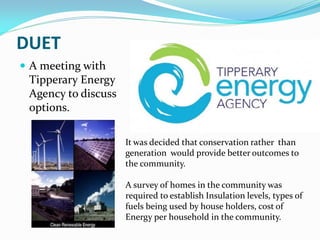
 A meeting with
Tipperary Energy
Agency to discuss
options.
It was decided that conservation rather than
generation would provide better outcomes to
the community.
A survey of homes in the community was
required to establish Insulation levels, types of
fuels being used by house holders, cost of
Energy per household in the community.
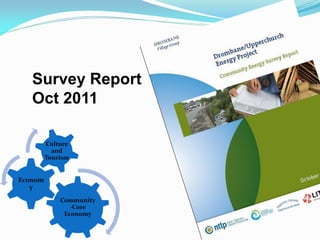
Survey Report
Oct 2011
Community
-Core
Economy
Econom
y
Culture
and
Tourism
Survey Results
 €1,000,000 per year spent on energy
◦ €1000 per person
◦ €2,500 per household
 A 25% reduction in energy usage could save the parish
€250,000
 60% (200 out of 349) cited financial savings as their
most important reason for investing in energy
efficiency
BETTER ENERGY COMMUNITIES
 SEAI launched a Grant under the Better Energy
Communities Pilot scheme -2012
 Drombane Upperchurch Energy Team were successful
Energy Team Achievements in
2012 & 2013
 A total of 50 houses upgraded and 2 community
buildings
 Total cost of project €400,000
 Grant from SEAI €300,000
Energy Communities Tipperary -2014
 Other Communities to replicate Drombane Project
 Kilcommon / Rearcross
 Lorrha / Rathcabbin
 Birdhill
Energy Team Achievements in 2014
 A total of 110 houses and 2 community buildings
 Total cost of project €1,078,000
 Grant from SEAI €840,000
 Approx 1.5 GWh/ year saved
Challenges
 Project Timeline – Often tight
 Admin seemed heavy and time consuming
 Contractors letting go good tradesmen – work starts in
June / July till November
 Possibility of rolling grants – 2/3 year program – with
yearly targets – or overlap on projects
Challenges
 Funding / Bridging Finance for Community groups
 Banks and Credit unions not interested
 Clan Credo – interest @ 6% - max lending is €500,000 to
one group
 Cost of application to new communities – professional
required to do the application for communities
Challenges
 Non SEAI registered contractors allowed
 Contractors have a learning curve to comply with SEAI
regulations for the BEC scheme – meet standards
 KSN inspectors – varying opinions on the standards –
this needs to be the same across the board
Challenges
 Recruiting houses – 1st year was the hardest – now
there is a waiting list in the parishes
 Convincing “Can Pay” homes to invest more money –
30% grant could be increased – bonus money for 3 or
more items upgraded
 Community Committees – dealing with people from
all different backgrounds – decision making slow
Positives
 Application stage has improved – better cross checks
 Milestone payments – keep interest rates down
 SEAI Staff very helpful
 Local contractors – homeowners happier because they
know and trust contractors
 160 houses retrofitted over 3 years – a lot of these
houses would never have been touched
Positives
 Excellent program – bringing life back into our
communities
 People have more comfort in their homes
 Provide local employment
 Significant cost saving in the community
 Significant reductions in carbon emissions
 A win win for the individuals, the community and the
country.
 First project of its kind in the country.
Government input
 More money available to the BEC program – reduced
by half this year – with 75 applications received
 Energy Credit unit costs could be increased -more
finance from Energy Providers
 Tax breaks for contractors willing to provide bridging
finance to communities to run projects instead of
lending from banks / Clan credo.
The Future
 People are willing to get involved – stimulating work
and energy efficiency savings for the country
 Doing it from the bottom up – communities feel
ownership of the projects – more involvement.
 2015 project included 8 communities
 Project is going from strength to strength – and can be
replicated throughout the country.
By Marcella Maher Keogh

Better Energy Communities - Marcella Maher Keogh

  • 1.
  • 2.
    Marcella Maher Keogh PMfor DUET & ECT  Architectural Technician  Building Energy Assessor  Project Manager  Internship with DUET in 2012  DUET are a group of Volunteers looking to generate activity in their community  Role facilitated by NTLP
  • 3.
    DUET  A meetingwith Tipperary Energy Agency to discuss options. It was decided that conservation rather than generation would provide better outcomes to the community. A survey of homes in the community was required to establish Insulation levels, types of fuels being used by house holders, cost of Energy per household in the community.
  • 4.
  • 5.
    Survey Results  €1,000,000per year spent on energy ◦ €1000 per person ◦ €2,500 per household  A 25% reduction in energy usage could save the parish €250,000  60% (200 out of 349) cited financial savings as their most important reason for investing in energy efficiency
  • 6.
    BETTER ENERGY COMMUNITIES SEAI launched a Grant under the Better Energy Communities Pilot scheme -2012  Drombane Upperchurch Energy Team were successful
  • 7.
    Energy Team Achievementsin 2012 & 2013  A total of 50 houses upgraded and 2 community buildings  Total cost of project €400,000  Grant from SEAI €300,000
  • 8.
    Energy Communities Tipperary-2014  Other Communities to replicate Drombane Project  Kilcommon / Rearcross  Lorrha / Rathcabbin  Birdhill
  • 9.
    Energy Team Achievementsin 2014  A total of 110 houses and 2 community buildings  Total cost of project €1,078,000  Grant from SEAI €840,000  Approx 1.5 GWh/ year saved
  • 10.
    Challenges  Project Timeline– Often tight  Admin seemed heavy and time consuming  Contractors letting go good tradesmen – work starts in June / July till November  Possibility of rolling grants – 2/3 year program – with yearly targets – or overlap on projects
  • 11.
    Challenges  Funding /Bridging Finance for Community groups  Banks and Credit unions not interested  Clan Credo – interest @ 6% - max lending is €500,000 to one group  Cost of application to new communities – professional required to do the application for communities
  • 12.
    Challenges  Non SEAIregistered contractors allowed  Contractors have a learning curve to comply with SEAI regulations for the BEC scheme – meet standards  KSN inspectors – varying opinions on the standards – this needs to be the same across the board
  • 13.
    Challenges  Recruiting houses– 1st year was the hardest – now there is a waiting list in the parishes  Convincing “Can Pay” homes to invest more money – 30% grant could be increased – bonus money for 3 or more items upgraded  Community Committees – dealing with people from all different backgrounds – decision making slow
  • 14.
    Positives  Application stagehas improved – better cross checks  Milestone payments – keep interest rates down  SEAI Staff very helpful  Local contractors – homeowners happier because they know and trust contractors  160 houses retrofitted over 3 years – a lot of these houses would never have been touched
  • 15.
    Positives  Excellent program– bringing life back into our communities  People have more comfort in their homes  Provide local employment  Significant cost saving in the community  Significant reductions in carbon emissions  A win win for the individuals, the community and the country.  First project of its kind in the country.
  • 16.
    Government input  Moremoney available to the BEC program – reduced by half this year – with 75 applications received  Energy Credit unit costs could be increased -more finance from Energy Providers  Tax breaks for contractors willing to provide bridging finance to communities to run projects instead of lending from banks / Clan credo.
  • 17.
    The Future  Peopleare willing to get involved – stimulating work and energy efficiency savings for the country  Doing it from the bottom up – communities feel ownership of the projects – more involvement.  2015 project included 8 communities  Project is going from strength to strength – and can be replicated throughout the country.
  • 18.