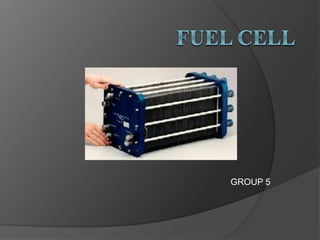
GROUP 5
Definition of fuel cells
Types of fuel cells
DESIGN
1. •Cathode
2. •anode
3. •eletrolyte
FUEL CELL TYPE EFFICIENCY APPLICATIONS ADVANTAGES
Polymer electrolyte
membrance(PEM)
24-32% •Backup power
•Portable power
•Distributed
generation
•Transporation
•Specially vehicles
•Solid
•Electrolyte reduce
corrosion
•Low temperature
•Quick start-up
Phosphoric acid
(PAFC)
40% •Military
•Space
•Low cost
components
•Cathode reaction
fast in alkaline
electrolyte, leads to
high performance
Molten
carbonate(MCFC)
45-50% •Electric utility
•Distributed
•generation
•High efficiency
•Fuel flexibily
Solid oxide(SOFC) 60% •Auxillary power
•Electric utility
•Distribution
•High efficiency
•Fuel flexibily
•Can use a variety
COMPARISON OF FUEL CELL
Efficiency of fuel cell
SCHEMATIC DIAGRAM OF PEM FUEL CELL
Advantages of fuel cell
1. It has very high conversion efficiencies as high as70
percent.
2. Fuel cells can be installed near the use point, thus
reducing electrical transmission requirements and
accompanying losses.
3.They have few mechanical components: hence, they
operated fairly quietly and require little attention and less
maintenance.
4.Atmospheric pollution is small.
5.There is no requirement for large volumes of cooling
water.
6.As fuel cell do not make noise, they can be readily
accepted in resdential areas.
7.The fuel cell takes little time to go in to operation.
8. The space requirements for fuel cell power plant is
considerably less.
Disadvantages of fuel cell
1.Fuel cell are costly.
2.Low service life.
Application of fuel cell
1.Fuel cells can be effectively used for load leveling.
2.Fuel cells are also suited for dispersed generation.
3.To meet the demand of isolated sites as construction
sites, military camps and small village communities.
4.Emergency /auxiliary supply to critical loads such as
hospitals etc.
5.Fuel cells can also be used as a mobile power in shuttle
spacecrafts.
6.Fuel cells are also proposed as power source for
propulsion of electric vehicles.
7. Fuel cells can be used to power portable electronic
device.

Fuel cell

  • 1.
  • 2.
  • 3.
  • 5.
  • 6.
  • 7.
    FUEL CELL TYPEEFFICIENCY APPLICATIONS ADVANTAGES Polymer electrolyte membrance(PEM) 24-32% •Backup power •Portable power •Distributed generation •Transporation •Specially vehicles •Solid •Electrolyte reduce corrosion •Low temperature •Quick start-up Phosphoric acid (PAFC) 40% •Military •Space •Low cost components •Cathode reaction fast in alkaline electrolyte, leads to high performance Molten carbonate(MCFC) 45-50% •Electric utility •Distributed •generation •High efficiency •Fuel flexibily Solid oxide(SOFC) 60% •Auxillary power •Electric utility •Distribution •High efficiency •Fuel flexibily •Can use a variety COMPARISON OF FUEL CELL
  • 8.
  • 9.
    SCHEMATIC DIAGRAM OFPEM FUEL CELL
  • 10.
    Advantages of fuelcell 1. It has very high conversion efficiencies as high as70 percent. 2. Fuel cells can be installed near the use point, thus reducing electrical transmission requirements and accompanying losses. 3.They have few mechanical components: hence, they operated fairly quietly and require little attention and less maintenance. 4.Atmospheric pollution is small. 5.There is no requirement for large volumes of cooling water. 6.As fuel cell do not make noise, they can be readily accepted in resdential areas. 7.The fuel cell takes little time to go in to operation. 8. The space requirements for fuel cell power plant is considerably less.
  • 11.
    Disadvantages of fuelcell 1.Fuel cell are costly. 2.Low service life.
  • 12.
    Application of fuelcell 1.Fuel cells can be effectively used for load leveling. 2.Fuel cells are also suited for dispersed generation. 3.To meet the demand of isolated sites as construction sites, military camps and small village communities. 4.Emergency /auxiliary supply to critical loads such as hospitals etc. 5.Fuel cells can also be used as a mobile power in shuttle spacecrafts. 6.Fuel cells are also proposed as power source for propulsion of electric vehicles. 7. Fuel cells can be used to power portable electronic device.