Introducing LNG as a new, cleaner and
quieter fuel for road transport and
marine navigation.
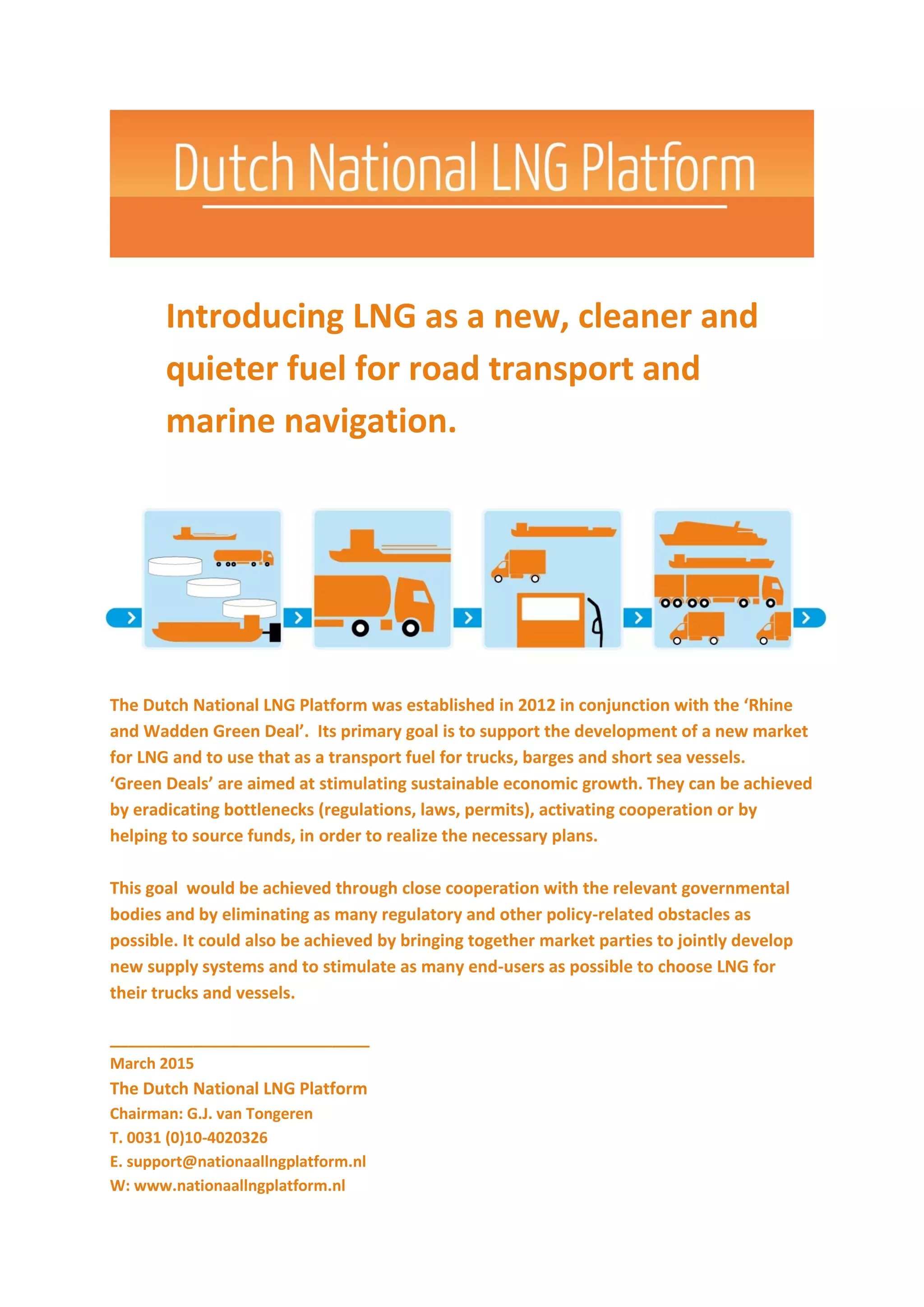
The Dutch National LNG Platform was established in 2012 in conjunction with the ‘Rhine
and Wadden Green Deal’. Its primary goal is to support the development of a new market
for LNG and to use that as a transport fuel for trucks, barges and short sea vessels.
‘Green Deals’ are aimed at stimulating sustainable economic growth. They can be achieved
by eradicating bottlenecks (regulations, laws, permits), activating cooperation or by
helping to source funds, in order to realize the necessary plans.
This goal would be achieved through close cooperation with the relevant governmental
bodies and by eliminating as many regulatory and other policy-related obstacles as
possible. It could also be achieved by bringing together market parties to jointly develop
new supply systems and to stimulate as many end-users as possible to choose LNG for
their trucks and vessels.
____________________________
March 2015
The Dutch National LNG Platform
Chairman: G.J. van Tongeren
T. 0031 (0)10-4020326
E. support@nationaallngplatform.nl
W: www.nationaallngplatform.nl
Our objective
The LNG platform has set itself the target of facilitating a
launching customer coalition by 2015 incorporating a
minimum of 50 sea-going vessels, 50 inland vessels and
500 trucks, all running on LNG.
The platform organization
Taskforce 1 - Safety and regulation
The taskforce is organized around topics that are safety
related. The following issues are addressed:
 The safety measures linked to the transport and
distribution of LNG. The constraints linked to LNG
distribution by road / rail.
 In-depth information on methane emissions
throughout the LNG chain – from well to
propeller/wheel – including emission standards.
 The implementation of a knowledge safety program
in cooperation with all the stakeholders involved.
 The mapping of safety responsibilities between
different organizations so that if problems arise all
organization are aware of the safety procedures and
know where their responsibilities lie.
 A safety design communication plan. On the basis of
previous activities a communication plan will be set
up in order to ensure that all information is
adequately dealt with and integrated into the
existing procedures.
 To establish an LNG Safety Deal with the Dutch
government and to create an interim policy
concerning the external safety of LNG.
Taskforce 2 - Trucks
 Business case: today the tax on LNG as a fuel for road
transport is fixed for a 5-year period. It is important
to make sure that the LNG framework continues to
be workable.
 Incentives and subsidies. On the one hand we must
map the current possibilities for incentives and
subsidies and make that publicly available whilst on
the other hand the Taskforce will have to endeavor
to make LNG fit in with existing incentives and
subsidy schemes.
 In 2014, the Green Deal Zero Emission for City
Distribution was launched. The system will grant
cleaner and quieter vehicles the privilege of having
better access and better delivery slots for city
distribution.
Taskforce 3 - Shipping
 The first activity was to gain a systematic overview of
the current limitations but also of the opportunities
for LNG propelled vessels. This has helped to define
the focus for the taskforce.
 Financing is the first market concern for LNG ships.
Many banks are hesitating to fund the re-engineering
of ships wishing to use LNG. Although the business
case is in principle valid, it is not clear to everyone
that using LNG for ships is a suitable alternative. So
funding is now the key to market development.
 In order to develop the LNG market for ships it is
important to have clear objectives with regard to the
requirements and the enforcement of such
requirements. Both have to be perfectly clear so that
ship owners can have an accurate idea of what the
future holds. Unless there is clarity they will be
uncertain about investing. The advantage of LNG
with regard to Sox is that it offers opportunities in
the Seca area.
 Probably the most important aspect when
developing LNG for ships’ engines has to do with
methane slip. Ships can often be equipped with dual
fuel engines. The advantage is that these kinds of
engines can also be used in areas where there are no
bunkering possibilities. The downside is that this
technology causes methane to escape from the
exhaust. This issue still has to be solved but it is
certainly high on the Platform agenda.
Taskforce 4 - Strategic stakeholder
management
This taskforce is engaged in dialogue with a group of
Dutch non-governmental organizations (NGO’s) such as
environmental and nature conservation organizations. The
support of these organizations is important for gaining
public attention and support for the introduction of LNG
to the market. Note that the northern NGO's were the
first to embrace the introduction of LNG.
The dialogue has already resulted in a short list of issues
relevant to both the NGO’s and the platform:
 What exactly is the environmental impact of LNG on
emissions within the transport sector, including
methane?
 Can we make LNG more sustainable as a fuel through
the introduction of bio-LNG?
 The external Safety of LNG and the related
distribution of LNG to the market by road or by
water?
Taskforce 5 - Bio-LNG
This Task force (devoted to Enhancing LNG Sustainability)
focusses on the development path for more sustainable
LNG in the future. The emission impacts of LNG on air
quality parameters (SO2, NOx and particulates) are
generally accepted. The climate improvement potential of
LNG (lower CO2) in comparison to traditional fuels (HFO,
MGO, MDO and diesel) does not, however, stand out
clearly enough. In this area LNG performance can be
improved when Bio-LNG is introduced to the LNG fuel
chain.
In order to realize the robust production of Bio-LNG the
following necessary measures have been defined:
 Certification route: establishing a way in which green
gas certificates can be converted into Bio-LNG
certificates.
 The Renewable Energy Directive (RED): this European
directive codifies the way in which the conversion of
bio-components into fuel must take place. A
transparent interpretation of this directive is
essential if the right technological choices are to be
supported and a clear attitude towards the future of
this directive is to be established.
 Stimulating the physical production of Bio-LNG: Bio-
LNG is only available on the Dutch market in very
limited quantities. Strengthening the LNG market by
increasing domestic Bio-LNG production is therefore
important.
Taskforce 6 - International
This is a recently established taskforce. The main activity
of this task force is to support the development of LNG in
neighboring countries. Since trucks and ships travel over
borders it is important to implement similar technology
and similar safety procedures in neighboring countries .
The Netherlands has developed a good knowledge basis
and position for supporting and cooperating with its
neighboring countries.
LNG position in the fuel mix
strategy
The SER (Social and Economic Council of the Netherlands)
Energy Agreement lists agreements concerning various
long-term targets for the mobility and transport sector.
This study was of strategic importance to LNG, since it is a
new fuel and since, until the time of this study, the market
position for LNG had not been clearly established.
Over 100 parties drawn from the corporate sector, from
civil society organizations, the public sector and even from
research and educational institutes joined forces. This
resulted in the Dutch Sustainable Fuel Vision on Transport
(an elaboration of the SER Energy Agreement). Now LNG
has established a clear position in the market.
LNG is seen as an alternative fuel for shipping and
trucking). For ships, LNG is the alternative for inland
vessels and for sea-going vessels. For inland vessel, the
relationship with air quality issues is clearly seen as a big
advantage when ships use LNG as opposed to diesel.
For trucks, LNG is presented as the alternative for heavy
duty tractor trailer combinations as well as long distance
haulage. The CO2 reduction WtW (Well-to-Wheel) for
fossil LNG is 15 percent. For trucks the TtW (Tank-to-
Wheel) CO2 reduction could go up to 25 percent.
Between now and 2030 the focus will be on fossil LNG. By
2050 the market should have gradually changed to bio-
LNG. Bio-LNG has TtW zero emission. The WtW CO2
performance of bio-LNG is 80 percent.
Achievements in 2014
 LNG is well positioned in discussions related to the
expected Dutch transport fuel mix for the coming
decades.
 An extensive LNG Safety Program has been
successfully launched. It represents cooperation
between private and public parties; the results are
due at the end of 2015.
 An LNG Interim Policy for LNG External Safety has
been launched by the Ministry of Infrastructure and
the Environment and it enjoys the full support of the
Platform.
 The LNG excise tax for heavy road transport is to be
stabilized for the next 5 years.
 Seven fueling stations are available for LNG.
 There are LNG-fuelled barges now operating on
rivers.
 Some 250 trucks are currently driving on LNG.
 The gate LNG terminal conversion project has been
approved and is now under construction. It will allow
large-scale LNG export from the terminal from 2016
onwards. It will potentially feed the Dutch and Nordic
LNG fuels markets.
Key issues for 2015
 The timely completion of the LNG Safety
Program involving proper communication with
stakeholders in order to allow new permits to be
granted for service stations, emergency
response organizations to act appropriately
when required and essential Codes and
Standards to be developed, also at European
level.
 To support the further market development of
all LNG-fuelled trucks entering the market by
developing truck container transport and to
further develop LNG for city distribution.
 The replacing of existing barging capacity is
going extremely slowly as a result of the excess
capacity in the market and the strong reluctance
on the part of banks to finance new barging
capacity under these conditions.
 There are too few LNG-based sea-going vessels
under construction. National and local
authorities are not clear enough on the
enforcement of the new SECA emission
requirements.
 Green and blue corridors for international
transport are developing very slowly, despite all
the EU financial incentives provided through
subsidies.
 Permit-granting organizations lack the
appropriate regulatory framework and are
therefore holding back on their decisions
concerning fuel and bunker stations.
 Retrofit engines for barges and ships but also
new dual fuel engines produce a degree of CH4
slip. Regulation is required from an
environmental point of view so that incentives
can be created for stakeholders to minimize
these emissions.
 Bio-LNG seems to be suffering from such
restricted raw material resources that its
credibility as a realistic sustainability enhancer
for regular LNG may be questioned.
 An adequate labor force in possession of the
required knowledge on LNG technologies for
automotive and marine applications is lacking,
as are trained crews and drivers.

LNG overview the Netherlands

  • 1.
    Introducing LNG asa new, cleaner and quieter fuel for road transport and marine navigation. The Dutch National LNG Platform was established in 2012 in conjunction with the ‘Rhine and Wadden Green Deal’. Its primary goal is to support the development of a new market for LNG and to use that as a transport fuel for trucks, barges and short sea vessels. ‘Green Deals’ are aimed at stimulating sustainable economic growth. They can be achieved by eradicating bottlenecks (regulations, laws, permits), activating cooperation or by helping to source funds, in order to realize the necessary plans. This goal would be achieved through close cooperation with the relevant governmental bodies and by eliminating as many regulatory and other policy-related obstacles as possible. It could also be achieved by bringing together market parties to jointly develop new supply systems and to stimulate as many end-users as possible to choose LNG for their trucks and vessels. ____________________________ March 2015 The Dutch National LNG Platform Chairman: G.J. van Tongeren T. 0031 (0)10-4020326 E. support@nationaallngplatform.nl W: www.nationaallngplatform.nl
  • 2.
    Our objective The LNGplatform has set itself the target of facilitating a launching customer coalition by 2015 incorporating a minimum of 50 sea-going vessels, 50 inland vessels and 500 trucks, all running on LNG. The platform organization Taskforce 1 - Safety and regulation The taskforce is organized around topics that are safety related. The following issues are addressed:  The safety measures linked to the transport and distribution of LNG. The constraints linked to LNG distribution by road / rail.  In-depth information on methane emissions throughout the LNG chain – from well to propeller/wheel – including emission standards.  The implementation of a knowledge safety program in cooperation with all the stakeholders involved.  The mapping of safety responsibilities between different organizations so that if problems arise all organization are aware of the safety procedures and know where their responsibilities lie.  A safety design communication plan. On the basis of previous activities a communication plan will be set up in order to ensure that all information is adequately dealt with and integrated into the existing procedures.  To establish an LNG Safety Deal with the Dutch government and to create an interim policy concerning the external safety of LNG. Taskforce 2 - Trucks  Business case: today the tax on LNG as a fuel for road transport is fixed for a 5-year period. It is important to make sure that the LNG framework continues to be workable.  Incentives and subsidies. On the one hand we must map the current possibilities for incentives and subsidies and make that publicly available whilst on the other hand the Taskforce will have to endeavor to make LNG fit in with existing incentives and subsidy schemes.  In 2014, the Green Deal Zero Emission for City Distribution was launched. The system will grant cleaner and quieter vehicles the privilege of having better access and better delivery slots for city distribution. Taskforce 3 - Shipping  The first activity was to gain a systematic overview of the current limitations but also of the opportunities for LNG propelled vessels. This has helped to define the focus for the taskforce.  Financing is the first market concern for LNG ships. Many banks are hesitating to fund the re-engineering of ships wishing to use LNG. Although the business case is in principle valid, it is not clear to everyone
  • 3.
    that using LNGfor ships is a suitable alternative. So funding is now the key to market development.  In order to develop the LNG market for ships it is important to have clear objectives with regard to the requirements and the enforcement of such requirements. Both have to be perfectly clear so that ship owners can have an accurate idea of what the future holds. Unless there is clarity they will be uncertain about investing. The advantage of LNG with regard to Sox is that it offers opportunities in the Seca area.  Probably the most important aspect when developing LNG for ships’ engines has to do with methane slip. Ships can often be equipped with dual fuel engines. The advantage is that these kinds of engines can also be used in areas where there are no bunkering possibilities. The downside is that this technology causes methane to escape from the exhaust. This issue still has to be solved but it is certainly high on the Platform agenda. Taskforce 4 - Strategic stakeholder management This taskforce is engaged in dialogue with a group of Dutch non-governmental organizations (NGO’s) such as environmental and nature conservation organizations. The support of these organizations is important for gaining public attention and support for the introduction of LNG to the market. Note that the northern NGO's were the first to embrace the introduction of LNG. The dialogue has already resulted in a short list of issues relevant to both the NGO’s and the platform:  What exactly is the environmental impact of LNG on emissions within the transport sector, including methane?  Can we make LNG more sustainable as a fuel through the introduction of bio-LNG?  The external Safety of LNG and the related distribution of LNG to the market by road or by water? Taskforce 5 - Bio-LNG This Task force (devoted to Enhancing LNG Sustainability) focusses on the development path for more sustainable LNG in the future. The emission impacts of LNG on air quality parameters (SO2, NOx and particulates) are generally accepted. The climate improvement potential of LNG (lower CO2) in comparison to traditional fuels (HFO, MGO, MDO and diesel) does not, however, stand out clearly enough. In this area LNG performance can be improved when Bio-LNG is introduced to the LNG fuel chain. In order to realize the robust production of Bio-LNG the following necessary measures have been defined:  Certification route: establishing a way in which green gas certificates can be converted into Bio-LNG certificates.  The Renewable Energy Directive (RED): this European directive codifies the way in which the conversion of bio-components into fuel must take place. A transparent interpretation of this directive is essential if the right technological choices are to be supported and a clear attitude towards the future of this directive is to be established.  Stimulating the physical production of Bio-LNG: Bio- LNG is only available on the Dutch market in very limited quantities. Strengthening the LNG market by increasing domestic Bio-LNG production is therefore important. Taskforce 6 - International This is a recently established taskforce. The main activity of this task force is to support the development of LNG in neighboring countries. Since trucks and ships travel over borders it is important to implement similar technology and similar safety procedures in neighboring countries . The Netherlands has developed a good knowledge basis and position for supporting and cooperating with its neighboring countries. LNG position in the fuel mix strategy The SER (Social and Economic Council of the Netherlands) Energy Agreement lists agreements concerning various long-term targets for the mobility and transport sector. This study was of strategic importance to LNG, since it is a new fuel and since, until the time of this study, the market position for LNG had not been clearly established.
  • 4.
    Over 100 partiesdrawn from the corporate sector, from civil society organizations, the public sector and even from research and educational institutes joined forces. This resulted in the Dutch Sustainable Fuel Vision on Transport (an elaboration of the SER Energy Agreement). Now LNG has established a clear position in the market. LNG is seen as an alternative fuel for shipping and trucking). For ships, LNG is the alternative for inland vessels and for sea-going vessels. For inland vessel, the relationship with air quality issues is clearly seen as a big advantage when ships use LNG as opposed to diesel. For trucks, LNG is presented as the alternative for heavy duty tractor trailer combinations as well as long distance haulage. The CO2 reduction WtW (Well-to-Wheel) for fossil LNG is 15 percent. For trucks the TtW (Tank-to- Wheel) CO2 reduction could go up to 25 percent. Between now and 2030 the focus will be on fossil LNG. By 2050 the market should have gradually changed to bio- LNG. Bio-LNG has TtW zero emission. The WtW CO2 performance of bio-LNG is 80 percent. Achievements in 2014  LNG is well positioned in discussions related to the expected Dutch transport fuel mix for the coming decades.  An extensive LNG Safety Program has been successfully launched. It represents cooperation between private and public parties; the results are due at the end of 2015.  An LNG Interim Policy for LNG External Safety has been launched by the Ministry of Infrastructure and the Environment and it enjoys the full support of the Platform.  The LNG excise tax for heavy road transport is to be stabilized for the next 5 years.  Seven fueling stations are available for LNG.  There are LNG-fuelled barges now operating on rivers.  Some 250 trucks are currently driving on LNG.  The gate LNG terminal conversion project has been approved and is now under construction. It will allow large-scale LNG export from the terminal from 2016 onwards. It will potentially feed the Dutch and Nordic LNG fuels markets. Key issues for 2015  The timely completion of the LNG Safety Program involving proper communication with stakeholders in order to allow new permits to be granted for service stations, emergency response organizations to act appropriately when required and essential Codes and Standards to be developed, also at European level.  To support the further market development of all LNG-fuelled trucks entering the market by developing truck container transport and to further develop LNG for city distribution.  The replacing of existing barging capacity is going extremely slowly as a result of the excess capacity in the market and the strong reluctance on the part of banks to finance new barging capacity under these conditions.  There are too few LNG-based sea-going vessels under construction. National and local authorities are not clear enough on the enforcement of the new SECA emission requirements.  Green and blue corridors for international transport are developing very slowly, despite all the EU financial incentives provided through subsidies.  Permit-granting organizations lack the appropriate regulatory framework and are therefore holding back on their decisions concerning fuel and bunker stations.  Retrofit engines for barges and ships but also new dual fuel engines produce a degree of CH4 slip. Regulation is required from an environmental point of view so that incentives can be created for stakeholders to minimize these emissions.  Bio-LNG seems to be suffering from such restricted raw material resources that its credibility as a realistic sustainability enhancer for regular LNG may be questioned.  An adequate labor force in possession of the required knowledge on LNG technologies for automotive and marine applications is lacking, as are trained crews and drivers.