Settlement
hierarchies and
shopping
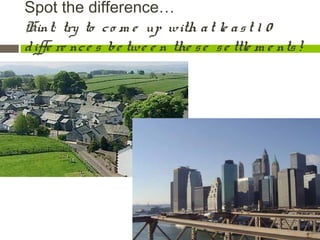
Spot the difference…
Hint: try to co m e up with at le ast 1 0
diffe re nce s be twe e n the se se ttle m e nts!
Learning objectives
 To know what a settlement hierarchy is
 To understand the main characteristics of
different types of settlements
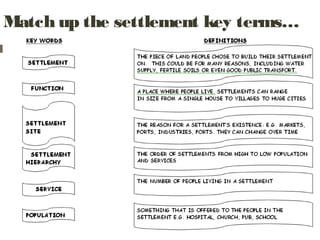
Match up the settlement key terms…
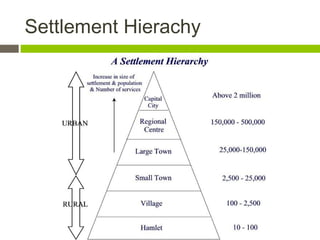
Settlement Hierachy
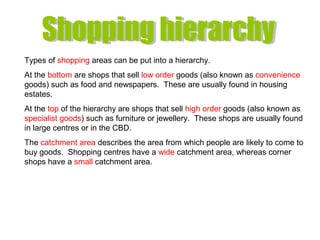
Types of shopping areas can be put into a hierarchy.
At the bottom are shops that sell low order goods (also known as convenience
goods) such as food and newspapers. These are usually found in housing
estates.
At the top of the hierarchy are shops that sell high order goods (also known as
specialist goods) such as furniture or jewellery. These shops are usually found
in large centres or in the CBD.
The catchment area describes the area from which people are likely to come to
buy goods. Shopping centres have a wide catchment area, whereas corner
shops have a small catchment area.
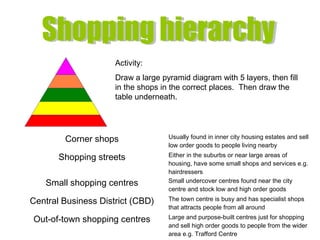
Activity:
Draw a large pyramid diagram with 5 layers, then fill
in the shops in the correct places. Then draw the
table underneath.
Corner shops Usually found in inner city housing estates and sell
low order goods to people living nearby
Shopping streets Either in the suburbs or near large areas of
housing, have some small shops and services e.g.
hairdressers
Small shopping centres Small undercover centres found near the city
centre and stock low and high order goods
Central Business District (CBD) The town centre is busy and has specialist shops
that attracts people from all around
Out-of-town shopping centres Large and purpose-built centres just for shopping
and sell high order goods to people from the wider
area e.g. Trafford Centre

Settlement Hierarchies and shopping

  • 1.
  • 2.
    Spot the difference… Hint:try to co m e up with at le ast 1 0 diffe re nce s be twe e n the se se ttle m e nts!
  • 3.
    Learning objectives  Toknow what a settlement hierarchy is  To understand the main characteristics of different types of settlements
  • 4.
    Match up thesettlement key terms…
  • 5.
  • 6.
    Types of shoppingareas can be put into a hierarchy. At the bottom are shops that sell low order goods (also known as convenience goods) such as food and newspapers. These are usually found in housing estates. At the top of the hierarchy are shops that sell high order goods (also known as specialist goods) such as furniture or jewellery. These shops are usually found in large centres or in the CBD. The catchment area describes the area from which people are likely to come to buy goods. Shopping centres have a wide catchment area, whereas corner shops have a small catchment area.
  • 7.
    Activity: Draw a largepyramid diagram with 5 layers, then fill in the shops in the correct places. Then draw the table underneath. Corner shops Usually found in inner city housing estates and sell low order goods to people living nearby Shopping streets Either in the suburbs or near large areas of housing, have some small shops and services e.g. hairdressers Small shopping centres Small undercover centres found near the city centre and stock low and high order goods Central Business District (CBD) The town centre is busy and has specialist shops that attracts people from all around Out-of-town shopping centres Large and purpose-built centres just for shopping and sell high order goods to people from the wider area e.g. Trafford Centre