Why has global
tourism increased?
Learning objectives
To know what the word tourism means
To understand how trends of world tourism have changed
over time
To be able to give reasons to explain this growth in
tourism
What do we mean by tourism?
Why has it increased?
KEY TERMS:
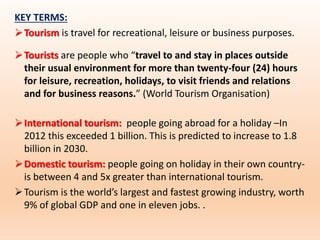
Tourism is travel for recreational, leisure or business purposes.
Tourists are people who “travel to and stay in places outside
their usual environment for more than twenty-four (24) hours
for leisure, recreation, holidays, to visit friends and relations
and for business reasons.” (World Tourism Organisation)
International tourism: people going abroad for a holiday –In
2012 this exceeded 1 billion. This is predicted to increase to 1.8
billion in 2030.
Domestic tourism: people going on holiday in their own country-
is between 4 and 5x greater than international tourism.
Tourism is the world’s largest and fastest growing industry, worth
9% of global GDP and one in eleven jobs. .
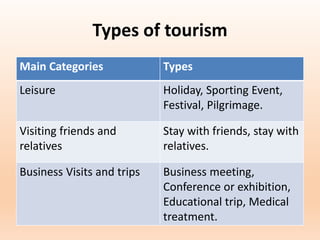
Types of tourism
Main Categories Types
Leisure Holiday, Sporting Event,
Festival, Pilgrimage.
Visiting friends and
relatives
Stay with friends, stay with
relatives.
Business Visits and trips Business meeting,
Conference or exhibition,
Educational trip, Medical
treatment.
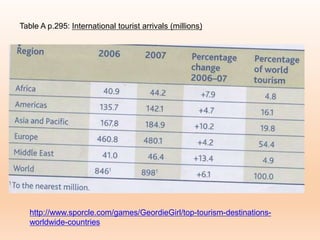
Table A p.295: International tourist arrivals (millions)
http://www.sporcle.com/games/GeordieGirl/top-tourism-destinations-
worldwide-countries
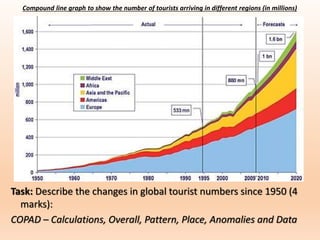
Compound line graph to show the number of tourists arriving in different regions (in millions)
Task: Describe the changes in global tourist numbers since 1950 (4
marks):
COPAD – Calculations, Overall, Pattern, Place, Anomalies and Data
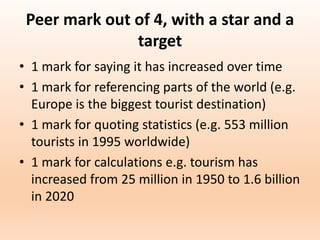
Peer mark out of 4, with a star and a
target
• 1 mark for saying it has increased over time
• 1 mark for referencing parts of the world (e.g.
Europe is the biggest tourist destination)
• 1 mark for quoting statistics (e.g. 553 million
tourists in 1995 worldwide)
• 1 mark for calculations e.g. tourism has
increased from 25 million in 1950 to 1.6 billion
in 2020
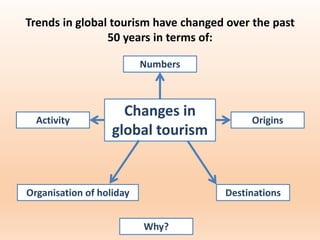
Trends in global tourism have changed over the past
50 years in terms of:
Changes in
global tourism
Numbers
Origins
DestinationsOrganisation of holiday
Activity
Why?
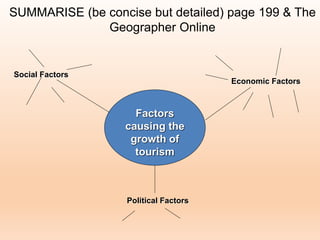
SUMMARISE (be concise but detailed) page 199 & The
Geographer Online
Factors
causing the
growth of
tourism
Social Factors
Economic Factors
Political Factors
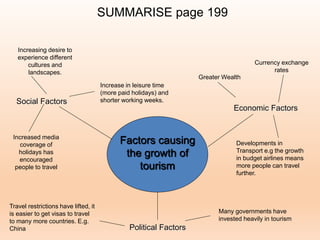
SUMMARISE page 199
Factors causing
the growth of
tourism
Social Factors
Economic Factors
Political Factors
Increase in leisure time
(more paid holidays) and
shorter working weeks.
Increased media
coverage of
holidays has
encouraged
people to travel
Increasing desire to
experience different
cultures and
landscapes.
Greater Wealth
Currency exchange
rates
Developments in
Transport e.g the growth
in budget airlines means
more people can travel
further.
Many governments have
invested heavily in tourism
Travel restrictions have lifted, it
is easier to get visas to travel
to many more countries. E.g.
China
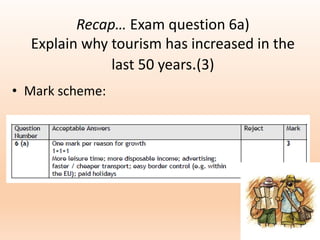
Recap… Exam question 6a)
Explain why tourism has increased in the
last 50 years.(3)
• Mark scheme:
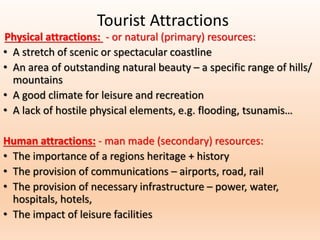
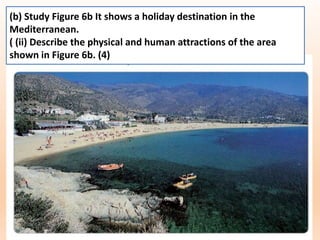
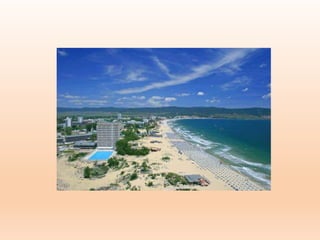
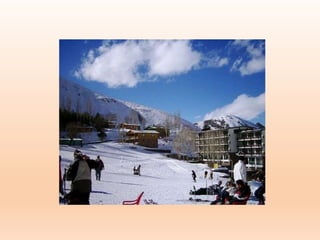
Tourist Attractions
Physical attractions: - or natural (primary) resources:
• A stretch of scenic or spectacular coastline
• An area of outstanding natural beauty – a specific range of hills/
mountains
• A good climate for leisure and recreation
• A lack of hostile physical elements, e.g. flooding, tsunamis…
Human attractions: - man made (secondary) resources:
• The importance of a regions heritage + history
• The provision of communications – airports, road, rail
• The provision of necessary infrastructure – power, water,
hospitals, hotels,
• The impact of leisure facilities
(b) Study Figure 6b It shows a holiday destination in the
Mediterranean.
( (ii) Describe the physical and human attractions of the area
shown in Figure 6b. (4)
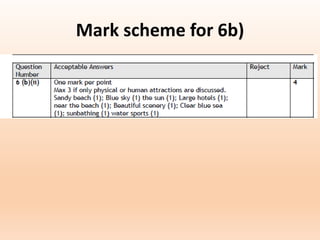
Mark scheme for 6b)
Global tourism
Global tourism
Global tourism
Global tourism
Global tourism
Global tourism
Global tourism
Global tourism
Global tourism

Global tourism

  • 1.
    Why has global tourismincreased? Learning objectives To know what the word tourism means To understand how trends of world tourism have changed over time To be able to give reasons to explain this growth in tourism
  • 2.
    What do wemean by tourism? Why has it increased?
  • 3.
    KEY TERMS: Tourism istravel for recreational, leisure or business purposes. Tourists are people who “travel to and stay in places outside their usual environment for more than twenty-four (24) hours for leisure, recreation, holidays, to visit friends and relations and for business reasons.” (World Tourism Organisation) International tourism: people going abroad for a holiday –In 2012 this exceeded 1 billion. This is predicted to increase to 1.8 billion in 2030. Domestic tourism: people going on holiday in their own country- is between 4 and 5x greater than international tourism. Tourism is the world’s largest and fastest growing industry, worth 9% of global GDP and one in eleven jobs. .
  • 4.
    Types of tourism MainCategories Types Leisure Holiday, Sporting Event, Festival, Pilgrimage. Visiting friends and relatives Stay with friends, stay with relatives. Business Visits and trips Business meeting, Conference or exhibition, Educational trip, Medical treatment.
  • 5.
    Table A p.295:International tourist arrivals (millions) http://www.sporcle.com/games/GeordieGirl/top-tourism-destinations- worldwide-countries
  • 6.
    Compound line graphto show the number of tourists arriving in different regions (in millions) Task: Describe the changes in global tourist numbers since 1950 (4 marks): COPAD – Calculations, Overall, Pattern, Place, Anomalies and Data
  • 7.
    Peer mark outof 4, with a star and a target • 1 mark for saying it has increased over time • 1 mark for referencing parts of the world (e.g. Europe is the biggest tourist destination) • 1 mark for quoting statistics (e.g. 553 million tourists in 1995 worldwide) • 1 mark for calculations e.g. tourism has increased from 25 million in 1950 to 1.6 billion in 2020
  • 8.
    Trends in globaltourism have changed over the past 50 years in terms of: Changes in global tourism Numbers Origins DestinationsOrganisation of holiday Activity Why?
  • 9.
    SUMMARISE (be concisebut detailed) page 199 & The Geographer Online Factors causing the growth of tourism Social Factors Economic Factors Political Factors
  • 10.
    SUMMARISE page 199 Factorscausing the growth of tourism Social Factors Economic Factors Political Factors Increase in leisure time (more paid holidays) and shorter working weeks. Increased media coverage of holidays has encouraged people to travel Increasing desire to experience different cultures and landscapes. Greater Wealth Currency exchange rates Developments in Transport e.g the growth in budget airlines means more people can travel further. Many governments have invested heavily in tourism Travel restrictions have lifted, it is easier to get visas to travel to many more countries. E.g. China
  • 11.
    Recap… Exam question6a) Explain why tourism has increased in the last 50 years.(3) • Mark scheme:
  • 12.
    Tourist Attractions Physical attractions:- or natural (primary) resources: • A stretch of scenic or spectacular coastline • An area of outstanding natural beauty – a specific range of hills/ mountains • A good climate for leisure and recreation • A lack of hostile physical elements, e.g. flooding, tsunamis… Human attractions: - man made (secondary) resources: • The importance of a regions heritage + history • The provision of communications – airports, road, rail • The provision of necessary infrastructure – power, water, hospitals, hotels, • The impact of leisure facilities
  • 13.
    (b) Study Figure6b It shows a holiday destination in the Mediterranean. ( (ii) Describe the physical and human attractions of the area shown in Figure 6b. (4)
  • 14.

Editor's Notes