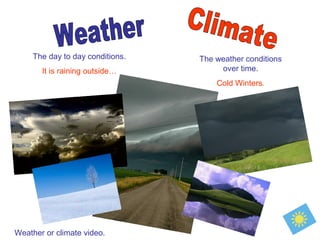
The day to day conditions.
It is raining outside…
The weather conditions
over time.
Cold Winters.
Weather or climate video.
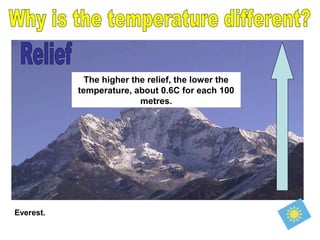
Everest.
The higher the relief, the lower the
temperature, about 0.6C for each 100
metres.
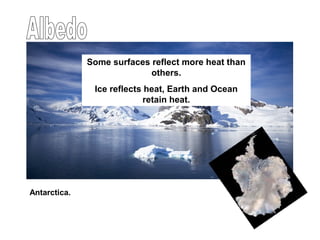
Antarctica.
Some surfaces reflect more heat than
others.
Ice reflects heat, Earth and Ocean
retain heat.
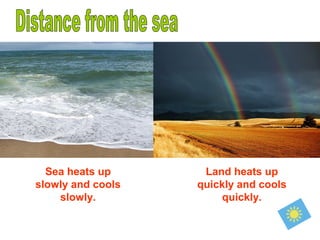
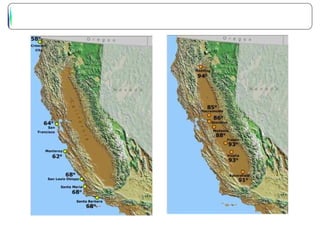
Sea heats up
slowly and cools
slowly.
Land heats up
quickly and cools
quickly.
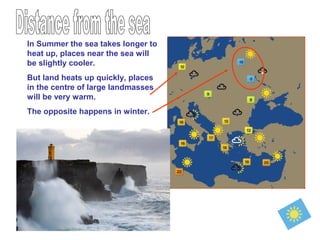
In Summer the sea takes longer to
heat up, places near the sea will
be slightly cooler.
But land heats up quickly, places
in the centre of large landmasses
will be very warm.
The opposite happens in winter.
FACTORS INFLUENCING
CLIMATE
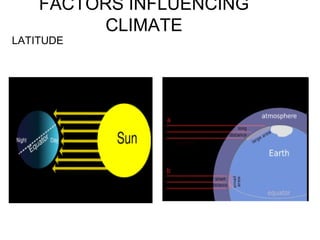
LATITUDE
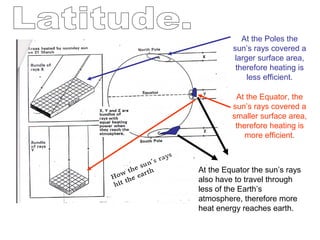
At the Poles the
sun’s rays covered a
larger surface area,
therefore heating is
less efficient.
At the Equator, the
sun’s rays covered a
smaller surface area,
therefore heating is
more efficient.
At the Equator the sun’s rays
also have to travel through
less of the Earth’s
atmosphere, therefore more
heat energy reaches earth.
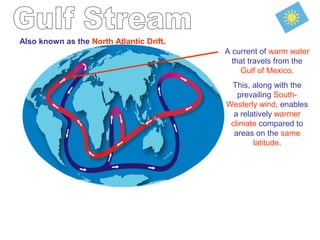
Also known as the North Atlantic Drift.
A current of warm water
that travels from the
Gulf of Mexico.
This, along with the
prevailing South-
Westerly wind, enables
a relatively warmer
climate compared to
areas on the same
latitude.
Also known as the North Atlantic Drift.
A current of warm water
that travels from the
Gulf of Mexico.
This, along with the
prevailing South-
Westerly wind, enables
a relatively warmer
climate compared to
areas on the same
latitude.

Factors affecting climate

  • 1.
    The day today conditions. It is raining outside… The weather conditions over time. Cold Winters. Weather or climate video.
  • 2.
    Everest. The higher therelief, the lower the temperature, about 0.6C for each 100 metres.
  • 3.
    Antarctica. Some surfaces reflectmore heat than others. Ice reflects heat, Earth and Ocean retain heat.
  • 4.
    Sea heats up slowlyand cools slowly. Land heats up quickly and cools quickly.
  • 5.
    In Summer thesea takes longer to heat up, places near the sea will be slightly cooler. But land heats up quickly, places in the centre of large landmasses will be very warm. The opposite happens in winter.
  • 7.
  • 8.
    At the Polesthe sun’s rays covered a larger surface area, therefore heating is less efficient. At the Equator, the sun’s rays covered a smaller surface area, therefore heating is more efficient. At the Equator the sun’s rays also have to travel through less of the Earth’s atmosphere, therefore more heat energy reaches earth.
  • 9.
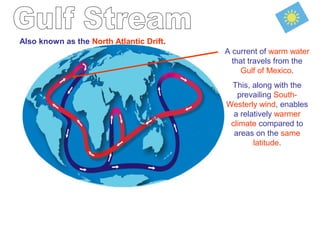
    Also known asthe North Atlantic Drift. A current of warm water that travels from the Gulf of Mexico. This, along with the prevailing South- Westerly wind, enables a relatively warmer climate compared to areas on the same latitude.
  • 10.
    Also known asthe North Atlantic Drift. A current of warm water that travels from the Gulf of Mexico. This, along with the prevailing South- Westerly wind, enables a relatively warmer climate compared to areas on the same latitude.