SETTING OUT OF WORKS
BY- SHUBHAM SINGH (16CM22F)
SHALIN SONI (16CM23F)
SHAURYA CHOPRA (16CM20F)
NATIONAL INSTITUTE OF TECHNOLOGY KARNATAKA, SURATHKAL
INTRODUCTION
The process of laying out engineering projects by placing pegs or marks at the site of works is
known as setting out works.
Setting out is the process of transferring the distance from the plan already prepared to the ground
before starting the construction
IMPORTANCE CONSIDERATION
• Recording and filling information, booking etc. for easy accuracy.
• Care of instruments; check instruments before work commences and at regular intervals.
• Maintaining accuracy, design points must be set from the control network and from other points to
avoid cumulative errors.
• Regular site inspections, to detect missing pegs i.e. A peg may be disturbed or replaced without the
surveyor being informed, control should be permanently and clearly marked and protected.
• Error detection- apply independent checks - nothing is gained hiding errors; therefore errors detected
must be corrected at an early stages.
• Communication on site- lack of it cause errors, the surveyors need to understand what needs to be
done before doing it.
Setting Out of Detail Points
 Setting Out of a point
 Setting Out of a line
 Prolongation of a line
 Setting Out of Angles
 Setting out of lines disturbed by obstacles.
The most commonly used methods are
 Orthogonal co-ordinates (Offsets)
 Polar co-ordinates.
 Intersections (Angle of Intersection 30o <<150o)
 Linear Intersections
For Vertical Control the basic tasks are
 Transfer of height
 Setting out a horizontal line.
 Setting out a gradient line.
 Setting out a contour line.
The methods used are
 Ordinary levelling
 Projected heights
 Trigonometric Heighting
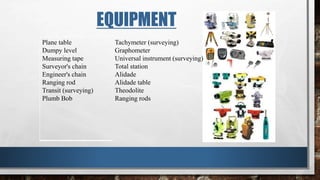
EQUIPMENT
Plane table
Dumpy level
Measuring tape
Surveyor's chain
Engineer's chain
Ranging rod
Transit (surveying)
Plumb Bob
Tachymeter (surveying)
Graphometer
Universal instrument (surveying)
Total station
Alidade
Alidade table
Theodolite
Ranging rods
DUMPY LEVEL
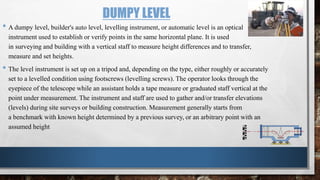
• A dumpy level, builder's auto level, levelling instrument, or automatic level is an optical
instrument used to establish or verify points in the same horizontal plane. It is used
in surveying and building with a vertical staff to measure height differences and to transfer,
measure and set heights.
• The level instrument is set up on a tripod and, depending on the type, either roughly or accurately
set to a levelled condition using footscrews (levelling screws). The operator looks through the
eyepiece of the telescope while an assistant holds a tape measure or graduated staff vertical at the
point under measurement. The instrument and staff are used to gather and/or transfer elevations
(levels) during site surveys or building construction. Measurement generally starts from
a benchmark with known height determined by a previous survey, or an arbitrary point with an
assumed height
• Dumpy levels can be used for determining the height of a particular point, differences in height between
points, drawing contours on a land, providing data to calculate volumes for earthworks, setting out level
surfaces for construction, setting out inclined surfaces for construction.
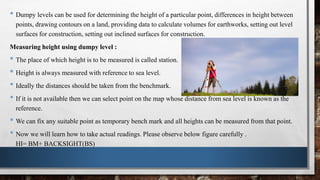
Measuring height using dumpy level :
• The place of which height is to be measured is called station.
• Height is always measured with reference to sea level.
• Ideally the distances should be taken from the benchmark.
• If it is not available then we can select point on the map whose distance from sea level is known as the
reference.
• We can fix any suitable point as temporary bench mark and all heights can be measured from that point.
• Now we will learn how to take actual readings. Please observe below figure carefully .
HI= BM+ BACKSIGHT(BS)
PRISMATIC COMPASS
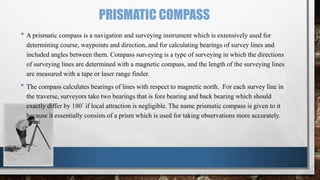
• A prismatic compass is a navigation and surveying instrument which is extensively used for
determining course, waypoints and direction, and for calculating bearings of survey lines and
included angles between them. Compass surveying is a type of surveying in which the directions
of surveying lines are determined with a magnetic compass, and the length of the surveying lines
are measured with a tape or laser range finder.
• The compass calculates bearings of lines with respect to magnetic north. For each survey line in
the traverse, surveyors take two bearings that is fore bearing and back bearing which should
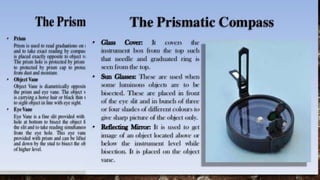
exactly differ by 180° if local attraction is negligible. The name prismatic compass is given to it
because it essentially consists of a prism which is used for taking observations more accurately.
THEODOLITE
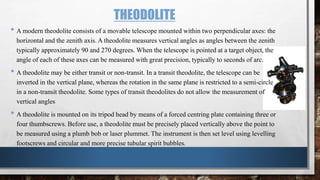
• A modern theodolite consists of a movable telescope mounted within two perpendicular axes: the
horizontal and the zenith axis. A theodolite measures vertical angles as angles between the zenith
typically approximately 90 and 270 degrees. When the telescope is pointed at a target object, the
angle of each of these axes can be measured with great precision, typically to seconds of arc.
• A theodolite may be either transit or non-transit. In a transit theodolite, the telescope can be
inverted in the vertical plane, whereas the rotation in the same plane is restricted to a semi-circle
in a non-transit theodolite. Some types of transit theodolites do not allow the measurement of
vertical angles
• A theodolite is mounted on its tripod head by means of a forced centring plate containing three or
four thumbscrews. Before use, a theodolite must be precisely placed vertically above the point to
be measured using a plumb bob or laser plummet. The instrument is then set level using levelling
footscrews and circular and more precise tubular spirit bubbles.
The theodolite is a versatile instrument and is commonly used for-
• measurement of horizontal angles
• vertical angles,
• ranging,
• levelling
• optical distance measurement
• controlling verticality.
TOTAL STATION
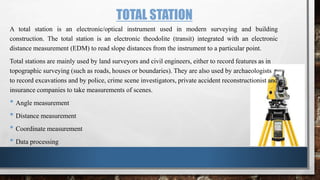
A total station is an electronic/optical instrument used in modern surveying and building
construction. The total station is an electronic theodolite (transit) integrated with an electronic
distance measurement (EDM) to read slope distances from the instrument to a particular point.
Total stations are mainly used by land surveyors and civil engineers, either to record features as in
topographic surveying (such as roads, houses or boundaries). They are also used by archaeologists
to record excavations and by police, crime scene investigators, private accident reconstructionist and
insurance companies to take measurements of scenes.
• Angle measurement
• Distance measurement
• Coordinate measurement
• Data processing
Operation of Total station
• Prior to physical setup of the total station
• Tripod setup
• Mounting the total station
• Levelling the total station
• Powering up the total station
• Powering up the palmtop computer
• Computer/total station alignment setup
• Now you are ready for mapping and data collection
REFERENCES
• https://en.wikipedia.org/wiki/list_of_surveying_instruments
• William gravatt" Craig-telescope.Co.Uk. Retrieved 2012-05-31
• languagehat.com : theodolite. Languagehat.Com
• https://www.youtube.com/watch?v=7aYsAwXlZkg
• https://www.youtube.com/watch?v=E_CVY9O-Rsw
• Cl kochher. "Surveying".
Setting out of works

Setting out of works

  • 1.
    SETTING OUT OFWORKS BY- SHUBHAM SINGH (16CM22F) SHALIN SONI (16CM23F) SHAURYA CHOPRA (16CM20F) NATIONAL INSTITUTE OF TECHNOLOGY KARNATAKA, SURATHKAL
  • 2.
    INTRODUCTION The process oflaying out engineering projects by placing pegs or marks at the site of works is known as setting out works. Setting out is the process of transferring the distance from the plan already prepared to the ground before starting the construction
  • 3.
    IMPORTANCE CONSIDERATION • Recordingand filling information, booking etc. for easy accuracy. • Care of instruments; check instruments before work commences and at regular intervals. • Maintaining accuracy, design points must be set from the control network and from other points to avoid cumulative errors. • Regular site inspections, to detect missing pegs i.e. A peg may be disturbed or replaced without the surveyor being informed, control should be permanently and clearly marked and protected. • Error detection- apply independent checks - nothing is gained hiding errors; therefore errors detected must be corrected at an early stages. • Communication on site- lack of it cause errors, the surveyors need to understand what needs to be done before doing it.
  • 4.
    Setting Out ofDetail Points  Setting Out of a point  Setting Out of a line  Prolongation of a line  Setting Out of Angles  Setting out of lines disturbed by obstacles. The most commonly used methods are  Orthogonal co-ordinates (Offsets)  Polar co-ordinates.  Intersections (Angle of Intersection 30o <<150o)  Linear Intersections For Vertical Control the basic tasks are  Transfer of height  Setting out a horizontal line.  Setting out a gradient line.  Setting out a contour line. The methods used are  Ordinary levelling  Projected heights  Trigonometric Heighting
  • 5.
    EQUIPMENT Plane table Dumpy level Measuringtape Surveyor's chain Engineer's chain Ranging rod Transit (surveying) Plumb Bob Tachymeter (surveying) Graphometer Universal instrument (surveying) Total station Alidade Alidade table Theodolite Ranging rods
  • 6.
    DUMPY LEVEL • Adumpy level, builder's auto level, levelling instrument, or automatic level is an optical instrument used to establish or verify points in the same horizontal plane. It is used in surveying and building with a vertical staff to measure height differences and to transfer, measure and set heights. • The level instrument is set up on a tripod and, depending on the type, either roughly or accurately set to a levelled condition using footscrews (levelling screws). The operator looks through the eyepiece of the telescope while an assistant holds a tape measure or graduated staff vertical at the point under measurement. The instrument and staff are used to gather and/or transfer elevations (levels) during site surveys or building construction. Measurement generally starts from a benchmark with known height determined by a previous survey, or an arbitrary point with an assumed height
  • 7.
    • Dumpy levelscan be used for determining the height of a particular point, differences in height between points, drawing contours on a land, providing data to calculate volumes for earthworks, setting out level surfaces for construction, setting out inclined surfaces for construction. Measuring height using dumpy level : • The place of which height is to be measured is called station. • Height is always measured with reference to sea level. • Ideally the distances should be taken from the benchmark. • If it is not available then we can select point on the map whose distance from sea level is known as the reference. • We can fix any suitable point as temporary bench mark and all heights can be measured from that point. • Now we will learn how to take actual readings. Please observe below figure carefully . HI= BM+ BACKSIGHT(BS)
  • 8.
    PRISMATIC COMPASS • Aprismatic compass is a navigation and surveying instrument which is extensively used for determining course, waypoints and direction, and for calculating bearings of survey lines and included angles between them. Compass surveying is a type of surveying in which the directions of surveying lines are determined with a magnetic compass, and the length of the surveying lines are measured with a tape or laser range finder. • The compass calculates bearings of lines with respect to magnetic north. For each survey line in the traverse, surveyors take two bearings that is fore bearing and back bearing which should exactly differ by 180° if local attraction is negligible. The name prismatic compass is given to it because it essentially consists of a prism which is used for taking observations more accurately.
  • 10.
    THEODOLITE • A moderntheodolite consists of a movable telescope mounted within two perpendicular axes: the horizontal and the zenith axis. A theodolite measures vertical angles as angles between the zenith typically approximately 90 and 270 degrees. When the telescope is pointed at a target object, the angle of each of these axes can be measured with great precision, typically to seconds of arc. • A theodolite may be either transit or non-transit. In a transit theodolite, the telescope can be inverted in the vertical plane, whereas the rotation in the same plane is restricted to a semi-circle in a non-transit theodolite. Some types of transit theodolites do not allow the measurement of vertical angles • A theodolite is mounted on its tripod head by means of a forced centring plate containing three or four thumbscrews. Before use, a theodolite must be precisely placed vertically above the point to be measured using a plumb bob or laser plummet. The instrument is then set level using levelling footscrews and circular and more precise tubular spirit bubbles.
  • 11.
    The theodolite isa versatile instrument and is commonly used for- • measurement of horizontal angles • vertical angles, • ranging, • levelling • optical distance measurement • controlling verticality.
  • 12.
    TOTAL STATION A totalstation is an electronic/optical instrument used in modern surveying and building construction. The total station is an electronic theodolite (transit) integrated with an electronic distance measurement (EDM) to read slope distances from the instrument to a particular point. Total stations are mainly used by land surveyors and civil engineers, either to record features as in topographic surveying (such as roads, houses or boundaries). They are also used by archaeologists to record excavations and by police, crime scene investigators, private accident reconstructionist and insurance companies to take measurements of scenes. • Angle measurement • Distance measurement • Coordinate measurement • Data processing
  • 13.
    Operation of Totalstation • Prior to physical setup of the total station • Tripod setup • Mounting the total station • Levelling the total station • Powering up the total station • Powering up the palmtop computer • Computer/total station alignment setup • Now you are ready for mapping and data collection
  • 14.
    REFERENCES • https://en.wikipedia.org/wiki/list_of_surveying_instruments • Williamgravatt" Craig-telescope.Co.Uk. Retrieved 2012-05-31 • languagehat.com : theodolite. Languagehat.Com • https://www.youtube.com/watch?v=7aYsAwXlZkg • https://www.youtube.com/watch?v=E_CVY9O-Rsw • Cl kochher. "Surveying".