Produced Water from
Offshore Conventional Wells
John Veil
410-212-0950
john@veilenvironmental.com
www.veilenvironmental.com
Fossil Fuel Produced Water: Asset Or Waste?
Atlantic Council
Washington, DC
June 24-25 2013
2
Topics for Discussion
 Gulf of Mexico oil and gas statistics
 Volume of offshore produced water
 Unique features of offshore production
 Characteristics of offshore produced water
 Regulations for offshore discharge
 Management of offshore produced water
Data for Gulf of Mexico Activity – from Bureau of Ocean Management
Well-by-Well Production data for oil, gas, and produced water can be seen at:
http://www.data.boem.gov/homepg/pubinfo/repcat/product/pdf/Production-A-2012.pdf
4
Produced Water Volume Profile for Conventional Well
U.S. Produced Water Volume by Management Practice
for 2007 (1,000 bbl/year)
Injection for
Enhanced
Recovery
Injection
for
Disposal
Surface
Discharge
Total
Managed
Total
Generated
Onshore
Total 10,676,530 7,144,071 139,002 18,057,527 20,258,560
Offshore
Total 48,673 1,298 537,381 587,353 587,353
Total 10,725,203 7,145,369 676,383 18,644,880 20,995,174
5
Offshore – 91% goes to discharge
Unique Features of Offshore Production
 Transportation to and from shore
 Water depth
 Cost
 Environmental risk
– Salinity is not a big concern
 Restrictions on footprint and weight
– Limits the types of treatment
7
Platforms Sampled for Produced Water Study in 2005
Platforms sampled one time and selected at random
Platforms sampled three times and selected based on discharge volume and
type of hydrocarbon produced
8
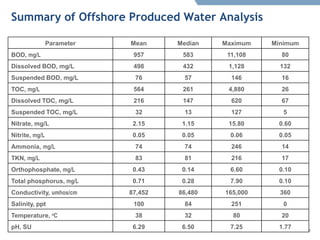
Summary of Offshore Produced Water Analysis
Parameter Mean Median Maximum Minimum
BOD, mg/L 957 583 11,108 80
Dissolved BOD, mg/L 498 432 1,128 132
Suspended BOD, mg/L 76 57 146 16
TOC, mg/L 564 261 4,880 26
Dissolved TOC, mg/L 216 147 620 67
Suspended TOC, mg/L 32 13 127 5
Nitrate, mg/L 2.15 1.15 15.80 0.60
Nitrite, mg/L 0.05 0.05 0.06 0.05
Ammonia, mg/L 74 74 246 14
TKN, mg/L 83 81 216 17
Orthophosphate, mg/L 0.43 0.14 6.60 0.10
Total phosphorus, mg/L 0.71 0.28 7.90 0.10
Conductivity, umhos/cm 87,452 86,480 165,000 360
Salinity, ppt 100 84 251 0
Temperature, oC 38 32 80 20
pH, SU 6.29 6.50 7.25 1.77
9
Distribution of Analytical Results
0 2000 4000 6000 8000 10000 12000
WD89A
WD73A
WD45A
WC71D
WC65JA
WC53A
WC237A
WC215A
WC173K
WC170A
WC168A
WC130A
WC110A
WC102
VR22B
VR164A
VR119G
ST34A
ST164C
ST161A
ST148E
SS58A
SS191B
SS189A
SS182E
SS182C
SS169C
SS157A
SS108D
SM40JA
SM33D
SM268A
SM23G
SM238-
HI46A
HI39A
HI37A
GI19 # 3
EI95F
EI74A
EI57A
EI50-1
EI184A
EI175B
EI172A
EI128A-
EI107A
EC49B
EC47JP
EC46B
BOD Value
Platform
0 2 4 6 8 10 12 14 16 18
WD89A
WD73A
WD45A
WC71D
WC65JA
WC53A
WC237A
WC215A
WC173K
WC170A
WC168A
WC130A
WC110A
WC102
VR22B
VR164A
VR119G
ST34A
ST164C
ST161A
ST148E
SS58A
SS191B
SS189A
SS182E
SS182C
SS169C
SS157A
SS108D
SM40JA
SM33D
SM268A
SM23G
SM238-
HI46A
HI39A
HI37A
GI19 # 3
EI95F
EI74A
EI57A
EI50-1
EI184A
EI175B
EI172A
EI128A-
EI107A
EC49B
EC47JP
EC46B
Platform
Nitrate Value
BOD
Nitrate
10
Offshore Discharge
Regulatory Requirements
11
U.S. Regulatory System
Laws
• Clean Water Act
• Safe Drinking Water Act
Water Regulations
• National Pollutant Discharge Elimination System (NPDES)
program
• Effluent limitations guidelines (ELGs)
• Underground Injection Control (UIC) program
Permits and Guidance
• Environmental Protection Agency (EPA) regions and states issue
NPDES and UIC permits
12
In the U.S., Most E&P Wastes Are Nonhazardous
Wastes
 Resource Conservation and Recovery Act (1980) directed EPA
to review E&P wastes and either establish national regulations
or make a determination that existing state controls were
adequate
 EPA issued determinations in 1988 and 1993
– E&P waste not subject to the hazardous waste requirements of RCRA
– States have regulatory authority over E&P wastes on state lands
• Can be more strict than federal requirements (I.e., can treat E&P
wastes as hazardous wastes at state discretion)
13
NPDES Permits
 Permits require
– Numerical limits
– Operational measures and controls
– Reporting and recordkeeping
– Self-monitoring
 Numerical limits are based on the more stringent of
– Technology-based limits or best professional judgment
– Water quality-based limits (considers dilution and mixing)
 Permits are issued for 5-year term and must be reissued
14
Offshore and Coastal Effluent Limitations Guidelines (ELGs)
 Minimum national discharge
standards for offshore
produced water:
– Oil and grease limits
• 29 mg/l monthly average
• 42 mg/l daily maximum
 Discharge standards for coastal
produced water
– zero discharge except in Cook
Inlet, Alaska
– Offshore limits are required there
15
General NPDES Permits
 Cover group of similar dischargers in the same geographic
area
 EPA regulations direct Regions to issue general permits for
offshore oil and gas activities
– EPA may issue individual permits in areas of biological concern
– Applicants may request individual permits
– Used by Regions 4, 6, 9, and 10 for coastal, territorial seas, and Outer
Continental Shelf areas
16
EPA Region 4 – Eastern Gulf of Mexico
Region 4 -
Eastern Gulf of
Mexico OCS
17
EPA Region 6 – Western Gulf of Mexico
Region 6 -
Western Gulf
of Mexico OCS
18
EPA Region 6 – Western Gulf of Mexico
Region 6 -
Western Gulf
of Mexico -
Territorial Seas
19
EPA Region 9 – California Coast
Region 9 –
California Coast
20
EPA Region 10 - Alaska
Region 10 – Cook
Inlet, Alaska
21
Overview of
Produced Water
Management
Basic Separation of Oil, Gas, and Water
 Free-water knockout tank
separates three fluid phases plus
solids
 Emulsions
- Heater-treater
- Demulsifying chemicals
 Most common practice
• Onshore – pass through tank
battery, then inject
• Offshore – discharge
23
Produced Water Management Options
 Follow 3-tier water management/pollution prevention hierarchy
– Water minimization
– Recycle/reuse
– Treatment and disposal
 Use most environmentally friendly option where possible
Tier 1 - Options for Minimizing Produced Water
 Keep produced water from the entering the well
– Mechanical blocking devices
– Water shut off chemicals
 Keep produced water from reaching the surface
– Downhole separation
– Sea floor separation
Waste Minimization – Keep Produced Water Out of the
Well
 Mechanical blocking devices
– Packers
– Plugs
– Cement
 Water shut-off chemicals
– Polymer gels
Source: Baker Hughes
Waste Minimization – Manage Water without Bringing It to
the Surface
 Downhole oil/water separation (DOWS)
– Tool that mounts in bottom of well and separates oil
from water
– Oil is pumped to the surface
– Water is pumped to injection zone without coming to
surface
26
Waste Minimization – Manage Water without Bringing It to
the Surface
 Separate at the sea floor
Source: ABB
Source: ABB
Tier 2 - Options for Recycle and Reuse of
Produced Water
• Injection for recovering more oil
• Injection for future use
• Injection for hydrological purposes
• Agricultural use
• Industrial use
• Drinking water and other domestic uses
• Secondary use
These are primarily applicable to onshore
production
28
Tier 3 - Options for Treatment and Disposal of Produced Water
 Practices to dispose of produced water
– Discharge
– Injection
– Evaporation
– Offsite commercial disposal
Of these, discharge is the predominant option for
offshore produced water
29
Tier 3 - Options for Treatment and Disposal of Produced Water
 Practices to dispose of produced water
– Discharge
– Injection
– Evaporation
– Offsite commercial disposal
 Practices to remove salt and other inorganics from
produced water
– Membrane processes
– Ion exchange
– Capacitive deionization
– Thermal distillation
These are rarely used for treating offshore produced
water because salt is not a significant concern when
discharging into the ocean
30
Tier 3 - Options for Treatment and Disposal of Produced Water
 Practices to dispose of produced water
– Discharge
– Injection
– Evaporation
– Offsite commercial disposal
 Practices to remove salt and other inorganics from produced water
– Membrane processes
– Ion exchange
– Capacitive deionization
– Thermal distillation
 Practices to remove oil and grease and other organics from
produced water
– Physical separation
– Flotation
– Coalescence
– Combined physical and extraction
– Solvent extraction
– Adsorption
31
Produced Water Offshore Treatment Technology
 There are many types of produced water treatment used at
offshore facilities
– Primarily designed to reduce free oil and other dissolved organics in order
to meet the oil and grease limit of 29 mg/l average and 42 mg/l maximum
 Oil and grease is a variable parameter
– Free oil (large droplets, easy to remove)
– Dispersed oil (small droplets)
– Dissolved oil (difficult to remove)
 Measurement of oil and grease depends on analytical method
32
Physical Separation
 Separation
 Hydrocyclone
 Filtration
 Centrifuge
Source: Natco
Source: USEPA
33
Flotation
Source: Natco
34
Coalescence
Source: Opus
Source: Opus
35
Combined Physical and Extraction Processes
Source: M-I Epcon AS Source: M-I Epcon AS
Source: Pro-Sep
Source: Pro-Sep
36
Extraction
Source: VWS MPP Systems
37
Adsorption
 Organoclay
 MyCelx
 Osorb
Source: CETCO Oilfield Service Company
Source: ABS
Produced Water Management Information System
http://www.netl.doe.gov/technologies/PWMIS/
Conclusions and Final Thoughts
 There is a lot of produced water generated
each year from several thousand offshore oil
and gas wells
 Nearly all produced water from offshore wells
is treated on the platform and discharged to
the ocean under the authority of a permit
 A variety of treatment technologies are
available to clean produced water before
discharge

Produced Water | Session III - John Veil

  • 1.
    Produced Water from OffshoreConventional Wells John Veil 410-212-0950 john@veilenvironmental.com www.veilenvironmental.com Fossil Fuel Produced Water: Asset Or Waste? Atlantic Council Washington, DC June 24-25 2013
  • 2.
    2 Topics for Discussion Gulf of Mexico oil and gas statistics  Volume of offshore produced water  Unique features of offshore production  Characteristics of offshore produced water  Regulations for offshore discharge  Management of offshore produced water
  • 3.
    Data for Gulfof Mexico Activity – from Bureau of Ocean Management Well-by-Well Production data for oil, gas, and produced water can be seen at: http://www.data.boem.gov/homepg/pubinfo/repcat/product/pdf/Production-A-2012.pdf
  • 4.
    4 Produced Water VolumeProfile for Conventional Well
  • 5.
    U.S. Produced WaterVolume by Management Practice for 2007 (1,000 bbl/year) Injection for Enhanced Recovery Injection for Disposal Surface Discharge Total Managed Total Generated Onshore Total 10,676,530 7,144,071 139,002 18,057,527 20,258,560 Offshore Total 48,673 1,298 537,381 587,353 587,353 Total 10,725,203 7,145,369 676,383 18,644,880 20,995,174 5 Offshore – 91% goes to discharge
  • 6.
    Unique Features ofOffshore Production  Transportation to and from shore  Water depth  Cost  Environmental risk – Salinity is not a big concern  Restrictions on footprint and weight – Limits the types of treatment
  • 7.
    7 Platforms Sampled forProduced Water Study in 2005 Platforms sampled one time and selected at random Platforms sampled three times and selected based on discharge volume and type of hydrocarbon produced
  • 8.
    8 Summary of OffshoreProduced Water Analysis Parameter Mean Median Maximum Minimum BOD, mg/L 957 583 11,108 80 Dissolved BOD, mg/L 498 432 1,128 132 Suspended BOD, mg/L 76 57 146 16 TOC, mg/L 564 261 4,880 26 Dissolved TOC, mg/L 216 147 620 67 Suspended TOC, mg/L 32 13 127 5 Nitrate, mg/L 2.15 1.15 15.80 0.60 Nitrite, mg/L 0.05 0.05 0.06 0.05 Ammonia, mg/L 74 74 246 14 TKN, mg/L 83 81 216 17 Orthophosphate, mg/L 0.43 0.14 6.60 0.10 Total phosphorus, mg/L 0.71 0.28 7.90 0.10 Conductivity, umhos/cm 87,452 86,480 165,000 360 Salinity, ppt 100 84 251 0 Temperature, oC 38 32 80 20 pH, SU 6.29 6.50 7.25 1.77
  • 9.
    9 Distribution of AnalyticalResults 0 2000 4000 6000 8000 10000 12000 WD89A WD73A WD45A WC71D WC65JA WC53A WC237A WC215A WC173K WC170A WC168A WC130A WC110A WC102 VR22B VR164A VR119G ST34A ST164C ST161A ST148E SS58A SS191B SS189A SS182E SS182C SS169C SS157A SS108D SM40JA SM33D SM268A SM23G SM238- HI46A HI39A HI37A GI19 # 3 EI95F EI74A EI57A EI50-1 EI184A EI175B EI172A EI128A- EI107A EC49B EC47JP EC46B BOD Value Platform 0 2 4 6 8 10 12 14 16 18 WD89A WD73A WD45A WC71D WC65JA WC53A WC237A WC215A WC173K WC170A WC168A WC130A WC110A WC102 VR22B VR164A VR119G ST34A ST164C ST161A ST148E SS58A SS191B SS189A SS182E SS182C SS169C SS157A SS108D SM40JA SM33D SM268A SM23G SM238- HI46A HI39A HI37A GI19 # 3 EI95F EI74A EI57A EI50-1 EI184A EI175B EI172A EI128A- EI107A EC49B EC47JP EC46B Platform Nitrate Value BOD Nitrate
  • 10.
  • 11.
    11 U.S. Regulatory System Laws •Clean Water Act • Safe Drinking Water Act Water Regulations • National Pollutant Discharge Elimination System (NPDES) program • Effluent limitations guidelines (ELGs) • Underground Injection Control (UIC) program Permits and Guidance • Environmental Protection Agency (EPA) regions and states issue NPDES and UIC permits
  • 12.
    12 In the U.S.,Most E&P Wastes Are Nonhazardous Wastes  Resource Conservation and Recovery Act (1980) directed EPA to review E&P wastes and either establish national regulations or make a determination that existing state controls were adequate  EPA issued determinations in 1988 and 1993 – E&P waste not subject to the hazardous waste requirements of RCRA – States have regulatory authority over E&P wastes on state lands • Can be more strict than federal requirements (I.e., can treat E&P wastes as hazardous wastes at state discretion)
  • 13.
    13 NPDES Permits  Permitsrequire – Numerical limits – Operational measures and controls – Reporting and recordkeeping – Self-monitoring  Numerical limits are based on the more stringent of – Technology-based limits or best professional judgment – Water quality-based limits (considers dilution and mixing)  Permits are issued for 5-year term and must be reissued
  • 14.
    14 Offshore and CoastalEffluent Limitations Guidelines (ELGs)  Minimum national discharge standards for offshore produced water: – Oil and grease limits • 29 mg/l monthly average • 42 mg/l daily maximum  Discharge standards for coastal produced water – zero discharge except in Cook Inlet, Alaska – Offshore limits are required there
  • 15.
    15 General NPDES Permits Cover group of similar dischargers in the same geographic area  EPA regulations direct Regions to issue general permits for offshore oil and gas activities – EPA may issue individual permits in areas of biological concern – Applicants may request individual permits – Used by Regions 4, 6, 9, and 10 for coastal, territorial seas, and Outer Continental Shelf areas
  • 16.
    16 EPA Region 4– Eastern Gulf of Mexico Region 4 - Eastern Gulf of Mexico OCS
  • 17.
    17 EPA Region 6– Western Gulf of Mexico Region 6 - Western Gulf of Mexico OCS
  • 18.
    18 EPA Region 6– Western Gulf of Mexico Region 6 - Western Gulf of Mexico - Territorial Seas
  • 19.
    19 EPA Region 9– California Coast Region 9 – California Coast
  • 20.
    20 EPA Region 10- Alaska Region 10 – Cook Inlet, Alaska
  • 21.
  • 22.
    Basic Separation ofOil, Gas, and Water  Free-water knockout tank separates three fluid phases plus solids  Emulsions - Heater-treater - Demulsifying chemicals  Most common practice • Onshore – pass through tank battery, then inject • Offshore – discharge
  • 23.
    23 Produced Water ManagementOptions  Follow 3-tier water management/pollution prevention hierarchy – Water minimization – Recycle/reuse – Treatment and disposal  Use most environmentally friendly option where possible Tier 1 - Options for Minimizing Produced Water  Keep produced water from the entering the well – Mechanical blocking devices – Water shut off chemicals  Keep produced water from reaching the surface – Downhole separation – Sea floor separation
  • 24.
    Waste Minimization –Keep Produced Water Out of the Well  Mechanical blocking devices – Packers – Plugs – Cement  Water shut-off chemicals – Polymer gels Source: Baker Hughes Source: Baker Hughes
  • 25.
    Waste Minimization –Manage Water without Bringing It to the Surface  Downhole oil/water separation (DOWS) – Tool that mounts in bottom of well and separates oil from water – Oil is pumped to the surface – Water is pumped to injection zone without coming to surface
  • 26.
    26 Waste Minimization –Manage Water without Bringing It to the Surface  Separate at the sea floor Source: ABB Source: ABB
  • 27.
    Tier 2 -Options for Recycle and Reuse of Produced Water • Injection for recovering more oil • Injection for future use • Injection for hydrological purposes • Agricultural use • Industrial use • Drinking water and other domestic uses • Secondary use These are primarily applicable to onshore production
  • 28.
    28 Tier 3 -Options for Treatment and Disposal of Produced Water  Practices to dispose of produced water – Discharge – Injection – Evaporation – Offsite commercial disposal Of these, discharge is the predominant option for offshore produced water
  • 29.
    29 Tier 3 -Options for Treatment and Disposal of Produced Water  Practices to dispose of produced water – Discharge – Injection – Evaporation – Offsite commercial disposal  Practices to remove salt and other inorganics from produced water – Membrane processes – Ion exchange – Capacitive deionization – Thermal distillation These are rarely used for treating offshore produced water because salt is not a significant concern when discharging into the ocean
  • 30.
    30 Tier 3 -Options for Treatment and Disposal of Produced Water  Practices to dispose of produced water – Discharge – Injection – Evaporation – Offsite commercial disposal  Practices to remove salt and other inorganics from produced water – Membrane processes – Ion exchange – Capacitive deionization – Thermal distillation  Practices to remove oil and grease and other organics from produced water – Physical separation – Flotation – Coalescence – Combined physical and extraction – Solvent extraction – Adsorption
  • 31.
    31 Produced Water OffshoreTreatment Technology  There are many types of produced water treatment used at offshore facilities – Primarily designed to reduce free oil and other dissolved organics in order to meet the oil and grease limit of 29 mg/l average and 42 mg/l maximum  Oil and grease is a variable parameter – Free oil (large droplets, easy to remove) – Dispersed oil (small droplets) – Dissolved oil (difficult to remove)  Measurement of oil and grease depends on analytical method
  • 32.
    32 Physical Separation  Separation Hydrocyclone  Filtration  Centrifuge Source: Natco Source: USEPA
  • 33.
  • 34.
  • 35.
    35 Combined Physical andExtraction Processes Source: M-I Epcon AS Source: M-I Epcon AS Source: Pro-Sep Source: Pro-Sep
  • 36.
    36 Extraction Source: VWS MPPSystems Source: VWS MPP Systems
  • 37.
    37 Adsorption  Organoclay  MyCelx Osorb Source: CETCO Oilfield Service Company Source: ABS
  • 38.
    Produced Water ManagementInformation System http://www.netl.doe.gov/technologies/PWMIS/
  • 39.
    Conclusions and FinalThoughts  There is a lot of produced water generated each year from several thousand offshore oil and gas wells  Nearly all produced water from offshore wells is treated on the platform and discharged to the ocean under the authority of a permit  A variety of treatment technologies are available to clean produced water before discharge

Editor's Notes