Mexico’s Energy Reform: Moving Forward
April, 2015
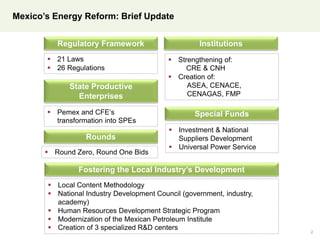
Mexico’s Energy Reform: Brief Update
2
 21 Laws
 26 Regulations
Regulatory Framework
 Strengthening of:
CRE & CNH
 Creation of:
ASEA, CENACE,
CENAGAS, FMP
Institutions
 Pemex and CFE’s
transformation into SPEs
State Productive
Enterprises
 Investment & National
Suppliers Development
 Universal Power Service
Special Funds
 Local Content Methodology
 National Industry Development Council (government, industry,
academy)
 Human Resources Development Strategic Program
 Modernization of the Mexican Petroleum Institute
 Creation of 3 specialized R&D centers
Fostering the Local Industry’s Development
 Round Zero, Round One Bids
Rounds
Transparency and Accountability
3
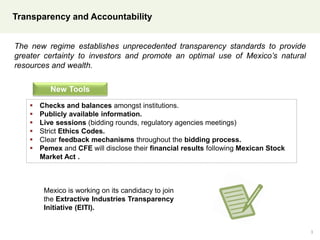
The new regime establishes unprecedented transparency standards to provide
greater certainty to investors and promote an optimal use of Mexico’s natural
resources and wealth.
New Tools
 Checks and balances amongst institutions.
 Publicly available information.
 Live sessions (bidding rounds, regulatory agencies meetings)
 Strict Ethics Codes.
 Clear feedback mechanisms throughout the bidding process.
 Pemex and CFE will disclose their financial results following Mexican Stock
Market Act .
Mexico is working on its candidacy to join
the Extractive Industries Transparency
Initiative (EITI).
Round 1:
First Approach
4
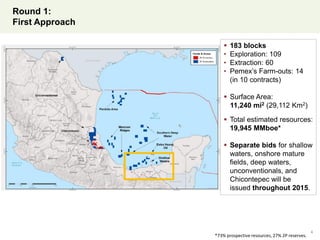
 183 blocks
• Exploration: 109
• Extraction: 60
• Pemex’s Farm-outs: 14
(in 10 contracts)
 Surface Area:
11,240 mi2 (29,112 Km2)
 Total estimated resources:
19,945 MMboe*
 Separate bids for shallow
waters, onshore mature
fields, deep waters,
unconventionals, and
Chicontepec will be
issued throughout 2015.
*73% prospective resources, 27% 2P reserves.
Round 1:
First and Second Bid
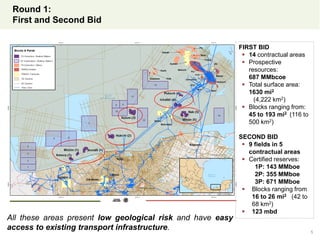
All these areas present low geological risk and have easy
access to existing transport infrastructure. 5
FIRST BID
 14 contractual areas
 Prospective
resources:
687 MMbcoe
 Total surface area:
1630 mi2
(4,222 km2)
 Blocks ranging from:
45 to 193 mi2 (116 to
500 km2)
SECOND BID
 9 fields in 5
contractual areas
 Certified reserves:
1P: 143 MMboe
2P: 355 MMboe
3P: 671 MMboe
 Blocks ranging from
16 to 26 mi2 (42 to
68 km2)
 123 mbd
Round 1:
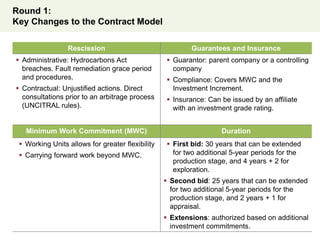
Key Changes to the Contract Model
Rescission Guarantees and Insurance
 Administrative: Hydrocarbons Act
breaches. Fault remediation grace period
and procedures.
 Contractual: Unjustified actions. Direct
consultations prior to an arbitrage process
(UNCITRAL rules).
 Guarantor: parent company or a controlling
company
 Compliance: Covers MWC and the
Investment Increment.
 Insurance: Can be issued by an affiliate
with an investment grade rating.
Minimum Work Commitment (MWC) Duration
 Working Units allows for greater flexibility
 Carrying forward work beyond MWC.
 First bid: 30 years that can be extended
for two additional 5-year periods for the
production stage, and 4 years + 2 for
exploration.
 Second bid: 25 years that can be extended
for two additional 5-year periods for the
production stage, and 2 years + 1 for
appraisal.
 Extensions: authorized based on additional
investment commitments.
Round 1:
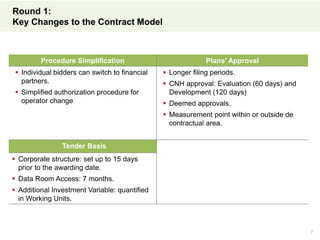
Key Changes to the Contract Model
Procedure Simplification Plans’ Approval
 Individual bidders can switch to financial
partners.
 Simplified authorization procedure for
operator change
 Longer filing periods.
 CNH approval: Evaluation (60 days) and
Development (120 days)
 Deemed approvals.
 Measurement point within or outside de
contractual area.
Tender Basis
 Corporate structure: set up to 15 days
prior to the awarding date.
 Data Room Access: 7 months.
 Additional Investment Variable: quantified
in Working Units.der Bas
7
Round 1:
Key Changes to the Contract Model
8
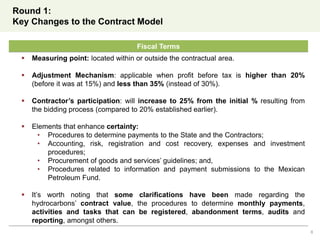
Fiscal Terms
 Measuring point: located within or outside the contractual area.
 Adjustment Mechanism: applicable when profit before tax is higher than 20%
(before it was at 15%) and less than 35% (instead of 30%).
 Contractor’s participation: will increase to 25% from the initial % resulting from
the bidding process (compared to 20% established earlier).
 Elements that enhance certainty:
• Procedures to determine payments to the State and the Contractors;
• Accounting, risk, registration and cost recovery, expenses and investment
procedures;
• Procurement of goods and services’ guidelines; and,
• Procedures related to information and payment submissions to the Mexican
Petroleum Fund.
 It’s worth noting that some clarifications have been made regarding the
hydrocarbons’ contract value, the procedures to determine monthly payments,
activities and tasks that can be registered, abandonment terms, audits and
reporting, amongst others.
Round 1:
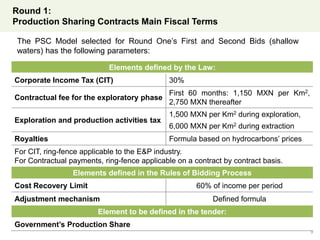
Production Sharing Contracts Main Fiscal Terms
9
Elements defined by the Law:
Corporate Income Tax (CIT) 30%
Contractual fee for the exploratory phase
First 60 months: 1,150 MXN per Km2,
2,750 MXN thereafter
Exploration and production activities tax
1,500 MXN per Km2 during exploration,
6,000 MXN per Km2 during extraction
Royalties Formula based on hydrocarbons’ prices
For CIT, ring-fence applicable to the E&P industry.
For Contractual payments, ring-fence applicable on a contract by contract basis.
Elements defined in the Rules of Bidding Process
Cost Recovery Limit 60% of income per period
Adjustment mechanism Defined formula
Element to be defined in the tender:
Government’s Production Share
The PSC Model selected for Round One’s First and Second Bids (shallow
waters) has the following parameters:
Round 1:
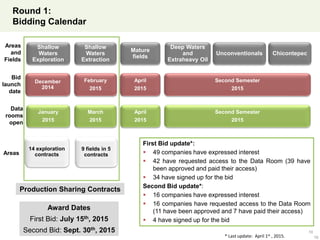
Bidding Calendar
10
Bid
launch
date
January
2015
March
2015
April
2015
Second Semester
2015
Data
rooms
open
December
2014
February
2015
April
2015
Second Semester
2015
Areas
and
Fields
Shallow
Waters
Exploration
Shallow
Waters
Extraction
Mature
fields
Deep Waters
and
Extraheavy Oil
Unconventionals
First Bid update*:
 49 companies have expressed interest
 42 have requested access to the Data Room (39 have
been approved and paid their access)
 34 have signed up for the bid
Second Bid update*:
 16 companies have expressed interest
 16 companies have requested access to the Data Room
(11 have been approved and 7 have paid their access)
 4 have signed up for the bid
14 exploration
contracts
9 fields in 5
contractsAreas
Award Dates
First Bid: July 15th, 2015
Second Bid: Sept. 30th, 2015
Chicontepec
Production Sharing Contracts
10* Last update: April 1st , 2015.
www.ronda1.gob.mx
www.energia.gob.mx
11
April, 2015
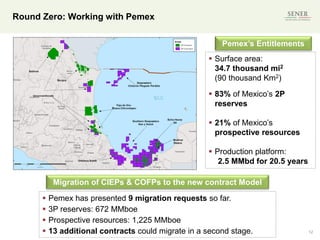
Round Zero: Working with Pemex
12
 Surface area:
34.7 thousand mi2
(90 thousand Km2)
 83% of Mexico’s 2P
reserves
 21% of Mexico’s
prospective resources
 Production platform:
2.5 MMbd for 20.5 years
 Pemex has presented 9 migration requests so far.
 3P reserves: 672 MMboe
 Prospective resources: 1,225 MMboe
 13 additional contracts could migrate in a second stage.
Pemex’s Entitlements
Migration of CIEPs & COFPs to the new contract Model
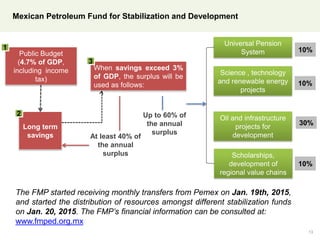
Mexican Petroleum Fund for Stabilization and Development
13
Public Budget
(4.7% of GDP,
including income
tax)
When savings exceed 3%
of GDP, the surplus will be
used as follows:
Long term
savings
Universal Pension
System
Scholarships,
development of
regional value chains
Science , technology
and renewable energy
projects
Oil and infrastructure
projects for
developmentAt least 40% of
the annual
surplus
Up to 60% of
the annual
surplus
1
2
3
10%
30%
10%
10%
The FMP started receiving monthly transfers from Pemex on Jan. 19th, 2015,
and started the distribution of resources amongst different stabilization funds
on Jan. 20, 2015. The FMP’s financial information can be consulted at:
www.fmped.org.mx

Mexicos energy reform

  • 1.
    Mexico’s Energy Reform:Moving Forward April, 2015
  • 2.
    Mexico’s Energy Reform:Brief Update 2  21 Laws  26 Regulations Regulatory Framework  Strengthening of: CRE & CNH  Creation of: ASEA, CENACE, CENAGAS, FMP Institutions  Pemex and CFE’s transformation into SPEs State Productive Enterprises  Investment & National Suppliers Development  Universal Power Service Special Funds  Local Content Methodology  National Industry Development Council (government, industry, academy)  Human Resources Development Strategic Program  Modernization of the Mexican Petroleum Institute  Creation of 3 specialized R&D centers Fostering the Local Industry’s Development  Round Zero, Round One Bids Rounds
  • 3.
    Transparency and Accountability 3 Thenew regime establishes unprecedented transparency standards to provide greater certainty to investors and promote an optimal use of Mexico’s natural resources and wealth. New Tools  Checks and balances amongst institutions.  Publicly available information.  Live sessions (bidding rounds, regulatory agencies meetings)  Strict Ethics Codes.  Clear feedback mechanisms throughout the bidding process.  Pemex and CFE will disclose their financial results following Mexican Stock Market Act . Mexico is working on its candidacy to join the Extractive Industries Transparency Initiative (EITI).
  • 4.
    Round 1: First Approach 4 183 blocks • Exploration: 109 • Extraction: 60 • Pemex’s Farm-outs: 14 (in 10 contracts)  Surface Area: 11,240 mi2 (29,112 Km2)  Total estimated resources: 19,945 MMboe*  Separate bids for shallow waters, onshore mature fields, deep waters, unconventionals, and Chicontepec will be issued throughout 2015. *73% prospective resources, 27% 2P reserves.
  • 5.
    Round 1: First andSecond Bid All these areas present low geological risk and have easy access to existing transport infrastructure. 5 FIRST BID  14 contractual areas  Prospective resources: 687 MMbcoe  Total surface area: 1630 mi2 (4,222 km2)  Blocks ranging from: 45 to 193 mi2 (116 to 500 km2) SECOND BID  9 fields in 5 contractual areas  Certified reserves: 1P: 143 MMboe 2P: 355 MMboe 3P: 671 MMboe  Blocks ranging from 16 to 26 mi2 (42 to 68 km2)  123 mbd
  • 6.
    Round 1: Key Changesto the Contract Model Rescission Guarantees and Insurance  Administrative: Hydrocarbons Act breaches. Fault remediation grace period and procedures.  Contractual: Unjustified actions. Direct consultations prior to an arbitrage process (UNCITRAL rules).  Guarantor: parent company or a controlling company  Compliance: Covers MWC and the Investment Increment.  Insurance: Can be issued by an affiliate with an investment grade rating. Minimum Work Commitment (MWC) Duration  Working Units allows for greater flexibility  Carrying forward work beyond MWC.  First bid: 30 years that can be extended for two additional 5-year periods for the production stage, and 4 years + 2 for exploration.  Second bid: 25 years that can be extended for two additional 5-year periods for the production stage, and 2 years + 1 for appraisal.  Extensions: authorized based on additional investment commitments.
  • 7.
    Round 1: Key Changesto the Contract Model Procedure Simplification Plans’ Approval  Individual bidders can switch to financial partners.  Simplified authorization procedure for operator change  Longer filing periods.  CNH approval: Evaluation (60 days) and Development (120 days)  Deemed approvals.  Measurement point within or outside de contractual area. Tender Basis  Corporate structure: set up to 15 days prior to the awarding date.  Data Room Access: 7 months.  Additional Investment Variable: quantified in Working Units.der Bas 7
  • 8.
    Round 1: Key Changesto the Contract Model 8 Fiscal Terms  Measuring point: located within or outside the contractual area.  Adjustment Mechanism: applicable when profit before tax is higher than 20% (before it was at 15%) and less than 35% (instead of 30%).  Contractor’s participation: will increase to 25% from the initial % resulting from the bidding process (compared to 20% established earlier).  Elements that enhance certainty: • Procedures to determine payments to the State and the Contractors; • Accounting, risk, registration and cost recovery, expenses and investment procedures; • Procurement of goods and services’ guidelines; and, • Procedures related to information and payment submissions to the Mexican Petroleum Fund.  It’s worth noting that some clarifications have been made regarding the hydrocarbons’ contract value, the procedures to determine monthly payments, activities and tasks that can be registered, abandonment terms, audits and reporting, amongst others.
  • 9.
    Round 1: Production SharingContracts Main Fiscal Terms 9 Elements defined by the Law: Corporate Income Tax (CIT) 30% Contractual fee for the exploratory phase First 60 months: 1,150 MXN per Km2, 2,750 MXN thereafter Exploration and production activities tax 1,500 MXN per Km2 during exploration, 6,000 MXN per Km2 during extraction Royalties Formula based on hydrocarbons’ prices For CIT, ring-fence applicable to the E&P industry. For Contractual payments, ring-fence applicable on a contract by contract basis. Elements defined in the Rules of Bidding Process Cost Recovery Limit 60% of income per period Adjustment mechanism Defined formula Element to be defined in the tender: Government’s Production Share The PSC Model selected for Round One’s First and Second Bids (shallow waters) has the following parameters:
  • 10.
    Round 1: Bidding Calendar 10 Bid launch date January 2015 March 2015 April 2015 SecondSemester 2015 Data rooms open December 2014 February 2015 April 2015 Second Semester 2015 Areas and Fields Shallow Waters Exploration Shallow Waters Extraction Mature fields Deep Waters and Extraheavy Oil Unconventionals First Bid update*:  49 companies have expressed interest  42 have requested access to the Data Room (39 have been approved and paid their access)  34 have signed up for the bid Second Bid update*:  16 companies have expressed interest  16 companies have requested access to the Data Room (11 have been approved and 7 have paid their access)  4 have signed up for the bid 14 exploration contracts 9 fields in 5 contractsAreas Award Dates First Bid: July 15th, 2015 Second Bid: Sept. 30th, 2015 Chicontepec Production Sharing Contracts 10* Last update: April 1st , 2015.
  • 11.
  • 12.
    Round Zero: Workingwith Pemex 12  Surface area: 34.7 thousand mi2 (90 thousand Km2)  83% of Mexico’s 2P reserves  21% of Mexico’s prospective resources  Production platform: 2.5 MMbd for 20.5 years  Pemex has presented 9 migration requests so far.  3P reserves: 672 MMboe  Prospective resources: 1,225 MMboe  13 additional contracts could migrate in a second stage. Pemex’s Entitlements Migration of CIEPs & COFPs to the new contract Model
  • 13.
    Mexican Petroleum Fundfor Stabilization and Development 13 Public Budget (4.7% of GDP, including income tax) When savings exceed 3% of GDP, the surplus will be used as follows: Long term savings Universal Pension System Scholarships, development of regional value chains Science , technology and renewable energy projects Oil and infrastructure projects for developmentAt least 40% of the annual surplus Up to 60% of the annual surplus 1 2 3 10% 30% 10% 10% The FMP started receiving monthly transfers from Pemex on Jan. 19th, 2015, and started the distribution of resources amongst different stabilization funds on Jan. 20, 2015. The FMP’s financial information can be consulted at: www.fmped.org.mx