STUDENT CHALLENGE
9/12
Cyber
We frequently hear the terms “Cyber 9/11” and “Digital Pearl Harbor,” but what might policymakers
do the day after a crisis? The Cyber 9/12 Student Challenge is an annual cyber policy competition for
students across the globe to compete in developing national security policy recommendations tackling
a fictional cyber catastrophe. In spring 2016, the Student Challenge will take place in Washington, DC,
and in Geneva, Switzerland.
THE STUDENT CHALLENGE
In Washington, DC, student teams confront a serious
cybersecurity breach of national and international im-
portance. Teams will compose policy recommenda-
tions and justify their decision-making process, con-
sidering the role and implications for relevant civilian,
military, law enforcement, and private sector entities
and updating the recommendations as the scenario
evolves.
In Geneva, Switzerland, in
partnership with the Ge-
neva Centre for Security
Policy (GCSP), students
respond to a major cyber-
attack on European networks. Competitors will pro-
vide recommendations balancing individual national
approaches and a collective crisis management re-
sponse, considering capabilities, policies, and gover-
nance structures of NATO, EU, and individual nations.
The competition fosters a culture of cooperation and
a better understanding of these organizations and
their member states in responding to cyberattacks.
WHAT IS THE CHALLENGE ALL ABOUT?
Now entering its fourth year, the Cyber 9/12 Student
Challenge is a one-of-a-kind competition designed
to provide students across academic disciplines with
a deeper understanding of the policy challenges
associated with cyber crisis and conflict. Part
interactive learning experience and part competitive
scenario exercise, it challenges teams to respond to a
realistic, evolving cyberattack and analyze the threat
it poses to national, international, and private sector
interests.
Students have a unique opportunity to interact with
expert mentors and high-level cyber professionals
while developing valuable skills in policy analysis and
presentation. The competition has already engaged
over four hundred students from universities in the
United States, United Kingdom, France, Poland,
Switzerland, Hungary, Finland, and Estonia.
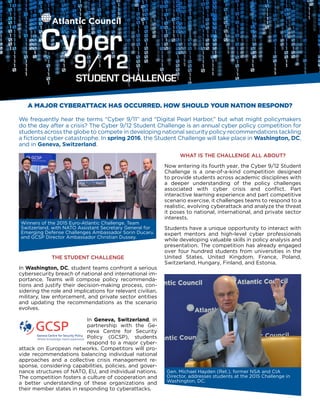
Gen. Michael Hayden (Ret.), former NSA and CIA
Director, addresses students at the 2015 Challenge in
Washington, DC.
Winners of the 2015 Euro-Atlantic Challenge, Team
Switzerland, with NATO Assistant Secretary General for
Emerging Defense Challenges Ambassador Sorin Ducaru
and GCSP Director Ambassador Christian Dussey.
A MAJOR CYBERATTACK HAS OCCURRED. HOW SHOULD YOUR NATION RESPOND?
HOW TO PARTICIPATE
. . .as a competitor:
Graduate and undergraduate students from any uni-
versity, including defense colleges and military acad-
emies, are invited to apply to compete in teams of
four. There are no requirements for team composition
based on academic majors, education levels, or na-
tionalities of team members.
. . .as a coach:
Each team must recruit a coach to assist in preparing
for the competition. One coach can serve for sever-
al teams. Teams are expected to consult with their
coaches to help develop and revise their policy ideas
for the competition and confer with them during
breaks between competition rounds.
. . .as a judge:
Experts with significant policy and cybersecurity ex-
perience are invited to serve as judges. Judges eval-
uate the student teams’ oral presentations based
on the quality of their policy responses, their deci-
sion-making processes, and their presentation skills.
Previous judges include practitioners from various
sectors, such as government, international organiza-
tions, information and communications technology,
finance, and the press.
. . .as an observer:
All competition events are open to the public, and we
welcome anyone interested in cybersecurity policy to
join us as an observer.
. . .as a sponsor:
The Cyber 9/12 Student Challenge is a unique op-
portunity for companies to support next-generation
cybersecurity education on both sides of the Atlan-
tic and position themselves as innovative thought
leaders in the field. Depending on the level of spon-
sorship, our partners receive great benefits including
recruitment of top tech and policy talent; extensive
advertisement in print and online; and keynote and
judging opportunities for company representatives.
To register or for more information, please contact:
Anni Piiparinen
Program Assistant
Cyber Statecraft Initiative
Atlantic Council
Email: APiiparinen@AtlanticCouncil.org
Phone: +1-202-292-5164
AtlanticCouncil.org
1030 15TH STREET, NW | 12TH FLOOR | WASHINGTON, DC 20005 | 202-463-7226
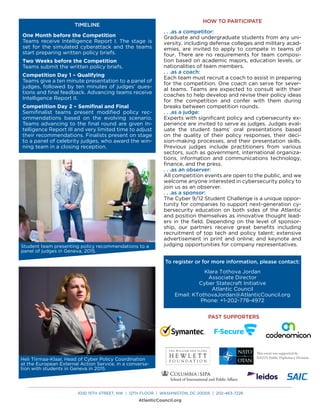
Student team presenting policy recommendations to a
panel of judges in Geneva, 2015.
Heli Tiirmaa-Klaar, Head of Cyber Policy Coordination
at the European External Action Service, in a conversa-
tion with students in Geneva in 2015.
TIMELINE
One Month before the Competition
Teams receive Intelligence Report I. The stage is
set for the simulated cyberattack and the teams
start preparing written policy briefs.
Two Weeks before the Competition
Teams submit the written policy briefs.
Competition Day 1 – Qualifying
Teams give a ten minute presentation to a panel of
judges, followed by ten minutes of judges’ ques-
tions and final feedback. Advancing teams receive
Intelligence Report II.
Competition Day 2 – Semifinal and Final
Semifinalist teams present modified policy rec-
ommendations based on the evolving scenario.
Teams advancing to the final round are given In-
telligence Report III and very limited time to adjust
their recommendations. Finalists present on stage
to a panel of celebrity judges, who award the win-
ning team in a closing reception.
PAST SUPPORTERS
This event was supported by
NATO’s Public Diplomacy Division

Cyber 9/12 Student Challenge General Information

  • 1.
    STUDENT CHALLENGE 9/12 Cyber We frequentlyhear the terms “Cyber 9/11” and “Digital Pearl Harbor,” but what might policymakers do the day after a crisis? The Cyber 9/12 Student Challenge is an annual cyber policy competition for students across the globe to compete in developing national security policy recommendations tackling a fictional cyber catastrophe. In spring 2016, the Student Challenge will take place in Washington, DC, and in Geneva, Switzerland. THE STUDENT CHALLENGE In Washington, DC, student teams confront a serious cybersecurity breach of national and international im- portance. Teams will compose policy recommenda- tions and justify their decision-making process, con- sidering the role and implications for relevant civilian, military, law enforcement, and private sector entities and updating the recommendations as the scenario evolves. In Geneva, Switzerland, in partnership with the Ge- neva Centre for Security Policy (GCSP), students respond to a major cyber- attack on European networks. Competitors will pro- vide recommendations balancing individual national approaches and a collective crisis management re- sponse, considering capabilities, policies, and gover- nance structures of NATO, EU, and individual nations. The competition fosters a culture of cooperation and a better understanding of these organizations and their member states in responding to cyberattacks. WHAT IS THE CHALLENGE ALL ABOUT? Now entering its fourth year, the Cyber 9/12 Student Challenge is a one-of-a-kind competition designed to provide students across academic disciplines with a deeper understanding of the policy challenges associated with cyber crisis and conflict. Part interactive learning experience and part competitive scenario exercise, it challenges teams to respond to a realistic, evolving cyberattack and analyze the threat it poses to national, international, and private sector interests. Students have a unique opportunity to interact with expert mentors and high-level cyber professionals while developing valuable skills in policy analysis and presentation. The competition has already engaged over four hundred students from universities in the United States, United Kingdom, France, Poland, Switzerland, Hungary, Finland, and Estonia. Gen. Michael Hayden (Ret.), former NSA and CIA Director, addresses students at the 2015 Challenge in Washington, DC. Winners of the 2015 Euro-Atlantic Challenge, Team Switzerland, with NATO Assistant Secretary General for Emerging Defense Challenges Ambassador Sorin Ducaru and GCSP Director Ambassador Christian Dussey. A MAJOR CYBERATTACK HAS OCCURRED. HOW SHOULD YOUR NATION RESPOND?
  • 2.
    HOW TO PARTICIPATE .. .as a competitor: Graduate and undergraduate students from any uni- versity, including defense colleges and military acad- emies, are invited to apply to compete in teams of four. There are no requirements for team composition based on academic majors, education levels, or na- tionalities of team members. . . .as a coach: Each team must recruit a coach to assist in preparing for the competition. One coach can serve for sever- al teams. Teams are expected to consult with their coaches to help develop and revise their policy ideas for the competition and confer with them during breaks between competition rounds. . . .as a judge: Experts with significant policy and cybersecurity ex- perience are invited to serve as judges. Judges eval- uate the student teams’ oral presentations based on the quality of their policy responses, their deci- sion-making processes, and their presentation skills. Previous judges include practitioners from various sectors, such as government, international organiza- tions, information and communications technology, finance, and the press. . . .as an observer: All competition events are open to the public, and we welcome anyone interested in cybersecurity policy to join us as an observer. . . .as a sponsor: The Cyber 9/12 Student Challenge is a unique op- portunity for companies to support next-generation cybersecurity education on both sides of the Atlan- tic and position themselves as innovative thought leaders in the field. Depending on the level of spon- sorship, our partners receive great benefits including recruitment of top tech and policy talent; extensive advertisement in print and online; and keynote and judging opportunities for company representatives. To register or for more information, please contact: Anni Piiparinen Program Assistant Cyber Statecraft Initiative Atlantic Council Email: APiiparinen@AtlanticCouncil.org Phone: +1-202-292-5164 AtlanticCouncil.org 1030 15TH STREET, NW | 12TH FLOOR | WASHINGTON, DC 20005 | 202-463-7226 Student team presenting policy recommendations to a panel of judges in Geneva, 2015. Heli Tiirmaa-Klaar, Head of Cyber Policy Coordination at the European External Action Service, in a conversa- tion with students in Geneva in 2015. TIMELINE One Month before the Competition Teams receive Intelligence Report I. The stage is set for the simulated cyberattack and the teams start preparing written policy briefs. Two Weeks before the Competition Teams submit the written policy briefs. Competition Day 1 – Qualifying Teams give a ten minute presentation to a panel of judges, followed by ten minutes of judges’ ques- tions and final feedback. Advancing teams receive Intelligence Report II. Competition Day 2 – Semifinal and Final Semifinalist teams present modified policy rec- ommendations based on the evolving scenario. Teams advancing to the final round are given In- telligence Report III and very limited time to adjust their recommendations. Finalists present on stage to a panel of celebrity judges, who award the win- ning team in a closing reception. PAST SUPPORTERS This event was supported by NATO’s Public Diplomacy Division