1 - Session -1
Session-1
Keyboard & Mouse
2 - Session -1
Keyboard
&
Mouse
3 - Session -1
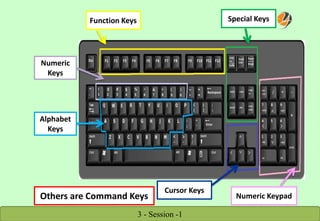
Function Keys Special Keys
Numeric
Keys
Alphabet
Keys
Cursor Keys
Numeric KeypadOthers are Command Keys
4 - Session -1
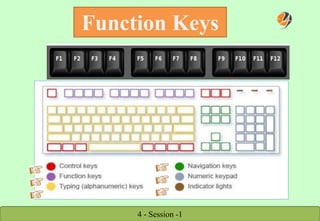
Function Keys
5 - Session -1
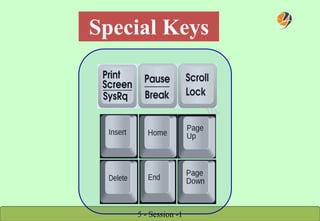
Special Keys
6 - Session -1
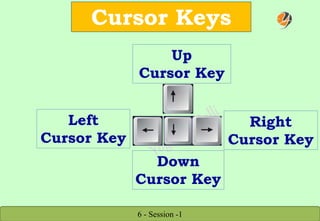
Up
Cursor Key
Down
Cursor Key
Left
Cursor Key
Right
Cursor Key
Cursor Keys
7 - Session -1
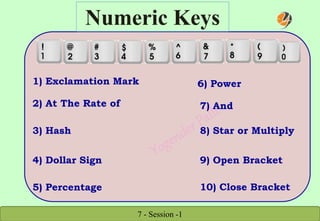
Numeric Keys
3) Hash
4) Dollar Sign
5) Percentage
1) Exclamation Mark
2) At The Rate of
8) Star or Multiply
9) Open Bracket
6) Power
7) And
10) Close Bracket
8 - Session -1
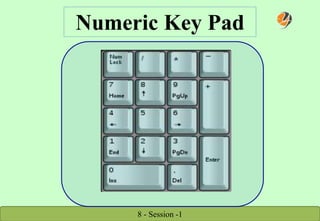
Numeric Key Pad
9 - Session -1
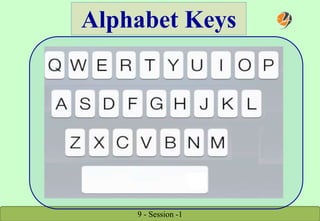
Alphabet Keys
10 - Session -1
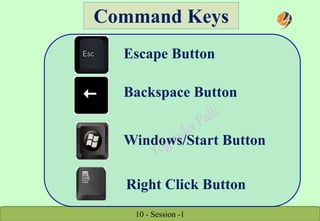
Command Keys
Escape Button
Backspace Button
Windows/Start Button
Right Click Button
11 - Session -1
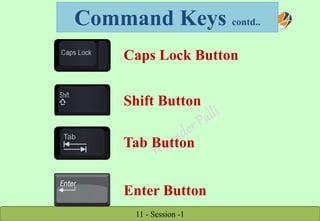
Command Keys contd..
Shift Button
Tab Button
Caps Lock Button
Enter Button
12 - Session -1
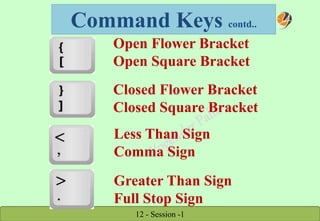
Command Keys contd..
Open Flower Bracket
Open Square Bracket
Closed Flower Bracket
Closed Square Bracket
Less Than Sign
Comma Sign
Greater Than Sign
Full Stop Sign
13 - Session -1
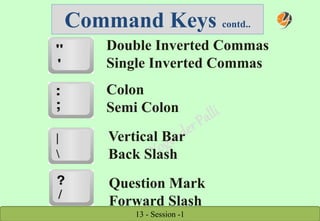
Command Keys contd..
Double Inverted Commas
Single Inverted Commas
Colon
Semi Colon
Vertical Bar
Back Slash
Question Mark
Forward Slash
14 - Session -1
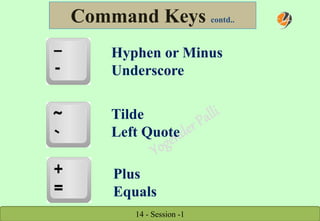
Command Keys contd..
Hyphen or Minus
Underscore
Tilde
Left Quote
Plus
Equals
15 - Session -1
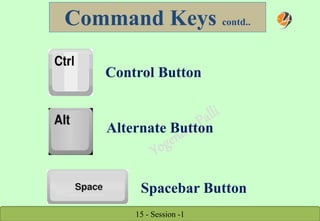
Command Keys contd..
Alternate Button
Spacebar Button
Control Button
16 - Session -1
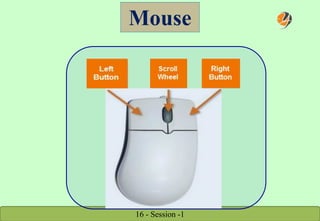
Mouse
17 - Session -1
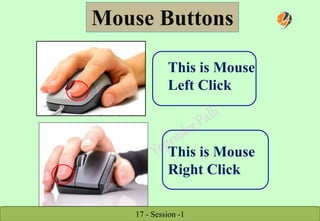
Mouse Buttons
This is Mouse
Left Click
This is Mouse
Right Click
18 - Session -1
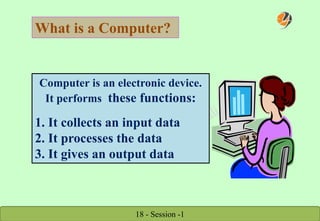
What is a Computer?
Computer is an electronic device.
It performs these functions:
1. It collects an input data
2. It processes the data
3. It gives an output data
19 - Session -1
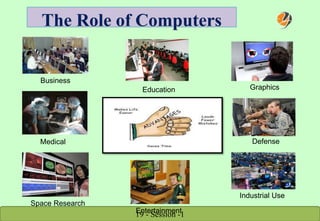
The Role of Computers
Business
Medical
Space Research
Education Graphics
Entertainment
Defense
Industrial Use
20 - Session -1
1. Input Devices (Keyboard, Mouse, etc.)
2. Output Devices (Monitor, Printer, Speakers, etc.)
3. Central Processing Unit (CPU) and Memory
4. Mother Board (Circuit Board)
5. Expansion Cards (Video Card, Sound Card)
6. Hard Drive Ports & Connections (USB, Fire wire, etc.)
HARDWARE & SOFTWARE
21 - Session -1
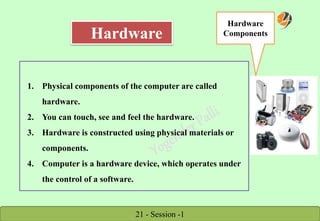
1. Physical components of the computer are called
hardware.
2. You can touch, see and feel the hardware.
3. Hardware is constructed using physical materials or
components.
4. Computer is a hardware device, which operates under
the control of a software.
Hardware
Hardware
Components
22 - Session -1
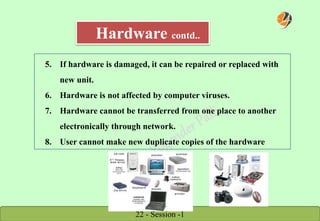
5. If hardware is damaged, it can be repaired or replaced with
new unit.
6. Hardware is not affected by computer viruses.
7. Hardware cannot be transferred from one place to another
electronically through network.
8. User cannot make new duplicate copies of the hardware
Hardware contd..
23 - Session -1
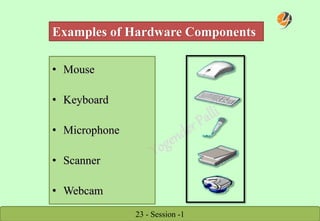
• Mouse
• Keyboard
• Microphone
• Scanner
• Webcam
Examples of Hardware Components
24 - Session -1
Software
1. A set of instructions given to the computer is called “Software”.
2. You cannot touch and feel Software.
3. Software is developed by writing instructions in a programming Language
4. The operations of computer are controlled through software.
5. If software is damaged or corrupted, its backup copy can be reinstalled.
6. Software is affected by computer viruses.
7. User can make new copies of the software.
25 - Session -1
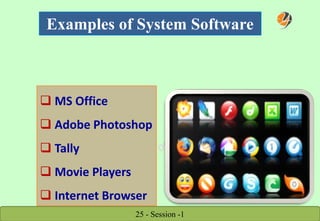
Examples of System Software
 MS Office
 Adobe Photoshop
 Tally
 Movie Players
 Internet Browser
26 - Session -1
Classification of Computers
Computers can be classified based on size, cost, storage
capacity, speed and nature of operations they can perform.
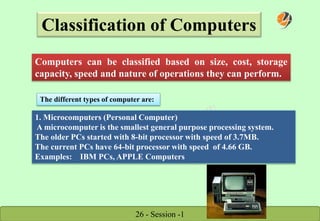
1. Microcomputers (Personal Computer)
A microcomputer is the smallest general purpose processing system.
The older PCs started with 8-bit processor with speed of 3.7MB.
The current PCs have 64-bit processor with speed of 4.66 GB.
Examples: IBM PCs, APPLE Computers
The different types of computer are:
27 - Session -1
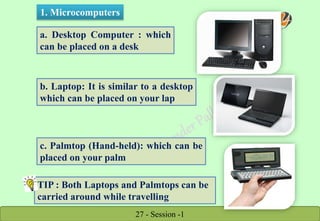
b. Laptop: It is similar to a desktop
which can be placed on your lap
a. Desktop Computer : which
can be placed on a desk
c. Palmtop (Hand-held): which can be
placed on your palm
TIP : Both Laptops and Palmtops can be
carried around while travelling
1. Microcomputers
28 - Session -1
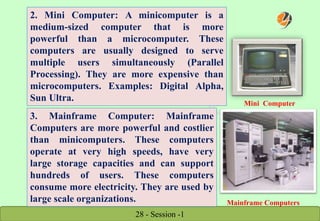
2. Mini Computer: A minicomputer is a
medium-sized computer that is more
powerful than a microcomputer. These
computers are usually designed to serve
multiple users simultaneously (Parallel
Processing). They are more expensive than
microcomputers. Examples: Digital Alpha,
Sun Ultra.
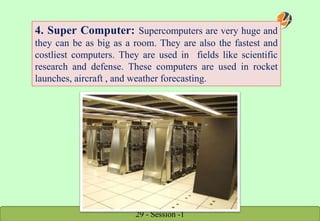
Mainframe Computers
Mini Computer
3. Mainframe Computer: Mainframe
Computers are more powerful and costlier
than minicomputers. These computers
operate at very high speeds, have very
large storage capacities and can support
hundreds of users. These computers
consume more electricity. They are used by
large scale organizations.
29 - Session -1
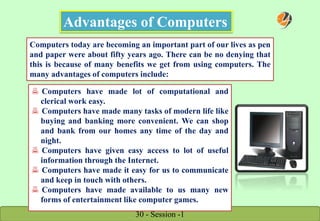
4. Super Computer: Supercomputers are very huge and
they can be as big as a room. They are also the fastest and
costliest computers. They are used in fields like scientific
research and defense. These computers are used in rocket
launches, aircraft , and weather forecasting.
30 - Session -1
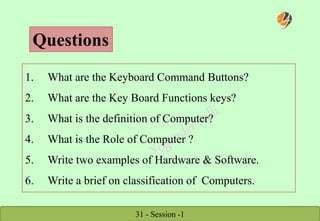
Computers today are becoming an important part of our lives as pen
and paper were about fifty years ago. There can be no denying that
this is because of many benefits we get from using computers. The
many advantages of computers include:
Advantages of Computers
 Computers have made lot of computational and
clerical work easy.
 Computers have made many tasks of modern life like
buying and banking more convenient. We can shop
and bank from our homes any time of the day and
night.
 Computers have given easy access to lot of useful
information through the Internet.
 Computers have made it easy for us to communicate
and keep in touch with others.
 Computers have made available to us many new
forms of entertainment like computer games.
31 - Session -1
Questions
1. What are the Keyboard Command Buttons?
2. What are the Key Board Functions keys?
3. What is the definition of Computer?
4. What is the Role of Computer ?
5. Write two examples of Hardware & Software.
6. Write a brief on classification of Computers.

Session 1 keyboard & mouse

  • 1.
    1 - Session-1 Session-1 Keyboard & Mouse
  • 2.
    2 - Session-1 Keyboard & Mouse
  • 3.
    3 - Session-1 Function Keys Special Keys Numeric Keys Alphabet Keys Cursor Keys Numeric KeypadOthers are Command Keys
  • 4.
    4 - Session-1 Function Keys
  • 5.
    5 - Session-1 Special Keys
  • 6.
    6 - Session-1 Up Cursor Key Down Cursor Key Left Cursor Key Right Cursor Key Cursor Keys
  • 7.
    7 - Session-1 Numeric Keys 3) Hash 4) Dollar Sign 5) Percentage 1) Exclamation Mark 2) At The Rate of 8) Star or Multiply 9) Open Bracket 6) Power 7) And 10) Close Bracket
  • 8.
    8 - Session-1 Numeric Key Pad
  • 9.
    9 - Session-1 Alphabet Keys
  • 10.
    10 - Session-1 Command Keys Escape Button Backspace Button Windows/Start Button Right Click Button
  • 11.
    11 - Session-1 Command Keys contd.. Shift Button Tab Button Caps Lock Button Enter Button
  • 12.
    12 - Session-1 Command Keys contd.. Open Flower Bracket Open Square Bracket Closed Flower Bracket Closed Square Bracket Less Than Sign Comma Sign Greater Than Sign Full Stop Sign
  • 13.
    13 - Session-1 Command Keys contd.. Double Inverted Commas Single Inverted Commas Colon Semi Colon Vertical Bar Back Slash Question Mark Forward Slash
  • 14.
    14 - Session-1 Command Keys contd.. Hyphen or Minus Underscore Tilde Left Quote Plus Equals
  • 15.
    15 - Session-1 Command Keys contd.. Alternate Button Spacebar Button Control Button
  • 16.
    16 - Session-1 Mouse
  • 17.
    17 - Session-1 Mouse Buttons This is Mouse Left Click This is Mouse Right Click
  • 18.
    18 - Session-1 What is a Computer? Computer is an electronic device. It performs these functions: 1. It collects an input data 2. It processes the data 3. It gives an output data
  • 19.
    19 - Session-1 The Role of Computers Business Medical Space Research Education Graphics Entertainment Defense Industrial Use
  • 20.
    20 - Session-1 1. Input Devices (Keyboard, Mouse, etc.) 2. Output Devices (Monitor, Printer, Speakers, etc.) 3. Central Processing Unit (CPU) and Memory 4. Mother Board (Circuit Board) 5. Expansion Cards (Video Card, Sound Card) 6. Hard Drive Ports & Connections (USB, Fire wire, etc.) HARDWARE & SOFTWARE
  • 21.
    21 - Session-1 1. Physical components of the computer are called hardware. 2. You can touch, see and feel the hardware. 3. Hardware is constructed using physical materials or components. 4. Computer is a hardware device, which operates under the control of a software. Hardware Hardware Components
  • 22.
    22 - Session-1 5. If hardware is damaged, it can be repaired or replaced with new unit. 6. Hardware is not affected by computer viruses. 7. Hardware cannot be transferred from one place to another electronically through network. 8. User cannot make new duplicate copies of the hardware Hardware contd..
  • 23.
    23 - Session-1 • Mouse • Keyboard • Microphone • Scanner • Webcam Examples of Hardware Components
  • 24.
    24 - Session-1 Software 1. A set of instructions given to the computer is called “Software”. 2. You cannot touch and feel Software. 3. Software is developed by writing instructions in a programming Language 4. The operations of computer are controlled through software. 5. If software is damaged or corrupted, its backup copy can be reinstalled. 6. Software is affected by computer viruses. 7. User can make new copies of the software.
  • 25.
    25 - Session-1 Examples of System Software  MS Office  Adobe Photoshop  Tally  Movie Players  Internet Browser
  • 26.
    26 - Session-1 Classification of Computers Computers can be classified based on size, cost, storage capacity, speed and nature of operations they can perform. 1. Microcomputers (Personal Computer) A microcomputer is the smallest general purpose processing system. The older PCs started with 8-bit processor with speed of 3.7MB. The current PCs have 64-bit processor with speed of 4.66 GB. Examples: IBM PCs, APPLE Computers The different types of computer are:
  • 27.
    27 - Session-1 b. Laptop: It is similar to a desktop which can be placed on your lap a. Desktop Computer : which can be placed on a desk c. Palmtop (Hand-held): which can be placed on your palm TIP : Both Laptops and Palmtops can be carried around while travelling 1. Microcomputers
  • 28.
    28 - Session-1 2. Mini Computer: A minicomputer is a medium-sized computer that is more powerful than a microcomputer. These computers are usually designed to serve multiple users simultaneously (Parallel Processing). They are more expensive than microcomputers. Examples: Digital Alpha, Sun Ultra. Mainframe Computers Mini Computer 3. Mainframe Computer: Mainframe Computers are more powerful and costlier than minicomputers. These computers operate at very high speeds, have very large storage capacities and can support hundreds of users. These computers consume more electricity. They are used by large scale organizations.
  • 29.
    29 - Session-1 4. Super Computer: Supercomputers are very huge and they can be as big as a room. They are also the fastest and costliest computers. They are used in fields like scientific research and defense. These computers are used in rocket launches, aircraft , and weather forecasting.
  • 30.
    30 - Session-1 Computers today are becoming an important part of our lives as pen and paper were about fifty years ago. There can be no denying that this is because of many benefits we get from using computers. The many advantages of computers include: Advantages of Computers  Computers have made lot of computational and clerical work easy.  Computers have made many tasks of modern life like buying and banking more convenient. We can shop and bank from our homes any time of the day and night.  Computers have given easy access to lot of useful information through the Internet.  Computers have made it easy for us to communicate and keep in touch with others.  Computers have made available to us many new forms of entertainment like computer games.
  • 31.
    31 - Session-1 Questions 1. What are the Keyboard Command Buttons? 2. What are the Key Board Functions keys? 3. What is the definition of Computer? 4. What is the Role of Computer ? 5. Write two examples of Hardware & Software. 6. Write a brief on classification of Computers.