CONTENTS
• Project Flow
• Introduction
• UART Design
• Baud Rate Generator
• Transmitter
• Receiver
• Block diagram of UART
• Simulation Result
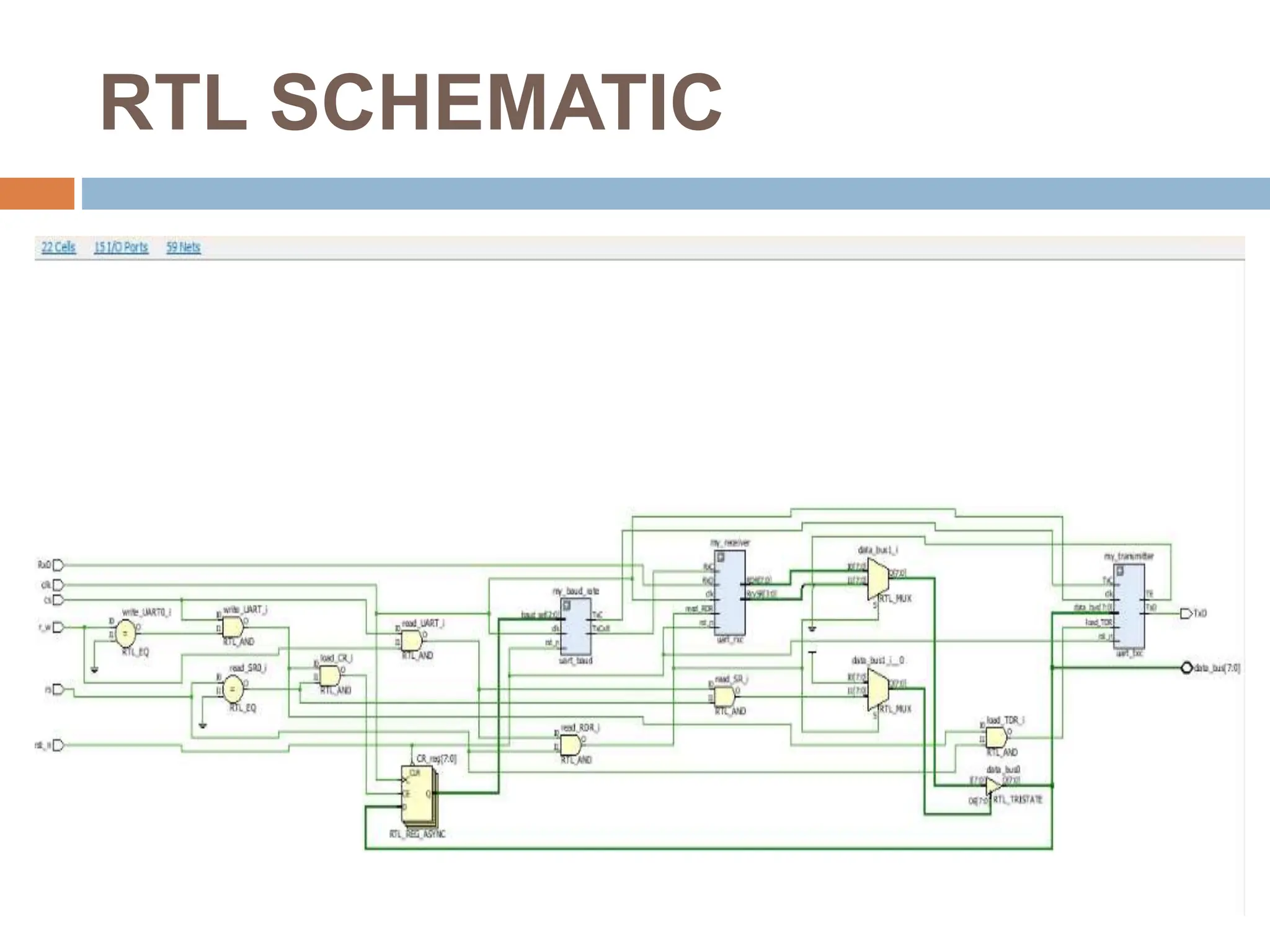
• RTL Schematic
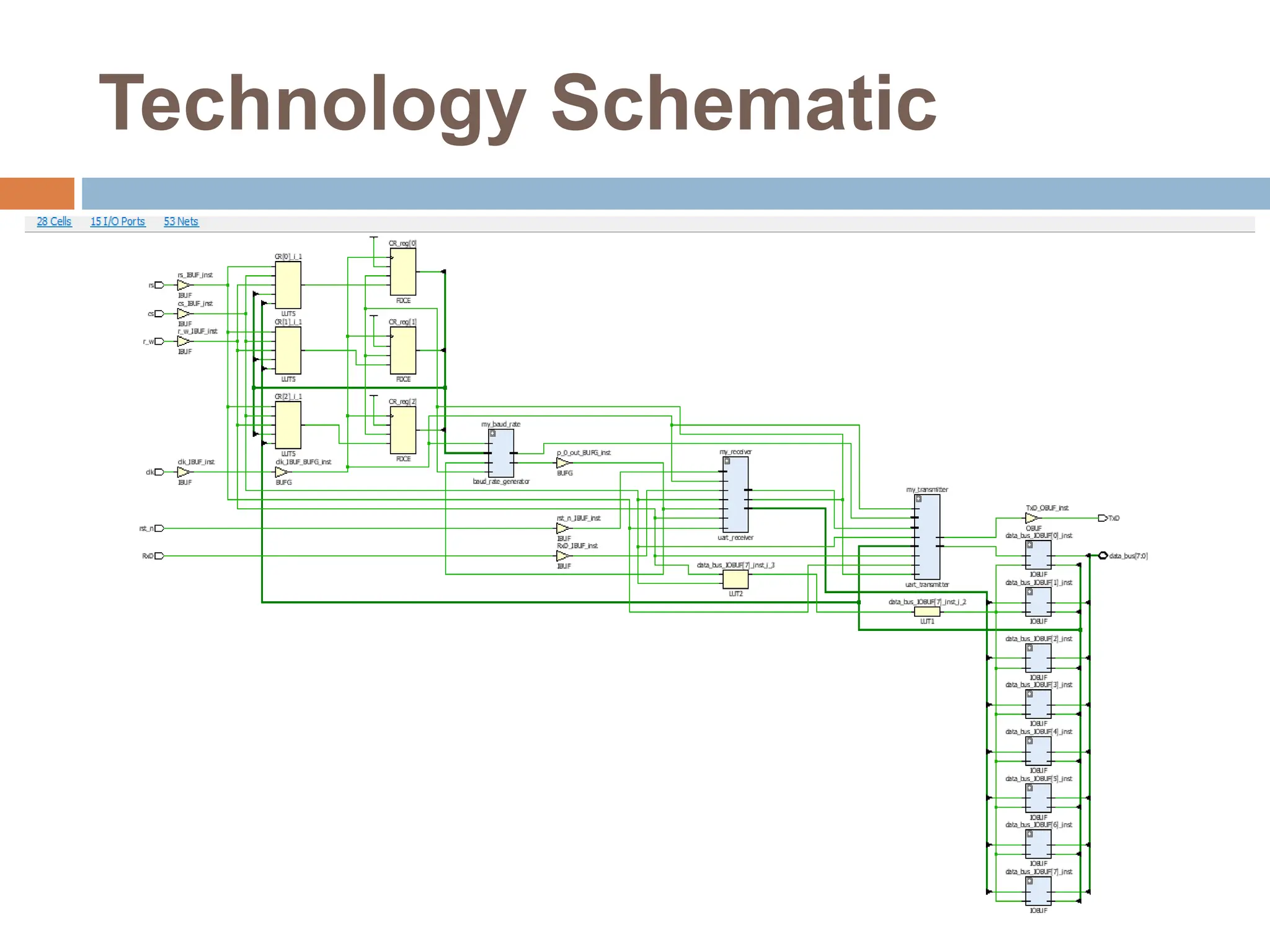
• Technology Schematic
• Reports
• Conclusion
• Future Work
• References
Project Flow
 Literature Survey.
 Design of Baud rate generator.
 Design of receiver and transmitter.
 Debugging of UART.
 Simulation.
 Synthesis.
 Verification.
 Implementation.
Introduction
 UART acronym for Universal Asynchronous
Receiver and Transmitter.
 Asynchronous Serial communication
protocol.
 Full Duplex communication.
 Used between the slow and the fast
peripheral devices.
Contd..
 Converts the bytes it gets from the computer
along parallel circuits to a single serial bit
stream for outbound transmission.
 For inbound transmission, converts the serial
bit stream to the bytes that the system
handles.
 Adds a parity bit after selection in outbound
transmissions, checks the parity of incoming
bytes (if selected) and rejects the parity bit.
UART Design
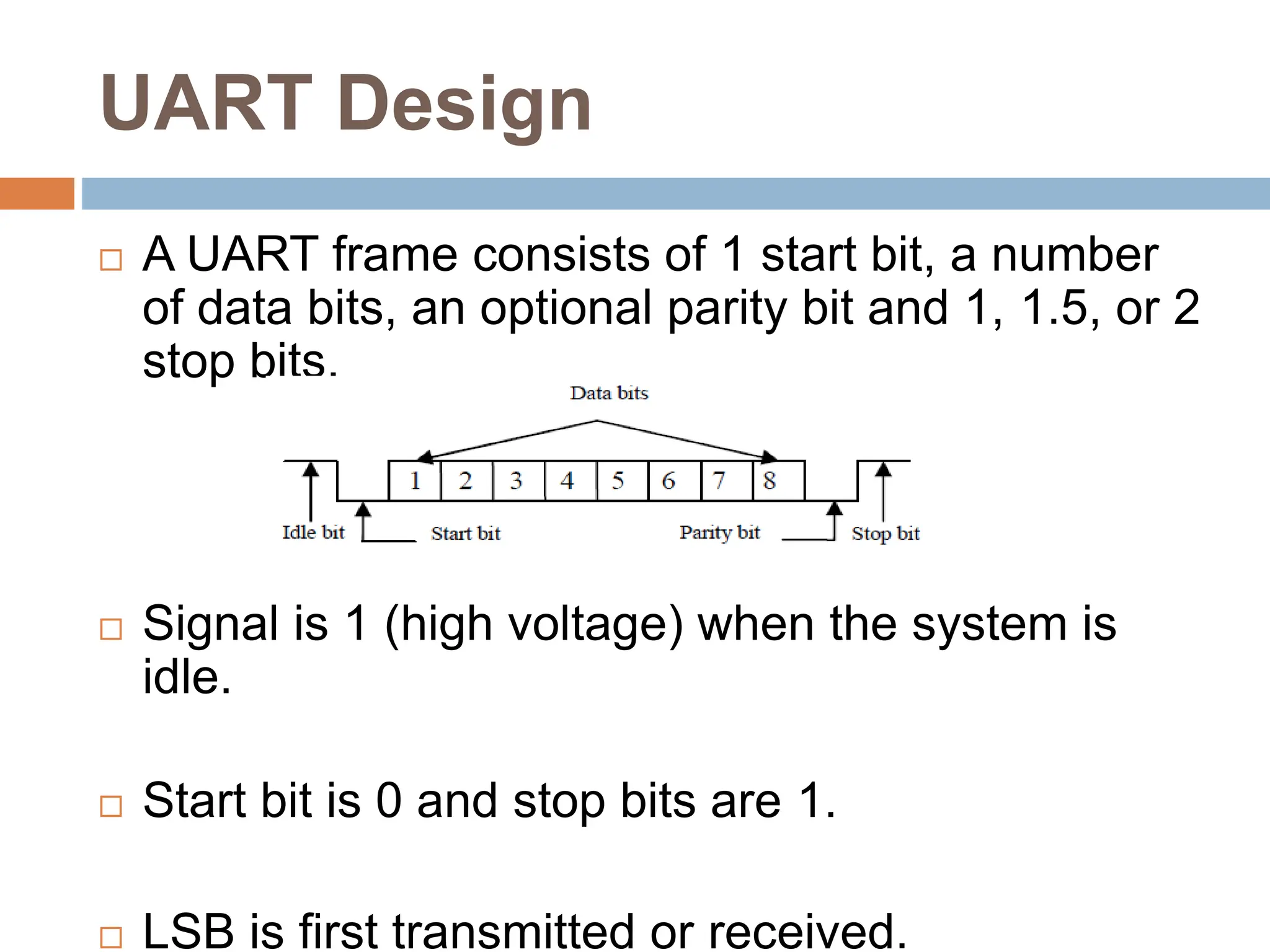
 A UART frame consists of 1 start bit, a number
of data bits, an optional parity bit and 1, 1.5, or 2
stop bits.
 Signal is 1 (high voltage) when the system is
idle.
 Start bit is 0 and stop bits are 1.
 LSB is first transmitted or received.
Contd..
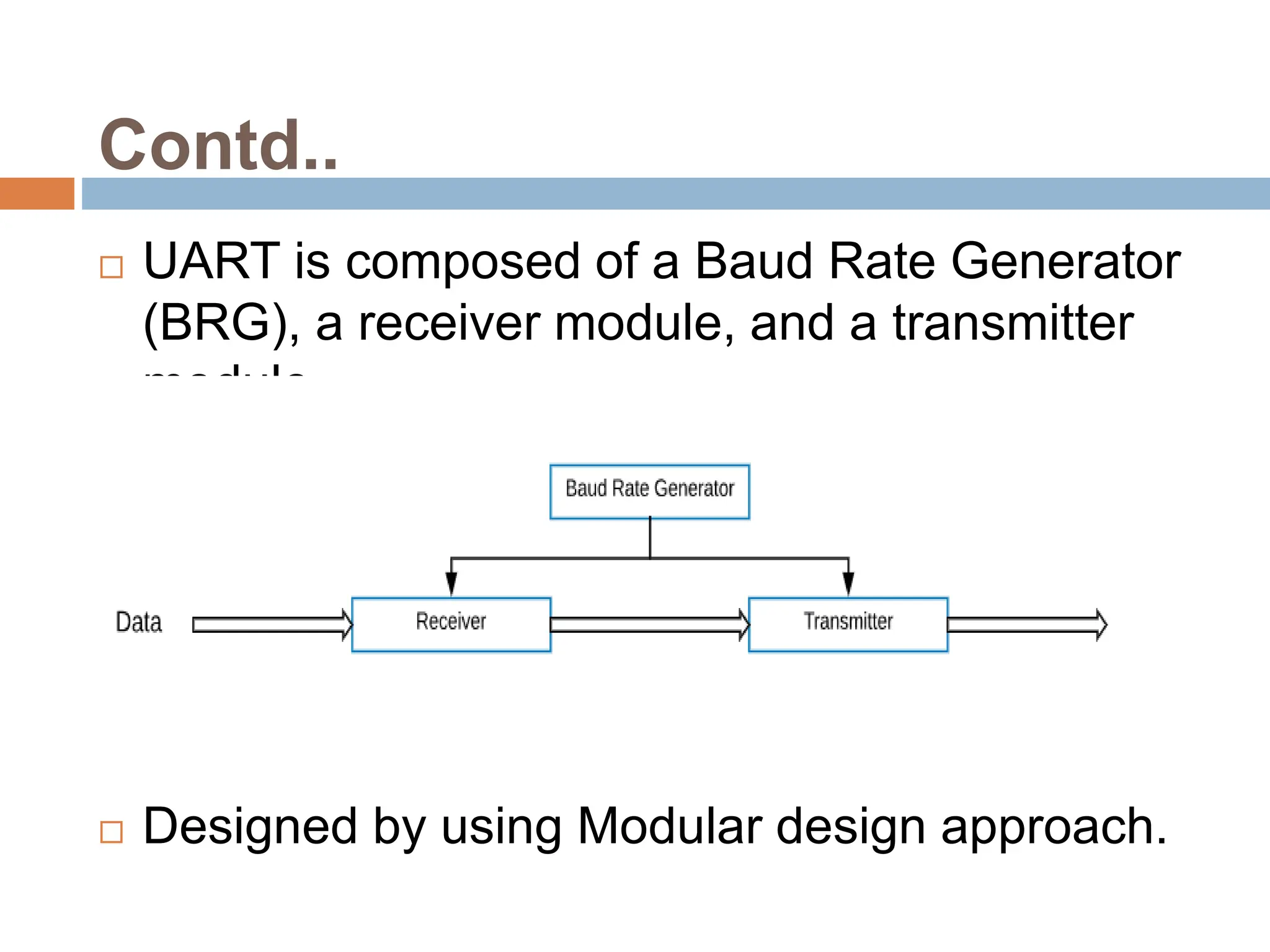
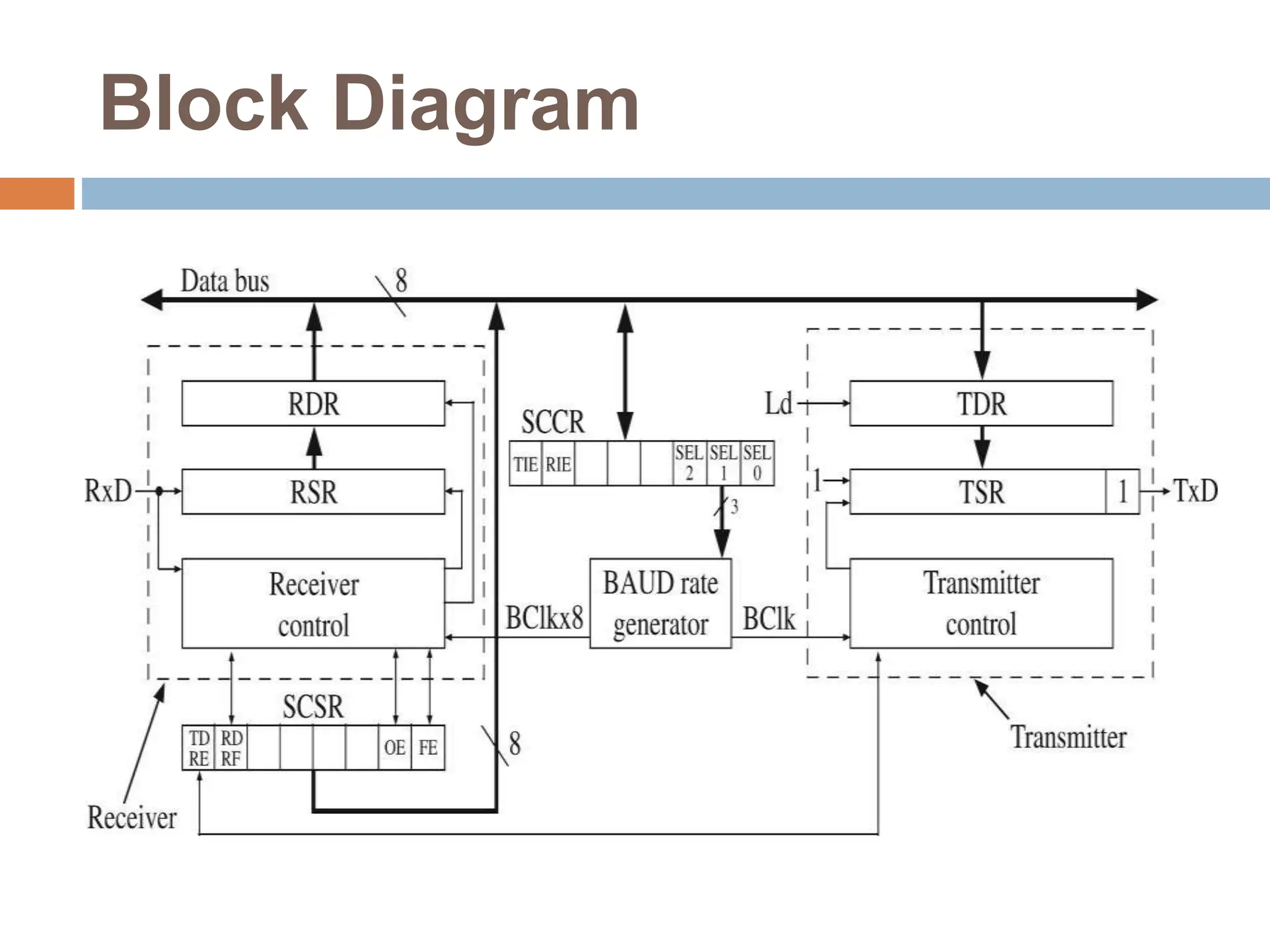
 UART is composed of a Baud Rate Generator
(BRG), a receiver module, and a transmitter
module
 Designed by using Modular design approach.
Baud Rate Generator
 Baud rate: The number of bits transmitted per
second. frequently used baud rate: 9600,
19,200.
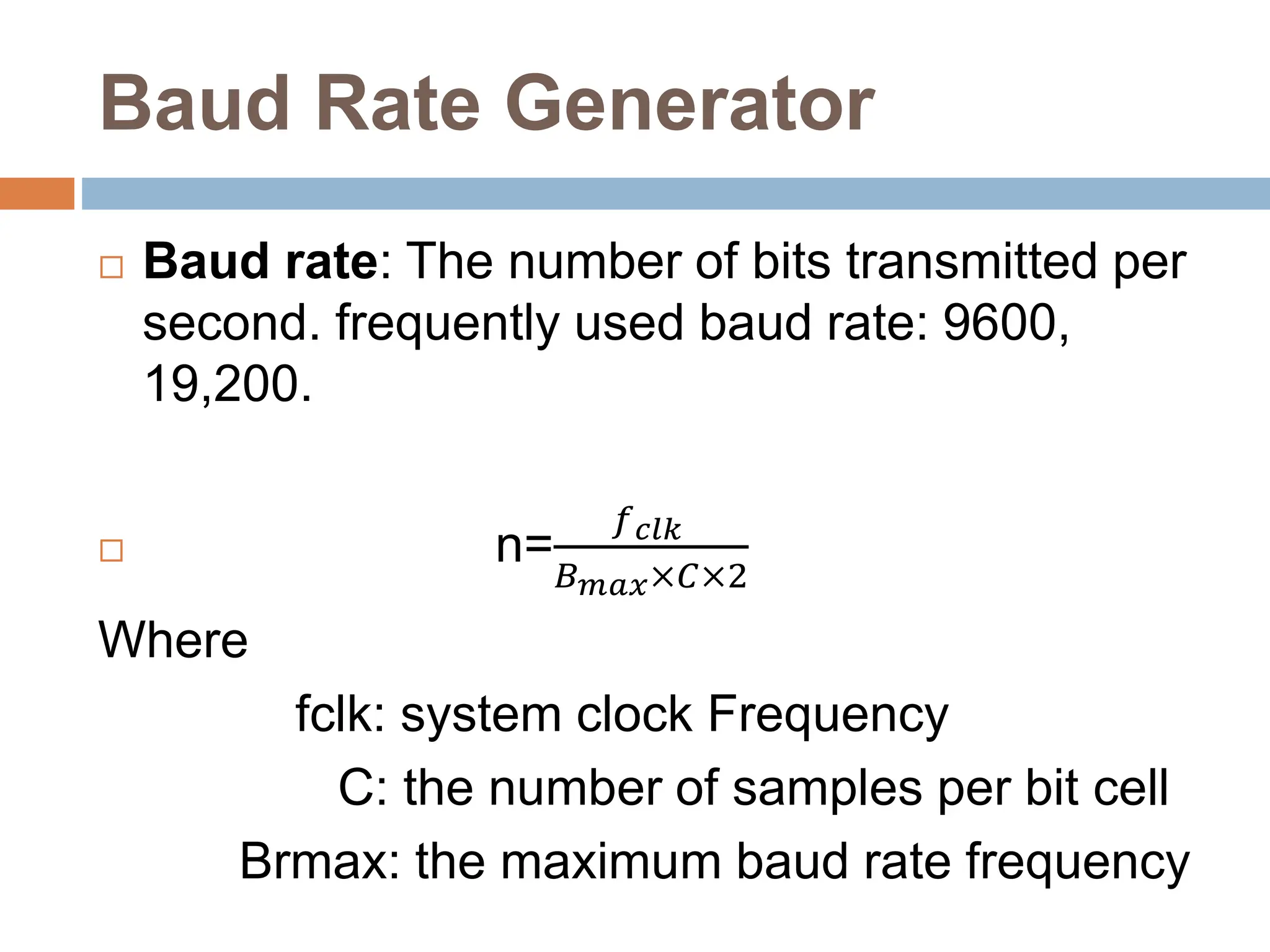
 n=
𝑓𝑐𝑙𝑘
𝐵𝑚𝑎𝑥×𝐶×2
Where
fclk: system clock Frequency
C: the number of samples per bit cell
Brmax: the maximum baud rate frequency
Contd..
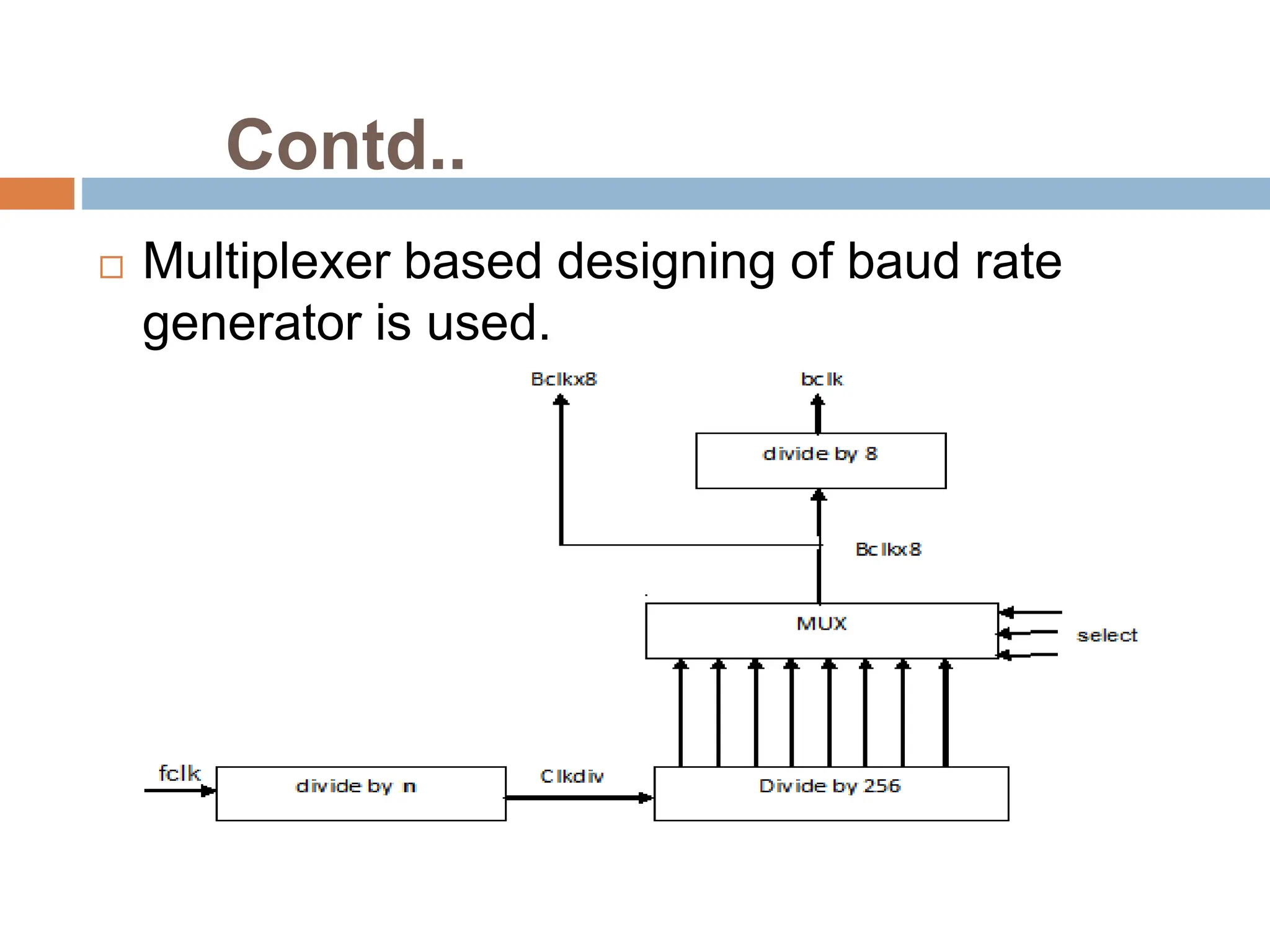
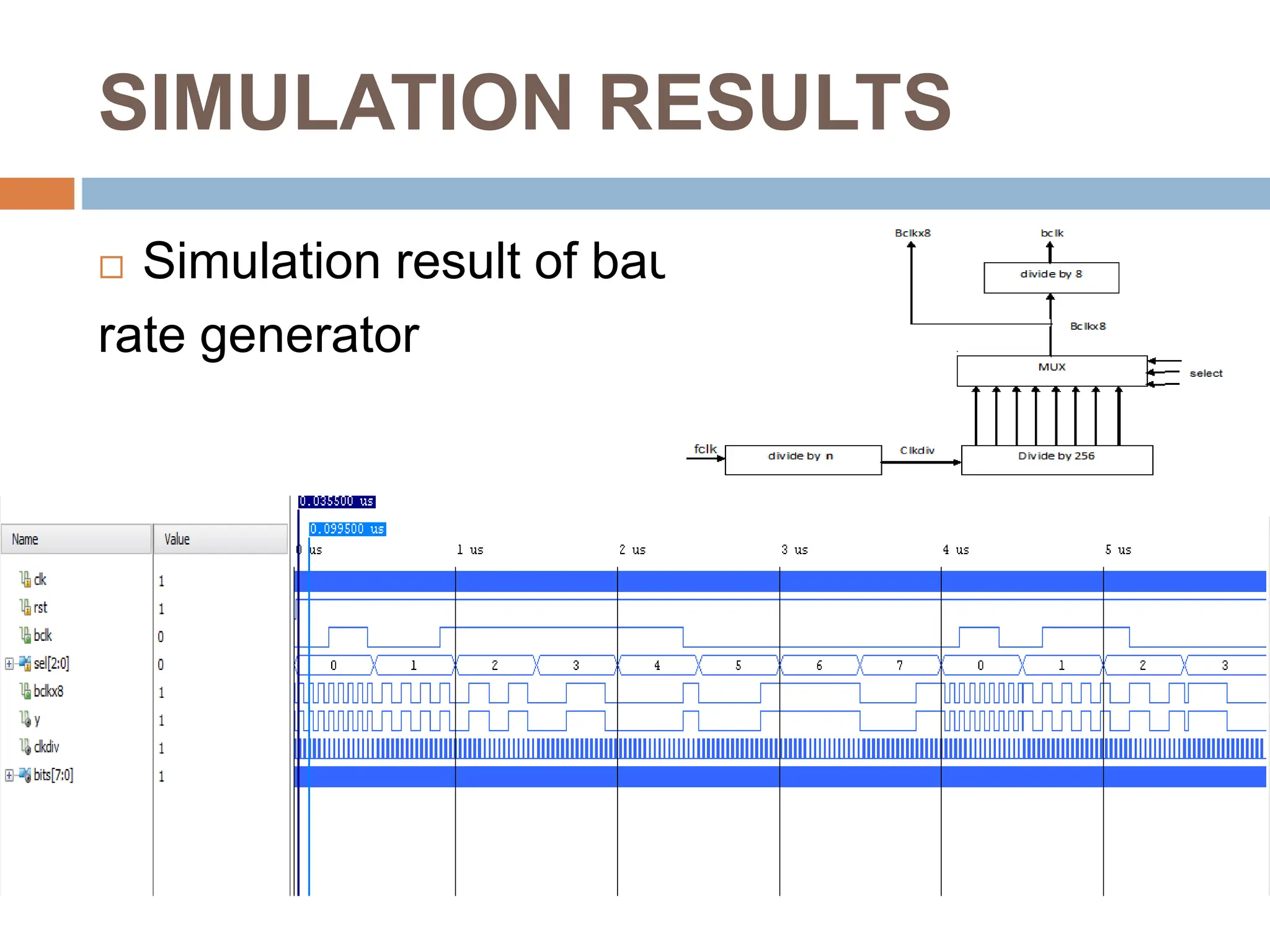
 Multiplexer based designing of baud rate
generator is used.
RTL Code of Baud Rate
generator
module clk_div(input clk,rst,
output q)
reg [2:0]q1;
always@(posedge clk)
begin if(!rst)
q1<=3'b001;
else
q1<={q1[0],q1[2:1]};
end
assign q=q1[0];
endmodule
module counter_8(input clk,rst,
output reg [7:0]q);
always@(posedge clk)
begin
if(!rst)
q<=8'd0;
else
q<=q+1;
end
endmodule
Clock divide by n Divide by 256
Contd..
module mux_8(input [7:0]d,
input [2:0]sel,
output reg y);
always@(d,sel)
begin case(sel)
3'b000:y=d[0];
3'b001:y=d[1];
3'b010:y=d[2];
3'b011:y=d[3];
3'b100:y=d[4];
3'b101:y=d[5];
3'b110:y=d[6];
3'b111:y=d[7];
endcase
end
endmodule
module divide_by_8(input clk,rst,
output q);
reg [2:0]count;
always@(posedge clk,negedge
rst)
begin
if(!rst)
count<=3'd0;
else
count<=count+1;
end
assign q=count[2];
endmodule
Multiplexer Divide by 8
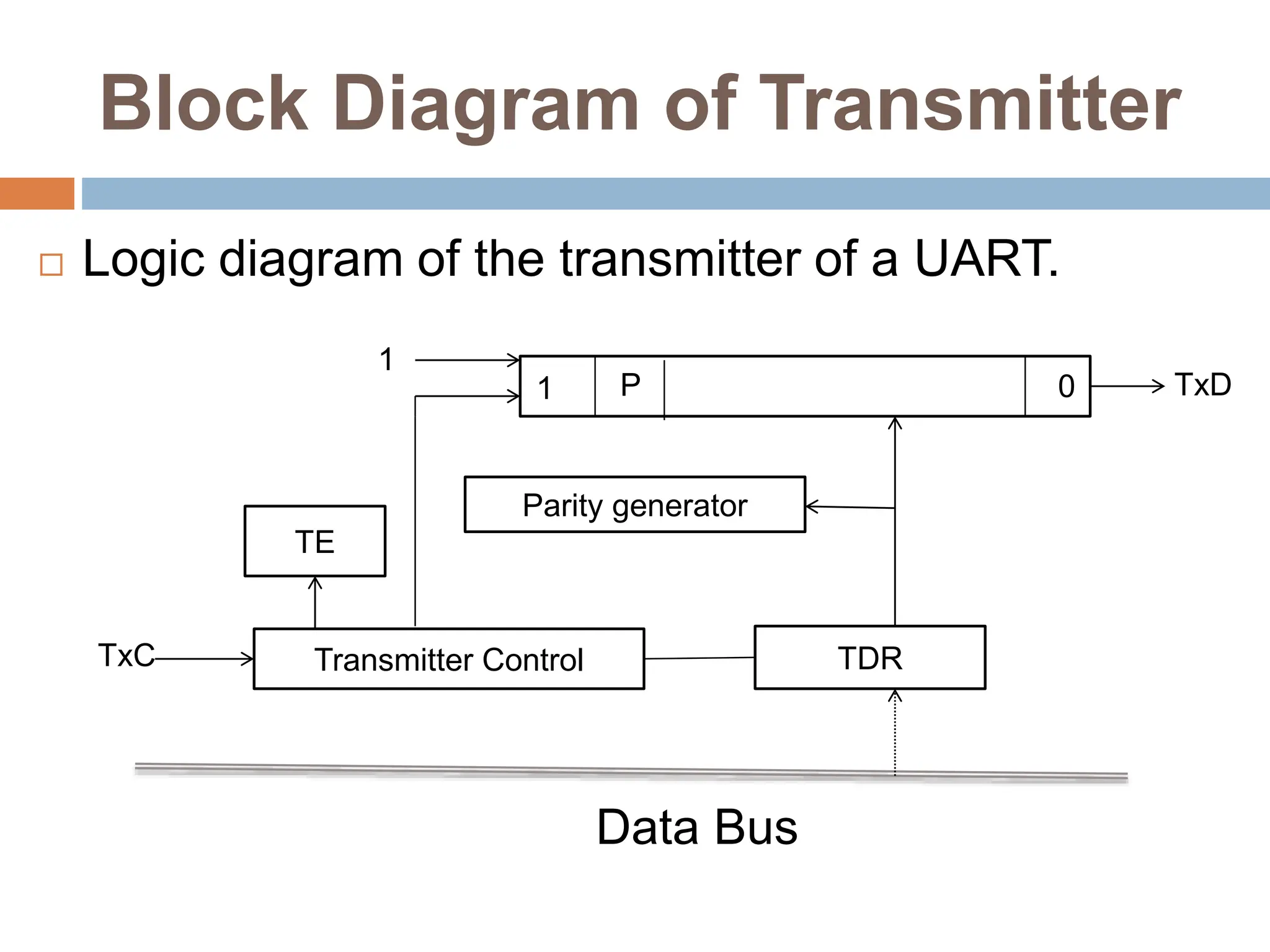
Block Diagram of Transmitter
 Logic diagram of the transmitter of a UART.
TDR
Transmitter Control
TE
Parity generator
1 P 0
1
TxD
TxC
Data Bus
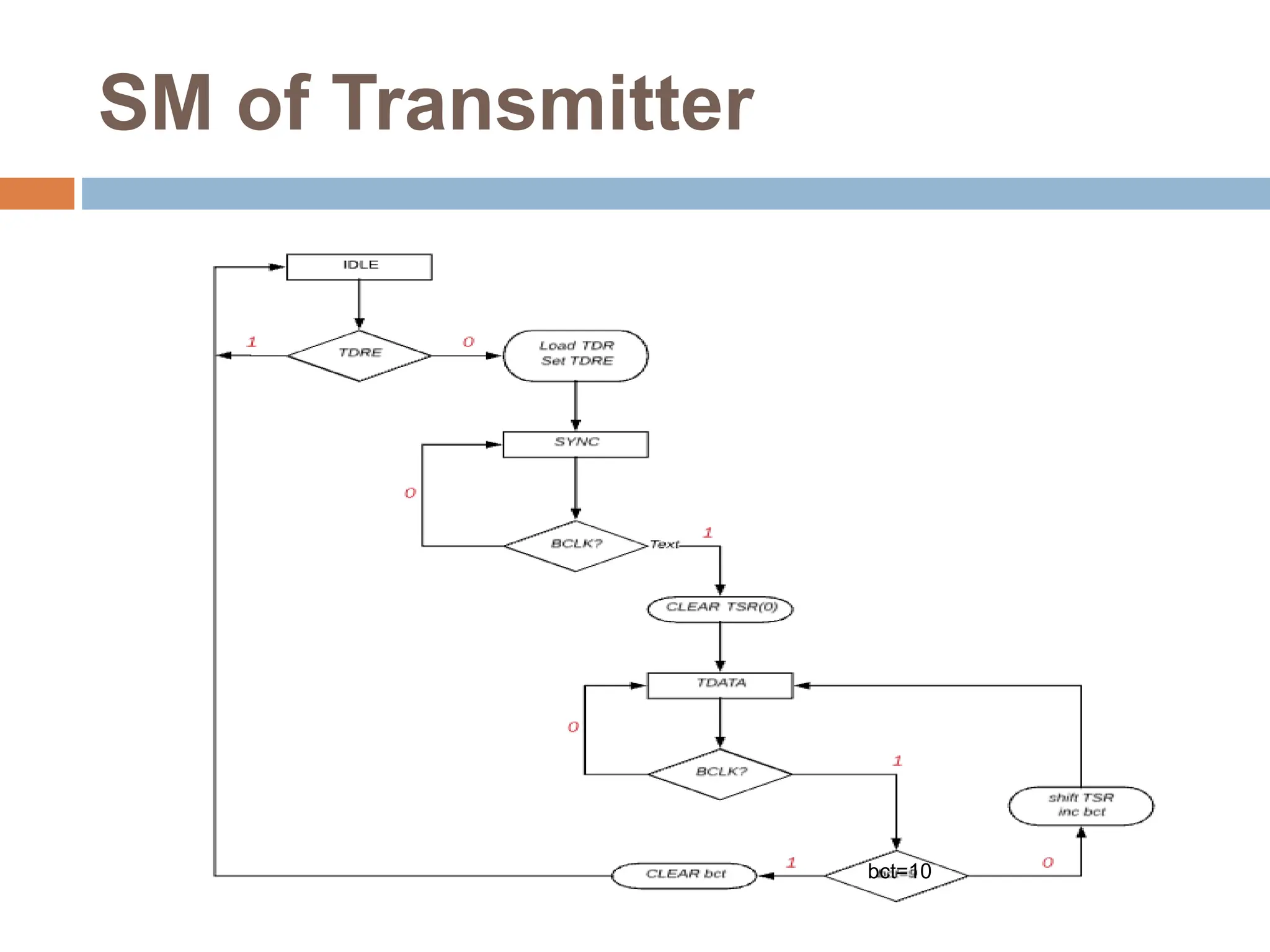
SM of Transmitter
bct=10
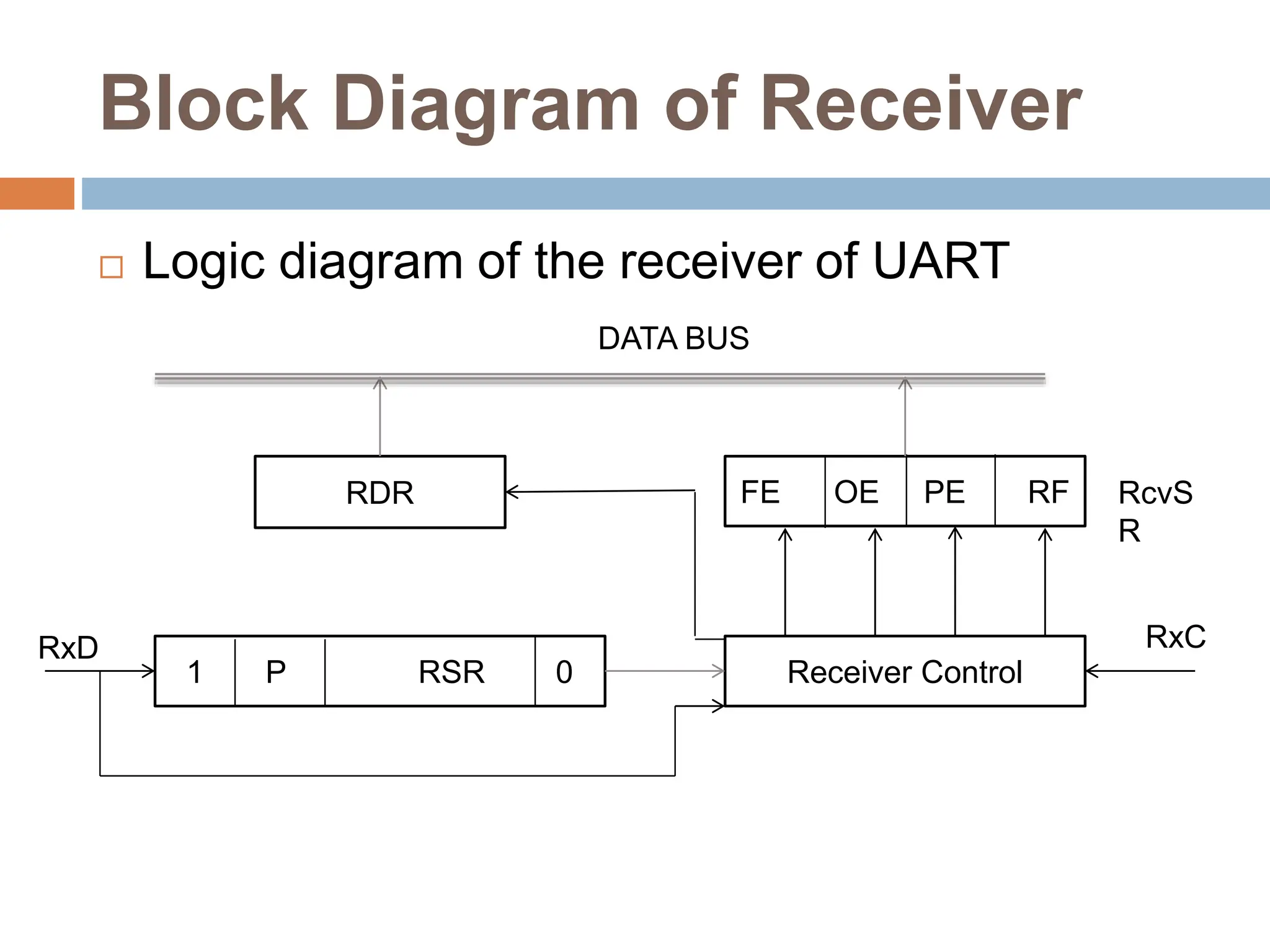
Block Diagram of Receiver
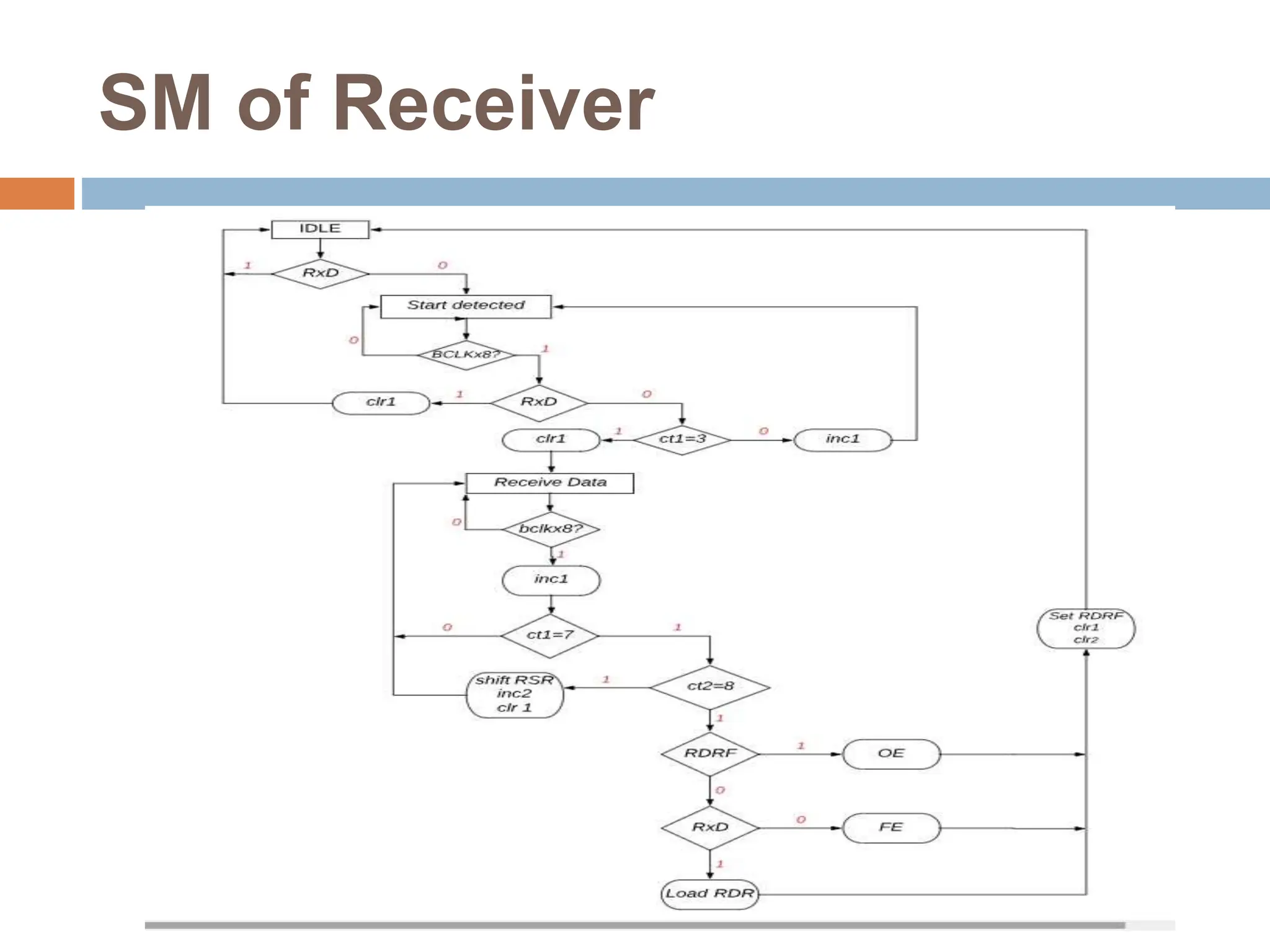
 Logic diagram of the receiver of UART
FE OE PE RF
RDR
1 P RSR 0 Receiver Control
DATA BUS
RxD RxC
RcvS
R
SM of Receiver
Block Diagram
SIMULATION RESULTS
 Simulation result of baud
rate generator
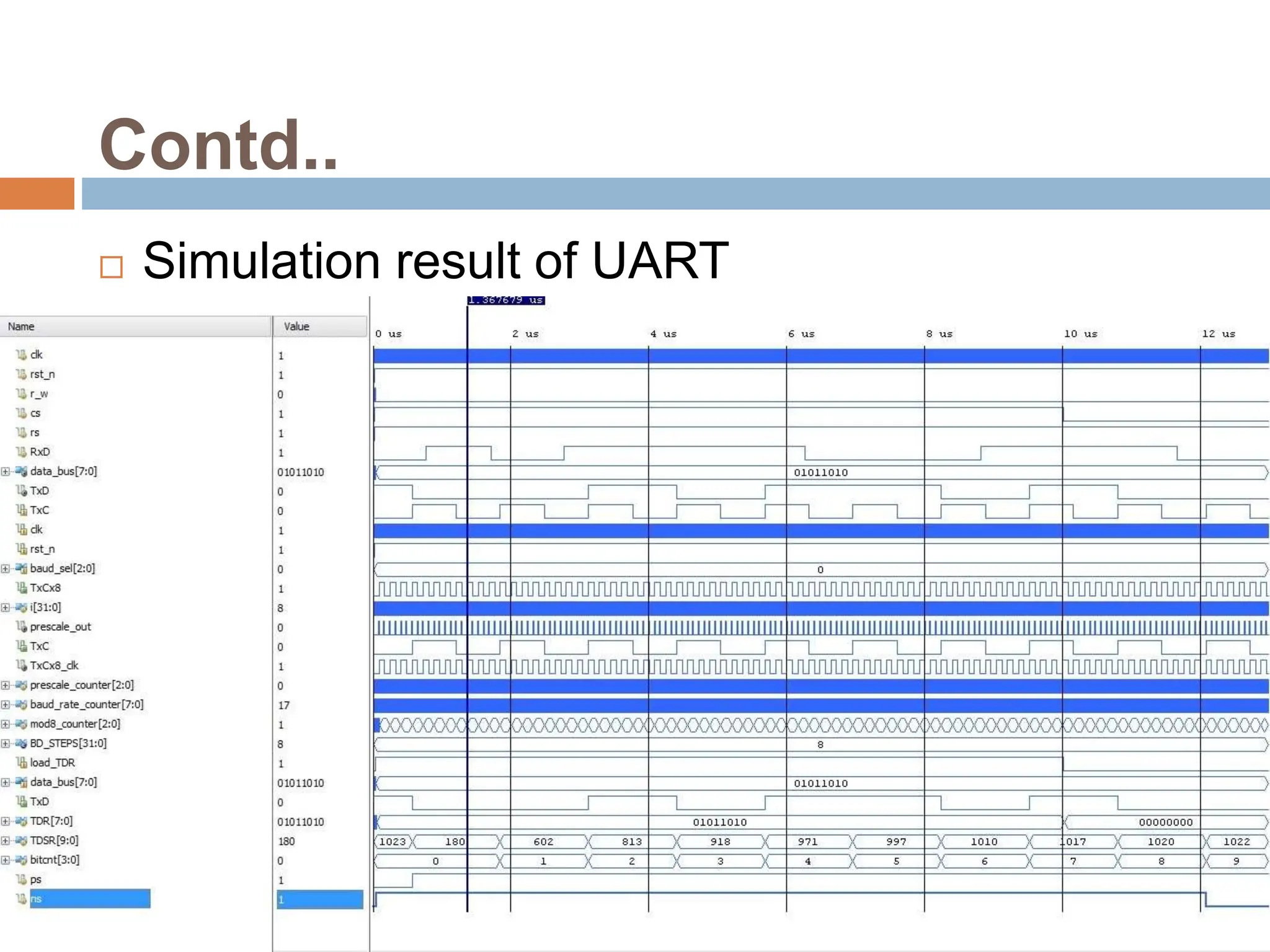
Contd..
 Simulation result of UART
RTL SCHEMATIC
Technology Schematic
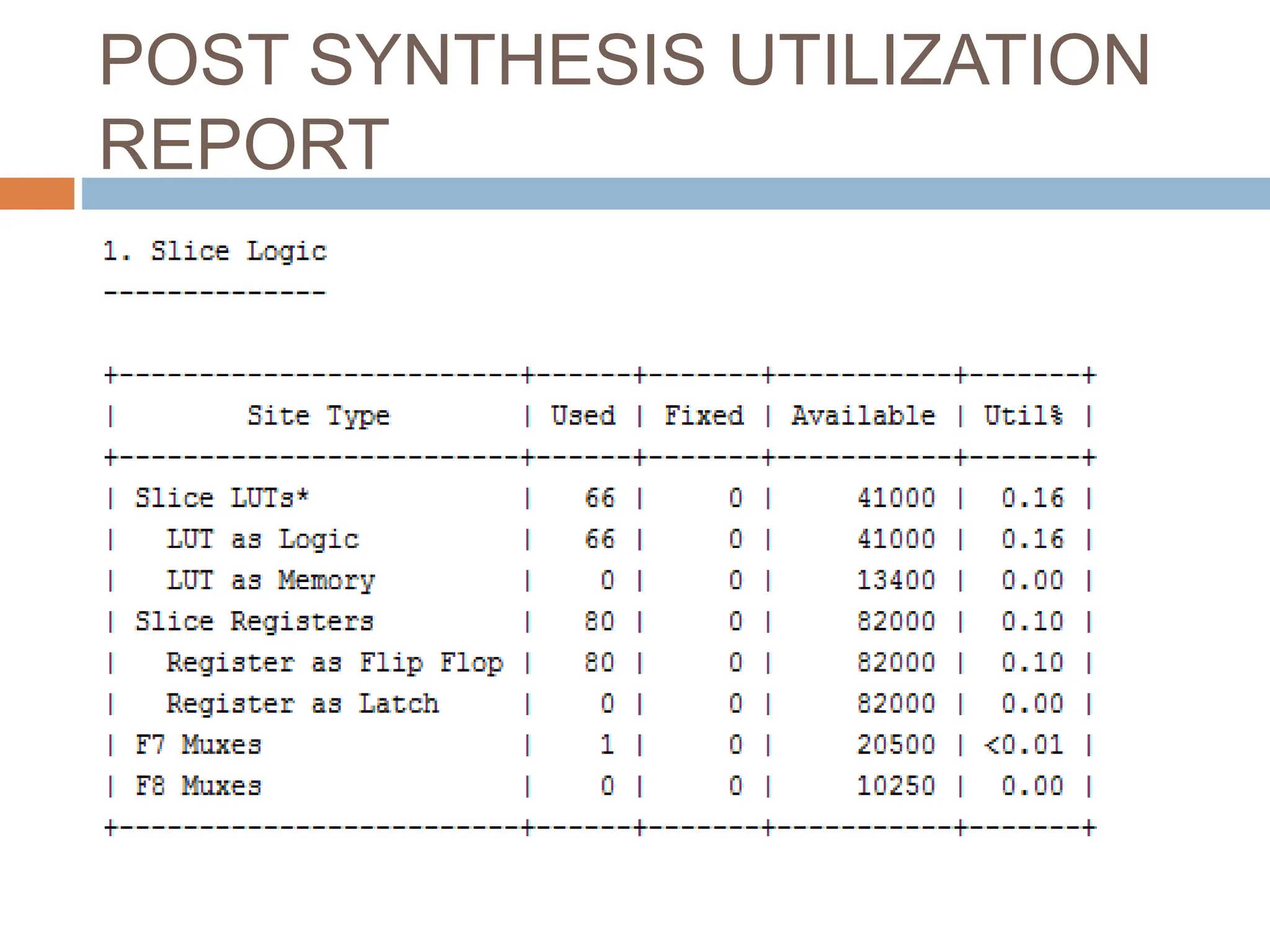
POST SYNTHESIS UTILIZATION
REPORT
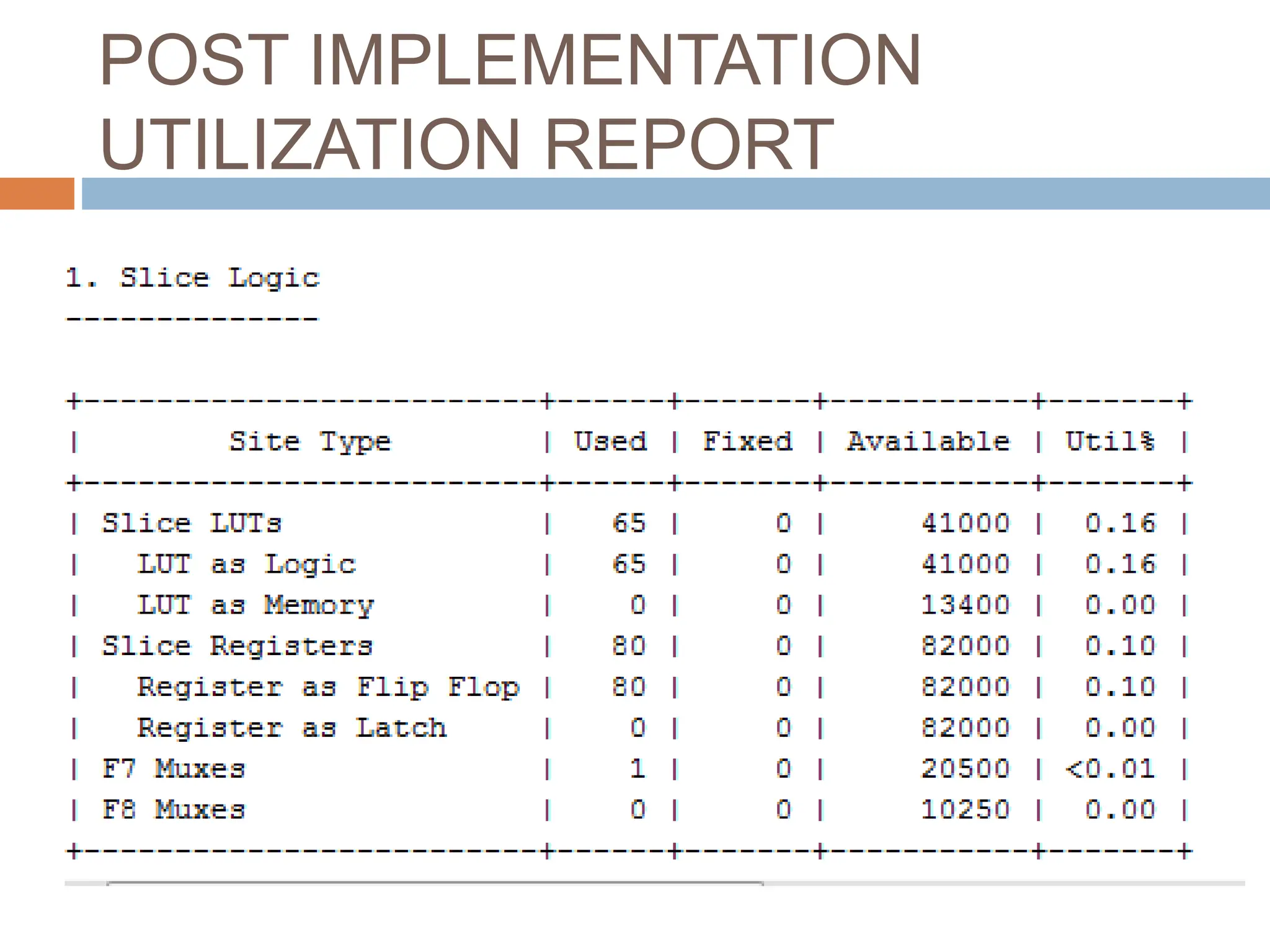
POST IMPLEMENTATION
UTILIZATION REPORT
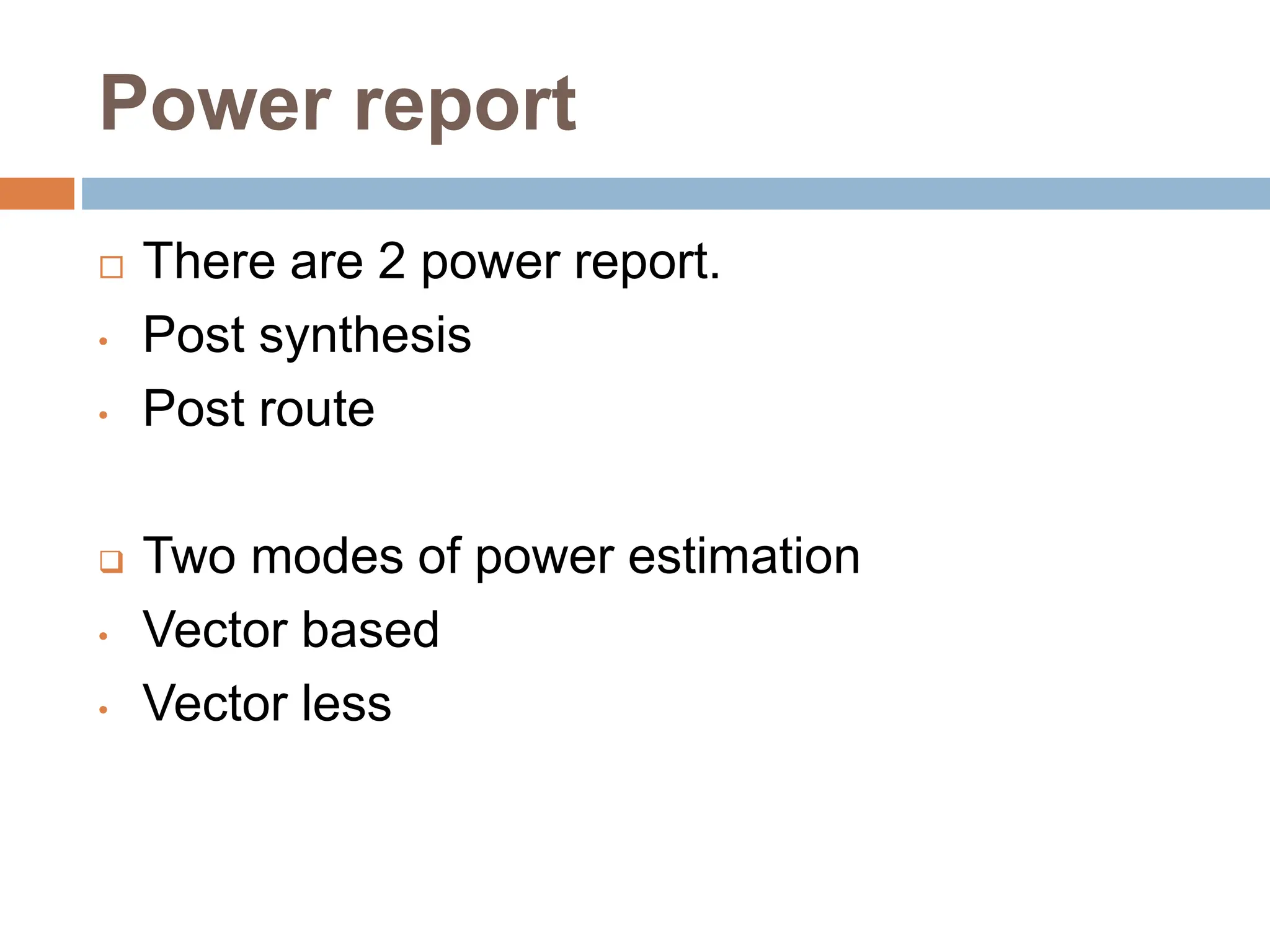
Power report
 There are 2 power report.
• Post synthesis
• Post route
 Two modes of power estimation
• Vector based
• Vector less
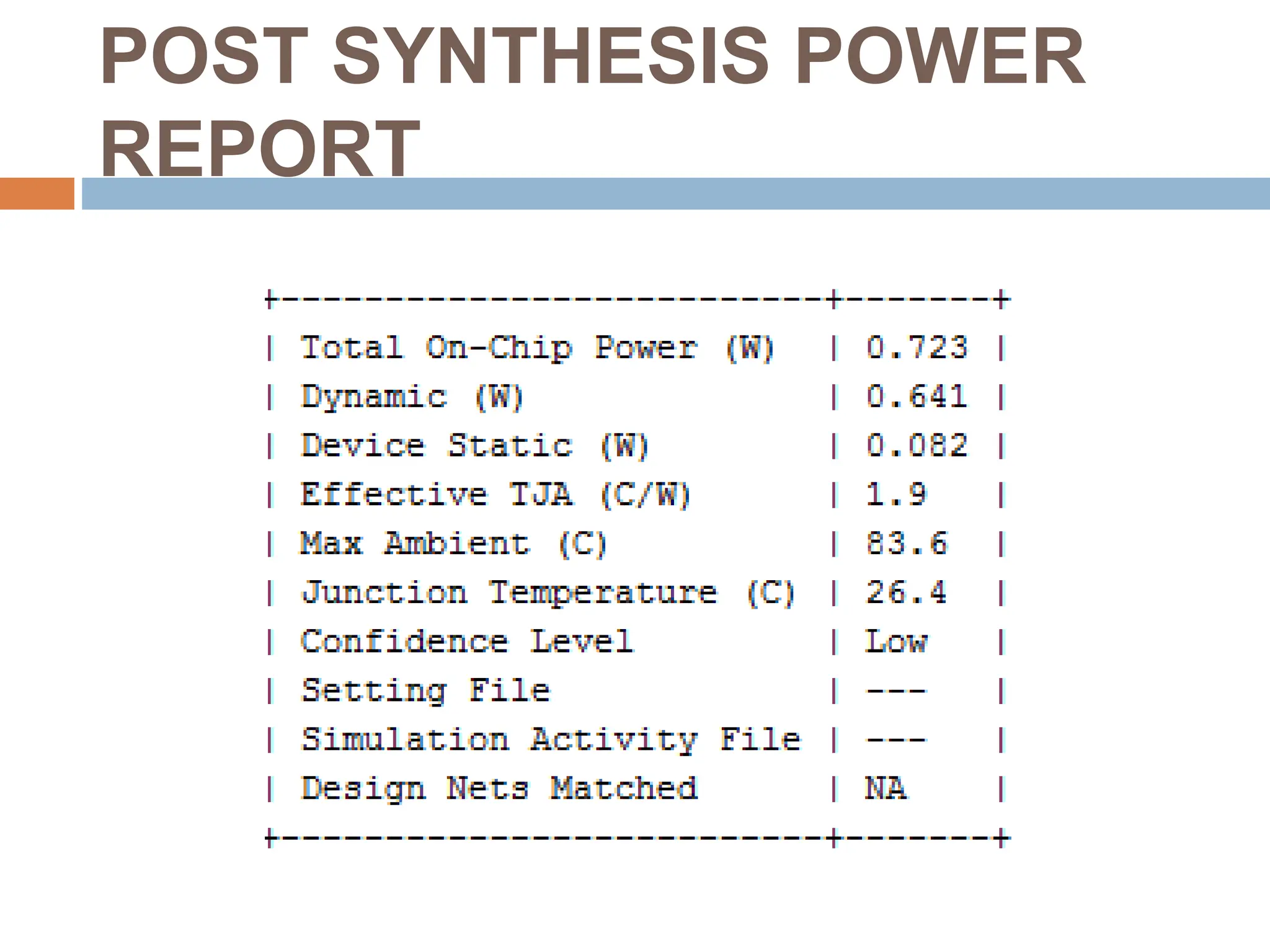
POST SYNTHESIS POWER
REPORT
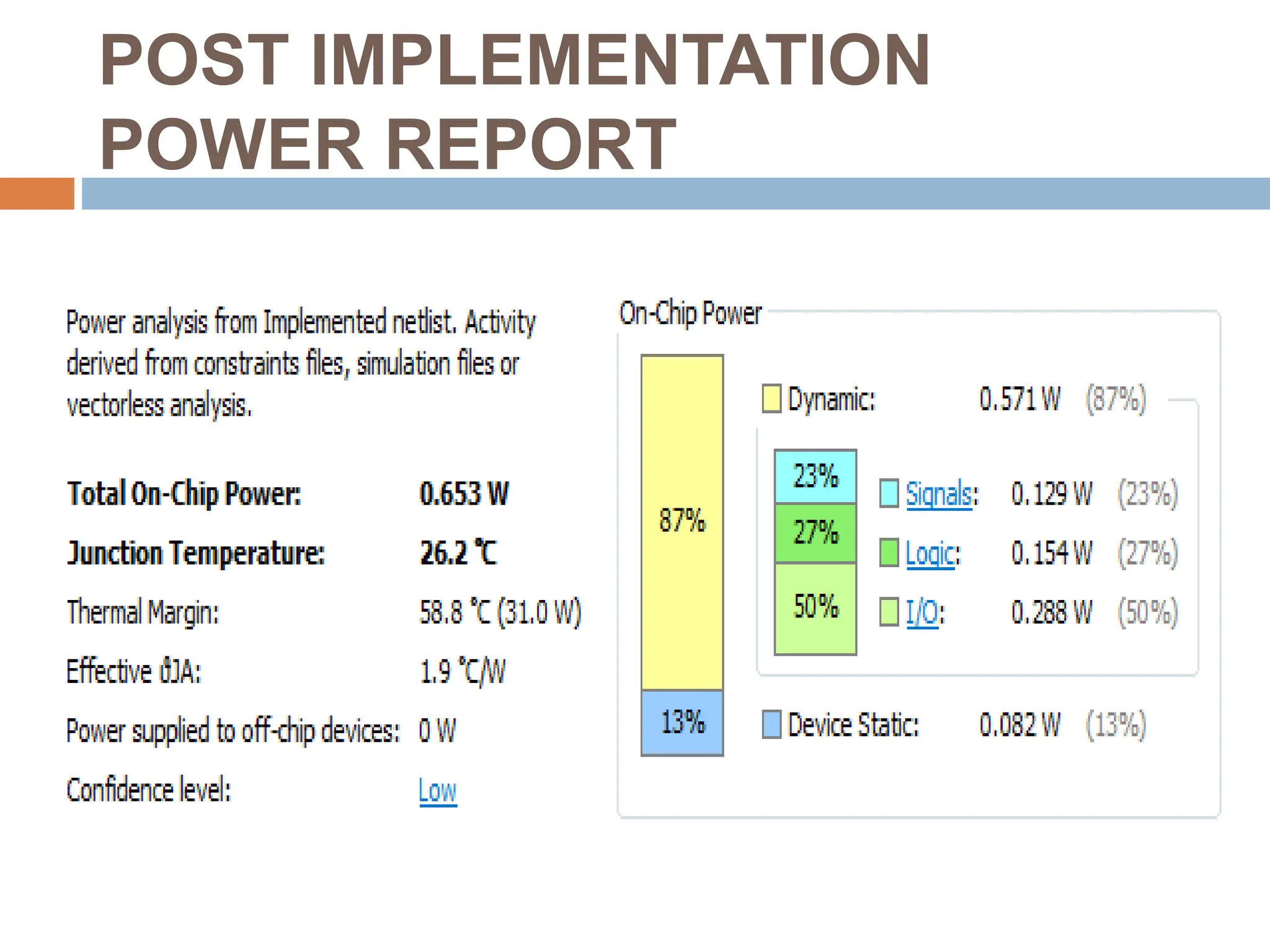
POST IMPLEMENTATION
POWER REPORT
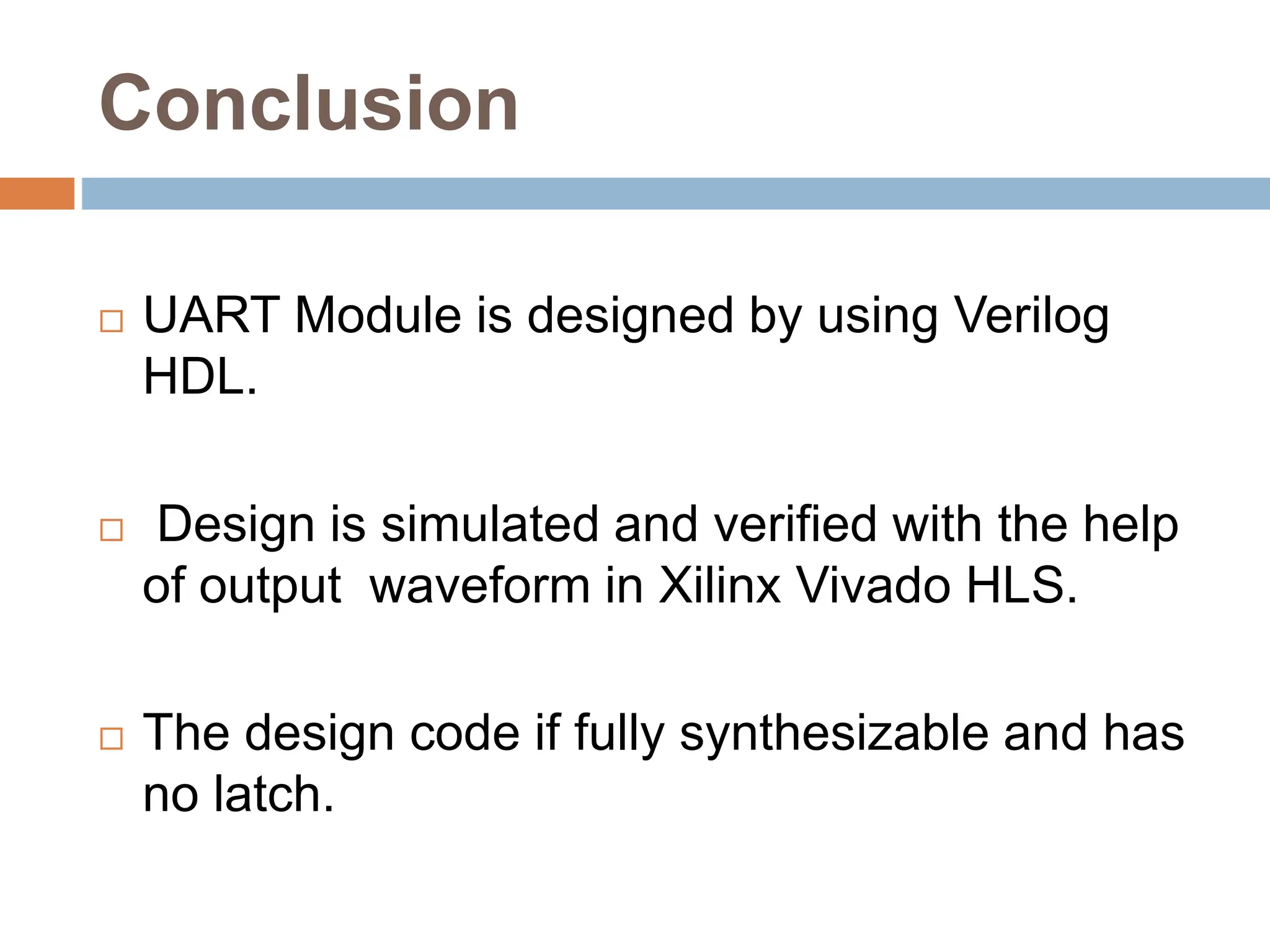
Conclusion
 UART Module is designed by using Verilog
HDL.
 Design is simulated and verified with the help
of output waveform in Xilinx Vivado HLS.
 The design code if fully synthesizable and has
no latch.
Future Work
 Verification of UART.
 Implementation on FPGA.
REFERENCES
 U. Nanda and S. K. Pattnaik, “Universal asynchronous
receiver and transmitter (uart),” in Advanced Computing
and Communication Systems (ICACCS), 2016 3rd
International Conference on, vol. 1. IEEE, 2016,pp. 1–5.
 Y.-y. Fang and X.-j. Chen, “Design and simulation of uart
serial communication module based on vhdl,” in Intelligent
Systems and Applications (ISA), 2011 3rd International
Workshop on. IEEE, 2011, pp. 1–4.
 G. B. Wakhle, I. Aggarwal, and S. Gaba, “Synthesis and
implementation of uart using vhdl codes,” in Computer,
Consumer and Control (IS3C), 2012 International
Symposium on. IEEE, 2012, pp. 1–3.
 Y. Wang, and K. Song, “A new approach to realize UART,”
Int’l Conf. on Elect. and Mech. Eng. and IT (EMEIT 2011),
Harbin, Heilongjiang, China, Aug. 2011.
407841208-Modular-UART.pptx design and architecture

407841208-Modular-UART.pptx design and architecture

  • 1.
    CONTENTS • Project Flow •Introduction • UART Design • Baud Rate Generator • Transmitter • Receiver • Block diagram of UART • Simulation Result • RTL Schematic • Technology Schematic • Reports • Conclusion • Future Work • References
  • 2.
    Project Flow  LiteratureSurvey.  Design of Baud rate generator.  Design of receiver and transmitter.  Debugging of UART.  Simulation.  Synthesis.  Verification.  Implementation.
  • 3.
    Introduction  UART acronymfor Universal Asynchronous Receiver and Transmitter.  Asynchronous Serial communication protocol.  Full Duplex communication.  Used between the slow and the fast peripheral devices.
  • 4.
    Contd..  Converts thebytes it gets from the computer along parallel circuits to a single serial bit stream for outbound transmission.  For inbound transmission, converts the serial bit stream to the bytes that the system handles.  Adds a parity bit after selection in outbound transmissions, checks the parity of incoming bytes (if selected) and rejects the parity bit.
  • 5.
    UART Design  AUART frame consists of 1 start bit, a number of data bits, an optional parity bit and 1, 1.5, or 2 stop bits.  Signal is 1 (high voltage) when the system is idle.  Start bit is 0 and stop bits are 1.  LSB is first transmitted or received.
  • 6.
    Contd..  UART iscomposed of a Baud Rate Generator (BRG), a receiver module, and a transmitter module  Designed by using Modular design approach.
  • 7.
    Baud Rate Generator Baud rate: The number of bits transmitted per second. frequently used baud rate: 9600, 19,200.  n= 𝑓𝑐𝑙𝑘 𝐵𝑚𝑎𝑥×𝐶×2 Where fclk: system clock Frequency C: the number of samples per bit cell Brmax: the maximum baud rate frequency
  • 8.
    Contd..  Multiplexer baseddesigning of baud rate generator is used.
  • 9.
    RTL Code ofBaud Rate generator module clk_div(input clk,rst, output q) reg [2:0]q1; always@(posedge clk) begin if(!rst) q1<=3'b001; else q1<={q1[0],q1[2:1]}; end assign q=q1[0]; endmodule module counter_8(input clk,rst, output reg [7:0]q); always@(posedge clk) begin if(!rst) q<=8'd0; else q<=q+1; end endmodule Clock divide by n Divide by 256
  • 10.
    Contd.. module mux_8(input [7:0]d, input[2:0]sel, output reg y); always@(d,sel) begin case(sel) 3'b000:y=d[0]; 3'b001:y=d[1]; 3'b010:y=d[2]; 3'b011:y=d[3]; 3'b100:y=d[4]; 3'b101:y=d[5]; 3'b110:y=d[6]; 3'b111:y=d[7]; endcase end endmodule module divide_by_8(input clk,rst, output q); reg [2:0]count; always@(posedge clk,negedge rst) begin if(!rst) count<=3'd0; else count<=count+1; end assign q=count[2]; endmodule Multiplexer Divide by 8
  • 11.
    Block Diagram ofTransmitter  Logic diagram of the transmitter of a UART. TDR Transmitter Control TE Parity generator 1 P 0 1 TxD TxC Data Bus
  • 12.
  • 13.
    Block Diagram ofReceiver  Logic diagram of the receiver of UART FE OE PE RF RDR 1 P RSR 0 Receiver Control DATA BUS RxD RxC RcvS R
  • 14.
  • 15.
  • 16.
    SIMULATION RESULTS  Simulationresult of baud rate generator
  • 17.
  • 18.
  • 19.
  • 20.
  • 21.
  • 22.
    Power report  Thereare 2 power report. • Post synthesis • Post route  Two modes of power estimation • Vector based • Vector less
  • 23.
  • 24.
  • 25.
    Conclusion  UART Moduleis designed by using Verilog HDL.  Design is simulated and verified with the help of output waveform in Xilinx Vivado HLS.  The design code if fully synthesizable and has no latch.
  • 26.
    Future Work  Verificationof UART.  Implementation on FPGA.
  • 27.
    REFERENCES  U. Nandaand S. K. Pattnaik, “Universal asynchronous receiver and transmitter (uart),” in Advanced Computing and Communication Systems (ICACCS), 2016 3rd International Conference on, vol. 1. IEEE, 2016,pp. 1–5.  Y.-y. Fang and X.-j. Chen, “Design and simulation of uart serial communication module based on vhdl,” in Intelligent Systems and Applications (ISA), 2011 3rd International Workshop on. IEEE, 2011, pp. 1–4.  G. B. Wakhle, I. Aggarwal, and S. Gaba, “Synthesis and implementation of uart using vhdl codes,” in Computer, Consumer and Control (IS3C), 2012 International Symposium on. IEEE, 2012, pp. 1–3.  Y. Wang, and K. Song, “A new approach to realize UART,” Int’l Conf. on Elect. and Mech. Eng. and IT (EMEIT 2011), Harbin, Heilongjiang, China, Aug. 2011.