
Servo Motor & Drive
Selection
Prepared & Presented by :
Abhishek Sahdev
9930322215
Abhishek_sit@yahoo.co.in
Energy cost
96%
Purchasing cost
2%
Service cost
2%
Life cycle cost of electric Motor
10 20 30 40 50 60 70 80 90 100
100
90
80
70
60
50
40
30
20
10
% Rated Load
%PowerFactor
Example Efficiency vs. Load
10 HP
Over Sized Motor
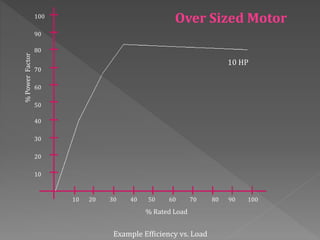
Above Picture shows an example of 10 HP motor. In above cases there is a sharp
decline of the motor’s efficiency at around 30% of the rated load.
However, the curves as shown in the picture, will vary substantially from motor to
motor and it is difficult to say when exactly a motor is oversized.
As a general rule of thumb, when a motor operates at 40% or less of
its rated load, it is a good candidate for downsizing, especially in cases where
the load does not vary very much.
Servo motor applications usually require short-term operation at higher loads,
especially during
acceleration and deceleration, which makes it necessary to look at the average (RMS)
torque and the peak torque of an application.
Over Sized Motor
Over Sized Motor
Advantages to over sizing :
 Oversized motors are more likely to start and operate in under voltage
conditions.
 Over sizing may provide additional capacity for future expansions and
may eliminate the need to replace the motor.
 Oversized motors can accommodate unanticipated high loads.
 Mechanical components (e.g. couplings, ball bearings, etc.) may, depending on the
environment and quality of service, encounter wear and as a result may produce
higher friction forces. Friction forces contribute to the constant torque of a mechanical
set up.
In general, a modest over sizing of up to 20% is absolutely acceptable.
Over Sized Motor
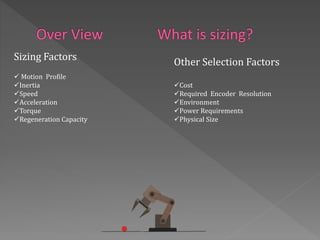
Sizing Factors
 Motion Profile
Inertia
Speed
Acceleration
Torque
Regeneration Capacity
Other Selection Factors
Cost
Required Encoder Resolution
Environment
Power Requirements
Physical Size
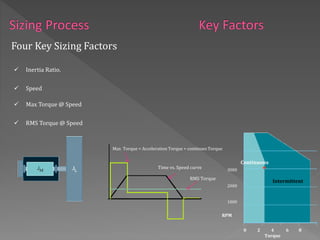
Four Key Sizing Factors
 Inertia Ratio.
 Speed
 Max Torque @ Speed
 RMS Torque @ Speed
RMS Torque
Max Torque = Acceleration Torque + continues Torque
Time vs. Speed curve
Intermittent
Continuous
0 2 4 6 8
Torque
3000
2000
1000
RPM
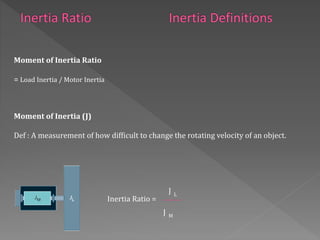
Moment of Inertia Ratio
= Load Inertia / Motor Inertia
Inertia Ratio =
L
J
M
J
Moment of Inertia (J)
Def : A measurement of how difficult to change the rotating velocity of an object.
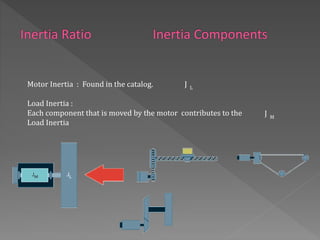
Motor Inertia : Found in the catalog.
Load Inertia :
Each component that is moved by the motor contributes to the
Load Inertia
L
J
M
J
Inertia Ratio Guidelines
5 : 1 typical
2 : 1 or less for highest performance
10 : 1 or higher when performance not critical
What if inertia ratio is too high ?
•Select a motor with higher inertia
•Decrease load inertia by
Increase ball screw pitch
Decrease shaft diameter
•Add a Gearbox
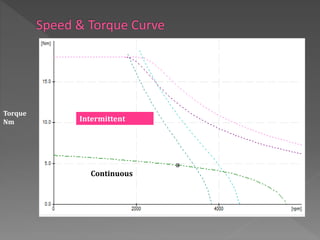
Torque
Nm
Continuous
Intermittent
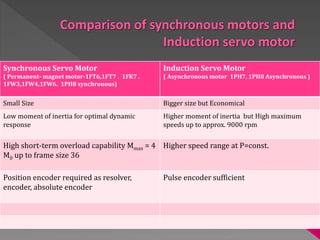
Synchronous Servo Motor
( Permanent- magnet motor-1FT6,1FT7 . 1FK7 .
1FW3,1FW4,1FW6. 1PH8 synchronous)
Induction Servo Motor
( Asynchronous motor 1PH7, 1PH8 Asynchronous )
Small Size Bigger size but Economical
Low moment of inertia for optimal dynamic
response
Higher moment of inertia but High maximum
speeds up to approx. 9000 rpm
High short-term overload capability Mmax = 4
M0 up to frame size 36
Higher speed range at P=const.
Position encoder required as resolver,
encoder, absolute encoder
Pulse encoder sufficient
Servo selection
Servo selection

Servo selection

  • 1.
    Servo Motor &Drive Selection Prepared & Presented by : Abhishek Sahdev 9930322215 Abhishek_sit@yahoo.co.in
  • 2.
    Energy cost 96% Purchasing cost 2% Servicecost 2% Life cycle cost of electric Motor
  • 3.
    10 20 3040 50 60 70 80 90 100 100 90 80 70 60 50 40 30 20 10 % Rated Load %PowerFactor Example Efficiency vs. Load 10 HP Over Sized Motor
  • 4.
    Above Picture showsan example of 10 HP motor. In above cases there is a sharp decline of the motor’s efficiency at around 30% of the rated load. However, the curves as shown in the picture, will vary substantially from motor to motor and it is difficult to say when exactly a motor is oversized. As a general rule of thumb, when a motor operates at 40% or less of its rated load, it is a good candidate for downsizing, especially in cases where the load does not vary very much. Servo motor applications usually require short-term operation at higher loads, especially during acceleration and deceleration, which makes it necessary to look at the average (RMS) torque and the peak torque of an application. Over Sized Motor
  • 5.
    Over Sized Motor Advantagesto over sizing :  Oversized motors are more likely to start and operate in under voltage conditions.  Over sizing may provide additional capacity for future expansions and may eliminate the need to replace the motor.  Oversized motors can accommodate unanticipated high loads.  Mechanical components (e.g. couplings, ball bearings, etc.) may, depending on the environment and quality of service, encounter wear and as a result may produce higher friction forces. Friction forces contribute to the constant torque of a mechanical set up.
  • 6.
    In general, amodest over sizing of up to 20% is absolutely acceptable. Over Sized Motor
  • 7.
    Sizing Factors  MotionProfile Inertia Speed Acceleration Torque Regeneration Capacity Other Selection Factors Cost Required Encoder Resolution Environment Power Requirements Physical Size
  • 8.
    Four Key SizingFactors  Inertia Ratio.  Speed  Max Torque @ Speed  RMS Torque @ Speed RMS Torque Max Torque = Acceleration Torque + continues Torque Time vs. Speed curve Intermittent Continuous 0 2 4 6 8 Torque 3000 2000 1000 RPM
  • 9.
    Moment of InertiaRatio = Load Inertia / Motor Inertia Inertia Ratio = L J M J Moment of Inertia (J) Def : A measurement of how difficult to change the rotating velocity of an object.
  • 10.
    Motor Inertia :Found in the catalog. Load Inertia : Each component that is moved by the motor contributes to the Load Inertia L J M J
  • 11.
    Inertia Ratio Guidelines 5: 1 typical 2 : 1 or less for highest performance 10 : 1 or higher when performance not critical What if inertia ratio is too high ? •Select a motor with higher inertia •Decrease load inertia by Increase ball screw pitch Decrease shaft diameter •Add a Gearbox
  • 12.
  • 13.
    Synchronous Servo Motor (Permanent- magnet motor-1FT6,1FT7 . 1FK7 . 1FW3,1FW4,1FW6. 1PH8 synchronous) Induction Servo Motor ( Asynchronous motor 1PH7, 1PH8 Asynchronous ) Small Size Bigger size but Economical Low moment of inertia for optimal dynamic response Higher moment of inertia but High maximum speeds up to approx. 9000 rpm High short-term overload capability Mmax = 4 M0 up to frame size 36 Higher speed range at P=const. Position encoder required as resolver, encoder, absolute encoder Pulse encoder sufficient