AL TABABA
TRAINING
SERIES
Steps for Successful Ser vice Improvement
Service Improvement
THE STEPS (IN THEIR CORRECT ORDER!)
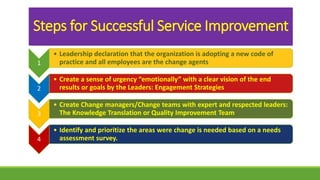
Steps for Successful Service Improvement
1
• Leadership declaration that the organization is adopting a new code of
practice and all employees are the change agents
2
• Create a sense of urgency “emotionally” with a clear vision of the end
results or goals by the Leaders: Engagement Strategies
3
• Create Change managers/Change teams with expert and respected leaders:
The Knowledge Translation or Quality Improvement Team
4
• Identify and prioritize the areas were change is needed based on a needs
assessment survey.
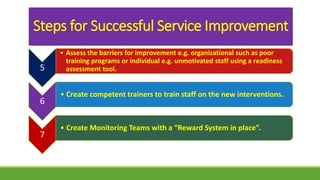
Steps for Successful Service Improvement
5
• Assess the barriers for improvement e.g. organizational such as poor
training programs or individual e.g. unmotivated staff using a readiness
assessment tool.
6
• Create competent trainers to train staff on the new interventions.
7
• Create Monitoring Teams with a “Reward System in place”.
The Steps: Step 1
The first and TOP RATED step is:
Leadership declaration that the organization is adopting a
new code of practice and all employees are the change
agents.
http://journal-dl.com/downloadpdf/591088333fbb6e13743edfa9
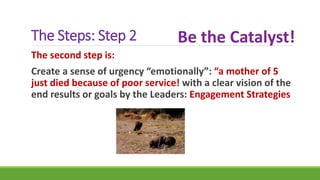
The Steps: Step 2
The second step is:
Create a sense of urgency “emotionally”: “a mother of 5
just died because of poor service! with a clear vision of the
end results or goals by the Leaders: Engagement Strategies
Be the Catalyst!
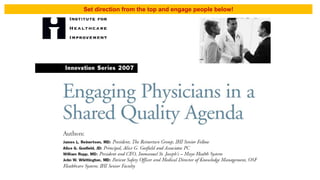
Set direction from the top and engage people below!
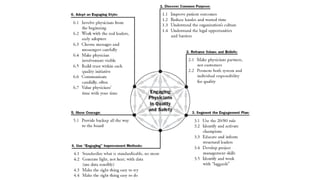
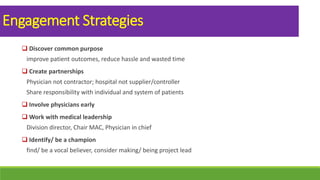
Engagement Strategies
 Discover common purpose
improve patient outcomes, reduce hassle and wasted time
 Create partnerships
Physician not contractor; hospital not supplier/controller
Share responsibility with individual and system of patients
 Involve physicians early
 Work with medical leadership
Division director, Chair MAC, Physician in chief
 Identify/ be a champion
find/ be a vocal believer, consider making/ being project lead
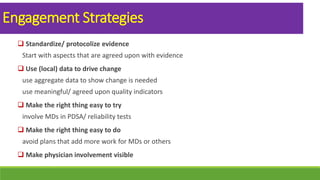
Engagement Strategies
 Standardize/ protocolize evidence
Start with aspects that are agreed upon with evidence
 Use (local) data to drive change
use aggregate data to show change is needed
use meaningful/ agreed upon quality indicators
 Make the right thing easy to try
involve MDs in PDSA/ reliability tests
 Make the right thing easy to do
avoid plans that add more work for MDs or others
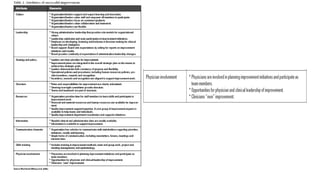
 Make physician involvement visible
Doeshigherphysicianinvolvementimproveservicequality?
The Steps: Step 3
The third step is: Improvement TEAM
Create Change managers/Change teams with expert and
respected leaders: Enroll Charismatic Figures
The Knowledge Translation or Quality Improvement Team
The Steps: Step 4
The Fourth step is:
Identify and prioritize the areas were change is needed
based on a needs assessment survey.
The Steps: Step 5
The Fifth Step
Assess the barriers for improvement e.g. organizational such
as poor training programs or individual e.g. unmotivated
staff using a readiness assessment tool.
Assessment Tools:
AHRQ survey tool to assess leaders' perspectives on organizational readiness:
https://www.ahrq.gov/professionals/systems/hospital/qitoolkit/index.html
Organizational Readiness to Change Assessment (ORCA):
http://ibr.tcu.edu/wp-content/uploads/2013/10/ORC-SA-sg.pdf
The Steps: Step 6
The Sixth Step:
Create competent trainers to train staff on the new
interventions.
The Steps: Step 7
The Seventh Step:
Create Monitoring Teams- NO Monitoring: Guaranteed
Failure! with
a “Reward System in place”-Make it a Pleasurable Change!
The Steps: Step 7-Incentives to improve staff
compliance
◦ Spot-checks
◦ Recognize Success/Make it Visible: Financial or Material incentives.
◦ Conference/Travel reimbursements
◦ Recognition/Accreditation Certificates: Champions/Employee-of-the
Month/Pathway Implementer Certificates etc.
◦ Unit League-tables-best &worst!
◦ Protection against Litigation.
Incentify your Workforce: Happiness at work!
What is NEXT?
•Try it out!
Please visit and subscribe to
altababa.org

Service improvement the steps v1 - ss1

  • 1.
    AL TABABA TRAINING SERIES Steps forSuccessful Ser vice Improvement
  • 2.
    Service Improvement THE STEPS(IN THEIR CORRECT ORDER!)
  • 4.
    Steps for SuccessfulService Improvement 1 • Leadership declaration that the organization is adopting a new code of practice and all employees are the change agents 2 • Create a sense of urgency “emotionally” with a clear vision of the end results or goals by the Leaders: Engagement Strategies 3 • Create Change managers/Change teams with expert and respected leaders: The Knowledge Translation or Quality Improvement Team 4 • Identify and prioritize the areas were change is needed based on a needs assessment survey.
  • 5.
    Steps for SuccessfulService Improvement 5 • Assess the barriers for improvement e.g. organizational such as poor training programs or individual e.g. unmotivated staff using a readiness assessment tool. 6 • Create competent trainers to train staff on the new interventions. 7 • Create Monitoring Teams with a “Reward System in place”.
  • 6.
    The Steps: Step1 The first and TOP RATED step is: Leadership declaration that the organization is adopting a new code of practice and all employees are the change agents. http://journal-dl.com/downloadpdf/591088333fbb6e13743edfa9
  • 7.
    The Steps: Step2 The second step is: Create a sense of urgency “emotionally”: “a mother of 5 just died because of poor service! with a clear vision of the end results or goals by the Leaders: Engagement Strategies Be the Catalyst!
  • 8.
    Set direction fromthe top and engage people below!
  • 11.
    Engagement Strategies  Discovercommon purpose improve patient outcomes, reduce hassle and wasted time  Create partnerships Physician not contractor; hospital not supplier/controller Share responsibility with individual and system of patients  Involve physicians early  Work with medical leadership Division director, Chair MAC, Physician in chief  Identify/ be a champion find/ be a vocal believer, consider making/ being project lead
  • 12.
    Engagement Strategies  Standardize/protocolize evidence Start with aspects that are agreed upon with evidence  Use (local) data to drive change use aggregate data to show change is needed use meaningful/ agreed upon quality indicators  Make the right thing easy to try involve MDs in PDSA/ reliability tests  Make the right thing easy to do avoid plans that add more work for MDs or others  Make physician involvement visible
  • 13.
  • 16.
    The Steps: Step3 The third step is: Improvement TEAM Create Change managers/Change teams with expert and respected leaders: Enroll Charismatic Figures The Knowledge Translation or Quality Improvement Team
  • 17.
    The Steps: Step4 The Fourth step is: Identify and prioritize the areas were change is needed based on a needs assessment survey.
  • 18.
    The Steps: Step5 The Fifth Step Assess the barriers for improvement e.g. organizational such as poor training programs or individual e.g. unmotivated staff using a readiness assessment tool. Assessment Tools: AHRQ survey tool to assess leaders' perspectives on organizational readiness: https://www.ahrq.gov/professionals/systems/hospital/qitoolkit/index.html Organizational Readiness to Change Assessment (ORCA): http://ibr.tcu.edu/wp-content/uploads/2013/10/ORC-SA-sg.pdf
  • 19.
    The Steps: Step6 The Sixth Step: Create competent trainers to train staff on the new interventions.
  • 20.
    The Steps: Step7 The Seventh Step: Create Monitoring Teams- NO Monitoring: Guaranteed Failure! with a “Reward System in place”-Make it a Pleasurable Change!
  • 21.
    The Steps: Step7-Incentives to improve staff compliance ◦ Spot-checks ◦ Recognize Success/Make it Visible: Financial or Material incentives. ◦ Conference/Travel reimbursements ◦ Recognition/Accreditation Certificates: Champions/Employee-of-the Month/Pathway Implementer Certificates etc. ◦ Unit League-tables-best &worst! ◦ Protection against Litigation. Incentify your Workforce: Happiness at work!
  • 23.
  • 24.
    Please visit andsubscribe to altababa.org