


The Journal Club:
Exploring New
Avenues
Dr. Imad Salah Ahmed Hassan MD FACP FRCPI MemAcadMEd MSc MBBS
Chairman, Knowledge Translation Committee
Department of Medicine, KAMC,KSA
The Journal Club:
One of EBM
Implementation
Tools
Objectives
 Definition
 History
 Goals
 Benefits to practice site
 How to select and present an article
 What next?
Objectives (cont’d)
 Journal club questions
 Conducting a journal club
The presentation
Learning Outcomes
Learning/Teaching Methods
Assessment
 Factors associated with successful journal
clubs
 Journal club models
Definition
 A group of individuals who meet regularly
to critically discuss applicability of current
articles found in medical journals.
Kleinpell RM. Rediscovering the value of the journal club. Am J Crit Care. 2002;11:412-4.
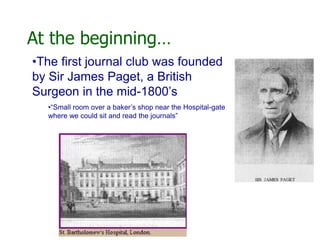
At the beginning…
•The first journal club was founded
by Sir James Paget, a British
Surgeon in the mid-1800’s
•“Small room over a baker’s shop near the Hospital-gate
where we could sit and read the journals”
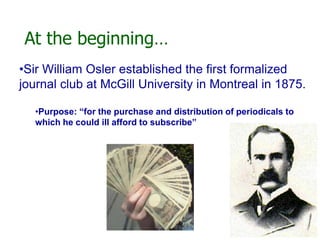
At the beginning…
•Sir William Osler established the first formalized
journal club at McGill University in Montreal in 1875.
•Purpose: “for the purchase and distribution of periodicals to
which he could ill afford to subscribe”
Medical Knowledge
• Update Knowledge and support life-long learning.
Skills: Training in evidence based
medicine skills
• JCs enhances literature searching skills, critical
appraisal etc.
Understand scientific concepts in
Epidemiology and Biostatistics:
• Basic study designs
• Basic statistical approaches
• Basic outcomes assessment methods.
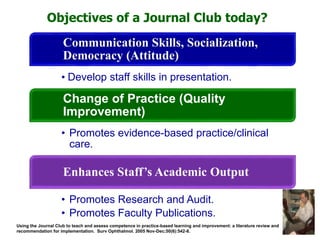
Objectives of a Journal Club today?
Using the Journal Club to teach and assess competence in practice-based learning and improvement: a literature review and
recommendation for implementation. Surv Ophthalmol. 2005 Nov-Dec;50(6):542-8.
Communication Skills, Socialization,
Democracy (Attitude)
• Develop staff skills in presentation.
Change of Practice (Quality
Improvement)
• Promotes evidence-based practice/clinical
care.
Enhances Staff’s Academic Output
• Promotes Research and Audit.
• Promotes Faculty Publications.
Objectives of a Journal Club today?
Using the Journal Club to teach and assess competence in practice-based learning and improvement: a literature review and
recommendation for implementation. Surv Ophthalmol. 2005 Nov-Dec;50(6):542-8.
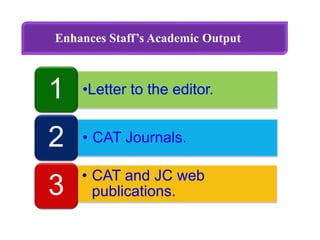
•Letter to the editor.1
• CAT Journals.2
• CAT and JC web
publications.3
Enhances Staff’s Academic Output
Knowledge Translation: Evidence to Practice
 Journal clubs have
been advocated as a
bridge between
Research and
Practice.
Goodfellow LM. Can a journal club bridge the gap between research and practice? Nurse
Educ. 2004 May-Jun;29(3):107-10.
The Journal Club: Does it work?
BMC Med Educ. 2006; 6: 43.
Do community medicine residency trainees learn
through journal club? An experience from a developing
country?
Saima Akhund et al Human Development Programme, Aga Khan University,
Karachi, Pakistan
Abstract
Methods
•Journal club effectiveness criteria were searched using
electronic search databases.
•Ninety percent of residents and alumni of Community
Medicine Residency Programme participated voluntarily in a
confidential survey.
The Journal Club: Does it work?
Results
The CMR-JC was regularly conducted.
More than 95% of residents attended. (Total residents in
the CMR-Programme: 32).
Twenty-seven out of 29 current residents/alumni
responded to the anonymous questionnaire.
Acquisition of critical appraisal skills (23 respondents)
and keeping up with current literature (18 respondents)
were the two most important objectives achieved.
Respondents recommended improved faculty
participation and incorporating a structured checklist for
article review.
Impact of a medical journal club on house-staff reading habits, knowledge,
and critical appraisal skills. A randomized controlled trial. Linzer M et al
To determine if a journal club improves house-staff
reading habits, knowledge of epidemiology and biostatistics,
and critical appraisal skills.
 Randomized 44 medical interns to receive either a journal
club or a control seminar series.
A test instrument developed by the Delphi method was
administered before and after the interventions (mean, five
journal club sessions).
The Journal Club: Does it work?
•By self-report, 86% of the house staff in the journal club group
improved their reading habits vs 0% in the control group.1
• Knowledge scores increased more in the journal club group
than in the control group, and a trend was found toward more
knowledge gained as more sessions were attended.2
• Ability to appraise critically a test article increased slightly in
each group, but there was no significant difference between
the groups.3
The Journal Club: Does it work?: A
Randomized Study.
Impact of a medical journal club on house-staff reading habits, knowledge,
and critical appraisal skills. A randomized controlled trial. Linzer M et al
We conclude that a journal club is a
powerful motivator of critical house-staff
reading behaviour and can help teach
epidemiology and biostatistics to
physicians-in-training.
Conclusion
Impact of a medical journal club on house-staff reading habits, knowledge,
and critical appraisal skills. A randomized controlled trial. Linzer M et al
A literature search was undertaken using 10 databases was
made as to whether studies have found journal clubs for
physicians in training to be:
1. Effective for improving patient care
2. Teaching critical appraisal skills
3. Improving reading habits
4. Increasing knowledge of clinical epidemiology and
biostatistics
5. Increasing the use of medical literature in clinical practice.
The Journal Club: Does it work?
Ebbert JO et al. The journal club in postgraduate medical education: a systematic
review. Department of Internal Medicine, Mayo Clinic, Rochester, Minnesota, USA. Med
Teach. 2001 Sep;23(5):455-461
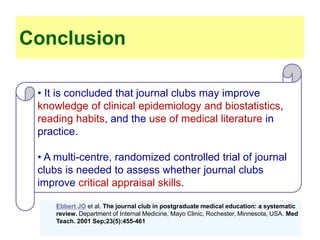
• It is concluded that journal clubs may improve
knowledge of clinical epidemiology and biostatistics,
reading habits, and the use of medical literature in
practice.
• A multi-centre, randomized controlled trial of journal
clubs is needed to assess whether journal clubs
improve critical appraisal skills.
Conclusion
Impact of a medical journal club on house-staff reading habits, knowledge,
and critical appraisal skills. A randomized controlled trial. Linzer M et al
Ebbert JO et al. The journal club in postgraduate medical education: a systematic
review. Department of Internal Medicine, Mayo Clinic, Rochester, Minnesota, USA. Med
Teach. 2001 Sep;23(5):455-461
Characteristics
of Successful
Journal Clubs
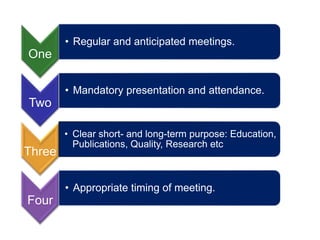
One
• Regular and anticipated meetings.
Two
• Mandatory presentation and attendance.
Three
• Clear short- and long-term purpose: Education,
Publications, Quality, Research etc .
Four
• Appropriate timing of meeting.
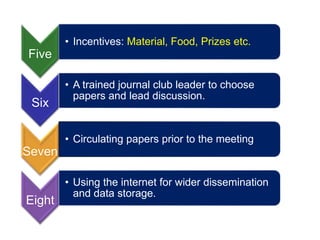
Five
• Incentives: Material, Food, Prizes etc.
Six
• A trained journal club leader to choose
papers and lead discussion.
Seven
• Circulating papers prior to the meeting.
Eight
• Using the internet for wider dissemination
and data storage.
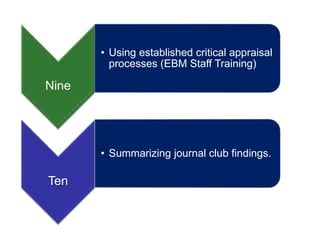
Nine
• Using established critical appraisal
processes (EBM Staff Training).
Ten
• Summarizing journal club findings.
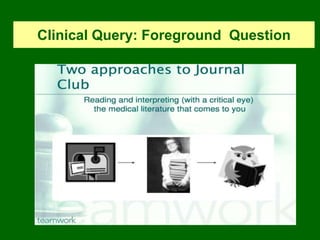
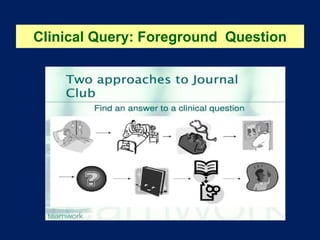
Clinical Query: Foreground Question
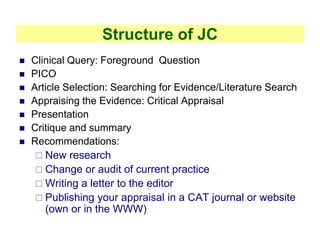
Structure of JC
 Clinical Query: Foreground Question
 PICO
 Article Selection: Searching for Evidence/Literature Search
 Appraising the Evidence: Critical Appraisal
 Presentation
 Critique and summary
 Recommendations:
 New research
 Change or audit of current practice
 Writing a letter to the editor
 Publishing your appraisal in a CAT journal or website
(own or in the WWW)
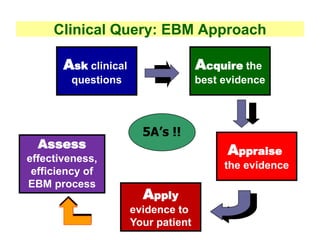
Clinical Query: EBM Approach
Ask clinical
questions
Acquire the
best evidence
Appraise
the evidence
Apply
evidence to
Your patient
5A’s !!
Assess
effectiveness,
efficiency of
EBM process
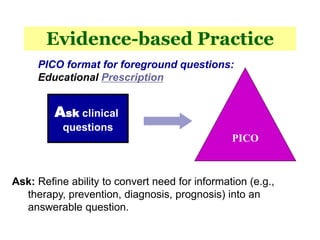
Evidence-based Practice
Ask clinical
questions
PICO
Ask: Refine ability to convert need for information (e.g.,
therapy, prevention, diagnosis, prognosis) into an
answerable question.
PICO format for foreground questions:
Educational Prescription
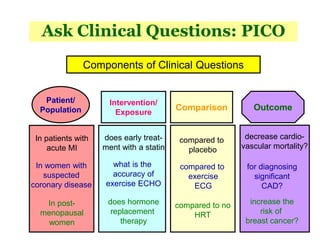
Ask Clinical Questions: PICO
Patient/
Population Outcome
Intervention/
Exposure
Comparison
Components of Clinical Questions
In patients with
acute MI
In post-
menopausal
women
In women with
suspected
coronary disease
does early treat-
ment with a statin
what is the
accuracy of
exercise ECHO
does hormone
replacement
therapy
compared to
placebo
compared to
exercise
ECG
compared to no
HRT
decrease cardio-
vascular mortality?
for diagnosing
significant
CAD?
increase the
risk of
breast cancer?
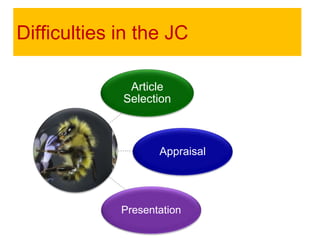
Article
Selection
Appraisal
Presentation
Difficulties in the JC
Article Selection
 Select articles from peer reviewed, quality journals.
 Try to select recent articles ( write a Letter to the
Editor!).
 Choose a research paper rather than a review article
that will not have a Methods section.
 Use the McMaster MORE tool to choose your article.
http://hiru.mcmaster.ca/MORE/InclusionCriteria.htm
 A pair of articles may be good for a lively discussion
particularly if they have opposite conclusions.
Literature Search and Retrieval of Article(s)
“Pubmed”: www.pubmed.org
 Limits
 Clinical Query
 PubmedviaPICO
 Askmedline
Journal Websites:
 www.acpjc.org
 www.hematology.org/education/training/index.cfm
 www.cancer.gov/clinicaltrials
McMaster Online Rating of Evidence (MORE)
 McMaster University has created the McMaster Online
Rating of Evidence (MORE) system to identify the
highest-quality published research.
 The ACP Journal Club uses the MORE system to select
their articles.
 Specific inclusion criteria have been delineated in order
to distinguish papers with the highest scientific merit.
McMaster Online Rating of Evidence (MORE)
 Articles that have passed this screening are then rated
by clinicians on their clinical relevance and
newsworthiness, using a graded scale.
 With the help of your mentors and colleagues, you can
use these criteria and the rating scale as informal
guidelines to ensure that your chosen article merits
presentation.
Critical Appraisal
 You should attempt to critically appraise the
article with help from your mentor.
 Use web-based/online CAT sites and Calculators
Critical Appraisal Checklists
 http://www.gla.ac.uk/departments/generalpracticeprimarycare/ebp/
checklists/#d.en.19536
 § Checklist for an article on treatment or prevention
 § Checklist for an article on qualitative research
 § Checklist for an article on decision analysis
 § Checklist for an article on an educational intervention
 § Checklist for an article on prognosis
 § Checklist for an article on harm or causation
 § Checklist for an article on guidelines
 § Checklist for an article on diagnosis or screening
 § Checklist for a systematic review
 § Checklist for economic evaluations
Critical Appraisal Calculators
 Oxford Centre for EBM:
http://www.cebm.net/?o=1023
Critical Appraisal: Shortcuts to Enriching your
Journal Club
 Check for an “Editorial Comment” (usually present in
the same journal issue where the article was published).
 Check for any “Letters to the Editor” relevant to the
article of your choice in PubMed.
 Check whether an appraisal of the article has been
published in one of the ACP Journal Club issues
(https://www.acponline.org/clinical-information/journals-
publications/acp-journal-club).
Critical Appraisal: Shortcuts to Enriching your
Journal Club
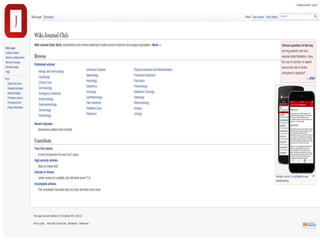
 Check whether an appraisal of the article has been
published in the wiki Journal Club
(https://www.wikijournalclub.org/wiki/Main_Page).
 Check whether an appraisal of the article has been
published in:
 Google.
 Pubmed
 On-line websites e.g. Slide Share
 Use keywords from the article title plus appraisal or
journal club in your search terms.
Preparing the Presentation
 Prepare your presentation on PowerPoint and
discuss it with your mentor.
 To make it easy for the trainees the Department
of Medicine has created readymade Word Doc
and PowerPoint Templates with Hyperlinks.
 Templates
 1.Doc
 2.Ppt
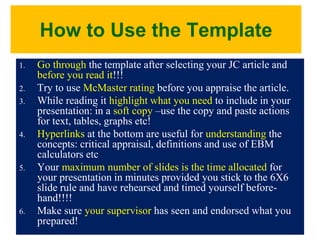
How to Use the Template
1. Go through the template after selecting your JC article and
before you read it!!!
2. Try to use McMaster rating before you appraise the article.
3. While reading it highlight what you need to include in your
presentation: in a soft copy –use the copy and paste actions
for text, tables, graphs etc!
4. Hyperlinks at the bottom are useful for understanding the
concepts: critical appraisal, definitions and use of EBM
calculators etc
5. Your maximum number of slides is the time allocated for
your presentation in minutes provided you stick to the 6X6
slide rule and have rehearsed and timed yourself before-
hand!!!!
6. Make sure your supervisor has seen and endorsed what you
prepared!
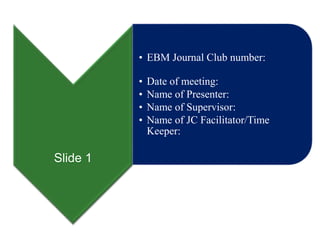
Slide 1
• EBM Journal Club number:
• Date of meeting:
• Name of Presenter:
• Name of Supervisor:
• Name of JC Facilitator/Time
Keeper:
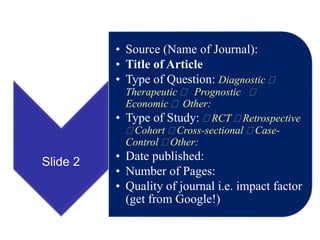
Slide 2
• Source (Name of Journal):
• Title of Article
• Type of Question: Diagnostic 
Therapeutic  Prognostic 
Economic  Other:
• Type of Study:  RCT  Retrospective
 Cohort  Cross-sectional  Case-
Control  Other:
• Date published:
• Number of Pages:
• Quality of journal i.e. impact factor
(get from Google!)
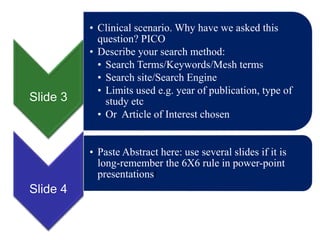
Slide 3
• Clinical scenario. Why have we asked this
question? PICO
• Describe your search method:
• Search Terms/Keywords/Mesh terms
• Search site/Search Engine
• Limits used e.g. year of publication, type of
study etc
• Or Article of Interest chosen
Slide 4
• Paste Abstract here: use several slides if it is
long-remember the 6X6 rule in power-point
presentations!
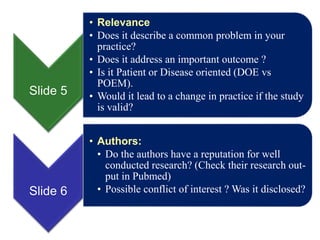
Slide 5
• Relevance
• Does it describe a common problem in your
practice?
• Does it address an important outcome ?
• Is it Patient or Disease oriented (DOE vs
POEM).
• Would it lead to a change in practice if the study
is valid?
Slide 6
• Authors:
• Do the authors have a reputation for well
conducted research? (Check their research out-
put in Pubmed)
• Possible conflict of interest ? Was it disclosed?
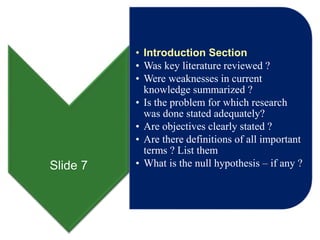
Slide 7
• Introduction Section
• Was key literature reviewed ?
• Were weaknesses in current
knowledge summarized ?
• Is the problem for which research
was done stated adequately?
• Are objectives clearly stated ?
• Are there definitions of all important
terms ? List them
• What is the null hypothesis – if any ?
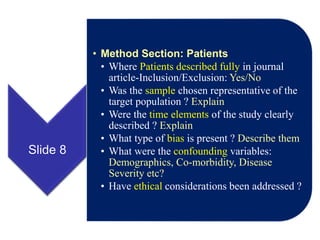
Slide 8
• Method Section: Patients
• Where Patients described fully in journal
article-Inclusion/Exclusion: Yes/No
• Was the sample chosen representative of the
target population ? Explain
• Were the time elements of the study clearly
described ? Explain
• What type of bias is present ? Describe them
• What were the confounding variables:
Demographics, Co-morbidity, Disease
Severity etc?
• Have ethical considerations been addressed ?
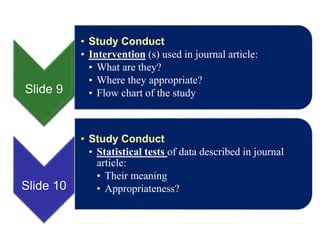
Slide 9
• Study Conduct
• Intervention (s) used in journal article:
• What are they?
• Where they appropriate?
• Flow chart of the study
Slide 10
• Study Conduct
• Statistical tests of data described in journal
article:
• Their meaning
• Appropriateness?
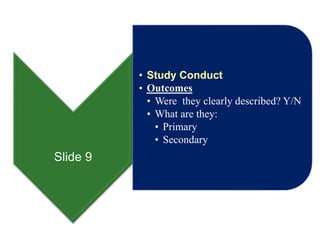
Slide 9
• Study Conduct
• Outcomes
• Were they clearly described? Y/N
• What are they:
• Primary
• Secondary
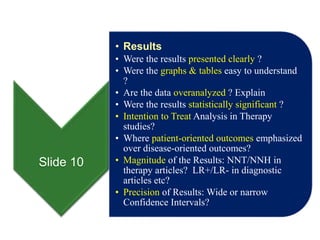
Slide 10
• Results
• Were the results presented clearly ?
• Were the graphs & tables easy to understand
?
• Are the data overanalyzed ? Explain
• Were the results statistically significant ?
• Intention to Treat Analysis in Therapy
studies?
• Where patient-oriented outcomes emphasized
over disease-oriented outcomes?
• Magnitude of the Results: NNT/NNH in
therapy articles? LR+/LR- in diagnostic
articles etc?
• Precision of Results: Wide or narrow
Confidence Intervals?
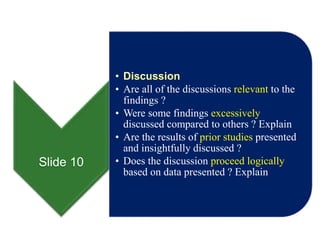
Slide 10
• Discussion
• Are all of the discussions relevant to the
findings ?
• Were some findings excessively
discussed compared to others ? Explain
• Are the results of prior studies presented
and insightfully discussed ?
• Does the discussion proceed logically
based on data presented ? Explain
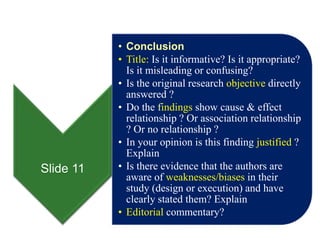
Slide 11
• Conclusion
• Title: Is it informative? Is it appropriate?
Is it misleading or confusing?
• Is the original research objective directly
answered ?
• Do the findings show cause & effect
relationship ? Or association relationship
? Or no relationship ?
• In your opinion is this finding justified ?
Explain
• Is there evidence that the authors are
aware of weaknesses/biases in their
study (design or execution) and have
clearly stated them? Explain
• Editorial commentary?
Actions after a
Journal Club?
Slide 12
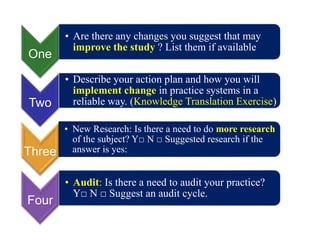
One
• Are there any changes you suggest that may
improve the study ? List them if available
Two
• Describe your action plan and how you will
implement change in practice systems in a
reliable way. (Knowledge Translation Exercise)
Three
• New Research: Is there a need to do more research
of the subject? Y□ N □ Suggested research if the
answer is yes:
Four
• Audit: Is there a need to audit your practice?
Y□ N □ Suggest an audit cycle.
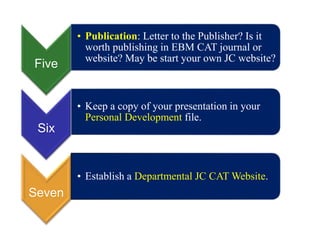
Five
• Publication: Letter to the Publisher? Is it
worth publishing in EBM CAT journal or
website? May be start your own JC website?
Six
• Keep a copy of your presentation in your
Personal Development file.
Seven
• Establish a Departmental JC CAT Website..
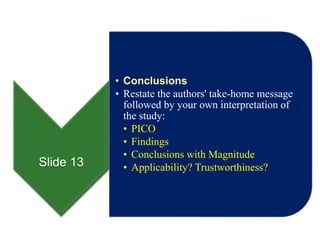
Slide 13
• Conclusions
• Restate the authors' take-home message
followed by your own interpretation of
the study:
• PICO
• Findings
• Conclusions with Magnitude
• Applicability? Trustworthiness?
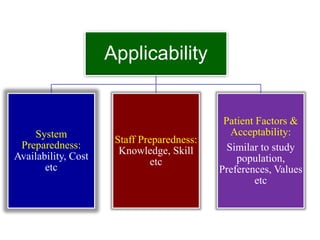
Applicability
System
Preparedness:
Availability, Cost
etc
Staff Preparedness:
Knowledge, Skill
etc
Patient Factors &
Acceptability:
Similar to study
population,
Preferences, Values
etc
Slide 14
• Open the floor for
Discussion
McMaster Online Rating of Evidence MORE
hiru.mcmaster.ca/more/InclusionCriteria.htm
hiru.mcmaster.ca/more/RatingFormSample.htm
Useful Links
Critical Appraisal Checklists & Calculators
http://www.gla.ac.uk/departments/generalpracticeprimarycare/ebp/ch
ecklists/#d.en.19536
Checklist for an article on treatment or prevention
Checklist for an article on qualitative research
Checklist for an article on decision analysis
Checklist for an article on an educational intervention
Checklist for an article on prognosis
Checklist for an article on harm or causation
Checklist for an article on guidelines
Checklist for an article on diagnosis or screening
Checklist for a systematic review
Checklist for economic evaluations
EBM toolbox/CATmaker http://www.cebm.net/?o=1023
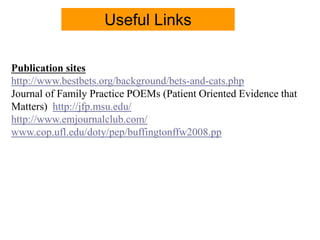
Useful Links
Publication sites
http://www.bestbets.org/background/bets-and-cats.php
Journal of Family Practice POEMs (Patient Oriented Evidence that
Matters) http://jfp.msu.edu/
http://www.emjournalclub.com/
www.cop.ufl.edu/doty/pep/buffingtonffw2008.pp
Useful Links
Acknowledgement
 Dr Kanaan Alshammari, MBChB Otago 08’
Senior Internal Medicine Resident,
 Dr Ali Al Shehri, SBIM, Assistant
Consultant.
 KAMC Internal Medicine Residents.
Journal club final  secrets v2   ss1

Journal club final secrets v2 ss1

  • 1.
    The Journal Club: ExploringNew Avenues Dr. Imad Salah Ahmed Hassan MD FACP FRCPI MemAcadMEd MSc MBBS Chairman, Knowledge Translation Committee Department of Medicine, KAMC,KSA
  • 2.
    The Journal Club: Oneof EBM Implementation Tools
  • 3.
    Objectives  Definition  History Goals  Benefits to practice site  How to select and present an article  What next?
  • 4.
    Objectives (cont’d)  Journalclub questions  Conducting a journal club The presentation Learning Outcomes Learning/Teaching Methods Assessment  Factors associated with successful journal clubs  Journal club models
  • 5.
    Definition  A groupof individuals who meet regularly to critically discuss applicability of current articles found in medical journals. Kleinpell RM. Rediscovering the value of the journal club. Am J Crit Care. 2002;11:412-4.
  • 6.
    At the beginning… •Thefirst journal club was founded by Sir James Paget, a British Surgeon in the mid-1800’s •“Small room over a baker’s shop near the Hospital-gate where we could sit and read the journals”
  • 7.
    At the beginning… •SirWilliam Osler established the first formalized journal club at McGill University in Montreal in 1875. •Purpose: “for the purchase and distribution of periodicals to which he could ill afford to subscribe”
  • 8.
    Medical Knowledge • UpdateKnowledge and support life-long learning. Skills: Training in evidence based medicine skills • JCs enhances literature searching skills, critical appraisal etc. Understand scientific concepts in Epidemiology and Biostatistics: • Basic study designs • Basic statistical approaches • Basic outcomes assessment methods. Objectives of a Journal Club today? Using the Journal Club to teach and assess competence in practice-based learning and improvement: a literature review and recommendation for implementation. Surv Ophthalmol. 2005 Nov-Dec;50(6):542-8.
  • 9.
    Communication Skills, Socialization, Democracy(Attitude) • Develop staff skills in presentation. Change of Practice (Quality Improvement) • Promotes evidence-based practice/clinical care. Enhances Staff’s Academic Output • Promotes Research and Audit. • Promotes Faculty Publications. Objectives of a Journal Club today? Using the Journal Club to teach and assess competence in practice-based learning and improvement: a literature review and recommendation for implementation. Surv Ophthalmol. 2005 Nov-Dec;50(6):542-8.
  • 10.
    •Letter to theeditor.1 • CAT Journals.2 • CAT and JC web publications.3 Enhances Staff’s Academic Output
  • 11.
    Knowledge Translation: Evidenceto Practice  Journal clubs have been advocated as a bridge between Research and Practice. Goodfellow LM. Can a journal club bridge the gap between research and practice? Nurse Educ. 2004 May-Jun;29(3):107-10.
  • 12.
    The Journal Club:Does it work? BMC Med Educ. 2006; 6: 43. Do community medicine residency trainees learn through journal club? An experience from a developing country? Saima Akhund et al Human Development Programme, Aga Khan University, Karachi, Pakistan Abstract Methods •Journal club effectiveness criteria were searched using electronic search databases. •Ninety percent of residents and alumni of Community Medicine Residency Programme participated voluntarily in a confidential survey.
  • 13.
    The Journal Club:Does it work? Results The CMR-JC was regularly conducted. More than 95% of residents attended. (Total residents in the CMR-Programme: 32). Twenty-seven out of 29 current residents/alumni responded to the anonymous questionnaire. Acquisition of critical appraisal skills (23 respondents) and keeping up with current literature (18 respondents) were the two most important objectives achieved. Respondents recommended improved faculty participation and incorporating a structured checklist for article review.
  • 14.
    Impact of amedical journal club on house-staff reading habits, knowledge, and critical appraisal skills. A randomized controlled trial. Linzer M et al To determine if a journal club improves house-staff reading habits, knowledge of epidemiology and biostatistics, and critical appraisal skills.  Randomized 44 medical interns to receive either a journal club or a control seminar series. A test instrument developed by the Delphi method was administered before and after the interventions (mean, five journal club sessions). The Journal Club: Does it work?
  • 15.
    •By self-report, 86%of the house staff in the journal club group improved their reading habits vs 0% in the control group.1 • Knowledge scores increased more in the journal club group than in the control group, and a trend was found toward more knowledge gained as more sessions were attended.2 • Ability to appraise critically a test article increased slightly in each group, but there was no significant difference between the groups.3 The Journal Club: Does it work?: A Randomized Study. Impact of a medical journal club on house-staff reading habits, knowledge, and critical appraisal skills. A randomized controlled trial. Linzer M et al
  • 16.
    We conclude thata journal club is a powerful motivator of critical house-staff reading behaviour and can help teach epidemiology and biostatistics to physicians-in-training. Conclusion Impact of a medical journal club on house-staff reading habits, knowledge, and critical appraisal skills. A randomized controlled trial. Linzer M et al
  • 17.
    A literature searchwas undertaken using 10 databases was made as to whether studies have found journal clubs for physicians in training to be: 1. Effective for improving patient care 2. Teaching critical appraisal skills 3. Improving reading habits 4. Increasing knowledge of clinical epidemiology and biostatistics 5. Increasing the use of medical literature in clinical practice. The Journal Club: Does it work? Ebbert JO et al. The journal club in postgraduate medical education: a systematic review. Department of Internal Medicine, Mayo Clinic, Rochester, Minnesota, USA. Med Teach. 2001 Sep;23(5):455-461
  • 18.
    • It isconcluded that journal clubs may improve knowledge of clinical epidemiology and biostatistics, reading habits, and the use of medical literature in practice. • A multi-centre, randomized controlled trial of journal clubs is needed to assess whether journal clubs improve critical appraisal skills. Conclusion Impact of a medical journal club on house-staff reading habits, knowledge, and critical appraisal skills. A randomized controlled trial. Linzer M et al Ebbert JO et al. The journal club in postgraduate medical education: a systematic review. Department of Internal Medicine, Mayo Clinic, Rochester, Minnesota, USA. Med Teach. 2001 Sep;23(5):455-461
  • 19.
  • 20.
    One • Regular andanticipated meetings. Two • Mandatory presentation and attendance. Three • Clear short- and long-term purpose: Education, Publications, Quality, Research etc . Four • Appropriate timing of meeting.
  • 21.
    Five • Incentives: Material,Food, Prizes etc. Six • A trained journal club leader to choose papers and lead discussion. Seven • Circulating papers prior to the meeting. Eight • Using the internet for wider dissemination and data storage.
  • 22.
    Nine • Using establishedcritical appraisal processes (EBM Staff Training). Ten • Summarizing journal club findings.
  • 24.
  • 25.
  • 26.
    Structure of JC Clinical Query: Foreground Question  PICO  Article Selection: Searching for Evidence/Literature Search  Appraising the Evidence: Critical Appraisal  Presentation  Critique and summary  Recommendations:  New research  Change or audit of current practice  Writing a letter to the editor  Publishing your appraisal in a CAT journal or website (own or in the WWW)
  • 27.
    Clinical Query: EBMApproach Ask clinical questions Acquire the best evidence Appraise the evidence Apply evidence to Your patient 5A’s !! Assess effectiveness, efficiency of EBM process
  • 28.
    Evidence-based Practice Ask clinical questions PICO Ask:Refine ability to convert need for information (e.g., therapy, prevention, diagnosis, prognosis) into an answerable question. PICO format for foreground questions: Educational Prescription
  • 29.
    Ask Clinical Questions:PICO Patient/ Population Outcome Intervention/ Exposure Comparison Components of Clinical Questions In patients with acute MI In post- menopausal women In women with suspected coronary disease does early treat- ment with a statin what is the accuracy of exercise ECHO does hormone replacement therapy compared to placebo compared to exercise ECG compared to no HRT decrease cardio- vascular mortality? for diagnosing significant CAD? increase the risk of breast cancer?
  • 30.
  • 31.
    Article Selection  Selectarticles from peer reviewed, quality journals.  Try to select recent articles ( write a Letter to the Editor!).  Choose a research paper rather than a review article that will not have a Methods section.  Use the McMaster MORE tool to choose your article. http://hiru.mcmaster.ca/MORE/InclusionCriteria.htm  A pair of articles may be good for a lively discussion particularly if they have opposite conclusions.
  • 32.
    Literature Search andRetrieval of Article(s) “Pubmed”: www.pubmed.org  Limits  Clinical Query  PubmedviaPICO  Askmedline Journal Websites:  www.acpjc.org  www.hematology.org/education/training/index.cfm  www.cancer.gov/clinicaltrials
  • 33.
    McMaster Online Ratingof Evidence (MORE)  McMaster University has created the McMaster Online Rating of Evidence (MORE) system to identify the highest-quality published research.  The ACP Journal Club uses the MORE system to select their articles.  Specific inclusion criteria have been delineated in order to distinguish papers with the highest scientific merit.
  • 34.
    McMaster Online Ratingof Evidence (MORE)  Articles that have passed this screening are then rated by clinicians on their clinical relevance and newsworthiness, using a graded scale.  With the help of your mentors and colleagues, you can use these criteria and the rating scale as informal guidelines to ensure that your chosen article merits presentation.
  • 35.
    Critical Appraisal  Youshould attempt to critically appraise the article with help from your mentor.  Use web-based/online CAT sites and Calculators
  • 36.
    Critical Appraisal Checklists http://www.gla.ac.uk/departments/generalpracticeprimarycare/ebp/ checklists/#d.en.19536  § Checklist for an article on treatment or prevention  § Checklist for an article on qualitative research  § Checklist for an article on decision analysis  § Checklist for an article on an educational intervention  § Checklist for an article on prognosis  § Checklist for an article on harm or causation  § Checklist for an article on guidelines  § Checklist for an article on diagnosis or screening  § Checklist for a systematic review  § Checklist for economic evaluations
  • 37.
    Critical Appraisal Calculators Oxford Centre for EBM: http://www.cebm.net/?o=1023
  • 38.
    Critical Appraisal: Shortcutsto Enriching your Journal Club  Check for an “Editorial Comment” (usually present in the same journal issue where the article was published).  Check for any “Letters to the Editor” relevant to the article of your choice in PubMed.  Check whether an appraisal of the article has been published in one of the ACP Journal Club issues (https://www.acponline.org/clinical-information/journals- publications/acp-journal-club).
  • 39.
    Critical Appraisal: Shortcutsto Enriching your Journal Club  Check whether an appraisal of the article has been published in the wiki Journal Club (https://www.wikijournalclub.org/wiki/Main_Page).  Check whether an appraisal of the article has been published in:  Google.  Pubmed  On-line websites e.g. Slide Share  Use keywords from the article title plus appraisal or journal club in your search terms.
  • 42.
    Preparing the Presentation Prepare your presentation on PowerPoint and discuss it with your mentor.  To make it easy for the trainees the Department of Medicine has created readymade Word Doc and PowerPoint Templates with Hyperlinks.  Templates  1.Doc  2.Ppt
  • 43.
    How to Usethe Template 1. Go through the template after selecting your JC article and before you read it!!! 2. Try to use McMaster rating before you appraise the article. 3. While reading it highlight what you need to include in your presentation: in a soft copy –use the copy and paste actions for text, tables, graphs etc! 4. Hyperlinks at the bottom are useful for understanding the concepts: critical appraisal, definitions and use of EBM calculators etc 5. Your maximum number of slides is the time allocated for your presentation in minutes provided you stick to the 6X6 slide rule and have rehearsed and timed yourself before- hand!!!! 6. Make sure your supervisor has seen and endorsed what you prepared!
  • 44.
    Slide 1 • EBMJournal Club number: • Date of meeting: • Name of Presenter: • Name of Supervisor: • Name of JC Facilitator/Time Keeper:
  • 45.
    Slide 2 • Source(Name of Journal): • Title of Article • Type of Question: Diagnostic  Therapeutic  Prognostic  Economic  Other: • Type of Study:  RCT  Retrospective  Cohort  Cross-sectional  Case- Control  Other: • Date published: • Number of Pages: • Quality of journal i.e. impact factor (get from Google!)
  • 46.
    Slide 3 • Clinicalscenario. Why have we asked this question? PICO • Describe your search method: • Search Terms/Keywords/Mesh terms • Search site/Search Engine • Limits used e.g. year of publication, type of study etc • Or Article of Interest chosen Slide 4 • Paste Abstract here: use several slides if it is long-remember the 6X6 rule in power-point presentations!
  • 47.
    Slide 5 • Relevance •Does it describe a common problem in your practice? • Does it address an important outcome ? • Is it Patient or Disease oriented (DOE vs POEM). • Would it lead to a change in practice if the study is valid? Slide 6 • Authors: • Do the authors have a reputation for well conducted research? (Check their research out- put in Pubmed) • Possible conflict of interest ? Was it disclosed?
  • 48.
    Slide 7 • IntroductionSection • Was key literature reviewed ? • Were weaknesses in current knowledge summarized ? • Is the problem for which research was done stated adequately? • Are objectives clearly stated ? • Are there definitions of all important terms ? List them • What is the null hypothesis – if any ?
  • 49.
    Slide 8 • MethodSection: Patients • Where Patients described fully in journal article-Inclusion/Exclusion: Yes/No • Was the sample chosen representative of the target population ? Explain • Were the time elements of the study clearly described ? Explain • What type of bias is present ? Describe them • What were the confounding variables: Demographics, Co-morbidity, Disease Severity etc? • Have ethical considerations been addressed ?
  • 50.
    Slide 9 • StudyConduct • Intervention (s) used in journal article: • What are they? • Where they appropriate? • Flow chart of the study Slide 10 • Study Conduct • Statistical tests of data described in journal article: • Their meaning • Appropriateness?
  • 51.
    Slide 9 • StudyConduct • Outcomes • Were they clearly described? Y/N • What are they: • Primary • Secondary
  • 52.
    Slide 10 • Results •Were the results presented clearly ? • Were the graphs & tables easy to understand ? • Are the data overanalyzed ? Explain • Were the results statistically significant ? • Intention to Treat Analysis in Therapy studies? • Where patient-oriented outcomes emphasized over disease-oriented outcomes? • Magnitude of the Results: NNT/NNH in therapy articles? LR+/LR- in diagnostic articles etc? • Precision of Results: Wide or narrow Confidence Intervals?
  • 53.
    Slide 10 • Discussion •Are all of the discussions relevant to the findings ? • Were some findings excessively discussed compared to others ? Explain • Are the results of prior studies presented and insightfully discussed ? • Does the discussion proceed logically based on data presented ? Explain
  • 54.
    Slide 11 • Conclusion •Title: Is it informative? Is it appropriate? Is it misleading or confusing? • Is the original research objective directly answered ? • Do the findings show cause & effect relationship ? Or association relationship ? Or no relationship ? • In your opinion is this finding justified ? Explain • Is there evidence that the authors are aware of weaknesses/biases in their study (design or execution) and have clearly stated them? Explain • Editorial commentary?
  • 55.
  • 56.
    One • Are thereany changes you suggest that may improve the study ? List them if available Two • Describe your action plan and how you will implement change in practice systems in a reliable way. (Knowledge Translation Exercise) Three • New Research: Is there a need to do more research of the subject? Y□ N □ Suggested research if the answer is yes: Four • Audit: Is there a need to audit your practice? Y□ N □ Suggest an audit cycle.
  • 57.
    Five • Publication: Letterto the Publisher? Is it worth publishing in EBM CAT journal or website? May be start your own JC website? Six • Keep a copy of your presentation in your Personal Development file. Seven • Establish a Departmental JC CAT Website..
  • 58.
    Slide 13 • Conclusions •Restate the authors' take-home message followed by your own interpretation of the study: • PICO • Findings • Conclusions with Magnitude • Applicability? Trustworthiness?
  • 59.
    Applicability System Preparedness: Availability, Cost etc Staff Preparedness: Knowledge,Skill etc Patient Factors & Acceptability: Similar to study population, Preferences, Values etc
  • 60.
    Slide 14 • Openthe floor for Discussion
  • 61.
    McMaster Online Ratingof Evidence MORE hiru.mcmaster.ca/more/InclusionCriteria.htm hiru.mcmaster.ca/more/RatingFormSample.htm Useful Links
  • 62.
    Critical Appraisal Checklists& Calculators http://www.gla.ac.uk/departments/generalpracticeprimarycare/ebp/ch ecklists/#d.en.19536 Checklist for an article on treatment or prevention Checklist for an article on qualitative research Checklist for an article on decision analysis Checklist for an article on an educational intervention Checklist for an article on prognosis Checklist for an article on harm or causation Checklist for an article on guidelines Checklist for an article on diagnosis or screening Checklist for a systematic review Checklist for economic evaluations EBM toolbox/CATmaker http://www.cebm.net/?o=1023 Useful Links
  • 63.
    Publication sites http://www.bestbets.org/background/bets-and-cats.php Journal ofFamily Practice POEMs (Patient Oriented Evidence that Matters) http://jfp.msu.edu/ http://www.emjournalclub.com/ www.cop.ufl.edu/doty/pep/buffingtonffw2008.pp Useful Links
  • 64.
    Acknowledgement  Dr KanaanAlshammari, MBChB Otago 08’ Senior Internal Medicine Resident,  Dr Ali Al Shehri, SBIM, Assistant Consultant.  KAMC Internal Medicine Residents.