LM1


        Provider
        Accreditation
        Guidelines


      Guidelines to providers of the
      Services SETA as outlined by SAQA


                  L. Meyer & D. E Damons
Slide 1

LM1       Linda Meyer, 2010/03/23
Overview
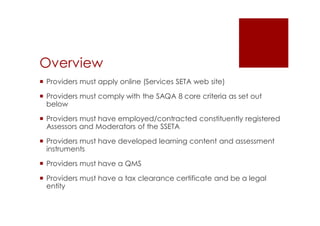
 Providers must apply online (Services SETA web site)

 Providers must comply with the SAQA 8 core criteria as set out
  below

 Providers must have employed/contracted constituently registered
  Assessors and Moderators of the SSETA

 Providers must have developed learning content and assessment
  instruments

 Providers must have a QMS

 Providers must have a tax clearance certificate and be a legal
  entity
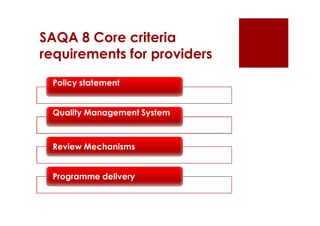
SAQA 8 Core criteria
requirements for providers
 Policy statement


 Quality Management System


 Review Mechanisms


 Programme delivery
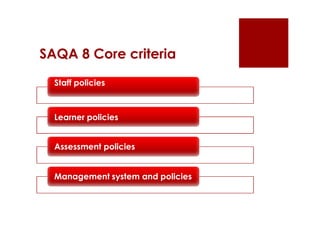
SAQA 8 Core criteria
  Staff policies


  Learner policies


  Assessment policies


  Management system and policies
Policy statement:
The organisation's aims, objectives
 and purposes are spelt out
The provider is Registered according
 to the applicable legislation:
 Registered as a Legal Entity
 Registered or in the process of
  registering with the Department of
  Education (DoE), Umalusi & CHE.
 SARS compliance
Policy statement

Provider Primary Focus:
 Legislation stipulates that “One
  provider one ETQA”. Is the provider
  accredited or in the process of
  being accredited by another ETQA?
 Verify provider non- primary focus
  learning programmes.
Quality Management
System QMS:

Outline procedures that implement
 quality management
Mission, Vision, and Goals of Training
 Provider:
Clear and unambiguous
Commitment to quality principles in
 Education, Training, and Development
Quality Management
System QMS:

Organisational Structure
Verify that theorganisational structure
 includes Facilitators, Moderators, and
 Assessors.
If service is outsourced (i.e. external
 facilitators, Assessment, Internal
 Moderation) check for contract or
 service level agreements.
Review mechanisms:

Outline the ways in which the
 implementation of policies would be
 monitored
Mechanisms for ensuring that the
 evaluation and amendment of
 policies and procedures are
 implemented, maintained and
 recorded.
Review mechanisms:

Verify on Management of Review
 Procedures.
Proof of Review Mechanisms, proof should
 include but not limited, to the following:
Internal review reports, Review meeting
 minutes, Implemented actions.
The Training Committee constitution,
 guidelines, administration policy and
 procedure (if applicable)
Programme delivery:
Outline how learning programmes
 would be developed, delivered and
 evaluated
Design and Development:
In respect of Integration Quality
 indicator, the provider must prove that
 the learning programme integrates
 theoretical and practical learning
 components, and Assessment thereof.
Programme delivery:

The learning programme/s are aligned
 to registered unit standards
The learning programme/s are in line
 with the targeted group
Programme delivery:

Learning Programme Delivery and
 Evaluation:
Suitability of staff
Relevance
Evaluation of learning programmes
Programme delivery:
The learning programme is aligned to
 registered unit standards.
The following must be verified:
 There is integration between the
  learning programme and Unit Standard
  and/or Qualification and the
  assessment thereof
 The learning programme is appropriate
  to the target audience
Programme delivery:
Learning activities are clearly
 documented
The learning outcomes to be achieved
 by the learner are clearly defined and
 documented
Formative and Summative assessment
 are clearly defined
Learning Material is in line with the
 providers policies and procedures.
Staff policies:
 Outline policies and procedures for staff
  selection, appraisal and development
 Human Resources Policies and Procedures:
 The provider should have details of staffing
  policies and procedures which includes but not
  limited to the following:
   Recruitment and Selection
   Promotions and Terminations
   Staff component i.e. permanent or
    contractual
   Staff development opportunities
Staff policies:

Details of Facilitators
Qualifications and Experience
 of the facilitators
Learning programmes each
 facilitator is delivering
Staff policies:

Details of Constituent Assessors
Qualifications and Experience of the
 assessor
Learning programmes each Assessor is
 assessing against
Confirmation of proof of registration
Staff policies:
Details of Registered Constituent
 Moderators
Qualifications and Experience of the
 moderator
Learning programmes being moderated
 by each moderator
Confirmation of proof of registration
Learner policies:

Policies and procedures for the selection
 of learners are outlined, and learners are
 given guidance and support
Policies and Procedures for capturing and
 maintaining learner records according to
 SAQA NLRD specifications.
 LEARNER GUIDANCE AND SUPPORT,
 CONFIDENTIALITY, AND FEEDBACK
Learner policies:

Policy and Procedure that ensures that
 the training provision is flexible and
 learner centred, which includes but not
 limited to the following:
 Entry requirements are as open as
   possible and make provision for RPL
Learner policies:
 Language Policy
 Provision for special needs i.e. Disabled
  learners ect.
Documentation on how feedback is
 communicated to the learner
The provider must address the learners’
 complaints and the procedure must be
 documented and implemented.
Confidentiality
Assessment policies:
Outline policies and procedures for
 forms of assessments that are used and
 how they are managed
The provider must have an Assessment
 policy in place, and must be
 implemented.
Assessment methods are relevant and in
 line with the SAQA registered unit
 standards and/or qualifications.
Assessment policies:

Moderation Policy and Procedure:
The policy reflect a fair, valid, and
 reliable moderation
Are moderators used to conduct
 moderation registered as constituent
 moderators?
Assessment policies:

Verify relevant experience and
 qualifications of the moderators; and
 subject matter expertise
SAQA principles of moderation have
 been followed.
Assessment policies:

Recognition of Prior Learning:
The criteria for RPL is stipulated in the
 policy
SAQA principles for RPL are stipulated in
 the policy and implemented.
Management system and
policies:
Indicate the financial, administrative and
 physical structures and resources of the
 organisation, as well as procedures of
 accountability within the organisation
There are proper financial resources,
 management and budgetary processes in
 place to sustain and conclude all contractual
 obligations in terms of the training provision
 throughout the accreditation period (e.g.
 Financial Statements).
Management system and
policies:
The Financial and Business Plan of
 theorganisationsupport the goals and mission
 and clearly indicate how they will enable the
 provider to achieve its goals and objectives.
There are policies and procedures for the
 accurate capturing, maintenance and
 regular updating of learner information and
 records (i.e. MIS system used to capture
 learner information complies with the NLRD
 requirements).
Management system and
policies:
Recording of Assessments and results
Recording of Moderation results ect.
Physical Resources:
Facilities, equipment, and learning
 materials support the learning process
 and are appropriate to the learning that
 is provided.
Management system and
policies:

Occupational Health and Safety
 compliance.
Policies and practices for the
 management of off-site practical or
 work-site components to ensure valid
 learning experience.
Questions ?


Thank you
Contact Details


    011 329 9000
www.knowledgeq.co.za

SETA Accreditation req -_updated

  • 1.
    LM1 Provider Accreditation Guidelines Guidelines to providers of the Services SETA as outlined by SAQA L. Meyer & D. E Damons
  • 2.
    Slide 1 LM1 Linda Meyer, 2010/03/23
  • 3.
    Overview  Providers mustapply online (Services SETA web site)  Providers must comply with the SAQA 8 core criteria as set out below  Providers must have employed/contracted constituently registered Assessors and Moderators of the SSETA  Providers must have developed learning content and assessment instruments  Providers must have a QMS  Providers must have a tax clearance certificate and be a legal entity
  • 4.
    SAQA 8 Corecriteria requirements for providers Policy statement Quality Management System Review Mechanisms Programme delivery
  • 5.
    SAQA 8 Corecriteria Staff policies Learner policies Assessment policies Management system and policies
  • 6.
    Policy statement: The organisation'saims, objectives and purposes are spelt out The provider is Registered according to the applicable legislation: Registered as a Legal Entity Registered or in the process of registering with the Department of Education (DoE), Umalusi & CHE. SARS compliance
  • 7.
    Policy statement Provider PrimaryFocus: Legislation stipulates that “One provider one ETQA”. Is the provider accredited or in the process of being accredited by another ETQA? Verify provider non- primary focus learning programmes.
  • 8.
    Quality Management System QMS: Outlineprocedures that implement quality management Mission, Vision, and Goals of Training Provider: Clear and unambiguous Commitment to quality principles in Education, Training, and Development
  • 9.
    Quality Management System QMS: OrganisationalStructure Verify that theorganisational structure includes Facilitators, Moderators, and Assessors. If service is outsourced (i.e. external facilitators, Assessment, Internal Moderation) check for contract or service level agreements.
  • 10.
    Review mechanisms: Outline theways in which the implementation of policies would be monitored Mechanisms for ensuring that the evaluation and amendment of policies and procedures are implemented, maintained and recorded.
  • 11.
    Review mechanisms: Verify onManagement of Review Procedures. Proof of Review Mechanisms, proof should include but not limited, to the following: Internal review reports, Review meeting minutes, Implemented actions. The Training Committee constitution, guidelines, administration policy and procedure (if applicable)
  • 12.
    Programme delivery: Outline howlearning programmes would be developed, delivered and evaluated Design and Development: In respect of Integration Quality indicator, the provider must prove that the learning programme integrates theoretical and practical learning components, and Assessment thereof.
  • 13.
    Programme delivery: The learningprogramme/s are aligned to registered unit standards The learning programme/s are in line with the targeted group
  • 14.
    Programme delivery: Learning ProgrammeDelivery and Evaluation: Suitability of staff Relevance Evaluation of learning programmes
  • 15.
    Programme delivery: The learningprogramme is aligned to registered unit standards. The following must be verified: There is integration between the learning programme and Unit Standard and/or Qualification and the assessment thereof The learning programme is appropriate to the target audience
  • 16.
    Programme delivery: Learning activitiesare clearly documented The learning outcomes to be achieved by the learner are clearly defined and documented Formative and Summative assessment are clearly defined Learning Material is in line with the providers policies and procedures.
  • 17.
    Staff policies:  Outlinepolicies and procedures for staff selection, appraisal and development  Human Resources Policies and Procedures:  The provider should have details of staffing policies and procedures which includes but not limited to the following:  Recruitment and Selection  Promotions and Terminations  Staff component i.e. permanent or contractual  Staff development opportunities
  • 18.
    Staff policies: Details ofFacilitators Qualifications and Experience of the facilitators Learning programmes each facilitator is delivering
  • 19.
    Staff policies: Details ofConstituent Assessors Qualifications and Experience of the assessor Learning programmes each Assessor is assessing against Confirmation of proof of registration
  • 20.
    Staff policies: Details ofRegistered Constituent Moderators Qualifications and Experience of the moderator Learning programmes being moderated by each moderator Confirmation of proof of registration
  • 21.
    Learner policies: Policies andprocedures for the selection of learners are outlined, and learners are given guidance and support Policies and Procedures for capturing and maintaining learner records according to SAQA NLRD specifications. LEARNER GUIDANCE AND SUPPORT, CONFIDENTIALITY, AND FEEDBACK
  • 22.
    Learner policies: Policy andProcedure that ensures that the training provision is flexible and learner centred, which includes but not limited to the following: Entry requirements are as open as possible and make provision for RPL
  • 23.
    Learner policies: LanguagePolicy Provision for special needs i.e. Disabled learners ect. Documentation on how feedback is communicated to the learner The provider must address the learners’ complaints and the procedure must be documented and implemented. Confidentiality
  • 24.
    Assessment policies: Outline policiesand procedures for forms of assessments that are used and how they are managed The provider must have an Assessment policy in place, and must be implemented. Assessment methods are relevant and in line with the SAQA registered unit standards and/or qualifications.
  • 25.
    Assessment policies: Moderation Policyand Procedure: The policy reflect a fair, valid, and reliable moderation Are moderators used to conduct moderation registered as constituent moderators?
  • 26.
    Assessment policies: Verify relevantexperience and qualifications of the moderators; and subject matter expertise SAQA principles of moderation have been followed.
  • 27.
    Assessment policies: Recognition ofPrior Learning: The criteria for RPL is stipulated in the policy SAQA principles for RPL are stipulated in the policy and implemented.
  • 28.
    Management system and policies: Indicatethe financial, administrative and physical structures and resources of the organisation, as well as procedures of accountability within the organisation There are proper financial resources, management and budgetary processes in place to sustain and conclude all contractual obligations in terms of the training provision throughout the accreditation period (e.g. Financial Statements).
  • 29.
    Management system and policies: TheFinancial and Business Plan of theorganisationsupport the goals and mission and clearly indicate how they will enable the provider to achieve its goals and objectives. There are policies and procedures for the accurate capturing, maintenance and regular updating of learner information and records (i.e. MIS system used to capture learner information complies with the NLRD requirements).
  • 30.
    Management system and policies: Recordingof Assessments and results Recording of Moderation results ect. Physical Resources: Facilities, equipment, and learning materials support the learning process and are appropriate to the learning that is provided.
  • 31.
    Management system and policies: OccupationalHealth and Safety compliance. Policies and practices for the management of off-site practical or work-site components to ensure valid learning experience.
  • 32.
  • 33.
    Contact Details 011 329 9000 www.knowledgeq.co.za