


AL TABABA
TRAINING
SERIES
Communication Mastery
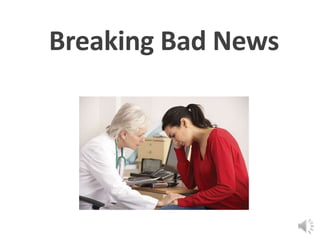
Breaking Bad News
NEWS!
Clinicians are the largest
professional group where breaking
bad news is an everyday exercise!
Breaking Bad News
Why should WE Master this
Skill?
Breaking Bad News Foundation, 2016:
Effective and compassionate communication between
clinicians and patients is associated with :
Medications and treatments: improved compliance
Patient coping: Less Distress
Decision making: Better Decision Making
The Breaking Bad News Foundation website also provides
educational videos and resources
(https://bbnprogram.com/).
Why should WE Master
this Skill?
The Essence of Humanity in
Medicine
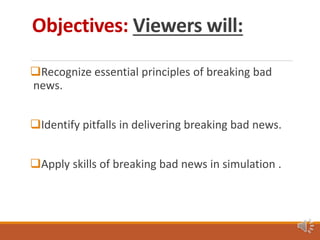
Objectives: Viewers will:
Recognize essential principles of breaking bad
news.
Identify pitfalls in delivering breaking bad news.
Apply skills of breaking bad news in simulation .
The bad news about
Breaking bad news
Is that bad news is
BAD NEWS
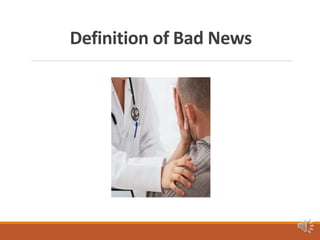
Definition of Bad News
Bad News
Any news that drastically and
negatively alters the patient’s
view of their future.
Buckman R. BMJ 1984
Bad News
Any news that drastically and
negatively alters the patient’s or
their loved ones view of their
future.
The Good News! about Bad
News!!!Easier than you thought!
Using a PLAN for determining the
patient’s understanding of the illness
etc. and their values
PLUS
their wishes for participation in
decision making.
Do You Tell?
Recent studies have shown that:
Patients generally (50-90%) desire full & frank
disclosure, though a sizeable minority still may not
want the full disclosure. (Ley p. Giving information
to patients. New York: Wiley, 1982)
So the issue is not “do you?”
Issue is “how?”
So How Do We Do This??
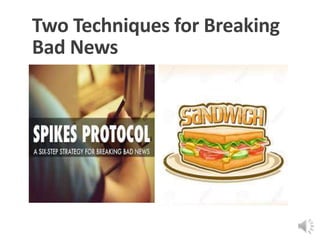
Two Techniques for Breaking
Bad News
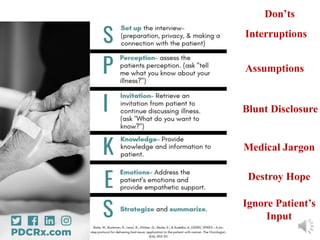
Don’ts
Ignore Patient’s
Input
Medical Jargon
Destroy Hope
Blunt Disclosure
Assumptions
Interruptions
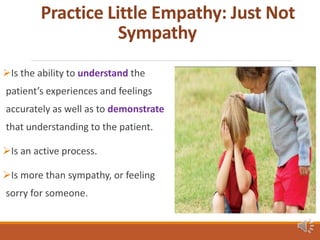
Practice Little Empathy: Just Not
Sympathy
Is the ability to understand the
patient’s experiences and feelings
accurately as well as to demonstrate
that understanding to the patient.
Is an active process.
Is more than sympathy, or feeling
sorry for someone.
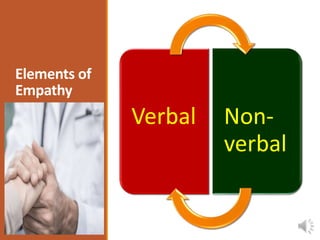
Elements of
Empathy
Verbal Non-
verbal
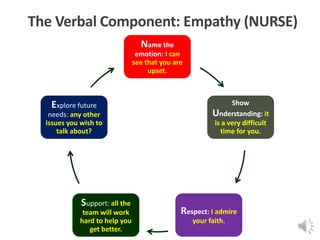
The Verbal Component: Empathy (NURSE)
Name the
emotion: I can
see that you are
upset.
Show
Understanding: it
is a very difficult
time for you.
Respect: I admire
your faith.
Support: all the
team will work
hard to help you
get better.
Explore future
needs: any other
issues you wish to
talk about?
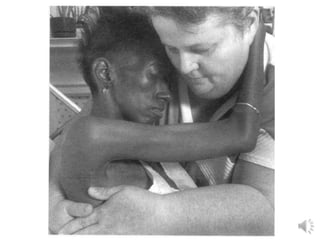
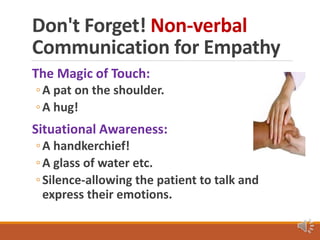
Don't Forget! Non-verbal
Communication for Empathy
The Magic of Touch:
◦A pat on the shoulder.
◦A hug!
Situational Awareness:
◦A handkerchief!
◦A glass of water etc.
◦Silence-allowing the patient to talk and
express their emotions.
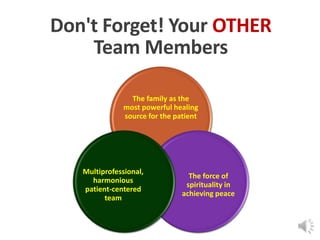
Don't Forget! Your OTHER
Team Members
The family as the
most powerful healing
source for the patient
The force of
spirituality in
achieving peace
Multiprofessional,
harmonious
patient-centered
team
Patientologist
Patientologists. They are empathetic; and understand what the
patient's fears and worries are, so that they can help them to
manage them.
How does a doctor become a good patientologist ? Unfortunately,
these skills are never taught formally in medical college.
Some doctors have a great bedside manner, because they have a
high EQ ( emotional quotient).
Others learn how to improve their patient skills by emulating their
teachers who are good clinicians
31
Do we need the SPIKES
Protocol for all Bad News?
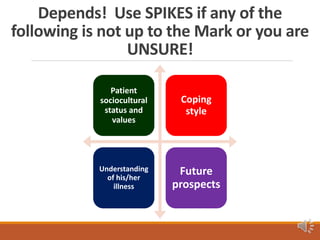
Depends! Use SPIKES if any of the
following is not up to the Mark or you are
UNSURE!
Patient
sociocultural
status and
values
Coping
style
Understanding
of his/her
illness
Future
prospects
Examples of Conditions
Requiring Breaking of Bad
News using SPIKES???!!!!
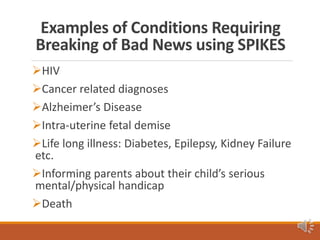
Examples of Conditions Requiring
Breaking of Bad News using SPIKES
HIV
Cancer related diagnoses
Alzheimer’s Disease
Intra-uterine fetal demise
Life long illness: Diabetes, Epilepsy, Kidney Failure
etc.
Informing parents about their child’s serious
mental/physical handicap
Death
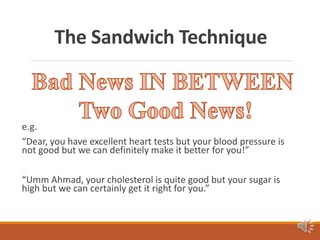
The Sandwich Technique: For
everyday bad news
The Sandwich Technique
e.g.
“Dear, you have excellent heart tests but your blood pressure is
not good but we can definitely make it better for you!”
“Umm Ahmad, your cholesterol is quite good but your sugar is
high but we can certainly get it right for you.”
What is NEXT?
•Practice the right way
of Breaking Bad News:
Apply them in your
everyday life!
Please visit and subscribe to
altababa.org

Breaking Bad News https://www.youtube.com/watch?v=AK1r-1gJkSk

  • 1.
  • 2.
  • 3.
    NEWS! Clinicians are thelargest professional group where breaking bad news is an everyday exercise!
  • 4.
  • 7.
    Why should WEMaster this Skill? Breaking Bad News Foundation, 2016: Effective and compassionate communication between clinicians and patients is associated with : Medications and treatments: improved compliance Patient coping: Less Distress Decision making: Better Decision Making The Breaking Bad News Foundation website also provides educational videos and resources (https://bbnprogram.com/).
  • 9.
    Why should WEMaster this Skill?
  • 10.
    The Essence ofHumanity in Medicine
  • 11.
    Objectives: Viewers will: Recognizeessential principles of breaking bad news. Identify pitfalls in delivering breaking bad news. Apply skills of breaking bad news in simulation .
  • 12.
    The bad newsabout Breaking bad news Is that bad news is BAD NEWS
  • 13.
  • 14.
    Bad News Any newsthat drastically and negatively alters the patient’s view of their future. Buckman R. BMJ 1984
  • 15.
    Bad News Any newsthat drastically and negatively alters the patient’s or their loved ones view of their future.
  • 16.
    The Good News!about Bad News!!!Easier than you thought! Using a PLAN for determining the patient’s understanding of the illness etc. and their values PLUS their wishes for participation in decision making.
  • 17.
    Do You Tell? Recentstudies have shown that: Patients generally (50-90%) desire full & frank disclosure, though a sizeable minority still may not want the full disclosure. (Ley p. Giving information to patients. New York: Wiley, 1982) So the issue is not “do you?” Issue is “how?”
  • 19.
    So How DoWe Do This??
  • 20.
    Two Techniques forBreaking Bad News
  • 23.
    Don’ts Ignore Patient’s Input Medical Jargon DestroyHope Blunt Disclosure Assumptions Interruptions
  • 26.
    Practice Little Empathy:Just Not Sympathy Is the ability to understand the patient’s experiences and feelings accurately as well as to demonstrate that understanding to the patient. Is an active process. Is more than sympathy, or feeling sorry for someone.
  • 27.
  • 28.
    The Verbal Component:Empathy (NURSE) Name the emotion: I can see that you are upset. Show Understanding: it is a very difficult time for you. Respect: I admire your faith. Support: all the team will work hard to help you get better. Explore future needs: any other issues you wish to talk about?
  • 29.
    Don't Forget! Non-verbal Communicationfor Empathy The Magic of Touch: ◦A pat on the shoulder. ◦A hug! Situational Awareness: ◦A handkerchief! ◦A glass of water etc. ◦Silence-allowing the patient to talk and express their emotions.
  • 30.
    Don't Forget! YourOTHER Team Members The family as the most powerful healing source for the patient The force of spirituality in achieving peace Multiprofessional, harmonious patient-centered team
  • 31.
    Patientologist Patientologists. They areempathetic; and understand what the patient's fears and worries are, so that they can help them to manage them. How does a doctor become a good patientologist ? Unfortunately, these skills are never taught formally in medical college. Some doctors have a great bedside manner, because they have a high EQ ( emotional quotient). Others learn how to improve their patient skills by emulating their teachers who are good clinicians 31
  • 32.
    Do we needthe SPIKES Protocol for all Bad News?
  • 33.
    Depends! Use SPIKESif any of the following is not up to the Mark or you are UNSURE! Patient sociocultural status and values Coping style Understanding of his/her illness Future prospects
  • 34.
    Examples of Conditions RequiringBreaking of Bad News using SPIKES???!!!!
  • 35.
    Examples of ConditionsRequiring Breaking of Bad News using SPIKES HIV Cancer related diagnoses Alzheimer’s Disease Intra-uterine fetal demise Life long illness: Diabetes, Epilepsy, Kidney Failure etc. Informing parents about their child’s serious mental/physical handicap Death
  • 36.
    The Sandwich Technique:For everyday bad news
  • 37.
    The Sandwich Technique e.g. “Dear,you have excellent heart tests but your blood pressure is not good but we can definitely make it better for you!” “Umm Ahmad, your cholesterol is quite good but your sugar is high but we can certainly get it right for you.”
  • 38.
    What is NEXT? •Practicethe right way of Breaking Bad News: Apply them in your everyday life!
  • 39.
    Please visit andsubscribe to altababa.org