Building a CBME
Curriculum
Redesigning the Curriculum
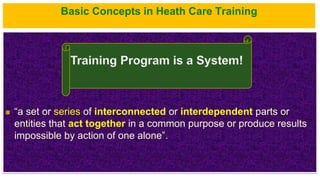
Basic Concepts in Heath Care Training
 “a set or series of interconnected or interdependent parts or
entities that act together in a common purpose or produce results
impossible by action of one alone”.
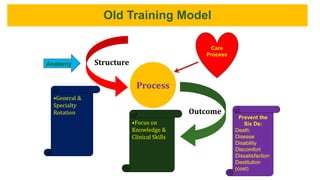
Old Training Model
Process
Structure
Outcome
Prevent the
Six Ds:
Death
Disease
Disability
Discomfort
Dissatisfaction
Destitution
(cost)
Care
Process
Anatomy
•Focus on
Knowledge &
Clinical Skills
•General &
Specialty
Rotation
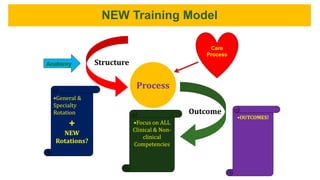
NEW Training Model
Process
Structure
Outcome
•OUTCOMES!
Care
Process
Anatomy
•Focus on ALL
Clinical & Non-
clinical
Competencies
•General &
Specialty
Rotation
+
NEW
Rotations?
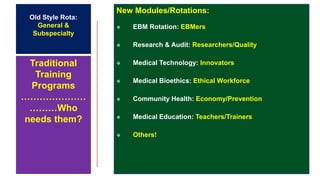
Old Style Rota:
General &
Subspecialty
Traditional
Training
Programs
…………………
………Who
needs them?
New Modules/Rotations:
 EBM Rotation: EBMers
 Research & Audit: Researchers/Quality
 Medical Technology: Innovators
 Medical Bioethics: Ethical Workforce
 Community Health: Economy/Prevention
 Medical Education: Teachers/Trainers
 Others!
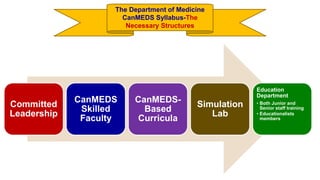
Committed
Leadership
CanMEDS
Skilled
Faculty
CanMEDS-
Based
Curricula
Simulation
Lab
Education
Department
• Both Junior and
Senior staff training
• Educationalists
members
The Department of Medicine
CanMEDS Syllabus-The
Necessary Structures
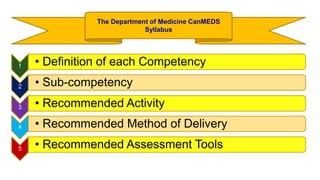
The Department of Medicine CanMEDS
Syllabus
1 • Definition of each Competency
2 • Sub-competency
3 • Recommended Activity
4 • Recommended Method of Delivery
5 • Recommended Assessment Tools
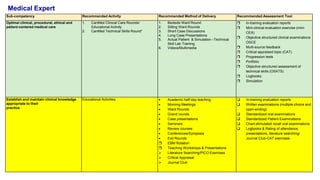
Sub-competency Recommended Activity Recommended Method of Delivery Recommended Assessment Tool
Optimal clinical, procedural, ethical and
patient-centered medical care
1. CanMed Clinical Care Rounds/
Educational Activity
2. CanMed Technical Skills Round*
1. Bedside Ward Round
2. Sitting Ward Rounds
3. Short Case Discussions
4. Long Case Presentations
5. Actual Patient & Simulation –Technical
Skill Lab Training
6. Videos/Multimedia
 In-training evaluation reports
 Mini-clinical evaluation exercise (mini-
CEX)
 Objective structured clinical examinations
OSCE
 Multi-source feedback
 Critical appraised topic (CAT)
 Progression tests
 Portfolio
 Objective structured assessment of
technical skills (OSATS)
 Logbooks
 Simulation
Establish and maintain clinical knowledge
appropriate to their
practice
Educational Activities  Academic half-day teaching
 Morning Meetings
 Ward Rounds
 Grand rounds
 Case presentations
 Seminars
 Review courses
 Conferences/Symposia
 Exit Rounds
 EBM Rotation
 Teaching Workshops & Presentations
 Literature Searching/PICO Exercises
 Critical Appraisal
 Journal Club
 In-training evaluation reports
 Written examinations (multiple choice and
open-ending)
 Standardized oral examinations
 Standardized Patient Examinations
 Chart-stimulated recall oral examinations
 Logbooks & Rating of attendance,
presentations, literature searching/
Journal Club-CAT exercises
Medical Expert
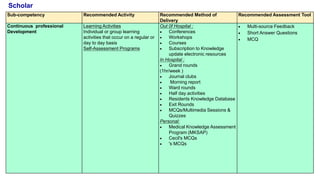
Sub-competency Recommended Activity Recommended Method of
Delivery
Recommended Assessment Tool
Continuous professional
Development
Learning Activities
Individual or group learning
activities that occur on a regular or
day to day basis
Self-Assessment Programs
Out 0f Hospital :
 Conferences
 Workshops
 Courses
 Subscription to Knowledge
update electronic resources
In Hospital :
 Grand rounds
(1hr/week )
 Journal clubs
 Morning report
 Ward rounds
 Half day activities
 Residents Knowledge Database
 Exit Rounds
 MCQs/Multimedia Sessions &
Quizzes
Personal:
 Medical Knowledge Assessment
Program (MKSAP)
 Cecil's MCQs
 's MCQs
 Multi-source Feedback
 Short Answer Questions
 MCQ
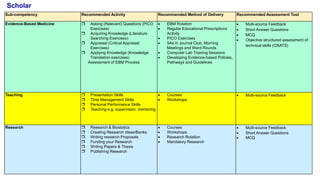
Scholar
Scholar
Sub-competency Recommended Activity Recommended Method of Delivery Recommended Assessment Tool
Evidence-Based Medicine  Asking (Relevant) Questions (PICO
Exercises)
 Acquiring Knowledge (Literature
Searching Exercises)
 Appraisal (Critical Appraisal
Exercises)
 Applying Knowledge (Knowledge
Translation exercises)
Assessment of EBM Process
 EBM Rotation
 Regular Educational Prescriptions
Activity
 PICO Exercises
 5As in Journal Club, Morning
Meetings and Ward Rounds
 Computer Lab Training Sessions
 Developing Evidence-based Policies,
Pathways and Guidelines
 Multi-source Feedback
 Short Answer Questions
 MCQ
 Objective structured assessment of
technical skills (OSATS)
Teaching  Presentation Skills
 Time Management Skills
 Personal Performance Skills
 Teaching e.g. supervision, mentoring
 Courses
 Workshops
 Multi-source Feedback
Research  Research & Biostatics
 Creating Research Ideas/Banks
 Writing research Proposals
 Funding your Research
 Writing Papers & Thesis
 Publishing Research
 Courses
 Workshops
 Research Rotation
 Mandatory Research
 Multi-source Feedback
 Short Answer Questions
 MCQ
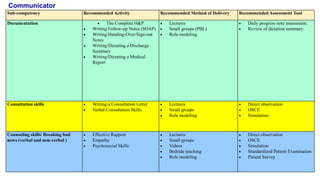
Sub-competency Recommended Activity Recommended Method of Delivery Recommended Assessment Tool
Documentation  The Complete H&P
 Writing Follow-up Notes (SOAP)
 Writing Handing-Over/Sign-out
Notes
 Writing/Dictating a Discharge
Summary
 Writing/Dictating a Medical
Report
 Lectures
 Small groups (PBL)
 Role modeling
 Daily progress note assessment.
 Review of dictation summary.
Consultation skills  Writing a Consultation Letter
 Verbal Consultation Skills
 Lectures
 Small groups
 Role modeling
 Direct observation
 OSCE
 Simulation
Counseling skills/ Breaking bad
news (verbal and non-verbal )
 Effective Rapport
 Empathy
 Psychosocial Skills
 Lectures
 Small groups
 Videos
 Bedside teaching
 Role modeling
 Direct observation
 OSCE
 Simulation
 Standardized Patient Examination
 Patient Survey
Communicator
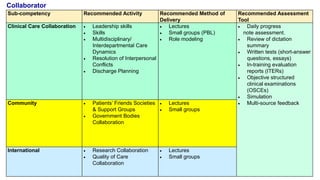
Sub-competency Recommended Activity Recommended Method of
Delivery
Recommended Assessment
Tool
Clinical Care Collaboration  Leadership skills
 Skills
 Multidisciplinary/
Interdepartmental Care
Dynamics
 Resolution of Interpersonal
Conflicts
 Discharge Planning
 Lectures
 Small groups (PBL)
 Role modeling
 Daily progress
note assessment.
 Review of dictation
summary
 Written tests (short-answer
questions, essays)
 In-training evaluation
reports (ITERs)
 Objective structured
clinical examinations
(OSCEs)
 Simulation
 Multi-source feedbackCommunity  Patients’ Friends Societies
& Support Groups
 Government Bodies
Collaboration
 Lectures
 Small groups
International  Research Collaboration
 Quality of Care
Collaboration
 Lectures
 Small groups
Collaborator
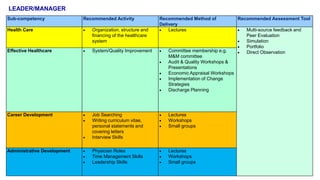
Sub-competency Recommended Activity Recommended Method of
Delivery
Recommended Assessment Tool
Health Care  Organization, structure and
financing of the healthcare
system
 Lectures  Multi-source feedback and
Peer Evaluation
 Simulation
 Portfolio
 Direct ObservationEffective Healthcare  System/Quality Improvement  Committee membership e.g.
M&M committee
 Audit & Quality Workshops &
Presentations
 Economic Appraisal Workshops
 Implementation of Change
Strategies
 Discharge Planning
Career Development  Job Searching
 Writing curriculum vitae,
personal statements and
covering letters
 Interview Skills
 Lectures
 Workshops
 Small groups
Administrative Development  Physician Roles
 Time Management Skills
 Leadership Skills
 Lectures
 Workshops
 Small groups
LEADER/MANAGER
Sub-competency Recommended Activity Recommended Method of Delivery Recommended Assessment Tool
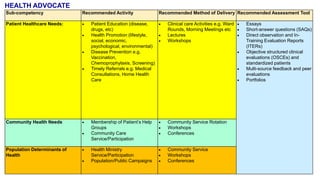
Patient Healthcare Needs:  Patient Education (disease,
drugs, etc)
 Health Promotion (lifestyle,
social, economic,
psychological, environmental)
 Disease Prevention e.g.
Vaccination,
Chemoprophylaxis, Screening)
 Timely Referrals e.g. Medical
Consultations, Home Health
Care
 Clinical care Activities e.g. Ward
Rounds, Morning Meetings etc
 Lectures
 Workshops
 Essays
 Short-answer questions (SAQs)
 Direct observation and In-
Training Evaluation Reports
(ITERs)
 Objective structured clinical
evaluations (OSCEs) and
standardized patients
 Multi-source feedback and peer
evaluations
 Portfolios
Community Health Needs  Membership of Patient’s Help
Groups
 Community Care
Service/Participation
 Community Service Rotation
 Workshops
 Conferences
Population Determinants of
Health
 Health Ministry
Service/Participation
 Population/Public Campaigns
 Community Service
 Workshops
 Conferences
HEALTH ADVOCATE
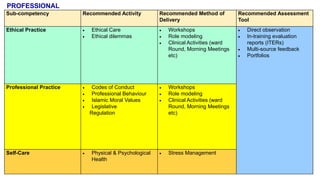
Sub-competency Recommended Activity Recommended Method of
Delivery
Recommended Assessment
Tool
Ethical Practice  Ethical Care
 Ethical dilemmas
 Workshops
 Role modeling
 Clinical Activities (ward
Round, Morning Meetings
etc)
 Direct observation
 In-training evaluation
reports (ITERs)
 Multi-source feedback
 Portfolios
Professional Practice  Codes of Conduct
 Professional Behaviour
 Islamic Moral Values
 Legislative
Regulation
 Workshops
 Role modeling
 Clinical Activities (ward
Round, Morning Meetings
etc)
Self-Care  Physical & Psychological
Health
 Stress Management
PROFESSIONAL
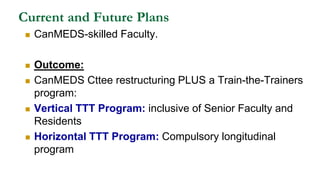
Current and Future Plans
 CanMEDS-skilled Faculty.
 Outcome:
 CanMEDS Cttee restructuring PLUS a Train-the-Trainers
program:
 Vertical TTT Program: inclusive of Senior Faculty and
Residents
 Horizontal TTT Program: Compulsory longitudinal
program
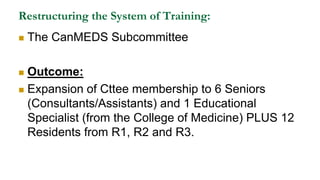
Restructuring the System of Training:
 The CanMEDS Subcommittee
 Outcome:
 Expansion of Cttee membership to 6 Seniors
(Consultants/Assistants) and 1 Educational
Specialist (from the College of Medicine) PLUS 12
Residents from R1, R2 and R3.
Restructuring the System of Training:
 The CanMEDS Training Proposal (Syllabus)
 Outcome:
 The CanMEDS Training Proposal is rich in its
content and will serve as a reference at least for
the initial drafting of the TTT educational curriculum
(together with other resources as outlined below).
The CanMEDS Champions: Faculty &
Resident
 Outcome:
 The new number of members will “set in motion”
the practical creation of skilled Champions (from
Seniors and Residents) by facilitating the
establishment of “ Competency-focused Micro
Teams” e.g. Micro-team for the Communicator
Role, Micro-team for the Professional Role etc.
The CanMEDS Champions: Faculty &
Resident
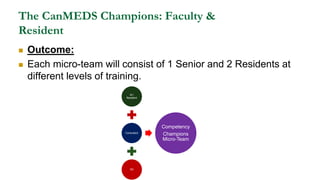
 Outcome:
 Each micro-team will consist of 1 Senior and 2 Residents at
different levels of training.
R1
Resident
Consultant
R2
Competency
Champions
Micro-Team
Train-the-Trainers Workshops
 Outcome:
 Each micro-team will be entrusted with the task of building a full-
curriculum for their allocated competency. Material (handouts,
power-point etc) prepared would have to be presented to the
committee and approved for inclusion in the TTT workshop.
 Resources from KAMC CanMEDS Collaborating centre CD as well
as from the RCP of Canada website may provide the micro-
teams with useful material.
 RCP of Canada CanMEDS best practice:
http://www.royalcollege.ca/portal/page/portal/rc/canmeds/whatworks
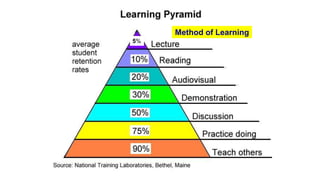
5%
Method of Learning
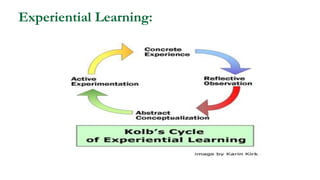
Experiential Learning:
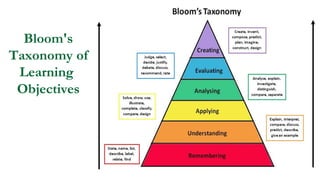
Bloom's
Taxonomy of
Learning
Objectives
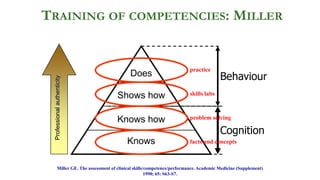
Miller GE. The assessment of clinical skills/competence/performance. Academic Medicine (Supplement)
1990; 65: S63-S7.
Knows
Shows how
Knows how
Does
Professionalauthenticity
Cognition
Behaviour
facts and concepts
problem solving
skills labs
practice
TRAINING OF COMPETENCIES: MILLER
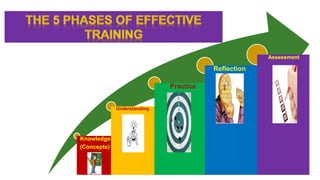
Knowledge
(Concepts)
Understanding
Practice
Reflection
Assessment
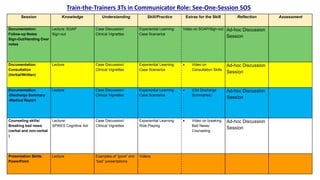
Session Knowledge Understanding Skill/Practice Extras for the Skill Reflection Assessment
Documentation:
Follow-up Notes
Sign-Out/Handing Over
notes
Lecture: SOAP
Sign-out
Case Discussion/
Clinical Vignettes
Experiential Learning:
Case Scenarios
Video on SOAP/Sign-out Ad-hoc Discussion
Session
Documentation:
Consultation
(Verbal/Written)
Lecture Case Discussion/
Clinical Vignettes
Experiential Learning:
Case Scenarios
 Video on
Consultation Skills
Ad-hoc Discussion
Session
Documentation:
-Discharge Summary
-Medical Report
Lecture Case Discussion/
Clinical Vignettes
Experiential Learning:
Case Scenarios
 (Old Discharge
Summaries)
Ad-hoc Discussion
Session
Counseling skills/
Breaking bad news
(verbal and non-verbal
)
Lecture/
SPIKES Cognitive Aid
Case Discussion/
Clinical Vignettes
Experiential Learning:
Role Playing
 Video on breaking
Bad News/
Counseling
Ad-hoc Discussion
Session
Presentation Skills:
PowerPoint
Lecture Examples of “good” and
“bad” presentations
Videos
Train-the-Trainers 3Ts in Communicator Role: See-One-Session SOS
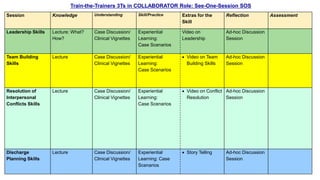
Session Knowledge Understanding Skill/Practice Extras for the
Skill
Reflection Assessment
Leadership Skills Lecture: What?
How?
Case Discussion/
Clinical Vignettes
Experiential
Learning:
Case Scenarios
Video on
Leadership
Ad-hoc Discussion
Session
Team Building
Skills
Lecture Case Discussion/
Clinical Vignettes
Experiential
Learning:
Case Scenarios
 Video on Team
Building Skills
Ad-hoc Discussion
Session
Resolution of
Interpersonal
Conflicts Skills
Lecture Case Discussion/
Clinical Vignettes
Experiential
Learning:
Case Scenarios
 Video on Conflict
Resolution
Ad-hoc Discussion
Session
Discharge
Planning Skills
Lecture Case Discussion/
Clinical Vignettes
Experiential
Learning: Case
Scenarios
 Story Telling Ad-hoc Discussion
Session
Train-the-Trainers 3Ts in COLLABORATOR Role: See-One-Session SOS
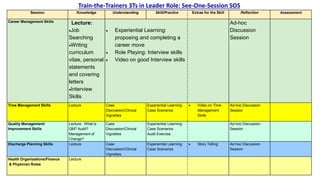
Session Knowledge Understanding Skill/Practice Extras for the Skill Reflection Assessment
Career Management Skills Lecture:
Job
Searching
Writing
curriculum
vitae, personal
statements
and covering
letters
Interview
Skills
 Experiential Learning:
proposing and completing a
career move
 Role Playing: Interview skills
 Video on good Interview skills
Ad-hoc
Discussion
Session
Time Management Skills Lecture Case
Discussion/Clinical
Vignettes
Experiential Learning:
Case Scenarios
 Video on Time
Management
Skills
Ad-hoc Discussion
Session
Quality Management/
Improvement Skills
Lecture : What is
QM? Audit?
Management of
Change?
Case
Discussion/Clinical
Vignettes
Experiential Learning:
Case Scenarios
Audit Exercise
Ad-hoc Discussion
Session
Discharge Planning Skills Lecture Case
Discussion/Clinical
Vignettes
Experiential Learning:
Case Scenarios
 Story Telling Ad-hoc Discussion
Session
Health Organizations/Finance
& Physician Roles
Lecture
Train-the-Trainers 3Ts in Leader Role: See-One-Session SOS
Restructuring the Process
of Training
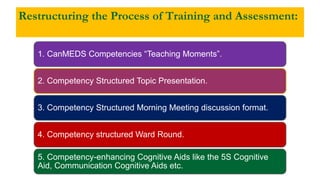
Restructuring the Process of Training and Assessment:
1. CanMEDS Competencies “Teaching Moments”.
2. Competency Structured Topic Presentation.
3. Competency Structured Morning Meeting discussion format.
4. Competency structured Ward Round.
5. Competency-enhancing Cognitive Aids like the 5S Cognitive
Aid, Communication Cognitive Aids etc.
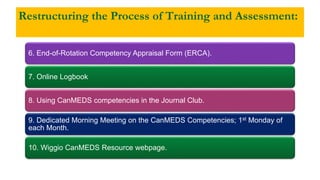
Restructuring the Process of Training and Assessment:
6. End-of-Rotation Competency Appraisal Form (ERCA).
7. Online Logbook
8. Using CanMEDS competencies in the Journal Club.
9. Dedicated Morning Meeting on the CanMEDS Competencies; 1st Monday of
each Month.
10. Wiggio CanMEDS Resource webpage.
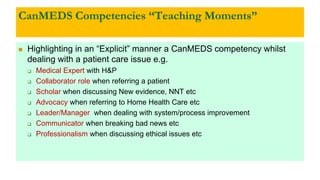
CanMEDS Competencies “Teaching Moments”
 Highlighting in an “Explicit” manner a CanMEDS competency whilst
dealing with a patient care issue e.g.
 Medical Expert with H&P
 Collaborator role when referring a patient
 Scholar when discussing New evidence, NNT etc
 Advocacy when referring to Home Health Care etc
 Leader/Manager when dealing with system/process improvement
 Communicator when breaking bad news etc
 Professionalism when discussing ethical issues etc
The Competency Structured Presentation (CSP)
 Classically and for educational purposes both undergraduates
and postgraduates present clinical topics in a narrative or
case-based style.
 In both of these, classic headings that are used include
definitions, etiology, epidemiology, clinical presentation,
differential diagnosis, investigations, therapy and prognosis
etc.
The Competency Structured Presentation (CSP)
 These formats of presentation do not explicitly
emphasize the new domains of knowledge or skills
necessary for both quality of care as outlined above or
empower the trainees with all the competencies outlined
by CanMeds or similar bodies for a comprehensive
outcome-based training and patient care.
The Competency Structured Presentation (CSP)
 Topic heading are now deliberately portrayed under
competency headings.
 Presumably, this conceptual framework or map would assist in
realizing a more competency-directed clinical training and
decision making and in drafting a comprehensive, high-
quality management plan for every patient.
 Practical patient-centered care actions and interventions may
thus be incorporated in the clinical decision process.
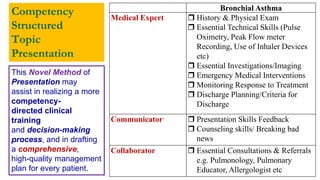
Competency
Structured
Topic
Presentation
Bronchial Asthma
Medical Expert  History & Physical Exam
 Essential Technical Skills (Pulse
Oximetry, Peak Flow meter
Recording, Use of Inhaler Devices
etc)
 Essential Investigations/Imaging
 Emergency Medical Interventions
 Monitoring Response to Treatment
 Discharge Planning/Criteria for
Discharge
Communicator  Presentation Skills Feedback
 Counseling skills/ Breaking bad
news
Collaborator  Essential Consultations & Referrals
e.g. Pulmonology, Pulmonary
Educator, Allergologist etc
This Novel Method of
Presentation may
assist in realizing a more
competency-
directed clinical
training
and decision-making
process, and in drafting
a comprehensive,
high-quality management
plan for every patient.
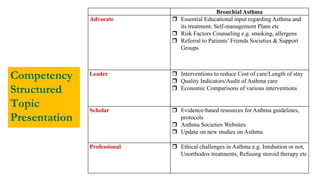
Competency
Structured
Topic
Presentation
Bronchial Asthma
Advocate  Essential Educational input regarding Asthma and
its treatment, Self-management Plans etc
 Risk Factors Counseling e.g. smoking, allergens
 Referral to Patients’ Friends Societies & Support
Groups
Leader  Interventions to reduce Cost of care/Length of stay
 Quality Indicators/Audit of Asthma care
 Economic Comparisons of various interventions
Scholar  Evidence-based resources for Asthma guidelines,
protocols
 Asthma Societies Websites
 Update on new studies on Asthma
Professional  Ethical challenges in Asthma e.g. Intubation or not,
Unorthodox treatments, Refusing steroid therapy etc
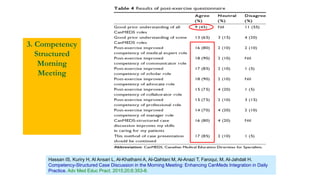
3. Competency
Structured
Morning
Meeting
Hassan IS, Kuriry H, Al Ansari L, Al-Khathami A, Al-Qahtani M, Al-Anazi T, Faroqui, M, Al-Jahdali H.
Competency-Structured Case Discussion in the Morning Meeting: Enhancing CanMeds Integration in Daily
Practice. Adv Med Educ Pract. 2015;20;6:353-8.
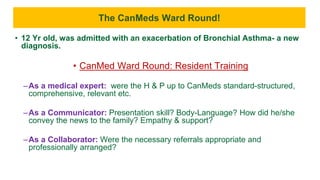
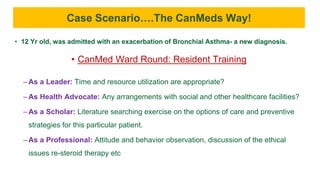
The CanMeds Ward Round!
• 12 Yr old, was admitted with an exacerbation of Bronchial Asthma- a new
diagnosis.
• CanMed Ward Round: Resident Training
–As a medical expert: were the H & P up to CanMeds standard-structured,
comprehensive, relevant etc.
–As a Communicator: Presentation skill? Body-Language? How did he/she
convey the news to the family? Empathy & support?
–As a Collaborator: Were the necessary referrals appropriate and
professionally arranged?
• 12 Yr old, was admitted with an exacerbation of Bronchial Asthma- a new diagnosis.
• CanMed Ward Round: Resident Training
– As a Leader: Time and resource utilization are appropriate?
– As Health Advocate: Any arrangements with social and other healthcare facilities?
– As a Scholar: Literature searching exercise on the options of care and preventive
strategies for this particular patient.
– As a Professional: Attitude and behavior observation, discussion of the ethical
issues re-steroid therapy etc
Case Scenario….The CanMeds Way!
End-of-Rotation Competency Appraisal Form (ERCA).
 Resident is requested to:
1. Select specific patient care issues
2. Itemize them and
3. Illustrate the selected CanMEDS competency intervention
that was used to deal with each of them.
End-of-Rotation Competency Appraisal Form (ERCA).
 An example courtesy of
Dr Raed Al Enazi R1.
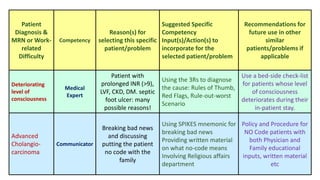
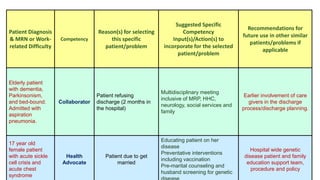
Patient
Diagnosis &
MRN or Work-
related
Difficulty
Competency
Reason(s) for
selecting this specific
patient/problem
Suggested Specific
Competency
Input(s)/Action(s) to
incorporate for the
selected patient/problem
Recommendations for
future use in other
similar
patients/problems if
applicable
Deteriorating
level of
consciousness
Medical
Expert
Patient with
prolonged INR (>9),
LVF, CKD, DM. septic
foot ulcer: many
possible reasons!
Using the 3Rs to diagnose
the cause: Rules of Thumb,
Red Flags, Rule-out-worst
Scenario
Use a bed-side check-list
for patients whose level
of consciousness
deteriorates during their
in-patient stay.
Advanced
Cholangio-
carcinoma
Communicator
Breaking bad news
and discussing
putting the patient
no code with the
family
Using SPIKES mnemonic for
breaking bad news
Providing written material
on what no-code means
Involving Religious affairs
department
Policy and Procedure for
NO Code patients with
both Physician and
Family educational
inputs, written material
etc
Patient Diagnosis
& MRN or Work-
related Difficulty
Competency
Reason(s) for selecting
this specific
patient/problem
Suggested Specific
Competency
Input(s)/Action(s) to
incorporate for the selected
patient/problem
Recommendations for
future use in other similar
patients/problems if
applicable
Elderly patient
with dementia,
Parkinsonism,
and bed-bound.
Admitted with
aspiration
pneumonia.
Collaborator
Patient refusing
discharge (2 months in
the hospital)
Multidisciplinary meeting
inclusive of MRP, HHC,
neurology, social services and
family
Earlier involvement of care
givers in the discharge
process/discharge planning.
17 year old
female patient
with acute sickle
cell crisis and
acute chest
syndrome
Health
Advocate
Patient due to get
married
Educating patient on her
disease
Preventative interventions
including vaccination
Pre-marital counseling and
husband screening for genetic
Hospital wide genetic
disease patient and family
education support team,
procedure and policy
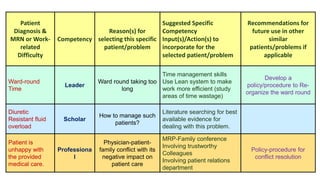
Patient
Diagnosis &
MRN or Work-
related
Difficulty
Competency
Reason(s) for
selecting this specific
patient/problem
Suggested Specific
Competency
Input(s)/Action(s) to
incorporate for the
selected patient/problem
Recommendations for
future use in other
similar
patients/problems if
applicable
Ward-round
Time
Leader
Ward round taking too
long
Time management skills
Use Lean system to make
work more efficient (study
areas of time wastage)
Develop a
policy/procedure to Re-
organize the ward round
Diuretic
Resistant fluid
overload
Scholar
How to manage such
patients?
Literature searching for best
available evidence for
dealing with this problem.
Patient is
unhappy with
the provided
medical care.
Professiona
l
Physician-patient-
family conflict with its
negative impact on
patient care
MRP-Family conference
Involving trustworthy
Colleagues
Involving patient relations
department
Policy-procedure for
conflict resolution
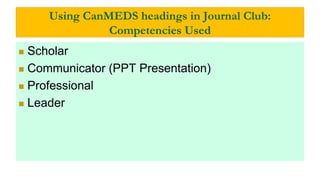
Using CanMEDS headings in Journal Club:
Competencies Used
 Scholar
 Communicator (PPT Presentation)
 Professional
 Leader
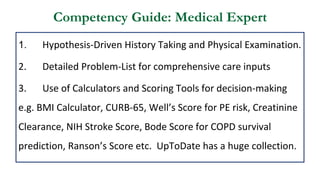
Competency Guide: Medical Expert
1. Hypothesis-Driven History Taking and Physical Examination.
2. Detailed Problem-List for comprehensive care inputs
3. Use of Calculators and Scoring Tools for decision-making
e.g. BMI Calculator, CURB-65, Well’s Score for PE risk, Creatinine
Clearance, NIH Stroke Score, Bode Score for COPD survival
prediction, Ranson’s Score etc. UpToDate has a huge collection.
Competency Guide: Medical Expert
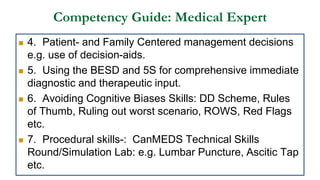
 4. Patient- and Family Centered management decisions
e.g. use of decision-aids.
 5. Using the BESD and 5S for comprehensive immediate
diagnostic and therapeutic input.
 6. Avoiding Cognitive Biases Skills: DD Scheme, Rules
of Thumb, Ruling out worst scenario, ROWS, Red Flags
etc.
 7. Procedural skills-: CanMEDS Technical Skills
Round/Simulation Lab: e.g. Lumbar Puncture, Ascitic Tap
etc.
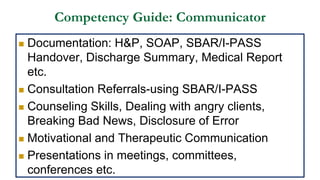
Competency Guide: Communicator
 Documentation: H&P, SOAP, SBAR/I-PASS
Handover, Discharge Summary, Medical Report
etc.
 Consultation Referrals-using SBAR/I-PASS
 Counseling Skills, Dealing with angry clients,
Breaking Bad News, Disclosure of Error
 Motivational and Therapeutic Communication
 Presentations in meetings, committees,
conferences etc.
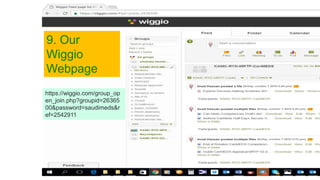
9. Our
Wiggio
Webpage
https://wiggio.com/group_op
en_join.php?groupid=26365
00&password=saudimeds&r
ef=2542911
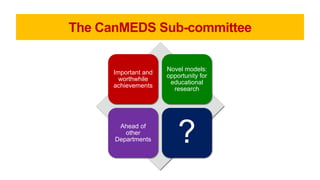
The CanMEDS Sub-committee
Important and
worthwhile
achievements
Novel models:
opportunity for
educational
research
Ahead of
other
Departments ?
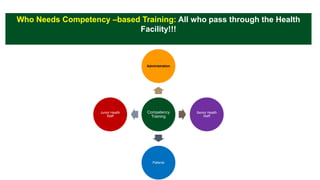
Competency
Training
Administration
Senior Health
Staff
Patients
Junior Health
Staff
Who Needs Competency –based Training: All who pass through the Health
Facility!!!
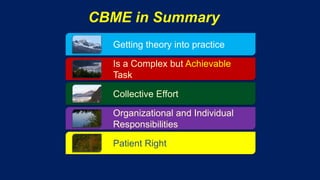
CBME in Summary
Getting theory into practice
Is a Complex but Achievable
Task
Collective Effort
Organizational and Individual
Responsibilities
Patient Right
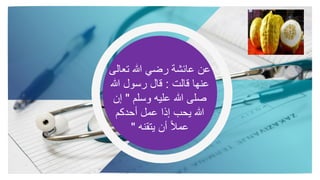
‫تعالى‬ ‫هللا‬ ‫رضي‬ ‫عائشة‬ ‫عن‬
‫قالت‬ ‫عنها‬:‫هللا‬ ‫رسول‬ ‫قال‬
‫وسلم‬ ‫عليه‬ ‫هللا‬ ‫صلى‬"‫إن‬
‫أحدكم‬ ‫عمل‬ ‫إذا‬ ‫يحب‬ ‫هللا‬
‫يتقنه‬ ‫أن‬ ً‫ال‬‫عم‬"

Competency-based Medical Education Curriculum

  • 1.
  • 2.
  • 4.
    Basic Concepts inHeath Care Training  “a set or series of interconnected or interdependent parts or entities that act together in a common purpose or produce results impossible by action of one alone”.
  • 5.
    Old Training Model Process Structure Outcome Preventthe Six Ds: Death Disease Disability Discomfort Dissatisfaction Destitution (cost) Care Process Anatomy •Focus on Knowledge & Clinical Skills •General & Specialty Rotation
  • 6.
    NEW Training Model Process Structure Outcome •OUTCOMES! Care Process Anatomy •Focuson ALL Clinical & Non- clinical Competencies •General & Specialty Rotation + NEW Rotations?
  • 7.
    Old Style Rota: General& Subspecialty Traditional Training Programs ………………… ………Who needs them? New Modules/Rotations:  EBM Rotation: EBMers  Research & Audit: Researchers/Quality  Medical Technology: Innovators  Medical Bioethics: Ethical Workforce  Community Health: Economy/Prevention  Medical Education: Teachers/Trainers  Others!
  • 8.
    Committed Leadership CanMEDS Skilled Faculty CanMEDS- Based Curricula Simulation Lab Education Department • Both Juniorand Senior staff training • Educationalists members The Department of Medicine CanMEDS Syllabus-The Necessary Structures
  • 9.
    The Department ofMedicine CanMEDS Syllabus 1 • Definition of each Competency 2 • Sub-competency 3 • Recommended Activity 4 • Recommended Method of Delivery 5 • Recommended Assessment Tools
  • 10.
    Sub-competency Recommended ActivityRecommended Method of Delivery Recommended Assessment Tool Optimal clinical, procedural, ethical and patient-centered medical care 1. CanMed Clinical Care Rounds/ Educational Activity 2. CanMed Technical Skills Round* 1. Bedside Ward Round 2. Sitting Ward Rounds 3. Short Case Discussions 4. Long Case Presentations 5. Actual Patient & Simulation –Technical Skill Lab Training 6. Videos/Multimedia  In-training evaluation reports  Mini-clinical evaluation exercise (mini- CEX)  Objective structured clinical examinations OSCE  Multi-source feedback  Critical appraised topic (CAT)  Progression tests  Portfolio  Objective structured assessment of technical skills (OSATS)  Logbooks  Simulation Establish and maintain clinical knowledge appropriate to their practice Educational Activities  Academic half-day teaching  Morning Meetings  Ward Rounds  Grand rounds  Case presentations  Seminars  Review courses  Conferences/Symposia  Exit Rounds  EBM Rotation  Teaching Workshops & Presentations  Literature Searching/PICO Exercises  Critical Appraisal  Journal Club  In-training evaluation reports  Written examinations (multiple choice and open-ending)  Standardized oral examinations  Standardized Patient Examinations  Chart-stimulated recall oral examinations  Logbooks & Rating of attendance, presentations, literature searching/ Journal Club-CAT exercises Medical Expert
  • 11.
    Sub-competency Recommended ActivityRecommended Method of Delivery Recommended Assessment Tool Continuous professional Development Learning Activities Individual or group learning activities that occur on a regular or day to day basis Self-Assessment Programs Out 0f Hospital :  Conferences  Workshops  Courses  Subscription to Knowledge update electronic resources In Hospital :  Grand rounds (1hr/week )  Journal clubs  Morning report  Ward rounds  Half day activities  Residents Knowledge Database  Exit Rounds  MCQs/Multimedia Sessions & Quizzes Personal:  Medical Knowledge Assessment Program (MKSAP)  Cecil's MCQs  's MCQs  Multi-source Feedback  Short Answer Questions  MCQ Scholar
  • 12.
    Scholar Sub-competency Recommended ActivityRecommended Method of Delivery Recommended Assessment Tool Evidence-Based Medicine  Asking (Relevant) Questions (PICO Exercises)  Acquiring Knowledge (Literature Searching Exercises)  Appraisal (Critical Appraisal Exercises)  Applying Knowledge (Knowledge Translation exercises) Assessment of EBM Process  EBM Rotation  Regular Educational Prescriptions Activity  PICO Exercises  5As in Journal Club, Morning Meetings and Ward Rounds  Computer Lab Training Sessions  Developing Evidence-based Policies, Pathways and Guidelines  Multi-source Feedback  Short Answer Questions  MCQ  Objective structured assessment of technical skills (OSATS) Teaching  Presentation Skills  Time Management Skills  Personal Performance Skills  Teaching e.g. supervision, mentoring  Courses  Workshops  Multi-source Feedback Research  Research & Biostatics  Creating Research Ideas/Banks  Writing research Proposals  Funding your Research  Writing Papers & Thesis  Publishing Research  Courses  Workshops  Research Rotation  Mandatory Research  Multi-source Feedback  Short Answer Questions  MCQ
  • 13.
    Sub-competency Recommended ActivityRecommended Method of Delivery Recommended Assessment Tool Documentation  The Complete H&P  Writing Follow-up Notes (SOAP)  Writing Handing-Over/Sign-out Notes  Writing/Dictating a Discharge Summary  Writing/Dictating a Medical Report  Lectures  Small groups (PBL)  Role modeling  Daily progress note assessment.  Review of dictation summary. Consultation skills  Writing a Consultation Letter  Verbal Consultation Skills  Lectures  Small groups  Role modeling  Direct observation  OSCE  Simulation Counseling skills/ Breaking bad news (verbal and non-verbal )  Effective Rapport  Empathy  Psychosocial Skills  Lectures  Small groups  Videos  Bedside teaching  Role modeling  Direct observation  OSCE  Simulation  Standardized Patient Examination  Patient Survey Communicator
  • 14.
    Sub-competency Recommended ActivityRecommended Method of Delivery Recommended Assessment Tool Clinical Care Collaboration  Leadership skills  Skills  Multidisciplinary/ Interdepartmental Care Dynamics  Resolution of Interpersonal Conflicts  Discharge Planning  Lectures  Small groups (PBL)  Role modeling  Daily progress note assessment.  Review of dictation summary  Written tests (short-answer questions, essays)  In-training evaluation reports (ITERs)  Objective structured clinical examinations (OSCEs)  Simulation  Multi-source feedbackCommunity  Patients’ Friends Societies & Support Groups  Government Bodies Collaboration  Lectures  Small groups International  Research Collaboration  Quality of Care Collaboration  Lectures  Small groups Collaborator
  • 15.
    Sub-competency Recommended ActivityRecommended Method of Delivery Recommended Assessment Tool Health Care  Organization, structure and financing of the healthcare system  Lectures  Multi-source feedback and Peer Evaluation  Simulation  Portfolio  Direct ObservationEffective Healthcare  System/Quality Improvement  Committee membership e.g. M&M committee  Audit & Quality Workshops & Presentations  Economic Appraisal Workshops  Implementation of Change Strategies  Discharge Planning Career Development  Job Searching  Writing curriculum vitae, personal statements and covering letters  Interview Skills  Lectures  Workshops  Small groups Administrative Development  Physician Roles  Time Management Skills  Leadership Skills  Lectures  Workshops  Small groups LEADER/MANAGER
  • 16.
    Sub-competency Recommended ActivityRecommended Method of Delivery Recommended Assessment Tool Patient Healthcare Needs:  Patient Education (disease, drugs, etc)  Health Promotion (lifestyle, social, economic, psychological, environmental)  Disease Prevention e.g. Vaccination, Chemoprophylaxis, Screening)  Timely Referrals e.g. Medical Consultations, Home Health Care  Clinical care Activities e.g. Ward Rounds, Morning Meetings etc  Lectures  Workshops  Essays  Short-answer questions (SAQs)  Direct observation and In- Training Evaluation Reports (ITERs)  Objective structured clinical evaluations (OSCEs) and standardized patients  Multi-source feedback and peer evaluations  Portfolios Community Health Needs  Membership of Patient’s Help Groups  Community Care Service/Participation  Community Service Rotation  Workshops  Conferences Population Determinants of Health  Health Ministry Service/Participation  Population/Public Campaigns  Community Service  Workshops  Conferences HEALTH ADVOCATE
  • 17.
    Sub-competency Recommended ActivityRecommended Method of Delivery Recommended Assessment Tool Ethical Practice  Ethical Care  Ethical dilemmas  Workshops  Role modeling  Clinical Activities (ward Round, Morning Meetings etc)  Direct observation  In-training evaluation reports (ITERs)  Multi-source feedback  Portfolios Professional Practice  Codes of Conduct  Professional Behaviour  Islamic Moral Values  Legislative Regulation  Workshops  Role modeling  Clinical Activities (ward Round, Morning Meetings etc) Self-Care  Physical & Psychological Health  Stress Management PROFESSIONAL
  • 18.
    Current and FuturePlans  CanMEDS-skilled Faculty.  Outcome:  CanMEDS Cttee restructuring PLUS a Train-the-Trainers program:  Vertical TTT Program: inclusive of Senior Faculty and Residents  Horizontal TTT Program: Compulsory longitudinal program
  • 19.
    Restructuring the Systemof Training:  The CanMEDS Subcommittee  Outcome:  Expansion of Cttee membership to 6 Seniors (Consultants/Assistants) and 1 Educational Specialist (from the College of Medicine) PLUS 12 Residents from R1, R2 and R3.
  • 20.
    Restructuring the Systemof Training:  The CanMEDS Training Proposal (Syllabus)  Outcome:  The CanMEDS Training Proposal is rich in its content and will serve as a reference at least for the initial drafting of the TTT educational curriculum (together with other resources as outlined below).
  • 21.
    The CanMEDS Champions:Faculty & Resident  Outcome:  The new number of members will “set in motion” the practical creation of skilled Champions (from Seniors and Residents) by facilitating the establishment of “ Competency-focused Micro Teams” e.g. Micro-team for the Communicator Role, Micro-team for the Professional Role etc.
  • 22.
    The CanMEDS Champions:Faculty & Resident  Outcome:  Each micro-team will consist of 1 Senior and 2 Residents at different levels of training. R1 Resident Consultant R2 Competency Champions Micro-Team
  • 23.
    Train-the-Trainers Workshops  Outcome: Each micro-team will be entrusted with the task of building a full- curriculum for their allocated competency. Material (handouts, power-point etc) prepared would have to be presented to the committee and approved for inclusion in the TTT workshop.  Resources from KAMC CanMEDS Collaborating centre CD as well as from the RCP of Canada website may provide the micro- teams with useful material.  RCP of Canada CanMEDS best practice: http://www.royalcollege.ca/portal/page/portal/rc/canmeds/whatworks
  • 24.
  • 25.
  • 26.
  • 27.
    Miller GE. Theassessment of clinical skills/competence/performance. Academic Medicine (Supplement) 1990; 65: S63-S7. Knows Shows how Knows how Does Professionalauthenticity Cognition Behaviour facts and concepts problem solving skills labs practice TRAINING OF COMPETENCIES: MILLER
  • 28.
  • 29.
    Session Knowledge UnderstandingSkill/Practice Extras for the Skill Reflection Assessment Documentation: Follow-up Notes Sign-Out/Handing Over notes Lecture: SOAP Sign-out Case Discussion/ Clinical Vignettes Experiential Learning: Case Scenarios Video on SOAP/Sign-out Ad-hoc Discussion Session Documentation: Consultation (Verbal/Written) Lecture Case Discussion/ Clinical Vignettes Experiential Learning: Case Scenarios  Video on Consultation Skills Ad-hoc Discussion Session Documentation: -Discharge Summary -Medical Report Lecture Case Discussion/ Clinical Vignettes Experiential Learning: Case Scenarios  (Old Discharge Summaries) Ad-hoc Discussion Session Counseling skills/ Breaking bad news (verbal and non-verbal ) Lecture/ SPIKES Cognitive Aid Case Discussion/ Clinical Vignettes Experiential Learning: Role Playing  Video on breaking Bad News/ Counseling Ad-hoc Discussion Session Presentation Skills: PowerPoint Lecture Examples of “good” and “bad” presentations Videos Train-the-Trainers 3Ts in Communicator Role: See-One-Session SOS
  • 30.
    Session Knowledge UnderstandingSkill/Practice Extras for the Skill Reflection Assessment Leadership Skills Lecture: What? How? Case Discussion/ Clinical Vignettes Experiential Learning: Case Scenarios Video on Leadership Ad-hoc Discussion Session Team Building Skills Lecture Case Discussion/ Clinical Vignettes Experiential Learning: Case Scenarios  Video on Team Building Skills Ad-hoc Discussion Session Resolution of Interpersonal Conflicts Skills Lecture Case Discussion/ Clinical Vignettes Experiential Learning: Case Scenarios  Video on Conflict Resolution Ad-hoc Discussion Session Discharge Planning Skills Lecture Case Discussion/ Clinical Vignettes Experiential Learning: Case Scenarios  Story Telling Ad-hoc Discussion Session Train-the-Trainers 3Ts in COLLABORATOR Role: See-One-Session SOS
  • 31.
    Session Knowledge UnderstandingSkill/Practice Extras for the Skill Reflection Assessment Career Management Skills Lecture: Job Searching Writing curriculum vitae, personal statements and covering letters Interview Skills  Experiential Learning: proposing and completing a career move  Role Playing: Interview skills  Video on good Interview skills Ad-hoc Discussion Session Time Management Skills Lecture Case Discussion/Clinical Vignettes Experiential Learning: Case Scenarios  Video on Time Management Skills Ad-hoc Discussion Session Quality Management/ Improvement Skills Lecture : What is QM? Audit? Management of Change? Case Discussion/Clinical Vignettes Experiential Learning: Case Scenarios Audit Exercise Ad-hoc Discussion Session Discharge Planning Skills Lecture Case Discussion/Clinical Vignettes Experiential Learning: Case Scenarios  Story Telling Ad-hoc Discussion Session Health Organizations/Finance & Physician Roles Lecture Train-the-Trainers 3Ts in Leader Role: See-One-Session SOS
  • 32.
  • 33.
    Restructuring the Processof Training and Assessment: 1. CanMEDS Competencies “Teaching Moments”. 2. Competency Structured Topic Presentation. 3. Competency Structured Morning Meeting discussion format. 4. Competency structured Ward Round. 5. Competency-enhancing Cognitive Aids like the 5S Cognitive Aid, Communication Cognitive Aids etc.
  • 34.
    Restructuring the Processof Training and Assessment: 6. End-of-Rotation Competency Appraisal Form (ERCA). 7. Online Logbook 8. Using CanMEDS competencies in the Journal Club. 9. Dedicated Morning Meeting on the CanMEDS Competencies; 1st Monday of each Month. 10. Wiggio CanMEDS Resource webpage.
  • 35.
    CanMEDS Competencies “TeachingMoments”  Highlighting in an “Explicit” manner a CanMEDS competency whilst dealing with a patient care issue e.g.  Medical Expert with H&P  Collaborator role when referring a patient  Scholar when discussing New evidence, NNT etc  Advocacy when referring to Home Health Care etc  Leader/Manager when dealing with system/process improvement  Communicator when breaking bad news etc  Professionalism when discussing ethical issues etc
  • 37.
    The Competency StructuredPresentation (CSP)  Classically and for educational purposes both undergraduates and postgraduates present clinical topics in a narrative or case-based style.  In both of these, classic headings that are used include definitions, etiology, epidemiology, clinical presentation, differential diagnosis, investigations, therapy and prognosis etc.
  • 38.
    The Competency StructuredPresentation (CSP)  These formats of presentation do not explicitly emphasize the new domains of knowledge or skills necessary for both quality of care as outlined above or empower the trainees with all the competencies outlined by CanMeds or similar bodies for a comprehensive outcome-based training and patient care.
  • 39.
    The Competency StructuredPresentation (CSP)  Topic heading are now deliberately portrayed under competency headings.  Presumably, this conceptual framework or map would assist in realizing a more competency-directed clinical training and decision making and in drafting a comprehensive, high- quality management plan for every patient.  Practical patient-centered care actions and interventions may thus be incorporated in the clinical decision process.
  • 40.
    Competency Structured Topic Presentation Bronchial Asthma Medical Expert History & Physical Exam  Essential Technical Skills (Pulse Oximetry, Peak Flow meter Recording, Use of Inhaler Devices etc)  Essential Investigations/Imaging  Emergency Medical Interventions  Monitoring Response to Treatment  Discharge Planning/Criteria for Discharge Communicator  Presentation Skills Feedback  Counseling skills/ Breaking bad news Collaborator  Essential Consultations & Referrals e.g. Pulmonology, Pulmonary Educator, Allergologist etc This Novel Method of Presentation may assist in realizing a more competency- directed clinical training and decision-making process, and in drafting a comprehensive, high-quality management plan for every patient.
  • 41.
    Competency Structured Topic Presentation Bronchial Asthma Advocate Essential Educational input regarding Asthma and its treatment, Self-management Plans etc  Risk Factors Counseling e.g. smoking, allergens  Referral to Patients’ Friends Societies & Support Groups Leader  Interventions to reduce Cost of care/Length of stay  Quality Indicators/Audit of Asthma care  Economic Comparisons of various interventions Scholar  Evidence-based resources for Asthma guidelines, protocols  Asthma Societies Websites  Update on new studies on Asthma Professional  Ethical challenges in Asthma e.g. Intubation or not, Unorthodox treatments, Refusing steroid therapy etc
  • 42.
    3. Competency Structured Morning Meeting Hassan IS,Kuriry H, Al Ansari L, Al-Khathami A, Al-Qahtani M, Al-Anazi T, Faroqui, M, Al-Jahdali H. Competency-Structured Case Discussion in the Morning Meeting: Enhancing CanMeds Integration in Daily Practice. Adv Med Educ Pract. 2015;20;6:353-8.
  • 43.
    The CanMeds WardRound! • 12 Yr old, was admitted with an exacerbation of Bronchial Asthma- a new diagnosis. • CanMed Ward Round: Resident Training –As a medical expert: were the H & P up to CanMeds standard-structured, comprehensive, relevant etc. –As a Communicator: Presentation skill? Body-Language? How did he/she convey the news to the family? Empathy & support? –As a Collaborator: Were the necessary referrals appropriate and professionally arranged?
  • 44.
    • 12 Yrold, was admitted with an exacerbation of Bronchial Asthma- a new diagnosis. • CanMed Ward Round: Resident Training – As a Leader: Time and resource utilization are appropriate? – As Health Advocate: Any arrangements with social and other healthcare facilities? – As a Scholar: Literature searching exercise on the options of care and preventive strategies for this particular patient. – As a Professional: Attitude and behavior observation, discussion of the ethical issues re-steroid therapy etc Case Scenario….The CanMeds Way!
  • 45.
    End-of-Rotation Competency AppraisalForm (ERCA).  Resident is requested to: 1. Select specific patient care issues 2. Itemize them and 3. Illustrate the selected CanMEDS competency intervention that was used to deal with each of them.
  • 46.
    End-of-Rotation Competency AppraisalForm (ERCA).  An example courtesy of Dr Raed Al Enazi R1.
  • 47.
    Patient Diagnosis & MRN orWork- related Difficulty Competency Reason(s) for selecting this specific patient/problem Suggested Specific Competency Input(s)/Action(s) to incorporate for the selected patient/problem Recommendations for future use in other similar patients/problems if applicable Deteriorating level of consciousness Medical Expert Patient with prolonged INR (>9), LVF, CKD, DM. septic foot ulcer: many possible reasons! Using the 3Rs to diagnose the cause: Rules of Thumb, Red Flags, Rule-out-worst Scenario Use a bed-side check-list for patients whose level of consciousness deteriorates during their in-patient stay. Advanced Cholangio- carcinoma Communicator Breaking bad news and discussing putting the patient no code with the family Using SPIKES mnemonic for breaking bad news Providing written material on what no-code means Involving Religious affairs department Policy and Procedure for NO Code patients with both Physician and Family educational inputs, written material etc
  • 48.
    Patient Diagnosis & MRNor Work- related Difficulty Competency Reason(s) for selecting this specific patient/problem Suggested Specific Competency Input(s)/Action(s) to incorporate for the selected patient/problem Recommendations for future use in other similar patients/problems if applicable Elderly patient with dementia, Parkinsonism, and bed-bound. Admitted with aspiration pneumonia. Collaborator Patient refusing discharge (2 months in the hospital) Multidisciplinary meeting inclusive of MRP, HHC, neurology, social services and family Earlier involvement of care givers in the discharge process/discharge planning. 17 year old female patient with acute sickle cell crisis and acute chest syndrome Health Advocate Patient due to get married Educating patient on her disease Preventative interventions including vaccination Pre-marital counseling and husband screening for genetic Hospital wide genetic disease patient and family education support team, procedure and policy
  • 49.
    Patient Diagnosis & MRN orWork- related Difficulty Competency Reason(s) for selecting this specific patient/problem Suggested Specific Competency Input(s)/Action(s) to incorporate for the selected patient/problem Recommendations for future use in other similar patients/problems if applicable Ward-round Time Leader Ward round taking too long Time management skills Use Lean system to make work more efficient (study areas of time wastage) Develop a policy/procedure to Re- organize the ward round Diuretic Resistant fluid overload Scholar How to manage such patients? Literature searching for best available evidence for dealing with this problem. Patient is unhappy with the provided medical care. Professiona l Physician-patient- family conflict with its negative impact on patient care MRP-Family conference Involving trustworthy Colleagues Involving patient relations department Policy-procedure for conflict resolution
  • 50.
    Using CanMEDS headingsin Journal Club: Competencies Used  Scholar  Communicator (PPT Presentation)  Professional  Leader
  • 51.
    Competency Guide: MedicalExpert 1. Hypothesis-Driven History Taking and Physical Examination. 2. Detailed Problem-List for comprehensive care inputs 3. Use of Calculators and Scoring Tools for decision-making e.g. BMI Calculator, CURB-65, Well’s Score for PE risk, Creatinine Clearance, NIH Stroke Score, Bode Score for COPD survival prediction, Ranson’s Score etc. UpToDate has a huge collection.
  • 52.
    Competency Guide: MedicalExpert  4. Patient- and Family Centered management decisions e.g. use of decision-aids.  5. Using the BESD and 5S for comprehensive immediate diagnostic and therapeutic input.  6. Avoiding Cognitive Biases Skills: DD Scheme, Rules of Thumb, Ruling out worst scenario, ROWS, Red Flags etc.  7. Procedural skills-: CanMEDS Technical Skills Round/Simulation Lab: e.g. Lumbar Puncture, Ascitic Tap etc.
  • 53.
    Competency Guide: Communicator Documentation: H&P, SOAP, SBAR/I-PASS Handover, Discharge Summary, Medical Report etc.  Consultation Referrals-using SBAR/I-PASS  Counseling Skills, Dealing with angry clients, Breaking Bad News, Disclosure of Error  Motivational and Therapeutic Communication  Presentations in meetings, committees, conferences etc.
  • 54.
  • 55.
    The CanMEDS Sub-committee Importantand worthwhile achievements Novel models: opportunity for educational research Ahead of other Departments ?
  • 56.
    Competency Training Administration Senior Health Staff Patients Junior Health Staff WhoNeeds Competency –based Training: All who pass through the Health Facility!!!
  • 57.
    CBME in Summary Gettingtheory into practice Is a Complex but Achievable Task Collective Effort Organizational and Individual Responsibilities Patient Right
  • 58.
    ‫تعالى‬ ‫هللا‬ ‫رضي‬‫عائشة‬ ‫عن‬ ‫قالت‬ ‫عنها‬:‫هللا‬ ‫رسول‬ ‫قال‬ ‫وسلم‬ ‫عليه‬ ‫هللا‬ ‫صلى‬"‫إن‬ ‫أحدكم‬ ‫عمل‬ ‫إذا‬ ‫يحب‬ ‫هللا‬ ‫يتقنه‬ ‫أن‬ ً‫ال‬‫عم‬"