BASICS OF BIOMEDICAL
Series and
parallel
circuits
Prepared by Atheena Pandian
Presentation Outline
TODAY'S DISCUSSION
What is Series Circuits?
What is Parallel Circyits?
Current and Vltage in Series and Parallel Circuits
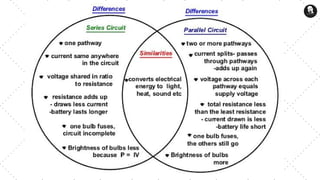
Difference Between Series and Parallel
1.
2.
3.
4.
What is Series
Circuit?
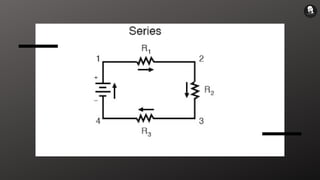
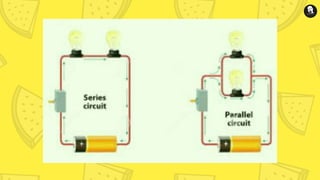
A series circuit is a circuit in which resistors
are arranged in a chain, so the current has only
one path to take. The current is the same
through each resistor.
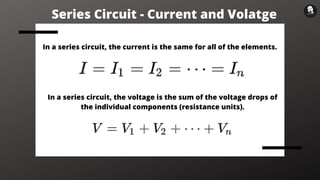
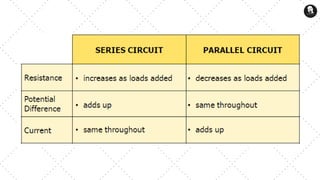
In a series circuit, the current is the same for all of the elements.
In a series circuit, the voltage is the sum of the voltage drops of
the individual components (resistance units).
Series Circuit - Current and Volatge
Series Circuit - Uses
Series circuits are most often used for lighting.
The most familiar example is a string of classic
Christmas tree lights, in which the loss of one
bulb shuts off the flow of electricity to each bulb
further down the line.
However, series circuits can be used for any
situation in which a single cable is used to
supply power to a number of widely spaced
lights or other devices.
1.
2.
3.
What is Parallel
Circuits?
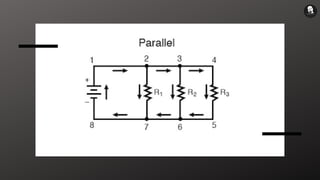
A parallel circuit is one that has two or
more paths for the electricity to flow, the
loads are parallel to each other.
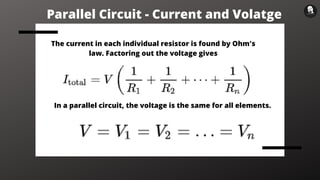
The current in each individual resistor is found by Ohm's
law. Factoring out the voltage gives
In a parallel circuit, the voltage is the same for all elements.
Parallel Circuit - Current and Volatge
Parallel Circuit - Uses
A parallel circuit is an electrical circuit which has
two or more paths for an electrical charge to flow
through.
The parallel circuit is the standard electrical
circuit found in most homes and devices. Because
it provides more than one way for a current to
flow through to a device, it creates a much more
stable and efficient power system than would
otherwise be possible.
The uses of the parallel circuit are manifold.
1.
2.
3.
Thank You

Series and parallel circuits basics

  • 1.
    BASICS OF BIOMEDICAL Seriesand parallel circuits Prepared by Atheena Pandian
  • 2.
    Presentation Outline TODAY'S DISCUSSION Whatis Series Circuits? What is Parallel Circyits? Current and Vltage in Series and Parallel Circuits Difference Between Series and Parallel 1. 2. 3. 4.
  • 3.
    What is Series Circuit? A seriescircuit is a circuit in which resistors are arranged in a chain, so the current has only one path to take. The current is the same through each resistor.
  • 5.
    In a seriescircuit, the current is the same for all of the elements. In a series circuit, the voltage is the sum of the voltage drops of the individual components (resistance units). Series Circuit - Current and Volatge
  • 6.
    Series Circuit -Uses Series circuits are most often used for lighting. The most familiar example is a string of classic Christmas tree lights, in which the loss of one bulb shuts off the flow of electricity to each bulb further down the line. However, series circuits can be used for any situation in which a single cable is used to supply power to a number of widely spaced lights or other devices. 1. 2. 3.
  • 7.
    What is Parallel Circuits? A parallelcircuit is one that has two or more paths for the electricity to flow, the loads are parallel to each other.
  • 9.
    The current ineach individual resistor is found by Ohm's law. Factoring out the voltage gives In a parallel circuit, the voltage is the same for all elements. Parallel Circuit - Current and Volatge
  • 10.
    Parallel Circuit -Uses A parallel circuit is an electrical circuit which has two or more paths for an electrical charge to flow through. The parallel circuit is the standard electrical circuit found in most homes and devices. Because it provides more than one way for a current to flow through to a device, it creates a much more stable and efficient power system than would otherwise be possible. The uses of the parallel circuit are manifold. 1. 2. 3.
  • 14.