Introduction to Electronics
November 03, 2015
Second Session
Syllabus
Review
short circuits
Series vs. Parallel
Resistance
Basic Components
Review
Electricity “AC - DC”
Ohm’s Law “ E = I x R ”
Multimeter
Circuits
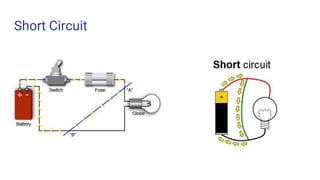
Short Circuit
Short Circuit
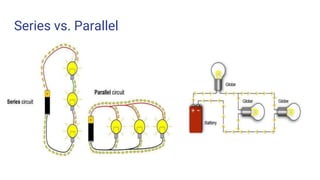
Series vs. Parallel
Series vs. Parallel
Series vs. Parallel
Series
When things are wired in series,
things are wired one after
another, such that electricity has
to pass through one thing, then
the next thing, then the next, and
so on.
Parallel
When things are wired in parallel,
they are wired side by side, such
that electricity passes through all
of them at the same time, from
one common point to another
common point.
Resistance
Resistance
Resistance
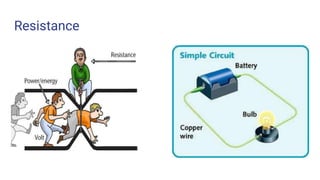
For instance, in the circuit above, the Lamp that electricity is
flowing through is adding resistance to the flow of electricity.
Thus, all of the electricity passing through the circuit is being
put to use.
Likewise, if electricity passes through a component that does not
add enough resistance to the circuit, a short will likewise occur
”Ohm’s Law”
It is very important to prevent short circuits by making sure that
the positive voltage is never wired directly to ground.
Resistance
That said, always keep in mind that electricity always follows the
path of least resistance to ground.
“What this means is that if you give positive voltage the choice to
pass through a lamp to ground, or follow a wire straight to ground,
it will follow the wire because the wire provides the least
resistance. This also means that by using the wire to bypass the
source of resistance straight to ground, you have created a short
circuit. Always make sure that you never accidentally connect
positive voltage to ground while wiring things in parallel.
Also note that a switch does not add any resistance to a circuit and
simply adding a switch between power and ground will create a short
circuit.”
Resistors
Resistors
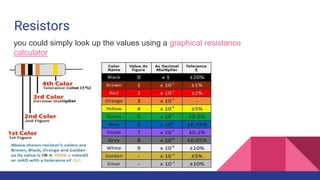
you could simply look up the values using a graphical resistance
calculator
Resistors
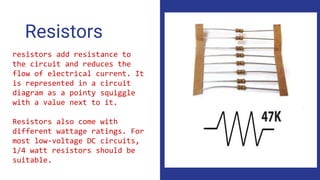
resistors add resistance to
the circuit and reduces the
flow of electrical current. It
is represented in a circuit
diagram as a pointy squiggle
with a value next to it.
Resistors also come with
different wattage ratings. For
most low-voltage DC circuits,
1/4 watt resistors should be
suitable.
Switches
Switches
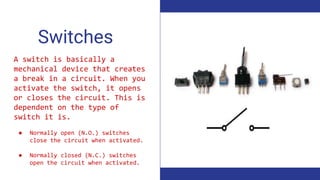
A switch is basically a
mechanical device that creates
a break in a circuit. When you
activate the switch, it opens
or closes the circuit. This is
dependent on the type of
switch it is.
● Normally open (N.O.) switches
close the circuit when activated.
● Normally closed (N.C.) switches
open the circuit when activated.
Batteries
Batteries
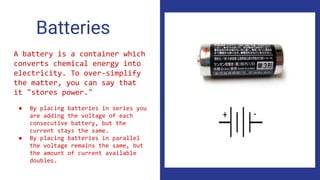
A battery is a container which
converts chemical energy into
electricity. To over-simplify
the matter, you can say that
it "stores power."
● By placing batteries in series you
are adding the voltage of each
consecutive battery, but the
current stays the same.
● By placing batteries in parallel
the voltage remains the same, but
the amount of current available
doubles.
BreadBoards
BreadBoards
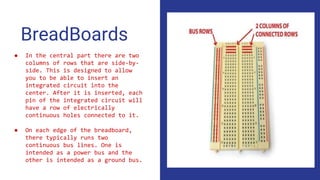
● In the central part there are two
columns of rows that are side-by-
side. This is designed to allow
you to be able to insert an
integrated circuit into the
center. After it is inserted, each
pin of the integrated circuit will
have a row of electrically
continuous holes connected to it.
● On each edge of the breadboard,
there typically runs two
continuous bus lines. One is
intended as a power bus and the
other is intended as a ground bus.
HomeWork
HomeWork
Resistors ¼ Watt: 1KΩ - 47Ω - 470Ω - 10 KΩ
BAttery: 9V - 3V ”2 Batteries 1.5volt”
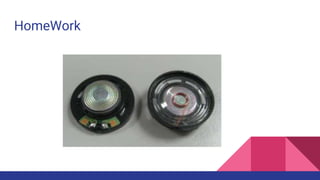
SPST toggle switch - LED - Bread Board - Small Speaker
Transistor: 2N3906
Potentiometer: 1MΩ
Integrated circuit: LM555
HomeWork

Introduction to electronics second session

  • 1.
  • 2.
    Second Session Syllabus Review short circuits Seriesvs. Parallel Resistance Basic Components
  • 3.
    Review Electricity “AC -DC” Ohm’s Law “ E = I x R ” Multimeter Circuits
  • 4.
  • 5.
  • 6.
  • 7.
  • 8.
    Series vs. Parallel Series Whenthings are wired in series, things are wired one after another, such that electricity has to pass through one thing, then the next thing, then the next, and so on. Parallel When things are wired in parallel, they are wired side by side, such that electricity passes through all of them at the same time, from one common point to another common point.
  • 9.
  • 10.
  • 11.
    Resistance For instance, inthe circuit above, the Lamp that electricity is flowing through is adding resistance to the flow of electricity. Thus, all of the electricity passing through the circuit is being put to use. Likewise, if electricity passes through a component that does not add enough resistance to the circuit, a short will likewise occur ”Ohm’s Law” It is very important to prevent short circuits by making sure that the positive voltage is never wired directly to ground.
  • 12.
    Resistance That said, alwayskeep in mind that electricity always follows the path of least resistance to ground. “What this means is that if you give positive voltage the choice to pass through a lamp to ground, or follow a wire straight to ground, it will follow the wire because the wire provides the least resistance. This also means that by using the wire to bypass the source of resistance straight to ground, you have created a short circuit. Always make sure that you never accidentally connect positive voltage to ground while wiring things in parallel. Also note that a switch does not add any resistance to a circuit and simply adding a switch between power and ground will create a short circuit.”
  • 13.
  • 14.
    Resistors you could simplylook up the values using a graphical resistance calculator
  • 15.
    Resistors resistors add resistanceto the circuit and reduces the flow of electrical current. It is represented in a circuit diagram as a pointy squiggle with a value next to it. Resistors also come with different wattage ratings. For most low-voltage DC circuits, 1/4 watt resistors should be suitable.
  • 16.
  • 17.
    Switches A switch isbasically a mechanical device that creates a break in a circuit. When you activate the switch, it opens or closes the circuit. This is dependent on the type of switch it is. ● Normally open (N.O.) switches close the circuit when activated. ● Normally closed (N.C.) switches open the circuit when activated.
  • 18.
  • 19.
    Batteries A battery isa container which converts chemical energy into electricity. To over-simplify the matter, you can say that it "stores power." ● By placing batteries in series you are adding the voltage of each consecutive battery, but the current stays the same. ● By placing batteries in parallel the voltage remains the same, but the amount of current available doubles.
  • 20.
  • 21.
    BreadBoards ● In thecentral part there are two columns of rows that are side-by- side. This is designed to allow you to be able to insert an integrated circuit into the center. After it is inserted, each pin of the integrated circuit will have a row of electrically continuous holes connected to it. ● On each edge of the breadboard, there typically runs two continuous bus lines. One is intended as a power bus and the other is intended as a ground bus.
  • 22.
  • 23.
    HomeWork Resistors ¼ Watt:1KΩ - 47Ω - 470Ω - 10 KΩ BAttery: 9V - 3V ”2 Batteries 1.5volt” SPST toggle switch - LED - Bread Board - Small Speaker Transistor: 2N3906 Potentiometer: 1MΩ Integrated circuit: LM555
  • 24.