Proundly presents
                         Task 4
  Alex Soh           032184   Fahmi     032799
  Lailatulkadariah   033059   Nazri     032515
  Nursyafiqah        032251   Shafiq    033035
  Nurul Afiqah       032656   Hafizah   033006
  Nurul Huda         032405   Thiba     032669
Topics:
4.1 Sequences
        - Definition of sequence
        - Example problem involving sequence.
        -Types of sequence
        -Give 1 example sequences use in computer programming

4.2 Mathematical Induction 1
      -List down the principle of Mathematical Induction.
      -Explain the method of Proof by mathematical Induction
      -Give 2 example problems that use for solving mathematical
       induction.
4.1 Sequence
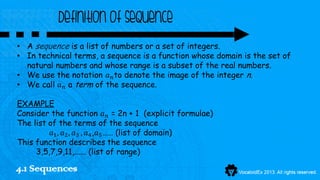
Definition of sequence
• A sequence is a list of numbers or a set of integers.
• In technical terms, a sequence is a function whose domain is the set of
  natural numbers and whose range is a subset of the real numbers.
• We use the notation 𝑎 𝑛 to denote the image of the integer n.
• We call 𝑎 𝑛 a term of the sequence.

EXAMPLE
Consider the function 𝑎 𝑛 = 2n + 1 (explicit formulae)
The list of the terms of the sequence
          𝑎1 , 𝑎2 , 𝑎3 , 𝑎4 ,𝑎5 …… (list of domain)
This function describes the sequence
     3,5,7,9,11,...... (list of range)

4.1 Sequences
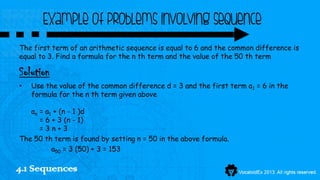
Example of problems involving sequence
The first term of an arithmetic sequence is equal to 6 and the common difference is
equal to 3. Find a formula for the n th term and the value of the 50 th term

Solution
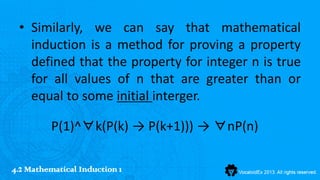
•   Use the value of the common difference d = 3 and the first term a1 = 6 in the
    formula for the n th term given above

   an = a1 + (n - 1 )d
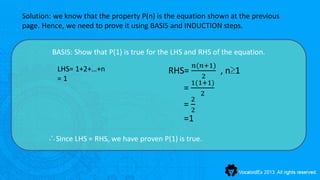
      = 6 + 3 (n - 1)
      =3n+3
The 50 th term is found by setting n = 50 in the above formula.
          a50 = 3 (50) + 3 = 153

4.1 Sequences
TYPES OF sequence

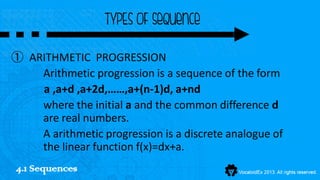
① ARITHMETIC PROGRESSION
    Arithmetic progression is a sequence of the form
    a ,a+d ,a+2d,……,a+(n-1)d, a+nd
    where the initial a and the common difference d
    are real numbers.
    A arithmetic progression is a discrete analogue of
    the linear function f(x)=dx+a.
4.1 Sequences
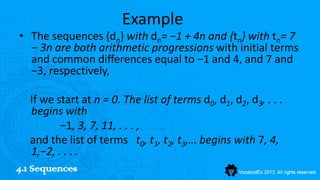
Example
• The sequences {dn} with dn= −1 + 4n and {tn} with tn= 7
  − 3n are both arithmetic progressions with initial terms
  and common differences equal to −1 and 4, and 7 and
  −3, respectively,

   If we start at n = 0. The list of terms d0, d1, d2, d3, . . .
   begins with
          −1, 3, 7, 11, . . . ,
   and the list of terms t0, t1, t2, t3,… begins with 7, 4,
   1,−2, . . . .
4.1 Sequences
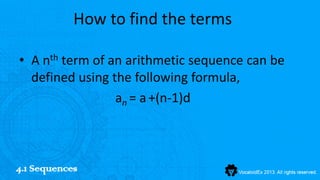
How to find the terms

• A nth term of an arithmetic sequence can be
  defined using the following formula,
                 an = a +(n-1)d


4.1 Sequences
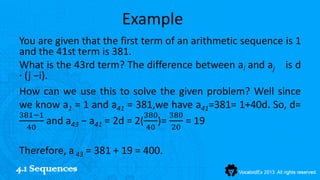
Example
You are given that the first term of an arithmetic sequence is 1
and the 41st term is 381.
What is the 43rd term? The difference between ai and aj is d
·(j −i).
How can we use this to solve the given problem? Well since
we know a1 = 1 and a41 = 381,we have a41=381= 1+40d. So, d=
381−1                         380 380
  40
       and a43 − a41 = 2d = 2( 40 )= 20 = 19

Therefore, a 43 = 381 + 19 = 400.
4.1 Sequences
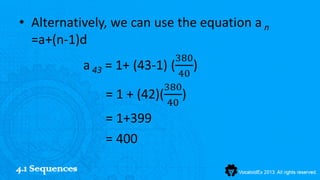
• Alternatively, we can use the equation a n
  =a+(n-1)d
                                  380
                a 43 = 1+ (43-1) ( )
                                   40
                                380
                     = 1 + (42)( )
                                40
                    = 1+399
                    = 400
4.1 Sequences
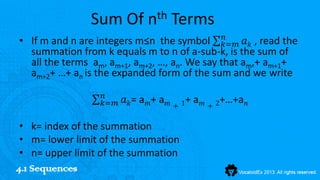
Sum Of nth Terms
                                               𝑛
• If m and n are integers m≤n the symbol 𝑘=𝑚 𝑎 𝑘 , read the
  summation from k equals m to n of a-sub-k, is the sum of
  all the terms am, am+1, am+2, …, an. We say that am,+ am+1+
  am+2+ …+ an is the expanded form of the sum and we write
                  𝑛
                  𝑘=𝑚   𝑎 𝑘= a 𝑚+ a 𝑚 + 1+ a 𝑚 + 2+…+a 𝑛

 • k= index of the summation
 • m= lower limit of the summation
 • n= upper limit of the summation
4.1 Sequences
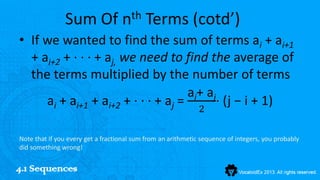
Sum Of nth Terms (cotd’)
• If we wanted to find the sum of terms ai + ai+1
  + ai+2 + ···+ aj, we need to find the average of
  the terms multiplied by the number of terms
                                  ai+ aj
     ai + ai+1 + ai+2 + ···+ aj =        · (j − i + 1)
                                                              2

Note that if you every get a fractional sum from an arithmetic sequence of integers, you probably
did something wrong!


4.1 Sequences
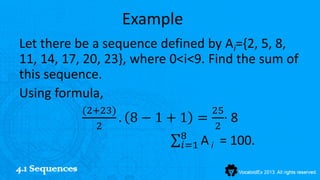
Example
Let there be a sequence defined by Ai={2, 5, 8,
11, 14, 17, 20, 23}, where 0<i<9. Find the sum of
this sequence.
Using formula,
                (2+23)                 25
                       .   8−1+1 =        ·8
                  2                    2
                                 8
                                 𝑖=1 A i   = 100.
4.1 Sequences
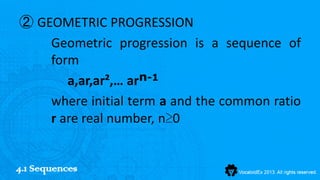
② GEOMETRIC PROGRESSION
    Geometric progression is a sequence of
    form
       a,ar,ar²,… arⁿ-1
    where initial term a and the common ratio
    r are real number, n≥0


4.1 Sequences
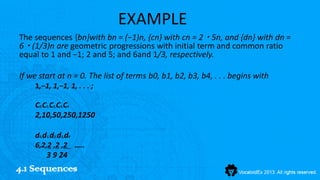
EXAMPLE
The sequences {bn}with bn = (−1)n, {cn} with cn = 2 ・ 5n, and {dn} with dn =
6 ・ (1/3)n are geometric progressions with initial term and common ratio
equal to 1 and −1; 2 and 5; and 6and 1/3, respectively.

If we start at n = 0. The list of terms b0, b1, b2, b3, b4, . . . begins with
    1,−1, 1,−1, 1, . . . ;

    C0,C1,C2,C3,C4
    2,10,50,250,1250

    d0,d1,d2,d3,d4
    6,2,2 ,2 ,2 …..
        3 9 24
4.1 Sequences
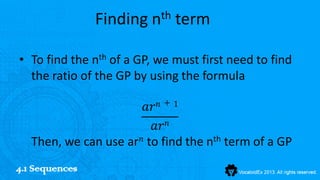
Finding nth term

• To find the nth of a GP, we must first need to find
  the ratio of the GP by using the formula

                         𝑎𝑟 𝑛 + 1
                           𝑎𝑟 𝑛
   Then, we can use ar 𝑛 to find the nth term of a GP
4.1 Sequences
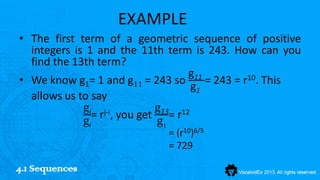
EXAMPLE
• The first term of a geometric sequence of positive
  integers is 1 and the 11th term is 243. How can you
  find the 13th term?
                                  g11
• We know g1= 1 and g11 = 243 so      = 243 = r10. This
                                   g1
  allows us to say
             gj j-i         g13 12
               = r , you get = r
             gi             g1
                             = (r10)6/5
                             = 729

4.1 Sequences
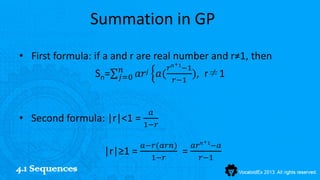
Summation in GP
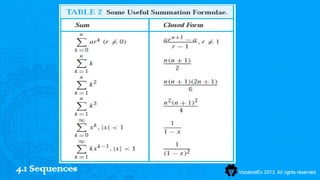
• First formula: if a and r are real number and r≠1, then
                                         +
                        𝑛               𝑟 𝑛 1−1
                 S n=   𝑗=0   𝑎𝑟 𝑗    𝑎( 𝑟−1 ),     r≠1


                                 𝑎
• Second formula: |r|<1 =
                                1−𝑟

                                                   +
                               𝑎−𝑟(𝑎𝑟𝑛)          𝑎𝑟 𝑛 1−𝑎
                   |r|≥1 =                   =
                                 1−𝑟               𝑟−1
4.1 Sequences
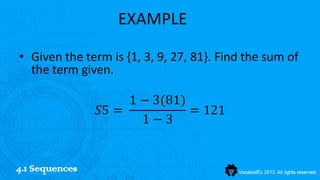
EXAMPLE

• Given the term is {1, 3, 9, 27, 81}. Find the sum of
  the term given.

                     1 − 3(81)
                𝑆5 =           = 121
                       1−3


4.1 Sequences
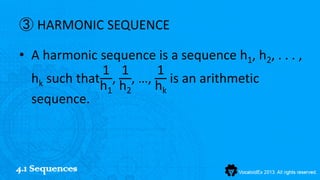
③ HARMONIC SEQUENCE

• A harmonic sequence is a sequence h1, h2, . . . ,
              1 1    1
  hk such that , , …, is an arithmetic
              h1 h2  hk
  sequence.


4.1 Sequences
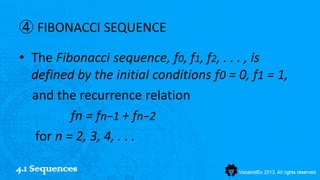
④ FIBONACCI SEQUENCE

• The Fibonacci sequence, f0, f1, f2, . . . , is
  defined by the initial conditions f0 = 0, f1 = 1,
  and the recurrence relation
          fn = fn−1 + fn−2
   for n = 2, 3, 4, . . .

4.1 Sequences
RECURRENCE RELATIONS

• A recurrence relation for the sequence { an } is an
  equation that expresses an in terms of one or
  more of the previous terms of the sequence,
  namely, a0 , a1 , . . . , an-1, an ,for all integers n
  with n ≥ n0 , where n0 is a nonnegative integer.
• A sequence is called a solution of a recurrence
  relation if its terms satisfy the recurrence relation.
4.1 Sequences
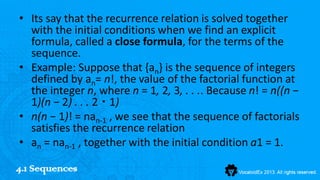
• Its say that the recurrence relation is solved together
  with the initial conditions when we find an explicit
  formula, called a close formula, for the terms of the
  sequence.
• Example: Suppose that {an} is the sequence of integers
  defined by an= n!, the value of the factorial function at
  the integer n, where n = 1, 2, 3, . . .. Because n! = n((n −
  1)(n − 2) . . . 2 ・ 1)
• n(n − 1)! = nan-1 , we see that the sequence of factorials
  satisfies the recurrence relation
• an = nan-1 , together with the initial condition a1 = 1.

4.1 Sequences
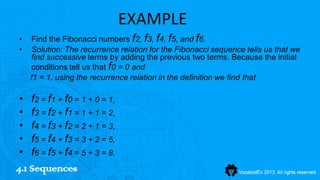
EXAMPLE
•   Find the Fibonacci numbers f2, f3, f4, f5, and f6.
•   Solution: The recurrence relation for the Fibonacci sequence tells us that we
    find successive terms by adding the previous two terms. Because the initial
    conditions tell us that f0 = 0 and
    f1 = 1, using the recurrence relation in the definition we find that

 • f2 = f1 + f0 = 1 + 0 = 1,
 • f3 = f2 + f1 = 1 + 1 = 2,
 • f4 = f3 + f2 = 2 + 1 = 3,
 • f5 = f4 + f3 = 3 + 2 = 5,
 • f6 = f5 + f4 = 5 + 3 = 8.
4.1 Sequences
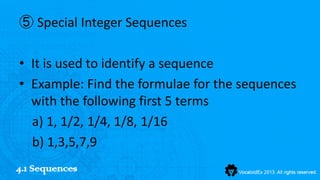
⑤ Special Integer Sequences

• It is used to identify a sequence
• Example: Find the formulae for the sequences
  with the following first 5 terms
  a) 1, 1/2, 1/4, 1/8, 1/16
  b) 1,3,5,7,9
4.1 Sequences
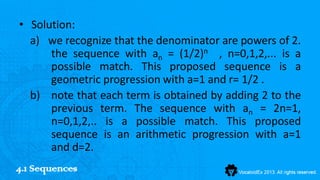
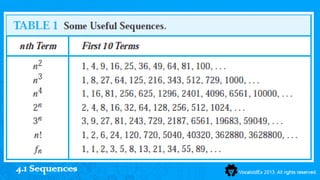
• Solution:
  a) we recognize that the denominator are powers of 2.
      the sequence with an = (1/2)n , n=0,1,2,... is a
      possible match. This proposed sequence is a
      geometric progression with a=1 and r= 1/2 .
  b) note that each term is obtained by adding 2 to the
      previous term. The sequence with an = 2n=1,
      n=0,1,2,.. is a possible match. This proposed
      sequence is an arithmetic progression with a=1
      and d=2.
4.1 Sequences
4.1 Sequences
4.1 Sequences
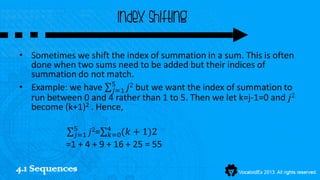
Index shifting

• Sometimes we shift the index of summation in a sum. This is often
  done when two sums need to be added but their indices of
  summation do not match.
• Example: we have 5 𝑗2 but we want the index of summation to
                      𝑗=1
  run between 0 and 4 rather than 1 to 5. Then we let k=j-1=0 and 𝑗2
  become (k+1)2 . Hence,

             5
             𝑗=1 𝑗2= 4 (𝑘
                      𝑘=0    + 1)2
           =1 + 4 + 9 + 16 + 25 = 55

4.1 Sequences
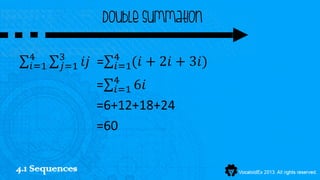
Double summation

  4      3             4
  𝑖=1    𝑗=1    𝑖𝑗 =   𝑖=1(𝑖 +   2𝑖 + 3𝑖)
                       4
                  =    𝑖=1 6𝑖
                  =6+12+18+24
                  =60

4.1 Sequences
usage on computer programming

• A structured series of shots or scenes with a
  beginning, middle and end , the term sequence
  can be applied to video, audio or graphics.
• Structured programming provides a number of
  constructs that are used to define the sequence
  in which the program statements are to be
  executed.
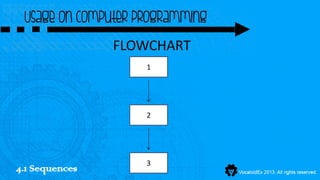
Usage on computer programming
                FLOWCHART
                    1


                    2


                    3
4.1 Sequences
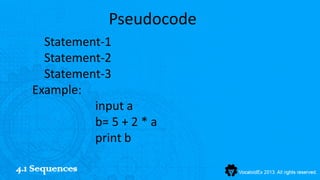
Pseudocode
     Statement-1
     Statement-2
     Statement-3
   Example:
             input a
             b= 5 + 2 * a
             print b

4.1 Sequences
4.2 Mathematical
    Induction
Principle of Mathematical Induction

To prove that P(n) is true for all positive intergers n, where P(n) is a propositional
function by 2 steps:

   BASIS: we verify that P(1) is true @ show that a initial value is true for all Z+ of the
                      propositional function (inductive hypothesis )


 INDUCTIVE: we show that the conditional statement ∀k (P(k) → P(k+1)) is true for all
                                      Z+ of k.


4.2 Mathematical Induction 1
• Similarly, we can say that mathematical
   induction is a method for proving a property
   defined that the property for integer n is true
   for all values of n that are greater than or
   equal to some initial interger.

          P(1)^∀k(P(k) → P(k+1))) → ∀nP(n)

4.2 Mathematical Induction 1
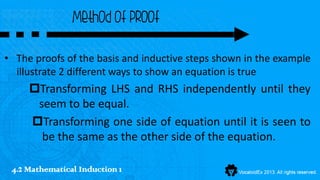
Method of proof

• The proofs of the basis and inductive steps shown in the example
  illustrate 2 different ways to show an equation is true
     Transforming LHS and RHS independently until they
      seem to be equal.
     Transforming one side of equation until it is seen to
       be the same as the other side of the equation.

 4.2 Mathematical Induction 1
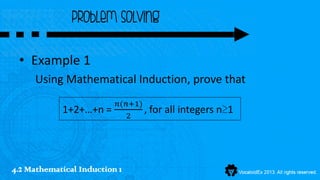
Problem Solving

 • Example 1
     Using Mathematical Induction, prove that
                          𝑛(𝑛+1)
            1+2+…+n =       2
                                 ,   for all integers n≥1


4.2 Mathematical Induction 1
Solution: we know that the property P(n) is the equation shown at the previous
page. Hence, we need to prove it using BASIS and INDUCTION steps.


         BASIS: Show that P(1) is true for the LHS and RHS of the equation.
                                                      𝑛(𝑛+1)
          LHS= 1+2+…+n                       RHS=              , n≥1
          =1                                            2
                                                     1(1+1)
                                                 =      2
                                                     2
                                                 =   2
                                                 =1

       ∴Since LHS = RHS, we have proven P(1) is true.
INDUCTIVE: we need to show that the equation can take any value k and it’s successive
value (k+1) by defining P(k) [the inductive hypothesis] and P(k+1) for k≥1. If P(k) is true
                                    then P(k+1) is true.


Inductive Hypothesis P(k+1)= 1+2+…+k+(k+1) P(k+1)= 1+2+…+k+(k+1)
P(k)= 1+2+…+k                (𝑘+1)(𝑘+1+1)        = P(k)+ (k+1)
                           =
      𝑘(𝑘+1)                        2              𝑘2+𝑘
    = 2                      (𝑘+1)(𝑘+2)          = 2 + (k+1)
                           =
      𝑘2+𝑘                    2
                                  2                 𝑘2+𝑘 +2(𝑘+1)
    = 2                      𝑘 +3𝑘+2             =
                           =    2
                                        -Eq.1        2
                                                         2
(assume that it is true)                           𝑘 +𝑘+2𝑘+2
                                                 =                           2
                                                                        𝑘2+3𝑘+2
                                                                    =      2
                                                                                     -Eq.2
   ∴Since Eq.1 and Eq.2 is identical for both LHS and RHS, therefore P(k+1) is true.
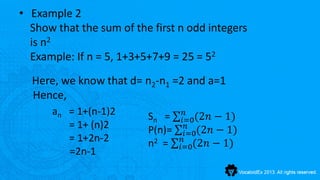
• Example 2
  Show that the sum of the first n odd integers
  is n2
  Example: If n = 5, 1+3+5+7+9 = 25 = 52
  Here, we know that d= n2-n1 =2 and a=1
  Hence,
      an = 1+(n-1)2                 𝑛
                          Sn =     𝑖=0(2𝑛 − 1)
         = 1+ (n)2                   𝑛
                          P(n)=     𝑖=0(2𝑛 − 1)
         = 1+2n-2                  𝑛
                          n2 =    𝑖=0(2𝑛 − 1)
         =2n-1
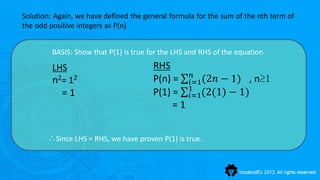
Solution: Again, we have defined the general formula for the sum of the nth term of
the odd positive integers as P(n)


         BASIS: Show that P(1) is true for the LHS and RHS of the equation.

         LHS                            RHS
                                                 𝑛
         n 2= 1 2                       P(n) = 𝑖=1(2𝑛 − 1) , n≥1
            =1                          P(1) = 1 (2(1) − 1)
                                                𝑖=1
                                             =1


       ∴Since LHS = RHS, we have proven P(1) is true.
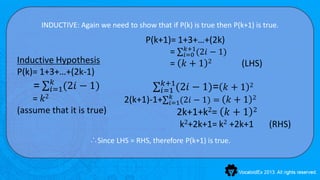
INDUCTIVE: Again we need to show that if P(k) is true then P(k+1) is true.
                                        P(k+1)= 1+3+…+(2k)
                                                 𝑘+1
                                              = 𝑖=0 (2𝑖 − 1)
Inductive Hypothesis                          = 𝑘+1 2                 (LHS)
P(k)= 1+3+…+(2k-1)
           𝑘                                  𝑘+1
    =     𝑖=1(2𝑖   − 1)                      𝑖=1 (2𝑖     − 1)= 𝑘 + 1     2

    = 𝑘2                         2(k+1)-1+       𝑘
                                                𝑖=1(2𝑖   − 1) = 𝑘 + 1    2

(assume that it is true)                          2k+1+k2= 𝑘 + 1          2

                                                   k2+2k+1= k2 +2k+1           (RHS)
                       ∴Since LHS = RHS, therefore P(k+1) is true.

Presentation4

  • 1.
    Proundly presents Task 4 Alex Soh 032184 Fahmi 032799 Lailatulkadariah 033059 Nazri 032515 Nursyafiqah 032251 Shafiq 033035 Nurul Afiqah 032656 Hafizah 033006 Nurul Huda 032405 Thiba 032669
  • 2.
    Topics: 4.1 Sequences - Definition of sequence - Example problem involving sequence. -Types of sequence -Give 1 example sequences use in computer programming 4.2 Mathematical Induction 1 -List down the principle of Mathematical Induction. -Explain the method of Proof by mathematical Induction -Give 2 example problems that use for solving mathematical induction.
  • 3.
  • 4.
    Definition of sequence •A sequence is a list of numbers or a set of integers. • In technical terms, a sequence is a function whose domain is the set of natural numbers and whose range is a subset of the real numbers. • We use the notation 𝑎 𝑛 to denote the image of the integer n. • We call 𝑎 𝑛 a term of the sequence. EXAMPLE Consider the function 𝑎 𝑛 = 2n + 1 (explicit formulae) The list of the terms of the sequence 𝑎1 , 𝑎2 , 𝑎3 , 𝑎4 ,𝑎5 …… (list of domain) This function describes the sequence 3,5,7,9,11,...... (list of range) 4.1 Sequences
  • 5.
    Example of problemsinvolving sequence The first term of an arithmetic sequence is equal to 6 and the common difference is equal to 3. Find a formula for the n th term and the value of the 50 th term Solution • Use the value of the common difference d = 3 and the first term a1 = 6 in the formula for the n th term given above an = a1 + (n - 1 )d = 6 + 3 (n - 1) =3n+3 The 50 th term is found by setting n = 50 in the above formula. a50 = 3 (50) + 3 = 153 4.1 Sequences
  • 6.
    TYPES OF sequence ①ARITHMETIC PROGRESSION Arithmetic progression is a sequence of the form a ,a+d ,a+2d,……,a+(n-1)d, a+nd where the initial a and the common difference d are real numbers. A arithmetic progression is a discrete analogue of the linear function f(x)=dx+a. 4.1 Sequences
  • 7.
    Example • The sequences{dn} with dn= −1 + 4n and {tn} with tn= 7 − 3n are both arithmetic progressions with initial terms and common differences equal to −1 and 4, and 7 and −3, respectively, If we start at n = 0. The list of terms d0, d1, d2, d3, . . . begins with −1, 3, 7, 11, . . . , and the list of terms t0, t1, t2, t3,… begins with 7, 4, 1,−2, . . . . 4.1 Sequences
  • 8.
    How to findthe terms • A nth term of an arithmetic sequence can be defined using the following formula, an = a +(n-1)d 4.1 Sequences
  • 9.
    Example You are giventhat the first term of an arithmetic sequence is 1 and the 41st term is 381. What is the 43rd term? The difference between ai and aj is d ·(j −i). How can we use this to solve the given problem? Well since we know a1 = 1 and a41 = 381,we have a41=381= 1+40d. So, d= 381−1 380 380 40 and a43 − a41 = 2d = 2( 40 )= 20 = 19 Therefore, a 43 = 381 + 19 = 400. 4.1 Sequences
  • 10.
    • Alternatively, wecan use the equation a n =a+(n-1)d 380 a 43 = 1+ (43-1) ( ) 40 380 = 1 + (42)( ) 40 = 1+399 = 400 4.1 Sequences
  • 11.
    Sum Of nthTerms 𝑛 • If m and n are integers m≤n the symbol 𝑘=𝑚 𝑎 𝑘 , read the summation from k equals m to n of a-sub-k, is the sum of all the terms am, am+1, am+2, …, an. We say that am,+ am+1+ am+2+ …+ an is the expanded form of the sum and we write 𝑛 𝑘=𝑚 𝑎 𝑘= a 𝑚+ a 𝑚 + 1+ a 𝑚 + 2+…+a 𝑛 • k= index of the summation • m= lower limit of the summation • n= upper limit of the summation 4.1 Sequences
  • 12.
    Sum Of nthTerms (cotd’) • If we wanted to find the sum of terms ai + ai+1 + ai+2 + ···+ aj, we need to find the average of the terms multiplied by the number of terms ai+ aj ai + ai+1 + ai+2 + ···+ aj = · (j − i + 1) 2 Note that if you every get a fractional sum from an arithmetic sequence of integers, you probably did something wrong! 4.1 Sequences
  • 13.
    Example Let there bea sequence defined by Ai={2, 5, 8, 11, 14, 17, 20, 23}, where 0<i<9. Find the sum of this sequence. Using formula, (2+23) 25 . 8−1+1 = ·8 2 2 8 𝑖=1 A i = 100. 4.1 Sequences
  • 14.
    ② GEOMETRIC PROGRESSION Geometric progression is a sequence of form a,ar,ar²,… arⁿ-1 where initial term a and the common ratio r are real number, n≥0 4.1 Sequences
  • 15.
    EXAMPLE The sequences {bn}withbn = (−1)n, {cn} with cn = 2 ・ 5n, and {dn} with dn = 6 ・ (1/3)n are geometric progressions with initial term and common ratio equal to 1 and −1; 2 and 5; and 6and 1/3, respectively. If we start at n = 0. The list of terms b0, b1, b2, b3, b4, . . . begins with 1,−1, 1,−1, 1, . . . ; C0,C1,C2,C3,C4 2,10,50,250,1250 d0,d1,d2,d3,d4 6,2,2 ,2 ,2 ….. 3 9 24 4.1 Sequences
  • 16.
    Finding nth term •To find the nth of a GP, we must first need to find the ratio of the GP by using the formula 𝑎𝑟 𝑛 + 1 𝑎𝑟 𝑛 Then, we can use ar 𝑛 to find the nth term of a GP 4.1 Sequences
  • 17.
    EXAMPLE • The firstterm of a geometric sequence of positive integers is 1 and the 11th term is 243. How can you find the 13th term? g11 • We know g1= 1 and g11 = 243 so = 243 = r10. This g1 allows us to say gj j-i g13 12 = r , you get = r gi g1 = (r10)6/5 = 729 4.1 Sequences
  • 18.
    Summation in GP •First formula: if a and r are real number and r≠1, then + 𝑛 𝑟 𝑛 1−1 S n= 𝑗=0 𝑎𝑟 𝑗 𝑎( 𝑟−1 ), r≠1 𝑎 • Second formula: |r|<1 = 1−𝑟 + 𝑎−𝑟(𝑎𝑟𝑛) 𝑎𝑟 𝑛 1−𝑎 |r|≥1 = = 1−𝑟 𝑟−1 4.1 Sequences
  • 19.
    EXAMPLE • Given theterm is {1, 3, 9, 27, 81}. Find the sum of the term given. 1 − 3(81) 𝑆5 = = 121 1−3 4.1 Sequences
  • 20.
    ③ HARMONIC SEQUENCE •A harmonic sequence is a sequence h1, h2, . . . , 1 1 1 hk such that , , …, is an arithmetic h1 h2 hk sequence. 4.1 Sequences
  • 21.
    ④ FIBONACCI SEQUENCE •The Fibonacci sequence, f0, f1, f2, . . . , is defined by the initial conditions f0 = 0, f1 = 1, and the recurrence relation fn = fn−1 + fn−2 for n = 2, 3, 4, . . . 4.1 Sequences
  • 22.
    RECURRENCE RELATIONS • Arecurrence relation for the sequence { an } is an equation that expresses an in terms of one or more of the previous terms of the sequence, namely, a0 , a1 , . . . , an-1, an ,for all integers n with n ≥ n0 , where n0 is a nonnegative integer. • A sequence is called a solution of a recurrence relation if its terms satisfy the recurrence relation. 4.1 Sequences
  • 23.
    • Its saythat the recurrence relation is solved together with the initial conditions when we find an explicit formula, called a close formula, for the terms of the sequence. • Example: Suppose that {an} is the sequence of integers defined by an= n!, the value of the factorial function at the integer n, where n = 1, 2, 3, . . .. Because n! = n((n − 1)(n − 2) . . . 2 ・ 1) • n(n − 1)! = nan-1 , we see that the sequence of factorials satisfies the recurrence relation • an = nan-1 , together with the initial condition a1 = 1. 4.1 Sequences
  • 24.
    EXAMPLE • Find the Fibonacci numbers f2, f3, f4, f5, and f6. • Solution: The recurrence relation for the Fibonacci sequence tells us that we find successive terms by adding the previous two terms. Because the initial conditions tell us that f0 = 0 and f1 = 1, using the recurrence relation in the definition we find that • f2 = f1 + f0 = 1 + 0 = 1, • f3 = f2 + f1 = 1 + 1 = 2, • f4 = f3 + f2 = 2 + 1 = 3, • f5 = f4 + f3 = 3 + 2 = 5, • f6 = f5 + f4 = 5 + 3 = 8. 4.1 Sequences
  • 25.
    ⑤ Special IntegerSequences • It is used to identify a sequence • Example: Find the formulae for the sequences with the following first 5 terms a) 1, 1/2, 1/4, 1/8, 1/16 b) 1,3,5,7,9 4.1 Sequences
  • 26.
    • Solution: a) we recognize that the denominator are powers of 2. the sequence with an = (1/2)n , n=0,1,2,... is a possible match. This proposed sequence is a geometric progression with a=1 and r= 1/2 . b) note that each term is obtained by adding 2 to the previous term. The sequence with an = 2n=1, n=0,1,2,.. is a possible match. This proposed sequence is an arithmetic progression with a=1 and d=2. 4.1 Sequences
  • 27.
  • 28.
  • 29.
    Index shifting • Sometimeswe shift the index of summation in a sum. This is often done when two sums need to be added but their indices of summation do not match. • Example: we have 5 𝑗2 but we want the index of summation to 𝑗=1 run between 0 and 4 rather than 1 to 5. Then we let k=j-1=0 and 𝑗2 become (k+1)2 . Hence, 5 𝑗=1 𝑗2= 4 (𝑘 𝑘=0 + 1)2 =1 + 4 + 9 + 16 + 25 = 55 4.1 Sequences
  • 30.
    Double summation 4 3 4 𝑖=1 𝑗=1 𝑖𝑗 = 𝑖=1(𝑖 + 2𝑖 + 3𝑖) 4 = 𝑖=1 6𝑖 =6+12+18+24 =60 4.1 Sequences
  • 31.
    usage on computerprogramming • A structured series of shots or scenes with a beginning, middle and end , the term sequence can be applied to video, audio or graphics. • Structured programming provides a number of constructs that are used to define the sequence in which the program statements are to be executed.
  • 32.
    Usage on computerprogramming FLOWCHART 1 2 3 4.1 Sequences
  • 33.
    Pseudocode Statement-1 Statement-2 Statement-3 Example: input a b= 5 + 2 * a print b 4.1 Sequences
  • 34.
  • 35.
    Principle of MathematicalInduction To prove that P(n) is true for all positive intergers n, where P(n) is a propositional function by 2 steps: BASIS: we verify that P(1) is true @ show that a initial value is true for all Z+ of the propositional function (inductive hypothesis ) INDUCTIVE: we show that the conditional statement ∀k (P(k) → P(k+1)) is true for all Z+ of k. 4.2 Mathematical Induction 1
  • 36.
    • Similarly, wecan say that mathematical induction is a method for proving a property defined that the property for integer n is true for all values of n that are greater than or equal to some initial interger. P(1)^∀k(P(k) → P(k+1))) → ∀nP(n) 4.2 Mathematical Induction 1
  • 37.
    Method of proof •The proofs of the basis and inductive steps shown in the example illustrate 2 different ways to show an equation is true Transforming LHS and RHS independently until they seem to be equal. Transforming one side of equation until it is seen to be the same as the other side of the equation. 4.2 Mathematical Induction 1
  • 38.
    Problem Solving •Example 1 Using Mathematical Induction, prove that 𝑛(𝑛+1) 1+2+…+n = 2 , for all integers n≥1 4.2 Mathematical Induction 1
  • 39.
    Solution: we knowthat the property P(n) is the equation shown at the previous page. Hence, we need to prove it using BASIS and INDUCTION steps. BASIS: Show that P(1) is true for the LHS and RHS of the equation. 𝑛(𝑛+1) LHS= 1+2+…+n RHS= , n≥1 =1 2 1(1+1) = 2 2 = 2 =1 ∴Since LHS = RHS, we have proven P(1) is true.
  • 40.
    INDUCTIVE: we needto show that the equation can take any value k and it’s successive value (k+1) by defining P(k) [the inductive hypothesis] and P(k+1) for k≥1. If P(k) is true then P(k+1) is true. Inductive Hypothesis P(k+1)= 1+2+…+k+(k+1) P(k+1)= 1+2+…+k+(k+1) P(k)= 1+2+…+k (𝑘+1)(𝑘+1+1) = P(k)+ (k+1) = 𝑘(𝑘+1) 2 𝑘2+𝑘 = 2 (𝑘+1)(𝑘+2) = 2 + (k+1) = 𝑘2+𝑘 2 2 𝑘2+𝑘 +2(𝑘+1) = 2 𝑘 +3𝑘+2 = = 2 -Eq.1 2 2 (assume that it is true) 𝑘 +𝑘+2𝑘+2 = 2 𝑘2+3𝑘+2 = 2 -Eq.2 ∴Since Eq.1 and Eq.2 is identical for both LHS and RHS, therefore P(k+1) is true.
  • 41.
    • Example 2 Show that the sum of the first n odd integers is n2 Example: If n = 5, 1+3+5+7+9 = 25 = 52 Here, we know that d= n2-n1 =2 and a=1 Hence, an = 1+(n-1)2 𝑛 Sn = 𝑖=0(2𝑛 − 1) = 1+ (n)2 𝑛 P(n)= 𝑖=0(2𝑛 − 1) = 1+2n-2 𝑛 n2 = 𝑖=0(2𝑛 − 1) =2n-1
  • 42.
    Solution: Again, wehave defined the general formula for the sum of the nth term of the odd positive integers as P(n) BASIS: Show that P(1) is true for the LHS and RHS of the equation. LHS RHS 𝑛 n 2= 1 2 P(n) = 𝑖=1(2𝑛 − 1) , n≥1 =1 P(1) = 1 (2(1) − 1) 𝑖=1 =1 ∴Since LHS = RHS, we have proven P(1) is true.
  • 43.
    INDUCTIVE: Again weneed to show that if P(k) is true then P(k+1) is true. P(k+1)= 1+3+…+(2k) 𝑘+1 = 𝑖=0 (2𝑖 − 1) Inductive Hypothesis = 𝑘+1 2 (LHS) P(k)= 1+3+…+(2k-1) 𝑘 𝑘+1 = 𝑖=1(2𝑖 − 1) 𝑖=1 (2𝑖 − 1)= 𝑘 + 1 2 = 𝑘2 2(k+1)-1+ 𝑘 𝑖=1(2𝑖 − 1) = 𝑘 + 1 2 (assume that it is true) 2k+1+k2= 𝑘 + 1 2 k2+2k+1= k2 +2k+1 (RHS) ∴Since LHS = RHS, therefore P(k+1) is true.