Symmetry
A Look at How it Applies to Geometric Transformations
In this lesson, we will learn:
• What line symmetry is and how to identify it
• How to determine a line of symmetry
• About rotational symmetry and how to identify it
• How to determine a center and angle of rotational symmetry
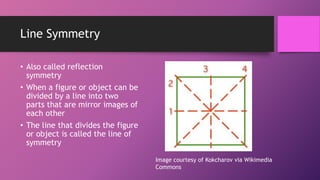
Line Symmetry
• Also called reflection
symmetry
• When a figure or object can be
divided by a line into two
parts that are mirror images of
each other
• The line that divides the figure
or object is called the line of
symmetry
Image courtesy of Kokcharov via Wikimedia
Commons
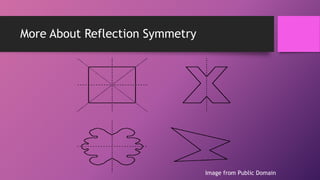
More About Reflection Symmetry
Image from Public Domain
Line Reflection in Nature
Spider Crab, image from Public Domain
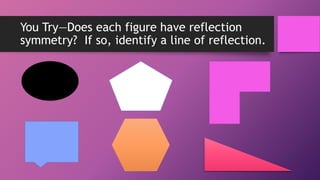
You Try—Does each figure have reflection
symmetry? If so, identify a line of reflection.
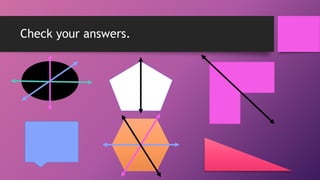
Check your answers.
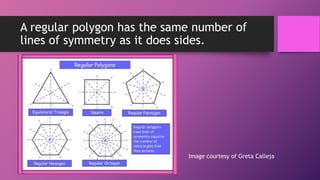
A regular polygon has the same number of
lines of symmetry as it does sides.
Image courtesy of Greta Calleja
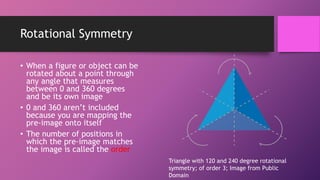
Rotational Symmetry
• When a figure or object can be
rotated about a point through
any angle that measures
between 0 and 360 degrees
and be its own image
• 0 and 360 aren’t included
because you are mapping the
pre-image onto itself
• The number of positions in
which the pre-image matches
the image is called the order
Triangle with 120 and 240 degree rotational
symmetry; of order 3; Image from Public
Domain
Regular Polygons and Rotational Symmetry
• All regular polygons have
rotational symmetry.
• The angle of rotational
symmetry can be found by
dividing 360 by the number of
sides
• Regular polygons have order
equal to the number of sides
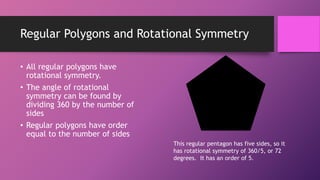
This regular pentagon has five sides, so it
has rotational symmetry of 360/5, or 72
degrees. It has an order of 5.
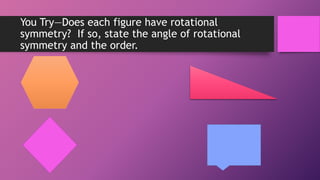
You Try—Does each figure have rotational
symmetry? If so, state the angle of rotational
symmetry and the order.
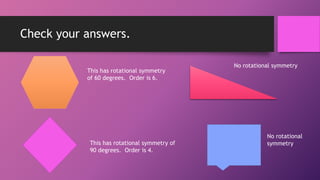
Check your answers.
This has rotational symmetry
of 60 degrees. Order is 6.
This has rotational symmetry of
90 degrees. Order is 4.
No rotational symmetry
No rotational
symmetry

Symmetry

  • 1.
    Symmetry A Look atHow it Applies to Geometric Transformations
  • 2.
    In this lesson,we will learn: • What line symmetry is and how to identify it • How to determine a line of symmetry • About rotational symmetry and how to identify it • How to determine a center and angle of rotational symmetry
  • 3.
    Line Symmetry • Alsocalled reflection symmetry • When a figure or object can be divided by a line into two parts that are mirror images of each other • The line that divides the figure or object is called the line of symmetry Image courtesy of Kokcharov via Wikimedia Commons
  • 4.
    More About ReflectionSymmetry Image from Public Domain
  • 5.
    Line Reflection inNature Spider Crab, image from Public Domain
  • 6.
    You Try—Does eachfigure have reflection symmetry? If so, identify a line of reflection.
  • 7.
  • 8.
    A regular polygonhas the same number of lines of symmetry as it does sides. Image courtesy of Greta Calleja
  • 9.
    Rotational Symmetry • Whena figure or object can be rotated about a point through any angle that measures between 0 and 360 degrees and be its own image • 0 and 360 aren’t included because you are mapping the pre-image onto itself • The number of positions in which the pre-image matches the image is called the order Triangle with 120 and 240 degree rotational symmetry; of order 3; Image from Public Domain
  • 10.
    Regular Polygons andRotational Symmetry • All regular polygons have rotational symmetry. • The angle of rotational symmetry can be found by dividing 360 by the number of sides • Regular polygons have order equal to the number of sides This regular pentagon has five sides, so it has rotational symmetry of 360/5, or 72 degrees. It has an order of 5.
  • 11.
    You Try—Does eachfigure have rotational symmetry? If so, state the angle of rotational symmetry and the order.
  • 12.
    Check your answers. Thishas rotational symmetry of 60 degrees. Order is 6. This has rotational symmetry of 90 degrees. Order is 4. No rotational symmetry No rotational symmetry