10.1 Infinite Sequencesand
Summation Notation
∙ Find terms of sequences given the
general or nth term.
∙Convert between sigma notation and
other notation for a series.
2.
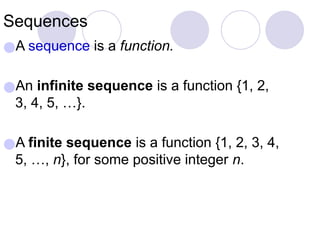
Sequences
●A sequence isa function.
●An infinite sequence is a function {1, 2,
3, 4, 5, …}.
●A finite sequence is a function {1, 2, 3, 4,
5, …, n}, for some positive integer n.
3.
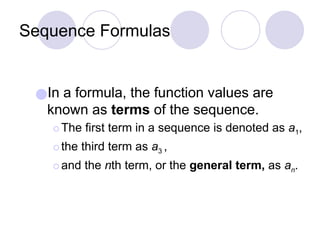
Sequence Formulas
●In aformula, the function values are
known as terms of the sequence.
⚪The first term in a sequence is denoted as a1,
⚪the third term as a3 ,
⚪and the nth term, or the general term, as an.
4.
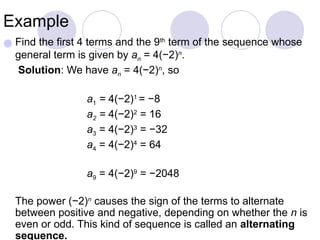
Example
● Find thefirst 4 terms and the 9th
term of the sequence whose
general term is given by an = 4(−2)n
.
Solution: We have an = 4(−2)n
, so
a1 = 4(−2)1
= −8
a2 = 4(−2)2
= 16
a3 = 4(−2)3
= −32
a4 = 4(−2)4
= 64
a9 = 4(−2)9
= −2048
The power (−2)n
causes the sign of the terms to alternate
between positive and negative, depending on whether the n is
even or odd. This kind of sequence is called an alternating
sequence.
5.
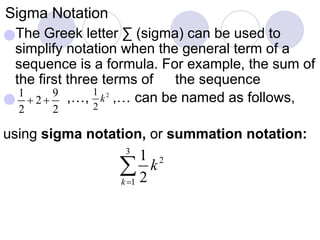
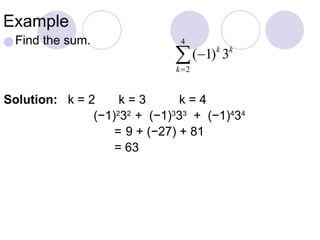
Sigma Notation
●The Greekletter ∑ (sigma) can be used to
simplify notation when the general term of a
sequence is a formula. For example, the sum of
the first three terms of the sequence
● ,…, ,… can be named as follows,
using sigma notation, or summation notation:
6.
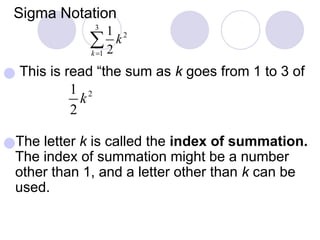
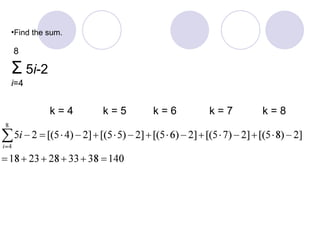
Sigma Notation
● Thisis read “the sum as k goes from 1 to 3 of
●The letter k is called the index of summation.
The index of summation might be a number
other than 1, and a letter other than k can be
used.
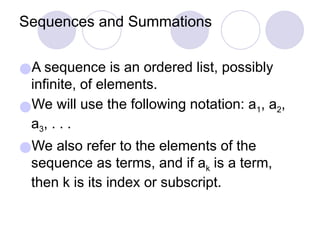
Sequences and Summations
●Asequence is an ordered list, possibly
infinite, of elements.
●We will use the following notation: a1, a2,
a3, . . .
●We also refer to the elements of the
sequence as terms, and if ak is a term,
then k is its index or subscript.
11.
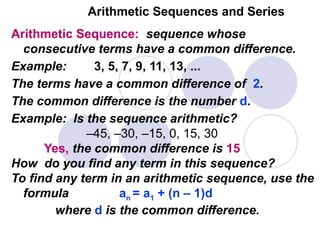
Arithmetic Sequences andSeries
Arithmetic Sequence: sequence whose
consecutive terms have a common difference.
Example: 3, 5, 7, 9, 11, 13, ...
The terms have a common difference of 2.
The common difference is the number d.
Example: Is the sequence arithmetic?
–45, –30, –15, 0, 15, 30
Yes, the common difference is 15
How do you find any term in this sequence?
To find any term in an arithmetic sequence, use the
formula an = a1 + (n – 1)d
where d is the common difference.
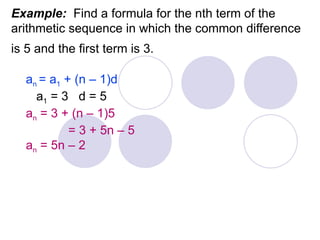
12.
Example: Find aformula for the nth term of the
arithmetic sequence in which the common difference
is 5 and the first term is 3.
an = a1 + (n – 1)d
a1 = 3 d = 5
an = 3 + (n – 1)5
= 3 + 5n – 5
an = 5n – 2
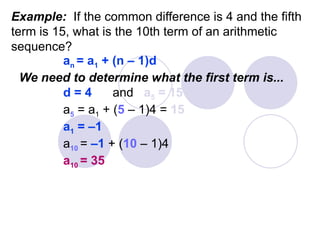
13.
Example: If thecommon difference is 4 and the fifth
term is 15, what is the 10th term of an arithmetic
sequence?
an = a1 + (n – 1)d
We need to determine what the first term is...
d = 4 and a5 = 15
a5 = a1 + (5 – 1)4 = 15
a1 = –1
a10 = –1 + (10 – 1)4
a10 = 35
14.
To find thesum of an arithmetic series:
Sn =
or
Sn = n/2 [2a1 + (n-1)d]
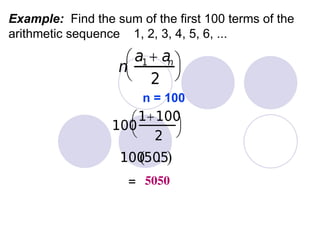
15.
Example: Find thesum of the first 100 terms of the
arithmetic sequence 1, 2, 3, 4, 5, 6, ...
n = 100
= 5050
16.
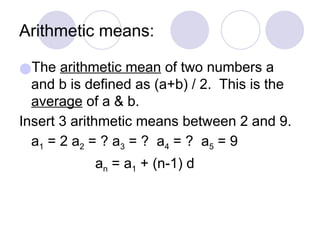
Arithmetic means:
●The arithmeticmean of two numbers a
and b is defined as (a+b) / 2. This is the
average of a & b.
Insert 3 arithmetic means between 2 and 9.
a1 = 2 a2 = ? a3 = ? a4 = ? a5 = 9
an = a1 + (n-1) d
17.
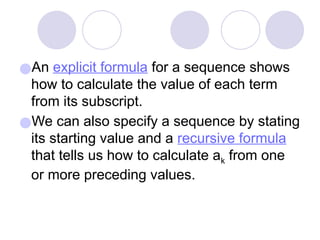
●An explicit formulafor a sequence shows
how to calculate the value of each term
from its subscript.
●We can also specify a sequence by stating
its starting value and a recursive formula
that tells us how to calculate ak from one
or more preceding values.
18.
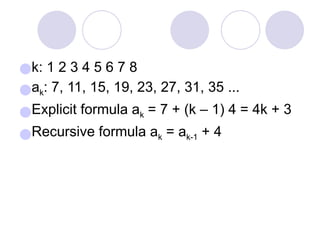
●k: 1 23 4 5 6 7 8
●ak: 7, 11, 15, 19, 23, 27, 31, 35 ...
●Explicit formula ak = 7 + (k – 1) 4 = 4k + 3
●Recursive formula ak = ak-1 + 4
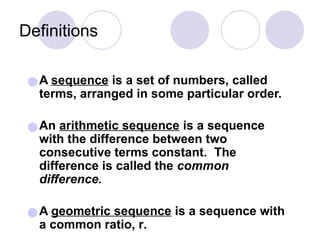
Definitions
●A sequence isa set of numbers, called
terms, arranged in some particular order.
●An arithmetic sequence is a sequence
with the difference between two
consecutive terms constant. The
difference is called the common
difference.
●A geometric sequence is a sequence with
a common ratio, r.
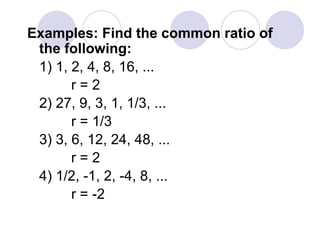
21.
Examples: Find thecommon ratio of
the following:
1) 1, 2, 4, 8, 16, ...
r = 2
2) 27, 9, 3, 1, 1/3, ...
r = 1/3
3) 3, 6, 12, 24, 48, ...
r = 2
4) 1/2, -1, 2, -4, 8, ...
r = -2
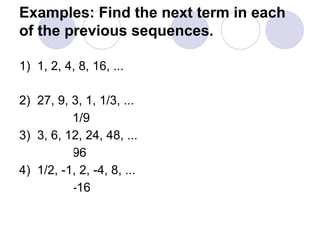
22.
Examples: Find thenext term in each
of the previous sequences.
1) 1, 2, 4, 8, 16, ...
32
2) 27, 9, 3, 1, 1/3, ...
1/9
3) 3, 6, 12, 24, 48, ...
96
4) 1/2, -1, 2, -4, 8, ...
-16
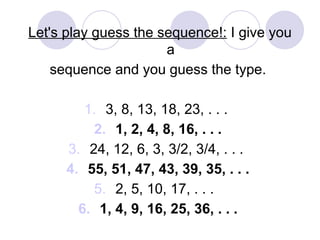
23.
Let's play guessthe sequence!: I give you
a
sequence and you guess the type.
1. 3, 8, 13, 18, 23, . . .
2. 1, 2, 4, 8, 16, . . .
3. 24, 12, 6, 3, 3/2, 3/4, . . .
4. 55, 51, 47, 43, 39, 35, . . .
5. 2, 5, 10, 17, . . .
6. 1, 4, 9, 16, 25, 36, . . .
24.
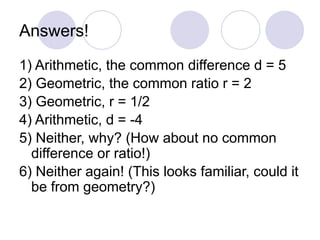
Answers!
1) Arithmetic, thecommon difference d = 5
2) Geometric, the common ratio r = 2
3) Geometric, r = 1/2
4) Arithmetic, d = -4
5) Neither, why? (How about no common
difference or ratio!)
6) Neither again! (This looks familiar, could it
be from geometry?)
25.
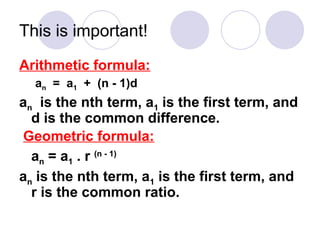
This is important!
Arithmeticformula:
an = a1 + (n - 1)d
an is the nth term, a1 is the first term, and
d is the common difference.
Geometric formula:
an = a1 . r (n - 1)
an is the nth term, a1 is the first term, and
r is the common ratio.
26.
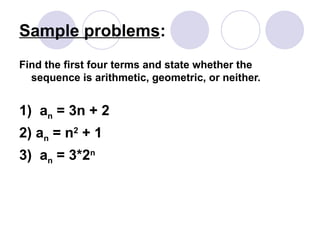
Sample problems:
Find thefirst four terms and state whether the
sequence is arithmetic, geometric, or neither.
1) an = 3n + 2
2) an = n2
+ 1
3) an = 3*2n
27.
Answers:
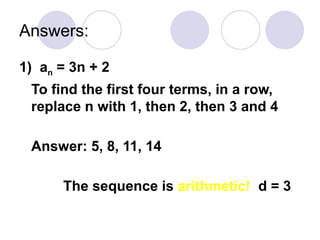
1) an =3n + 2
To find the first four terms, in a row,
replace n with 1, then 2, then 3 and 4
Answer: 5, 8, 11, 14
The sequence is arithmetic! d = 3
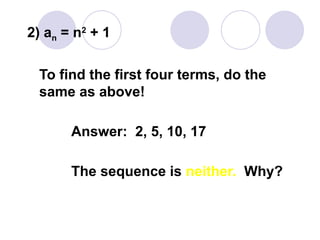
28.
2) an =n2
+ 1
To find the first four terms, do the
same as above!
Answer: 2, 5, 10, 17
The sequence is neither. Why?
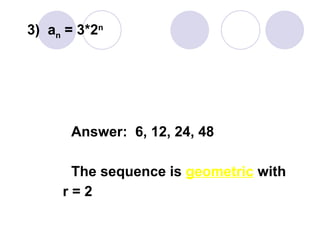
29.
3) an =3*2n
Answer: 6, 12, 24, 48
The sequence is geometric with
r = 2
30.
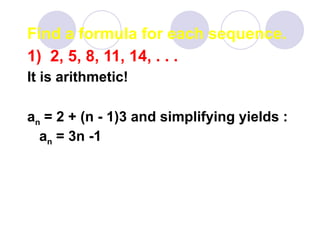
Find a formulafor each sequence.
1) 2, 5, 8, 11, 14, . . .
It is arithmetic!
an = 2 + (n - 1)3 and simplifying yields :
an = 3n -1
31.
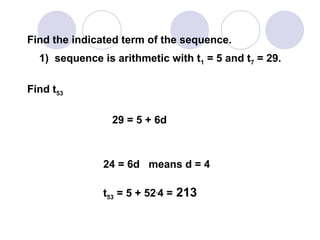
Find the indicatedterm of the sequence.
1) sequence is arithmetic with t1 = 5 and t7 = 29.
Find t53
29 = 5 + 6d
24 = 6d means d = 4
t53 = 5 + 52.
4 = 213
32.
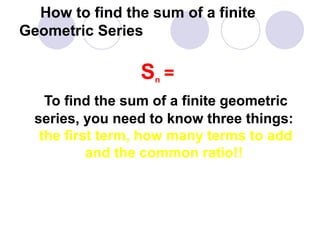
How to findthe sum of a finite
Geometric Series
Sn =
To find the sum of a finite geometric
series, you need to know three things:
the first term, how many terms to add
and the common ratio!!
33.
Definition
geometric series -the expression
formed by adding the terms of a
geometric sequence.
Finding the Sum of the First n Terms of
a Geometric Sequence.
⚪ Use Sn = [a1(1 - rn
)/(1 - r)], Sn is the sum of
the first n terms.
⚪ Substitute the n, a, and r values into Sn =
[a1(1 - rn
)/(1 - r)].
⚪ Simplify to find the sum.
34.
Example:
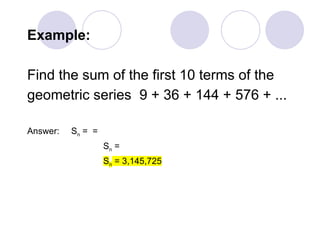
Find the sumof the first 10 terms of the
geometric series 9 + 36 + 144 + 576 + ...
Answer: Sn = =
Sn =
Sn = 3,145,725
35.
Example:
Find the sumof the first 10 terms of the
geometric series 4 + 12 + 36 + 108 + ...
Answer: Sn = [a1(1 - rn
)/(1 - r)]
Sn = [4(1- 310
)/(1-3)]
Sn = [4(-59,048)/(-2)]
Sn = 118,096
36.
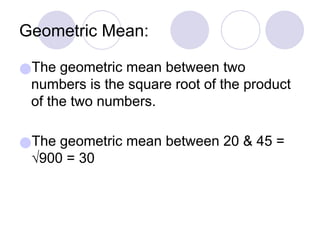
Geometric Mean:
●The geometricmean between two
numbers is the square root of the product
of the two numbers.
●The geometric mean between 20 & 45 =
√900 = 30
37.
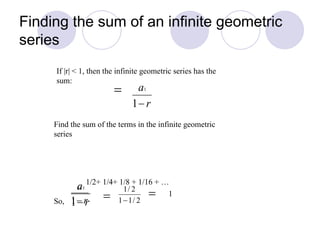
Finding the sumof an infinite geometric
series
Find the sum of the terms in the infinite geometric
series
1/2+ 1/4+ 1/8 + 1/16 + …
So,
If |r| < 1, then the infinite geometric series has the
sum:
1
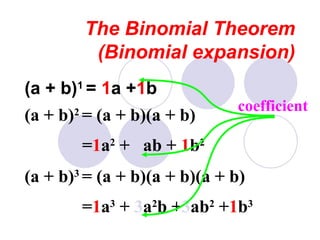
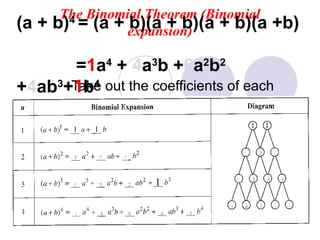
The Binomial Theorem
(Binomialexpansion)
(a + b)1
= 1a +1b
(a + b)2
= (a + b)(a + b)
=1a2
+ 2ab + 1b2
(a + b)3
= (a + b)(a + b)(a + b)
=1a3
+ 3a2
b +3ab2
+1b3
coefficient
40.
Take out thecoefficients of each
expansion.
The Binomial Theorem (Binomial
expansion)
(a + b)4
= (a + b)(a + b)(a + b)(a +b)
=1a4
+ 4a3
b +6a2
b2
+4ab3
+1b4
1
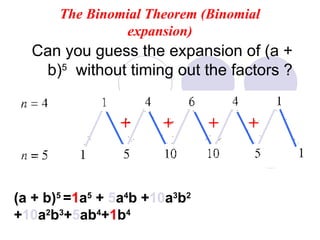
41.
Can you guessthe expansion of (a +
b)5
without timing out the factors ?
The Binomial Theorem (Binomial
expansion)
(a + b)5
=1a5
+ 5a4
b +10a3
b2
+10a2
b3
+5ab4
+1b4
+ + + +
43.
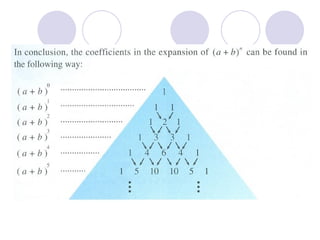
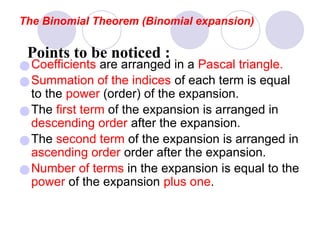
●Coefficients are arrangedin a Pascal triangle.
●Summation of the indices of each term is equal
to the power (order) of the expansion.
●The first term of the expansion is arranged in
descending order after the expansion.
●The second term of the expansion is arranged in
ascending order order after the expansion.
●Number of terms in the expansion is equal to the
power of the expansion plus one.
The Binomial Theorem (Binomial expansion)
Points to be noticed :
44.
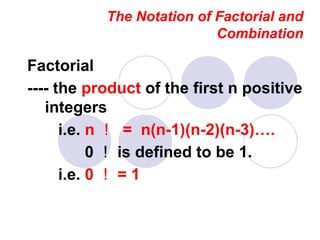
The Notation ofFactorial and
Combination
Factorial
---- the product of the first n positive
integers
i.e. n ! = n(n-1)(n-2)(n-3)….
0 ! is defined to be 1.
i.e. 0 ! = 1
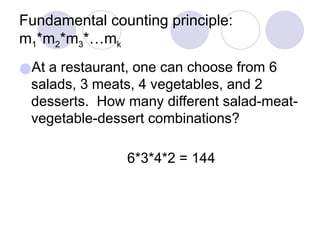
Fundamental counting principle:
m1*m2*m3*…mk
●Ata restaurant, one can choose from 6
salads, 3 meats, 4 vegetables, and 2
desserts. How many different salad-meat-
vegetable-dessert combinations?
6*3*4*2 = 144
47.
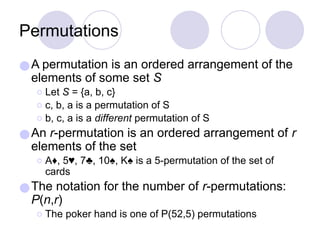
Permutations
●A permutation isan ordered arrangement of the
elements of some set S
⚪Let S = {a, b, c}
⚪c, b, a is a permutation of S
⚪b, c, a is a different permutation of S
●An r-permutation is an ordered arrangement of r
elements of the set
⚪A♦, 5♥, 7♣, 10♠, K♠ is a 5-permutation of the set of
cards
●The notation for the number of r-permutations:
P(n,r)
⚪The poker hand is one of P(52,5) permutations
48.
Permutations
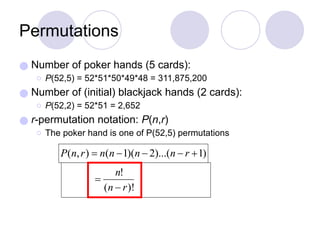
● Number ofpoker hands (5 cards):
⚪ P(52,5) = 52*51*50*49*48 = 311,875,200
● Number of (initial) blackjack hands (2 cards):
⚪ P(52,2) = 52*51 = 2,652
● r-permutation notation: P(n,r)
⚪ The poker hand is one of P(52,5) permutations
49.
r-permutations example
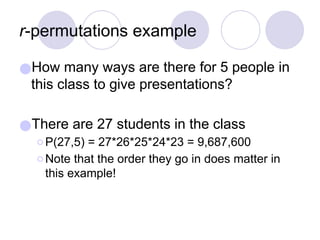
●How manyways are there for 5 people in
this class to give presentations?
●There are 27 students in the class
⚪P(27,5) = 27*26*25*24*23 = 9,687,600
⚪Note that the order they go in does matter in
this example!
50.
Permutation formula proof
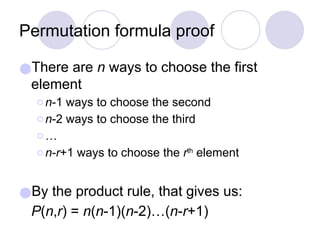
●Thereare n ways to choose the first
element
⚪n-1 ways to choose the second
⚪n-2 ways to choose the third
⚪…
⚪n-r+1 ways to choose the rth
element
●By the product rule, that gives us:
P(n,r) = n(n-1)(n-2)…(n-r+1)
51.
Permutations vs. r-permutations
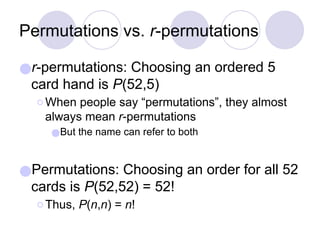
●r-permutations:Choosing an ordered 5
card hand is P(52,5)
⚪When people say “permutations”, they almost
always mean r-permutations
●But the name can refer to both
●Permutations: Choosing an order for all 52
cards is P(52,52) = 52!
⚪Thus, P(n,n) = n!
52.
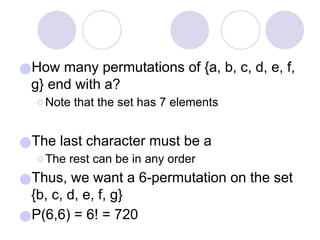
●How many permutationsof {a, b, c, d, e, f,
g} end with a?
⚪Note that the set has 7 elements
●The last character must be a
⚪The rest can be in any order
●Thus, we want a 6-permutation on the set
{b, c, d, e, f, g}
●P(6,6) = 6! = 720
53.
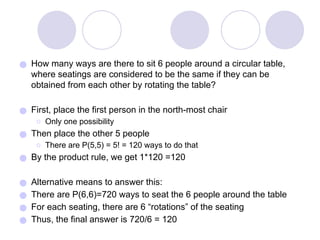
● How manyways are there to sit 6 people around a circular table,
where seatings are considered to be the same if they can be
obtained from each other by rotating the table?
● First, place the first person in the north-most chair
⚪ Only one possibility
● Then place the other 5 people
⚪ There are P(5,5) = 5! = 120 ways to do that
● By the product rule, we get 1*120 =120
● Alternative means to answer this:
● There are P(6,6)=720 ways to seat the 6 people around the table
● For each seating, there are 6 “rotations” of the seating
● Thus, the final answer is 720/6 = 120
54.
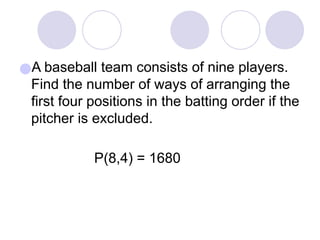
●A baseball teamconsists of nine players.
Find the number of ways of arranging the
first four positions in the batting order if the
pitcher is excluded.
P(8,4) = 1680
55.
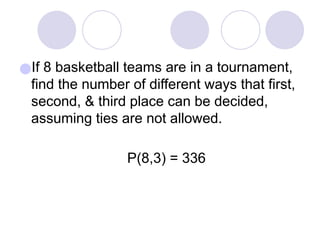
●If 8 basketballteams are in a tournament,
find the number of different ways that first,
second, & third place can be decided,
assuming ties are not allowed.
P(8,3) = 336
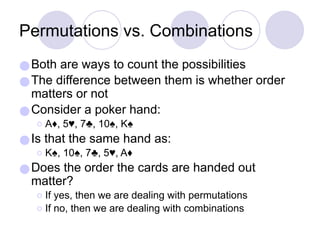
Permutations vs. Combinations
●Bothare ways to count the possibilities
●The difference between them is whether order
matters or not
●Consider a poker hand:
⚪A♦, 5♥, 7♣, 10♠, K♠
●Is that the same hand as:
⚪K♠, 10♠, 7♣, 5♥, A♦
●Does the order the cards are handed out
matter?
⚪If yes, then we are dealing with permutations
⚪If no, then we are dealing with combinations
58.
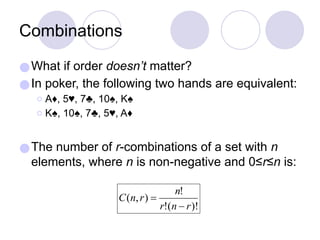
Combinations
●What if orderdoesn’t matter?
●In poker, the following two hands are equivalent:
⚪A♦, 5♥, 7♣, 10♠, K♠
⚪K♠, 10♠, 7♣, 5♥, A♦
●The number of r-combinations of a set with n
elements, where n is non-negative and 0≤r≤n is:
59.
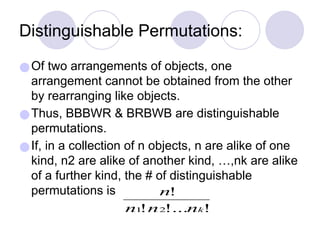
Distinguishable Permutations:
●Of twoarrangements of objects, one
arrangement cannot be obtained from the other
by rearranging like objects.
●Thus, BBBWR & BRBWB are distinguishable
permutations.
●If, in a collection of n objects, n are alike of one
kind, n2 are alike of another kind, …,nk are alike
of a further kind, the # of distinguishable
permutations is
60.
●Find the numberof distinguishable
permutations of the letters in the word
MISSISSIPPI.
61.
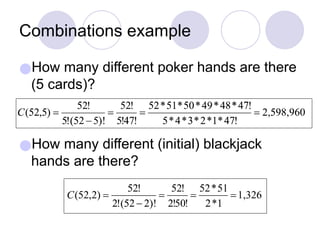
Combinations example
●How manydifferent poker hands are there
(5 cards)?
●How many different (initial) blackjack
hands are there?
62.
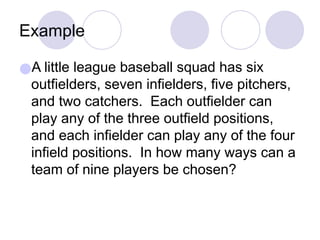
Example
●A little leaguebaseball squad has six
outfielders, seven infielders, five pitchers,
and two catchers. Each outfielder can
play any of the three outfield positions,
and each infielder can play any of the four
infield positions. In how many ways can a
team of nine players be chosen?
63.
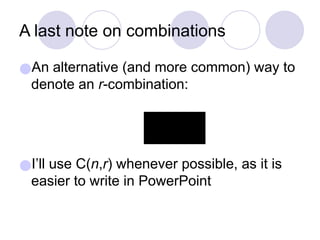
A last noteon combinations
●An alternative (and more common) way to
denote an r-combination:
●I’ll use C(n,r) whenever possible, as it is
easier to write in PowerPoint
64.
10.8 Probability
●Objective:
Students willbe introduced to both
theoretical and experimental probabilities.
Students will also find probabilities of
mutually exclusive events.
65.
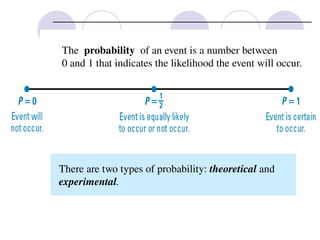
The probability ofan event is a number between
0 and 1 that indicates the likelihood the event will occur.
There are two types of probability: theoretical and
experimental.
66.
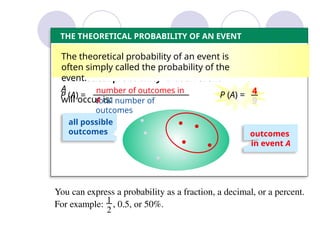
THE THEORETICAL PROBABILITYOF AN EVENT
When all outcomes are equally likely,
the
theoretical probability that an event
A
will occur is:
P (A) =
total number of
outcomes
The theoretical probability of an event is
often simply called the probability of the
event.
all possible
outcomes
number of outcomes in
A
outcomes
in event A
You can express a probability as a fraction, a decimal, or a percent.
For example: , 0.5, or 50%.
1
2
P (A) = 4
9
67.
Finding Probabilities of
Events
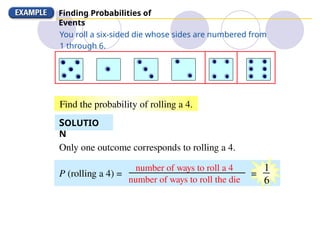
Youroll a six-sided die whose sides are numbered from
1 through 6.
Find the probability of rolling a 4.
SOLUTIO
N
Only one outcome corresponds to rolling a 4.
P (rolling a 4) =
number of ways to roll a 4
number of ways to roll the die
1
6
=
68.
Finding Probabilities of
Events
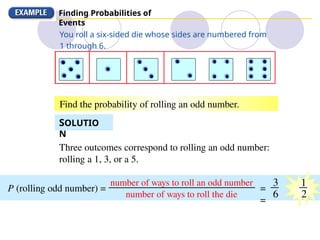
Threeoutcomes correspond to rolling an odd number:
rolling a 1, 3, or a 5.
P (rolling odd number) =
number of ways to roll an odd number
number of ways to roll the die
You roll a six-sided die whose sides are numbered from
1 through 6.
Find the probability of rolling an odd number.
SOLUTIO
N
3
6
1
2
=
=
69.
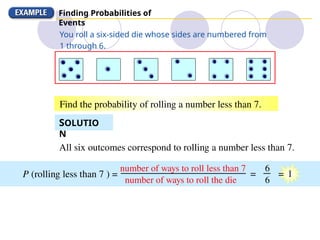
Finding Probabilities of
Events
Allsix outcomes correspond to rolling a number less than 7.
P (rolling less than 7 ) =
number of ways to roll less than 7
You roll a six-sided die whose sides are numbered from
1 through 6.
Find the probability of rolling a number less than 7.
SOLUTIO
N
number of ways to roll the die
6
6
= = 1
70.
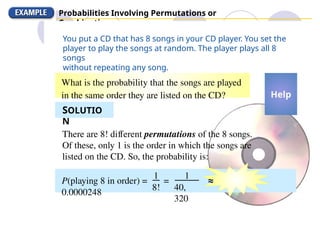
Probabilities Involving Permutationsor
Combinations
You put a CD that has 8 songs in your CD player. You set the
player to play the songs at random. The player plays all 8
songs
without repeating any song.
What is the probability that the songs are played
in the same order they are listed on the CD?
SOLUTIO
N
There are 8! different permutations of the 8 songs.
Of these, only 1 is the order in which the songs are
listed on the CD. So, the probability is:
Help
1
8!
1
40,
320
P(playing 8 in order) = = ≈
0.0000248
71.
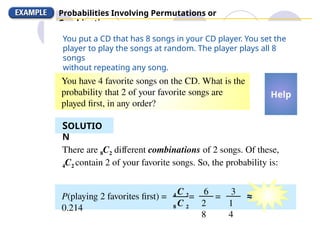
Probabilities Involving Permutationsor
Combinations
You put a CD that has 8 songs in your CD player. You set the
player to play the songs at random. The player plays all 8
songs
without repeating any song.
You have 4 favorite songs on the CD. What is the
probability that 2 of your favorite songs are
played first, in any order?
SOLUTIO
N
There are 8C2 different combinations of 2 songs. Of these,
4C2 contain 2 of your favorite songs. So, the probability is:
Help
P(playing 2 favorites first) = = = ≈
0.214
4 C 2
8 C 2
6
2
8
3
1
4
72.
Probabilities Involving Permutationsor
Combinations
Sometimes it is not possible or convenient to find the
theoretical probability of an event. In such cases you
may be able to calculate an experimental probability
by performing an experiment, conducting a survey, or
looking at the history of the event.
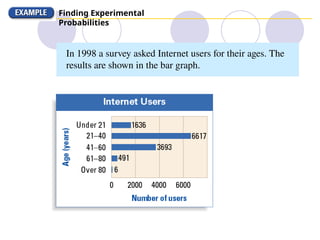
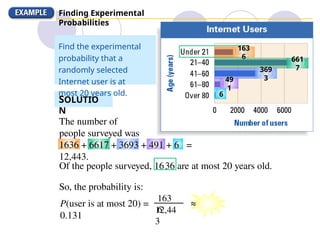
Finding Experimental
Probabilities
SOLUTIO
N
The numberof
people surveyed was
1636 + 6617 + 3693 + 491 + 6 =
12,443.
Of the people surveyed, 1636 are at most 20 years old.
So, the probability is:
163
6 661
7
369
3
49
1
6
P(user is at most 20) = ≈
0.131
163
6
12,44
3
Find the experimental
probability that a
randomly selected
Internet user is at
most 20 years old.
75.
Finding Experimental
Probabilities
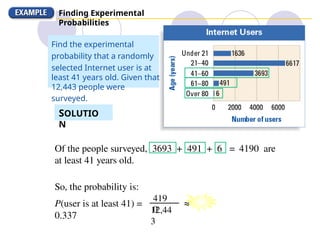
SOLUTIO
N
Find theexperimental
probability that a randomly
selected Internet user is at
least 41 years old. Given that
12,443 people were
surveyed.
Of the people surveyed, 3693 + 491 + 6 = 4190 are
at least 41 years old.
So, the probability is:
P(user is at least 41) = ≈
0.337
419
0
12,44
3
76.
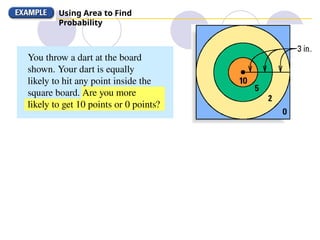
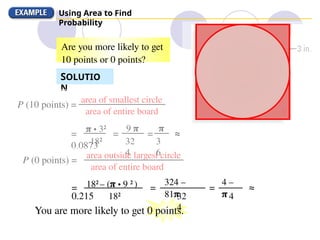
Using Area toFind
Probability
You throw a dart at the board
shown. Your dart is equally
likely to hit any point inside the
square board. Are you more
likely to get 10 points or 0 points?
77.
π • 32
182
== = ≈
0.0873 32
4
9 π π
3
6
Using Area to Find
Probability
SOLUTIO
N
P (10 points) =
area of smallest circle
area of entire board
Are you more likely to get
10 points or 0 points?
You are more likely to get 0 points.
P (0 points) =
area outside largest circle
area of entire board
182
– (π • 9 2
)
182
= = = ≈
0.215 32
4
324 –
81π 4
4 –
π
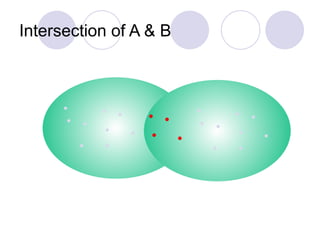
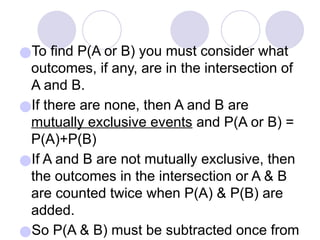
●To find P(Aor B) you must consider what
outcomes, if any, are in the intersection of
A and B.
●If there are none, then A and B are
mutually exclusive events and P(A or B) =
P(A)+P(B)
●If A and B are not mutually exclusive, then
the outcomes in the intersection or A & B
are counted twice when P(A) & P(B) are
added.
●So P(A & B) must be subtracted once from
82.
EXAMPLE 1
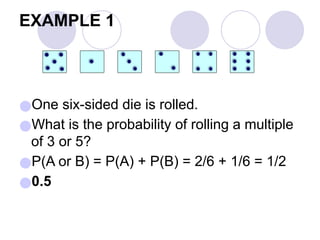
●One six-sideddie is rolled.
●What is the probability of rolling a multiple
of 3 or 5?
●P(A or B) = P(A) + P(B) = 2/6 + 1/6 = 1/2
●0.5
83.
EXAMPLE 2
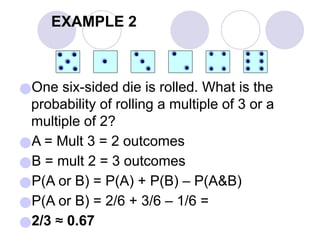
●One six-sideddie is rolled. What is the
probability of rolling a multiple of 3 or a
multiple of 2?
●A = Mult 3 = 2 outcomes
●B = mult 2 = 3 outcomes
●P(A or B) = P(A) + P(B) – P(A&B)
●P(A or B) = 2/6 + 3/6 – 1/6 =
●2/3 ≈ 0.67
84.
EXAMPLE 3
●In apoll of high school juniors, 6 out of 15
took a French class and 11 out of 15 took
a math class.
●Fourteen out of 15 students took French
or math.
●What is the probability that a student took
both French and math?
85.
●A = French
●B= Math
●P(A) = 6/15, P(B) = 11/15, P(AorB) = 14/15
●P(A or B) = P(A) + P(B) – P(A&B)
●14/15 = 6/15 + 11/15 – P(A & B)
●P(A & B) = 6/15 + 11/15 – 14/15
●P(A & B) = 3/15 = 1/5 = .20
86.
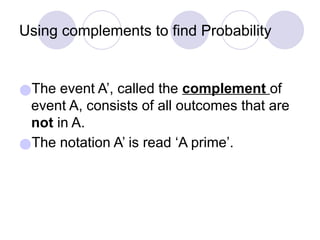
Using complements tofind Probability
●The event A’, called the complement of
event A, consists of all outcomes that are
not in A.
●The notation A’ is read ‘A prime’.
87.
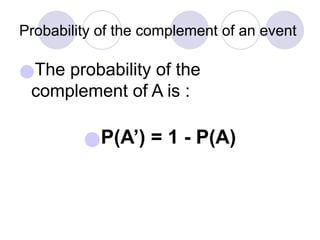
Probability of thecomplement of an event
●The probability of the
complement of A is :
●P(A’) = 1 - P(A)
88.
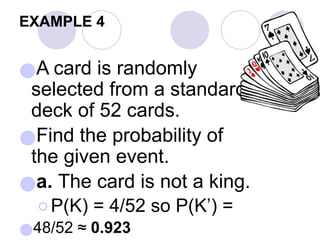
EXAMPLE 4
●A cardis randomly
selected from a standard
deck of 52 cards.
●Find the probability of
the given event.
●a. The card is not a king.
⚪P(K) = 4/52 so P(K’) =
●48/52 ≈ 0.923
89.
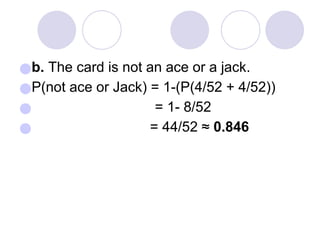
●b. The cardis not an ace or a jack.
●P(not ace or Jack) = 1-(P(4/52 + 4/52))
● = 1- 8/52
● = 44/52 ≈ 0.846
●Two events are
Independentif the
occurrence of 1 has no
effect on the occurrence of
the other. (a coin toss 2
times, the first toss has no
effect on the 2nd
toss)
92.
Probability of TwoIndependent Events
(can be extended to probability of 3 or
more ind. events)
●A & B are independent events then the
probability that both A & B occur is:
●P(A and B) = P(A) • P(B)
93.
BASEBALL
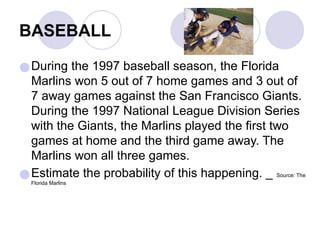
●During the 1997baseball season, the Florida
Marlins won 5 out of 7 home games and 3 out of
7 away games against the San Francisco Giants.
During the 1997 National League Division Series
with the Giants, the Marlins played the first two
games at home and the third game away. The
Marlins won all three games.
●Estimate the probability of this happening. _ Source: The
Florida Marlins
94.
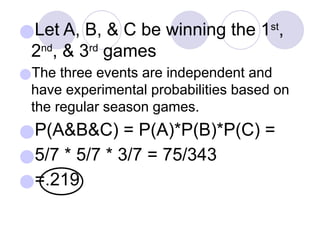
●Let A, B,& C be winning the 1st
,
2nd
, & 3rd
games
●The three events are independent and
have experimental probabilities based on
the regular season games.
●P(A&B&C) = P(A)*P(B)*P(C) =
●5/7 * 5/7 * 3/7 = 75/343
●=.219
95.
PROBABILITIES OF DEPENDENT
EVENTS
●Twoevents A and B are dependent
events if the occurrence of one affects the
occurrence of the other.
●The probability that B will occur given that
A has occurred is called the conditional
probability of B given A and is written
P(B|A).
96.
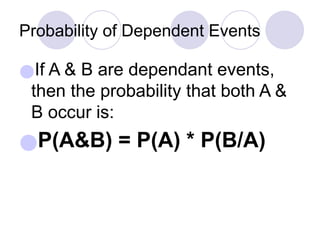
Probability of DependentEvents
●If A & B are dependant events,
then the probability that both A &
B occur is:
●P(A&B) = P(A) * P(B/A)
97.
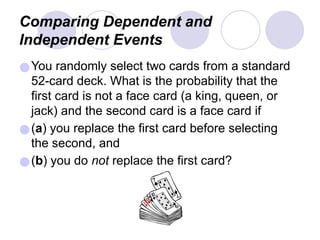
Comparing Dependent and
IndependentEvents
●You randomly select two cards from a standard
52-card deck. What is the probability that the
first card is not a face card (a king, queen, or
jack) and the second card is a face card if
●(a) you replace the first card before selecting
the second, and
●(b) you do not replace the first card?
98.
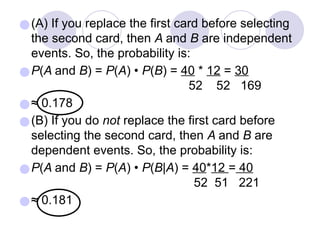
●(A) If youreplace the first card before selecting
the second card, then A and B are independent
events. So, the probability is:
●P(A and B) = P(A) • P(B) = 40 * 12 = 30
52 52 169
●≈ 0.178
●(B) If you do not replace the first card before
selecting the second card, then A and B are
dependent events. So, the probability is:
●P(A and B) = P(A) • P(B|A) = 40*12 = 40
52 51 221
●≈ 0.181
![To find the sum of an arithmetic series:
Sn =
or
Sn = n/2 [2a1 + (n-1)d]](https://image.slidesharecdn.com/sequencesandseries-250911065143-f7055b85/85/Mathematics-10_Sequences-and-Series-pptx-14-320.jpg)
![Definition
geometric series - the expression
formed by adding the terms of a
geometric sequence.
Finding the Sum of the First n Terms of
a Geometric Sequence.
⚪ Use Sn = [a1(1 - rn
)/(1 - r)], Sn is the sum of
the first n terms.
⚪ Substitute the n, a, and r values into Sn =
[a1(1 - rn
)/(1 - r)].
⚪ Simplify to find the sum.](https://image.slidesharecdn.com/sequencesandseries-250911065143-f7055b85/85/Mathematics-10_Sequences-and-Series-pptx-33-320.jpg)
![Example:
Find the sum of the first 10 terms of the
geometric series 4 + 12 + 36 + 108 + ...
Answer: Sn = [a1(1 - rn
)/(1 - r)]
Sn = [4(1- 310
)/(1-3)]
Sn = [4(-59,048)/(-2)]
Sn = 118,096](https://image.slidesharecdn.com/sequencesandseries-250911065143-f7055b85/85/Mathematics-10_Sequences-and-Series-pptx-35-320.jpg)