QUARTER 1: WEEK 8
Learning
Competencies
The learners
formulate the rule
for finding the next
term in a sequence
by looking for
patterns.
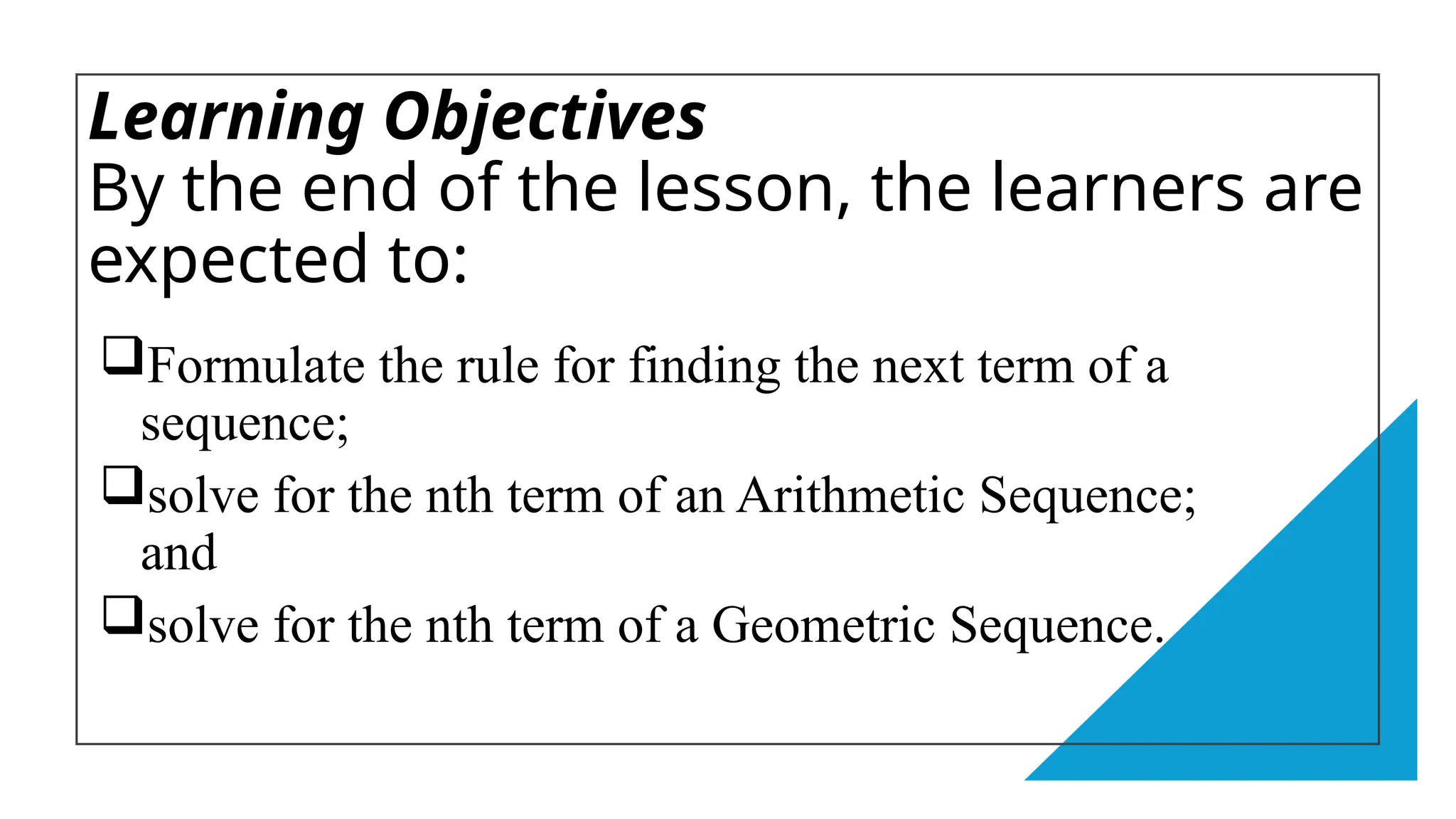
Learning Objectives
By the end of the lesson, the learners are
expected to:
Formulate the rule for finding the next term of a
sequence;
solve for the nth term of an Arithmetic Sequence;
and
solve for the nth term of a Geometric Sequence.
Content:
• Sequence
• Finding the Rule of a Sequence
• Arithmetic Sequence
• Geometric Sequence
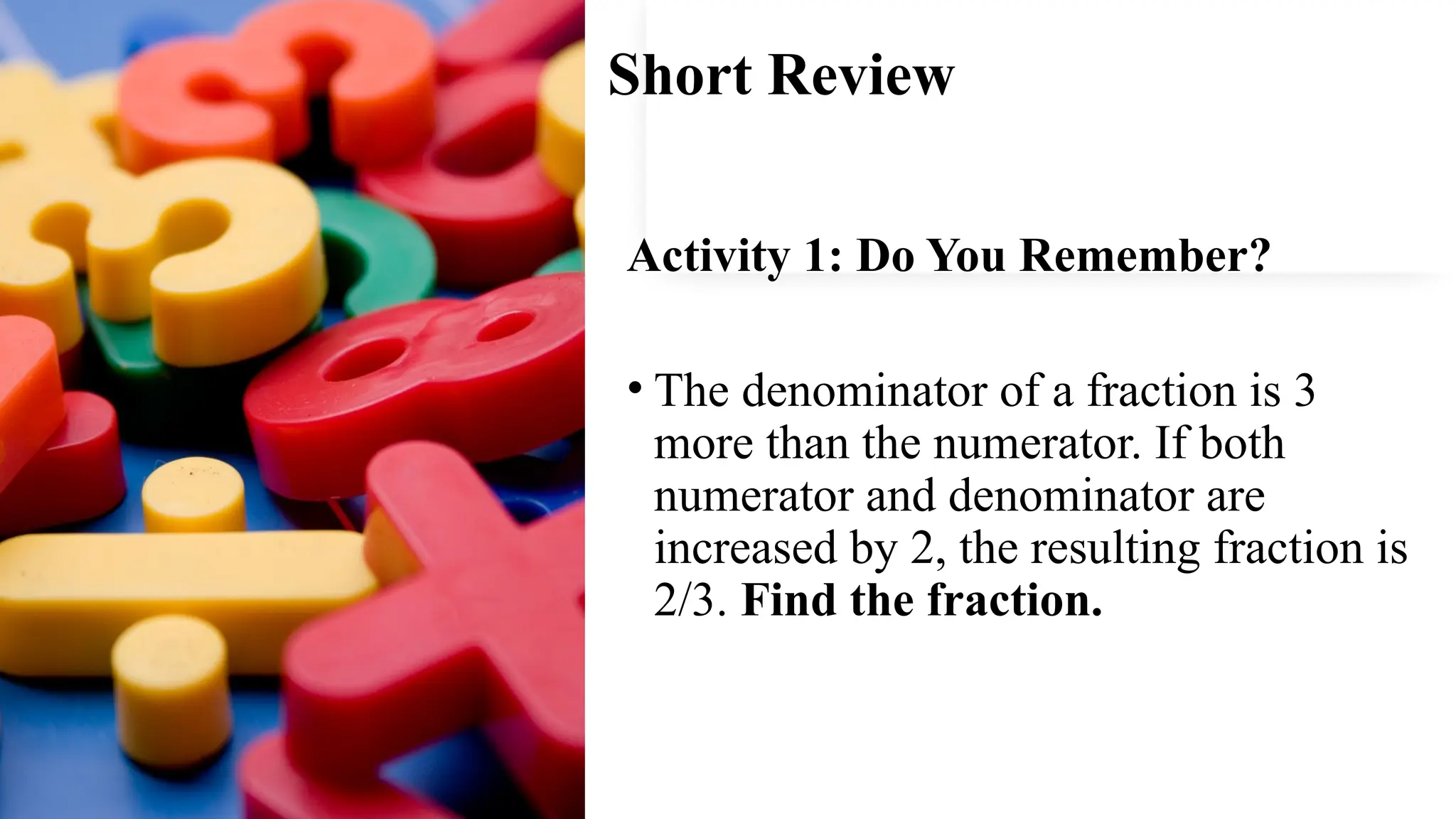
Short Review
Activity 1: Do You Remember?
• The denominator of a fraction is 3
more than the numerator. If both
numerator and denominator are
increased by 2, the resulting fraction is
2/3. Find the fraction.
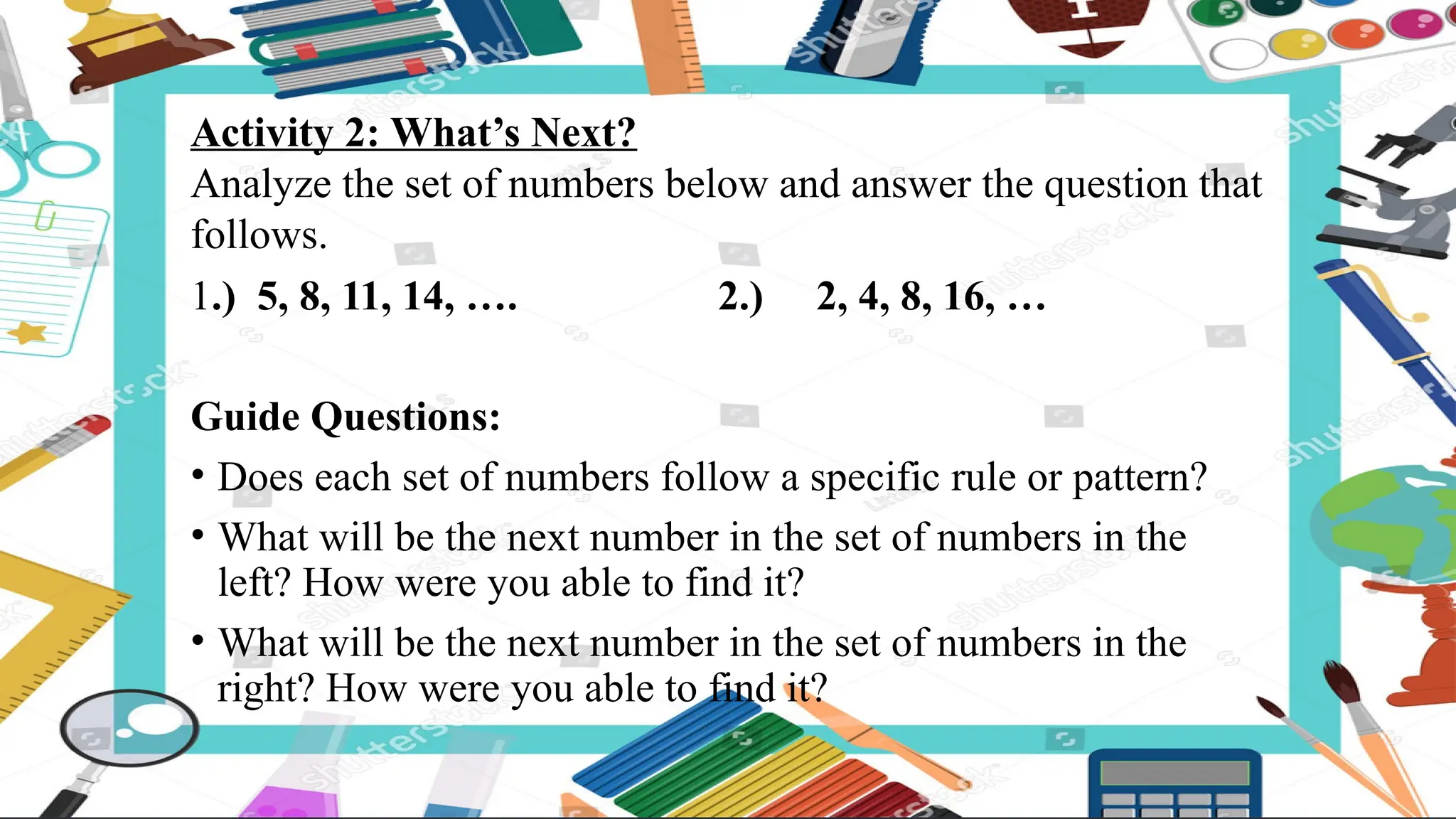
Activity 2: What’s Next?
Analyze the set of numbers below and answer the question that
follows.
1.) 5, 8, 11, 14, …. 2.) 2, 4, 8, 16, …
Guide Questions:
• Does each set of numbers follow a specific rule or pattern?
• What will be the next number in the set of numbers in the
left? How were you able to find it?
• What will be the next number in the set of numbers in the
right? How were you able to find it?
Unlocking Content Vocabulary
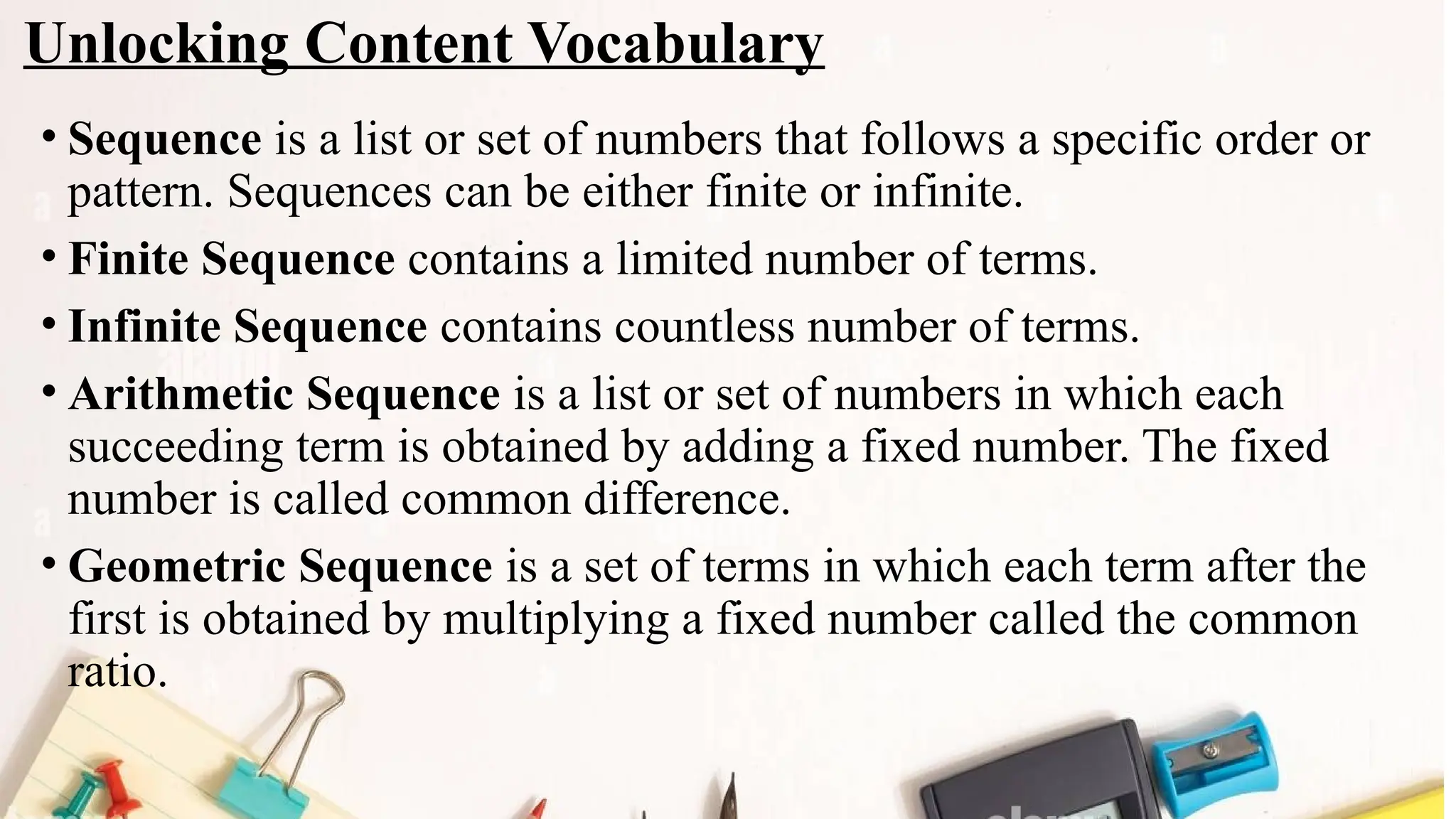
• Sequence is a list or set of numbers that follows a specific order or
pattern. Sequences can be either finite or infinite.
• Finite Sequence contains a limited number of terms.
• Infinite Sequence contains countless number of terms.
• Arithmetic Sequence is a list or set of numbers in which each
succeeding term is obtained by adding a fixed number. The fixed
number is called common difference.
• Geometric Sequence is a set of terms in which each term after the
first is obtained by multiplying a fixed number called the common
ratio.
SUB-TOPIC 1:
Finding the Rule of a Sequence
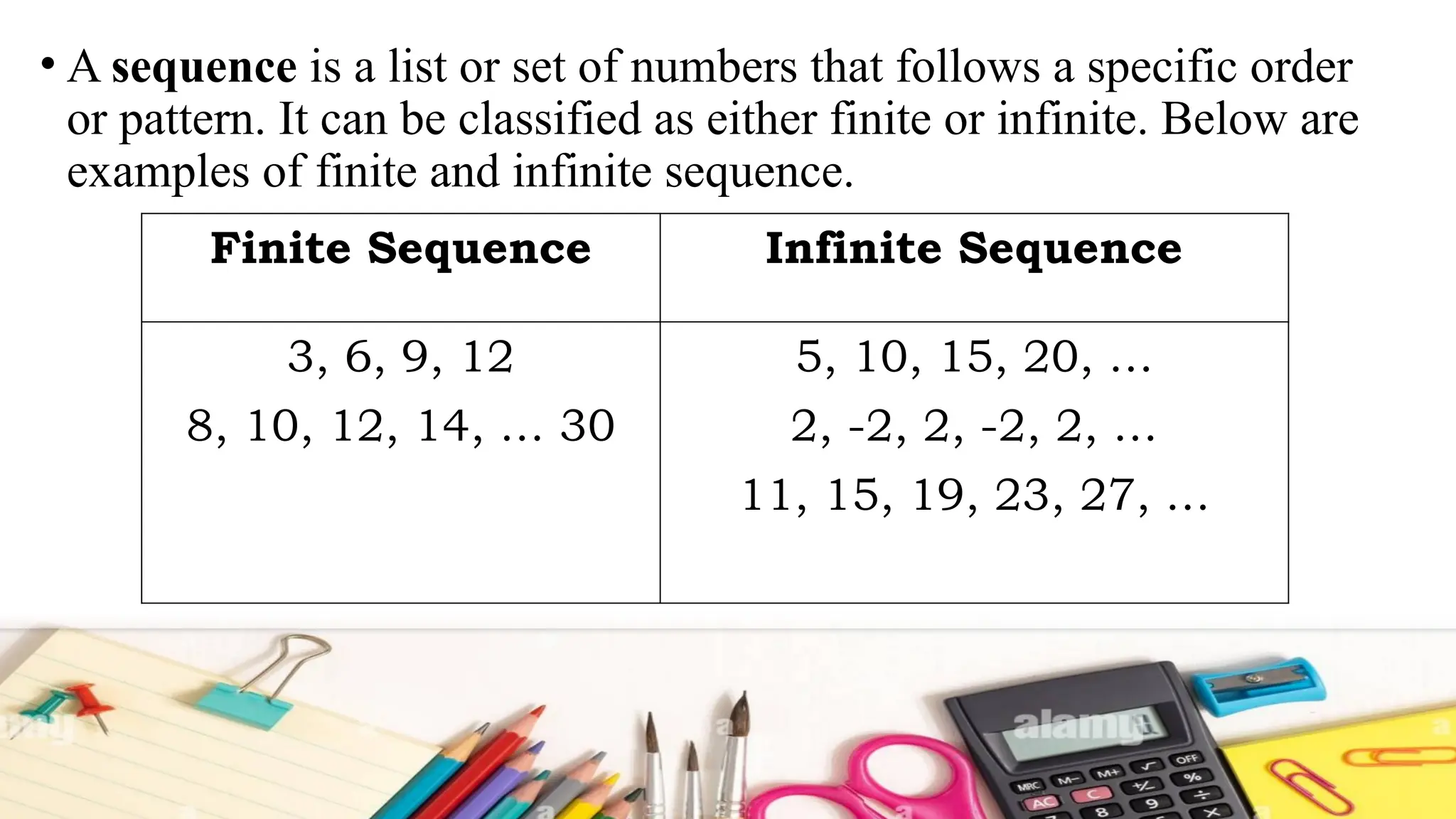
• A sequence is a list or set of numbers that follows a specific order
or pattern. It can be classified as either finite or infinite. Below are
examples of finite and infinite sequence.
Finite Sequence Infinite Sequence
3, 6, 9, 12
8, 10, 12, 14, … 30
5, 10, 15, 20, …
2, -2, 2, -2, 2, …
11, 15, 19, 23, 27, …
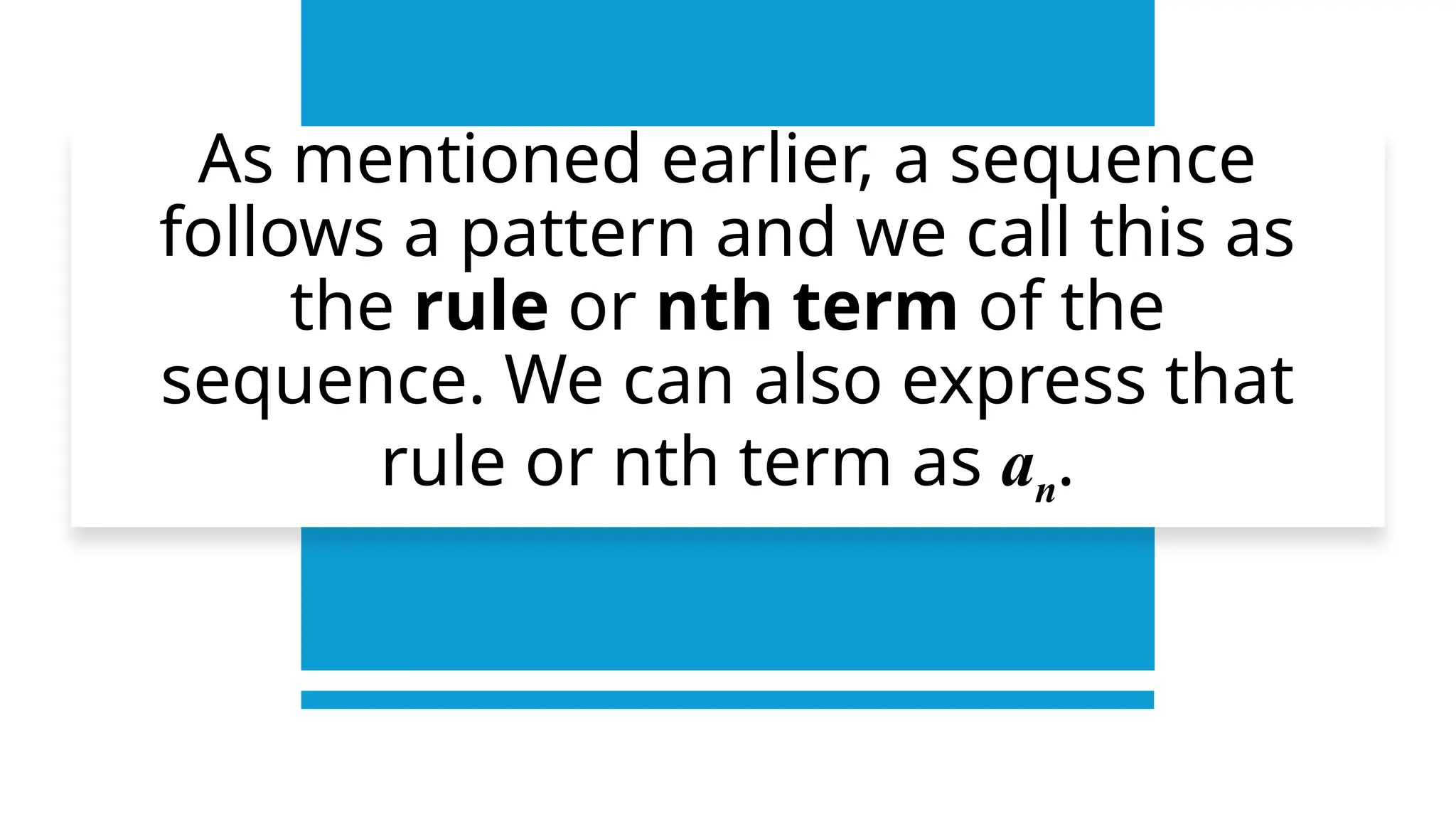
As mentioned earlier, a sequence
follows a pattern and we call this as
the rule or nth term of the
sequence. We can also express that
rule or nth term as an.
Worked Example
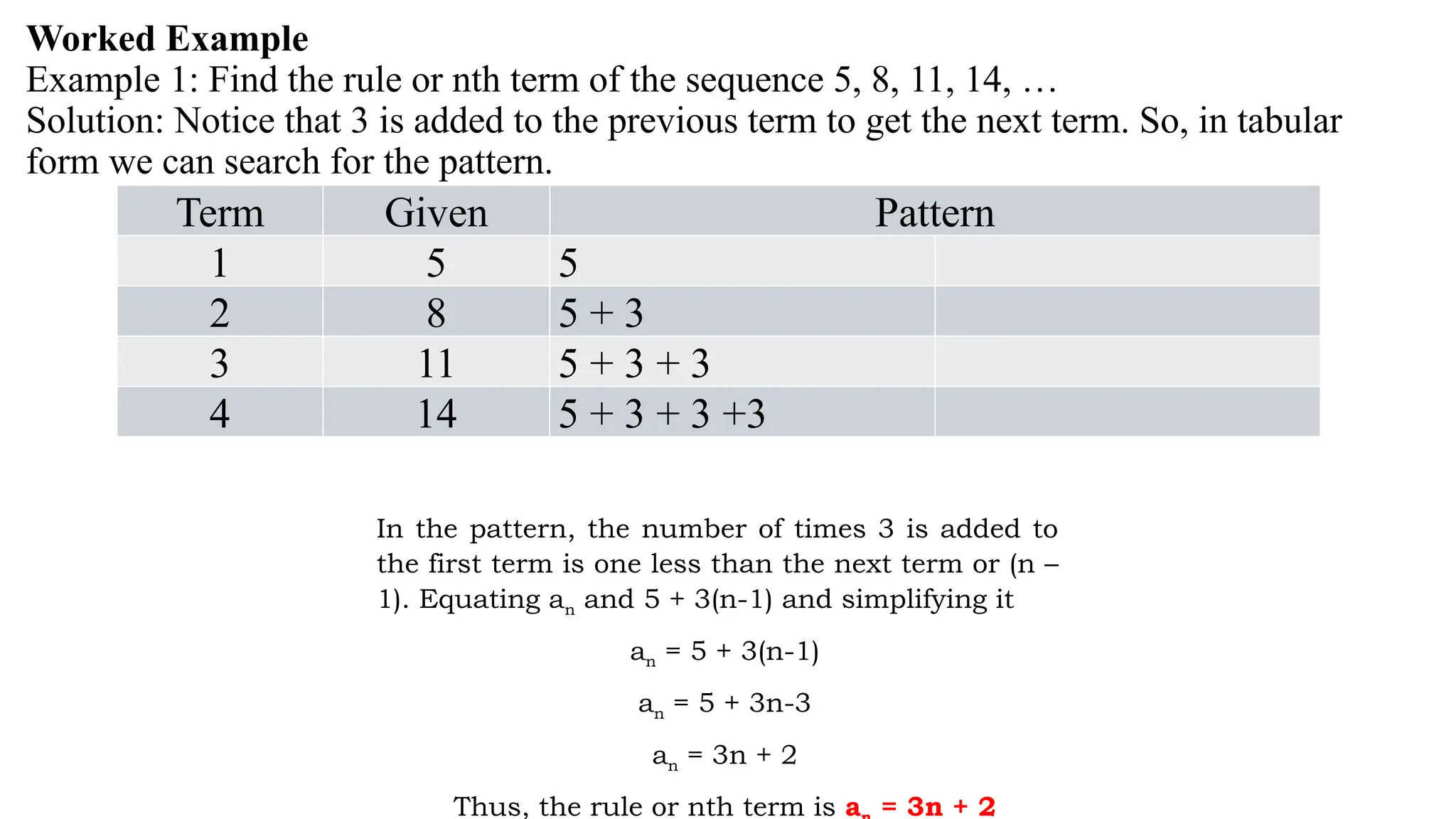
Example 1: Find the rule or nth term of the sequence 5, 8, 11, 14, …
Solution: Notice that 3 is added to the previous term to get the next term. So, in tabular
form we can search for the pattern.
Term Given Pattern
1 5 5
2 8 5 + 3
3 11 5 + 3 + 3
4 14 5 + 3 + 3 +3
In the pattern, the number of times 3 is added to
the first term is one less than the next term or (n –
1). Equating an and 5 + 3(n-1) and simplifying it
an = 5 + 3(n-1)
an = 5 + 3n-3
an = 3n + 2
Thus, the rule or nth term is a = 3n + 2
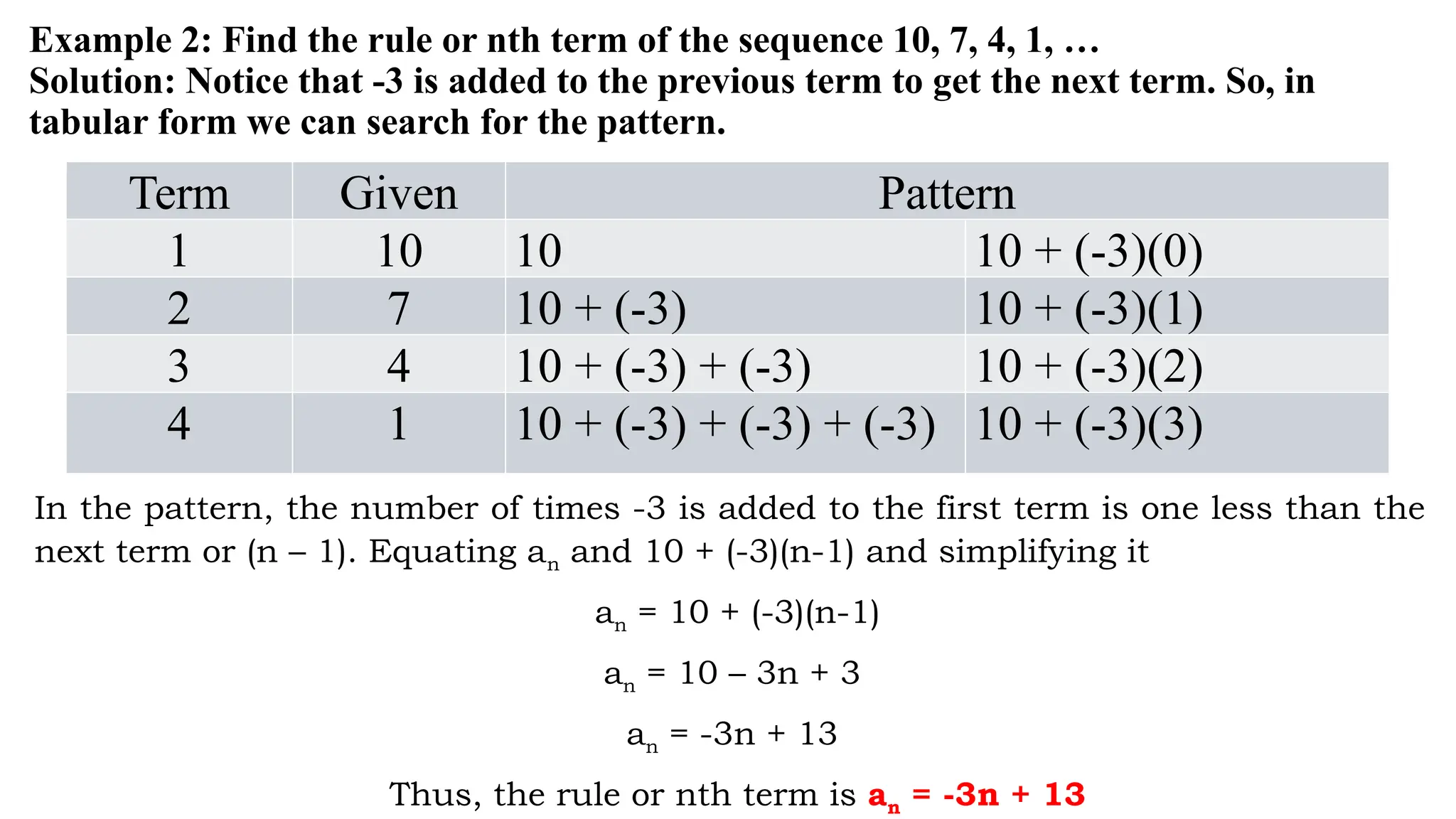
Example 2: Find the rule or nth term of the sequence 10, 7, 4, 1, …
Solution: Notice that -3 is added to the previous term to get the next term. So, in
tabular form we can search for the pattern.
Term Given Pattern
1 10 10 10 + (-3)(0)
2 7 10 + (-3) 10 + (-3)(1)
3 4 10 + (-3) + (-3) 10 + (-3)(2)
4 1 10 + (-3) + (-3) + (-3) 10 + (-3)(3)
In the pattern, the number of times -3 is added to the first term is one less than the
next term or (n – 1). Equating an and 10 + (-3)(n-1) and simplifying it
an = 10 + (-3)(n-1)
an = 10 – 3n + 3
an = -3n + 13
Thus, the rule or nth term is an = -3n + 13
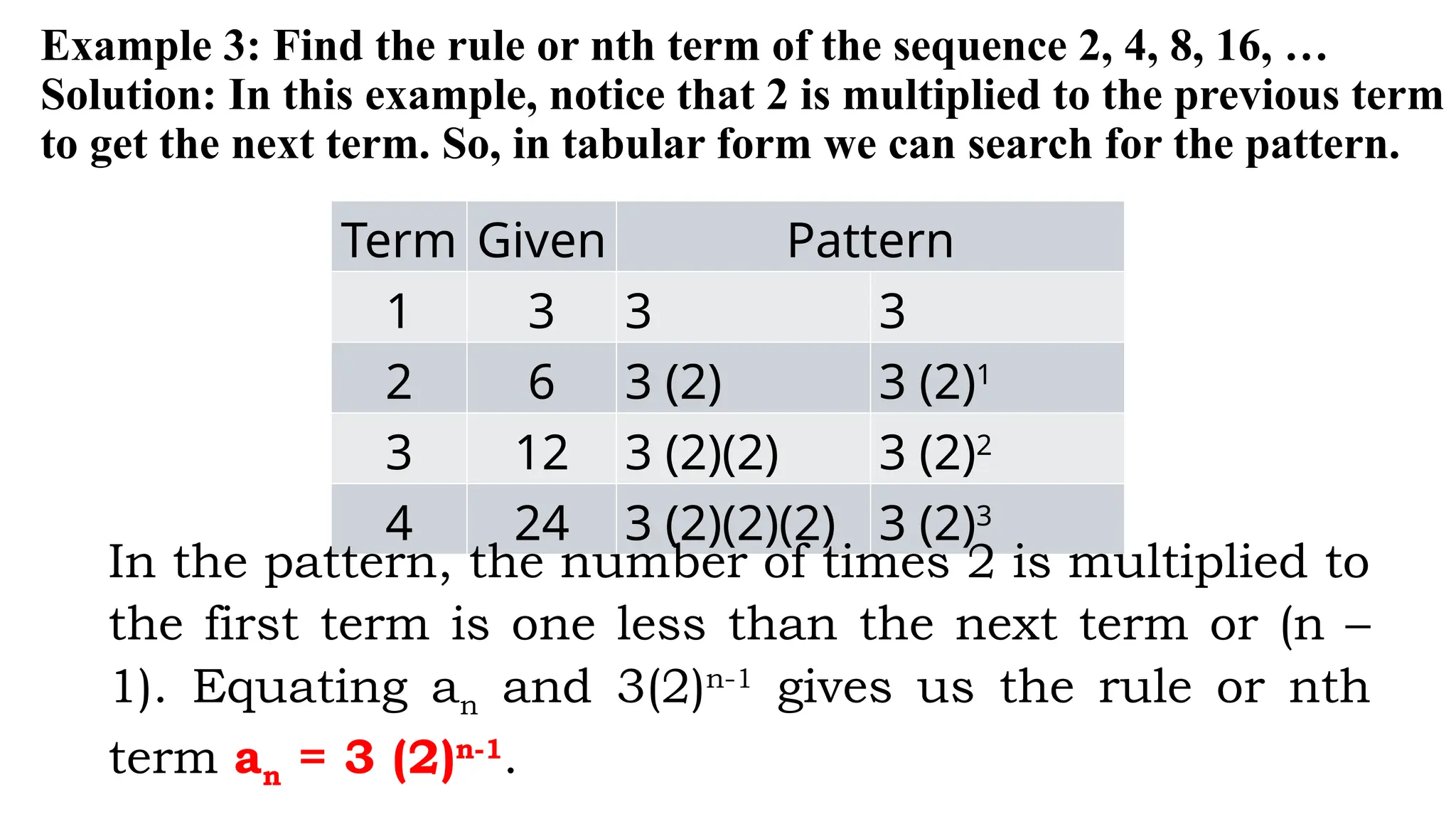
Example 3: Find the rule or nth term of the sequence 2, 4, 8, 16, …
Solution: In this example, notice that 2 is multiplied to the previous term
to get the next term. So, in tabular form we can search for the pattern.
Term Given Pattern
1 3 3 3
2 6 3 (2) 3 (2)1
3 12 3 (2)(2) 3 (2)2
4 24 3 (2)(2)(2) 3 (2)3
In the pattern, the number of times 2 is multiplied to
the first term is one less than the next term or (n –
1). Equating an and 3(2)n-1
gives us the rule or nth
term an = 3 (2)n-1
.
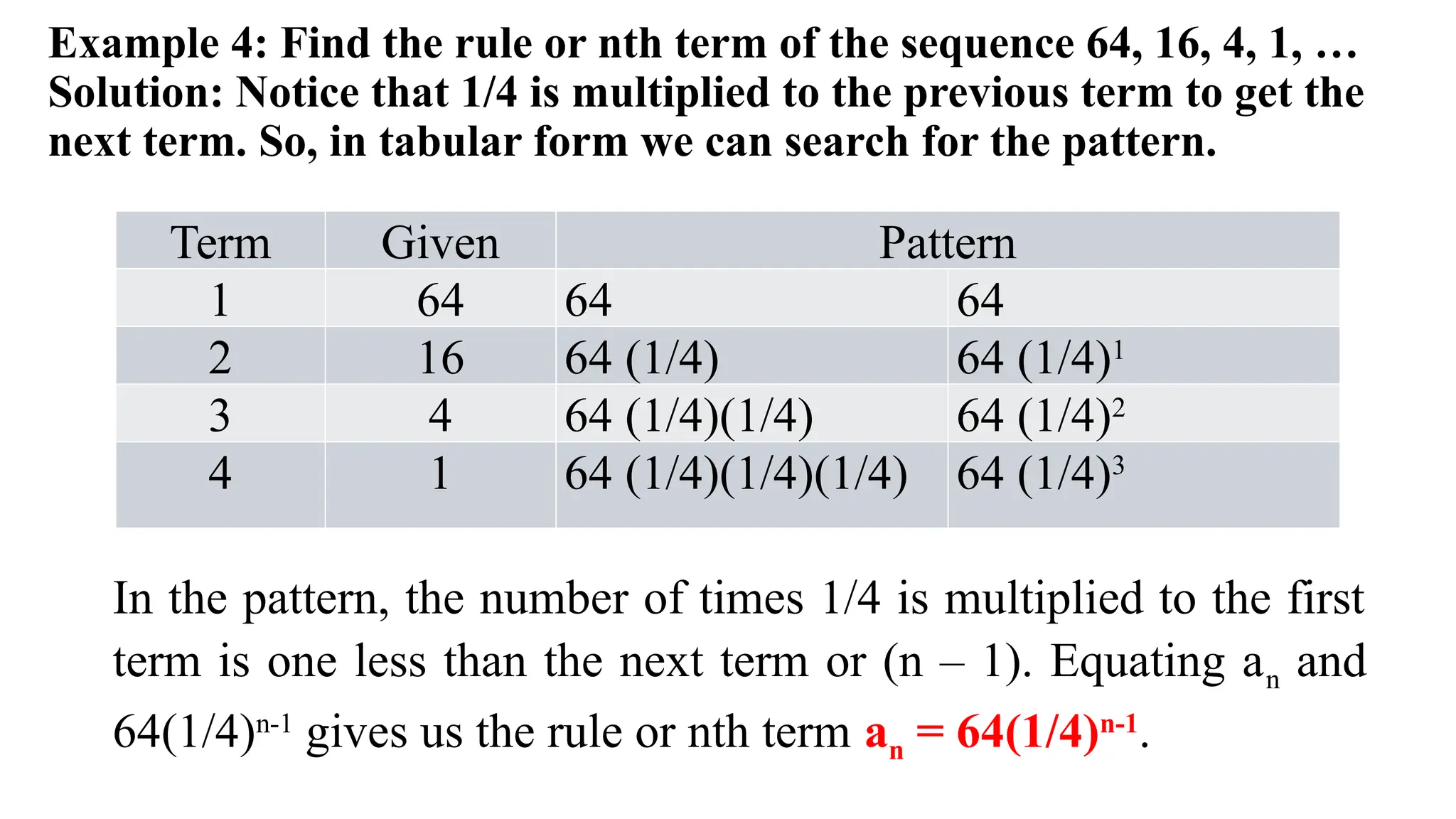
Example 4: Find the rule or nth term of the sequence 64, 16, 4, 1, …
Solution: Notice that 1/4 is multiplied to the previous term to get the
next term. So, in tabular form we can search for the pattern.
Term Given Pattern
1 64 64 64
2 16 64 (1/4) 64 (1/4)1
3 4 64 (1/4)(1/4) 64 (1/4)2
4 1 64 (1/4)(1/4)(1/4) 64 (1/4)3
In the pattern, the number of times 1/4 is multiplied to the first
term is one less than the next term or (n – 1). Equating an and
64(1/4)n-1
gives us the rule or nth term an = 64(1/4)n-1
.
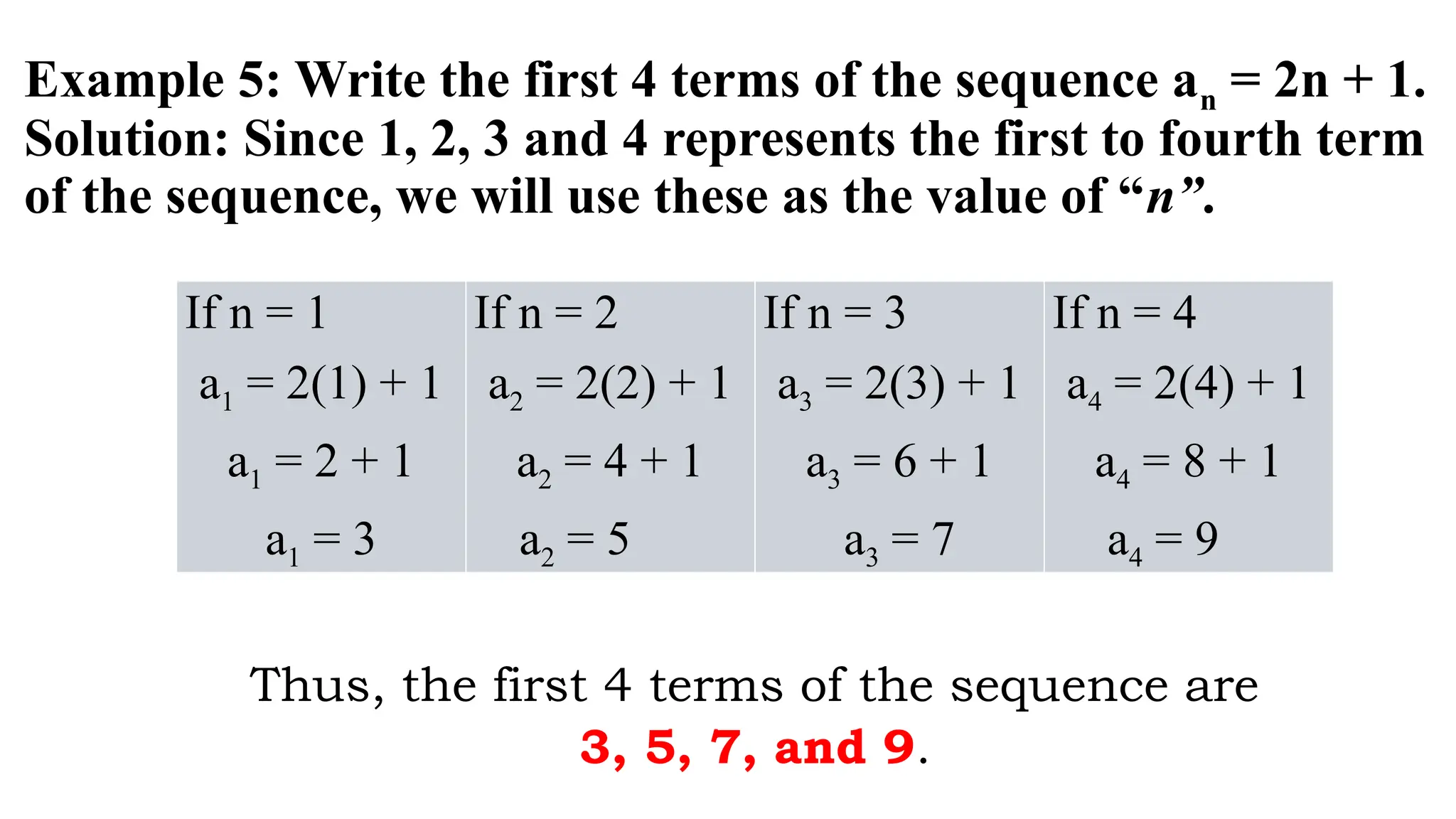
Example 5: Write the first 4 terms of the sequence an = 2n + 1.
Solution: Since 1, 2, 3 and 4 represents the first to fourth term
of the sequence, we will use these as the value of “n”.
If n = 1
a1 = 2(1) + 1
a1 = 2 + 1
a1 = 3
If n = 2
a2 = 2(2) + 1
a2 = 4 + 1
a2 = 5
If n = 3
a3 = 2(3) + 1
a3 = 6 + 1
a3 = 7
If n = 4
a4 = 2(4) + 1
a4 = 8 + 1
a4 = 9
Thus, the first 4 terms of the sequence are
3, 5, 7, and 9.
Lesson Activity
Activity 3A: Try This!
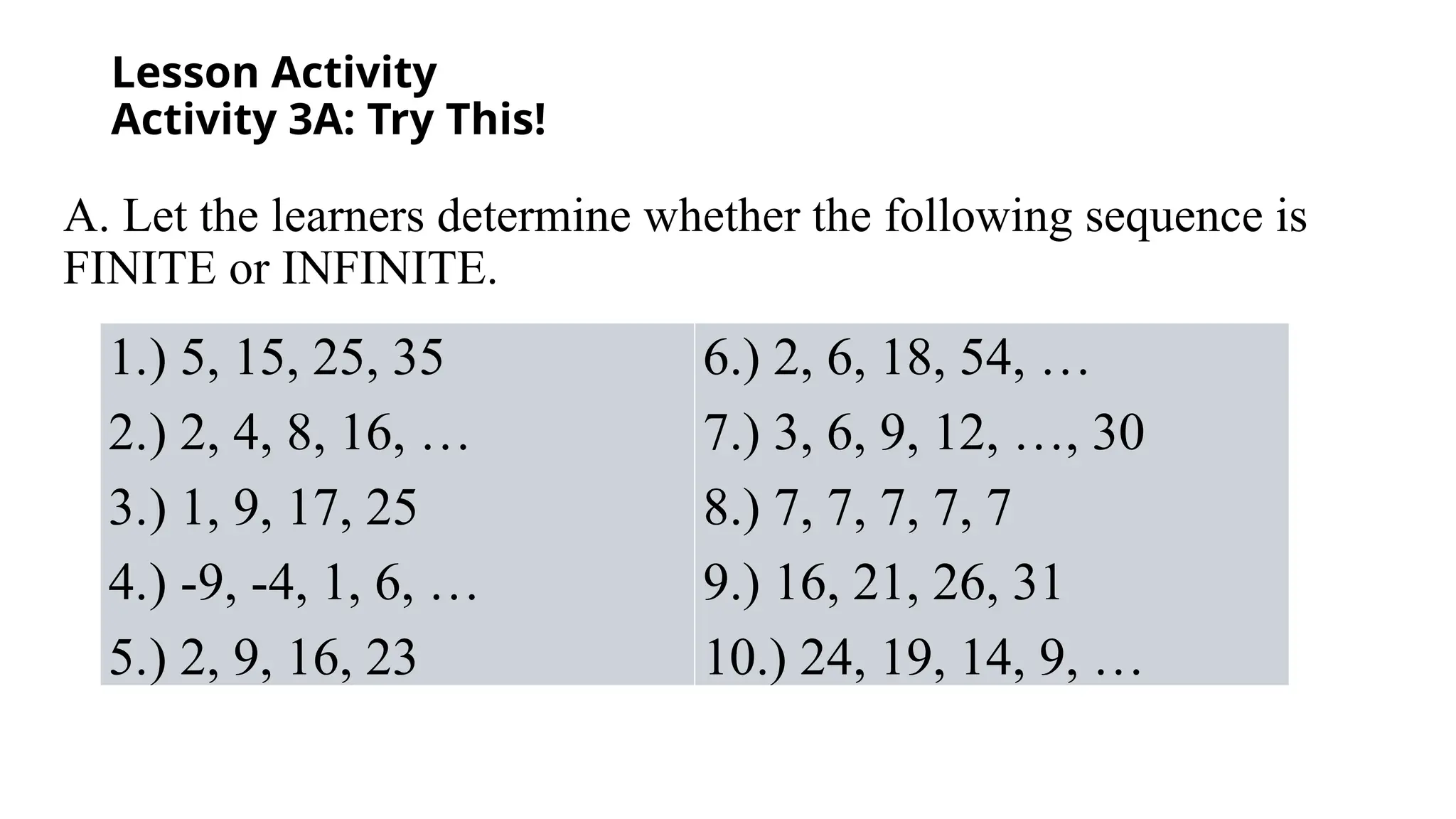
A. Let the learners determine whether the following sequence is
FINITE or INFINITE.
1.) 5, 15, 25, 35
2.) 2, 4, 8, 16, …
3.) 1, 9, 17, 25
4.) -9, -4, 1, 6, …
5.) 2, 9, 16, 23
6.) 2, 6, 18, 54, …
7.) 3, 6, 9, 12, …, 30
8.) 7, 7, 7, 7, 7
9.) 16, 21, 26, 31
10.) 24, 19, 14, 9, …
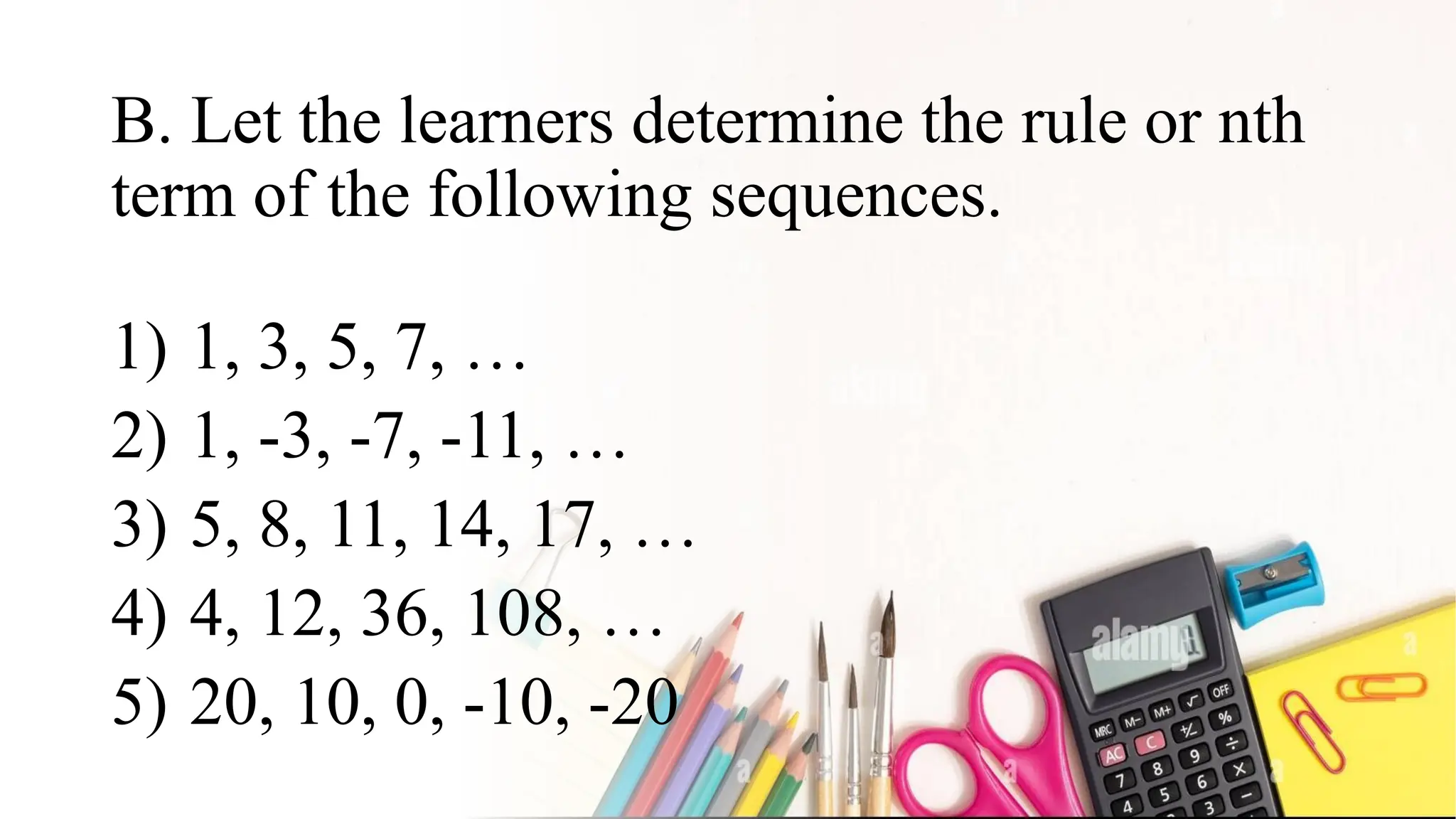
B. Let the learners determine the rule or nth
term of the following sequences.
1) 1, 3, 5, 7, …
2) 1, -3, -7, -11, …
3) 5, 8, 11, 14, 17, …
4) 4, 12, 36, 108, …
5) 20, 10, 0, -10, -20
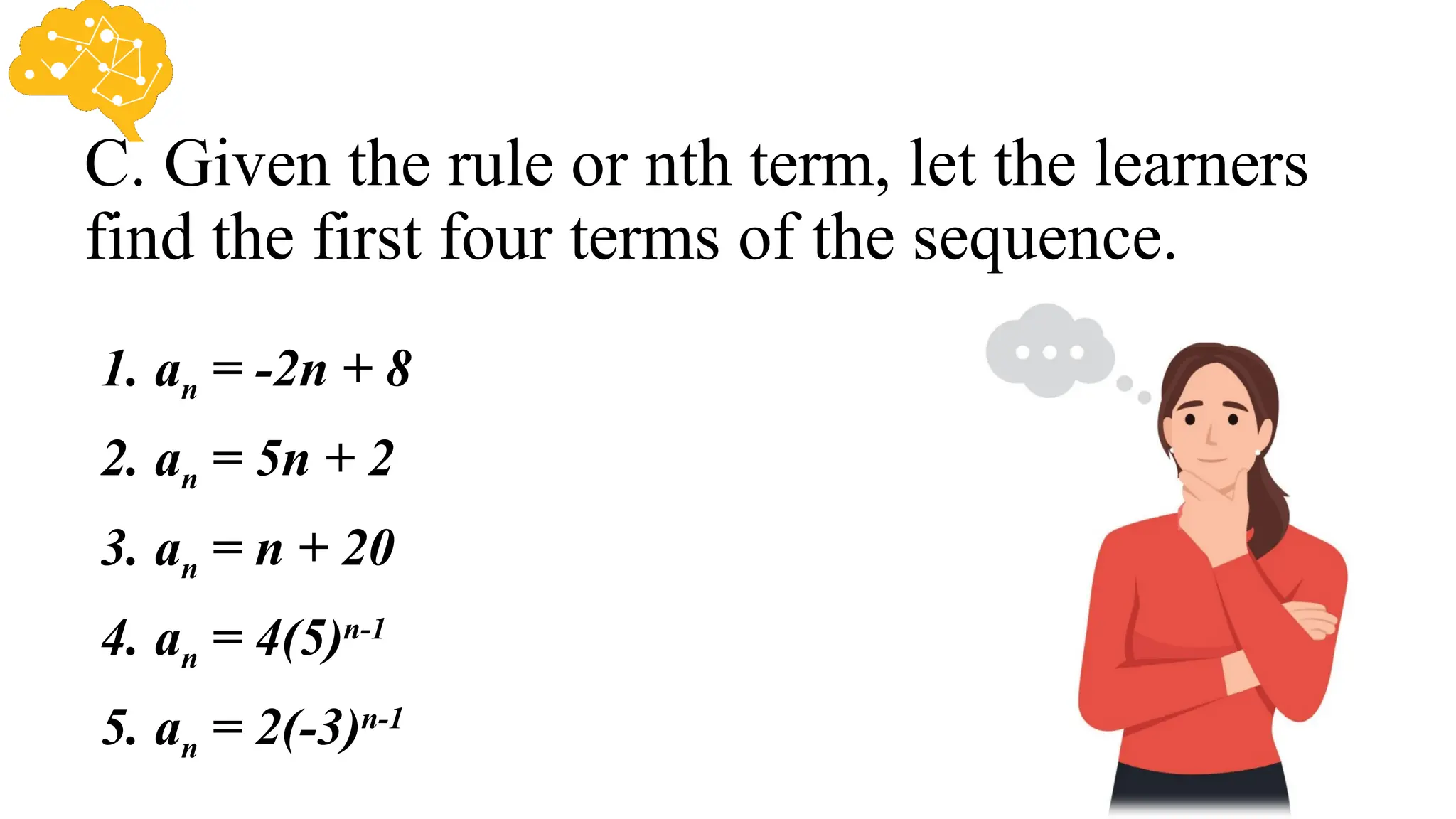
C. Given the rule or nth term, let the learners
find the first four terms of the sequence.
1. an = -2n + 8
2. an = 5n + 2
3. an = n + 20
4. an = 4(5)n-1
5. an = 2(-3)n-1
SUB-TOPIC 2:
Arithmetic Sequence
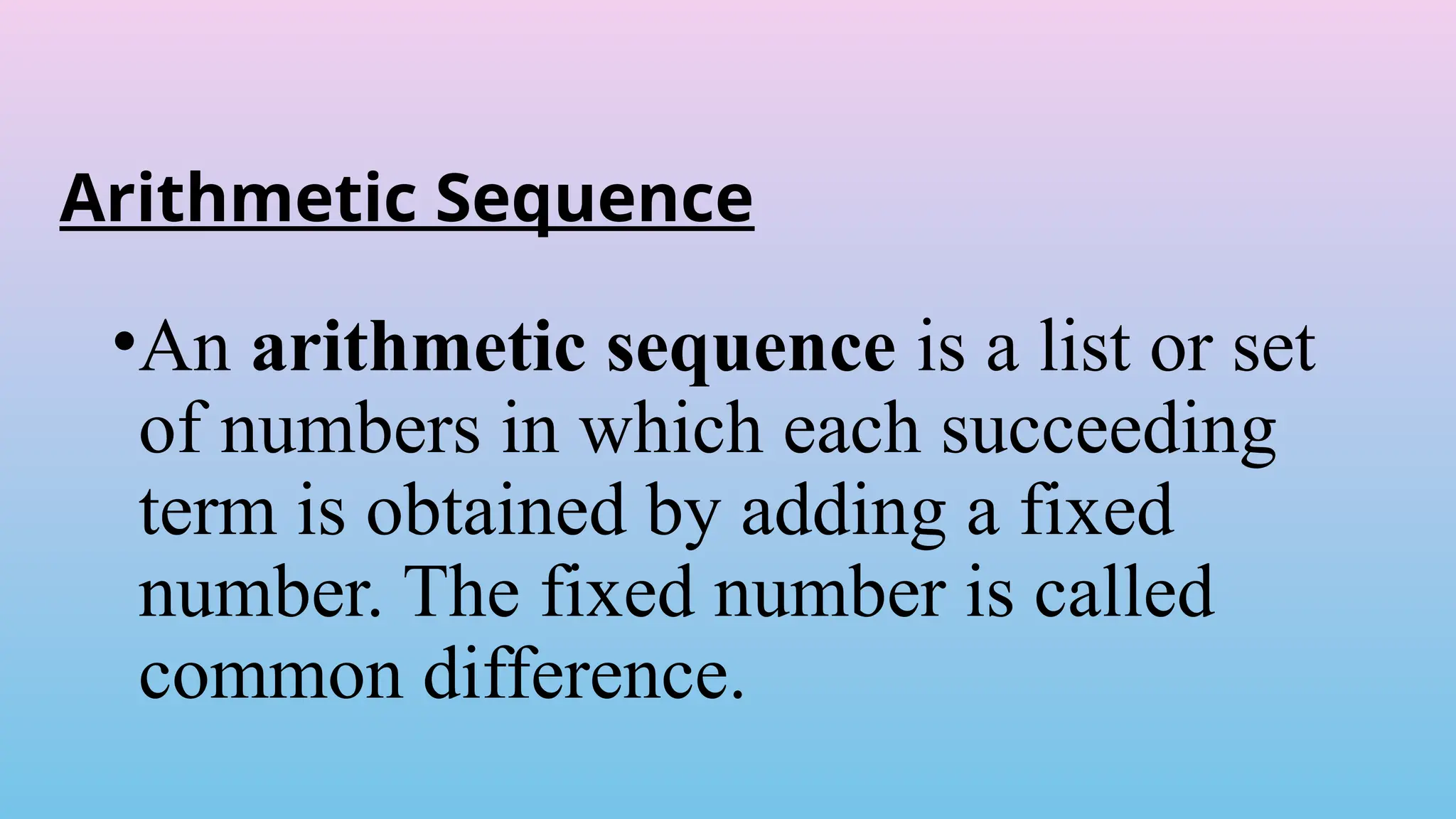
Arithmetic Sequence
•An arithmetic sequence is a list or set
of numbers in which each succeeding
term is obtained by adding a fixed
number. The fixed number is called
common difference.
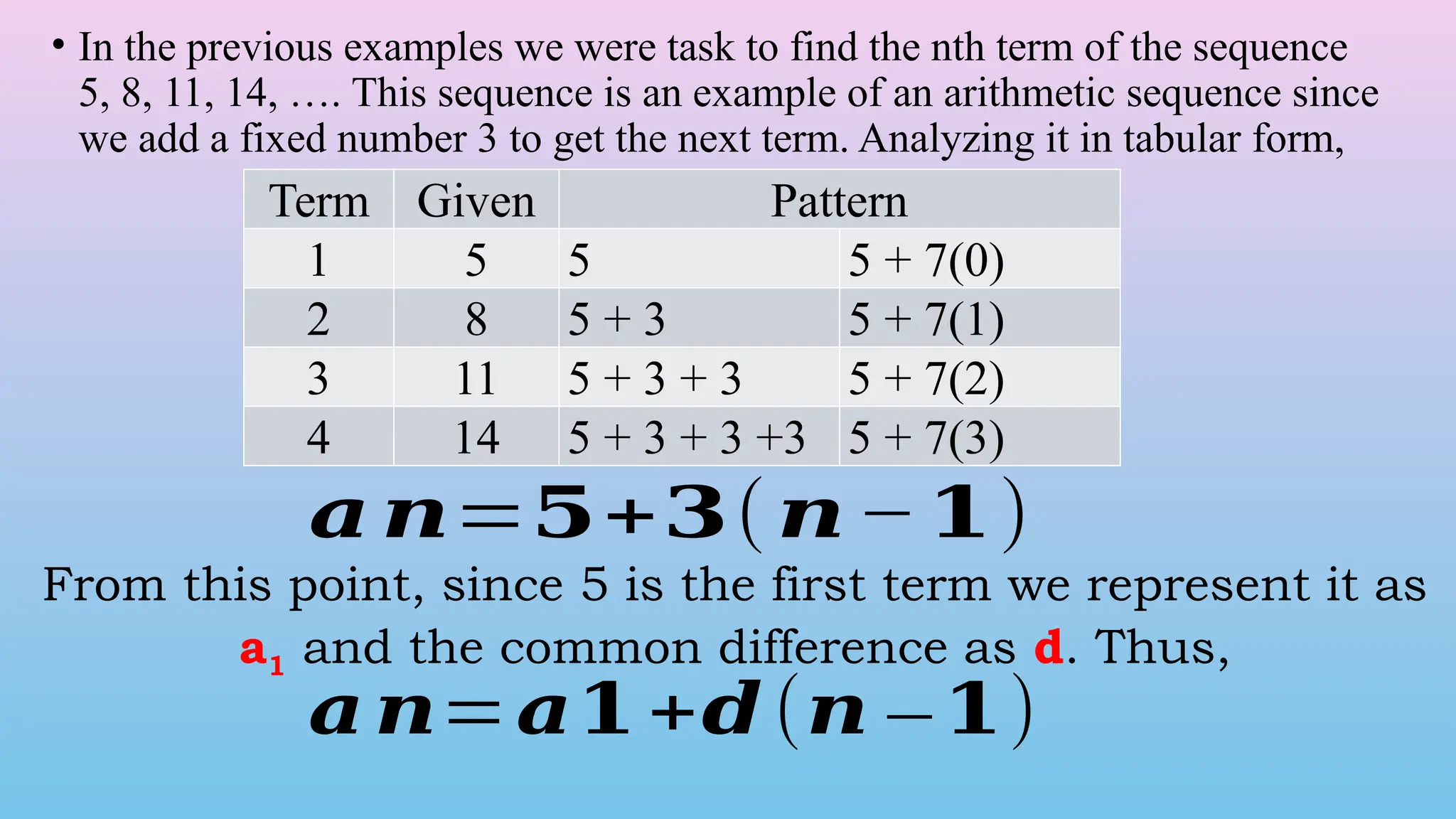
• In the previous examples we were task to find the nth term of the sequence
5, 8, 11, 14, …. This sequence is an example of an arithmetic sequence since
we add a fixed number 3 to get the next term. Analyzing it in tabular form,
Term Given Pattern
1 5 5 5 + 7(0)
2 8 5 + 3 5 + 7(1)
3 11 5 + 3 + 3 5 + 7(2)
4 14 5 + 3 + 3 +3 5 + 7(3)
𝒂𝒏=𝟓+𝟑(𝒏−𝟏)
From this point, since 5 is the first term we represent it as
a1 and the common difference as d. Thus,
𝒂𝒏=𝒂𝟏+𝒅(𝒏 – 𝟏)
Worked Example
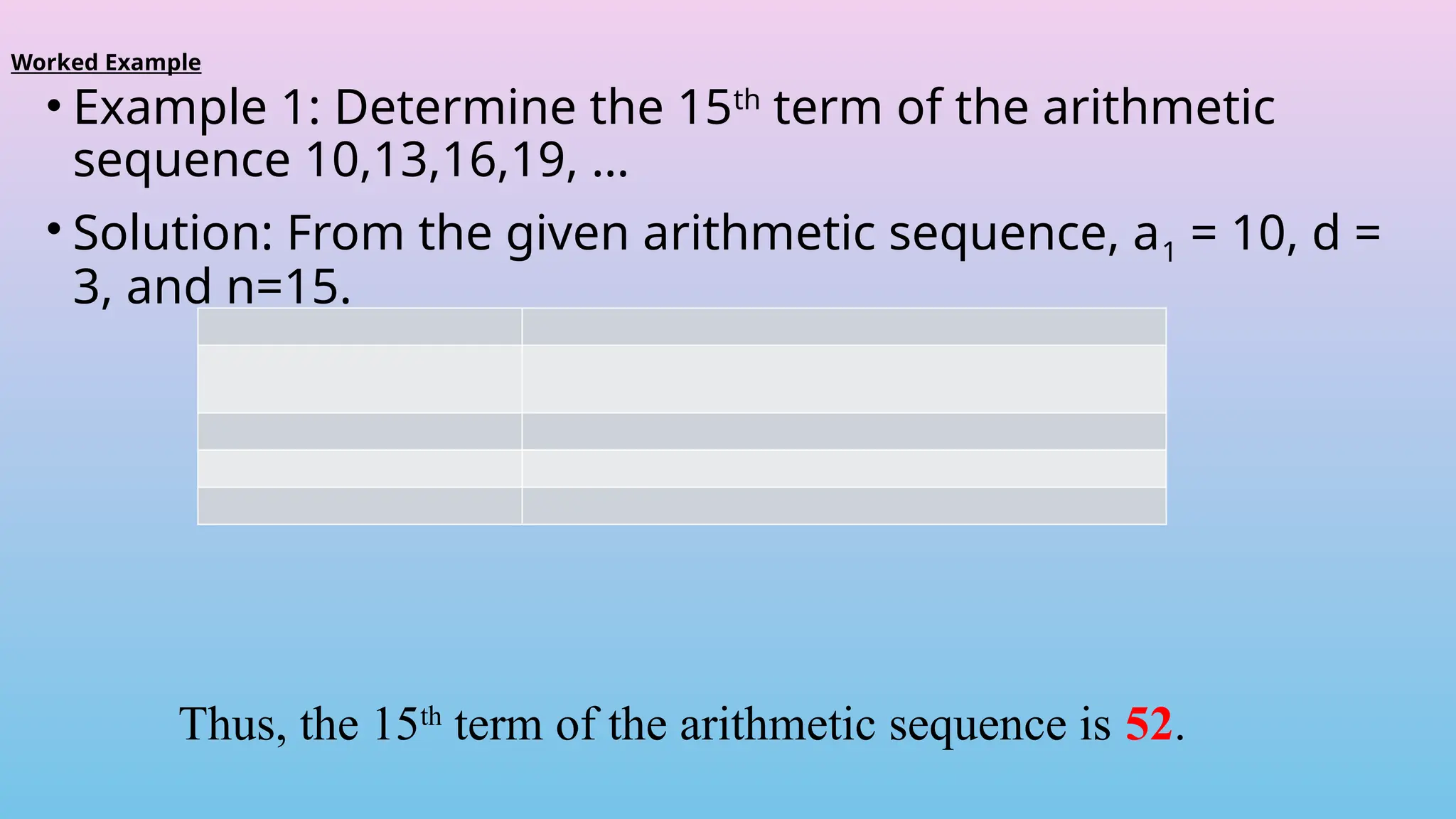
• Example 1: Determine the 15th
term of the arithmetic
sequence 10,13,16,19, …
• Solution: From the given arithmetic sequence, a1 = 10, d =
3, and n=15.
Thus, the 15th
term of the arithmetic sequence is 52.
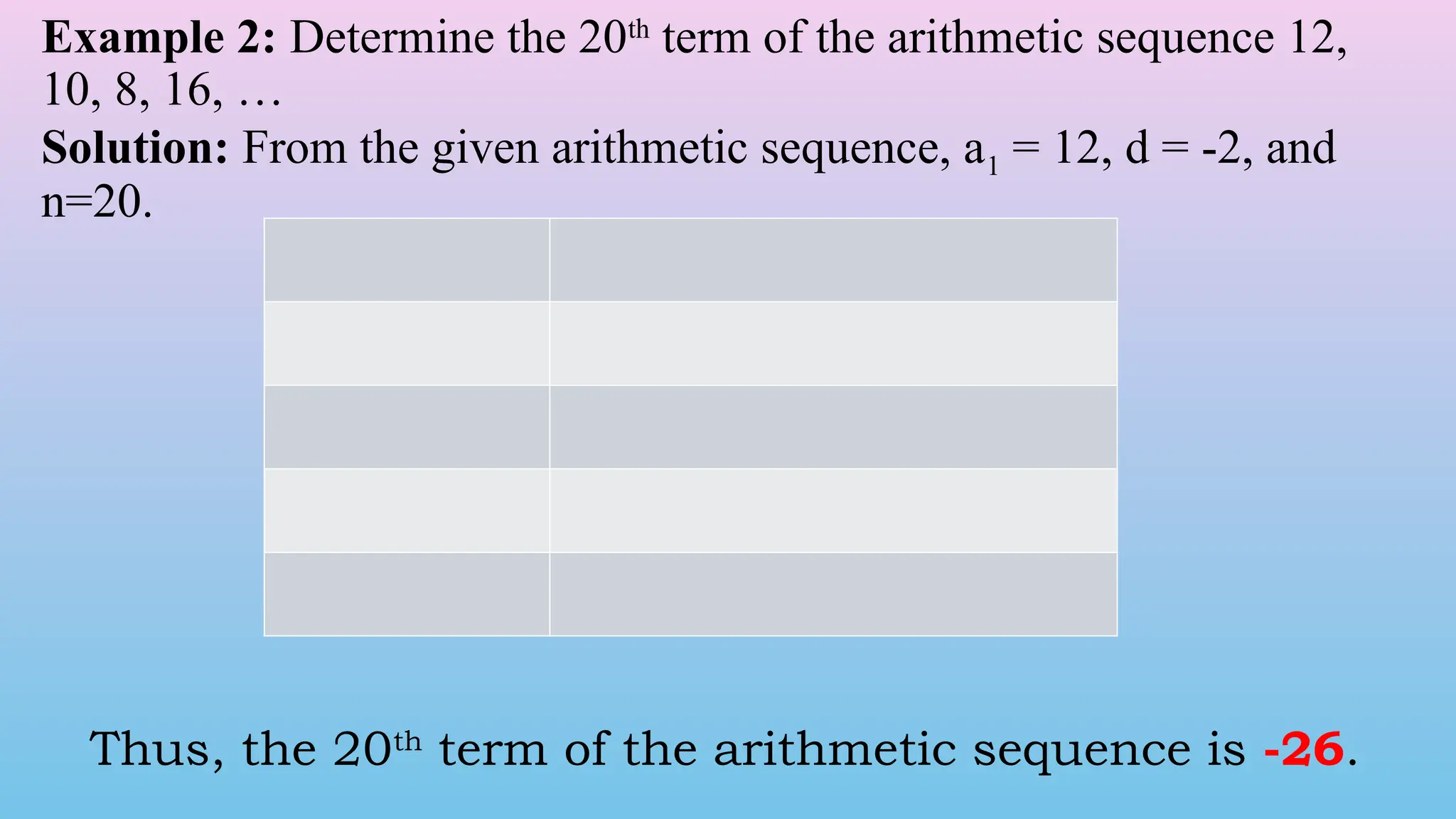
Example 2: Determine the 20th
term of the arithmetic sequence 12,
10, 8, 16, …
Solution: From the given arithmetic sequence, a1 = 12, d = -2, and
n=20.
Thus, the 20th
term of the arithmetic sequence is -26.
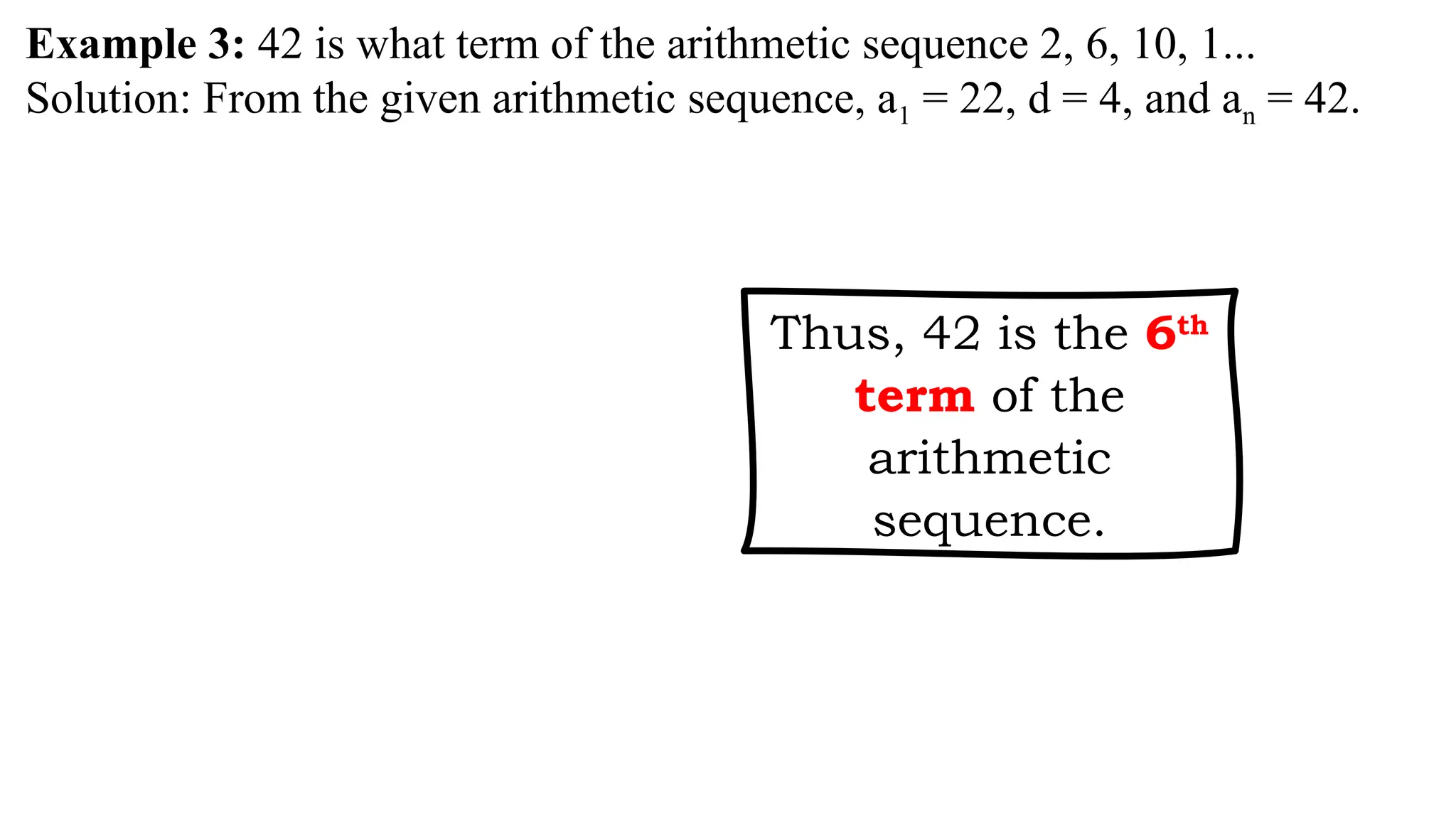
Example 3: 42 is what term of the arithmetic sequence 2, 6, 10, 1...
Solution: From the given arithmetic sequence, a1 = 22, d = 4, and an = 42.
Thus, 42 is the 6th
term of the
arithmetic
sequence.
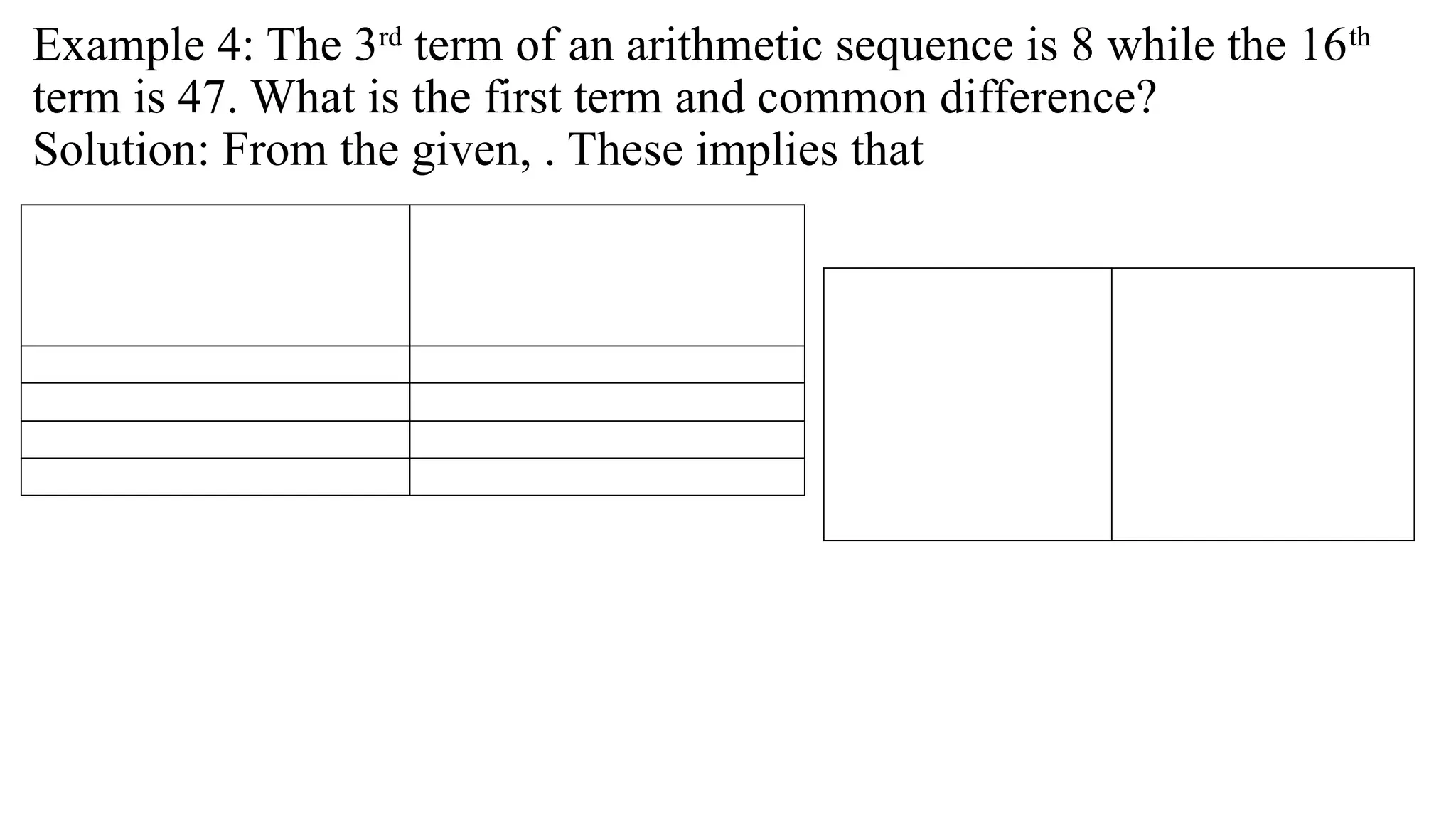
Example 4: The 3rd
term of an arithmetic sequence is 8 while the 16th
term is 47. What is the first term and common difference?
Solution: From the given, . These implies that
Lesson Activity
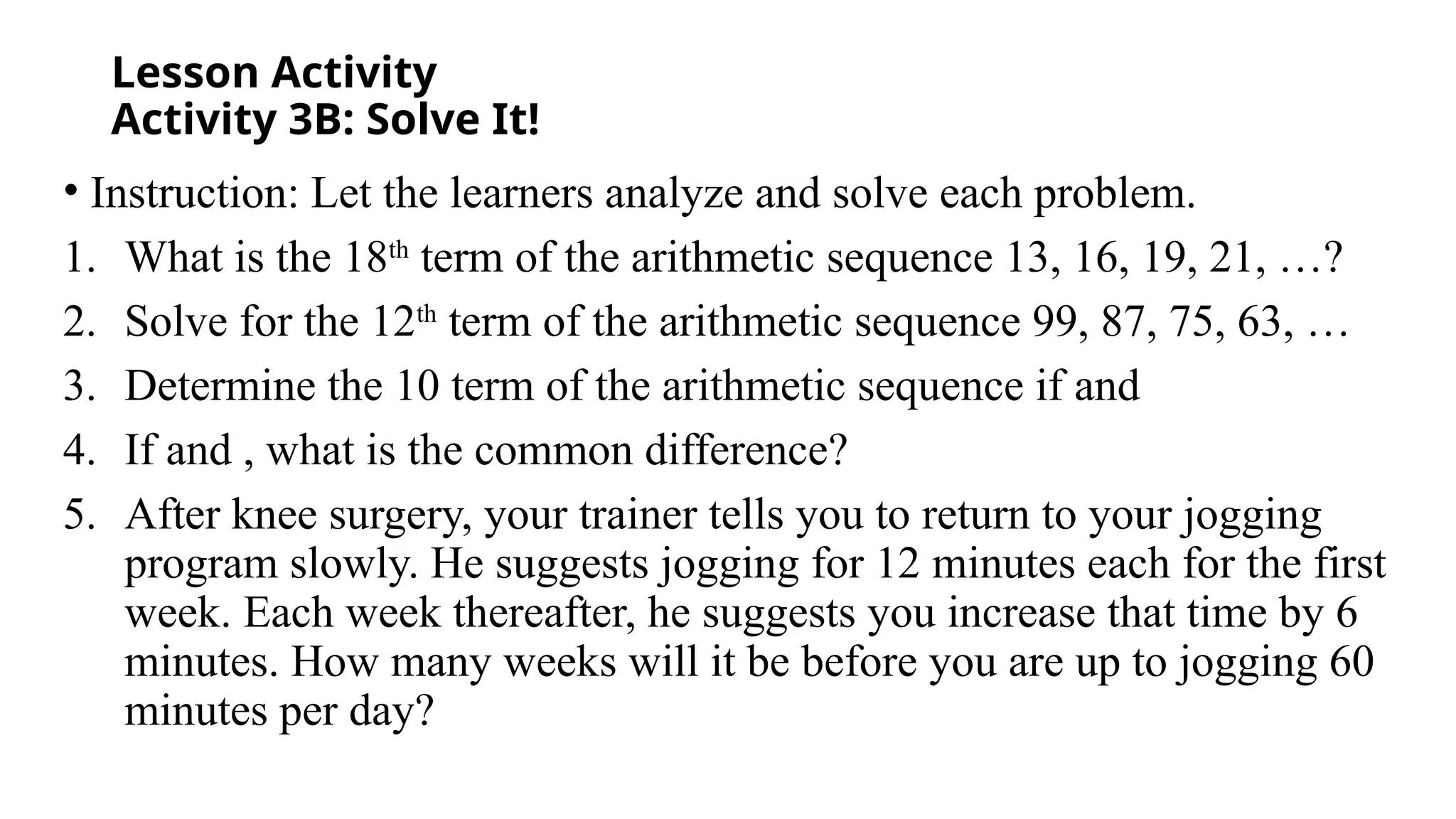
Activity 3B: Solve It!
• Instruction: Let the learners analyze and solve each problem.
1. What is the 18th
term of the arithmetic sequence 13, 16, 19, 21, …?
2. Solve for the 12th
term of the arithmetic sequence 99, 87, 75, 63, …
3. Determine the 10 term of the arithmetic sequence if and
4. If and , what is the common difference?
5. After knee surgery, your trainer tells you to return to your jogging
program slowly. He suggests jogging for 12 minutes each for the first
week. Each week thereafter, he suggests you increase that time by 6
minutes. How many weeks will it be before you are up to jogging 60
minutes per day?
SUB-TOPIC 3:
Geometric Sequence
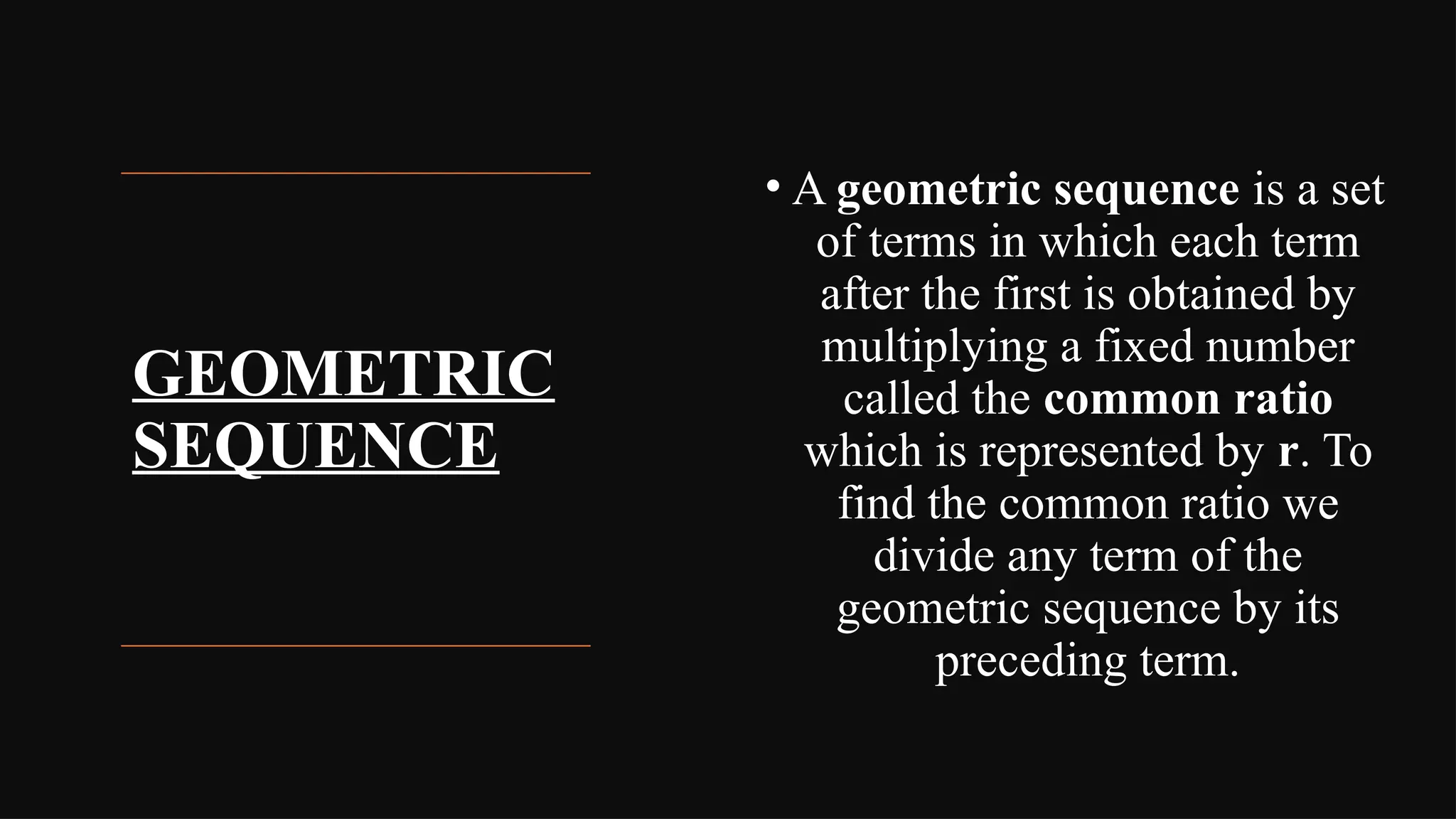
GEOMETRIC
SEQUENCE
• A geometric sequence is a set
of terms in which each term
after the first is obtained by
multiplying a fixed number
called the common ratio
which is represented by r. To
find the common ratio we
divide any term of the
geometric sequence by its
preceding term.
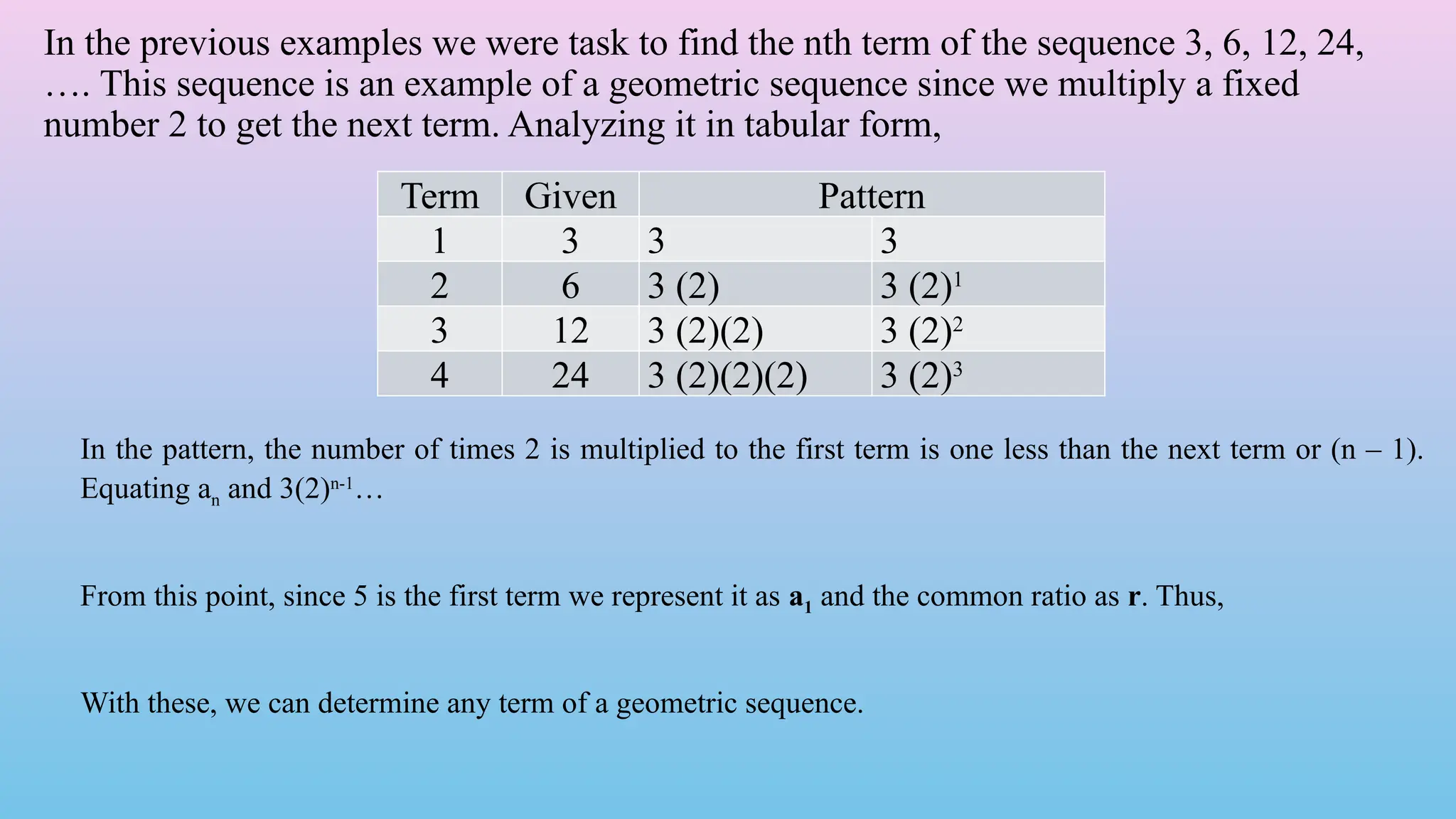
In the previous examples we were task to find the nth term of the sequence 3, 6, 12, 24,
…. This sequence is an example of a geometric sequence since we multiply a fixed
number 2 to get the next term. Analyzing it in tabular form,
Term Given Pattern
1 3 3 3
2 6 3 (2) 3 (2)1
3 12 3 (2)(2) 3 (2)2
4 24 3 (2)(2)(2) 3 (2)3
In the pattern, the number of times 2 is multiplied to the first term is one less than the next term or (n – 1).
Equating an and 3(2)n-1
…
From this point, since 5 is the first term we represent it as a1 and the common ratio as r. Thus,
With these, we can determine any term of a geometric sequence.
Worked Example
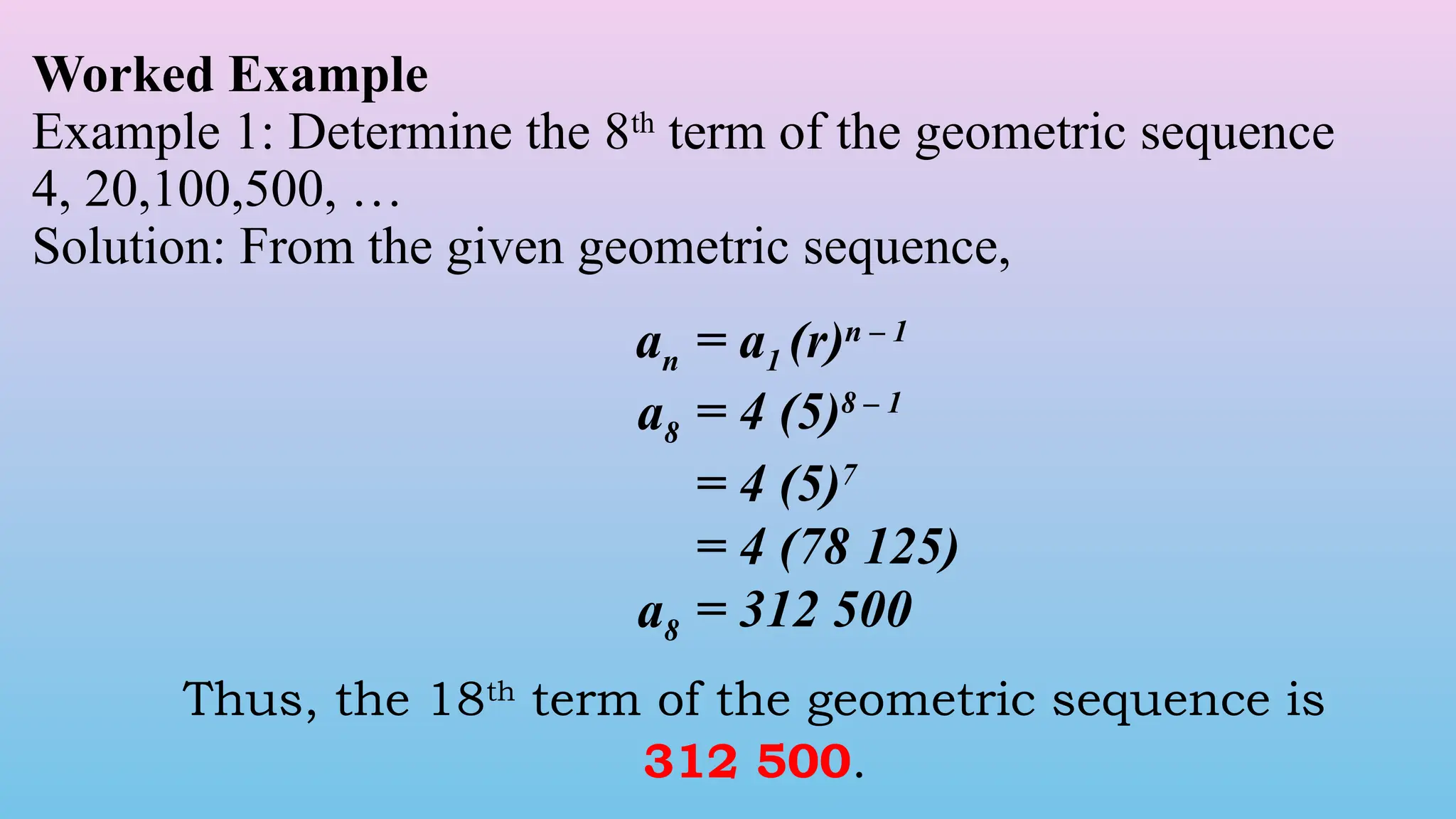
Example 1: Determine the 8th
term of the geometric sequence
4, 20,100,500, …
Solution: From the given geometric sequence,
an = a1 (r)n – 1
a8 = 4 (5)8 – 1
= 4 (5)7
= 4 (78 125)
a8 = 312 500
Thus, the 18th
term of the geometric sequence is
312 500.
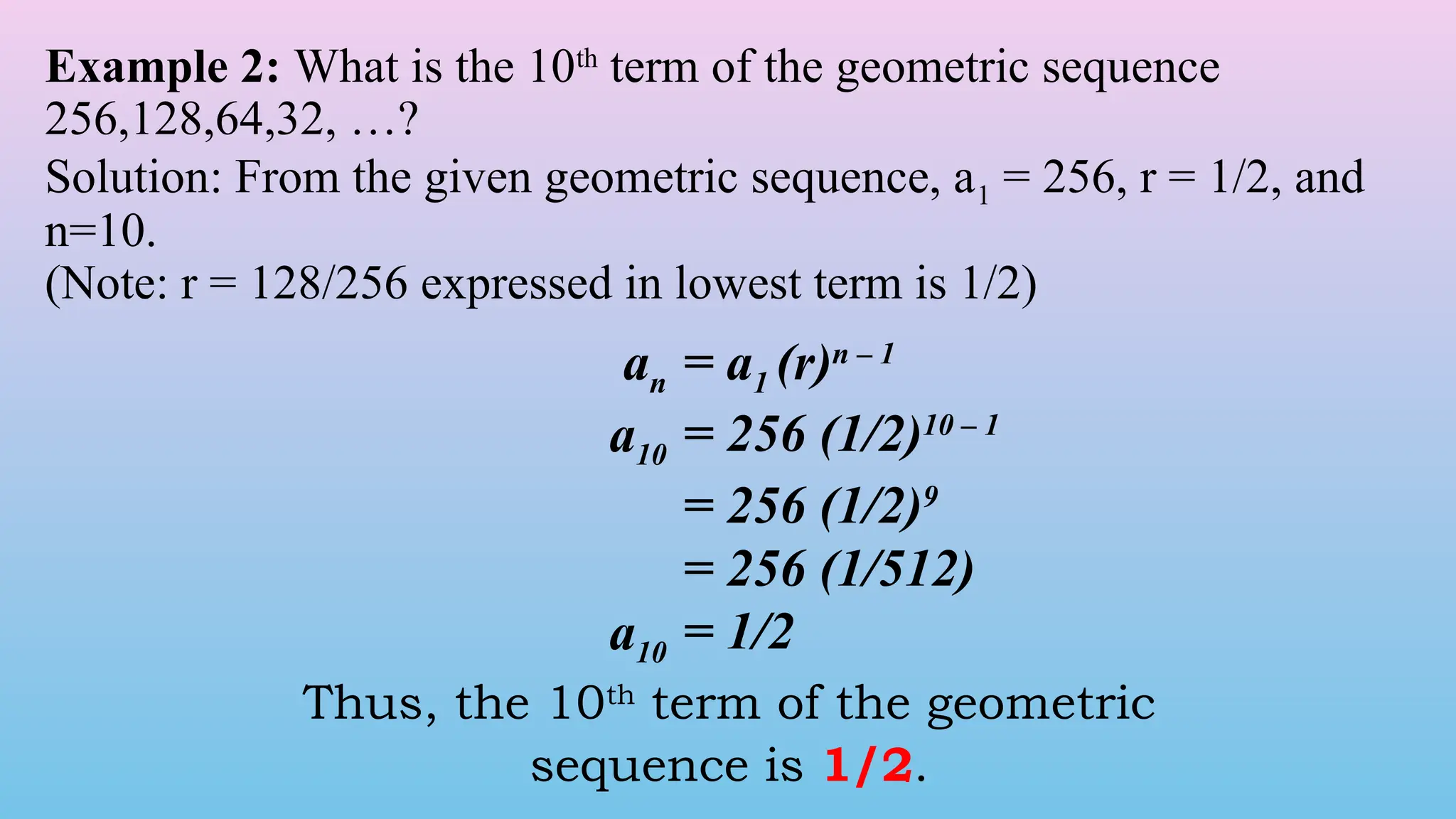
Example 2: What is the 10th
term of the geometric sequence
256,128,64,32, …?
Solution: From the given geometric sequence, a1 = 256, r = 1/2, and
n=10.
(Note: r = 128/256 expressed in lowest term is 1/2)
an = a1 (r)n – 1
a10 = 256 (1/2)10 – 1
= 256 (1/2)9
= 256 (1/512)
a10 = 1/2
Thus, the 10th
term of the geometric
sequence is 1/2.
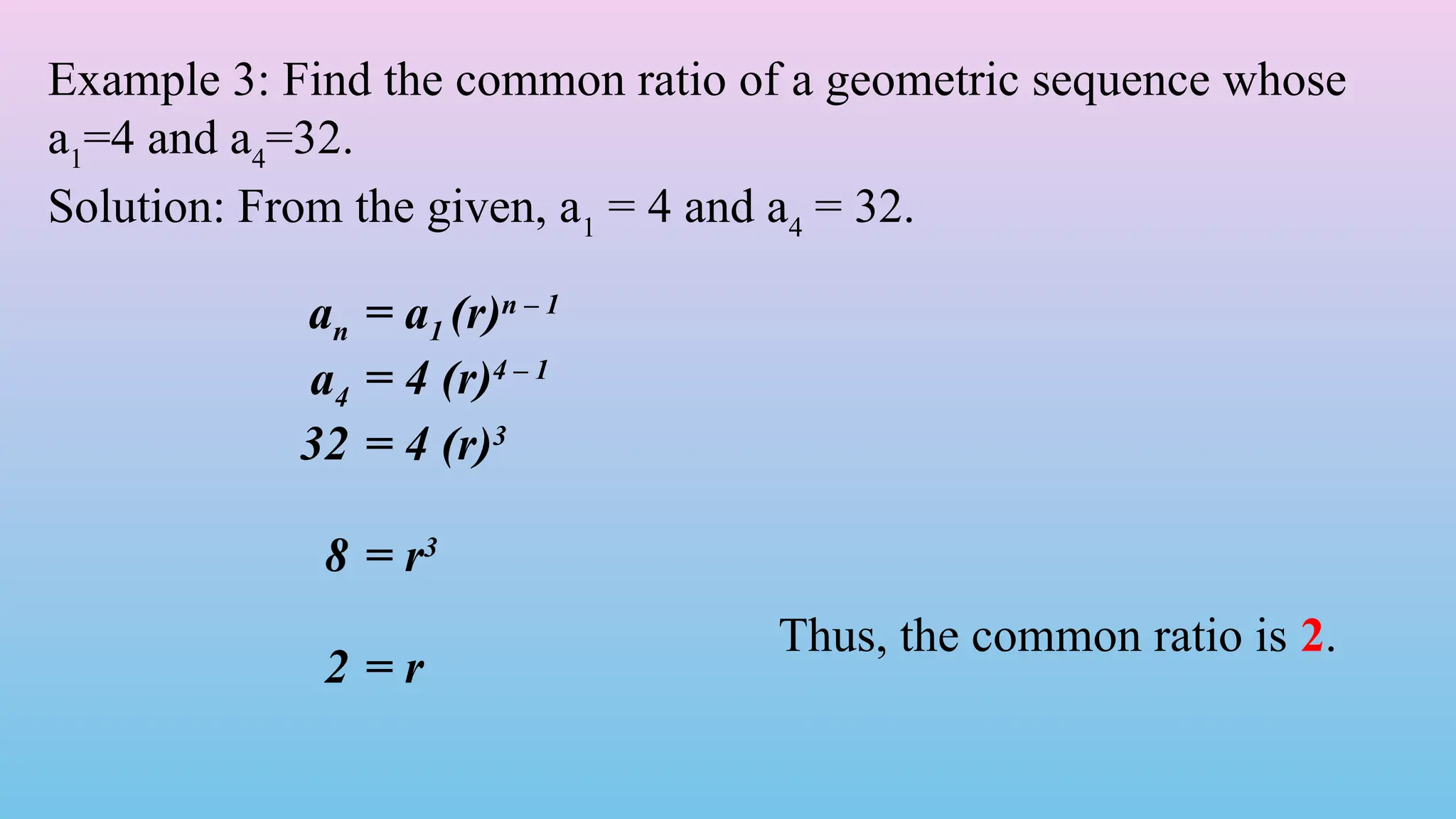
an = a1 (r)n – 1
a4 = 4 (r)4 – 1
32 = 4 (r)3
8 = r3
2 = r
Example 3: Find the common ratio of a geometric sequence whose
a1
=4 and a4
=32.
Solution: From the given, a1
= 4 and a4
= 32.
Thus, the common ratio is 2.
Lesson Activity
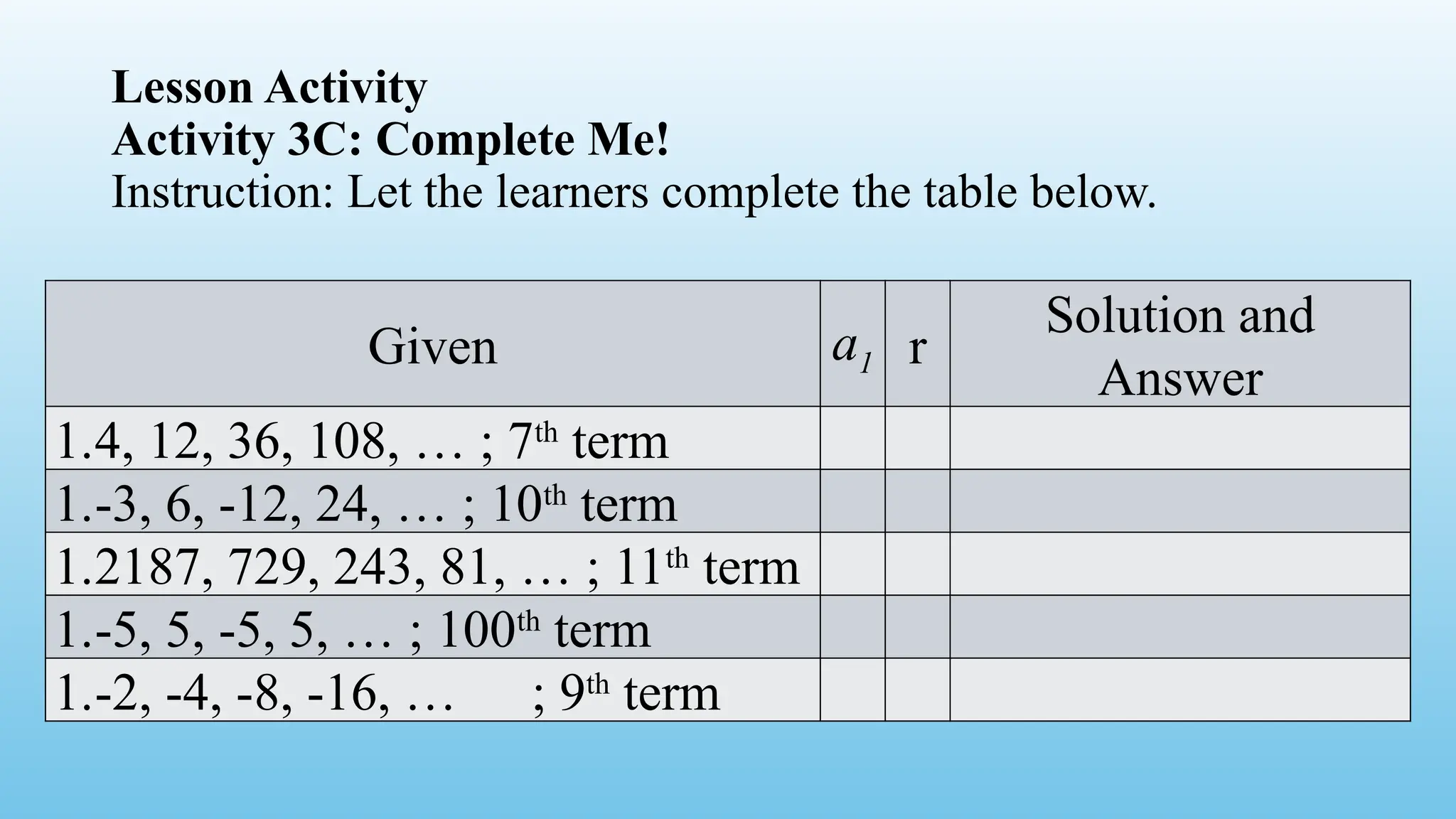
Activity 3C: Complete Me!
Instruction: Let the learners complete the table below.
Given a1 r
Solution and
Answer
1.4, 12, 36, 108, … ; 7th
term
1.-3, 6, -12, 24, … ; 10th
term
1.2187, 729, 243, 81, … ; 11th
term
1.-5, 5, -5, 5, … ; 100th
term
1.-2, -4, -8, -16, … ; 9th
term
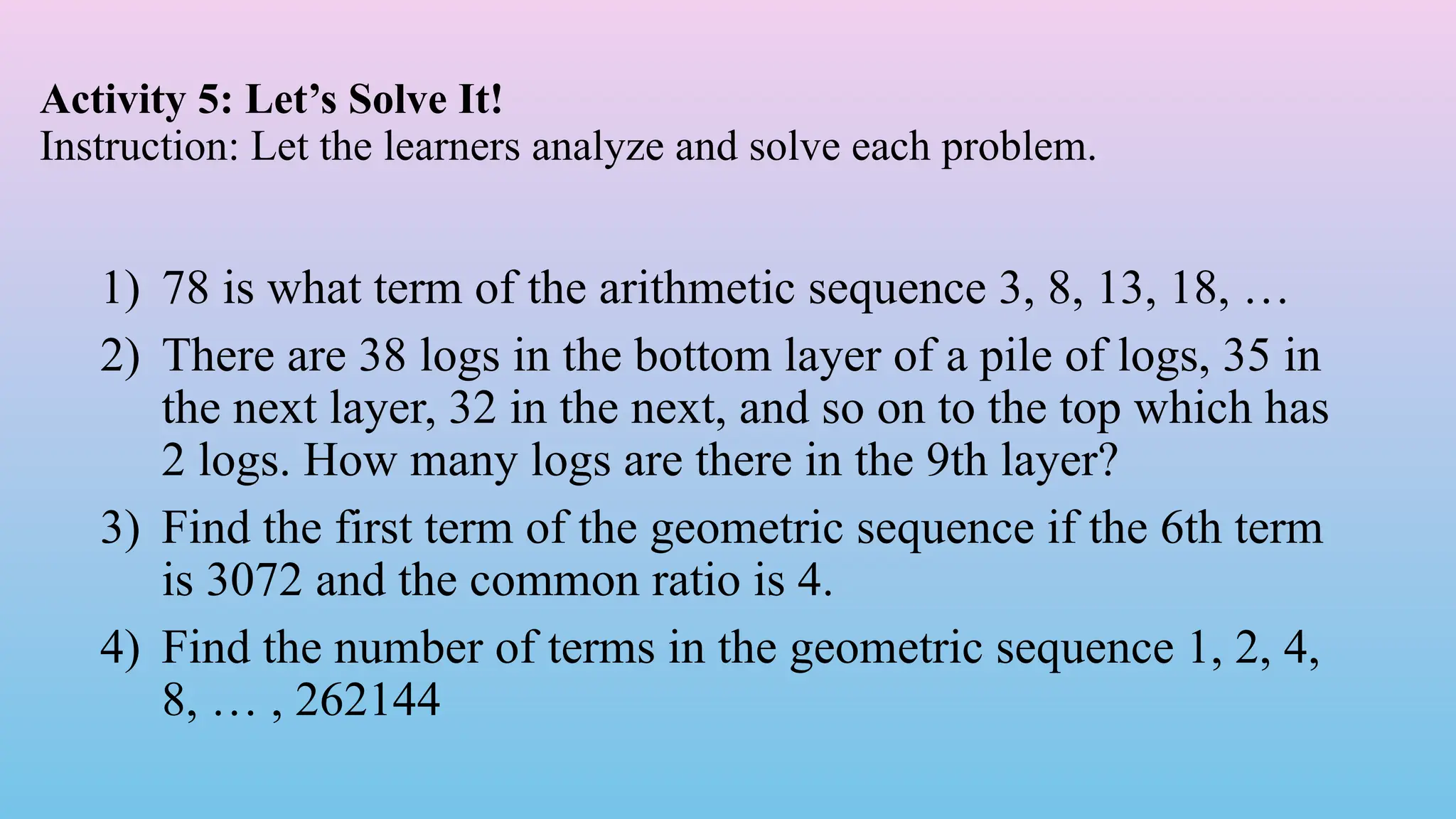
Activity 5: Let’s Solve It!
Instruction: Let the learners analyze and solve each problem.
1) 78 is what term of the arithmetic sequence 3, 8, 13, 18, …
2) There are 38 logs in the bottom layer of a pile of logs, 35 in
the next layer, 32 in the next, and so on to the top which has
2 logs. How many logs are there in the 9th layer?
3) Find the first term of the geometric sequence if the 6th term
is 3072 and the common ratio is 4.
4) Find the number of terms in the geometric sequence 1, 2, 4,
8, … , 262144
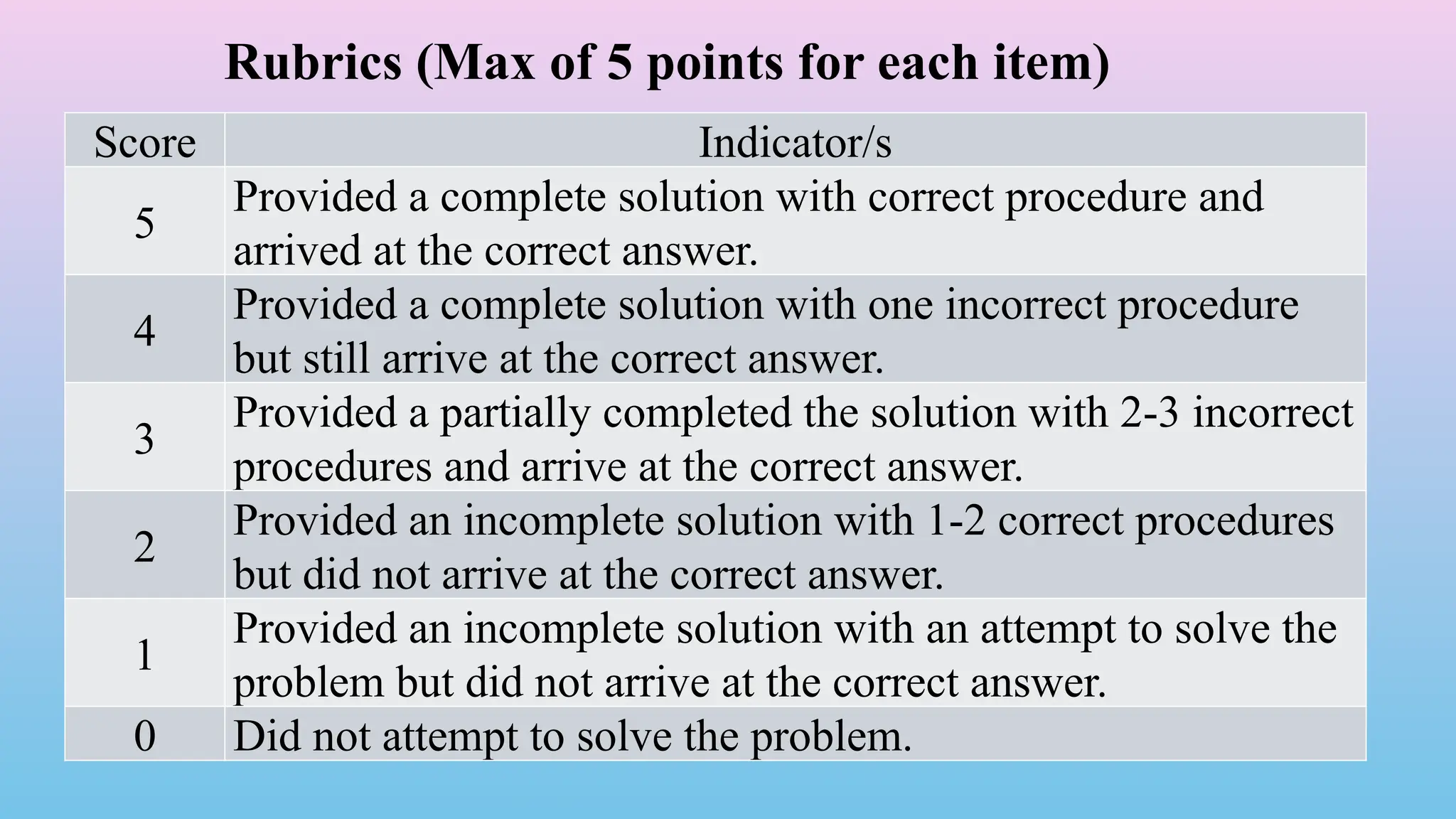
Rubrics (Max of 5 points for each item)
Score Indicator/s
5
Provided a complete solution with correct procedure and
arrived at the correct answer.
4
Provided a complete solution with one incorrect procedure
but still arrive at the correct answer.
3
Provided a partially completed the solution with 2-3 incorrect
procedures and arrive at the correct answer.
2
Provided an incomplete solution with 1-2 correct procedures
but did not arrive at the correct answer.
1
Provided an incomplete solution with an attempt to solve the
problem but did not arrive at the correct answer.
0 Did not attempt to solve the problem.
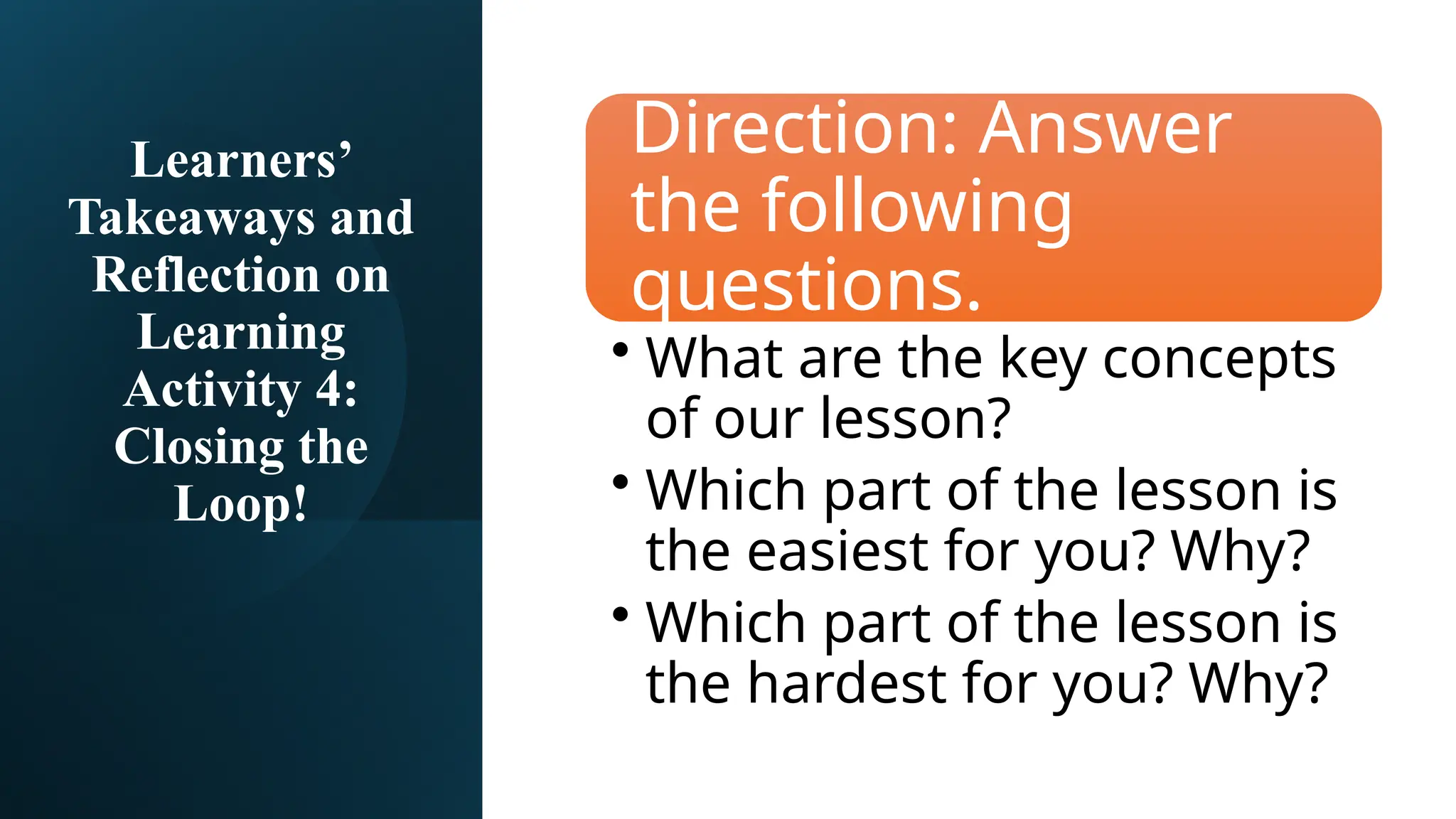
Learners’
Takeaways and
Reflection on
Learning
Activity 4:
Closing the
Loop!
Direction: Answer
the following
questions.
• What are the key concepts
of our lesson?
• Which part of the lesson is
the easiest for you? Why?
• Which part of the lesson is
the hardest for you? Why?

Formulate the rule for finding the next term

  • 1.
    QUARTER 1: WEEK8 Learning Competencies The learners formulate the rule for finding the next term in a sequence by looking for patterns.
  • 2.
    Learning Objectives By theend of the lesson, the learners are expected to: Formulate the rule for finding the next term of a sequence; solve for the nth term of an Arithmetic Sequence; and solve for the nth term of a Geometric Sequence.
  • 3.
    Content: • Sequence • Findingthe Rule of a Sequence • Arithmetic Sequence • Geometric Sequence
  • 4.
    Short Review Activity 1:Do You Remember? • The denominator of a fraction is 3 more than the numerator. If both numerator and denominator are increased by 2, the resulting fraction is 2/3. Find the fraction.
  • 5.
    Activity 2: What’sNext? Analyze the set of numbers below and answer the question that follows. 1.) 5, 8, 11, 14, …. 2.) 2, 4, 8, 16, … Guide Questions: • Does each set of numbers follow a specific rule or pattern? • What will be the next number in the set of numbers in the left? How were you able to find it? • What will be the next number in the set of numbers in the right? How were you able to find it?
  • 6.
    Unlocking Content Vocabulary •Sequence is a list or set of numbers that follows a specific order or pattern. Sequences can be either finite or infinite. • Finite Sequence contains a limited number of terms. • Infinite Sequence contains countless number of terms. • Arithmetic Sequence is a list or set of numbers in which each succeeding term is obtained by adding a fixed number. The fixed number is called common difference. • Geometric Sequence is a set of terms in which each term after the first is obtained by multiplying a fixed number called the common ratio.
  • 7.
    SUB-TOPIC 1: Finding theRule of a Sequence
  • 8.
    • A sequenceis a list or set of numbers that follows a specific order or pattern. It can be classified as either finite or infinite. Below are examples of finite and infinite sequence. Finite Sequence Infinite Sequence 3, 6, 9, 12 8, 10, 12, 14, … 30 5, 10, 15, 20, … 2, -2, 2, -2, 2, … 11, 15, 19, 23, 27, …
  • 9.
    As mentioned earlier,a sequence follows a pattern and we call this as the rule or nth term of the sequence. We can also express that rule or nth term as an.
  • 10.
    Worked Example Example 1:Find the rule or nth term of the sequence 5, 8, 11, 14, … Solution: Notice that 3 is added to the previous term to get the next term. So, in tabular form we can search for the pattern. Term Given Pattern 1 5 5 2 8 5 + 3 3 11 5 + 3 + 3 4 14 5 + 3 + 3 +3 In the pattern, the number of times 3 is added to the first term is one less than the next term or (n – 1). Equating an and 5 + 3(n-1) and simplifying it an = 5 + 3(n-1) an = 5 + 3n-3 an = 3n + 2 Thus, the rule or nth term is a = 3n + 2
  • 11.
    Example 2: Findthe rule or nth term of the sequence 10, 7, 4, 1, … Solution: Notice that -3 is added to the previous term to get the next term. So, in tabular form we can search for the pattern. Term Given Pattern 1 10 10 10 + (-3)(0) 2 7 10 + (-3) 10 + (-3)(1) 3 4 10 + (-3) + (-3) 10 + (-3)(2) 4 1 10 + (-3) + (-3) + (-3) 10 + (-3)(3) In the pattern, the number of times -3 is added to the first term is one less than the next term or (n – 1). Equating an and 10 + (-3)(n-1) and simplifying it an = 10 + (-3)(n-1) an = 10 – 3n + 3 an = -3n + 13 Thus, the rule or nth term is an = -3n + 13
  • 12.
    Example 3: Findthe rule or nth term of the sequence 2, 4, 8, 16, … Solution: In this example, notice that 2 is multiplied to the previous term to get the next term. So, in tabular form we can search for the pattern. Term Given Pattern 1 3 3 3 2 6 3 (2) 3 (2)1 3 12 3 (2)(2) 3 (2)2 4 24 3 (2)(2)(2) 3 (2)3 In the pattern, the number of times 2 is multiplied to the first term is one less than the next term or (n – 1). Equating an and 3(2)n-1 gives us the rule or nth term an = 3 (2)n-1 .
  • 13.
    Example 4: Findthe rule or nth term of the sequence 64, 16, 4, 1, … Solution: Notice that 1/4 is multiplied to the previous term to get the next term. So, in tabular form we can search for the pattern. Term Given Pattern 1 64 64 64 2 16 64 (1/4) 64 (1/4)1 3 4 64 (1/4)(1/4) 64 (1/4)2 4 1 64 (1/4)(1/4)(1/4) 64 (1/4)3 In the pattern, the number of times 1/4 is multiplied to the first term is one less than the next term or (n – 1). Equating an and 64(1/4)n-1 gives us the rule or nth term an = 64(1/4)n-1 .
  • 14.
    Example 5: Writethe first 4 terms of the sequence an = 2n + 1. Solution: Since 1, 2, 3 and 4 represents the first to fourth term of the sequence, we will use these as the value of “n”. If n = 1 a1 = 2(1) + 1 a1 = 2 + 1 a1 = 3 If n = 2 a2 = 2(2) + 1 a2 = 4 + 1 a2 = 5 If n = 3 a3 = 2(3) + 1 a3 = 6 + 1 a3 = 7 If n = 4 a4 = 2(4) + 1 a4 = 8 + 1 a4 = 9 Thus, the first 4 terms of the sequence are 3, 5, 7, and 9.
  • 15.
    Lesson Activity Activity 3A:Try This! A. Let the learners determine whether the following sequence is FINITE or INFINITE. 1.) 5, 15, 25, 35 2.) 2, 4, 8, 16, … 3.) 1, 9, 17, 25 4.) -9, -4, 1, 6, … 5.) 2, 9, 16, 23 6.) 2, 6, 18, 54, … 7.) 3, 6, 9, 12, …, 30 8.) 7, 7, 7, 7, 7 9.) 16, 21, 26, 31 10.) 24, 19, 14, 9, …
  • 16.
    B. Let thelearners determine the rule or nth term of the following sequences. 1) 1, 3, 5, 7, … 2) 1, -3, -7, -11, … 3) 5, 8, 11, 14, 17, … 4) 4, 12, 36, 108, … 5) 20, 10, 0, -10, -20
  • 17.
    C. Given therule or nth term, let the learners find the first four terms of the sequence. 1. an = -2n + 8 2. an = 5n + 2 3. an = n + 20 4. an = 4(5)n-1 5. an = 2(-3)n-1
  • 18.
  • 19.
    Arithmetic Sequence •An arithmeticsequence is a list or set of numbers in which each succeeding term is obtained by adding a fixed number. The fixed number is called common difference.
  • 20.
    • In theprevious examples we were task to find the nth term of the sequence 5, 8, 11, 14, …. This sequence is an example of an arithmetic sequence since we add a fixed number 3 to get the next term. Analyzing it in tabular form, Term Given Pattern 1 5 5 5 + 7(0) 2 8 5 + 3 5 + 7(1) 3 11 5 + 3 + 3 5 + 7(2) 4 14 5 + 3 + 3 +3 5 + 7(3) 𝒂𝒏=𝟓+𝟑(𝒏−𝟏) From this point, since 5 is the first term we represent it as a1 and the common difference as d. Thus, 𝒂𝒏=𝒂𝟏+𝒅(𝒏 – 𝟏)
  • 21.
    Worked Example • Example1: Determine the 15th term of the arithmetic sequence 10,13,16,19, … • Solution: From the given arithmetic sequence, a1 = 10, d = 3, and n=15. Thus, the 15th term of the arithmetic sequence is 52.
  • 22.
    Example 2: Determinethe 20th term of the arithmetic sequence 12, 10, 8, 16, … Solution: From the given arithmetic sequence, a1 = 12, d = -2, and n=20. Thus, the 20th term of the arithmetic sequence is -26.
  • 23.
    Example 3: 42is what term of the arithmetic sequence 2, 6, 10, 1... Solution: From the given arithmetic sequence, a1 = 22, d = 4, and an = 42. Thus, 42 is the 6th term of the arithmetic sequence.
  • 24.
    Example 4: The3rd term of an arithmetic sequence is 8 while the 16th term is 47. What is the first term and common difference? Solution: From the given, . These implies that
  • 25.
    Lesson Activity Activity 3B:Solve It! • Instruction: Let the learners analyze and solve each problem. 1. What is the 18th term of the arithmetic sequence 13, 16, 19, 21, …? 2. Solve for the 12th term of the arithmetic sequence 99, 87, 75, 63, … 3. Determine the 10 term of the arithmetic sequence if and 4. If and , what is the common difference? 5. After knee surgery, your trainer tells you to return to your jogging program slowly. He suggests jogging for 12 minutes each for the first week. Each week thereafter, he suggests you increase that time by 6 minutes. How many weeks will it be before you are up to jogging 60 minutes per day?
  • 26.
  • 27.
    GEOMETRIC SEQUENCE • A geometricsequence is a set of terms in which each term after the first is obtained by multiplying a fixed number called the common ratio which is represented by r. To find the common ratio we divide any term of the geometric sequence by its preceding term.
  • 28.
    In the previousexamples we were task to find the nth term of the sequence 3, 6, 12, 24, …. This sequence is an example of a geometric sequence since we multiply a fixed number 2 to get the next term. Analyzing it in tabular form, Term Given Pattern 1 3 3 3 2 6 3 (2) 3 (2)1 3 12 3 (2)(2) 3 (2)2 4 24 3 (2)(2)(2) 3 (2)3 In the pattern, the number of times 2 is multiplied to the first term is one less than the next term or (n – 1). Equating an and 3(2)n-1 … From this point, since 5 is the first term we represent it as a1 and the common ratio as r. Thus, With these, we can determine any term of a geometric sequence.
  • 29.
    Worked Example Example 1:Determine the 8th term of the geometric sequence 4, 20,100,500, … Solution: From the given geometric sequence, an = a1 (r)n – 1 a8 = 4 (5)8 – 1 = 4 (5)7 = 4 (78 125) a8 = 312 500 Thus, the 18th term of the geometric sequence is 312 500.
  • 30.
    Example 2: Whatis the 10th term of the geometric sequence 256,128,64,32, …? Solution: From the given geometric sequence, a1 = 256, r = 1/2, and n=10. (Note: r = 128/256 expressed in lowest term is 1/2) an = a1 (r)n – 1 a10 = 256 (1/2)10 – 1 = 256 (1/2)9 = 256 (1/512) a10 = 1/2 Thus, the 10th term of the geometric sequence is 1/2.
  • 31.
    an = a1(r)n – 1 a4 = 4 (r)4 – 1 32 = 4 (r)3 8 = r3 2 = r Example 3: Find the common ratio of a geometric sequence whose a1 =4 and a4 =32. Solution: From the given, a1 = 4 and a4 = 32. Thus, the common ratio is 2.
  • 32.
    Lesson Activity Activity 3C:Complete Me! Instruction: Let the learners complete the table below. Given a1 r Solution and Answer 1.4, 12, 36, 108, … ; 7th term 1.-3, 6, -12, 24, … ; 10th term 1.2187, 729, 243, 81, … ; 11th term 1.-5, 5, -5, 5, … ; 100th term 1.-2, -4, -8, -16, … ; 9th term
  • 33.
    Activity 5: Let’sSolve It! Instruction: Let the learners analyze and solve each problem. 1) 78 is what term of the arithmetic sequence 3, 8, 13, 18, … 2) There are 38 logs in the bottom layer of a pile of logs, 35 in the next layer, 32 in the next, and so on to the top which has 2 logs. How many logs are there in the 9th layer? 3) Find the first term of the geometric sequence if the 6th term is 3072 and the common ratio is 4. 4) Find the number of terms in the geometric sequence 1, 2, 4, 8, … , 262144
  • 34.
    Rubrics (Max of5 points for each item) Score Indicator/s 5 Provided a complete solution with correct procedure and arrived at the correct answer. 4 Provided a complete solution with one incorrect procedure but still arrive at the correct answer. 3 Provided a partially completed the solution with 2-3 incorrect procedures and arrive at the correct answer. 2 Provided an incomplete solution with 1-2 correct procedures but did not arrive at the correct answer. 1 Provided an incomplete solution with an attempt to solve the problem but did not arrive at the correct answer. 0 Did not attempt to solve the problem.
  • 35.
    Learners’ Takeaways and Reflection on Learning Activity4: Closing the Loop! Direction: Answer the following questions. • What are the key concepts of our lesson? • Which part of the lesson is the easiest for you? Why? • Which part of the lesson is the hardest for you? Why?

Editor's Notes

  • #4 This activity is intended to recall the concept of problems involving rational algebraic expressions.     Answer: The fraction is since x = 4
  • #5 Activity 2 is intended to give the learners an idea of what is a sequence without introducing yet the concept to the class. You may also add other questions if necessary.   Answer Key: Yes 17, by adding 3 64, by multiplying 2
  • #8 Note: A sequence is different from a series in a sense that the latter is generalized as the sum of all the terms of a sequence. However, there has to be a definite relationship between all the terms.  
  • #15  1. FINITE INFINITE FINITE INFINITE FINITE INFINITE FINITE FINITE FINITE INFINITE
  • #16 1. an = 2n – 1 an = -4n – 1 an = 3n + 2 an = 4(3)n-1 an = 20(1/2)n-1
  • #17  1. 6, 4, 2, 0 7, 12, 17, 22 20, 21, 22, 23 4, 20, 100, 500 2, -6, 18, -64
  • #20 With these, we can determine any term of an arithmetic sequence.  
  • #25 Answer key: 1.
  • #29 In the solution for each example, emphasize to the learners that the common ratio can be determined by getting the quotient of the succeeding term and preceding term of a sequence.

  • #32 Activity 3C Answer Key: 4, 3, 2916 -3, -2, 1536 2187, 1/3, 1/27 -5, -1, 5 -2, 2, -512
  • #33 Activity 5 Answer Key: 16 22 logs 3 19