Name: ______________________________________________ Date: __________
ARITHMETIC SEQUENCE
An arithmetic sequence is a sequence in which the difference between any two
successive terms is a constant. This constant is called the common difference.
Term is any number in a sequence.
The formula for the nth term of an arithmetic sequence is
an = a1 + (n – 1)d
where an = the nth term
a1 = the first term
d = the common difference
n = the number of terms
The terms between two given terms of an arithmetic sequence are called
arithmetic means.
One arithmetic mean between two terms is called the arithmetic mean or average
of the two terms. The average of a and b is
2
ba +
.
ARITHMETIC SERIES
A series is an indicated sum of terms of a sequence.
The sum of the terms of an arithmetic sequence is called an arithmetic series.
The formula for the sum of an arithmetic series is
Sn =
2
n
[2a1 +(n– 1)d] or Sn =
2
n
(a1 + an )
where Sn = the sum
n = the number of terms
a1 = the first term
an = the last term
d = the common difference
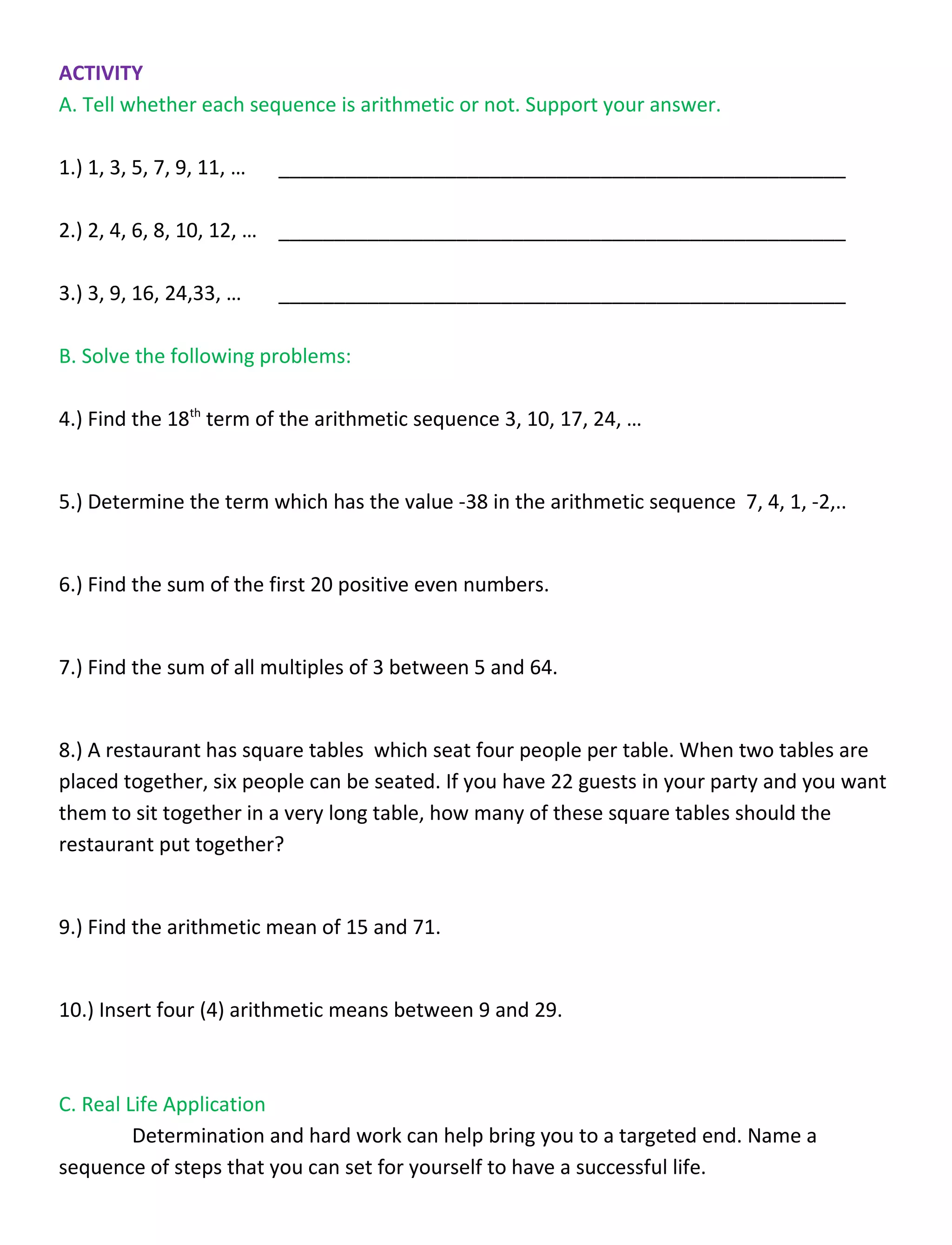
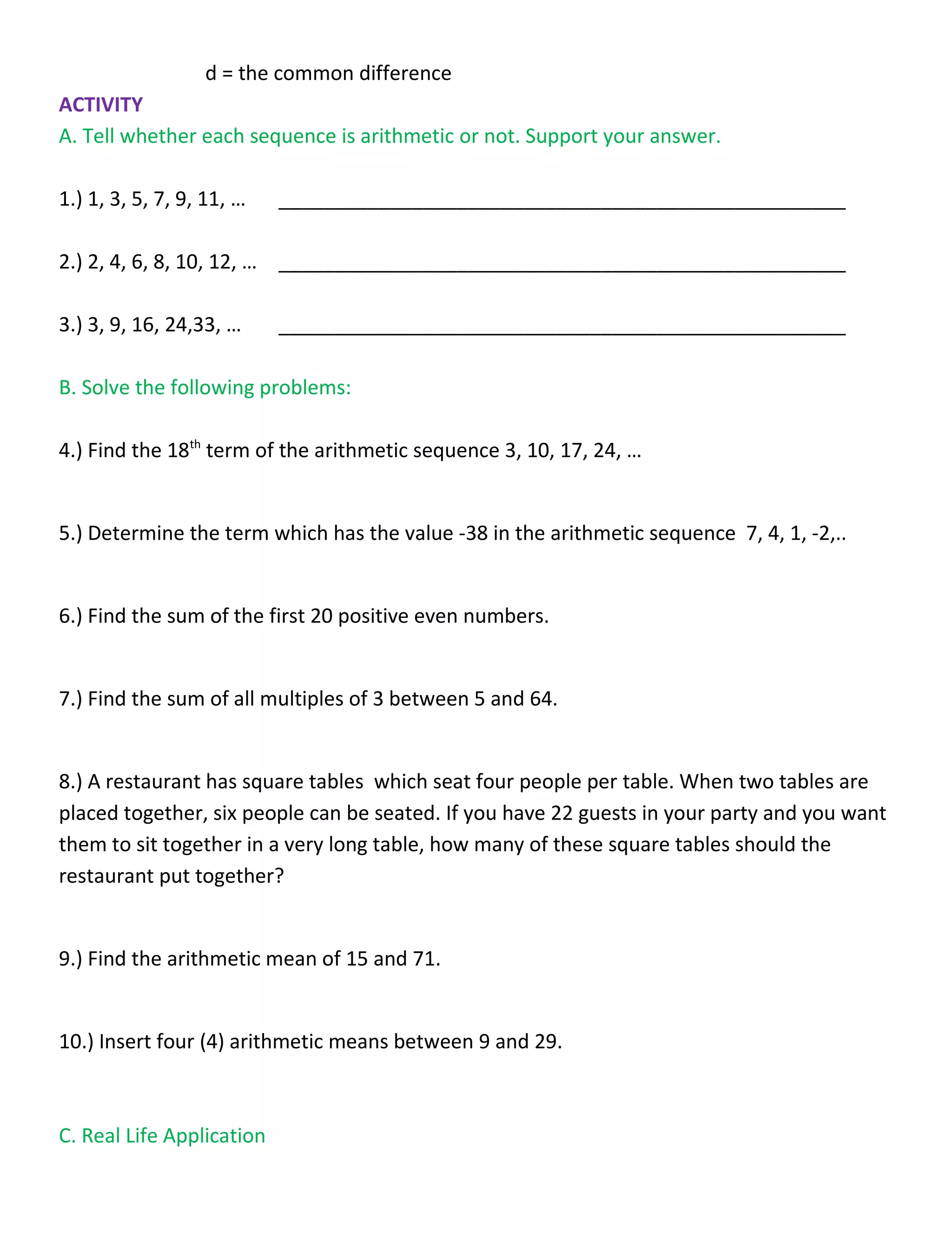
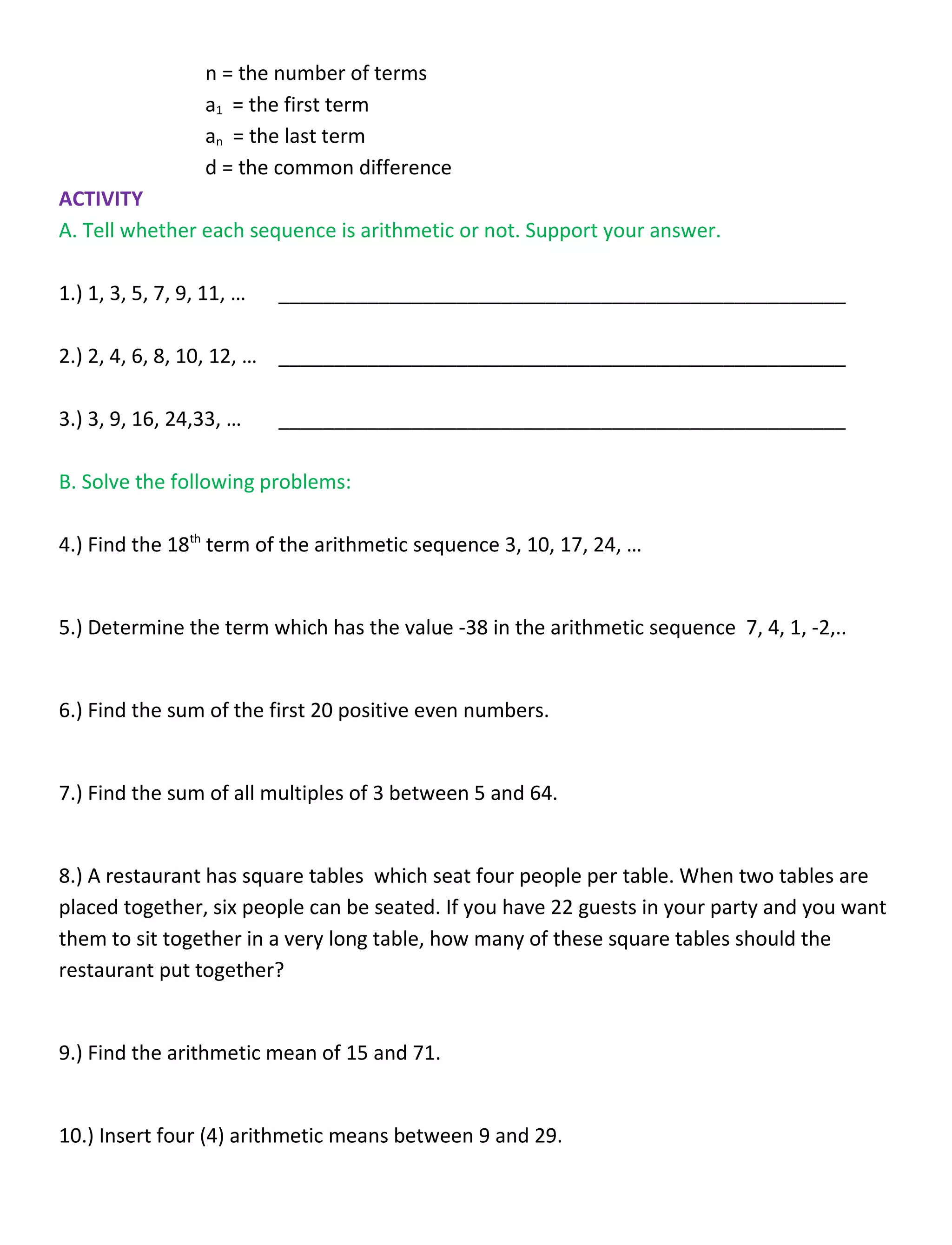
ACTIVITY
A. Tell whether each sequence is arithmetic or not. Support your answer.
1.) 1, 3, 5, 7, 9, 11, … ___________________________________________________
2.) 2, 4, 6, 8, 10, 12, … ___________________________________________________
3.) 3, 9, 16, 24,33, … ___________________________________________________
B. Solve the following problems:
4.) Find the 18th
term of the arithmetic sequence 3, 10, 17, 24, …
5.) Determine the term which has the value -38 in the arithmetic sequence 7, 4, 1, -2,..
6.) Find the sum of the first 20 positive even numbers.
7.) Find the sum of all multiples of 3 between 5 and 64.
8.) A restaurant has square tables which seat four people per table. When two tables are
placed together, six people can be seated. If you have 22 guests in your party and you want
them to sit together in a very long table, how many of these square tables should the
restaurant put together?
9.) Find the arithmetic mean of 15 and 71.
10.) Insert four (4) arithmetic means between 9 and 29.
C. Real Life Application
Determination and hard work can help bring you to a targeted end. Name a
sequence of steps that you can set for yourself to have a successful life.
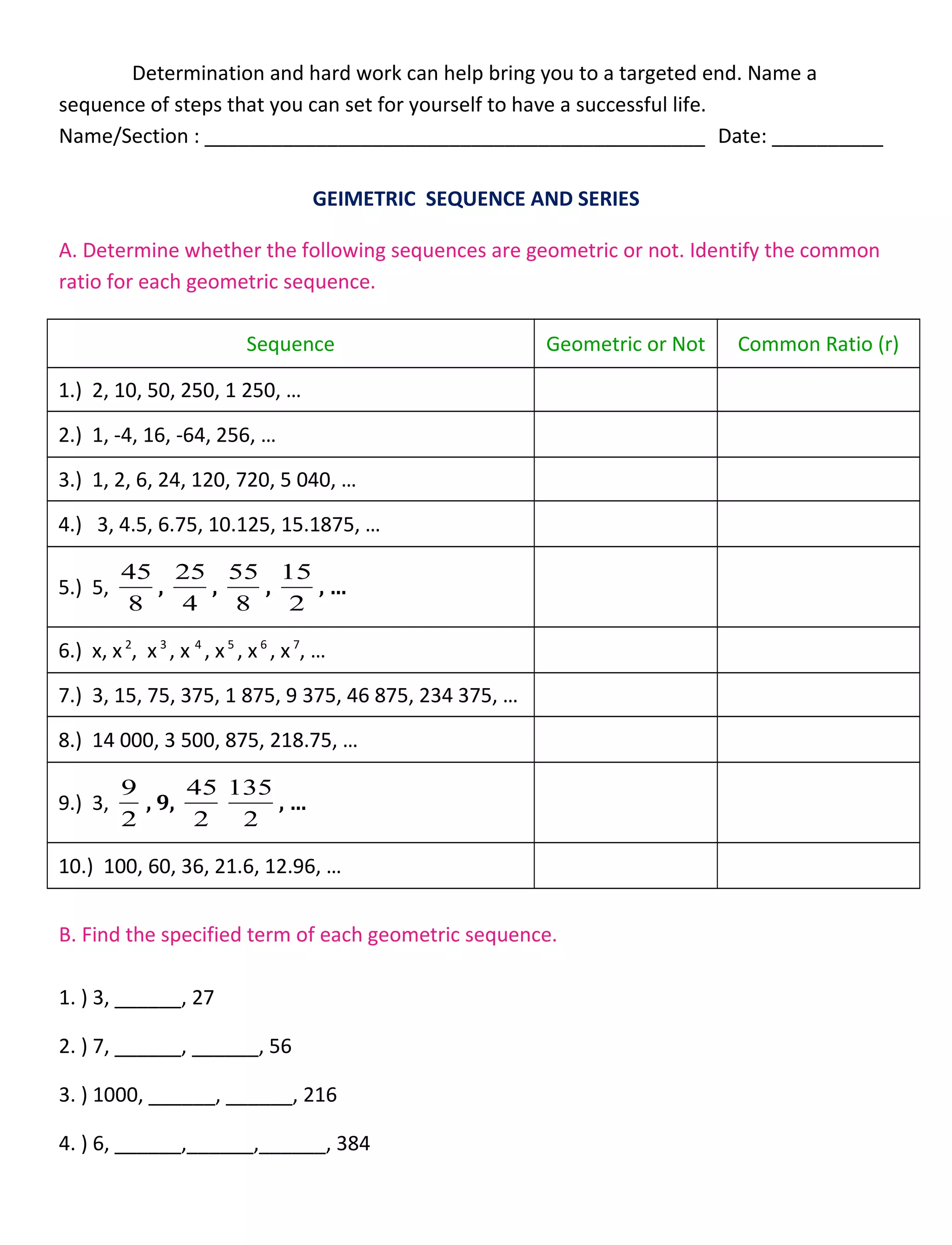
Name/Section : _____________________________________________ Date: __________
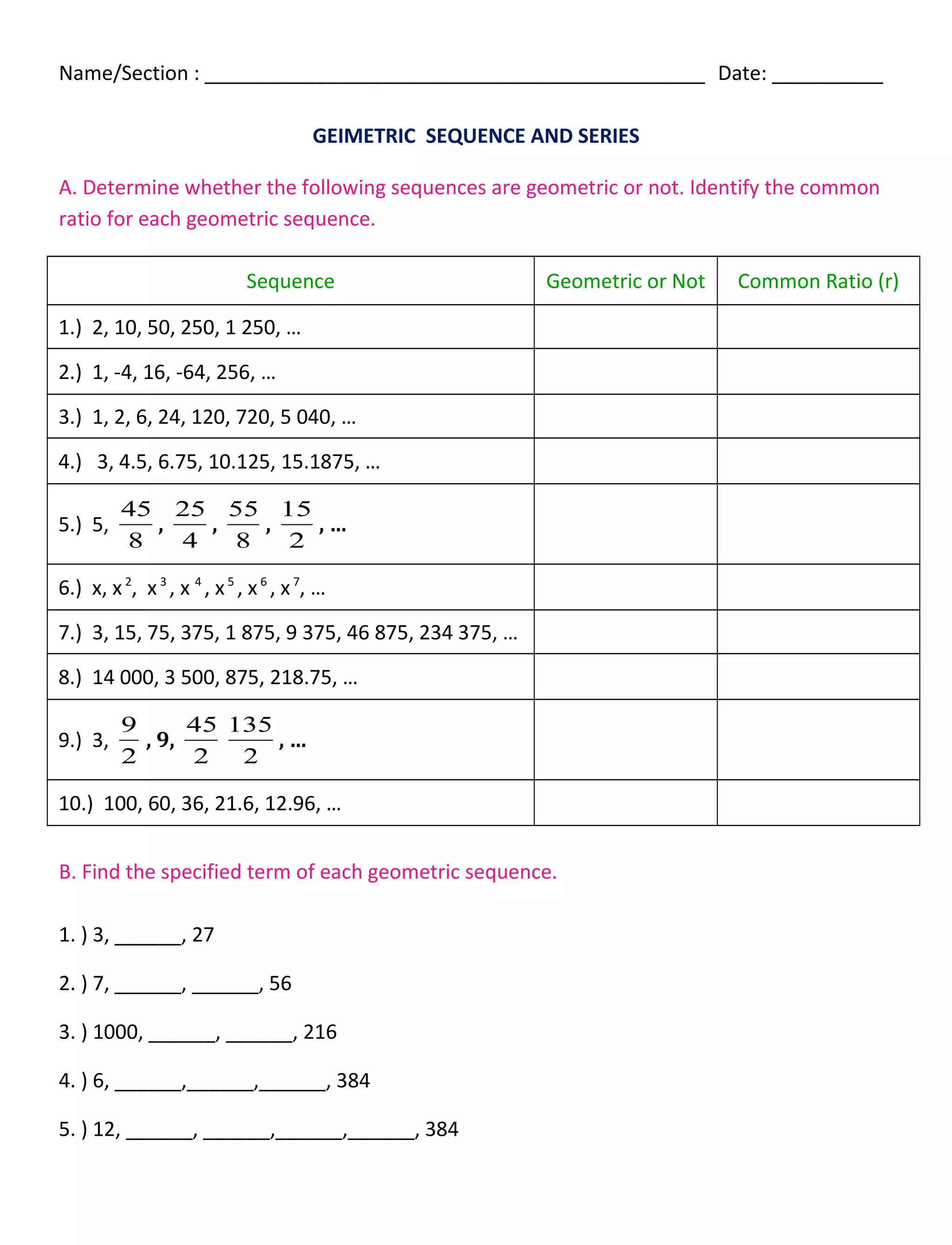
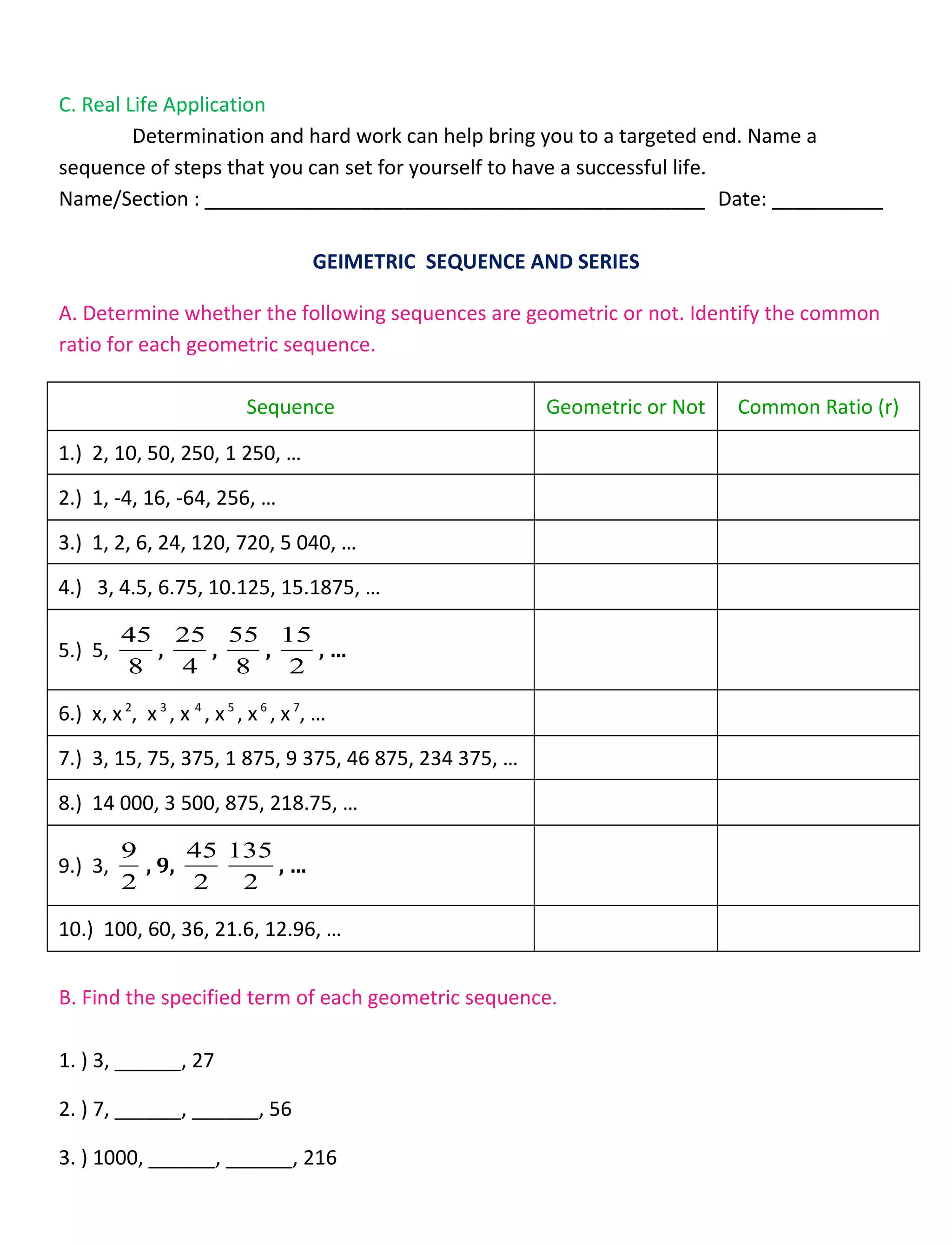
GEIMETRIC SEQUENCE AND SERIES
A. Determine whether the following sequences are geometric or not. Identify the common
ratio for each geometric sequence.
Sequence Geometric or Not Common Ratio (r)
1.) 2, 10, 50, 250, 1 250, …
2.) 1, -4, 16, -64, 256, …
3.) 1, 2, 6, 24, 120, 720, 5 040, …
4.) 3, 4.5, 6.75, 10.125, 15.1875, …
5.) 5,
8
45
,
4
25
,
8
55
,
2
15
, …
6.) x, x2
, x3
, x 4
, x5
, x6
, x7
, …
7.) 3, 15, 75, 375, 1 875, 9 375, 46 875, 234 375, …
8.) 14 000, 3 500, 875, 218.75, …
9.) 3,
2
9
, 9,
2
45
2
135
, …
10.) 100, 60, 36, 21.6, 12.96, …
B. Find the specified term of each geometric sequence.
1. ) 3, ______, 27
2. ) 7, ______, ______, 56
3. ) 1000, ______, ______, 216
4. ) 6, ______,______,______, 384
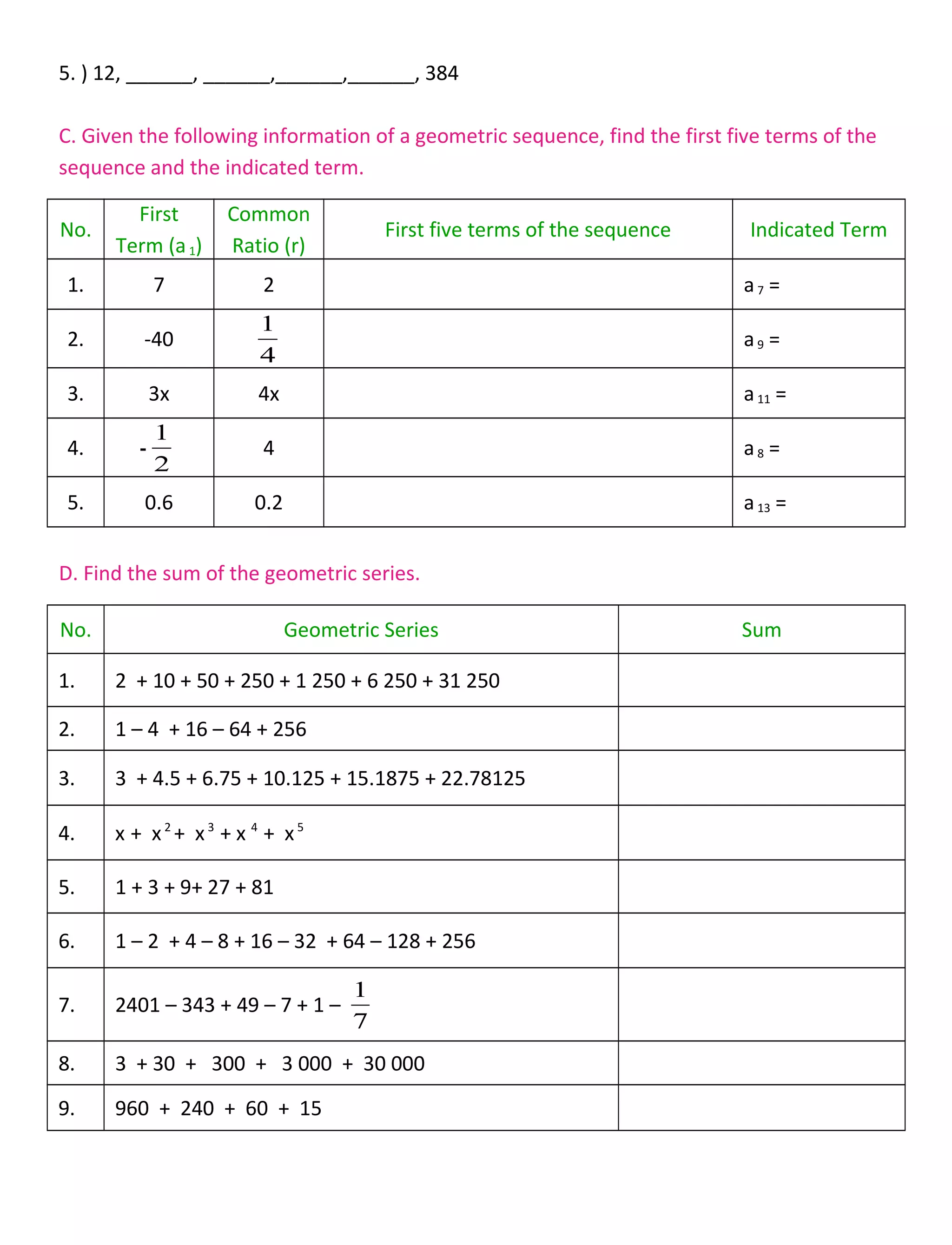
5. ) 12, ______, ______,______,______, 384
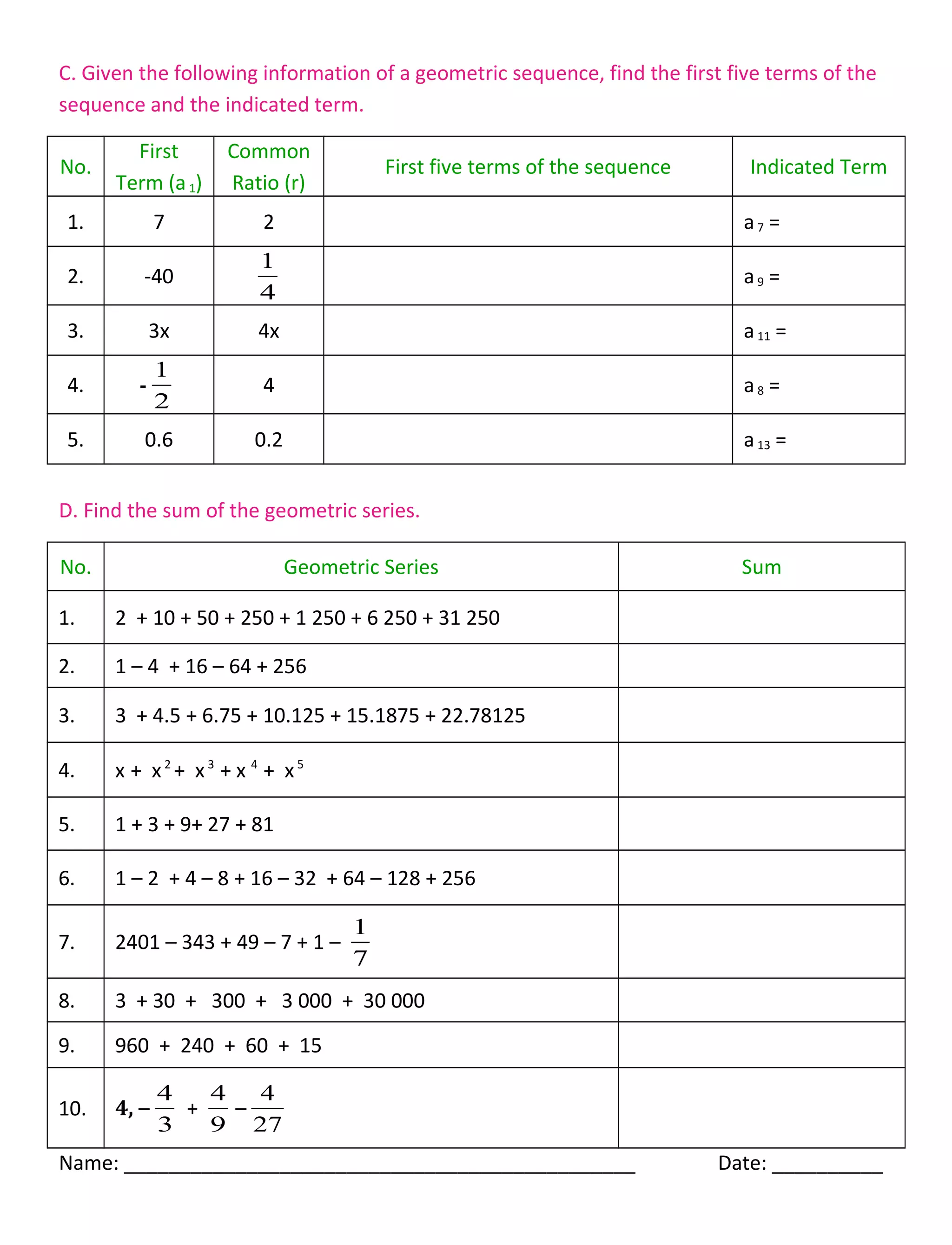
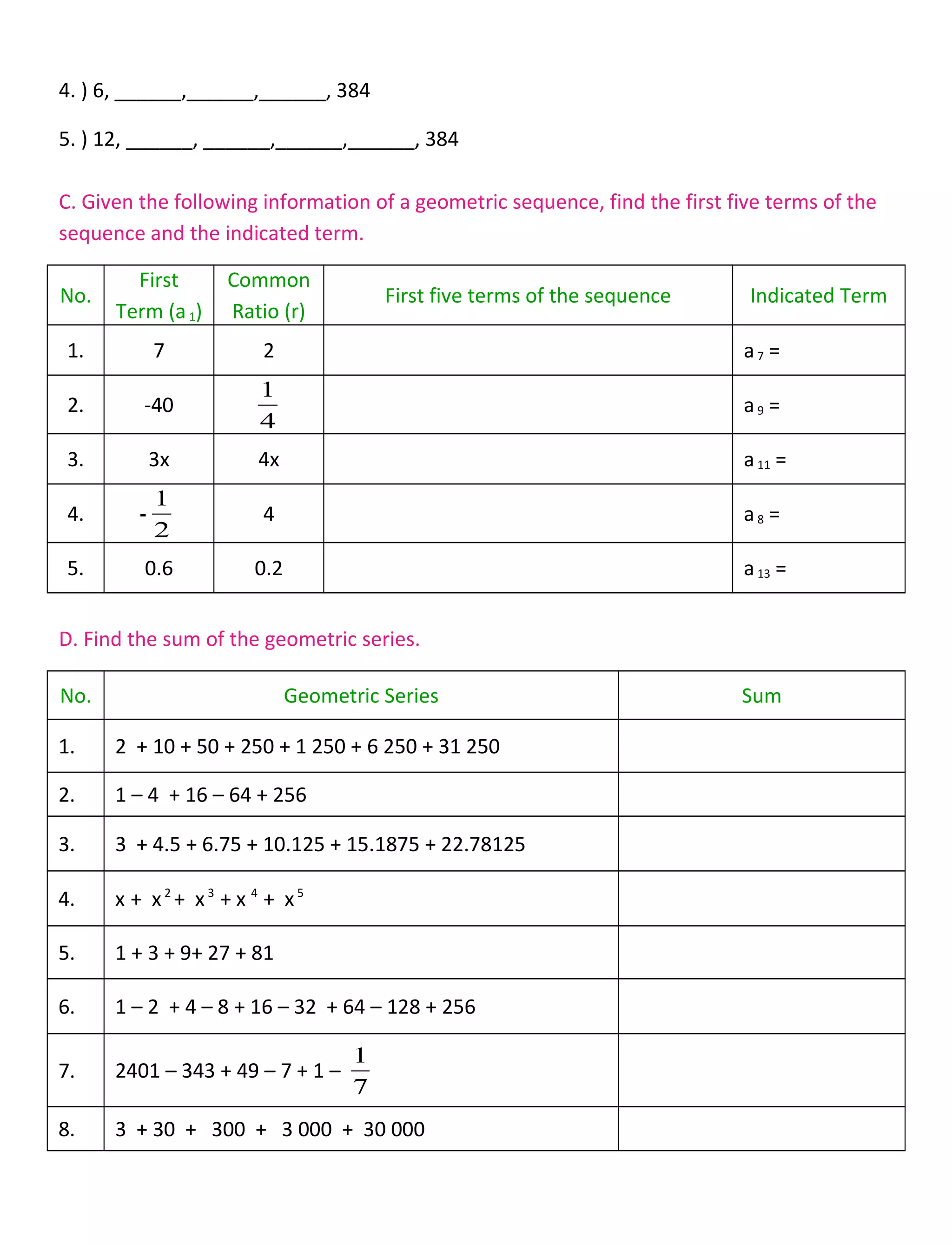
C. Given the following information of a geometric sequence, find the first five terms of the
sequence and the indicated term.
No.
First
Term (a1)
Common
Ratio (r)
First five terms of the sequence Indicated Term
1. 7 2 a7 =
2. -40
4
1
a9 =
3. 3x 4x a11 =
4. -
2
1
4 a8 =
5. 0.6 0.2 a13 =
D. Find the sum of the geometric series.
No. Geometric Series Sum
1. 2 + 10 + 50 + 250 + 1 250 + 6 250 + 31 250
2. 1 – 4 + 16 – 64 + 256
3. 3 + 4.5 + 6.75 + 10.125 + 15.1875 + 22.78125
4. x + x2
+ x3
+ x 4
+ x5
5. 1 + 3 + 9+ 27 + 81
6. 1 – 2 + 4 – 8 + 16 – 32 + 64 – 128 + 256
7. 2401 – 343 + 49 – 7 + 1 –
7
1
8. 3 + 30 + 300 + 3 000 + 30 000
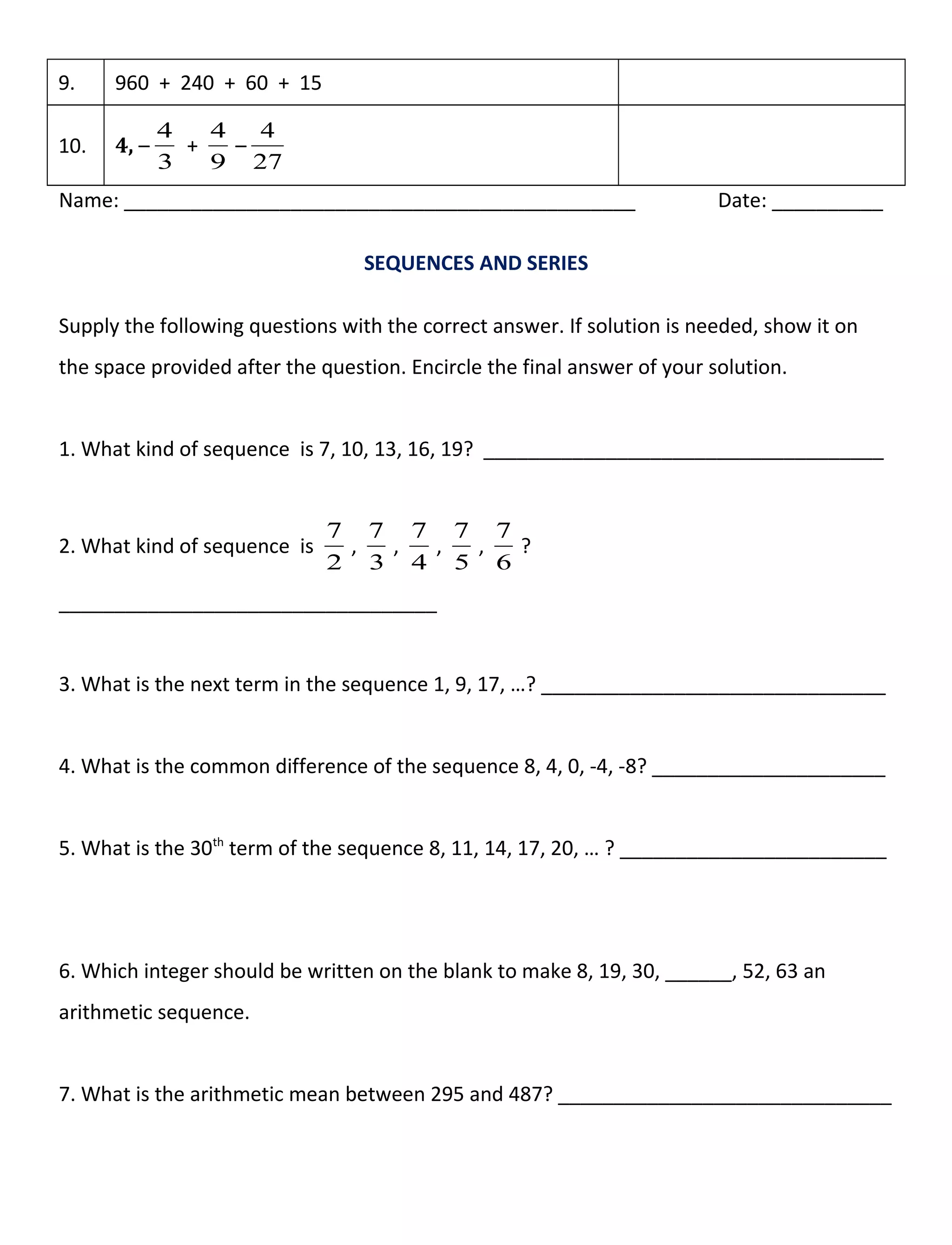
9. 960 + 240 + 60 + 15
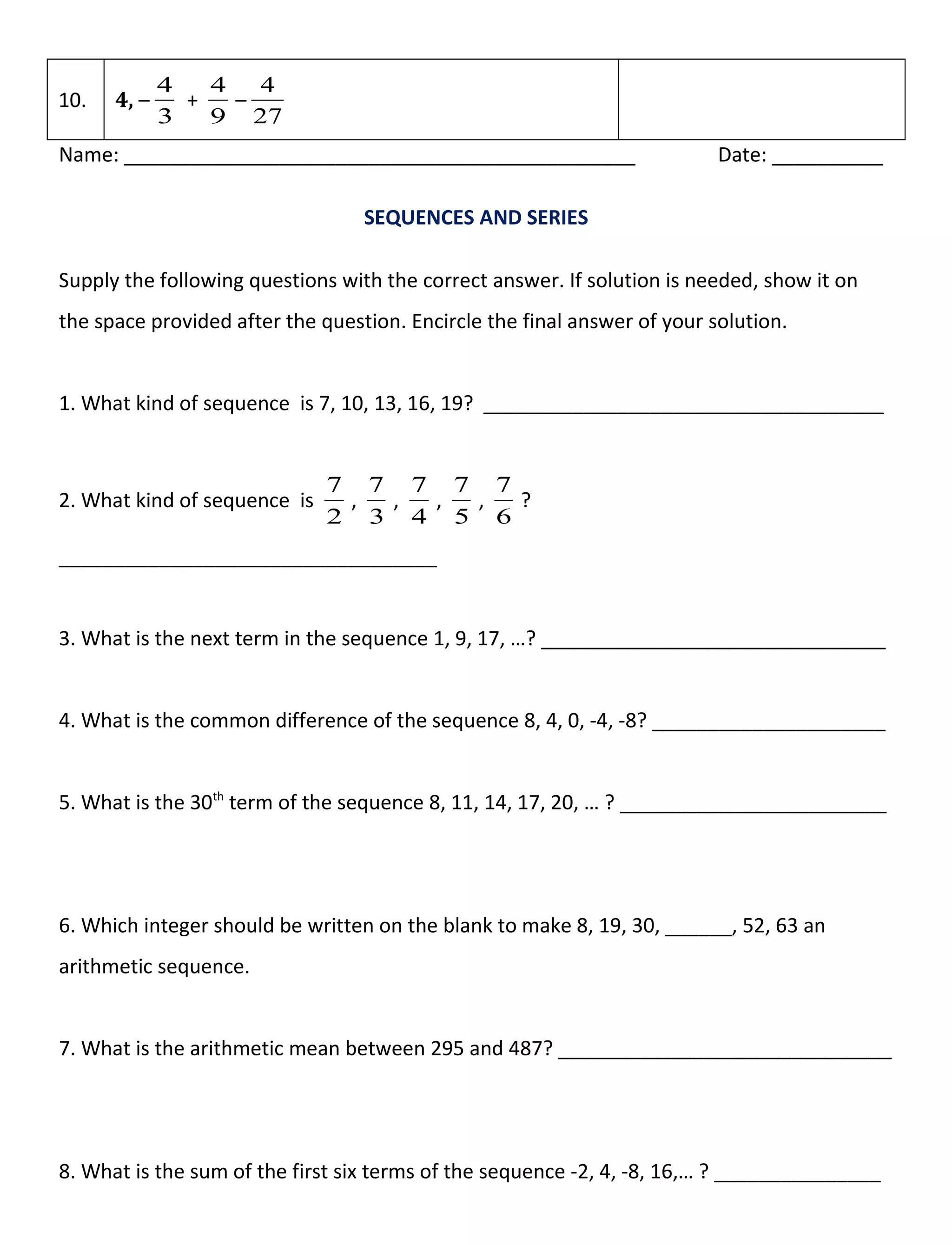
10. 4, –
3
4
+
9
4
–
27
4
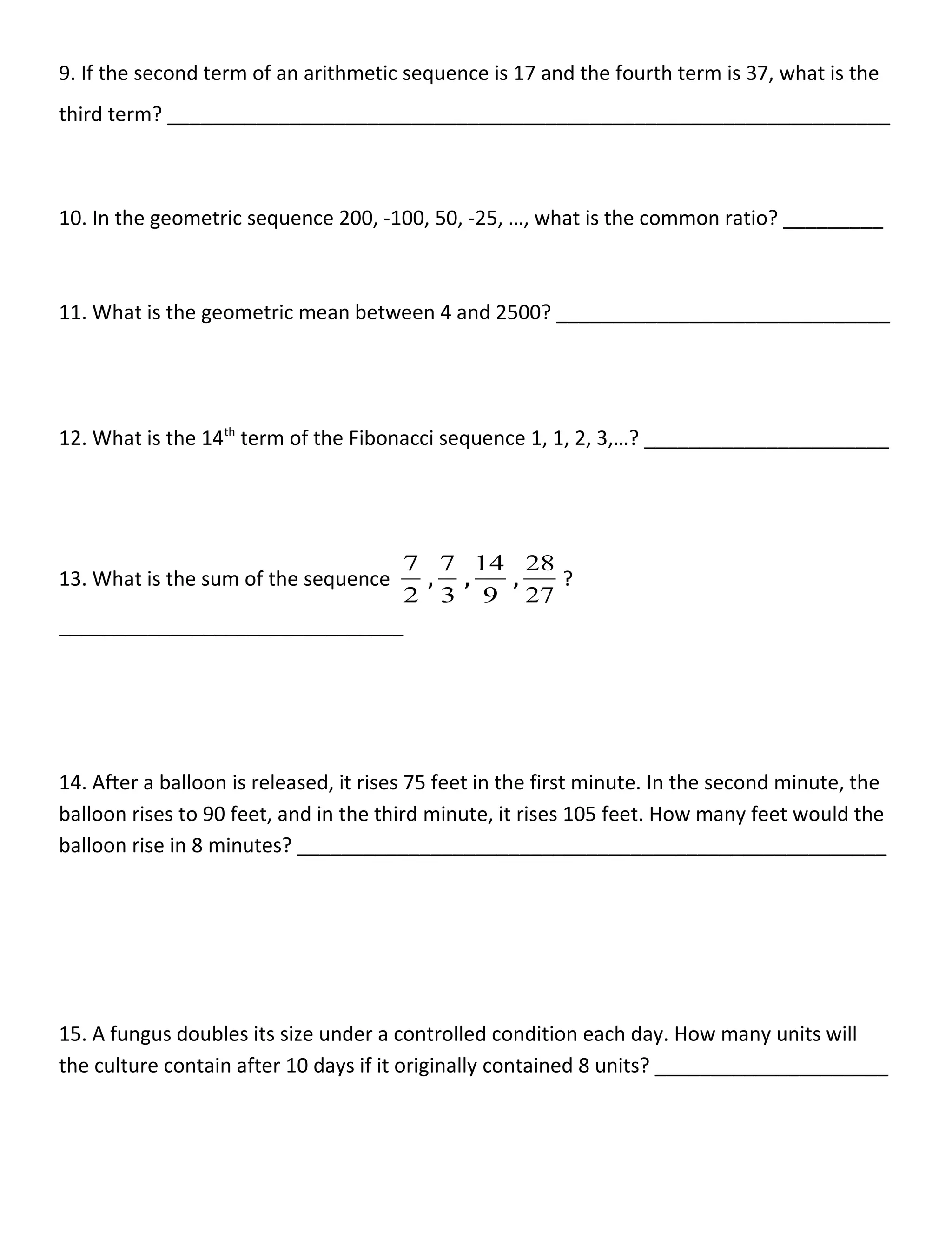
Name: ______________________________________________ Date: __________
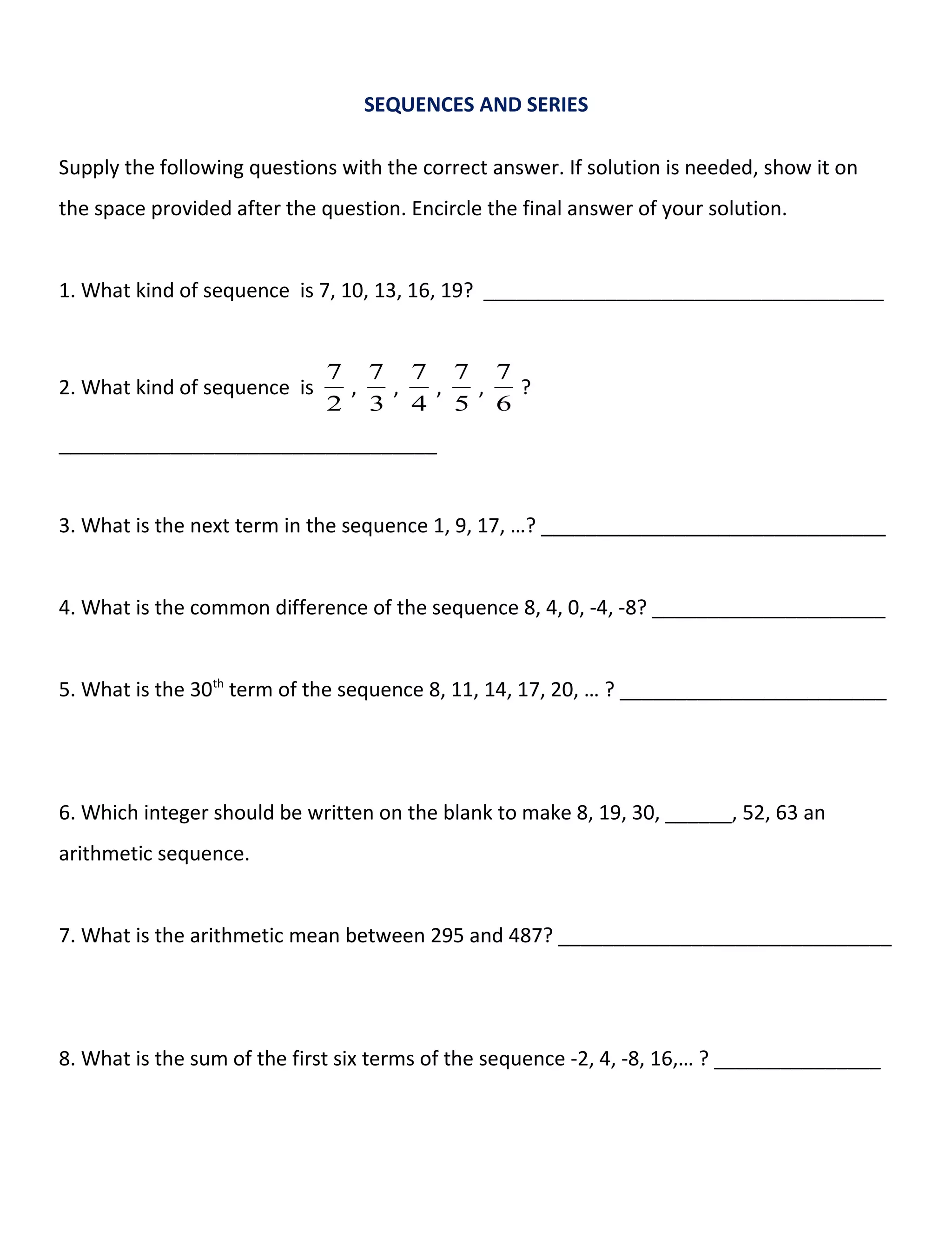
SEQUENCES AND SERIES
Supply the following questions with the correct answer. If solution is needed, show it on
the space provided after the question. Encircle the final answer of your solution.
1. What kind of sequence is 7, 10, 13, 16, 19? ____________________________________
2. What kind of sequence is
2
7
,
3
7
,
4
7
,
5
7
,
6
7
?
__________________________________
3. What is the next term in the sequence 1, 9, 17, …? _______________________________
4. What is the common difference of the sequence 8, 4, 0, -4, -8? _____________________
5. What is the 30th
term of the sequence 8, 11, 14, 17, 20, … ? ________________________
6. Which integer should be written on the blank to make 8, 19, 30, ______, 52, 63 an
arithmetic sequence.
7. What is the arithmetic mean between 295 and 487? ______________________________
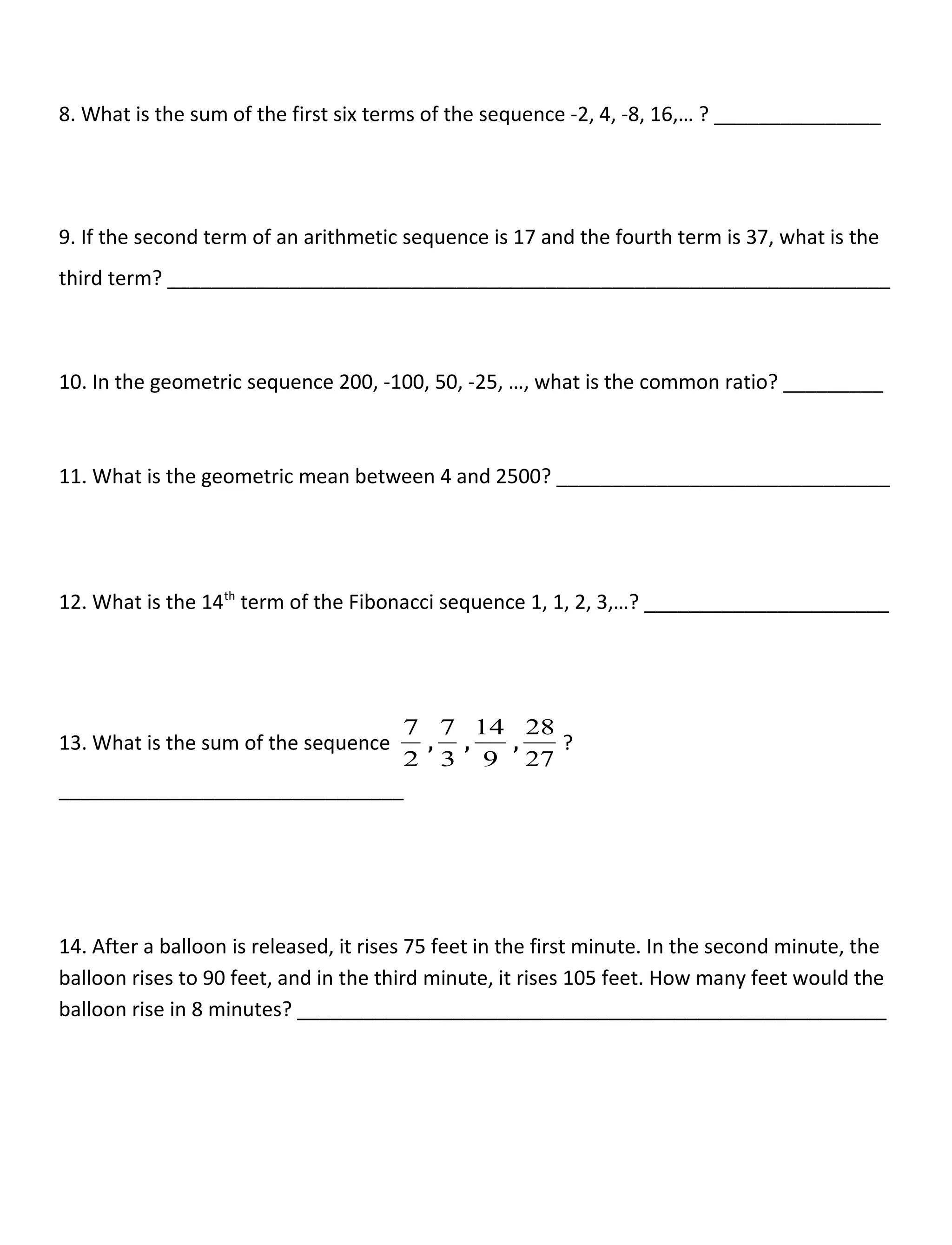
8. What is the sum of the first six terms of the sequence -2, 4, -8, 16,… ? _______________
9. If the second term of an arithmetic sequence is 17 and the fourth term is 37, what is the
third term? _________________________________________________________________
10. In the geometric sequence 200, -100, 50, -25, …, what is the common ratio? _________
11. What is the geometric mean between 4 and 2500? ______________________________
12. What is the 14th
term of the Fibonacci sequence 1, 1, 2, 3,…? ______________________
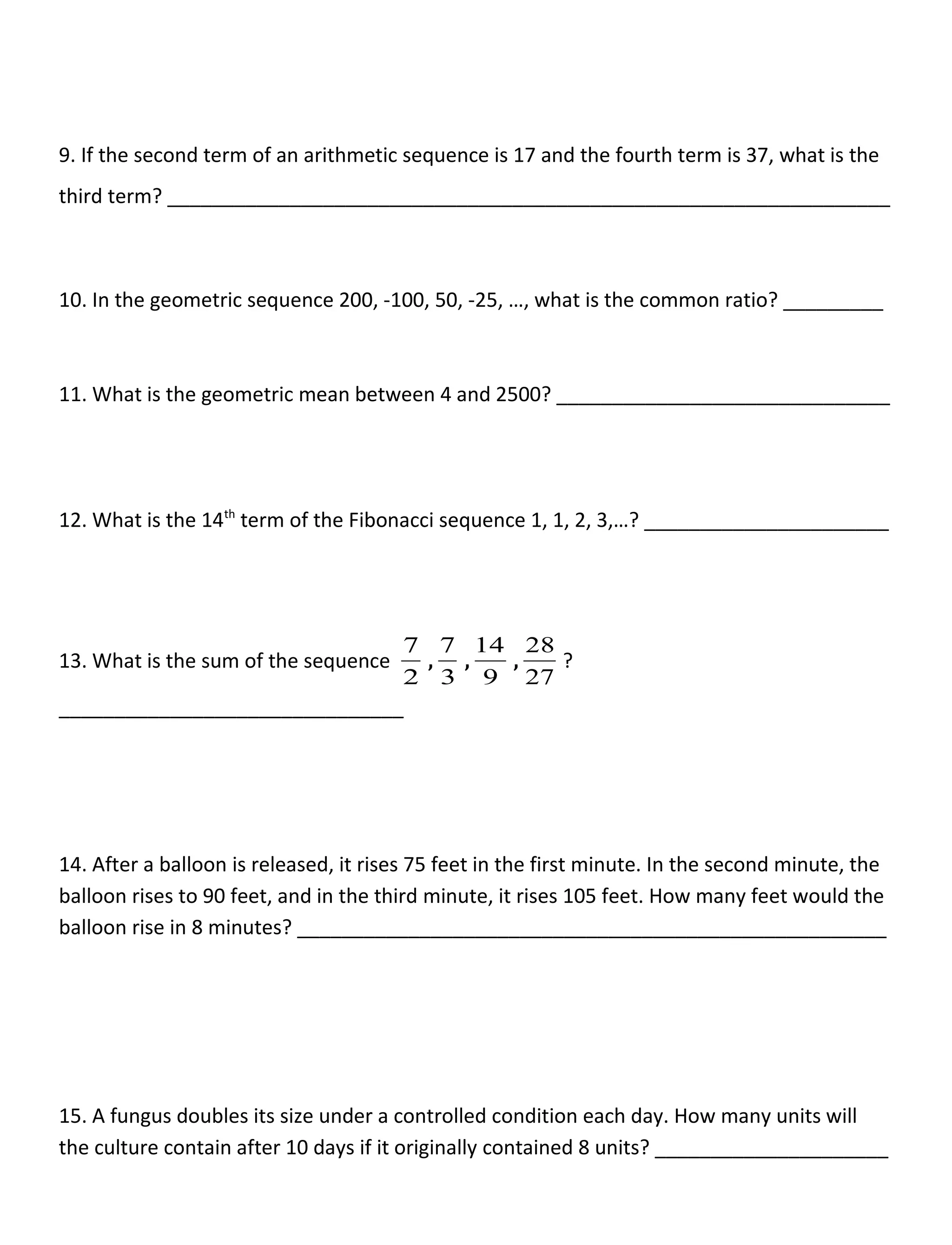
13. What is the sum of the sequence
2
7
,
3
7
,
9
14
,
27
28
?
_______________________________
14. After a balloon is released, it rises 75 feet in the first minute. In the second minute, the
balloon rises to 90 feet, and in the third minute, it rises 105 feet. How many feet would the
balloon rise in 8 minutes? _____________________________________________________
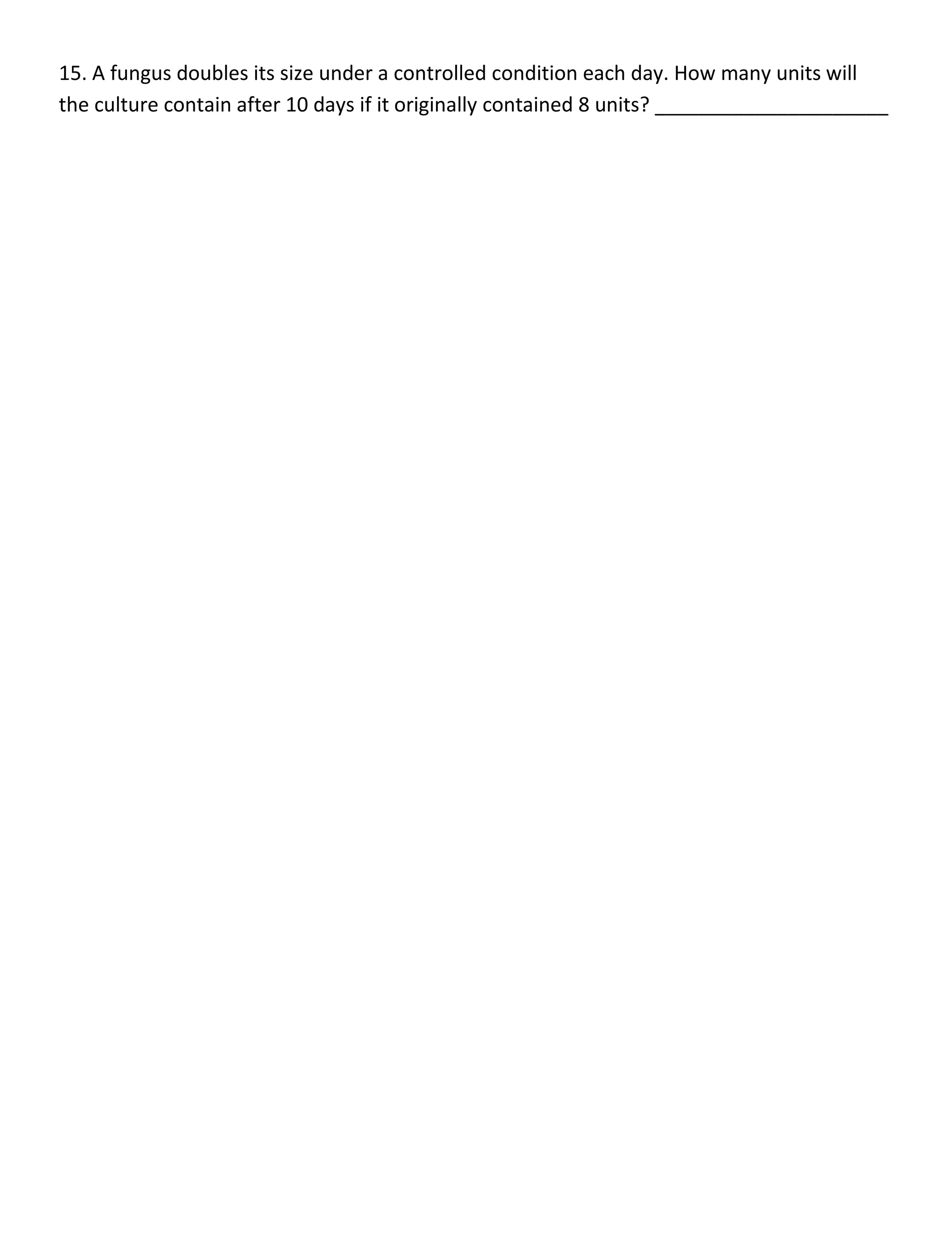
15. A fungus doubles its size under a controlled condition each day. How many units will
the culture contain after 10 days if it originally contained 8 units? _____________________
Name: ______________________________________________ Date: __________
ARITHMETIC SEQUENCE
An arithmetic sequence is a sequence in which the difference between any two
successive terms is a constant. This constant is called the common difference.
Term is any number in a sequence.
The formula for the nth term of an arithmetic sequence is
an = a1 + (n – 1)d
where an = the nth term
a1 = the first term
d = the common difference
n = the number of terms
The terms between two given terms of an arithmetic sequence are called
arithmetic means.
One arithmetic mean between two terms is called the arithmetic mean or average
of the two terms. The average of a and b is
2
ba +
.
ARITHMETIC SERIES
A series is an indicated sum of terms of a sequence.
The sum of the terms of an arithmetic sequence is called an arithmetic series.
The formula for the sum of an arithmetic series is
Sn =
2
n
[2a1 +(n– 1)d] or Sn =
2
n
(a1 + an )
where Sn = the sum
n = the number of terms
a1 = the first term
an = the last term
d = the common difference
ACTIVITY
A. Tell whether each sequence is arithmetic or not. Support your answer.
1.) 1, 3, 5, 7, 9, 11, … ___________________________________________________
2.) 2, 4, 6, 8, 10, 12, … ___________________________________________________
3.) 3, 9, 16, 24,33, … ___________________________________________________
B. Solve the following problems:
4.) Find the 18th
term of the arithmetic sequence 3, 10, 17, 24, …
5.) Determine the term which has the value -38 in the arithmetic sequence 7, 4, 1, -2,..
6.) Find the sum of the first 20 positive even numbers.
7.) Find the sum of all multiples of 3 between 5 and 64.
8.) A restaurant has square tables which seat four people per table. When two tables are
placed together, six people can be seated. If you have 22 guests in your party and you want
them to sit together in a very long table, how many of these square tables should the
restaurant put together?
9.) Find the arithmetic mean of 15 and 71.
10.) Insert four (4) arithmetic means between 9 and 29.
C. Real Life Application
Determination and hard work can help bring you to a targeted end. Name a
sequence of steps that you can set for yourself to have a successful life.
Name/Section : _____________________________________________ Date: __________
GEIMETRIC SEQUENCE AND SERIES
A. Determine whether the following sequences are geometric or not. Identify the common
ratio for each geometric sequence.
Sequence Geometric or Not Common Ratio (r)
1.) 2, 10, 50, 250, 1 250, …
2.) 1, -4, 16, -64, 256, …
3.) 1, 2, 6, 24, 120, 720, 5 040, …
4.) 3, 4.5, 6.75, 10.125, 15.1875, …
5.) 5,
8
45
,
4
25
,
8
55
,
2
15
, …
6.) x, x2
, x3
, x 4
, x5
, x6
, x7
, …
7.) 3, 15, 75, 375, 1 875, 9 375, 46 875, 234 375, …
8.) 14 000, 3 500, 875, 218.75, …
9.) 3,
2
9
, 9,
2
45
2
135
, …
10.) 100, 60, 36, 21.6, 12.96, …
B. Find the specified term of each geometric sequence.
1. ) 3, ______, 27
2. ) 7, ______, ______, 56
3. ) 1000, ______, ______, 216
4. ) 6, ______,______,______, 384
5. ) 12, ______, ______,______,______, 384
C. Given the following information of a geometric sequence, find the first five terms of the
sequence and the indicated term.
No.
First
Term (a1)
Common
Ratio (r)
First five terms of the sequence Indicated Term
1. 7 2 a7 =
2. -40
4
1
a9 =
3. 3x 4x a11 =
4. -
2
1
4 a8 =
5. 0.6 0.2 a13 =
D. Find the sum of the geometric series.
No. Geometric Series Sum
1. 2 + 10 + 50 + 250 + 1 250 + 6 250 + 31 250
2. 1 – 4 + 16 – 64 + 256
3. 3 + 4.5 + 6.75 + 10.125 + 15.1875 + 22.78125
4. x + x2
+ x3
+ x 4
+ x5
5. 1 + 3 + 9+ 27 + 81
6. 1 – 2 + 4 – 8 + 16 – 32 + 64 – 128 + 256
7. 2401 – 343 + 49 – 7 + 1 –
7
1
8. 3 + 30 + 300 + 3 000 + 30 000
9. 960 + 240 + 60 + 15
10. 4, –
3
4
+
9
4
–
27
4
Name: ______________________________________________ Date: __________
SEQUENCES AND SERIES
Supply the following questions with the correct answer. If solution is needed, show it on
the space provided after the question. Encircle the final answer of your solution.
1. What kind of sequence is 7, 10, 13, 16, 19? ____________________________________
2. What kind of sequence is
2
7
,
3
7
,
4
7
,
5
7
,
6
7
?
__________________________________
3. What is the next term in the sequence 1, 9, 17, …? _______________________________
4. What is the common difference of the sequence 8, 4, 0, -4, -8? _____________________
5. What is the 30th
term of the sequence 8, 11, 14, 17, 20, … ? ________________________
6. Which integer should be written on the blank to make 8, 19, 30, ______, 52, 63 an
arithmetic sequence.
7. What is the arithmetic mean between 295 and 487? ______________________________
8. What is the sum of the first six terms of the sequence -2, 4, -8, 16,… ? _______________
9. If the second term of an arithmetic sequence is 17 and the fourth term is 37, what is the
third term? _________________________________________________________________
10. In the geometric sequence 200, -100, 50, -25, …, what is the common ratio? _________
11. What is the geometric mean between 4 and 2500? ______________________________
12. What is the 14th
term of the Fibonacci sequence 1, 1, 2, 3,…? ______________________
13. What is the sum of the sequence
2
7
,
3
7
,
9
14
,
27
28
?
_______________________________
14. After a balloon is released, it rises 75 feet in the first minute. In the second minute, the
balloon rises to 90 feet, and in the third minute, it rises 105 feet. How many feet would the
balloon rise in 8 minutes? _____________________________________________________
15. A fungus doubles its size under a controlled condition each day. How many units will
the culture contain after 10 days if it originally contained 8 units? _____________________
Name: ______________________________________________ Date: __________
ARITHMETIC SEQUENCE
An arithmetic sequence is a sequence in which the difference between any two
successive terms is a constant. This constant is called the common difference.
Term is any number in a sequence.
The formula for the nth term of an arithmetic sequence is
an = a1 + (n – 1)d
where an = the nth term
a1 = the first term
d = the common difference
n = the number of terms
The terms between two given terms of an arithmetic sequence are called
arithmetic means.
One arithmetic mean between two terms is called the arithmetic mean or average
of the two terms. The average of a and b is
2
ba +
.
ARITHMETIC SERIES
A series is an indicated sum of terms of a sequence.
The sum of the terms of an arithmetic sequence is called an arithmetic series.
The formula for the sum of an arithmetic series is
Sn =
2
n
[2a1 +(n– 1)d] or Sn =
2
n
(a1 + an )
where Sn = the sum
n = the number of terms
a1 = the first term
an = the last term
d = the common difference
ACTIVITY
A. Tell whether each sequence is arithmetic or not. Support your answer.
1.) 1, 3, 5, 7, 9, 11, … ___________________________________________________
2.) 2, 4, 6, 8, 10, 12, … ___________________________________________________
3.) 3, 9, 16, 24,33, … ___________________________________________________
B. Solve the following problems:
4.) Find the 18th
term of the arithmetic sequence 3, 10, 17, 24, …
5.) Determine the term which has the value -38 in the arithmetic sequence 7, 4, 1, -2,..
6.) Find the sum of the first 20 positive even numbers.
7.) Find the sum of all multiples of 3 between 5 and 64.
8.) A restaurant has square tables which seat four people per table. When two tables are
placed together, six people can be seated. If you have 22 guests in your party and you want
them to sit together in a very long table, how many of these square tables should the
restaurant put together?
9.) Find the arithmetic mean of 15 and 71.
10.) Insert four (4) arithmetic means between 9 and 29.
C. Real Life Application
Determination and hard work can help bring you to a targeted end. Name a
sequence of steps that you can set for yourself to have a successful life.
Name/Section : _____________________________________________ Date: __________
GEIMETRIC SEQUENCE AND SERIES
A. Determine whether the following sequences are geometric or not. Identify the common
ratio for each geometric sequence.
Sequence Geometric or Not Common Ratio (r)
1.) 2, 10, 50, 250, 1 250, …
2.) 1, -4, 16, -64, 256, …
3.) 1, 2, 6, 24, 120, 720, 5 040, …
4.) 3, 4.5, 6.75, 10.125, 15.1875, …
5.) 5,
8
45
,
4
25
,
8
55
,
2
15
, …
6.) x, x2
, x3
, x 4
, x5
, x6
, x7
, …
7.) 3, 15, 75, 375, 1 875, 9 375, 46 875, 234 375, …
8.) 14 000, 3 500, 875, 218.75, …
9.) 3,
2
9
, 9,
2
45
2
135
, …
10.) 100, 60, 36, 21.6, 12.96, …
B. Find the specified term of each geometric sequence.
1. ) 3, ______, 27
2. ) 7, ______, ______, 56
3. ) 1000, ______, ______, 216
4. ) 6, ______,______,______, 384
5. ) 12, ______, ______,______,______, 384
C. Given the following information of a geometric sequence, find the first five terms of the
sequence and the indicated term.
No.
First
Term (a1)
Common
Ratio (r)
First five terms of the sequence Indicated Term
1. 7 2 a7 =
2. -40
4
1
a9 =
3. 3x 4x a11 =
4. -
2
1
4 a8 =
5. 0.6 0.2 a13 =
D. Find the sum of the geometric series.
No. Geometric Series Sum
1. 2 + 10 + 50 + 250 + 1 250 + 6 250 + 31 250
2. 1 – 4 + 16 – 64 + 256
3. 3 + 4.5 + 6.75 + 10.125 + 15.1875 + 22.78125
4. x + x2
+ x3
+ x 4
+ x5
5. 1 + 3 + 9+ 27 + 81
6. 1 – 2 + 4 – 8 + 16 – 32 + 64 – 128 + 256
7. 2401 – 343 + 49 – 7 + 1 –
7
1
8. 3 + 30 + 300 + 3 000 + 30 000
9. 960 + 240 + 60 + 15
10. 4, –
3
4
+
9
4
–
27
4
Name: ______________________________________________ Date: __________
SEQUENCES AND SERIES
Supply the following questions with the correct answer. If solution is needed, show it on
the space provided after the question. Encircle the final answer of your solution.
1. What kind of sequence is 7, 10, 13, 16, 19? ____________________________________
2. What kind of sequence is
2
7
,
3
7
,
4
7
,
5
7
,
6
7
?
__________________________________
3. What is the next term in the sequence 1, 9, 17, …? _______________________________
4. What is the common difference of the sequence 8, 4, 0, -4, -8? _____________________
5. What is the 30th
term of the sequence 8, 11, 14, 17, 20, … ? ________________________
6. Which integer should be written on the blank to make 8, 19, 30, ______, 52, 63 an
arithmetic sequence.
7. What is the arithmetic mean between 295 and 487? ______________________________
8. What is the sum of the first six terms of the sequence -2, 4, -8, 16,… ? _______________
9. If the second term of an arithmetic sequence is 17 and the fourth term is 37, what is the
third term? _________________________________________________________________
10. In the geometric sequence 200, -100, 50, -25, …, what is the common ratio? _________
11. What is the geometric mean between 4 and 2500? ______________________________
12. What is the 14th
term of the Fibonacci sequence 1, 1, 2, 3,…? ______________________
13. What is the sum of the sequence
2
7
,
3
7
,
9
14
,
27
28
?
_______________________________
14. After a balloon is released, it rises 75 feet in the first minute. In the second minute, the
balloon rises to 90 feet, and in the third minute, it rises 105 feet. How many feet would the
balloon rise in 8 minutes? _____________________________________________________
15. A fungus doubles its size under a controlled condition each day. How many units will
the culture contain after 10 days if it originally contained 8 units? _____________________

Sequence and series

  • 1.
    Name: ______________________________________________ Date:__________ ARITHMETIC SEQUENCE An arithmetic sequence is a sequence in which the difference between any two successive terms is a constant. This constant is called the common difference. Term is any number in a sequence. The formula for the nth term of an arithmetic sequence is an = a1 + (n – 1)d where an = the nth term a1 = the first term d = the common difference n = the number of terms The terms between two given terms of an arithmetic sequence are called arithmetic means. One arithmetic mean between two terms is called the arithmetic mean or average of the two terms. The average of a and b is 2 ba + . ARITHMETIC SERIES A series is an indicated sum of terms of a sequence. The sum of the terms of an arithmetic sequence is called an arithmetic series. The formula for the sum of an arithmetic series is Sn = 2 n [2a1 +(n– 1)d] or Sn = 2 n (a1 + an ) where Sn = the sum n = the number of terms a1 = the first term an = the last term d = the common difference
  • 2.
    ACTIVITY A. Tell whethereach sequence is arithmetic or not. Support your answer. 1.) 1, 3, 5, 7, 9, 11, … ___________________________________________________ 2.) 2, 4, 6, 8, 10, 12, … ___________________________________________________ 3.) 3, 9, 16, 24,33, … ___________________________________________________ B. Solve the following problems: 4.) Find the 18th term of the arithmetic sequence 3, 10, 17, 24, … 5.) Determine the term which has the value -38 in the arithmetic sequence 7, 4, 1, -2,.. 6.) Find the sum of the first 20 positive even numbers. 7.) Find the sum of all multiples of 3 between 5 and 64. 8.) A restaurant has square tables which seat four people per table. When two tables are placed together, six people can be seated. If you have 22 guests in your party and you want them to sit together in a very long table, how many of these square tables should the restaurant put together? 9.) Find the arithmetic mean of 15 and 71. 10.) Insert four (4) arithmetic means between 9 and 29. C. Real Life Application Determination and hard work can help bring you to a targeted end. Name a sequence of steps that you can set for yourself to have a successful life.
  • 3.
    Name/Section : _____________________________________________Date: __________ GEIMETRIC SEQUENCE AND SERIES A. Determine whether the following sequences are geometric or not. Identify the common ratio for each geometric sequence. Sequence Geometric or Not Common Ratio (r) 1.) 2, 10, 50, 250, 1 250, … 2.) 1, -4, 16, -64, 256, … 3.) 1, 2, 6, 24, 120, 720, 5 040, … 4.) 3, 4.5, 6.75, 10.125, 15.1875, … 5.) 5, 8 45 , 4 25 , 8 55 , 2 15 , … 6.) x, x2 , x3 , x 4 , x5 , x6 , x7 , … 7.) 3, 15, 75, 375, 1 875, 9 375, 46 875, 234 375, … 8.) 14 000, 3 500, 875, 218.75, … 9.) 3, 2 9 , 9, 2 45 2 135 , … 10.) 100, 60, 36, 21.6, 12.96, … B. Find the specified term of each geometric sequence. 1. ) 3, ______, 27 2. ) 7, ______, ______, 56 3. ) 1000, ______, ______, 216 4. ) 6, ______,______,______, 384 5. ) 12, ______, ______,______,______, 384
  • 4.
    C. Given thefollowing information of a geometric sequence, find the first five terms of the sequence and the indicated term. No. First Term (a1) Common Ratio (r) First five terms of the sequence Indicated Term 1. 7 2 a7 = 2. -40 4 1 a9 = 3. 3x 4x a11 = 4. - 2 1 4 a8 = 5. 0.6 0.2 a13 = D. Find the sum of the geometric series. No. Geometric Series Sum 1. 2 + 10 + 50 + 250 + 1 250 + 6 250 + 31 250 2. 1 – 4 + 16 – 64 + 256 3. 3 + 4.5 + 6.75 + 10.125 + 15.1875 + 22.78125 4. x + x2 + x3 + x 4 + x5 5. 1 + 3 + 9+ 27 + 81 6. 1 – 2 + 4 – 8 + 16 – 32 + 64 – 128 + 256 7. 2401 – 343 + 49 – 7 + 1 – 7 1 8. 3 + 30 + 300 + 3 000 + 30 000 9. 960 + 240 + 60 + 15 10. 4, – 3 4 + 9 4 – 27 4 Name: ______________________________________________ Date: __________
  • 5.
    SEQUENCES AND SERIES Supplythe following questions with the correct answer. If solution is needed, show it on the space provided after the question. Encircle the final answer of your solution. 1. What kind of sequence is 7, 10, 13, 16, 19? ____________________________________ 2. What kind of sequence is 2 7 , 3 7 , 4 7 , 5 7 , 6 7 ? __________________________________ 3. What is the next term in the sequence 1, 9, 17, …? _______________________________ 4. What is the common difference of the sequence 8, 4, 0, -4, -8? _____________________ 5. What is the 30th term of the sequence 8, 11, 14, 17, 20, … ? ________________________ 6. Which integer should be written on the blank to make 8, 19, 30, ______, 52, 63 an arithmetic sequence. 7. What is the arithmetic mean between 295 and 487? ______________________________ 8. What is the sum of the first six terms of the sequence -2, 4, -8, 16,… ? _______________
  • 6.
    9. If thesecond term of an arithmetic sequence is 17 and the fourth term is 37, what is the third term? _________________________________________________________________ 10. In the geometric sequence 200, -100, 50, -25, …, what is the common ratio? _________ 11. What is the geometric mean between 4 and 2500? ______________________________ 12. What is the 14th term of the Fibonacci sequence 1, 1, 2, 3,…? ______________________ 13. What is the sum of the sequence 2 7 , 3 7 , 9 14 , 27 28 ? _______________________________ 14. After a balloon is released, it rises 75 feet in the first minute. In the second minute, the balloon rises to 90 feet, and in the third minute, it rises 105 feet. How many feet would the balloon rise in 8 minutes? _____________________________________________________ 15. A fungus doubles its size under a controlled condition each day. How many units will the culture contain after 10 days if it originally contained 8 units? _____________________
  • 7.
    Name: ______________________________________________ Date:__________ ARITHMETIC SEQUENCE An arithmetic sequence is a sequence in which the difference between any two successive terms is a constant. This constant is called the common difference. Term is any number in a sequence. The formula for the nth term of an arithmetic sequence is an = a1 + (n – 1)d where an = the nth term a1 = the first term d = the common difference n = the number of terms The terms between two given terms of an arithmetic sequence are called arithmetic means. One arithmetic mean between two terms is called the arithmetic mean or average of the two terms. The average of a and b is 2 ba + . ARITHMETIC SERIES A series is an indicated sum of terms of a sequence. The sum of the terms of an arithmetic sequence is called an arithmetic series. The formula for the sum of an arithmetic series is Sn = 2 n [2a1 +(n– 1)d] or Sn = 2 n (a1 + an ) where Sn = the sum n = the number of terms a1 = the first term an = the last term
  • 8.
    d = thecommon difference ACTIVITY A. Tell whether each sequence is arithmetic or not. Support your answer. 1.) 1, 3, 5, 7, 9, 11, … ___________________________________________________ 2.) 2, 4, 6, 8, 10, 12, … ___________________________________________________ 3.) 3, 9, 16, 24,33, … ___________________________________________________ B. Solve the following problems: 4.) Find the 18th term of the arithmetic sequence 3, 10, 17, 24, … 5.) Determine the term which has the value -38 in the arithmetic sequence 7, 4, 1, -2,.. 6.) Find the sum of the first 20 positive even numbers. 7.) Find the sum of all multiples of 3 between 5 and 64. 8.) A restaurant has square tables which seat four people per table. When two tables are placed together, six people can be seated. If you have 22 guests in your party and you want them to sit together in a very long table, how many of these square tables should the restaurant put together? 9.) Find the arithmetic mean of 15 and 71. 10.) Insert four (4) arithmetic means between 9 and 29. C. Real Life Application
  • 9.
    Determination and hardwork can help bring you to a targeted end. Name a sequence of steps that you can set for yourself to have a successful life. Name/Section : _____________________________________________ Date: __________ GEIMETRIC SEQUENCE AND SERIES A. Determine whether the following sequences are geometric or not. Identify the common ratio for each geometric sequence. Sequence Geometric or Not Common Ratio (r) 1.) 2, 10, 50, 250, 1 250, … 2.) 1, -4, 16, -64, 256, … 3.) 1, 2, 6, 24, 120, 720, 5 040, … 4.) 3, 4.5, 6.75, 10.125, 15.1875, … 5.) 5, 8 45 , 4 25 , 8 55 , 2 15 , … 6.) x, x2 , x3 , x 4 , x5 , x6 , x7 , … 7.) 3, 15, 75, 375, 1 875, 9 375, 46 875, 234 375, … 8.) 14 000, 3 500, 875, 218.75, … 9.) 3, 2 9 , 9, 2 45 2 135 , … 10.) 100, 60, 36, 21.6, 12.96, … B. Find the specified term of each geometric sequence. 1. ) 3, ______, 27 2. ) 7, ______, ______, 56 3. ) 1000, ______, ______, 216 4. ) 6, ______,______,______, 384
  • 10.
    5. ) 12,______, ______,______,______, 384 C. Given the following information of a geometric sequence, find the first five terms of the sequence and the indicated term. No. First Term (a1) Common Ratio (r) First five terms of the sequence Indicated Term 1. 7 2 a7 = 2. -40 4 1 a9 = 3. 3x 4x a11 = 4. - 2 1 4 a8 = 5. 0.6 0.2 a13 = D. Find the sum of the geometric series. No. Geometric Series Sum 1. 2 + 10 + 50 + 250 + 1 250 + 6 250 + 31 250 2. 1 – 4 + 16 – 64 + 256 3. 3 + 4.5 + 6.75 + 10.125 + 15.1875 + 22.78125 4. x + x2 + x3 + x 4 + x5 5. 1 + 3 + 9+ 27 + 81 6. 1 – 2 + 4 – 8 + 16 – 32 + 64 – 128 + 256 7. 2401 – 343 + 49 – 7 + 1 – 7 1 8. 3 + 30 + 300 + 3 000 + 30 000 9. 960 + 240 + 60 + 15
  • 11.
    10. 4, – 3 4 + 9 4 – 27 4 Name:______________________________________________ Date: __________ SEQUENCES AND SERIES Supply the following questions with the correct answer. If solution is needed, show it on the space provided after the question. Encircle the final answer of your solution. 1. What kind of sequence is 7, 10, 13, 16, 19? ____________________________________ 2. What kind of sequence is 2 7 , 3 7 , 4 7 , 5 7 , 6 7 ? __________________________________ 3. What is the next term in the sequence 1, 9, 17, …? _______________________________ 4. What is the common difference of the sequence 8, 4, 0, -4, -8? _____________________ 5. What is the 30th term of the sequence 8, 11, 14, 17, 20, … ? ________________________ 6. Which integer should be written on the blank to make 8, 19, 30, ______, 52, 63 an arithmetic sequence. 7. What is the arithmetic mean between 295 and 487? ______________________________ 8. What is the sum of the first six terms of the sequence -2, 4, -8, 16,… ? _______________
  • 12.
    9. If thesecond term of an arithmetic sequence is 17 and the fourth term is 37, what is the third term? _________________________________________________________________ 10. In the geometric sequence 200, -100, 50, -25, …, what is the common ratio? _________ 11. What is the geometric mean between 4 and 2500? ______________________________ 12. What is the 14th term of the Fibonacci sequence 1, 1, 2, 3,…? ______________________ 13. What is the sum of the sequence 2 7 , 3 7 , 9 14 , 27 28 ? _______________________________ 14. After a balloon is released, it rises 75 feet in the first minute. In the second minute, the balloon rises to 90 feet, and in the third minute, it rises 105 feet. How many feet would the balloon rise in 8 minutes? _____________________________________________________ 15. A fungus doubles its size under a controlled condition each day. How many units will the culture contain after 10 days if it originally contained 8 units? _____________________
  • 13.
    Name: ______________________________________________ Date:__________ ARITHMETIC SEQUENCE An arithmetic sequence is a sequence in which the difference between any two successive terms is a constant. This constant is called the common difference. Term is any number in a sequence. The formula for the nth term of an arithmetic sequence is an = a1 + (n – 1)d where an = the nth term a1 = the first term d = the common difference n = the number of terms The terms between two given terms of an arithmetic sequence are called arithmetic means. One arithmetic mean between two terms is called the arithmetic mean or average of the two terms. The average of a and b is 2 ba + . ARITHMETIC SERIES A series is an indicated sum of terms of a sequence. The sum of the terms of an arithmetic sequence is called an arithmetic series. The formula for the sum of an arithmetic series is Sn = 2 n [2a1 +(n– 1)d] or Sn = 2 n (a1 + an ) where Sn = the sum
  • 14.
    n = thenumber of terms a1 = the first term an = the last term d = the common difference ACTIVITY A. Tell whether each sequence is arithmetic or not. Support your answer. 1.) 1, 3, 5, 7, 9, 11, … ___________________________________________________ 2.) 2, 4, 6, 8, 10, 12, … ___________________________________________________ 3.) 3, 9, 16, 24,33, … ___________________________________________________ B. Solve the following problems: 4.) Find the 18th term of the arithmetic sequence 3, 10, 17, 24, … 5.) Determine the term which has the value -38 in the arithmetic sequence 7, 4, 1, -2,.. 6.) Find the sum of the first 20 positive even numbers. 7.) Find the sum of all multiples of 3 between 5 and 64. 8.) A restaurant has square tables which seat four people per table. When two tables are placed together, six people can be seated. If you have 22 guests in your party and you want them to sit together in a very long table, how many of these square tables should the restaurant put together? 9.) Find the arithmetic mean of 15 and 71. 10.) Insert four (4) arithmetic means between 9 and 29.
  • 15.
    C. Real LifeApplication Determination and hard work can help bring you to a targeted end. Name a sequence of steps that you can set for yourself to have a successful life. Name/Section : _____________________________________________ Date: __________ GEIMETRIC SEQUENCE AND SERIES A. Determine whether the following sequences are geometric or not. Identify the common ratio for each geometric sequence. Sequence Geometric or Not Common Ratio (r) 1.) 2, 10, 50, 250, 1 250, … 2.) 1, -4, 16, -64, 256, … 3.) 1, 2, 6, 24, 120, 720, 5 040, … 4.) 3, 4.5, 6.75, 10.125, 15.1875, … 5.) 5, 8 45 , 4 25 , 8 55 , 2 15 , … 6.) x, x2 , x3 , x 4 , x5 , x6 , x7 , … 7.) 3, 15, 75, 375, 1 875, 9 375, 46 875, 234 375, … 8.) 14 000, 3 500, 875, 218.75, … 9.) 3, 2 9 , 9, 2 45 2 135 , … 10.) 100, 60, 36, 21.6, 12.96, … B. Find the specified term of each geometric sequence. 1. ) 3, ______, 27 2. ) 7, ______, ______, 56 3. ) 1000, ______, ______, 216
  • 16.
    4. ) 6,______,______,______, 384 5. ) 12, ______, ______,______,______, 384 C. Given the following information of a geometric sequence, find the first five terms of the sequence and the indicated term. No. First Term (a1) Common Ratio (r) First five terms of the sequence Indicated Term 1. 7 2 a7 = 2. -40 4 1 a9 = 3. 3x 4x a11 = 4. - 2 1 4 a8 = 5. 0.6 0.2 a13 = D. Find the sum of the geometric series. No. Geometric Series Sum 1. 2 + 10 + 50 + 250 + 1 250 + 6 250 + 31 250 2. 1 – 4 + 16 – 64 + 256 3. 3 + 4.5 + 6.75 + 10.125 + 15.1875 + 22.78125 4. x + x2 + x3 + x 4 + x5 5. 1 + 3 + 9+ 27 + 81 6. 1 – 2 + 4 – 8 + 16 – 32 + 64 – 128 + 256 7. 2401 – 343 + 49 – 7 + 1 – 7 1 8. 3 + 30 + 300 + 3 000 + 30 000
  • 17.
    9. 960 +240 + 60 + 15 10. 4, – 3 4 + 9 4 – 27 4 Name: ______________________________________________ Date: __________ SEQUENCES AND SERIES Supply the following questions with the correct answer. If solution is needed, show it on the space provided after the question. Encircle the final answer of your solution. 1. What kind of sequence is 7, 10, 13, 16, 19? ____________________________________ 2. What kind of sequence is 2 7 , 3 7 , 4 7 , 5 7 , 6 7 ? __________________________________ 3. What is the next term in the sequence 1, 9, 17, …? _______________________________ 4. What is the common difference of the sequence 8, 4, 0, -4, -8? _____________________ 5. What is the 30th term of the sequence 8, 11, 14, 17, 20, … ? ________________________ 6. Which integer should be written on the blank to make 8, 19, 30, ______, 52, 63 an arithmetic sequence. 7. What is the arithmetic mean between 295 and 487? ______________________________
  • 18.
    8. What isthe sum of the first six terms of the sequence -2, 4, -8, 16,… ? _______________ 9. If the second term of an arithmetic sequence is 17 and the fourth term is 37, what is the third term? _________________________________________________________________ 10. In the geometric sequence 200, -100, 50, -25, …, what is the common ratio? _________ 11. What is the geometric mean between 4 and 2500? ______________________________ 12. What is the 14th term of the Fibonacci sequence 1, 1, 2, 3,…? ______________________ 13. What is the sum of the sequence 2 7 , 3 7 , 9 14 , 27 28 ? _______________________________ 14. After a balloon is released, it rises 75 feet in the first minute. In the second minute, the balloon rises to 90 feet, and in the third minute, it rises 105 feet. How many feet would the balloon rise in 8 minutes? _____________________________________________________
  • 19.
    15. A fungusdoubles its size under a controlled condition each day. How many units will the culture contain after 10 days if it originally contained 8 units? _____________________