SEQUENCE AND
SERIES
DISCRETE STRUCTURES
AROOJ MOHIB
LECTURER
FACULTY OF COMPUTING, RIPHAH INTERNATIONAL UNIVERSITY LAHORE
SEQUENCE
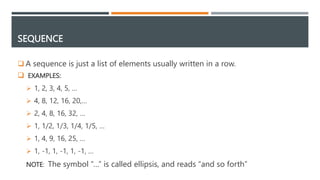
 A sequence is just a list of elements usually written in a row.
 EXAMPLES:
 1, 2, 3, 4, 5, …
 4, 8, 12, 16, 20,…
 2, 4, 8, 16, 32, …
 1, 1/2, 1/3, 1/4, 1/5, …
 1, 4, 9, 16, 25, …
 1, -1, 1, -1, 1, -1, …
NOTE: The symbol “…” is called ellipsis, and reads “and so forth”
FORMAL DEFINITION
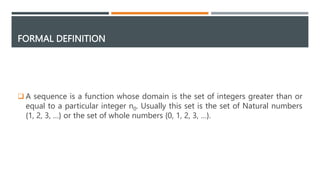
 A sequence is a function whose domain is the set of integers greater than or
equal to a particular integer n0. Usually this set is the set of Natural numbers
{1, 2, 3, …} or the set of whole numbers {0, 1, 2, 3, …}.
NOTATION
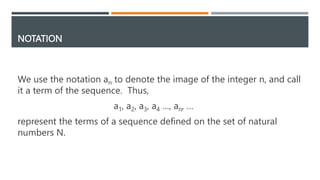
We use the notation an to denote the image of the integer n, and call
it a term of the sequence. Thus,
a1, a2, a3, a4 …, an, …
represent the terms of a sequence defined on the set of natural
numbers N.
EXAMPLE
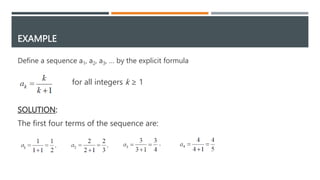
Define a sequence a1, a2, a3, … by the explicit formula
for all integers k ≥ 1
SOLUTION:
The first four terms of the sequence are:
EXAMPLE
Write the first four terms of the sequence defined by the formula
bj = 1 + 2j, for all integers j ≥ 0
SOLUTION:
 b0 = 1 + 20 = 1 + 1 = 2
 b1 = 1 + 21 = 1 + 2 = 3
 b2 = 1 + 22 = 1 + 4 = 5
 b3 = 1 + 23 = 1 + 8 = 9
EXAMPLE
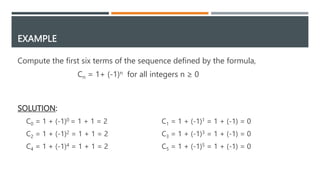
Compute the first six terms of the sequence defined by the formula,
Cn = 1+ (-1)n for all integers n ≥ 0
SOLUTION:
C0 = 1 + (-1)0 = 1 + 1 = 2 C1 = 1 + (-1)1 = 1 + (-1) = 0
C2 = 1 + (-1)2 = 1 + 1 = 2 C3 = 1 + (-1)3 = 1 + (-1) = 0
C4 = 1 + (-1)4 = 1 + 1 = 2 C5 = 1 + (-1)5 = 1 + (-1) = 0
EXAMPLE
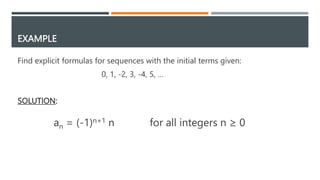
Find explicit formulas for sequences with the initial terms given:
0, 1, -2, 3, -4, 5, …
SOLUTION:
an = (-1)n+1 n for all integers n ≥ 0
EXAMPLE
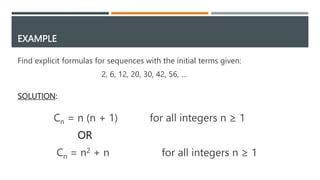
Find explicit formulas for sequences with the initial terms given:
2, 6, 12, 20, 30, 42, 56, …
SOLUTION:
Cn = n (n + 1) for all integers n ≥ 1
OR
Cn = n2 + n for all integers n ≥ 1
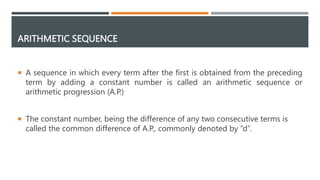
ARITHMETIC SEQUENCE
 A sequence in which every term after the first is obtained from the preceding
term by adding a constant number is called an arithmetic sequence or
arithmetic progression (A.P.)
 The constant number, being the difference of any two consecutive terms is
called the common difference of A.P., commonly denoted by “d”.
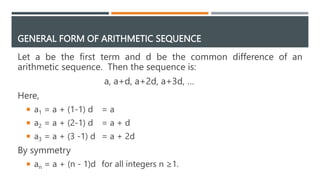
GENERAL FORM OF ARITHMETIC SEQUENCE
Let a be the first term and d be the common difference of an
arithmetic sequence. Then the sequence is:
a, a+d, a+2d, a+3d, …
Here,
 a1 = a + (1-1) d = a
 a2 = a + (2-1) d = a + d
 a3 = a + (3 -1) d = a + 2d
By symmetry
 an = a + (n - 1)d for all integers n ≥1.
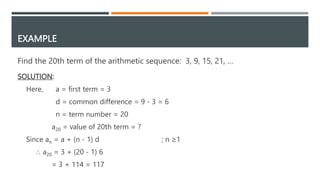
EXAMPLE
Find the 20th term of the arithmetic sequence: 3, 9, 15, 21, …
SOLUTION:
Here, a = first term = 3
d = common difference = 9 - 3 = 6
n = term number = 20
a20 = value of 20th term = ?
Since an = a + (n - 1) d ; n ≥1
∴ a20 = 3 + (20 - 1) 6
= 3 + 114 = 117
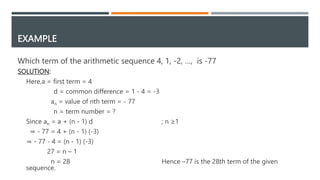
EXAMPLE
Which term of the arithmetic sequence 4, 1, -2, …, is -77
SOLUTION:
Here,a = first term = 4
d = common difference = 1 - 4 = -3
an = value of nth term = - 77
n = term number = ?
Since an = a + (n - 1) d ; n ≥1
⇒ - 77 = 4 + (n - 1) (-3)
⇒ - 77 - 4 = (n - 1) (-3)
27 = n – 1
n = 28 Hence –77 is the 28th term of the given
sequence.
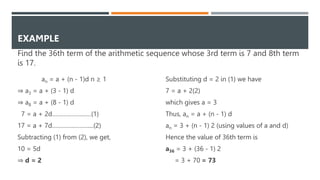
an = a + (n - 1)d n ≥ 1
⇒ a3 = a + (3 - 1) d
⇒ a8 = a + (8 - 1) d
7 = a + 2d……………………(1)
17 = a + 7d………….………....(2)
Subtracting (1) from (2), we get,
10 = 5d
⇒ d = 2
Substituting d = 2 in (1) we have
7 = a + 2(2)
which gives a = 3
Thus, an = a + (n - 1) d
an = 3 + (n - 1) 2 (using values of a and d)
Hence the value of 36th term is
a36 = 3 + (36 - 1) 2
= 3 + 70 = 73
EXAMPLE
Find the 36th term of the arithmetic sequence whose 3rd term is 7 and 8th term
is 17.
GEOMETRIC SEQUENCE
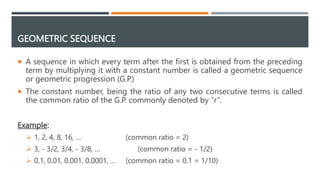
 A sequence in which every term after the first is obtained from the preceding
term by multiplying it with a constant number is called a geometric sequence
or geometric progression (G.P.)
 The constant number, being the ratio of any two consecutive terms is called
the common ratio of the G.P. commonly denoted by “r”.
Example:
 1, 2, 4, 8, 16, … (common ratio = 2)
 3, - 3/2, 3/4, - 3/8, … (common ratio = - 1/2)
 0.1, 0.01, 0.001, 0.0001, … (common ratio = 0.1 = 1/10)
GENERAL FORM OF GEOMETRIC SEQUENCE
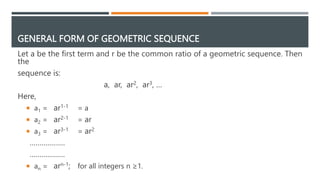
Let a be the first term and r be the common ratio of a geometric sequence. Then
the
sequence is:
a, ar, ar2, ar3, …
Here,
 a1 = ar1-1 = a
 a2 = ar2-1 = ar
 a3 = ar3-1 = ar2
………………
………………
 an = arn-1; for all integers n ≥1.
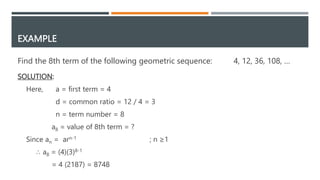
EXAMPLE
SOLUTION:
Here, a = first term = 4
d = common ratio = 12 / 4 = 3
n = term number = 8
a8 = value of 8th term = ?
Since an = arn-1 ; n ≥1
∴ a8 = (4)(3)8-1
= 4 (2187) = 8748
Find the 8th term of the following geometric sequence: 4, 12, 36, 108, …
EXAMPLE
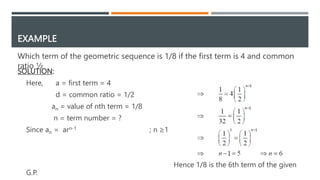
Which term of the geometric sequence is 1/8 if the first term is 4 and common
ratio ½
SOLUTION:
Here, a = first term = 4
d = common ratio = 1/2
an = value of nth term = 1/8
n = term number = ?
Since an = arn-1 ; n ≥1
Hence 1/8 is the 6th term of the given
G.P.
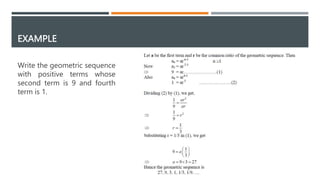
EXAMPLE
Write the geometric sequence
with positive terms whose
second term is 9 and fourth
term is 1.

Series in Discrete Structure || Computer Science

  • 1.
    SEQUENCE AND SERIES DISCRETE STRUCTURES AROOJMOHIB LECTURER FACULTY OF COMPUTING, RIPHAH INTERNATIONAL UNIVERSITY LAHORE
  • 2.
    SEQUENCE  A sequenceis just a list of elements usually written in a row.  EXAMPLES:  1, 2, 3, 4, 5, …  4, 8, 12, 16, 20,…  2, 4, 8, 16, 32, …  1, 1/2, 1/3, 1/4, 1/5, …  1, 4, 9, 16, 25, …  1, -1, 1, -1, 1, -1, … NOTE: The symbol “…” is called ellipsis, and reads “and so forth”
  • 3.
    FORMAL DEFINITION  Asequence is a function whose domain is the set of integers greater than or equal to a particular integer n0. Usually this set is the set of Natural numbers {1, 2, 3, …} or the set of whole numbers {0, 1, 2, 3, …}.
  • 4.
    NOTATION We use thenotation an to denote the image of the integer n, and call it a term of the sequence. Thus, a1, a2, a3, a4 …, an, … represent the terms of a sequence defined on the set of natural numbers N.
  • 5.
    EXAMPLE Define a sequencea1, a2, a3, … by the explicit formula for all integers k ≥ 1 SOLUTION: The first four terms of the sequence are:
  • 6.
    EXAMPLE Write the firstfour terms of the sequence defined by the formula bj = 1 + 2j, for all integers j ≥ 0 SOLUTION:  b0 = 1 + 20 = 1 + 1 = 2  b1 = 1 + 21 = 1 + 2 = 3  b2 = 1 + 22 = 1 + 4 = 5  b3 = 1 + 23 = 1 + 8 = 9
  • 7.
    EXAMPLE Compute the firstsix terms of the sequence defined by the formula, Cn = 1+ (-1)n for all integers n ≥ 0 SOLUTION: C0 = 1 + (-1)0 = 1 + 1 = 2 C1 = 1 + (-1)1 = 1 + (-1) = 0 C2 = 1 + (-1)2 = 1 + 1 = 2 C3 = 1 + (-1)3 = 1 + (-1) = 0 C4 = 1 + (-1)4 = 1 + 1 = 2 C5 = 1 + (-1)5 = 1 + (-1) = 0
  • 8.
    EXAMPLE Find explicit formulasfor sequences with the initial terms given: 0, 1, -2, 3, -4, 5, … SOLUTION: an = (-1)n+1 n for all integers n ≥ 0
  • 9.
    EXAMPLE Find explicit formulasfor sequences with the initial terms given: 2, 6, 12, 20, 30, 42, 56, … SOLUTION: Cn = n (n + 1) for all integers n ≥ 1 OR Cn = n2 + n for all integers n ≥ 1
  • 10.
    ARITHMETIC SEQUENCE  Asequence in which every term after the first is obtained from the preceding term by adding a constant number is called an arithmetic sequence or arithmetic progression (A.P.)  The constant number, being the difference of any two consecutive terms is called the common difference of A.P., commonly denoted by “d”.
  • 11.
    GENERAL FORM OFARITHMETIC SEQUENCE Let a be the first term and d be the common difference of an arithmetic sequence. Then the sequence is: a, a+d, a+2d, a+3d, … Here,  a1 = a + (1-1) d = a  a2 = a + (2-1) d = a + d  a3 = a + (3 -1) d = a + 2d By symmetry  an = a + (n - 1)d for all integers n ≥1.
  • 12.
    EXAMPLE Find the 20thterm of the arithmetic sequence: 3, 9, 15, 21, … SOLUTION: Here, a = first term = 3 d = common difference = 9 - 3 = 6 n = term number = 20 a20 = value of 20th term = ? Since an = a + (n - 1) d ; n ≥1 ∴ a20 = 3 + (20 - 1) 6 = 3 + 114 = 117
  • 13.
    EXAMPLE Which term ofthe arithmetic sequence 4, 1, -2, …, is -77 SOLUTION: Here,a = first term = 4 d = common difference = 1 - 4 = -3 an = value of nth term = - 77 n = term number = ? Since an = a + (n - 1) d ; n ≥1 ⇒ - 77 = 4 + (n - 1) (-3) ⇒ - 77 - 4 = (n - 1) (-3) 27 = n – 1 n = 28 Hence –77 is the 28th term of the given sequence.
  • 14.
    an = a+ (n - 1)d n ≥ 1 ⇒ a3 = a + (3 - 1) d ⇒ a8 = a + (8 - 1) d 7 = a + 2d……………………(1) 17 = a + 7d………….………....(2) Subtracting (1) from (2), we get, 10 = 5d ⇒ d = 2 Substituting d = 2 in (1) we have 7 = a + 2(2) which gives a = 3 Thus, an = a + (n - 1) d an = 3 + (n - 1) 2 (using values of a and d) Hence the value of 36th term is a36 = 3 + (36 - 1) 2 = 3 + 70 = 73 EXAMPLE Find the 36th term of the arithmetic sequence whose 3rd term is 7 and 8th term is 17.
  • 15.
    GEOMETRIC SEQUENCE  Asequence in which every term after the first is obtained from the preceding term by multiplying it with a constant number is called a geometric sequence or geometric progression (G.P.)  The constant number, being the ratio of any two consecutive terms is called the common ratio of the G.P. commonly denoted by “r”. Example:  1, 2, 4, 8, 16, … (common ratio = 2)  3, - 3/2, 3/4, - 3/8, … (common ratio = - 1/2)  0.1, 0.01, 0.001, 0.0001, … (common ratio = 0.1 = 1/10)
  • 16.
    GENERAL FORM OFGEOMETRIC SEQUENCE Let a be the first term and r be the common ratio of a geometric sequence. Then the sequence is: a, ar, ar2, ar3, … Here,  a1 = ar1-1 = a  a2 = ar2-1 = ar  a3 = ar3-1 = ar2 ……………… ………………  an = arn-1; for all integers n ≥1.
  • 17.
    EXAMPLE SOLUTION: Here, a =first term = 4 d = common ratio = 12 / 4 = 3 n = term number = 8 a8 = value of 8th term = ? Since an = arn-1 ; n ≥1 ∴ a8 = (4)(3)8-1 = 4 (2187) = 8748 Find the 8th term of the following geometric sequence: 4, 12, 36, 108, …
  • 18.
    EXAMPLE Which term ofthe geometric sequence is 1/8 if the first term is 4 and common ratio ½ SOLUTION: Here, a = first term = 4 d = common ratio = 1/2 an = value of nth term = 1/8 n = term number = ? Since an = arn-1 ; n ≥1 Hence 1/8 is the 6th term of the given G.P.
  • 19.
    EXAMPLE Write the geometricsequence with positive terms whose second term is 9 and fourth term is 1.