1
Laboratory 1: SEQUENCE ALIGNMENT
2
Laboratory 1: SEQUENCE ALIGNMENT
On sequence alignment
Sequence alignment is the most important task in
bioinformatics!
3
Laboratory 1: SEQUENCE ALIGNMENT
On sequence alignment
Sequence alignment is important for:
* prediction of function
* database searching
* gene finding
* sequence divergence
* sequence assembly
4
Laboratory 1: SEQUENCE ALIGNMENT
On sequence similarity
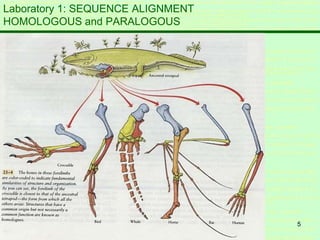
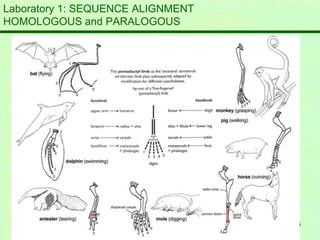
Homology: genes that derive from a common ancestor-gene
are called homologs
Orthologous genes are homologous genes in different
organisms
Paralogous genes are homologous genes in one organism
that derive from gene duplication
Gene duplication: one gene is duplicated in multiple copies
that therefore free to evolve and assume new functions
5
Laboratory 1: SEQUENCE ALIGNMENT
HOMOLOGOUS and PARALOGOUS
6
Laboratory 1: SEQUENCE ALIGNMENT
HOMOLOGOUS and PARALOGOUS
7
Laboratory 1: SEQUENCE ALIGNMENT
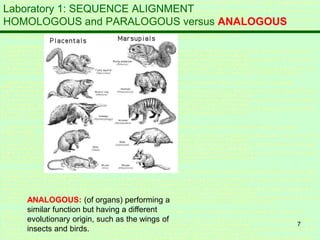
HOMOLOGOUS and PARALOGOUS versus ANALOGOUS
ANALOGOUS: (of organs) performing a
similar function but having a different
evolutionary origin, such as the wings of
insects and birds.
8
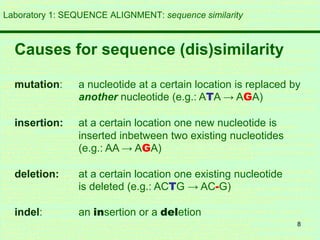
Laboratory 1: SEQUENCE ALIGNMENT: sequence similarity
Causes for sequence (dis)similarity
mutation: a nucleotide at a certain location is replaced by
another nucleotide (e.g.: ATA → AGA)
insertion: at a certain location one new nucleotide is
inserted inbetween two existing nucleotides
(e.g.: AA → AGA)
deletion: at a certain location one existing nucleotide
is deleted (e.g.: ACTG → AC-G)
indel: an insertion or a deletion
9
Laboratory 1: SEQUENCE ALIGNMENT
Sequence alignment: global and local
Find the similarity between two (or more)
DNA-sequences by finding a good
alignment between them.
10
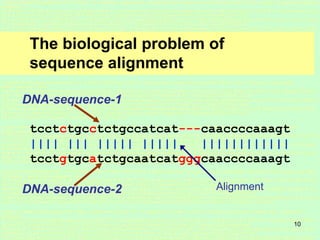
The biological problem of
sequence alignment
DNA-sequence-1
tcctctgcctctgccatcat---caaccccaaagt
|||| ||| ||||| ||||| ||||||||||||
tcctgtgcatctgcaatcatgggcaaccccaaagt
DNA-sequence-2 Alignment
11
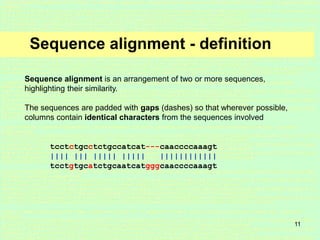
Sequence alignment - definition
Sequence alignment is an arrangement of two or more sequences,
highlighting their similarity.
The sequences are padded with gaps (dashes) so that wherever possible,
columns contain identical characters from the sequences involved
tcctctgcctctgccatcat---caaccccaaagt
|||| ||| ||||| ||||| ||||||||||||
tcctgtgcatctgcaatcatgggcaaccccaaagt
12
Algorithms
Needleman-Wunsch
Pairwise global alignment only.
Smith-Waterman
Pairwise, local (or global) alignment.
BLAST
Pairwise heuristic local alignment
13
Pairwise alignment
Pairwise sequence alignment methods are concerned with finding the best-
matching piecewise local or global alignments of protein (amino acid) or DNA
(nucleic acid) sequences.
Typically, the purpose of this is to find homologues (relatives) of a gene or gene-
product in a database of known examples.
This information is useful for answering a variety of biological questions:
1. The identification of sequences of unknown structure or function.
2. The study of molecular evolution.
14
Global alignment
A global alignment between two sequences is an alignment in which all the
characters in both sequences participate in the alignment.
Global alignments are useful mostly for finding closely-related sequences.
As these sequences are also easily identified by local alignment methods global
alignment is now somewhat deprecated as a technique.
Further, there are several complications to molecular evolution (such as domain
shuffling) which prevent these methods from being useful.
15
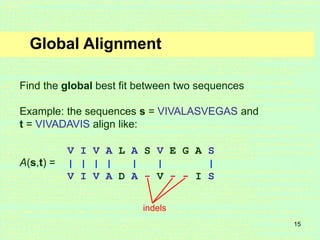
Global Alignment
Find the global best fit between two sequences
Example: the sequences s = VIVALASVEGAS and
t = VIVADAVIS align like:
A(s,t) =
V I V A L A S V E G A S
| | | | | | |
V I V A D A - V - - I S
indels
16
The Needleman-Wunsch algorithm
The Needleman-Wunsch algorithm (1970, J Mol Biol.
48(3):443-53) performs a global alignment on two
sequences (s and t) and is applied to align protein or
nucleotide sequences.
The Needleman-Wunsch algorithm is an example of
dynamic programming, and is guaranteed to find the
alignment with the maximum score.
17
The Needleman-Wunsch algorithm
Of course this works for both DNA-sequences
as for protein-sequences.
18
Local alignment
Local alignment methods find related regions within sequences - they can
consist of a subset of the characters within each sequence.
For example, positions 20-40 of sequence A might be aligned with positions
50-70 of sequence B.
This is a more flexible technique than global alignment and has the advantage
that related regions which appear in a different order in the two proteins (which is
known as domain shuffling) can be identified as being related.
This is not possible with global alignment methods.
19
The Smith Waterman algorithm
The Smith-Waterman algorithm (1981) is for determining similar regions
between two nucleotide or protein sequences.
Smith-Waterman is also a dynamic programming algorithm and improves
on Needleman-Wunsch. As such, it has the desirable property that it is
guaranteed to find the optimal local alignment with respect to the scoring
system being used (which includes the substitution matrix and the gap-
scoring scheme).
However, the Smith-Waterman algorithm is demanding of time and
memory resources: in order to align two sequences of lengths m and n,
O(mn) time and space are required.
As a result, it has largely been replaced in practical use by the BLAST
algorithm; although not guaranteed to find optimal alignments, BLAST is
much more efficient.
20
Sequence alignment - meaning
Sequence alignment is used to study the evolution of the sequences
from a common ancestor such as protein sequences or DNA
sequences.
Mismatches in the alignment correspond to mutations,
and gaps correspond to insertions or deletions.
Sequence alignment also refers to the process of constructing
significant alignments in a database of potentially unrelated sequences.
21
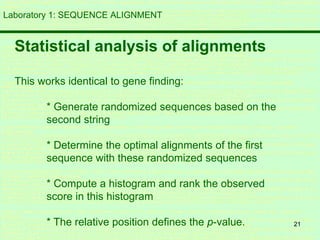
Laboratory 1: SEQUENCE ALIGNMENT
Statistical analysis of alignments
This works identical to gene finding:
* Generate randomized sequences based on the
second string
* Determine the optimal alignments of the first
sequence with these randomized sequences
* Compute a histogram and rank the observed
score in this histogram
* The relative position defines the p-value.
22
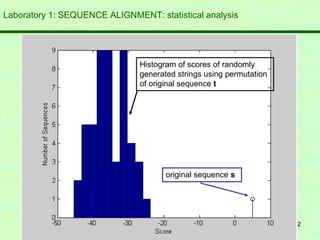
Laboratory 1: SEQUENCE ALIGNMENT: statistical analysis
Histogram of scores of randomly
generated strings using permutation
of original sequence t
original sequence s
23
Laboratory 1: SEQUENCE ALIGNMENT
BLAST:
fast approximate alignment
• Fast but heuristic
• Most used algorithm in bioinformatics
• Verb: to blast
24
Laboratory 1: SEQUENCE ALIGNMENT
Multiple sequence alignment:
Determine the best alignment between multiple
(more than two) DNA-sequences.
25
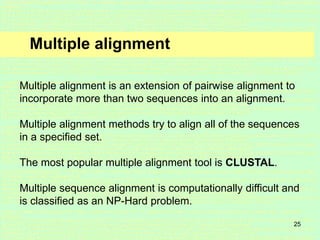
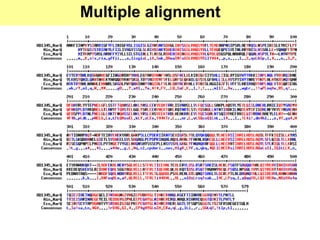
Multiple alignment
Multiple alignment is an extension of pairwise alignment to
incorporate more than two sequences into an alignment.
Multiple alignment methods try to align all of the sequences
in a specified set.
The most popular multiple alignment tool is CLUSTAL.
Multiple sequence alignment is computationally difficult and
is classified as an NP-Hard problem.
26
Multiple alignment
27
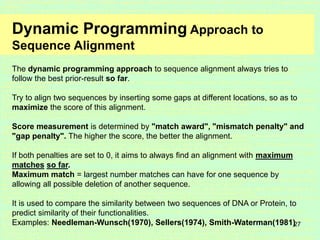
Dynamic Programming Approach to
Sequence Alignment
The dynamic programming approach to sequence alignment always tries to
follow the best prior-result so far.
Try to align two sequences by inserting some gaps at different locations, so as to
maximize the score of this alignment.
Score measurement is determined by "match award", "mismatch penalty" and
"gap penalty". The higher the score, the better the alignment.
If both penalties are set to 0, it aims to always find an alignment with maximum
matches so far.
Maximum match = largest number matches can have for one sequence by
allowing all possible deletion of another sequence.
It is used to compare the similarity between two sequences of DNA or Protein, to
predict similarity of their functionalities.
Examples: Needleman-Wunsch(1970), Sellers(1974), Smith-Waterman(1981)

Laboratory 1 sequence_alignments

  • 1.
  • 2.
    2 Laboratory 1: SEQUENCEALIGNMENT On sequence alignment Sequence alignment is the most important task in bioinformatics!
  • 3.
    3 Laboratory 1: SEQUENCEALIGNMENT On sequence alignment Sequence alignment is important for: * prediction of function * database searching * gene finding * sequence divergence * sequence assembly
  • 4.
    4 Laboratory 1: SEQUENCEALIGNMENT On sequence similarity Homology: genes that derive from a common ancestor-gene are called homologs Orthologous genes are homologous genes in different organisms Paralogous genes are homologous genes in one organism that derive from gene duplication Gene duplication: one gene is duplicated in multiple copies that therefore free to evolve and assume new functions
  • 5.
    5 Laboratory 1: SEQUENCEALIGNMENT HOMOLOGOUS and PARALOGOUS
  • 6.
    6 Laboratory 1: SEQUENCEALIGNMENT HOMOLOGOUS and PARALOGOUS
  • 7.
    7 Laboratory 1: SEQUENCEALIGNMENT HOMOLOGOUS and PARALOGOUS versus ANALOGOUS ANALOGOUS: (of organs) performing a similar function but having a different evolutionary origin, such as the wings of insects and birds.
  • 8.
    8 Laboratory 1: SEQUENCEALIGNMENT: sequence similarity Causes for sequence (dis)similarity mutation: a nucleotide at a certain location is replaced by another nucleotide (e.g.: ATA → AGA) insertion: at a certain location one new nucleotide is inserted inbetween two existing nucleotides (e.g.: AA → AGA) deletion: at a certain location one existing nucleotide is deleted (e.g.: ACTG → AC-G) indel: an insertion or a deletion
  • 9.
    9 Laboratory 1: SEQUENCEALIGNMENT Sequence alignment: global and local Find the similarity between two (or more) DNA-sequences by finding a good alignment between them.
  • 10.
    10 The biological problemof sequence alignment DNA-sequence-1 tcctctgcctctgccatcat---caaccccaaagt |||| ||| ||||| ||||| |||||||||||| tcctgtgcatctgcaatcatgggcaaccccaaagt DNA-sequence-2 Alignment
  • 11.
    11 Sequence alignment -definition Sequence alignment is an arrangement of two or more sequences, highlighting their similarity. The sequences are padded with gaps (dashes) so that wherever possible, columns contain identical characters from the sequences involved tcctctgcctctgccatcat---caaccccaaagt |||| ||| ||||| ||||| |||||||||||| tcctgtgcatctgcaatcatgggcaaccccaaagt
  • 12.
    12 Algorithms Needleman-Wunsch Pairwise global alignmentonly. Smith-Waterman Pairwise, local (or global) alignment. BLAST Pairwise heuristic local alignment
  • 13.
    13 Pairwise alignment Pairwise sequencealignment methods are concerned with finding the best- matching piecewise local or global alignments of protein (amino acid) or DNA (nucleic acid) sequences. Typically, the purpose of this is to find homologues (relatives) of a gene or gene- product in a database of known examples. This information is useful for answering a variety of biological questions: 1. The identification of sequences of unknown structure or function. 2. The study of molecular evolution.
  • 14.
    14 Global alignment A globalalignment between two sequences is an alignment in which all the characters in both sequences participate in the alignment. Global alignments are useful mostly for finding closely-related sequences. As these sequences are also easily identified by local alignment methods global alignment is now somewhat deprecated as a technique. Further, there are several complications to molecular evolution (such as domain shuffling) which prevent these methods from being useful.
  • 15.
    15 Global Alignment Find theglobal best fit between two sequences Example: the sequences s = VIVALASVEGAS and t = VIVADAVIS align like: A(s,t) = V I V A L A S V E G A S | | | | | | | V I V A D A - V - - I S indels
  • 16.
    16 The Needleman-Wunsch algorithm TheNeedleman-Wunsch algorithm (1970, J Mol Biol. 48(3):443-53) performs a global alignment on two sequences (s and t) and is applied to align protein or nucleotide sequences. The Needleman-Wunsch algorithm is an example of dynamic programming, and is guaranteed to find the alignment with the maximum score.
  • 17.
    17 The Needleman-Wunsch algorithm Ofcourse this works for both DNA-sequences as for protein-sequences.
  • 18.
    18 Local alignment Local alignmentmethods find related regions within sequences - they can consist of a subset of the characters within each sequence. For example, positions 20-40 of sequence A might be aligned with positions 50-70 of sequence B. This is a more flexible technique than global alignment and has the advantage that related regions which appear in a different order in the two proteins (which is known as domain shuffling) can be identified as being related. This is not possible with global alignment methods.
  • 19.
    19 The Smith Watermanalgorithm The Smith-Waterman algorithm (1981) is for determining similar regions between two nucleotide or protein sequences. Smith-Waterman is also a dynamic programming algorithm and improves on Needleman-Wunsch. As such, it has the desirable property that it is guaranteed to find the optimal local alignment with respect to the scoring system being used (which includes the substitution matrix and the gap- scoring scheme). However, the Smith-Waterman algorithm is demanding of time and memory resources: in order to align two sequences of lengths m and n, O(mn) time and space are required. As a result, it has largely been replaced in practical use by the BLAST algorithm; although not guaranteed to find optimal alignments, BLAST is much more efficient.
  • 20.
    20 Sequence alignment -meaning Sequence alignment is used to study the evolution of the sequences from a common ancestor such as protein sequences or DNA sequences. Mismatches in the alignment correspond to mutations, and gaps correspond to insertions or deletions. Sequence alignment also refers to the process of constructing significant alignments in a database of potentially unrelated sequences.
  • 21.
    21 Laboratory 1: SEQUENCEALIGNMENT Statistical analysis of alignments This works identical to gene finding: * Generate randomized sequences based on the second string * Determine the optimal alignments of the first sequence with these randomized sequences * Compute a histogram and rank the observed score in this histogram * The relative position defines the p-value.
  • 22.
    22 Laboratory 1: SEQUENCEALIGNMENT: statistical analysis Histogram of scores of randomly generated strings using permutation of original sequence t original sequence s
  • 23.
    23 Laboratory 1: SEQUENCEALIGNMENT BLAST: fast approximate alignment • Fast but heuristic • Most used algorithm in bioinformatics • Verb: to blast
  • 24.
    24 Laboratory 1: SEQUENCEALIGNMENT Multiple sequence alignment: Determine the best alignment between multiple (more than two) DNA-sequences.
  • 25.
    25 Multiple alignment Multiple alignmentis an extension of pairwise alignment to incorporate more than two sequences into an alignment. Multiple alignment methods try to align all of the sequences in a specified set. The most popular multiple alignment tool is CLUSTAL. Multiple sequence alignment is computationally difficult and is classified as an NP-Hard problem.
  • 26.
  • 27.
    27 Dynamic Programming Approachto Sequence Alignment The dynamic programming approach to sequence alignment always tries to follow the best prior-result so far. Try to align two sequences by inserting some gaps at different locations, so as to maximize the score of this alignment. Score measurement is determined by "match award", "mismatch penalty" and "gap penalty". The higher the score, the better the alignment. If both penalties are set to 0, it aims to always find an alignment with maximum matches so far. Maximum match = largest number matches can have for one sequence by allowing all possible deletion of another sequence. It is used to compare the similarity between two sequences of DNA or Protein, to predict similarity of their functionalities. Examples: Needleman-Wunsch(1970), Sellers(1974), Smith-Waterman(1981)