OMIM database
Online Mendelian Inheritance in Man®
• (http://omim.org) relationship between genotype and phenotype
• The phenotype–gene relationships are tabulated in OMIM’s Morbid Map of the Human
Genome (Morbid Map)
• initiated as MIM (Medelian Inheritance in Men) catalogue of 12 books in 1960s.
• 1985, OMIM started as the online version of MIM
• The entries contain structured summaries of new and important information based on
expert review of the biomedical literature
• interactive access to the knowledge repository (genomic coordinate, genetic heterogeneity
of phenotypes in Phenotypic Series, and side-by-side comparisons of clinical synopses)
• OMIM.org also supports computational queries via a robust API
• >24,600 entries, updated nightly
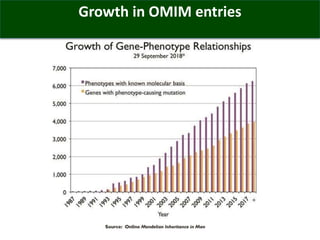
• OMIM Morbid Map Scorecard had 6,259 molecularized phenotypes connected to 3,961 genes
OMIM entries
• structured free-text format that provides the flexibility to describe genotype-phenotype
relationship
• Genes and phenotypes are described in separate entries
• OMIM also has a derivative table of genes and genetic phenotypes, the Morbid Map.
•
• OMIM.org has enhanced search capabilities such as genome coordinate searching and
thesaurus-enhanced search term options
• Phenotypic series facilitate viewing genetic heterogeneity of phenotypes
• Clinical synopsis features are enhanced with UMLS, Human Phenotype Ontology and
Elements of Morphology terms and image links
• All OMIM data are available for FTP download and through an API
• MIMmatch is a novel outreach feature to disseminate updates and encourage collaboration.
OMIM entries
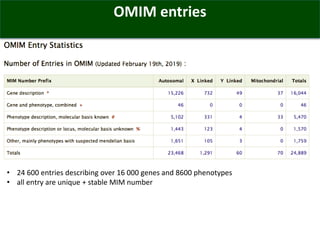
• 24 600 entries describing over 16 000 genes and 8600 phenotypes
• all entry are unique + stable MIM number
Growth in OMIM entries
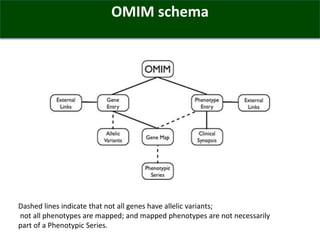
OMIM schema
Dashed lines indicate that not all genes have allelic variants;
not all phenotypes are mapped; and mapped phenotypes are not necessarily
part of a Phenotypic Series.
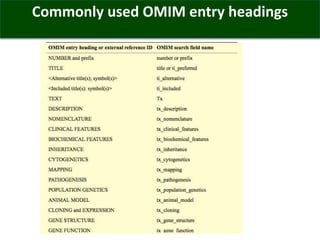
Commonly used OMIM entry headings
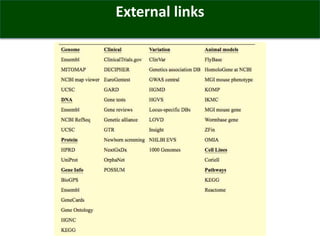
External links
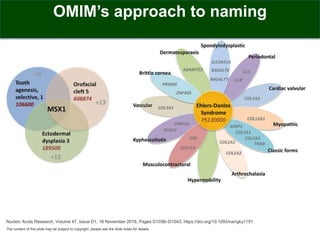
OMIM’s approach to naming
Nucleic Acids Research, Volume 47, Issue D1, 16 November 2018, Pages D1038–D1043, https://doi.org/10.1093/nar/gky1151
The content of this slide may be subject to copyright: please see the slide notes for details.

OMIM Database

  • 1.
    OMIM database Online MendelianInheritance in Man® • (http://omim.org) relationship between genotype and phenotype • The phenotype–gene relationships are tabulated in OMIM’s Morbid Map of the Human Genome (Morbid Map) • initiated as MIM (Medelian Inheritance in Men) catalogue of 12 books in 1960s. • 1985, OMIM started as the online version of MIM • The entries contain structured summaries of new and important information based on expert review of the biomedical literature • interactive access to the knowledge repository (genomic coordinate, genetic heterogeneity of phenotypes in Phenotypic Series, and side-by-side comparisons of clinical synopses) • OMIM.org also supports computational queries via a robust API • >24,600 entries, updated nightly • OMIM Morbid Map Scorecard had 6,259 molecularized phenotypes connected to 3,961 genes
  • 2.
    OMIM entries • structuredfree-text format that provides the flexibility to describe genotype-phenotype relationship • Genes and phenotypes are described in separate entries • OMIM also has a derivative table of genes and genetic phenotypes, the Morbid Map. • • OMIM.org has enhanced search capabilities such as genome coordinate searching and thesaurus-enhanced search term options • Phenotypic series facilitate viewing genetic heterogeneity of phenotypes • Clinical synopsis features are enhanced with UMLS, Human Phenotype Ontology and Elements of Morphology terms and image links • All OMIM data are available for FTP download and through an API • MIMmatch is a novel outreach feature to disseminate updates and encourage collaboration.
  • 3.
    OMIM entries • 24600 entries describing over 16 000 genes and 8600 phenotypes • all entry are unique + stable MIM number
  • 4.
  • 5.
    OMIM schema Dashed linesindicate that not all genes have allelic variants; not all phenotypes are mapped; and mapped phenotypes are not necessarily part of a Phenotypic Series.
  • 6.
    Commonly used OMIMentry headings
  • 7.
  • 8.
    OMIM’s approach tonaming Nucleic Acids Research, Volume 47, Issue D1, 16 November 2018, Pages D1038–D1043, https://doi.org/10.1093/nar/gky1151 The content of this slide may be subject to copyright: please see the slide notes for details.

Editor's Notes

  • #2 Make y axis bolder Unstim has red
  • #3 Make y axis bolder Unstim has red
  • #4 Make y axis bolder Unstim has red
  • #9 Figure 3. Leveraging clinical naming across molecular biology. OMIM’s approach to naming enhances analysis of the relationship between phenotypes and their molecular basis and provides new avenues of research through increased molecular understanding. Grouping of similar phenotypes into a Phenotypic Series facilitates the collection of genes underlying related clinical conditions. (A) Variation in the MSX1 gene can cause 3 clinically distinct disorders, each of which is part of separate Phenotypic Series. Each series lists various forms of the same phenotype caused by distinct genes (numbers in gray). (B) Ehlers-Danlos syndrome has been classified into 13 different clinical subtypes. The mutated gene(s) in one subtype, hypermobile, has not been found. Some of the subtypes have been found to be genetically heterogeneous, with a total of 21 different EDS syndromes. The grouping of the subtypes with their causative genes provides a unique focus for biological research.