The Scope of a Semantic Theory
Words and Phrases
Meaning Properties
Meaning Relation

Lina Magally Vázquez
Adriana María Rodríguez
ning
des lear rings of
inclu
anguage s of certain st
al
ful
Learning on" meaning
meaning
these
ing.
ombine
reed-up
e " ag
ow to c o convey mean
th
ing h
nd learn units that als
words a o larger
units int

The Scope of Semantic Theory

Meaning
Properties

Meaningful and
Meaningless

Ambiguity

Meaning
Relations

Anomaly

Synonymy

Homonymy

Homophony

Polysemy

Inclusion

Antonymy
Meaning properties
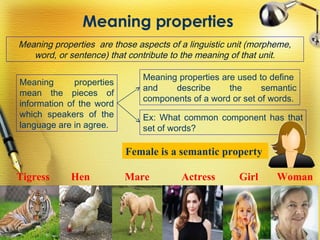
Meaning properties are those aspects of a linguistic unit (morpheme,
word, or sentence) that contribute to the meaning of that unit.
Meaning
properties
mean the pieces of
information of the word
which speakers of the
language are in agree.

Meaning properties are used to define
and
describe
the
semantic
components of a word or set of words.
Ex: What common component has that
set of words?

Female is a semantic property
Tigress

Hen

Mare

Actress

Girl

Woman
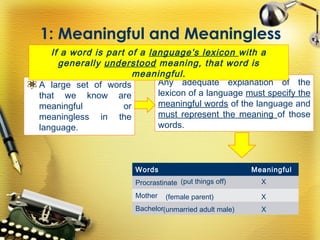
1: Meaningful and Meaningless
If a word is part of a language's lexicon with a
generally understood meaning, that word is
meaningful.
Any adequate explanation of the
A large set of words
lexicon of a language must specify the
that we know are
meaningful words of the language and
meaningful
or
must represent the meaning of those
meaningless in the
words.
language.

Words

Meaningful

Procrastinate (put things off)

X

Mother

X

(female parent)

Bachelor(unmarried adult male)

X
2: Ambiguity
Activity: Choose (a) or (b)
I hope you are not lyinga__ to me.
My books are lyingb on the table.
__

(a) telling a lie
(b) being in a horizontal

1. The kids are going to watch ___ TV
b
tonight.
What time is it? I have to set my
a
watch____.

(a) small clock
(b) look at

a
2. Which page _____ is the homework on?
Please page _____the doctor if you need
b
help.

(a) one sheet of
(b) to call

3. Let’s playa___ soccer after school.
The author wrote a new playb
___.

(a) participate in a sport
(b) theater piece

b
4. Ouch! The mosquito bit ___ me!
I’ll have a little bita___ of sugar in my tea.

(a) a tiny amount
(b) past tense of bite

5. My rabbits are in a pen b
___ outside.
Please sign this form with a blacka pen
___.

(a) a writing instrument
(b) an enclosed area
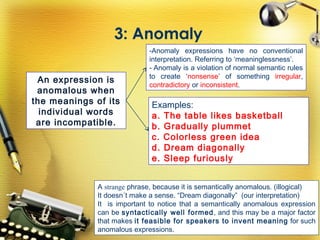
3: Anomaly
An expression is
anomalous when
the meanings of its
individual words
are incompatible.

-Anomaly expressions have no conventional
interpretation. Referring to ‘meaninglessness’.
- Anomaly is a violation of normal semantic rules
to create ‘nonsense’ of something irregular,
contradictory or inconsistent.

Examples:
a. The table likes basketball
b. Gradually plummet
c. Colorless green idea
d. Dream diagonally
e. Sleep furiously

A strange phrase, because it is semantically anomalous. (illogical)
It doesn´t make a sense. “Dream diagonally” (our interpretation)
It is important to notice that a semantically anomalous expression
can be syntactically well formed, and this may be a major factor
that makes it feasible for speakers to invent meaning for such
anomalous expressions.
ng
ni
ea
«M
s»
ion
at
el
R
Synonymy
Synonymy: words that have the same meanings or that
are closely related in meaning
Synonymy is a meaning relation which involves two or
more expression having the same interpretation.
Synonymy will always mean one of two or more words in
the English language which have the same or very nearly
the same essential meaning.
Synonym: words which have the same meaning.
Kinds of synonim yy
Kinds of synonim

True synonymy is a
meaning relation
which involves two
or more sentences
having the same
exact meaning.
E.g.: "Uncle is a true
synonymy of the brother
of one’s father or mother,
or the husband of one’s
aunt."

Close synonymy is a
meaning relation
which involves two or
more expressions of
which the
interpretation is not
entirely the same but
very close.
E.g. war, battle,
combat, fight,
struggle.

Partial synonymy is
Partial synonymy is
a meaning relation in
which the meaning
which the meaning
or interpretation of
one lexicon only a
one lexicon only a
part of the meaning
part of the meaning
of the other . .
of the other
E.g. hen is partial
meaning of
chicken.
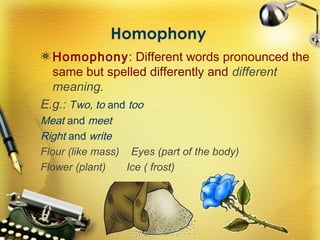
Homophony
Homophony: Different words pronounced the
same but spelled differently and different
meaning.
E.g.: Two, to and too
Meat and meet
Right and write
Flour (like mass) Eyes (part of the body)
Flower (plant)
Ice ( frost)
Polysemy
Polysemy is a word or phrase with multiple, related
meanings.
e.g. The house is at the foot of the mountains
One of his shoes felt too tight for his foot
'Foot' here refers to the bottom part of the mountains in the
first sentence and the bottom part of the leg in the second.
e.g. bright: ‘shining’ ; ‘intelligent’
‘Head’ of the body and the person at the top of
a company.
‘Foot’ of a body and of a mountain and of the
bed or chair.
‘Run’ a person runs, the water runs
INCLUSION
Meaning inclusion : words included in a group specifically
 The meaning of sister includes the meaning of famale
The meaning of murder includes the meaning of illegal
The meaning of kill includes the meaning of dead
We derive expressions thet are redundant, when we put words
together That are related by Meaning inclusion.

E.g.: female sister
fruit apple
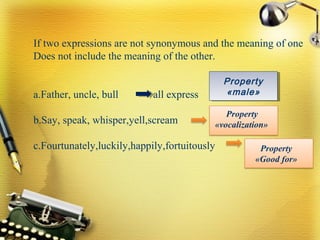
If two expressions are not synonymous and the meaning of one
Does not include the meaning of the other.
a.Father, uncle, bull

Property
Property
«male»
«male»

all express

b.Say, speak, whisper,yell,scream

Property
«vocalization»

c.Fourtunately,luckily,happily,fortuitously

Property
«Good for»
Classical examples of semantics fields include

Color terms

Kinship terms

Animal terms

Red,green,blue,yellow

Mother,father,sister,brother

fox,bear,snake,fish

:
Antonymy
Antonymy: words that are opposites in meaning, e.g. hot
& cold.
Types
Gradable= not absolute, question of degree
Hot & cold – small & big
Non-gradable:
Dead & alive – asleep & awake
E.g. happy/sad
married/single
present/absent fast/slow
Kinds of
Kinds of
Antonym y
Antonym y
Homonymy
Homonymy: Homonyms are different words that
are pronounced the same, but may or may not be
spelled the same and has unrelated meaning.
Homonyms can create ambiguity.
e.g. bank: ‘financial institution’ ; ‘of a river’.
Bat: ‘flying creature’ or ‘used in sports’
Race: ‘contest of speed’ or ‘ethnic group’
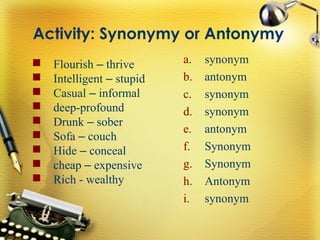
Activity: Synonymy or Antonymy










Flourish – thrive
Intelligent – stupid
Casual – informal
deep-profound
Drunk – sober
Sofa – couch
Hide – conceal
cheap – expensive
Rich - wealthy

a.
b.
c.
d.
e.
f.
g.
h.
i.

synonym
antonym
synonym
synonym
antonym
Synonym
Synonym
Antonym
synonym

Meaning relations and properties

  • 1.
    The Scope ofa Semantic Theory Words and Phrases Meaning Properties Meaning Relation Lina Magally Vázquez Adriana María Rodríguez
  • 2.
    ning des lear ringsof inclu anguage s of certain st al ful Learning on" meaning meaning these ing. ombine reed-up e " ag ow to c o convey mean th ing h nd learn units that als words a o larger units int The Scope of Semantic Theory Meaning Properties Meaningful and Meaningless Ambiguity Meaning Relations Anomaly Synonymy Homonymy Homophony Polysemy Inclusion Antonymy
  • 3.
    Meaning properties Meaning propertiesare those aspects of a linguistic unit (morpheme, word, or sentence) that contribute to the meaning of that unit. Meaning properties mean the pieces of information of the word which speakers of the language are in agree. Meaning properties are used to define and describe the semantic components of a word or set of words. Ex: What common component has that set of words? Female is a semantic property Tigress Hen Mare Actress Girl Woman
  • 4.
    1: Meaningful andMeaningless If a word is part of a language's lexicon with a generally understood meaning, that word is meaningful. Any adequate explanation of the A large set of words lexicon of a language must specify the that we know are meaningful words of the language and meaningful or must represent the meaning of those meaningless in the words. language. Words Meaningful Procrastinate (put things off) X Mother X (female parent) Bachelor(unmarried adult male) X
  • 5.
  • 6.
    Activity: Choose (a)or (b) I hope you are not lyinga__ to me. My books are lyingb on the table. __ (a) telling a lie (b) being in a horizontal 1. The kids are going to watch ___ TV b tonight. What time is it? I have to set my a watch____. (a) small clock (b) look at a 2. Which page _____ is the homework on? Please page _____the doctor if you need b help. (a) one sheet of (b) to call 3. Let’s playa___ soccer after school. The author wrote a new playb ___. (a) participate in a sport (b) theater piece b 4. Ouch! The mosquito bit ___ me! I’ll have a little bita___ of sugar in my tea. (a) a tiny amount (b) past tense of bite 5. My rabbits are in a pen b ___ outside. Please sign this form with a blacka pen ___. (a) a writing instrument (b) an enclosed area
  • 7.
    3: Anomaly An expressionis anomalous when the meanings of its individual words are incompatible. -Anomaly expressions have no conventional interpretation. Referring to ‘meaninglessness’. - Anomaly is a violation of normal semantic rules to create ‘nonsense’ of something irregular, contradictory or inconsistent. Examples: a. The table likes basketball b. Gradually plummet c. Colorless green idea d. Dream diagonally e. Sleep furiously A strange phrase, because it is semantically anomalous. (illogical) It doesn´t make a sense. “Dream diagonally” (our interpretation) It is important to notice that a semantically anomalous expression can be syntactically well formed, and this may be a major factor that makes it feasible for speakers to invent meaning for such anomalous expressions.
  • 8.
  • 9.
    Synonymy Synonymy: words thathave the same meanings or that are closely related in meaning Synonymy is a meaning relation which involves two or more expression having the same interpretation. Synonymy will always mean one of two or more words in the English language which have the same or very nearly the same essential meaning. Synonym: words which have the same meaning.
  • 10.
    Kinds of synonimyy Kinds of synonim True synonymy is a meaning relation which involves two or more sentences having the same exact meaning. E.g.: "Uncle is a true synonymy of the brother of one’s father or mother, or the husband of one’s aunt." Close synonymy is a meaning relation which involves two or more expressions of which the interpretation is not entirely the same but very close. E.g. war, battle, combat, fight, struggle. Partial synonymy is Partial synonymy is a meaning relation in a meaning relation in which the meaning which the meaning or interpretation of or interpretation of one lexicon only a one lexicon only a part of the meaning part of the meaning of the other . . of the other E.g. hen is partial meaning of chicken.
  • 11.
    Homophony Homophony: Different wordspronounced the same but spelled differently and different meaning. E.g.: Two, to and too Meat and meet Right and write Flour (like mass) Eyes (part of the body) Flower (plant) Ice ( frost)
  • 12.
    Polysemy Polysemy is a wordor phrase with multiple, related meanings. e.g. The house is at the foot of the mountains One of his shoes felt too tight for his foot 'Foot' here refers to the bottom part of the mountains in the first sentence and the bottom part of the leg in the second. e.g. bright: ‘shining’ ; ‘intelligent’ ‘Head’ of the body and the person at the top of a company. ‘Foot’ of a body and of a mountain and of the bed or chair. ‘Run’ a person runs, the water runs
  • 13.
    INCLUSION Meaning inclusion :words included in a group specifically  The meaning of sister includes the meaning of famale The meaning of murder includes the meaning of illegal The meaning of kill includes the meaning of dead We derive expressions thet are redundant, when we put words together That are related by Meaning inclusion. E.g.: female sister fruit apple
  • 14.
    If two expressionsare not synonymous and the meaning of one Does not include the meaning of the other. a.Father, uncle, bull Property Property «male» «male» all express b.Say, speak, whisper,yell,scream Property «vocalization» c.Fourtunately,luckily,happily,fortuitously Property «Good for»
  • 15.
    Classical examples ofsemantics fields include Color terms Kinship terms Animal terms Red,green,blue,yellow Mother,father,sister,brother fox,bear,snake,fish :
  • 16.
    Antonymy Antonymy: words thatare opposites in meaning, e.g. hot & cold. Types Gradable= not absolute, question of degree Hot & cold – small & big Non-gradable: Dead & alive – asleep & awake E.g. happy/sad married/single present/absent fast/slow
  • 17.
  • 18.
    Homonymy Homonymy: Homonyms aredifferent words that are pronounced the same, but may or may not be spelled the same and has unrelated meaning. Homonyms can create ambiguity. e.g. bank: ‘financial institution’ ; ‘of a river’. Bat: ‘flying creature’ or ‘used in sports’ Race: ‘contest of speed’ or ‘ethnic group’
  • 19.
    Activity: Synonymy orAntonymy          Flourish – thrive Intelligent – stupid Casual – informal deep-profound Drunk – sober Sofa – couch Hide – conceal cheap – expensive Rich - wealthy a. b. c. d. e. f. g. h. i. synonym antonym synonym synonym antonym Synonym Synonym Antonym synonym