Referential Theory of
Meaning
Presenter: Ayesha Bashir
Facilitator: Sir Naveed Khattak
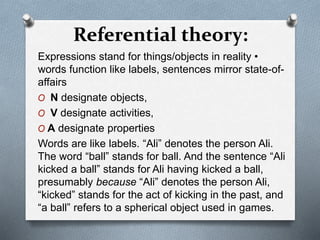
Referential theory:
Expressions stand for things/objects in reality •
words function like labels, sentences mirror state-of-
affairs
O N designate objects,
O V designate activities,
O A designate properties
Words are like labels. “Ali” denotes the person Ali.
The word “ball” stands for ball. And the sentence “Ali
kicked a ball” stands for Ali having kicked a ball,
presumably because “Ali” denotes the person Ali,
“kicked” stands for the act of kicking in the past, and
“a ball” refers to a spherical object used in games.
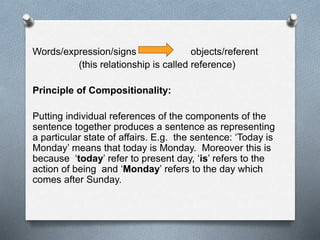
Words/expression/signs objects/referent
(this relationship is called reference)
Principle of Compositionality:
Putting individual references of the components of the
sentence together produces a sentence as representing
a particular state of affairs. E.g. the sentence: ‘Today is
Monday’ means that today is Monday. Moreover this is
because ‘today’ refer to present day, ‘is’ refers to the
action of being and ‘Monday’ refers to the day which
comes after Sunday.
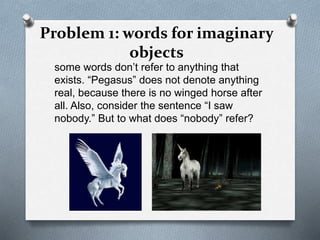
Problem 1: words for imaginary
objects
some words don’t refer to anything that
exists. “Pegasus” does not denote anything
real, because there is no winged horse after
all. Also, consider the sentence “I saw
nobody.” But to what does “nobody” refer?
Problem 2: Semantic Intension
The philosopher Frege pointed out a critical flaw
using the phrases morning star and evening star.
These phrases have the same referent, but
different meanings. Using them in a sentence
makes this difference obvious.
The morning star is the morning star.
The morning star is the evening star.
The first of these sentences does not tell us anything
new, while the second sentence does. A referential
theory of meaning does not predict this difference.
Frege distinguished between a word’s semantic
extension and its semantic intension..
Problem 3: Referential Change
O The things that words refer to seem to be
changing constantly. A good example of this
change is the name of a town, e.g., Lawrence.
Lawrence has been continuously expanding
since its beginning. It was even burnt to the
ground once and rose from its ashes.
Individual buildings in the town are constantly
changing shape and color. The entity denoted
by the name Lawrence is not the same from
one day to the next. A strict interpretation of a
referential theory of meaning would predict
that the meanings of most names is
constantly changing
Problem 4: Semantic Expertise
Putnam alleges that many people cannot
pick out the referents for many words. He
claims that he cannot tell the difference
between beech trees and elms even though
he has used the words beech and elm for
most of his life. A referential theory of
meaning suggests that anyone would know
the difference if they knew the meanings of
the words beech and elm
The End

Referential theory of meaning

  • 1.
    Referential Theory of Meaning Presenter:Ayesha Bashir Facilitator: Sir Naveed Khattak
  • 2.
    Referential theory: Expressions standfor things/objects in reality • words function like labels, sentences mirror state-of- affairs O N designate objects, O V designate activities, O A designate properties Words are like labels. “Ali” denotes the person Ali. The word “ball” stands for ball. And the sentence “Ali kicked a ball” stands for Ali having kicked a ball, presumably because “Ali” denotes the person Ali, “kicked” stands for the act of kicking in the past, and “a ball” refers to a spherical object used in games.
  • 3.
    Words/expression/signs objects/referent (this relationshipis called reference) Principle of Compositionality: Putting individual references of the components of the sentence together produces a sentence as representing a particular state of affairs. E.g. the sentence: ‘Today is Monday’ means that today is Monday. Moreover this is because ‘today’ refer to present day, ‘is’ refers to the action of being and ‘Monday’ refers to the day which comes after Sunday.
  • 4.
    Problem 1: wordsfor imaginary objects some words don’t refer to anything that exists. “Pegasus” does not denote anything real, because there is no winged horse after all. Also, consider the sentence “I saw nobody.” But to what does “nobody” refer?
  • 5.
    Problem 2: SemanticIntension The philosopher Frege pointed out a critical flaw using the phrases morning star and evening star. These phrases have the same referent, but different meanings. Using them in a sentence makes this difference obvious. The morning star is the morning star. The morning star is the evening star. The first of these sentences does not tell us anything new, while the second sentence does. A referential theory of meaning does not predict this difference. Frege distinguished between a word’s semantic extension and its semantic intension..
  • 6.
    Problem 3: ReferentialChange O The things that words refer to seem to be changing constantly. A good example of this change is the name of a town, e.g., Lawrence. Lawrence has been continuously expanding since its beginning. It was even burnt to the ground once and rose from its ashes. Individual buildings in the town are constantly changing shape and color. The entity denoted by the name Lawrence is not the same from one day to the next. A strict interpretation of a referential theory of meaning would predict that the meanings of most names is constantly changing
  • 7.
    Problem 4: SemanticExpertise Putnam alleges that many people cannot pick out the referents for many words. He claims that he cannot tell the difference between beech trees and elms even though he has used the words beech and elm for most of his life. A referential theory of meaning suggests that anyone would know the difference if they knew the meanings of the words beech and elm
  • 8.