Fd
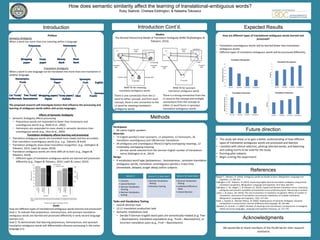
How does semantic similarity affect the learning of translational-ambiguous words?
Ruby Slabicki, Chelsea Eddington, & Natasha Tokowicz
Fd
Introduction
Fd
Methods
Future direction
Expected Results
References
Acknowledgments
Fd
Fd
Semantic Ambiguity
When a word has more than one meaning within a language
Translation Ambiguity
When a word in one language can be translated into more than one translation in
another language
The proposed research will investigate factors that influence the processing and
learning of ambiguous words within and across languages.
Effects of Semantic Ambiguity
• Semantic Ambiguity affects processing
• Polysemous words are responded to faster than homonyms and
unambiguous words (e.g., Rodd et al., 2002)
• Homonyms are responded to more slowly in semantic decisions than
unambiguous words (e.g., Hino et al., 2002)
Translation Ambiguity affects learning and processing
• Translation-ambiguous words are translated more slowly and less accurately
than translation-unambiguous words (e.g., e.g., Tokowicz & Kroll)
• Translation ambiguity slows down translation recognition (e.g., Eddington &
Tokowicz, 2013; Laxén & Lavaur, 2010)
• Translation ambiguous words are more difficult to learn (e.g., Degani &
Tokowicz, 2010).
• Different types of translation-ambiguous words are learned and processed
differently (e.g., Degani & Tokowicz, 2010; Laxén & Lavaur, 2010)
Results from Degani & Tokowicz (2010)
Goals
How are different types of translational-ambiguous words learned and processed?
Goal 1: To indicate that polysemous, homonymous, and synonym translation-
ambiguous words are learned and processed differently in early second language
learners (L2).
Goal 2: To demonstrate that learning polysemous, homonymous, and synonym
translation-ambiguous words will differentially influence processing in the native
language (L1).
Preface
Participants
• 60 native English speakers
Materials
• 72 English words(12 near-synonyms, 12 polysemes, 12 homonyms, 36
translation-unambiguous) and 108 German translations
• 36 ambiguous and unambiguous fillers(12 highly overlapping meanings, 12
moderately overlapping meaning
• German words selected from the German-English number of translations
norms (Eddington et al., 2014)
Design
• 4 vocabulary word type (polysemous-, homonymous-, synonym-translation
ambiguous words, translation unambiguous words) x 3 test time
(immediate, delayed, longer delay) within subjects
Tasks and Vocabulary Testing
• Lexical decision task
• L2-L1 translation production task
• Semantic relatedness task
• Decide if German-English word pairs are semantically-related (e.g. Tree
– Baumstamm), translation equivalents (e.g., Trunk – Baumstamm), or
incorrect translation pairs (e.g., Fruit – Baumstamm)
Fd
How are different types of translational-ambiguous words learned and
processed?
• Translation-unambiguous words will be learned better than translation-
ambiguous words.
• Different types of translation-ambiguous words will be processed differently.
There is a strong connection from the
L1 word to the concept and multiple
connections from the concept to
either L2 word forms in synonym
translation-ambiguous words.
There is one connection from the L1
word to either concept, and from each
concept, there is one connection to the
L2 word for meaning translation-
ambiguous words.
• This study will allow us to gain a better understanding of how different
types of translation-ambiguous words are processed and learned.
• I assisted with stimuli selection, piloting selected words, and balancing
and coding norms to be used for the study.
• Running pilot subjects.
• Begin running the experiment!
Degani T., Tokowicz, N. (2010). Ambiguous words are harder to learn. Bilingualism: Language and
Cognition, 13, 299-314.
Eddington, C.M., Tokowicz, N. (2013). Examining English-German translation ambiguity using primed
translation recognition. Bilingualism: Language and Cognition, First View, 442-457.
Eddington, C. M., Degani, T., & Tokowicz, N. (2014). English and German translation norms: Examining
ambiguity and semantic variability of translations across proficiency levels. Manuscript in revision.
Laxén, J., & Lavaur, J.M. (2010). The role of semantics in translation recognition: Effects of number of
translations, dominance of translations and semantic relatedness of multiple translations.
Bilingualism: Language and Cognition, 13(2), 157-183.
Rodd, J., Gaskell, G., Marslen-Wilson, W. (2002). Making Sense of Semantic Ambiguity: Semantic
Competition in Lexical Access. Journal of Memory and Language, 46, 245-266.
Tokowicz, N., & Kroll, J. F. (2007). Number of meanings and concreteness: Consequences of ambiguity
within and across languages. Language and Cognitive Processes, 22, 727-779.
Introduction Cont’d.
Models
The Revised Hierarchical Model of Translation Ambiguity (RHM-TA)(Eddington &
Tokowicz, 2013).
RHM-TA for meaning
translation-ambiguous words
Number Odd Strange Odd
ungerade
merkwürdig
RHM-TA for synonym
translation-ambiguous words
shy
schüchtern
scheu
Session 1
• Consent
• Lexical Decision
• German Vocabulary
training
• German Vocabulary
testing
Session 2 (2 days later)
• German Vocabulary
Testing
• Germany training
Session 3(1 week later)
• German Vocabulary
Testing
• Individual Difference
Tasks
• Lexical Decision
1200
1250
1300
1350
1400
1450
1500
1550
Synonym Polysemes Homonyms Unambiguous
MeanResponsTime(ms)
Translation Recognition
1000
1100
1200
1300
1400
1500
1600
1700
1800
Synonym Polysemes Homonyms Unambiguous
MeanResponseTime(ms)
Translation Production
0
10
20
30
40
50
60
70
80
90
Synonym Polysemes Homonyms Unambiguous
Accuracy
Translation Production
0
10
20
30
40
50
60
70
80
Synonym Polysemes Homonyms Unambiguous
Accuracy
Translation Recognition
We would like to thank members of the PLUM lab for their research
assistance.

semantic ambiguity final

  • 1.
    Fd How does semanticsimilarity affect the learning of translational-ambiguous words? Ruby Slabicki, Chelsea Eddington, & Natasha Tokowicz Fd Introduction Fd Methods Future direction Expected Results References Acknowledgments Fd Fd Semantic Ambiguity When a word has more than one meaning within a language Translation Ambiguity When a word in one language can be translated into more than one translation in another language The proposed research will investigate factors that influence the processing and learning of ambiguous words within and across languages. Effects of Semantic Ambiguity • Semantic Ambiguity affects processing • Polysemous words are responded to faster than homonyms and unambiguous words (e.g., Rodd et al., 2002) • Homonyms are responded to more slowly in semantic decisions than unambiguous words (e.g., Hino et al., 2002) Translation Ambiguity affects learning and processing • Translation-ambiguous words are translated more slowly and less accurately than translation-unambiguous words (e.g., e.g., Tokowicz & Kroll) • Translation ambiguity slows down translation recognition (e.g., Eddington & Tokowicz, 2013; Laxén & Lavaur, 2010) • Translation ambiguous words are more difficult to learn (e.g., Degani & Tokowicz, 2010). • Different types of translation-ambiguous words are learned and processed differently (e.g., Degani & Tokowicz, 2010; Laxén & Lavaur, 2010) Results from Degani & Tokowicz (2010) Goals How are different types of translational-ambiguous words learned and processed? Goal 1: To indicate that polysemous, homonymous, and synonym translation- ambiguous words are learned and processed differently in early second language learners (L2). Goal 2: To demonstrate that learning polysemous, homonymous, and synonym translation-ambiguous words will differentially influence processing in the native language (L1). Preface Participants • 60 native English speakers Materials • 72 English words(12 near-synonyms, 12 polysemes, 12 homonyms, 36 translation-unambiguous) and 108 German translations • 36 ambiguous and unambiguous fillers(12 highly overlapping meanings, 12 moderately overlapping meaning • German words selected from the German-English number of translations norms (Eddington et al., 2014) Design • 4 vocabulary word type (polysemous-, homonymous-, synonym-translation ambiguous words, translation unambiguous words) x 3 test time (immediate, delayed, longer delay) within subjects Tasks and Vocabulary Testing • Lexical decision task • L2-L1 translation production task • Semantic relatedness task • Decide if German-English word pairs are semantically-related (e.g. Tree – Baumstamm), translation equivalents (e.g., Trunk – Baumstamm), or incorrect translation pairs (e.g., Fruit – Baumstamm) Fd How are different types of translational-ambiguous words learned and processed? • Translation-unambiguous words will be learned better than translation- ambiguous words. • Different types of translation-ambiguous words will be processed differently. There is a strong connection from the L1 word to the concept and multiple connections from the concept to either L2 word forms in synonym translation-ambiguous words. There is one connection from the L1 word to either concept, and from each concept, there is one connection to the L2 word for meaning translation- ambiguous words. • This study will allow us to gain a better understanding of how different types of translation-ambiguous words are processed and learned. • I assisted with stimuli selection, piloting selected words, and balancing and coding norms to be used for the study. • Running pilot subjects. • Begin running the experiment! Degani T., Tokowicz, N. (2010). Ambiguous words are harder to learn. Bilingualism: Language and Cognition, 13, 299-314. Eddington, C.M., Tokowicz, N. (2013). Examining English-German translation ambiguity using primed translation recognition. Bilingualism: Language and Cognition, First View, 442-457. Eddington, C. M., Degani, T., & Tokowicz, N. (2014). English and German translation norms: Examining ambiguity and semantic variability of translations across proficiency levels. Manuscript in revision. Laxén, J., & Lavaur, J.M. (2010). The role of semantics in translation recognition: Effects of number of translations, dominance of translations and semantic relatedness of multiple translations. Bilingualism: Language and Cognition, 13(2), 157-183. Rodd, J., Gaskell, G., Marslen-Wilson, W. (2002). Making Sense of Semantic Ambiguity: Semantic Competition in Lexical Access. Journal of Memory and Language, 46, 245-266. Tokowicz, N., & Kroll, J. F. (2007). Number of meanings and concreteness: Consequences of ambiguity within and across languages. Language and Cognitive Processes, 22, 727-779. Introduction Cont’d. Models The Revised Hierarchical Model of Translation Ambiguity (RHM-TA)(Eddington & Tokowicz, 2013). RHM-TA for meaning translation-ambiguous words Number Odd Strange Odd ungerade merkwürdig RHM-TA for synonym translation-ambiguous words shy schüchtern scheu Session 1 • Consent • Lexical Decision • German Vocabulary training • German Vocabulary testing Session 2 (2 days later) • German Vocabulary Testing • Germany training Session 3(1 week later) • German Vocabulary Testing • Individual Difference Tasks • Lexical Decision 1200 1250 1300 1350 1400 1450 1500 1550 Synonym Polysemes Homonyms Unambiguous MeanResponsTime(ms) Translation Recognition 1000 1100 1200 1300 1400 1500 1600 1700 1800 Synonym Polysemes Homonyms Unambiguous MeanResponseTime(ms) Translation Production 0 10 20 30 40 50 60 70 80 90 Synonym Polysemes Homonyms Unambiguous Accuracy Translation Production 0 10 20 30 40 50 60 70 80 Synonym Polysemes Homonyms Unambiguous Accuracy Translation Recognition We would like to thank members of the PLUM lab for their research assistance.