Prepared by:
Kamal Salman
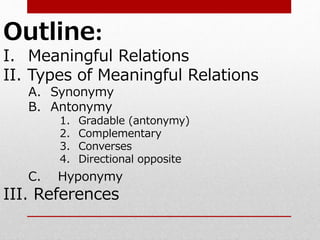
:Outline
I. Meaningful Relations
II. Types of Meaningful Relations
A. Synonymy
B. Antonymy
1. Gradable (antonymy)
2. Complementary
3. Converses
4. Directional opposite
C. Hyponymy
III. References
.
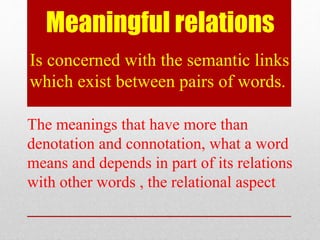
The meanings that have more than
denotation and connotation, what a word
means and depends in part of its relations
with other words , the relational aspect
Meaningful relations
Is concerned with the semantic links
which exist between pairs of words.
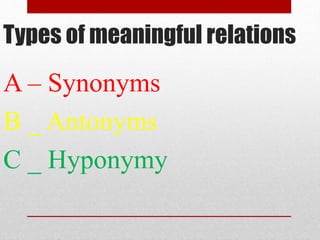
Types of meaningful relations
A – Synonyms
B _ Antonyms
C _ Hyponymy
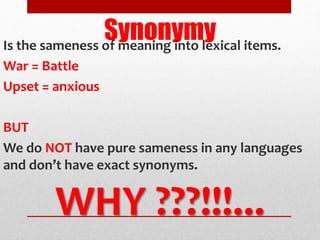
SynonymyIs the sameness of meaning into lexical items.
War = Battle
Upset = anxious
BUT
We do NOT have pure sameness in any languages
and don’t have exact synonyms.
WHY ???!!!...
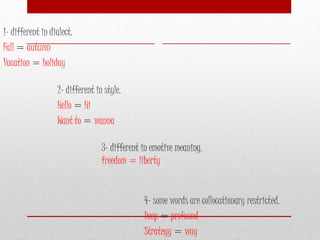
3- different in emotive meaning.
freedom = liberty
1- different in dialect.
Fall = autumn
Vacation = holiday
4- some words are collocationary restricted.
Deep = profound
Strategy = way
2- different in style.
Hello = Hi
Want to = wanna
Antonyms
A type of oppositeness, often involving adjectives
and adverbs.
The quality of being antonym is the relationship
between two lexical words according to the
context
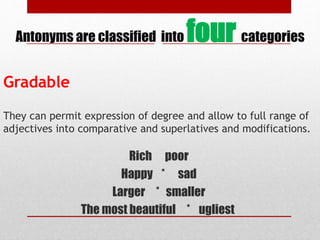
Antonyms are classified into four categories
Gradable
They can permit expression of degree and allow to full range of
adjectives into comparative and superlatives and modifications.
Rich poor
Happy * sad
Larger * smaller
The most beautiful * ugliest
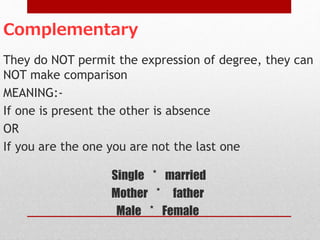
Complementary
They do NOT permit the expression of degree, they can
NOT make comparison
MEANING:-
If one is present the other is absence
OR
If you are the one you are not the last one
Single * married
Mother * father
Male * Female
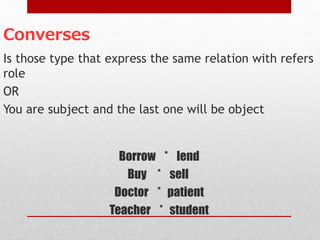
Converses
Is those type that express the same relation with refers
role
OR
You are subject and the last one will be object
Borrow * lend
Buy * sell
Doctor * patient
Teacher * student
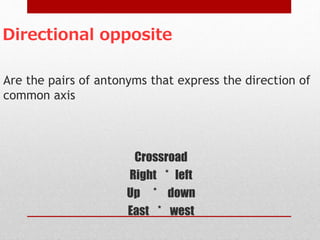
Directional opposite
Are the pairs of antonyms that express the direction of
common axis
Crossroad
Right * left
Up * down
East * west
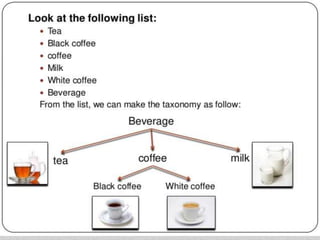
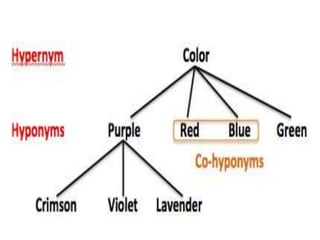
Hyponymy
The semantic relationship of some words which are
related as one belong to another lie
The quality of being subordinate and belong to its
superordinate ( Hypernyms )
References
Alan Cruse: lexical Semantics. Cambridge University Press 1986
Cowie, A. P., (2009), Semantics, Oxford: Oxford university press.
John Lyons: semantics vol. I. Cambridge University Press !977
HAVE Any
QuestionsQ

Meaningful relations

  • 1.
  • 2.
    :Outline I. Meaningful Relations II.Types of Meaningful Relations A. Synonymy B. Antonymy 1. Gradable (antonymy) 2. Complementary 3. Converses 4. Directional opposite C. Hyponymy III. References .
  • 3.
    The meanings thathave more than denotation and connotation, what a word means and depends in part of its relations with other words , the relational aspect Meaningful relations Is concerned with the semantic links which exist between pairs of words.
  • 4.
    Types of meaningfulrelations A – Synonyms B _ Antonyms C _ Hyponymy
  • 5.
    SynonymyIs the samenessof meaning into lexical items. War = Battle Upset = anxious BUT We do NOT have pure sameness in any languages and don’t have exact synonyms. WHY ???!!!...
  • 6.
    3- different inemotive meaning. freedom = liberty 1- different in dialect. Fall = autumn Vacation = holiday 4- some words are collocationary restricted. Deep = profound Strategy = way 2- different in style. Hello = Hi Want to = wanna
  • 7.
    Antonyms A type ofoppositeness, often involving adjectives and adverbs. The quality of being antonym is the relationship between two lexical words according to the context
  • 8.
    Antonyms are classifiedinto four categories Gradable They can permit expression of degree and allow to full range of adjectives into comparative and superlatives and modifications. Rich poor Happy * sad Larger * smaller The most beautiful * ugliest
  • 9.
    Complementary They do NOTpermit the expression of degree, they can NOT make comparison MEANING:- If one is present the other is absence OR If you are the one you are not the last one Single * married Mother * father Male * Female
  • 10.
    Converses Is those typethat express the same relation with refers role OR You are subject and the last one will be object Borrow * lend Buy * sell Doctor * patient Teacher * student
  • 11.
    Directional opposite Are thepairs of antonyms that express the direction of common axis Crossroad Right * left Up * down East * west
  • 12.
    Hyponymy The semantic relationshipof some words which are related as one belong to another lie The quality of being subordinate and belong to its superordinate ( Hypernyms )
  • 15.
    References Alan Cruse: lexicalSemantics. Cambridge University Press 1986 Cowie, A. P., (2009), Semantics, Oxford: Oxford university press. John Lyons: semantics vol. I. Cambridge University Press !977
  • 16.