Introduction to Sensation
 and Perception: Vision
      (Module 14)
How do we construct our
     representations of the world?
Our sensory receptors detect physical energy from the
   environment and translate it into neural signals. This is
   called sensation.
At this level of detection, sensory analysis uses bottom-up
   processing (…is sensory analysis that begins at the
   entry level, with information flowing from the sensory
   receptors to the brain).
However, we also select, organize, and interpret our
   sensations—a process called perception.
During perception, our mind processes what our senses
   detect. At this level, sensory analysis uses top-down
   processing (… is information processing guided by
   higher-level mental processes, as when someone
   constructs perceptions drawing on experience and
   expectations).
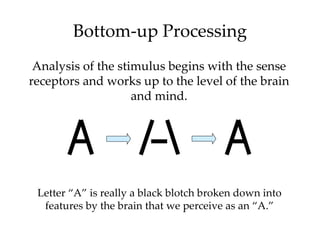
Bottom-up Processing
 Analysis of the stimulus begins with the sense
receptors and works up to the level of the brain
                    and mind.


 Letter “A” is really a black blotch broken down into
  features by the brain that we perceive as an “A.”
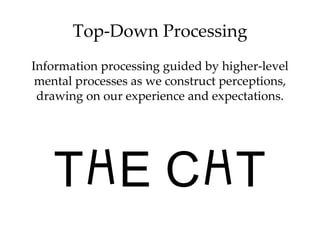
Top-Down Processing
Information processing guided by higher-level
 mental processes as we construct perceptions,
 drawing on our experience and expectations.


   THE CHT
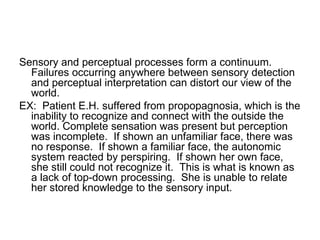
Sensory and perceptual processes form a continuum.
  Failures occurring anywhere between sensory detection
  and perceptual interpretation can distort our view of the
  world.
EX: Patient E.H. suffered from propopagnosia, which is the
  inability to recognize and connect with the outside the
  world. Complete sensation was present but perception
  was incomplete. If shown an unfamiliar face, there was
  no response. If shown a familiar face, the autonomic
  system reacted by perspiring. If shown her own face,
  she still could not recognize it. This is what is known as
  a lack of top-down processing. She is unable to relate
  her stored knowledge to the sensory input.
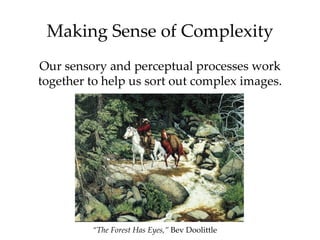
Making Sense of Complexity
Our sensory and perceptual processes work
together to help us sort out complex images.


         “The Forest Has Eyes,” Bev Doolittle
Sensing the World
  Senses are nature’s gifts that suit an organism’s needs.

 Because of particular receptor cells in a frog’s eyes, a frog
can detect the motion of insects and can therefore thrive. A
frog could be surrounded by motionless insects and starve
                          to death!

A male silkworm moth is sensitive to female sex-attractant
      odor and can be affected up to a mile a way!

We as human beings are sensitive to sound frequencies that
          represent the range of human voice.
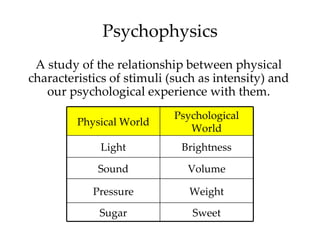
Psychophysics
 A study of the relationship between physical
characteristics of stimuli (such as intensity) and
   our psychological experience with them.
                           Psychological
         Physical World
                              World
             Light           Brightness

             Sound            Volume

            Pressure          Weight

             Sugar             Sweet
Sensation

Sensing the World:
Some Basic Principles
 Thresholds
 Sensory Adaptation
Exploring the Senses


What stimuli cross our threshold for
      conscious awareness?
       (Absolute Threshold)
Absolute Threshold
To some kinds of stimuli we are especially sensitive. If we
  were to stand on top of a mountain (on a dark, clear
  night), most of us would be able to see a candle flame
  on top of another mountain 30 miles away.
Most of us would be able to feel the wing of a bee on our
  cheek.
Most of us would be able to smell a drop of perfume in a 3
  room apartment.
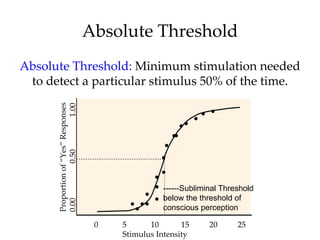
Our awareness of these faint stimuli illustrates our absolute
  thresholds— which is the minimum stimulation
  necessary to detect a particular light, sound, pressure,
  taste, or odor 50% of the time.
EX: A hearing specialist exposes an individual to varying
  sounds in order to figure out their absolute threshold for
  hearing certain pitches.
Absolute Threshold
Absolute Threshold: Minimum stimulation needed
 to detect a particular stimulus 50% of the time.
      Proportion of “Yes” Responses
                   0.50        1.00


                                                     ------Subliminal Threshold
                                                     below the threshold of
      0.00


                                                     conscious perception

                                       0   5      10       15     20      25
                                           Stimulus Intensity
Subliminal Threshold
Have you ever tried a cessation program that delivered you
  messages subliminally?
For example, listening to audiotapes that are supposed to
  help you lose weight, stop smoking, or improve your
  memory?
These audiotapes are usually masked by soothing ocean
  sounds and unheard messages such as “I am thin”,
  “Smoke tastes bad”, or “I do well on tests because I have
  total recall of information”.
These subliminal messages are all in an attempt to
  influence our behavior.
We can unconsciously sense subliminal stimuli and without
  our awareness can to some extent be affected by it.
A stimulus is Subliminal if it is below your
  absolute threshold, meaning that you detect
  it less than 50% of the time. For instance, a
  microscopic cell is subliminal to you because
  you cannot see it with your naked eye.
Subliminal advertisements (Drink Coke,
  eat popcorn etc.), do have an affect on you,
  (they prime you—predisposing you to making a
  particular decision) but do not persuade you.
The final statement of subliminal messages is that
  much of our information processing occurs
  automatically, out of sight, and off the radar
  screen of our conscious mind.
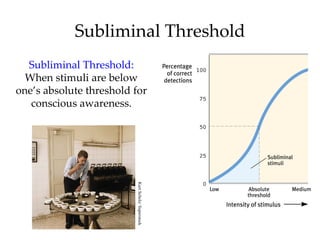
Subliminal Threshold
  Subliminal Threshold:
  When stimuli are below
one’s absolute threshold for
   conscious awareness.

                         Kurt Scholz/ Superstock
Difference Thresholds
How does the magnitude of a stimulus
 influence our threshold for detecting
 differences?
The Difference Threshold (a.k.a the just
 noticeable difference or jnd) is the lowest
 difference you can detect between any
 two stimuli 50% of the time. For example,
 you are just able to notice the difference
 between 1kg and 1.02kg half the time.
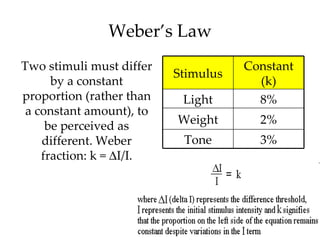
Weber’s Law
Two stimuli must differ              Constant
                          Stimulus
      by a constant                    (k)
proportion (rather than    Light       8%
 a constant amount), to
     be perceived as      Weight       2%
    different. Weber       Tone        3%
    fraction: k = ∆I/I.
Sensation

Sensing the World:
Some Basic Principles
 Thresholds √√
 Sensory Adaptation
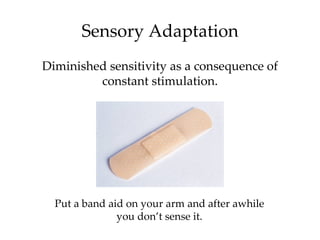
Sensory Adaptation
Diminished sensitivity as a consequence of
         constant stimulation.


  Put a band aid on your arm and after awhile
               you don’t sense it.
Sensory Adaptation: What purpose
         does it serve?
Although sensory adaptation reduces our
  sensitivity, it offers an important benefit:
  Freedom to focus on informative changes in our
  environment without being distracted by the
  constant chatter of uninformative background
  stimulation.
Our sensory receptors are alert to novelty; bore
  them with repetition and they free our attention
  for more important things.
This reinforces a fundamental lesson: We
  perceive the world not exactly as it is, but as it is
  useful for us to perceive it. (ex: smokers, body
  scents, etc.)
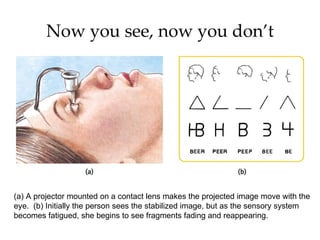
Now you see, now you don’t


(a) A projector mounted on a contact lens makes the projected image move with the
eye. (b) Initially the person sees the stabilized image, but as the sensory system
becomes fatigued, she begins to see fragments fading and reappearing.
Sensation

Vision
 The Stimulus Input: Light Energy
 The Eye
 Visual Information Processing
 Color Vision
Vision
Transduction


The transformation of stimulus energy (sights,
    sounds, smells) into neural impulses.
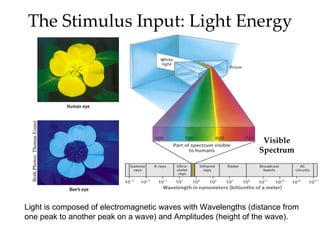
The Stimulus Input: Light Energy
 Both Photos: Thomas Eisner


                                                                Visible
                                                               Spectrum


Light is composed of electromagnetic waves with Wavelengths (distance from
one peak to another peak on a wave) and Amplitudes (height of the wave).
Physical Characteristics of Light


    1. Wavelength (hue/color)

    3. Intensity (brightness)
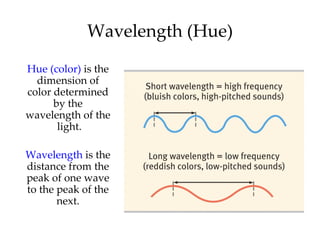
Wavelength (Hue)

Hue (color) is the
  dimension of
color determined
      by the
wavelength of the
       light.

Wavelength is the
distance from the
peak of one wave
to the peak of the
       next.
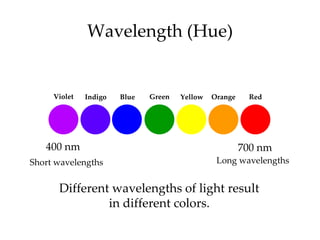
Wavelength (Hue)


     Violet   Indigo   Blue   Green   Yellow   Orange    Red


   400 nm                                               700 nm
Short wavelengths                               Long wavelengths


      Different wavelengths of light result
               in different colors.
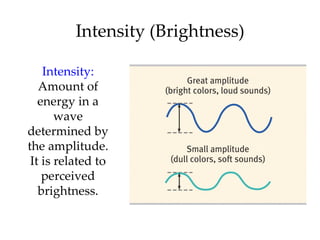
Intensity (Brightness)

    Intensity:
   Amount of
   energy in a
       wave
determined by
the amplitude.
 It is related to
    perceived
   brightness.
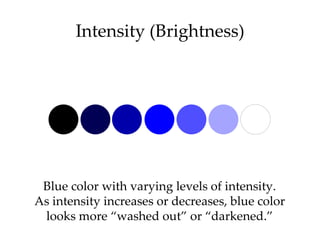
Intensity (Brightness)


 Blue color with varying levels of intensity.
As intensity increases or decreases, blue color
 looks more “washed out” or “darkened.”
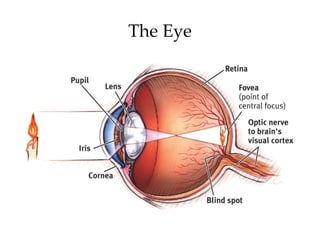
The Eye
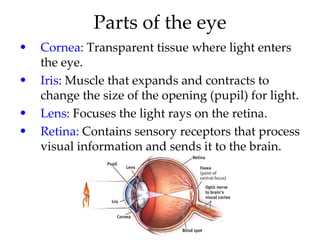
Parts of the eye
•   Cornea: Transparent tissue where light enters
    the eye.
•   Iris: Muscle that expands and contracts to
    change the size of the opening (pupil) for light.
•   Lens: Focuses the light rays on the retina.
•   Retina: Contains sensory receptors that process
    visual information and sends it to the brain.
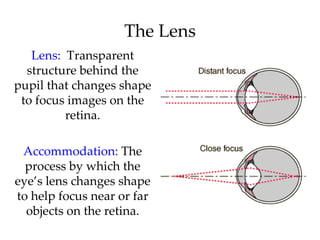
The Lens
   Lens: Transparent
  structure behind the
pupil that changes shape
 to focus images on the
         retina.

 Accommodation: The
  process by which the
eye’s lens changes shape
to help focus near or far
  objects on the retina.
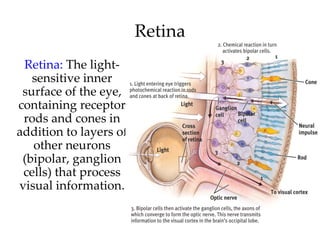
Retina
 Retina: The light-
   sensitive inner
 surface of the eye,
containing receptor
 rods and cones in
addition to layers of
   other neurons
 (bipolar, ganglion
 cells) that process
visual information.
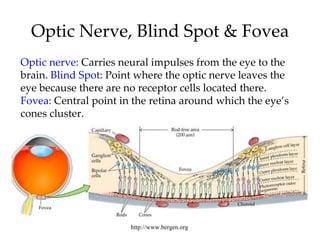
Optic Nerve, Blind Spot & Fovea
Optic nerve: Carries neural impulses from the eye to the
brain. Blind Spot: Point where the optic nerve leaves the
eye because there are no receptor cells located there.
Fovea: Central point in the retina around which the eye’s
cones cluster.


                       http://www.bergen.org
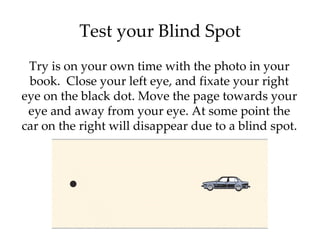
Test your Blind Spot
 Try is on your own time with the photo in your
 book. Close your left eye, and fixate your right
eye on the black dot. Move the page towards your
 eye and away from your eye. At some point the
car on the right will disappear due to a blind spot.
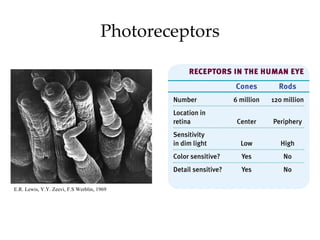
Photoreceptors


E.R. Lewis, Y.Y. Zeevi, F.S Werblin, 1969
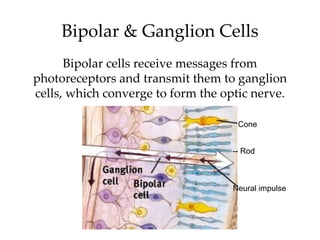
Bipolar & Ganglion Cells
      Bipolar cells receive messages from
photoreceptors and transmit them to ganglion
cells, which converge to form the optic nerve.

                                     Cone


                                    -- Rod


                                    Neural impulse
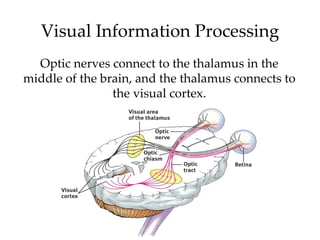
Visual Information Processing
  Optic nerves connect to the thalamus in the
middle of the brain, and the thalamus connects to
                the visual cortex.
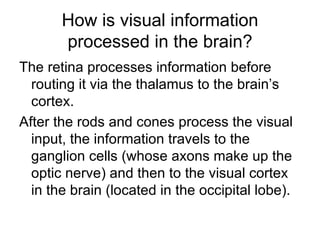
How is visual information
       processed in the brain?
The retina processes information before
  routing it via the thalamus to the brain’s
  cortex.
After the rods and cones process the visual
  input, the information travels to the
  ganglion cells (whose axons make up the
  optic nerve) and then to the visual cortex
  in the brain (located in the occipital lobe).
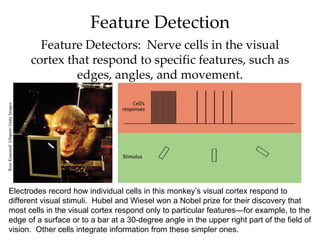
Feature Detection
                                          Feature Detectors: Nerve cells in the visual
                                        cortex that respond to specific features, such as
                                                 edges, angles, and movement.
Ross Kinnaird/ Allsport/ Getty Images


         Electrodes record how individual cells in this monkey’s visual cortex respond to
         different visual stimuli. Hubel and Wiesel won a Nobel prize for their discovery that
         most cells in the visual cortex respond only to particular features—for example, to the
         edge of a surface or to a bar at a 30-degree angle in the upper right part of the field of
         vision. Other cells integrate information from these simpler ones.
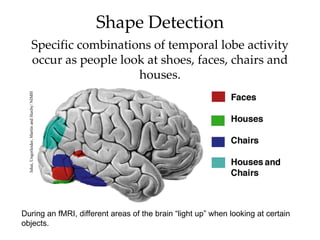
Shape Detection
                       Specific combinations of temporal lobe activity
                       occur as people look at shoes, faces, chairs and
                                          houses.
  Ishai, Ungerleider, Martin and Haxby/ NIMH


During an fMRI, different areas of the brain “light up” when looking at certain
objects.
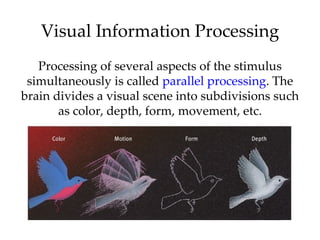
Visual Information Processing
   Processing of several aspects of the stimulus
 simultaneously is called parallel processing. The
brain divides a visual scene into subdivisions such
       as color, depth, form, movement, etc.
Sometimes parallel processing is hindered in some way.
For example: Mrs. M was a woman who suffered stroke
  damage to both sides of her brain. She became unable
  to perceive movement. She was unable to see people
  move yet they would miraculously appear in different
  places although she could not see how they had gotten
  there.
There is also a phenomenon called Blindsight. This is when
  people who cannot consciously perceive can still
  remarkably locate objects but are consciously unaware
  of how they knew where the objects were or what their
  orientation was.
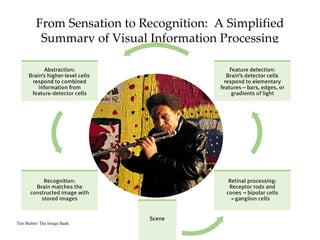
From Sensation to Recognition: A Simplified
          Summary of Visual Information Processing


Tim Bieber/ The Image Bank
Color Vision
The Young-Helmholtz Trichromatic (three color)
  theory and the Opponent-Process theory help
  contribute to our understanding of color vision.
We know (or we think we know) that a tomato is
  red.
Ask yourself this: If a tree falls in the forest and no
  one is around to hear it, does it make a sound?
Now ask yourself this: If no one sees the tomato,
  is it red?
The answer is NO.
The tomato is everything but red, because it
  rejects (or better yet, reflects) the long
  wavelengths of red.
Also, the tomato’s color is our mental
  construction.
Light rays are not colored. Color does not
  reside in an object; it resides within our
  brain; hence our ability to dream in color.
Color Vision
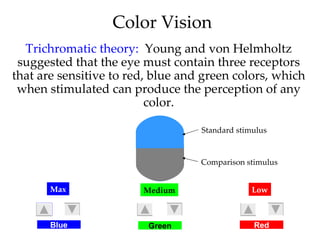
  Trichromatic theory: Young and von Helmholtz
 suggested that the eye must contain three receptors
that are sensitive to red, blue and green colors, which
 when stimulated can produce the perception of any
                          color.

                                   Standard stimulus


                                   Comparison stimulus


       Max              Medium                  Low


       Blue              Green                  Red
Color Blindness
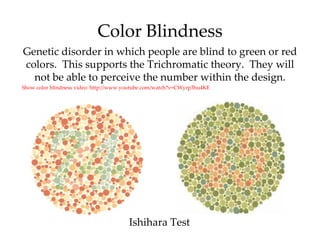
Genetic disorder in which people are blind to green or red
colors. This supports the Trichromatic theory. They will
  not be able to perceive the number within the design.
Show color blindness video: http://www.youtube.com/watch?v=CWyrp3hu4KE


                                       Ishihara Test
Color Vision
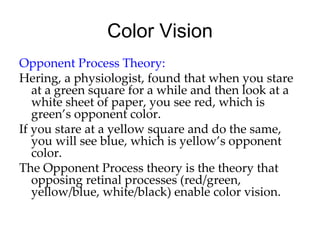
Opponent Process Theory:
Hering, a physiologist, found that when you stare
   at a green square for a while and then look at a
   white sheet of paper, you see red, which is
   green’s opponent color.
If you stare at a yellow square and do the same,
   you will see blue, which is yellow’s opponent
   color.
The Opponent Process theory is the theory that
   opposing retinal processes (red/green,
   yellow/blue, white/black) enable color vision.
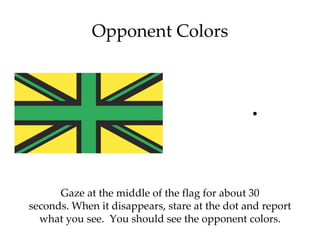
Opponent Colors


      Gaze at the middle of the flag for about 30
seconds. When it disappears, stare at the dot and report
  what you see. You should see the opponent colors.

Mod 14 Basic Concepts and Vision

  • 1.
    Introduction to Sensation and Perception: Vision (Module 14)
  • 2.
    How do weconstruct our representations of the world? Our sensory receptors detect physical energy from the environment and translate it into neural signals. This is called sensation. At this level of detection, sensory analysis uses bottom-up processing (…is sensory analysis that begins at the entry level, with information flowing from the sensory receptors to the brain). However, we also select, organize, and interpret our sensations—a process called perception. During perception, our mind processes what our senses detect. At this level, sensory analysis uses top-down processing (… is information processing guided by higher-level mental processes, as when someone constructs perceptions drawing on experience and expectations).
  • 3.
    Bottom-up Processing Analysisof the stimulus begins with the sense receptors and works up to the level of the brain and mind. Letter “A” is really a black blotch broken down into features by the brain that we perceive as an “A.”
  • 4.
    Top-Down Processing Information processingguided by higher-level mental processes as we construct perceptions, drawing on our experience and expectations. THE CHT
  • 5.
    Sensory and perceptualprocesses form a continuum. Failures occurring anywhere between sensory detection and perceptual interpretation can distort our view of the world. EX: Patient E.H. suffered from propopagnosia, which is the inability to recognize and connect with the outside the world. Complete sensation was present but perception was incomplete. If shown an unfamiliar face, there was no response. If shown a familiar face, the autonomic system reacted by perspiring. If shown her own face, she still could not recognize it. This is what is known as a lack of top-down processing. She is unable to relate her stored knowledge to the sensory input.
  • 6.
    Making Sense ofComplexity Our sensory and perceptual processes work together to help us sort out complex images. “The Forest Has Eyes,” Bev Doolittle
  • 7.
    Sensing the World Senses are nature’s gifts that suit an organism’s needs. Because of particular receptor cells in a frog’s eyes, a frog can detect the motion of insects and can therefore thrive. A frog could be surrounded by motionless insects and starve to death! A male silkworm moth is sensitive to female sex-attractant odor and can be affected up to a mile a way! We as human beings are sensitive to sound frequencies that represent the range of human voice.
  • 8.
    Psychophysics A studyof the relationship between physical characteristics of stimuli (such as intensity) and our psychological experience with them. Psychological Physical World World Light Brightness Sound Volume Pressure Weight Sugar Sweet
  • 9.
    Sensation Sensing the World: SomeBasic Principles  Thresholds  Sensory Adaptation
  • 10.
    Exploring the Senses Whatstimuli cross our threshold for conscious awareness? (Absolute Threshold)
  • 11.
    Absolute Threshold To somekinds of stimuli we are especially sensitive. If we were to stand on top of a mountain (on a dark, clear night), most of us would be able to see a candle flame on top of another mountain 30 miles away. Most of us would be able to feel the wing of a bee on our cheek. Most of us would be able to smell a drop of perfume in a 3 room apartment. Our awareness of these faint stimuli illustrates our absolute thresholds— which is the minimum stimulation necessary to detect a particular light, sound, pressure, taste, or odor 50% of the time. EX: A hearing specialist exposes an individual to varying sounds in order to figure out their absolute threshold for hearing certain pitches.
  • 12.
    Absolute Threshold Absolute Threshold:Minimum stimulation needed to detect a particular stimulus 50% of the time. Proportion of “Yes” Responses 0.50 1.00 ------Subliminal Threshold below the threshold of 0.00 conscious perception 0 5 10 15 20 25 Stimulus Intensity
  • 13.
    Subliminal Threshold Have youever tried a cessation program that delivered you messages subliminally? For example, listening to audiotapes that are supposed to help you lose weight, stop smoking, or improve your memory? These audiotapes are usually masked by soothing ocean sounds and unheard messages such as “I am thin”, “Smoke tastes bad”, or “I do well on tests because I have total recall of information”. These subliminal messages are all in an attempt to influence our behavior. We can unconsciously sense subliminal stimuli and without our awareness can to some extent be affected by it.
  • 14.
    A stimulus isSubliminal if it is below your absolute threshold, meaning that you detect it less than 50% of the time. For instance, a microscopic cell is subliminal to you because you cannot see it with your naked eye. Subliminal advertisements (Drink Coke, eat popcorn etc.), do have an affect on you, (they prime you—predisposing you to making a particular decision) but do not persuade you. The final statement of subliminal messages is that much of our information processing occurs automatically, out of sight, and off the radar screen of our conscious mind.
  • 15.
    Subliminal Threshold Subliminal Threshold: When stimuli are below one’s absolute threshold for conscious awareness. Kurt Scholz/ Superstock
  • 16.
    Difference Thresholds How doesthe magnitude of a stimulus influence our threshold for detecting differences? The Difference Threshold (a.k.a the just noticeable difference or jnd) is the lowest difference you can detect between any two stimuli 50% of the time. For example, you are just able to notice the difference between 1kg and 1.02kg half the time.
  • 17.
    Weber’s Law Two stimulimust differ Constant Stimulus by a constant (k) proportion (rather than Light 8% a constant amount), to be perceived as Weight 2% different. Weber Tone 3% fraction: k = ∆I/I.
  • 18.
    Sensation Sensing the World: SomeBasic Principles  Thresholds √√  Sensory Adaptation
  • 19.
    Sensory Adaptation Diminished sensitivityas a consequence of constant stimulation. Put a band aid on your arm and after awhile you don’t sense it.
  • 20.
    Sensory Adaptation: Whatpurpose does it serve? Although sensory adaptation reduces our sensitivity, it offers an important benefit: Freedom to focus on informative changes in our environment without being distracted by the constant chatter of uninformative background stimulation. Our sensory receptors are alert to novelty; bore them with repetition and they free our attention for more important things. This reinforces a fundamental lesson: We perceive the world not exactly as it is, but as it is useful for us to perceive it. (ex: smokers, body scents, etc.)
  • 21.
    Now you see,now you don’t (a) A projector mounted on a contact lens makes the projected image move with the eye. (b) Initially the person sees the stabilized image, but as the sensory system becomes fatigued, she begins to see fragments fading and reappearing.
  • 22.
    Sensation Vision  The StimulusInput: Light Energy  The Eye  Visual Information Processing  Color Vision
  • 23.
  • 24.
    Transduction The transformation ofstimulus energy (sights, sounds, smells) into neural impulses.
  • 25.
    The Stimulus Input:Light Energy Both Photos: Thomas Eisner Visible Spectrum Light is composed of electromagnetic waves with Wavelengths (distance from one peak to another peak on a wave) and Amplitudes (height of the wave).
  • 26.
    Physical Characteristics ofLight 1. Wavelength (hue/color) 3. Intensity (brightness)
  • 27.
    Wavelength (Hue) Hue (color)is the dimension of color determined by the wavelength of the light. Wavelength is the distance from the peak of one wave to the peak of the next.
  • 28.
    Wavelength (Hue) Violet Indigo Blue Green Yellow Orange Red 400 nm 700 nm Short wavelengths Long wavelengths Different wavelengths of light result in different colors.
  • 29.
    Intensity (Brightness) Intensity: Amount of energy in a wave determined by the amplitude. It is related to perceived brightness.
  • 30.
    Intensity (Brightness) Bluecolor with varying levels of intensity. As intensity increases or decreases, blue color looks more “washed out” or “darkened.”
  • 31.
  • 32.
    Parts of theeye • Cornea: Transparent tissue where light enters the eye. • Iris: Muscle that expands and contracts to change the size of the opening (pupil) for light. • Lens: Focuses the light rays on the retina. • Retina: Contains sensory receptors that process visual information and sends it to the brain.
  • 33.
    The Lens Lens: Transparent structure behind the pupil that changes shape to focus images on the retina. Accommodation: The process by which the eye’s lens changes shape to help focus near or far objects on the retina.
  • 34.
    Retina Retina: Thelight- sensitive inner surface of the eye, containing receptor rods and cones in addition to layers of other neurons (bipolar, ganglion cells) that process visual information.
  • 35.
    Optic Nerve, BlindSpot & Fovea Optic nerve: Carries neural impulses from the eye to the brain. Blind Spot: Point where the optic nerve leaves the eye because there are no receptor cells located there. Fovea: Central point in the retina around which the eye’s cones cluster. http://www.bergen.org
  • 36.
    Test your BlindSpot Try is on your own time with the photo in your book. Close your left eye, and fixate your right eye on the black dot. Move the page towards your eye and away from your eye. At some point the car on the right will disappear due to a blind spot.
  • 37.
    Photoreceptors E.R. Lewis, Y.Y.Zeevi, F.S Werblin, 1969
  • 38.
    Bipolar & GanglionCells Bipolar cells receive messages from photoreceptors and transmit them to ganglion cells, which converge to form the optic nerve. Cone -- Rod Neural impulse
  • 39.
    Visual Information Processing Optic nerves connect to the thalamus in the middle of the brain, and the thalamus connects to the visual cortex.
  • 40.
    How is visualinformation processed in the brain? The retina processes information before routing it via the thalamus to the brain’s cortex. After the rods and cones process the visual input, the information travels to the ganglion cells (whose axons make up the optic nerve) and then to the visual cortex in the brain (located in the occipital lobe).
  • 41.
    Feature Detection Feature Detectors: Nerve cells in the visual cortex that respond to specific features, such as edges, angles, and movement. Ross Kinnaird/ Allsport/ Getty Images Electrodes record how individual cells in this monkey’s visual cortex respond to different visual stimuli. Hubel and Wiesel won a Nobel prize for their discovery that most cells in the visual cortex respond only to particular features—for example, to the edge of a surface or to a bar at a 30-degree angle in the upper right part of the field of vision. Other cells integrate information from these simpler ones.
  • 42.
    Shape Detection Specific combinations of temporal lobe activity occur as people look at shoes, faces, chairs and houses. Ishai, Ungerleider, Martin and Haxby/ NIMH During an fMRI, different areas of the brain “light up” when looking at certain objects.
  • 43.
    Visual Information Processing Processing of several aspects of the stimulus simultaneously is called parallel processing. The brain divides a visual scene into subdivisions such as color, depth, form, movement, etc.
  • 44.
    Sometimes parallel processingis hindered in some way. For example: Mrs. M was a woman who suffered stroke damage to both sides of her brain. She became unable to perceive movement. She was unable to see people move yet they would miraculously appear in different places although she could not see how they had gotten there. There is also a phenomenon called Blindsight. This is when people who cannot consciously perceive can still remarkably locate objects but are consciously unaware of how they knew where the objects were or what their orientation was.
  • 45.
    From Sensation toRecognition: A Simplified Summary of Visual Information Processing Tim Bieber/ The Image Bank
  • 46.
    Color Vision The Young-HelmholtzTrichromatic (three color) theory and the Opponent-Process theory help contribute to our understanding of color vision. We know (or we think we know) that a tomato is red. Ask yourself this: If a tree falls in the forest and no one is around to hear it, does it make a sound? Now ask yourself this: If no one sees the tomato, is it red?
  • 47.
    The answer isNO. The tomato is everything but red, because it rejects (or better yet, reflects) the long wavelengths of red. Also, the tomato’s color is our mental construction. Light rays are not colored. Color does not reside in an object; it resides within our brain; hence our ability to dream in color.
  • 48.
    Color Vision Trichromatic theory: Young and von Helmholtz suggested that the eye must contain three receptors that are sensitive to red, blue and green colors, which when stimulated can produce the perception of any color. Standard stimulus Comparison stimulus Max Medium Low Blue Green Red
  • 49.
    Color Blindness Genetic disorderin which people are blind to green or red colors. This supports the Trichromatic theory. They will not be able to perceive the number within the design. Show color blindness video: http://www.youtube.com/watch?v=CWyrp3hu4KE Ishihara Test
  • 50.
    Color Vision Opponent ProcessTheory: Hering, a physiologist, found that when you stare at a green square for a while and then look at a white sheet of paper, you see red, which is green’s opponent color. If you stare at a yellow square and do the same, you will see blue, which is yellow’s opponent color. The Opponent Process theory is the theory that opposing retinal processes (red/green, yellow/blue, white/black) enable color vision.
  • 51.
    Opponent Colors Gaze at the middle of the flag for about 30 seconds. When it disappears, stare at the dot and report what you see. You should see the opponent colors.

Editor's Notes

  • #13 Preview Question 1: What is an absolute threshold, and are we influenced by stimuli below it?
  • #14 Priming – images seen as flashes of light cued before a pictures – pos images evoked a pos response of pics – neg images evoked a neg response of pics
  • #16 Priming – images seen as flashes of light before a pic – pos images evoked pos response of pic – neg images evoked a neg response of pic
  • #20 Preview Question 3: What function does sensory adaptation serve?
  • #26 Preview Question 4: What are the characteristics of the energy we see as visible light?
  • #32 Preview Question 5: How does the eye transform light energy into neural messages?
  • #40 Preview Question 6: How is visual information processed in the brain?
  • #49 Preview Question 7: What theories contribute to our understanding of color vision?