I do not have a strong opinion on the ethics of the experiment. It raised important questions about human behavior, but also involved deceiving and potentially harming participants. Reasonable people can disagree on this issue.
Types of SocialPressure
Conformity
A change in behavior or attitudes
brought about by a desire to follow the
beliefs or standards of other people.
Compliance
A type of social influence where an
individual is persuaded or urged to do
what someone else wants them to do,
following his or her request.
Obedience
A change in behavior in response to
the commands of others.
3.
Stanley Milgram
Milligram (1933-1984)was an
American Psychologist from
NewYork. He went to school
with Solomon Asch, and was
inspired by Asch to create his
own social psychology
experiment. Milligram’s
parents were Jews who
immigrated to the United
States prior to the Holocaust,
which also inspired his
experiment.
4.
Stanley Milgram
In 1961,Nazi Lieutenant Colonel Adolf
Eichmann was put on trial for his
involvement in the Holocaust. Like
other Nazis, he said he was “just
following orders.” Because Eichmann
was the main organizer of the
concentration camps, he was found
guilty and given the death penalty.
However, some lower-ranking Nazis
did avoid punishment using the same
excuse…which made Milgram wonder,
is it possible that authority figures can
make regular people do horrible things?
And, is following authority a valid excuse
for doing horrible things?
5.
The Milgram ShockExperiment
In 1963, Stanley Milgram created an experiment to see if
participants would follow orders even when the requested
behavior went against their moral beliefs or good judgment.
Fake Test
Subject
Subject
Experimenter
(Administers
shocks)
(Pretends to
feel pain)
(Urges the
participant to
keep going)
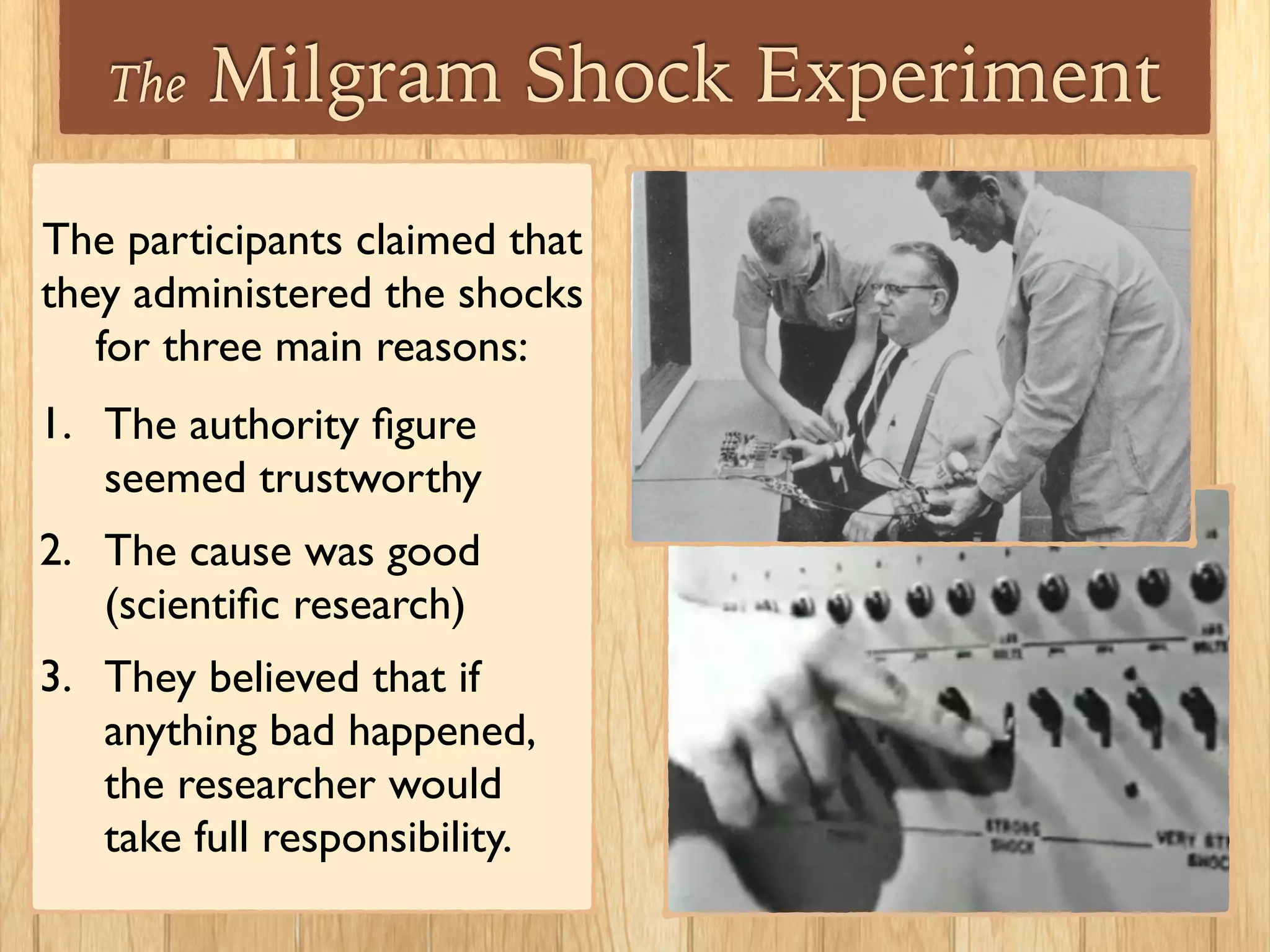
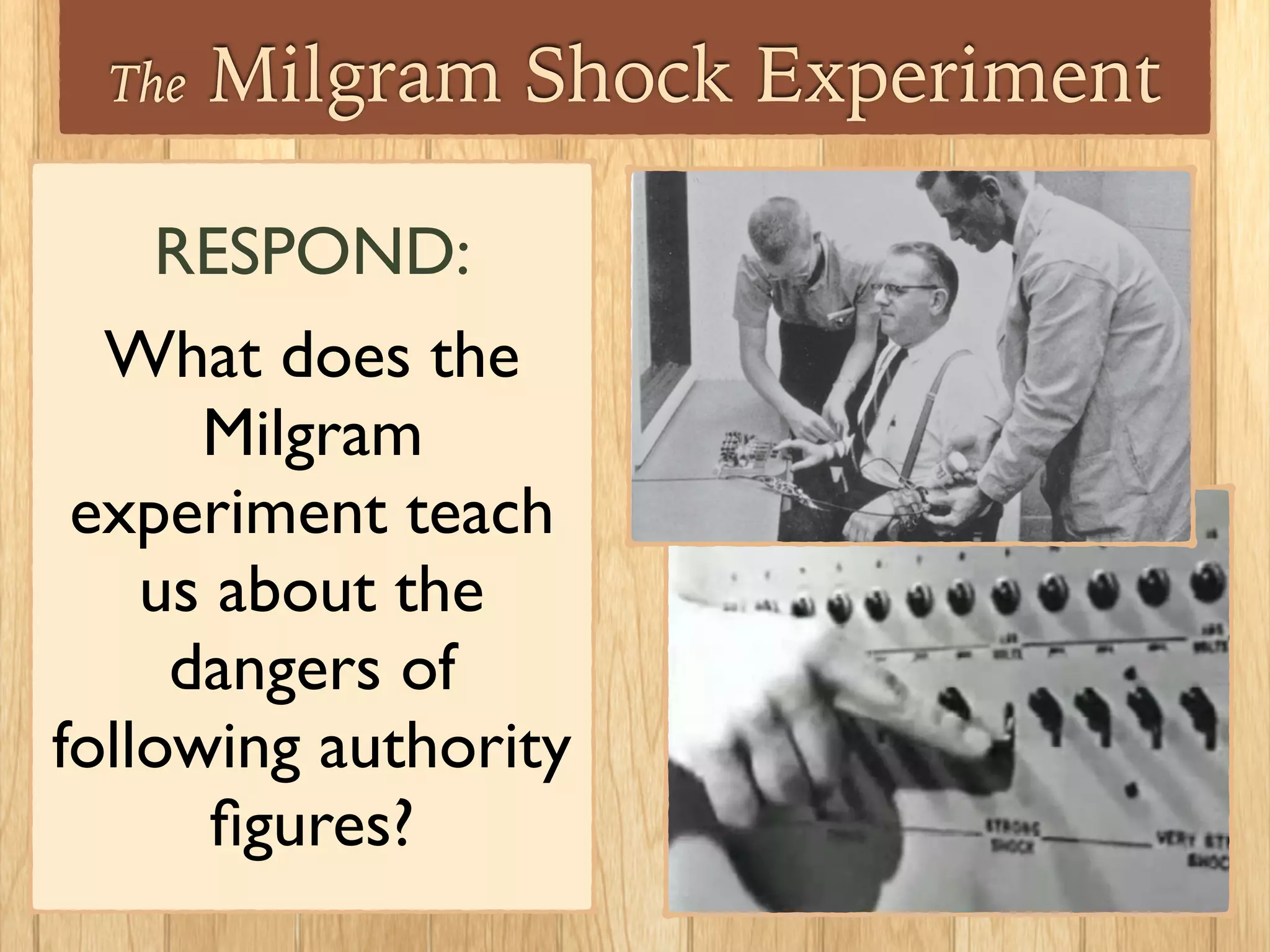
A researcher asks the participant
to administer electric shocks to a
test subject when he answers
questions incorrectly.The test
subject is an actor, who makes
noises of pain when he receives
the shocks.The participant is
made to believe that each shock
is stronger than the last one.
6.
The Milgram ShockExperiment
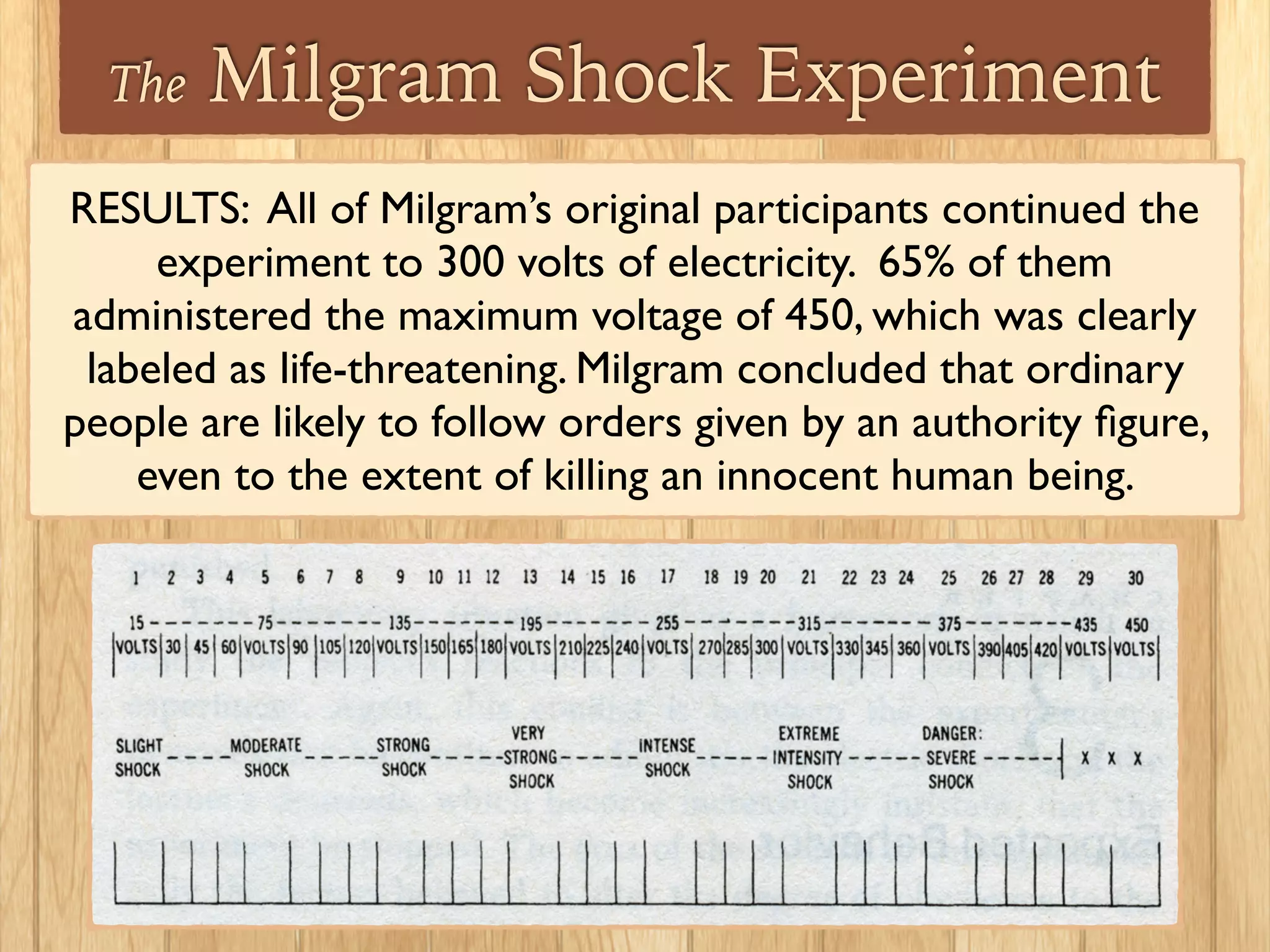
RESULTS: All of Milgram’s original participants continued the
experiment to 300 volts of electricity. 65% of them
administered the maximum voltage of 450, which was clearly
labeled as life-threatening. Milgram concluded that ordinary
people are likely to follow orders given by an authority figure,
even to the extent of killing an innocent human being.
7.
The Milgram ShockExperiment
The participants claimed that
they administered the shocks
for three main reasons:
1. The authority figure
seemed trustworthy
2. The cause was good
(scientific research)
3. They believed that if
anything bad happened,
the researcher would
take full responsibility.





![Hunter Poster for April 25[1]](https://cdn.slidesharecdn.com/ss_thumbnails/d6ea8904-7cea-4674-bd8e-81fa8b1e7cf6-150310094032-conversion-gate01-thumbnail.jpg?width=640&height=640&fit=bounds)


