Moral
Development
Morality:
Our understanding of the difference between
right and wrong or good and bad behavior.
Some people believe in absolute morality: the idea that moral rules apply to all people in all
situations at all times in history. They might argue that killing another person is always wrong in
every situation.
Some people believe in relative morality: the idea that moral rules are relative to our personal
or cultural environments.They might argue that each individual society or era of history
determines what is morally right and wrong.
We are talking about morality in this unit
because morality can be thought of as a
force that motivates our behavior.
Morality & Freud
From Freud’s perspective, motivation looks like this:
ID
Desire to seek
pleasure and
avoid pain
SUPEREGO
Desire to be a
good human
being
(morality)
INTERNAL
STRUGGLE
Morality & Maslow
Maslow saw morality as related to self-actualization.
From his perspective, becoming a morally good
human being is a necessary part of fulfilling your
highest potential.
A poor man named Heinz has a wife who is dying, and needs a
newly developed drug that will cure her. The drug is very
expensive and Heinz has no health insurance, so every day, Heinz
crowd funds to raise the money. However, he fails to earn enough
to pay for the medicine. The company CEO charges ten times
what the drug cost him to make, so Heinz decides to ask him if he
can give one dose away for free. The CEO refuses to give the drug
away for free because “research and development is expensive and
the company needs to make a profit,” he says. One day, Heinz
decides to break into the hospital pharmacy and steal the drug.
Warm up: Write a letter to Heinz (5 sentences
minimum) explaining why his choice was either RIGHT
or WRONG, and explain WHY you believe this.
Kohlberg’s Theory of
Moral Development
Lawrence Kohlberg
(1927-1987) was a psychologist
who created a theory of moral
development: it describes how
one’s sense of right and wrong
changes with age.
How do we develop a sense of
justice? How do we learn to
make moral judgements?
“Kohlberg Dilemmas”
In order to study moral development, Kohlberg
created situations (like the Heinz story) which he
called “dilemmas,” and read them to people of all ages.
He took their responses and categorized them into
three levels of morality (6 stages total: two in each
level) based on certain characteristics that he noticed.
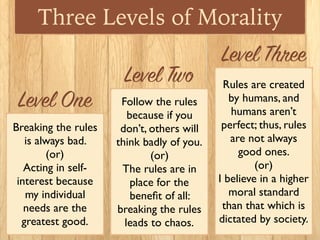
Three Levels of Morality
Breaking the rules
is always bad.
(or)
Acting in self-
interest because
my individual
needs are the
greatest good.
Follow the rules
because if you
don’t, others will
think badly of you.
(or)
The rules are in
place for the
benefit of all:
breaking the rules
leads to chaos.
Rules are created
by humans, and
humans aren’t
perfect; thus, rules
are not always
good ones.
(or)
I believe in a higher
moral standard
than that which is
dictated by society.
Level One
Level Two
Level Three
Stage 1: Obedience & Punishment
Sense of morality is based
on avoiding external
punishments.Thus, an action
is perceived as wrong only if
the person is punished.
People in this stage are
overly trusting of authority
figures (such as parents,
governments, holy texts),
and will often say something
is right or wrong “because
authority figure says so.”
Level 1: Preconventional Morality
Stealing is bad because
the law says so. You
will get in trouble if you
steal!
Stage 2: Self-Interest
Sense of morality is
based on whatever
the individual believes
is in their best
interest (but in a
narrow way which
does not consider
one's reputation or
relationships to
groups of people).
Level 1: Preconventional Morality
Stealing is ok if it allows you
to get what you want.
Level One:
“The law is always right”
or
“Acting in self-interest”
( Video )
Stage 3: Accord & Conformity
Sense of morality is
based on social
standards and how
one will be
perceived by others.
Being approved of
and respected by
others is considered
important because
it is self-beneficial.
Level 2: Conventional Morality
Stealing is a bad idea
because if people find out,
they will think you’re
untrustworthy, or a criminal.
Stage 4: Social Order-Maintaining
Sense of morality is based
on the fact that following
laws provides us with a
stable, safe, and functioning
society. If one person breaks
a law, everyone could
potentially break it, creating
danger and chaos.Thus,
following laws and the
orders of an outside
authority is beneficial for
everyone.
Level 2: Conventional Morality
Stealing is bad because
if everyone were
allowed to steal, no
one’s property would be
safe.There would be no
social order.
Level Two:
“Act in a way that other
people will approve of”
or
“The law benefits and
protects society”
Stage 5: Social Contract Understanding
Sense of morality is based on
an understanding that each
society creates it own values,
laws, rights, and moral
standards. Laws are understood
to be social contracts between
the governors and the
governed: people are capable of
making bad laws, and any laws
that do not promote general
welfare should be removed or
changed.
Level 3: Postconventional Morality
If the rules cause an
injustice to happen,
perhaps the rules
need to be changed,
or perhaps you should
defy the rules.
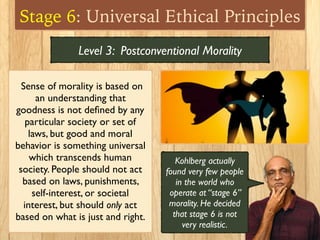
Stage 6: Universal Ethical Principles
Sense of morality is based on
an understanding that
goodness is not defined by any
particular society or set of
laws, but good and moral
behavior is something universal
which transcends human
society. People should not act
based on laws, punishments,
self-interest, or societal
interest, but should only act
based on what is just and right.
Level 3: Postconventional Morality
Kohlberg actually
found very few people
in the world who
operate at “stage 6”
morality. He decided
that stage 6 is not
very realistic.
Level Three:
“The law is not always moral”
or
“There is a universal
definition of good beyond
what an individual society
defines it to be”
Moral Level In Favor of Stealing Against Stealing
Level 1:
Preconventional
Morality
(Interests of the individual are
considered in terms of rewards
and punishments)
“It was right to steal, because he
might have been blamed for the
death of his wife.”
“It was wrong to steal, because
he might be caught and sent to
jail. If he doesn't get caught, he
might spend his whole life in fear
thinking of how the police could
catch him at any minute”.
Level 2: Conventional
Morality
(Interests of the individual are
considered in terms of how others
perceive them and how they act as
good members of society)
“It was right to steal, because if
his wife had died he would never
be able to face other people
again. He will be thought of as a
bad husband and a bad person.”
“It was wrong to steal because
he will feel bad about how he
brought dishonor on himself and
his family by not following the
laws. Everyone must follow laws
in order to keep society orderly.”
Level 3:
Postconventional
Morality
(Individuals follow moral standards
that are greater than those of any
particular society)
“It was right to steal, because life
is more important than property.
What is truly wrong in this
situation is that society does not
agree: the law favors property
over life.”
“It was wrong to steal because
he will always condemn himself
for not living up to his own
standards of honesty.”
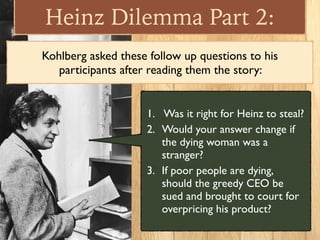
Heinz Dilemma Part 2:
Kohlberg asked these follow up questions to his
participants after reading them the story:
1. Was it right for Heinz to steal?
2. Would your answer change if
the dying woman was a
stranger?
3. If poor people are dying,
should the greedy CEO be
sued and brought to court for
overpricing his product?
Problems with Kohlberg’s Theory:
Does moral behavior actually match moral thoughts?
People have pointed out that Kohlberg’s scenario is
hypothetical: the way people answer the question may not
be how they would act in real life.
Are there distinct stages to moral development, or do different
situations result in different types of moral choices? Some
adults may make a level three decision in one scenario, but
fall back to a level one decision in another.
Is justice the most important moral principle? Some argue
that compassion is more important.
1
2
3
Review:
Breaking the rules
is always bad.
(or)
Acting in self-
interest because
my individual
needs are the
greatest good.
Follow the rules
because if you
don’t, others will
think badly of you.
(or)
The rules are in
place for the
benefit of all:
breaking the rules
leads to chaos.
Rules are created
by humans, and
humans aren’t
perfect; thus, rules
are not always
good ones.
(or)
I believe in a higher
moral standard
than that which is
dictated by society.
Level One
Level Two
Level Three
Group Activity:
Which brother’s action
was worse? Why?

Moral Development

  • 1.
  • 2.
    Morality: Our understanding ofthe difference between right and wrong or good and bad behavior. Some people believe in absolute morality: the idea that moral rules apply to all people in all situations at all times in history. They might argue that killing another person is always wrong in every situation. Some people believe in relative morality: the idea that moral rules are relative to our personal or cultural environments.They might argue that each individual society or era of history determines what is morally right and wrong. We are talking about morality in this unit because morality can be thought of as a force that motivates our behavior.
  • 3.
    Morality & Freud FromFreud’s perspective, motivation looks like this: ID Desire to seek pleasure and avoid pain SUPEREGO Desire to be a good human being (morality) INTERNAL STRUGGLE
  • 4.
    Morality & Maslow Maslowsaw morality as related to self-actualization. From his perspective, becoming a morally good human being is a necessary part of fulfilling your highest potential.
  • 5.
    A poor mannamed Heinz has a wife who is dying, and needs a newly developed drug that will cure her. The drug is very expensive and Heinz has no health insurance, so every day, Heinz crowd funds to raise the money. However, he fails to earn enough to pay for the medicine. The company CEO charges ten times what the drug cost him to make, so Heinz decides to ask him if he can give one dose away for free. The CEO refuses to give the drug away for free because “research and development is expensive and the company needs to make a profit,” he says. One day, Heinz decides to break into the hospital pharmacy and steal the drug. Warm up: Write a letter to Heinz (5 sentences minimum) explaining why his choice was either RIGHT or WRONG, and explain WHY you believe this.
  • 6.
    Kohlberg’s Theory of MoralDevelopment Lawrence Kohlberg (1927-1987) was a psychologist who created a theory of moral development: it describes how one’s sense of right and wrong changes with age. How do we develop a sense of justice? How do we learn to make moral judgements?
  • 7.
    “Kohlberg Dilemmas” In orderto study moral development, Kohlberg created situations (like the Heinz story) which he called “dilemmas,” and read them to people of all ages. He took their responses and categorized them into three levels of morality (6 stages total: two in each level) based on certain characteristics that he noticed.
  • 8.
    Three Levels ofMorality Breaking the rules is always bad. (or) Acting in self- interest because my individual needs are the greatest good. Follow the rules because if you don’t, others will think badly of you. (or) The rules are in place for the benefit of all: breaking the rules leads to chaos. Rules are created by humans, and humans aren’t perfect; thus, rules are not always good ones. (or) I believe in a higher moral standard than that which is dictated by society. Level One Level Two Level Three
  • 9.
    Stage 1: Obedience& Punishment Sense of morality is based on avoiding external punishments.Thus, an action is perceived as wrong only if the person is punished. People in this stage are overly trusting of authority figures (such as parents, governments, holy texts), and will often say something is right or wrong “because authority figure says so.” Level 1: Preconventional Morality Stealing is bad because the law says so. You will get in trouble if you steal!
  • 10.
    Stage 2: Self-Interest Senseof morality is based on whatever the individual believes is in their best interest (but in a narrow way which does not consider one's reputation or relationships to groups of people). Level 1: Preconventional Morality Stealing is ok if it allows you to get what you want.
  • 11.
    Level One: “The lawis always right” or “Acting in self-interest” ( Video )
  • 12.
    Stage 3: Accord& Conformity Sense of morality is based on social standards and how one will be perceived by others. Being approved of and respected by others is considered important because it is self-beneficial. Level 2: Conventional Morality Stealing is a bad idea because if people find out, they will think you’re untrustworthy, or a criminal.
  • 13.
    Stage 4: SocialOrder-Maintaining Sense of morality is based on the fact that following laws provides us with a stable, safe, and functioning society. If one person breaks a law, everyone could potentially break it, creating danger and chaos.Thus, following laws and the orders of an outside authority is beneficial for everyone. Level 2: Conventional Morality Stealing is bad because if everyone were allowed to steal, no one’s property would be safe.There would be no social order.
  • 14.
    Level Two: “Act ina way that other people will approve of” or “The law benefits and protects society”
  • 15.
    Stage 5: SocialContract Understanding Sense of morality is based on an understanding that each society creates it own values, laws, rights, and moral standards. Laws are understood to be social contracts between the governors and the governed: people are capable of making bad laws, and any laws that do not promote general welfare should be removed or changed. Level 3: Postconventional Morality If the rules cause an injustice to happen, perhaps the rules need to be changed, or perhaps you should defy the rules.
  • 16.
    Stage 6: UniversalEthical Principles Sense of morality is based on an understanding that goodness is not defined by any particular society or set of laws, but good and moral behavior is something universal which transcends human society. People should not act based on laws, punishments, self-interest, or societal interest, but should only act based on what is just and right. Level 3: Postconventional Morality Kohlberg actually found very few people in the world who operate at “stage 6” morality. He decided that stage 6 is not very realistic.
  • 17.
    Level Three: “The lawis not always moral” or “There is a universal definition of good beyond what an individual society defines it to be”
  • 18.
    Moral Level InFavor of Stealing Against Stealing Level 1: Preconventional Morality (Interests of the individual are considered in terms of rewards and punishments) “It was right to steal, because he might have been blamed for the death of his wife.” “It was wrong to steal, because he might be caught and sent to jail. If he doesn't get caught, he might spend his whole life in fear thinking of how the police could catch him at any minute”. Level 2: Conventional Morality (Interests of the individual are considered in terms of how others perceive them and how they act as good members of society) “It was right to steal, because if his wife had died he would never be able to face other people again. He will be thought of as a bad husband and a bad person.” “It was wrong to steal because he will feel bad about how he brought dishonor on himself and his family by not following the laws. Everyone must follow laws in order to keep society orderly.” Level 3: Postconventional Morality (Individuals follow moral standards that are greater than those of any particular society) “It was right to steal, because life is more important than property. What is truly wrong in this situation is that society does not agree: the law favors property over life.” “It was wrong to steal because he will always condemn himself for not living up to his own standards of honesty.”
  • 19.
    Heinz Dilemma Part2: Kohlberg asked these follow up questions to his participants after reading them the story: 1. Was it right for Heinz to steal? 2. Would your answer change if the dying woman was a stranger? 3. If poor people are dying, should the greedy CEO be sued and brought to court for overpricing his product?
  • 20.
    Problems with Kohlberg’sTheory: Does moral behavior actually match moral thoughts? People have pointed out that Kohlberg’s scenario is hypothetical: the way people answer the question may not be how they would act in real life. Are there distinct stages to moral development, or do different situations result in different types of moral choices? Some adults may make a level three decision in one scenario, but fall back to a level one decision in another. Is justice the most important moral principle? Some argue that compassion is more important. 1 2 3
  • 21.
    Review: Breaking the rules isalways bad. (or) Acting in self- interest because my individual needs are the greatest good. Follow the rules because if you don’t, others will think badly of you. (or) The rules are in place for the benefit of all: breaking the rules leads to chaos. Rules are created by humans, and humans aren’t perfect; thus, rules are not always good ones. (or) I believe in a higher moral standard than that which is dictated by society. Level One Level Two Level Three
  • 22.
    Group Activity: Which brother’saction was worse? Why?