Sensation and Perception
Sensation & Perception

 How do we construct our representations of the external
                       world?

  To represent the world, we must detect physical energy
(stimulus) from the environment and convert it into neural
             signals, a process called sensation.

When we select, organize, and interpret our sensations, the
              process is called perception.
Perceptual Interpretation

Perceptual Interpretation
 Perceptual Adaptation
 Perceptual Set
 Perception and Human Factors
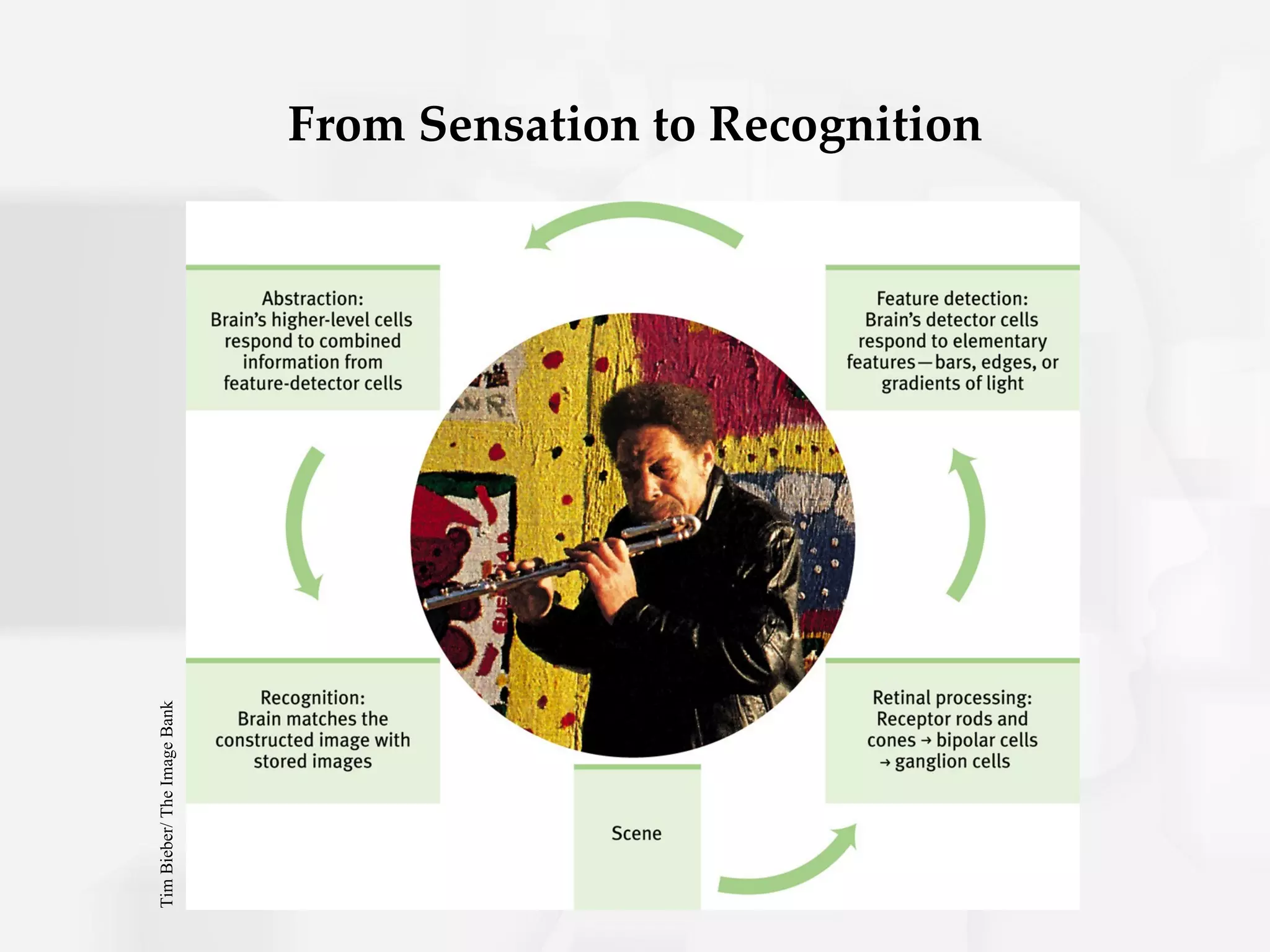
From Sensation to Recognition
Tim Bieber/ The Image Bank
Information Processing in the Visual Cortex


• Early 1960s: Hubel and Wiesel
   – Microelectrode recording of axons in
     primary visual cortex of animals
   – Discovered feature detectors: neurons that
     respond selectively to lines, edges, etc.
   – Groundbreaking research: Nobel Prize in
     1981
• Later research: cells specific to faces in the
  temporal lobes of monkeys and humans
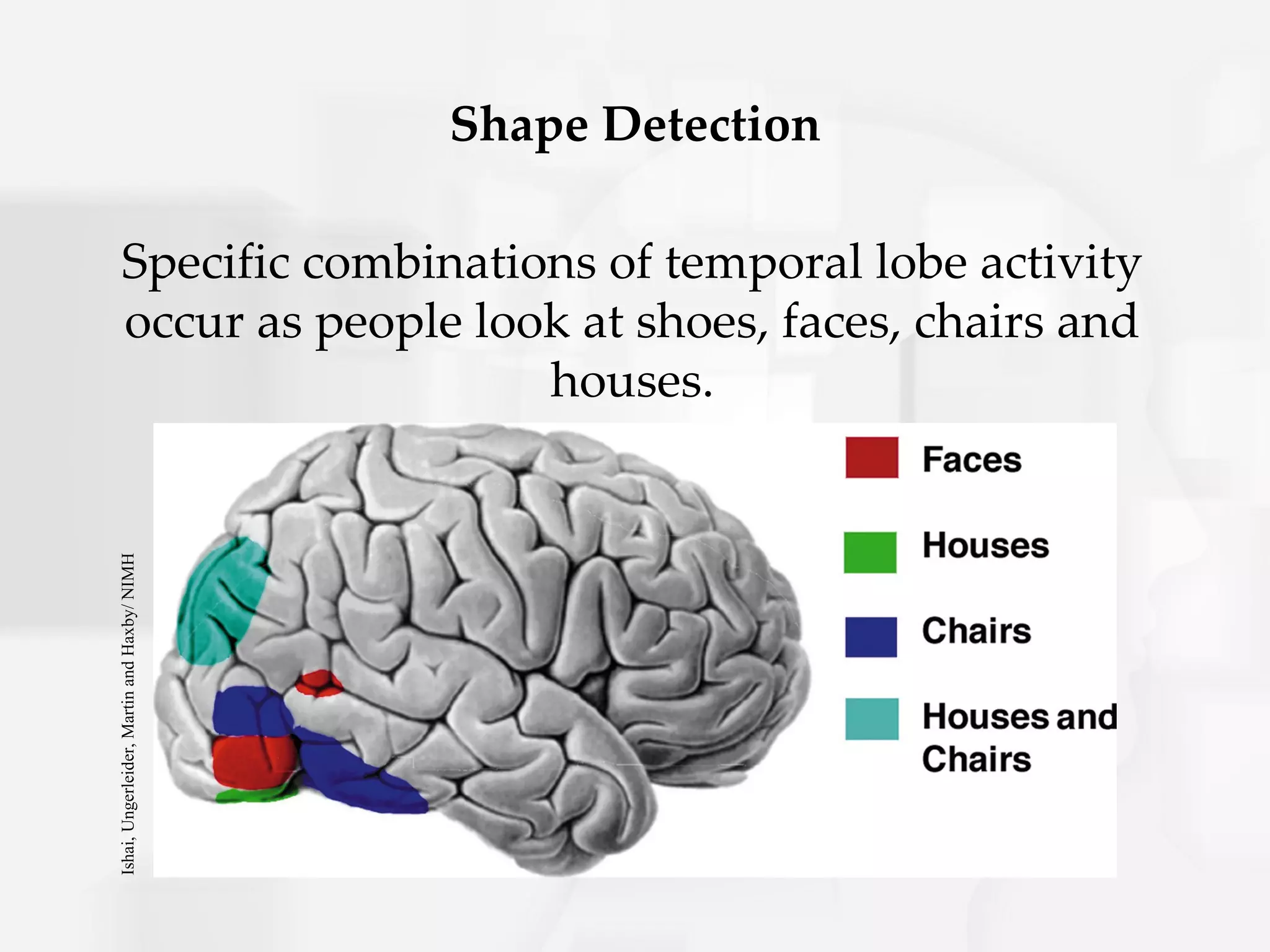
Shape Detection

        Specific combinations of temporal lobe activity
        occur as people look at shoes, faces, chairs and
                           houses.
Ishai, Ungerleider, Martin and Haxby/ NIMH
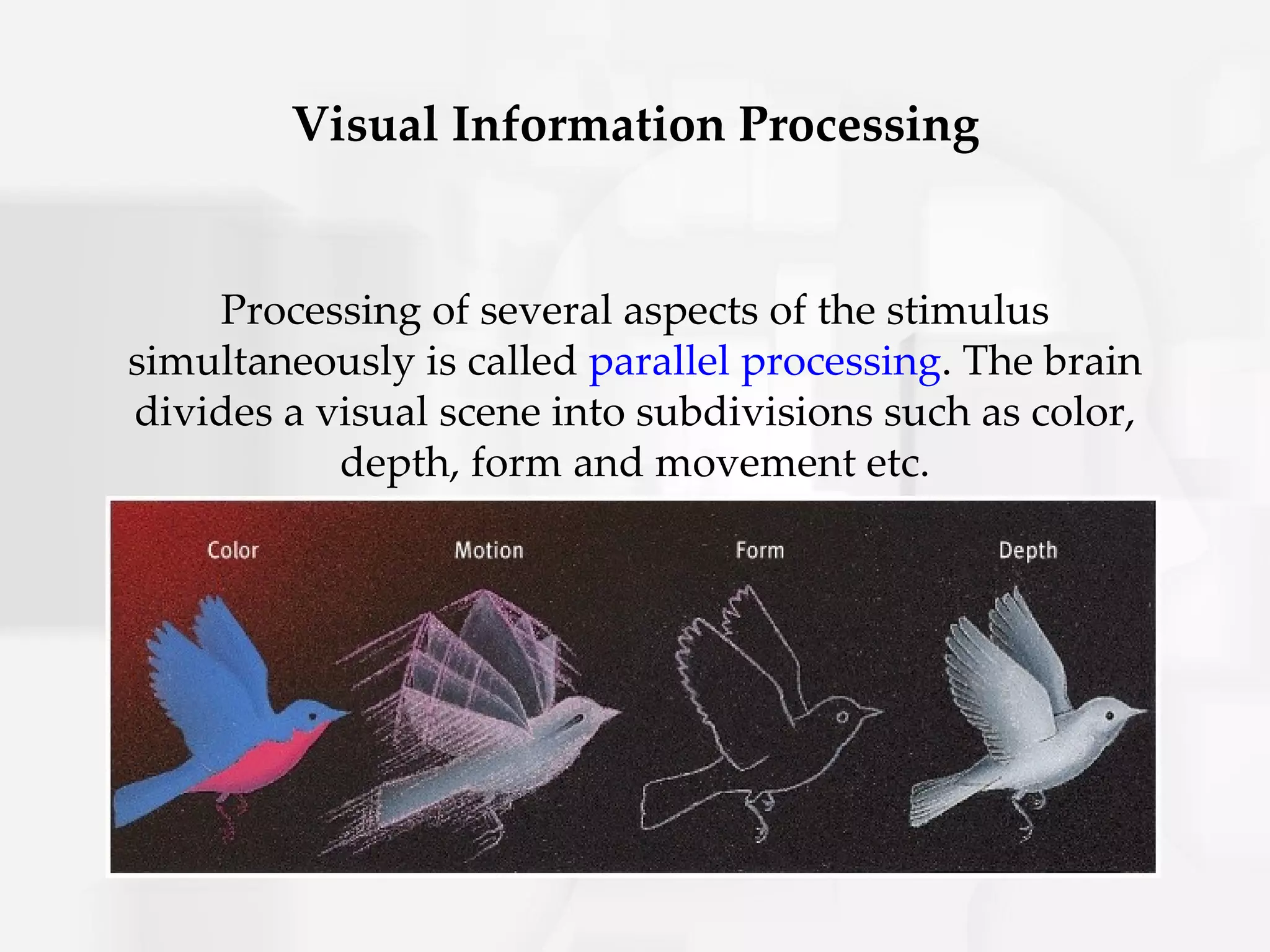
Visual Information Processing


    Processing of several aspects of the stimulus
simultaneously is called parallel processing. The brain
divides a visual scene into subdivisions such as color,
           depth, form and movement etc.
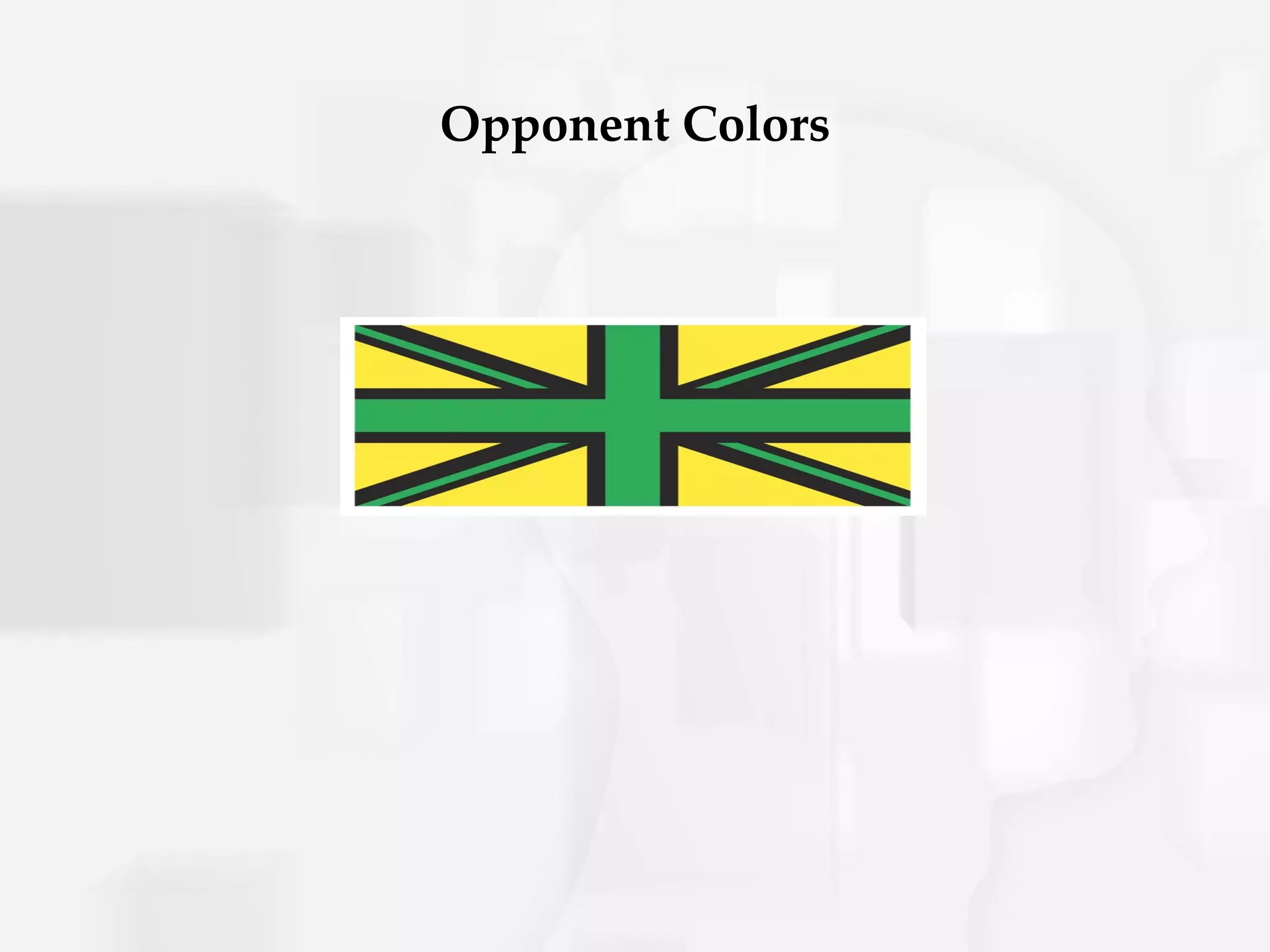
Opponent Colors
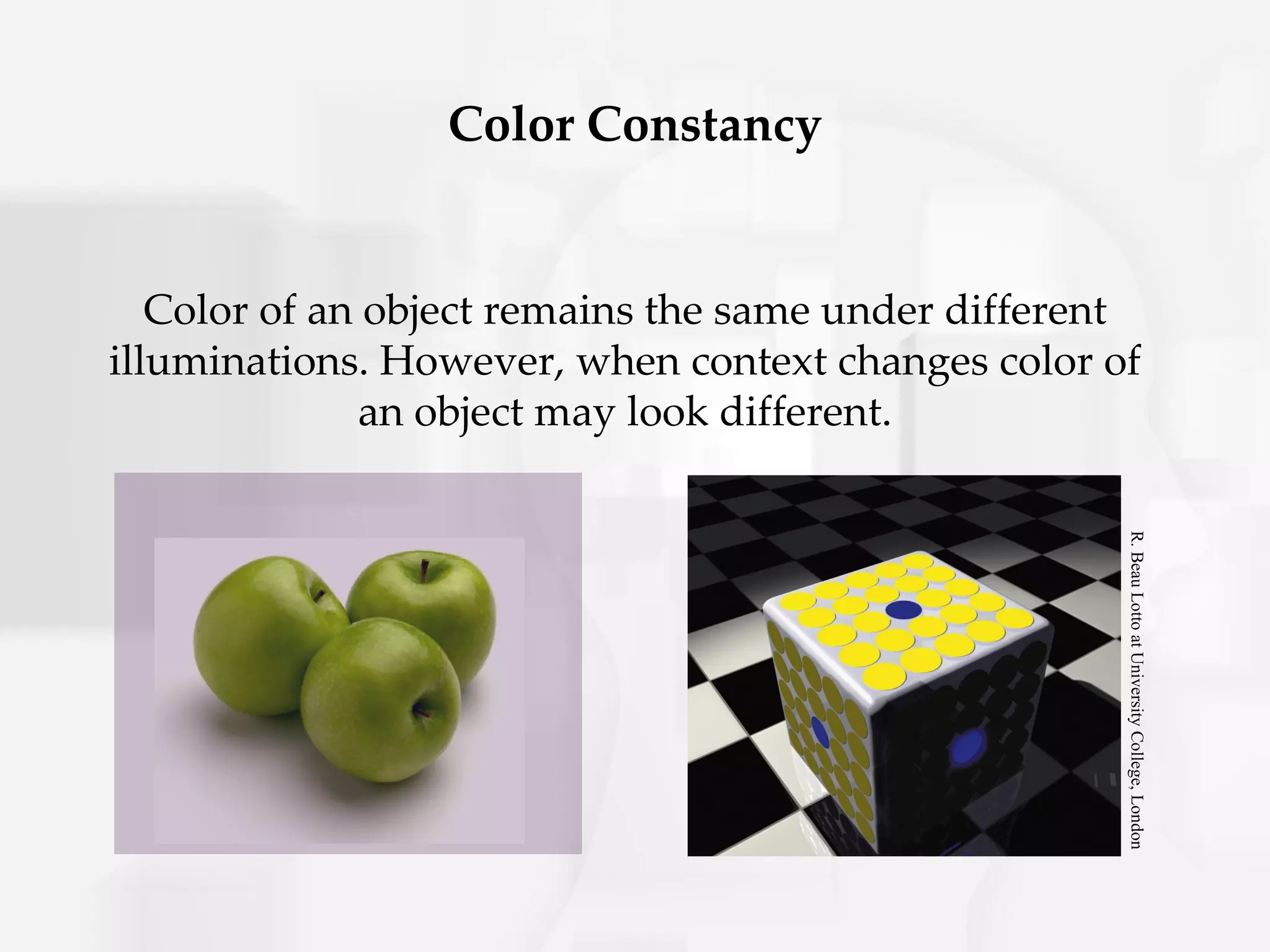
Color Constancy


   Color of an object remains the same under different
illuminations. However, when context changes color of
              an object may look different.


                                                     R. Beau Lotto at University College, London
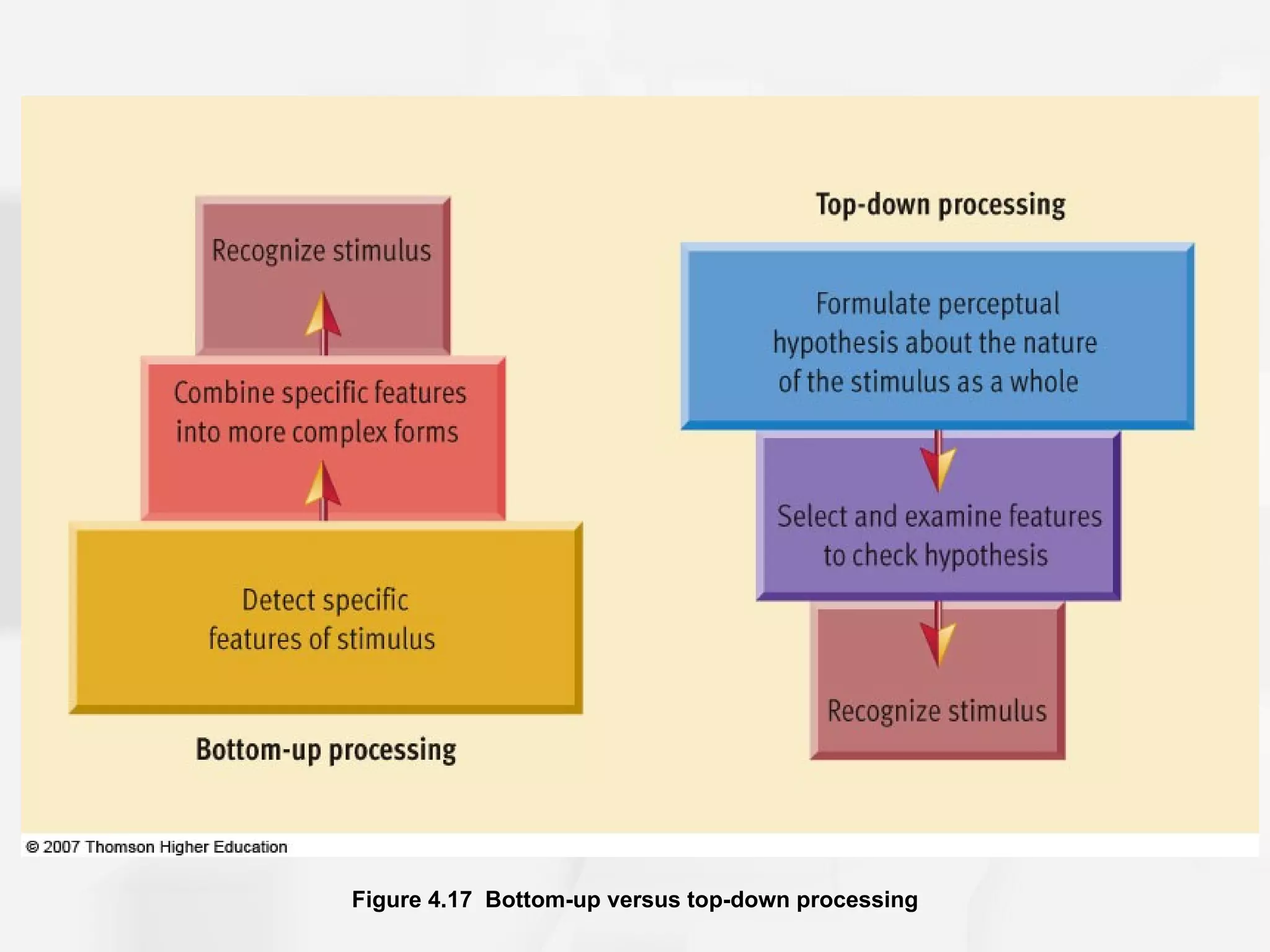
Figure 4.17 Bottom-up versus top-down processing
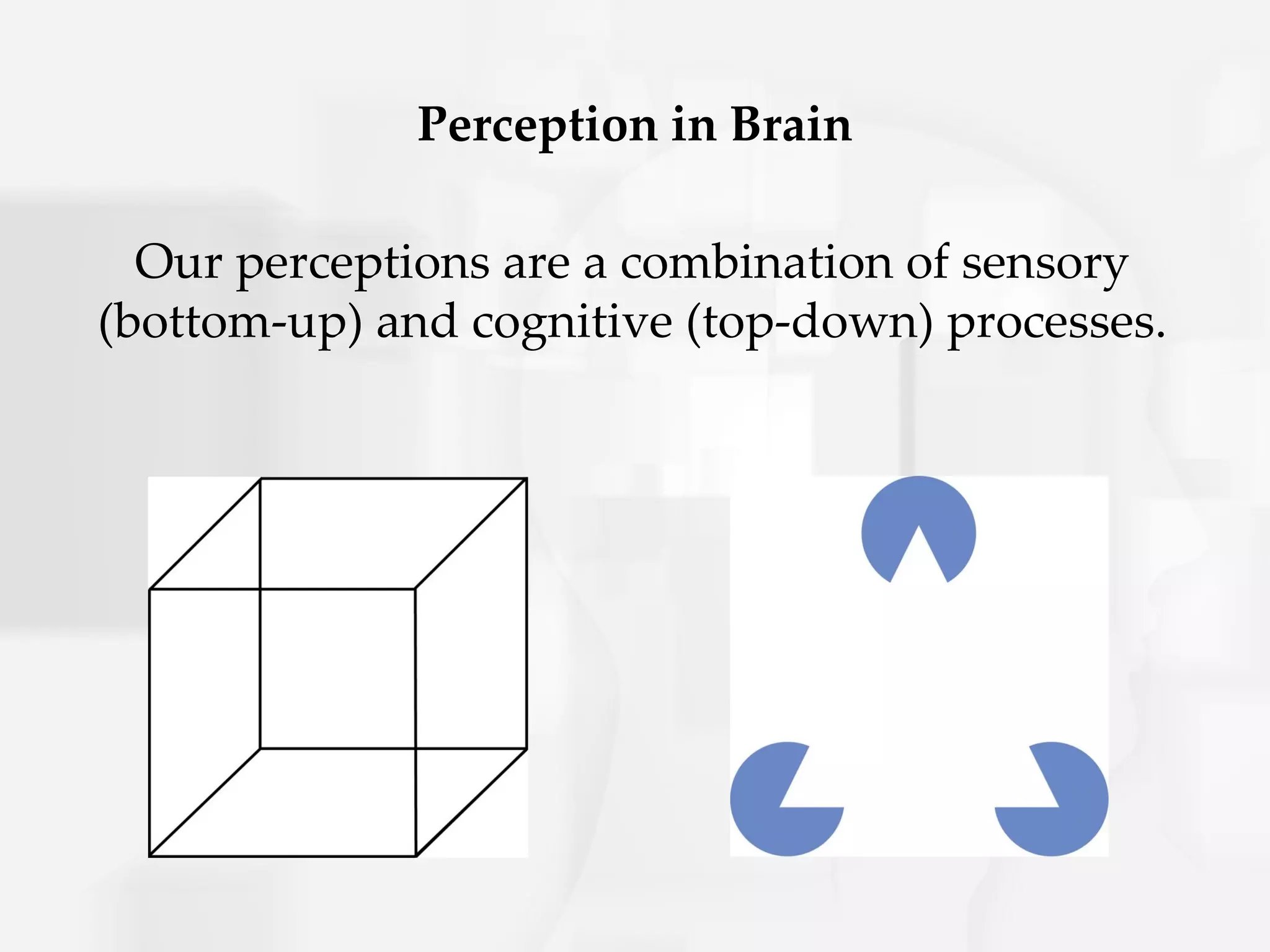
Perception in Brain

  Our perceptions are a combination of sensory
(bottom-up) and cognitive (top-down) processes.
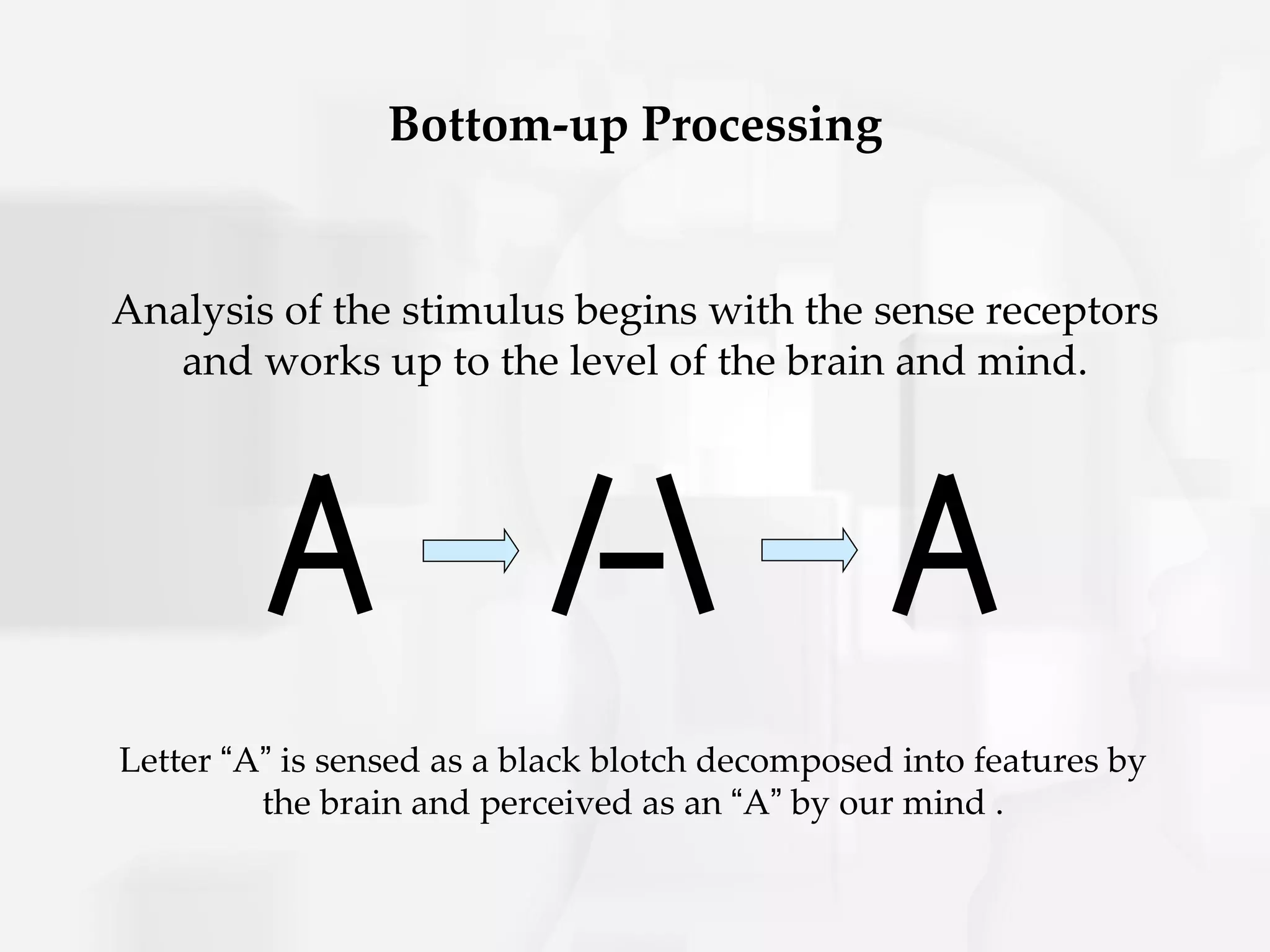
Bottom-up Processing


Analysis of the stimulus begins with the sense receptors
   and works up to the level of the brain and mind.


Letter “A” is sensed as a black blotch decomposed into features by
         the brain and perceived as an “A” by our mind .
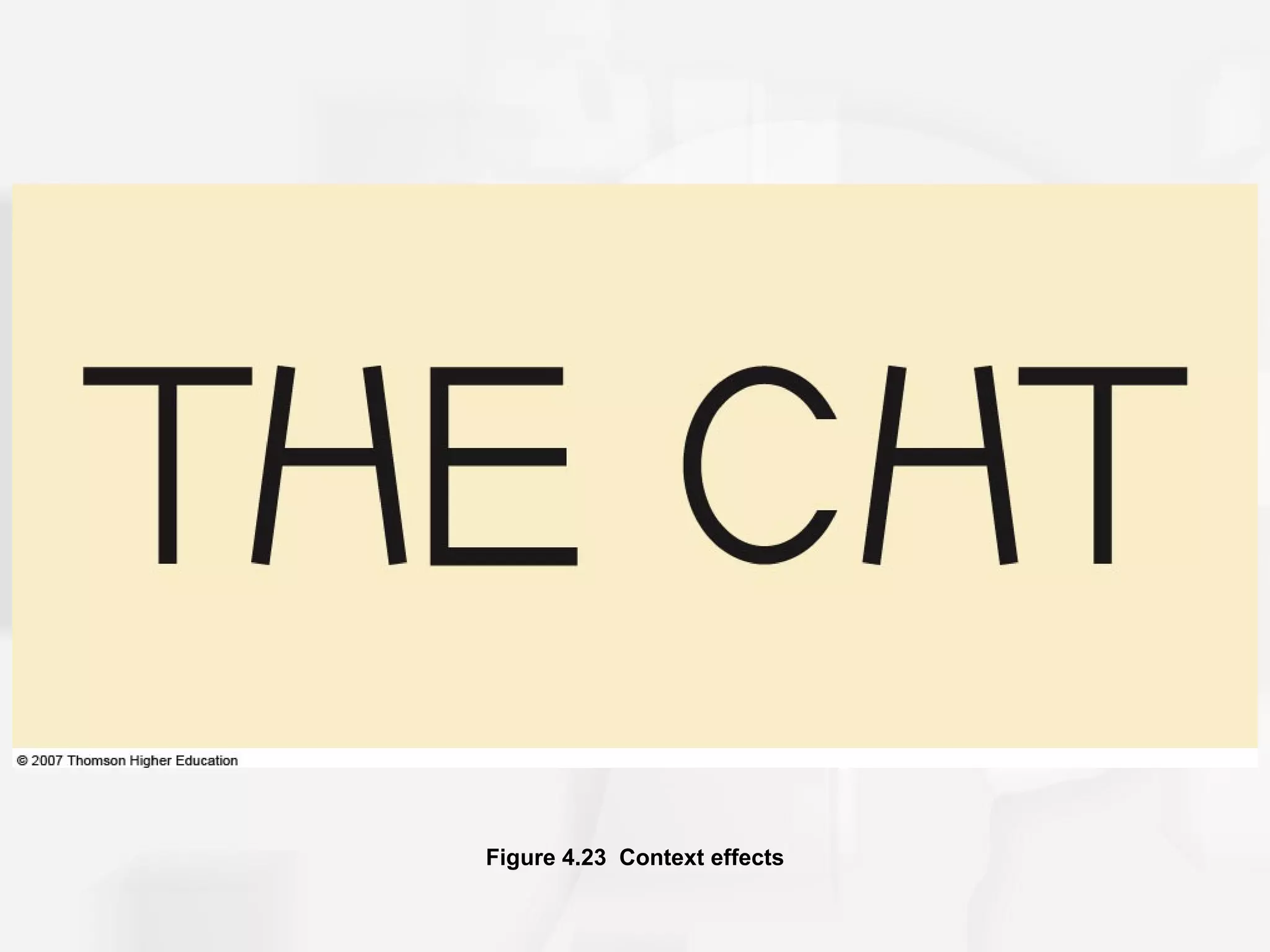
Figure 4.23 Context effects
Principles of Perception


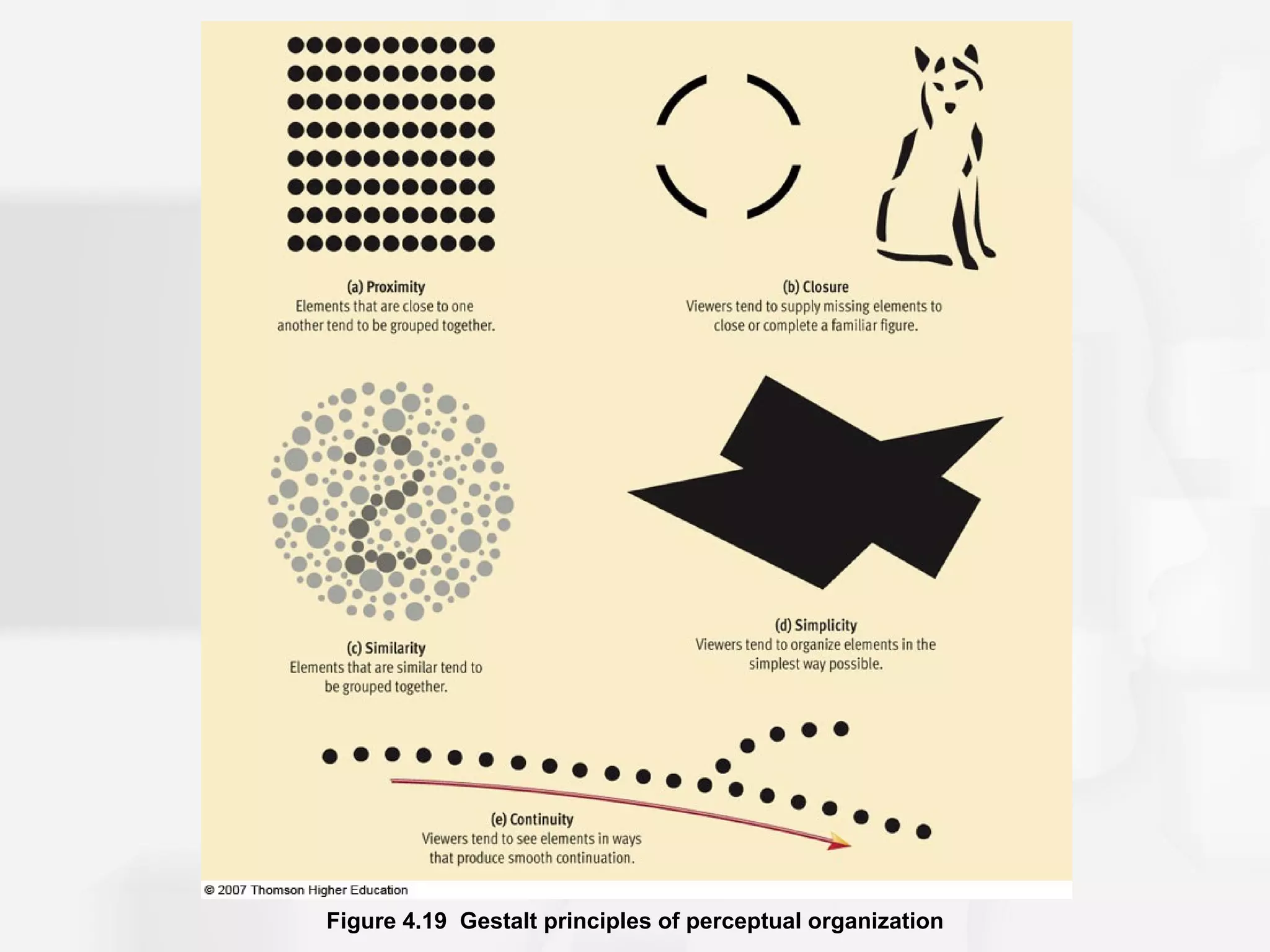
• Gestalt principles of form perception:
  – figure-ground, proximity, closure, similarity,
    simplicity, and continuity
• Recent research:
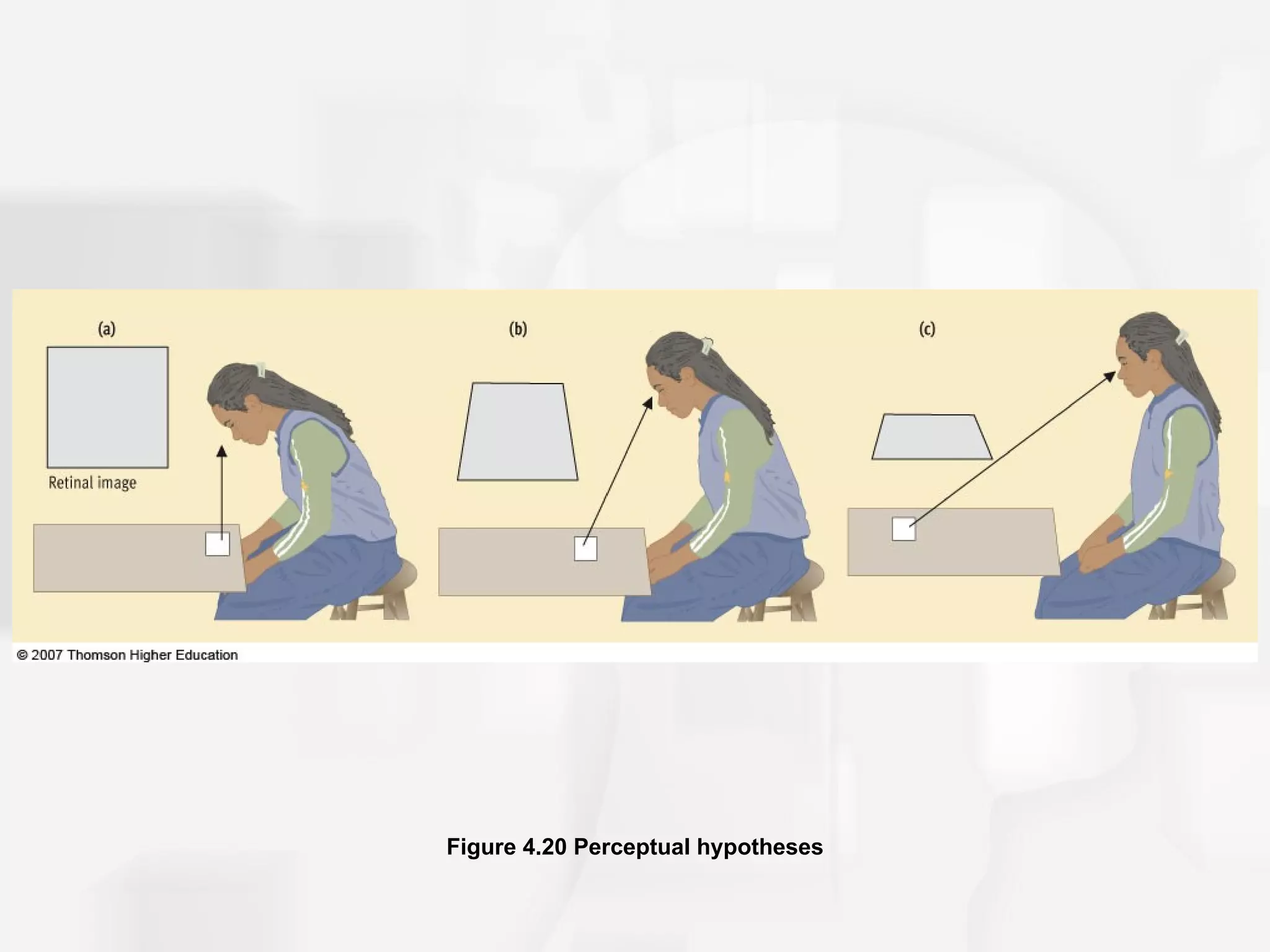
  – Perceptual hypotheses
      • Context
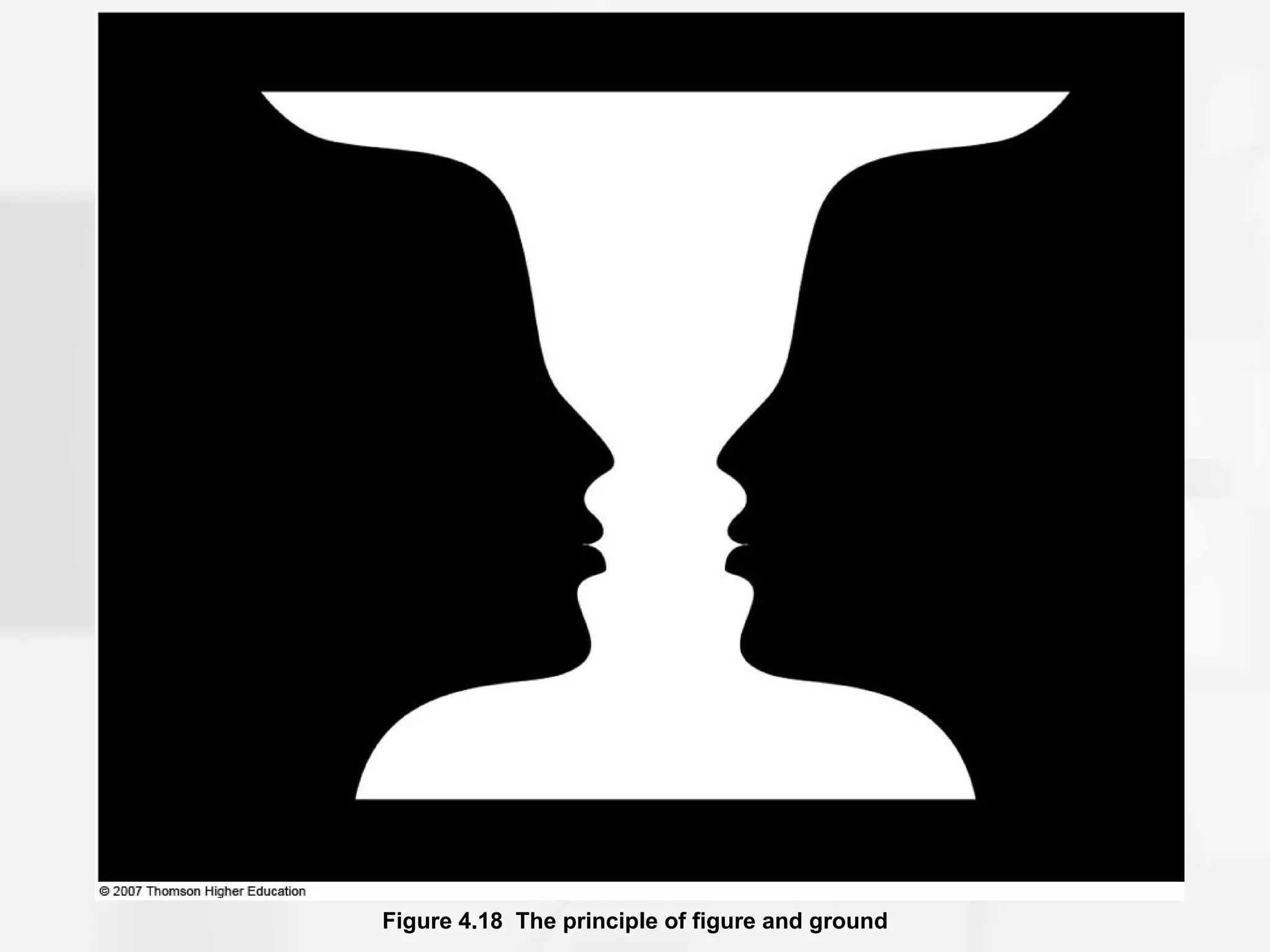
Figure 4.18 The principle of figure and ground
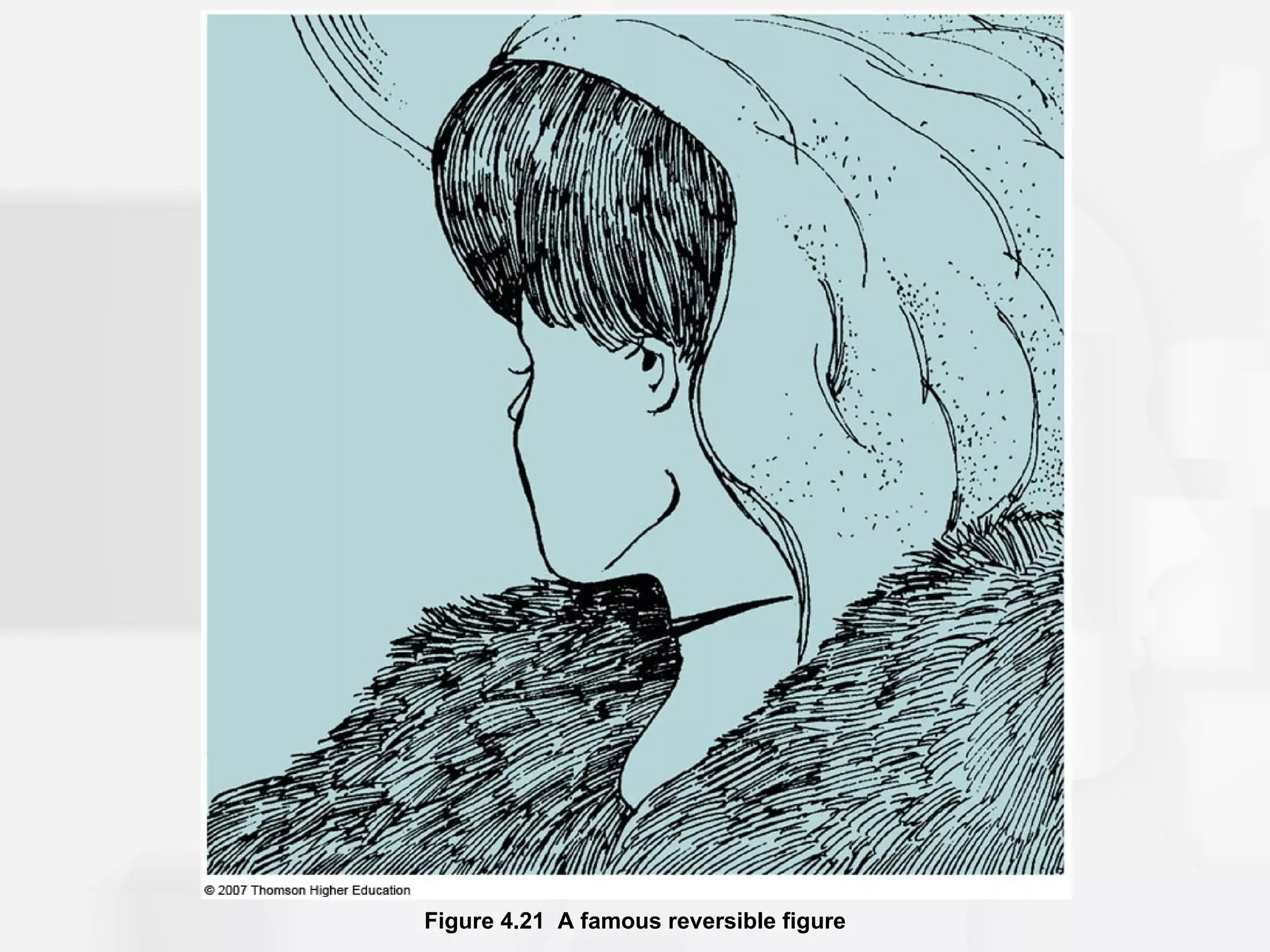
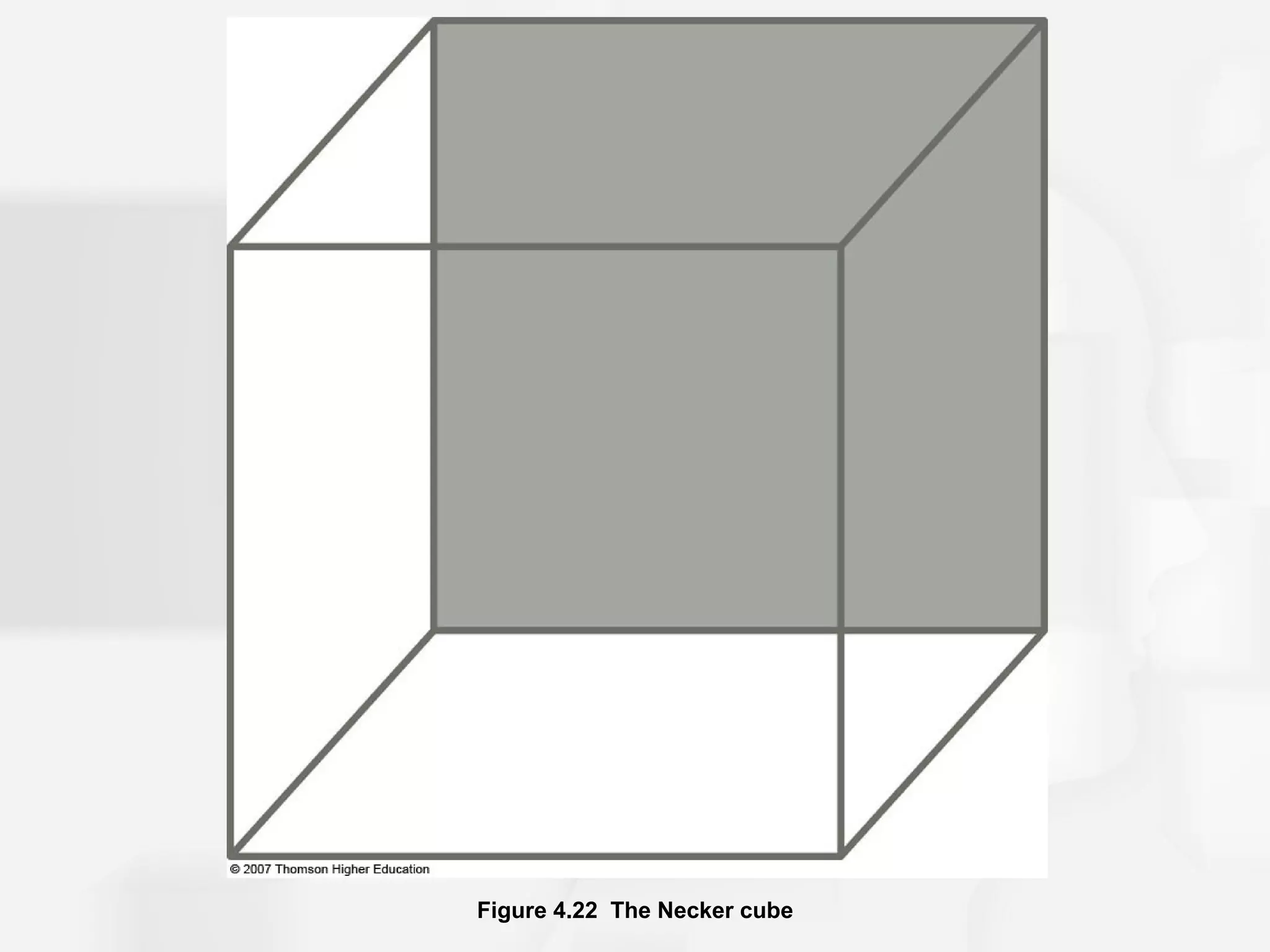
Figure 4.21 A famous reversible figure
Figure 4.19 Gestalt principles of perceptual organization
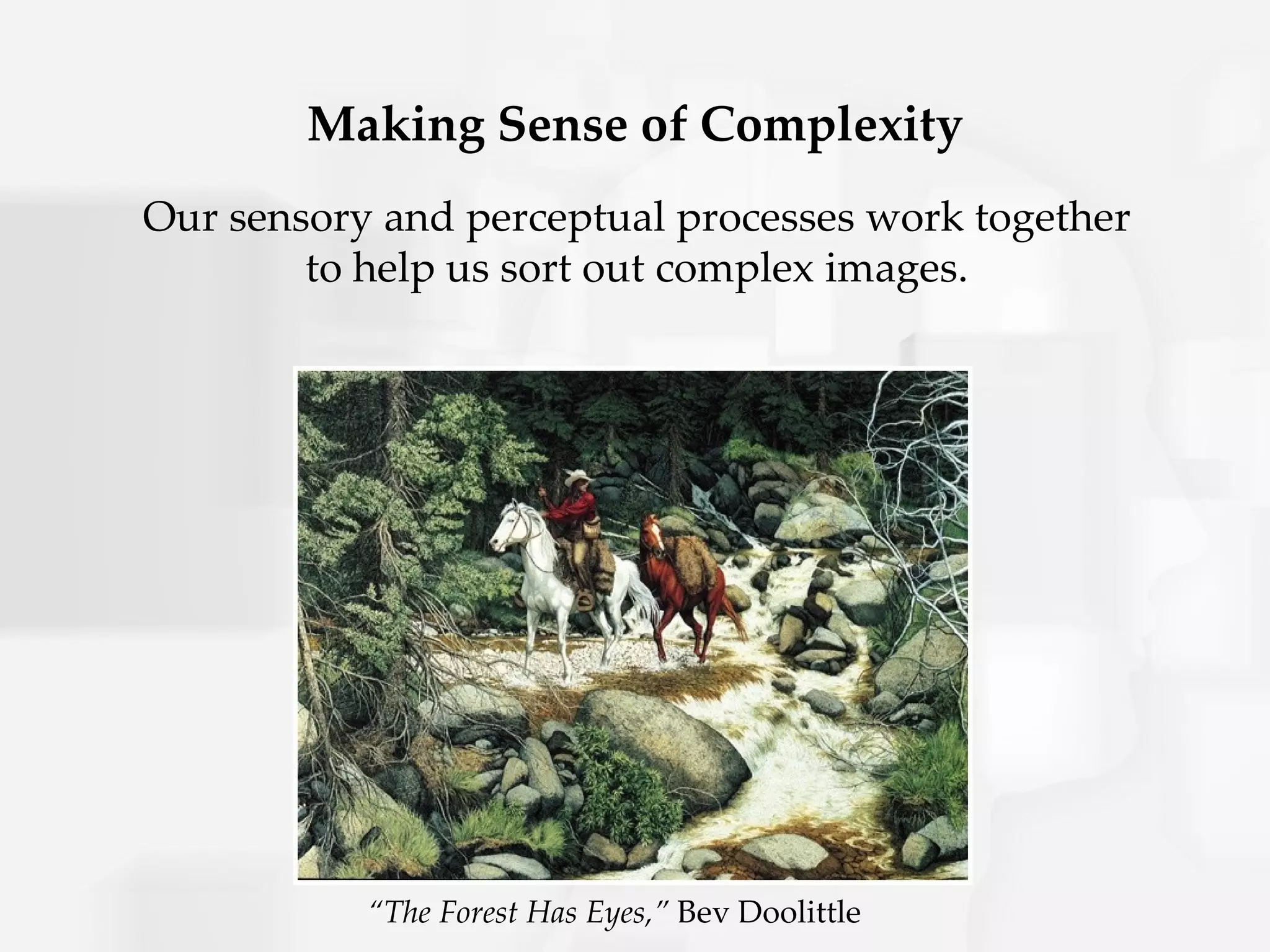
Making Sense of Complexity
Our sensory and perceptual processes work together
        to help us sort out complex images.


           “The Forest Has Eyes,” Bev Doolittle
Figure 4.20 Perceptual hypotheses
Figure 4.22 The Necker cube
The Power of Misleading Cues:
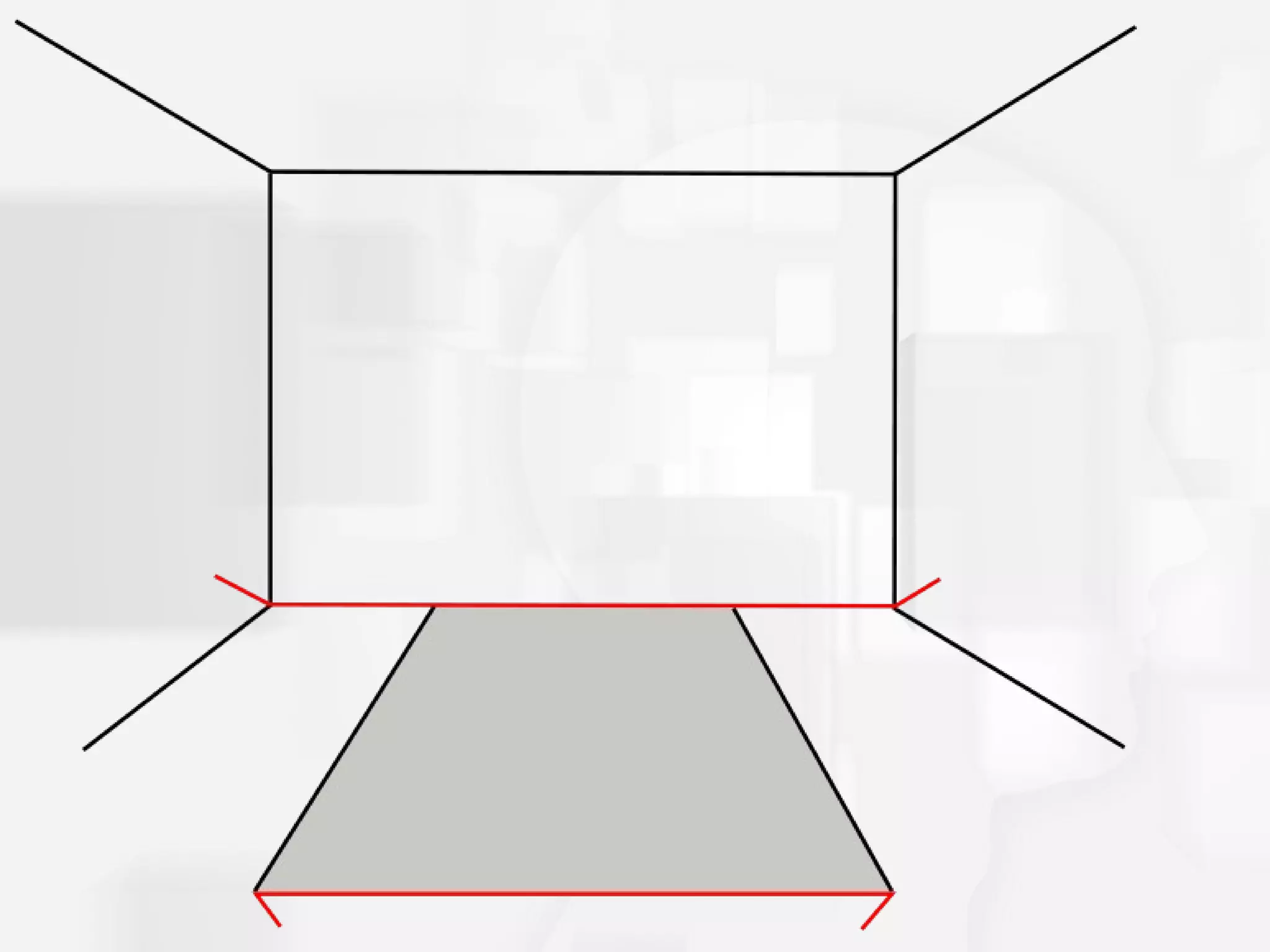
              Visual Illusions

• Optical Illusions - discrepancy between
  visual appearance and physical reality
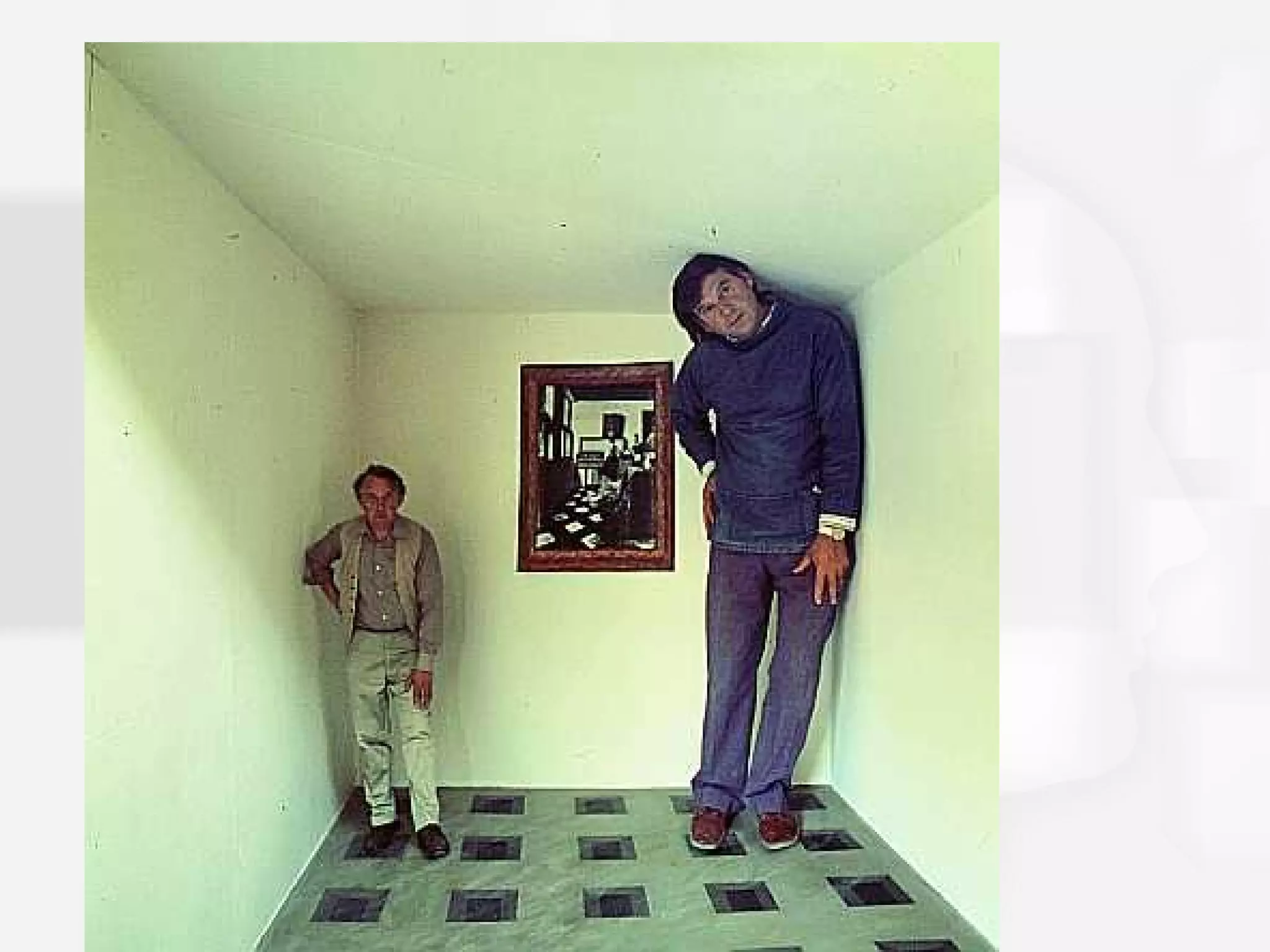
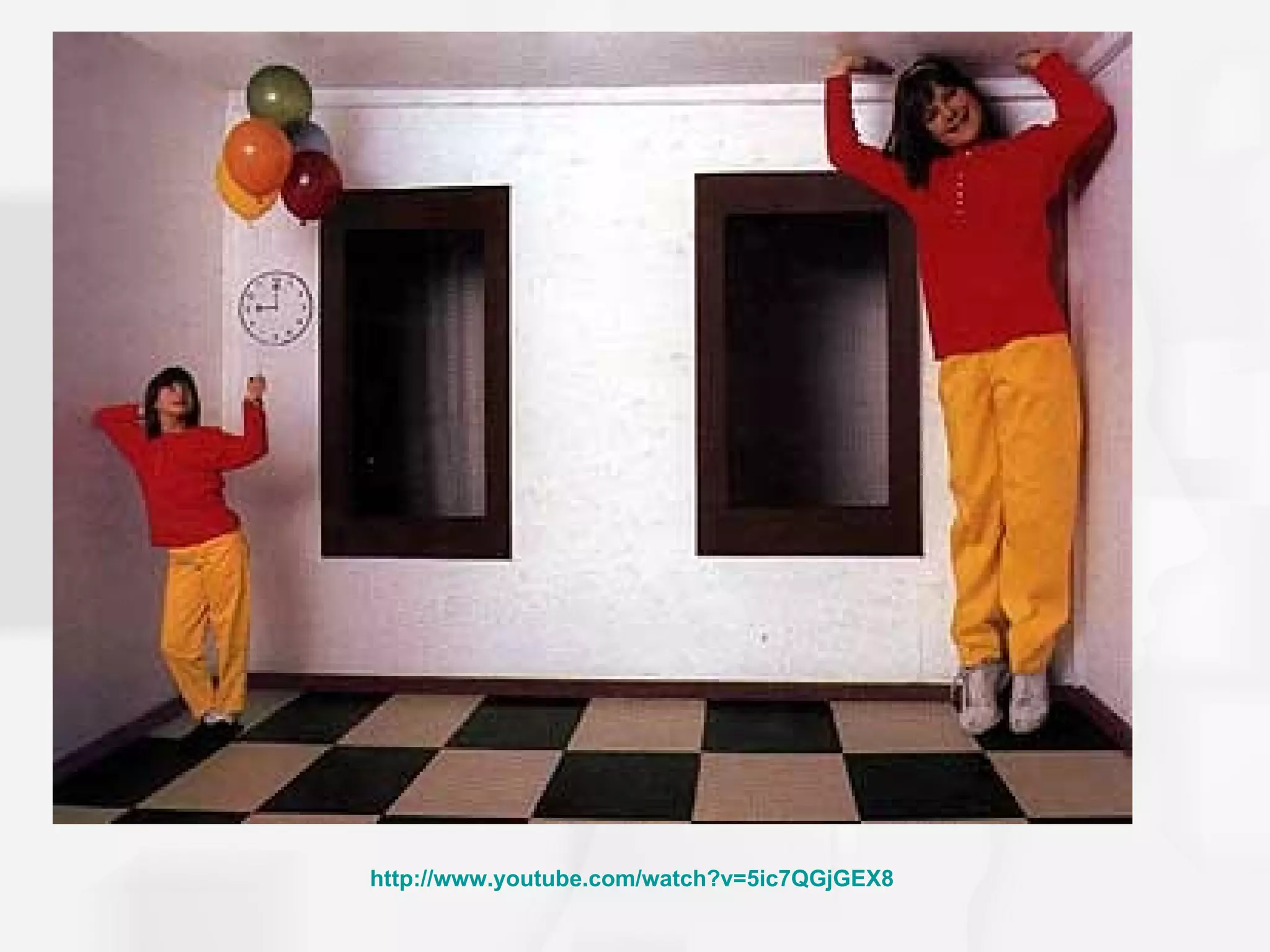
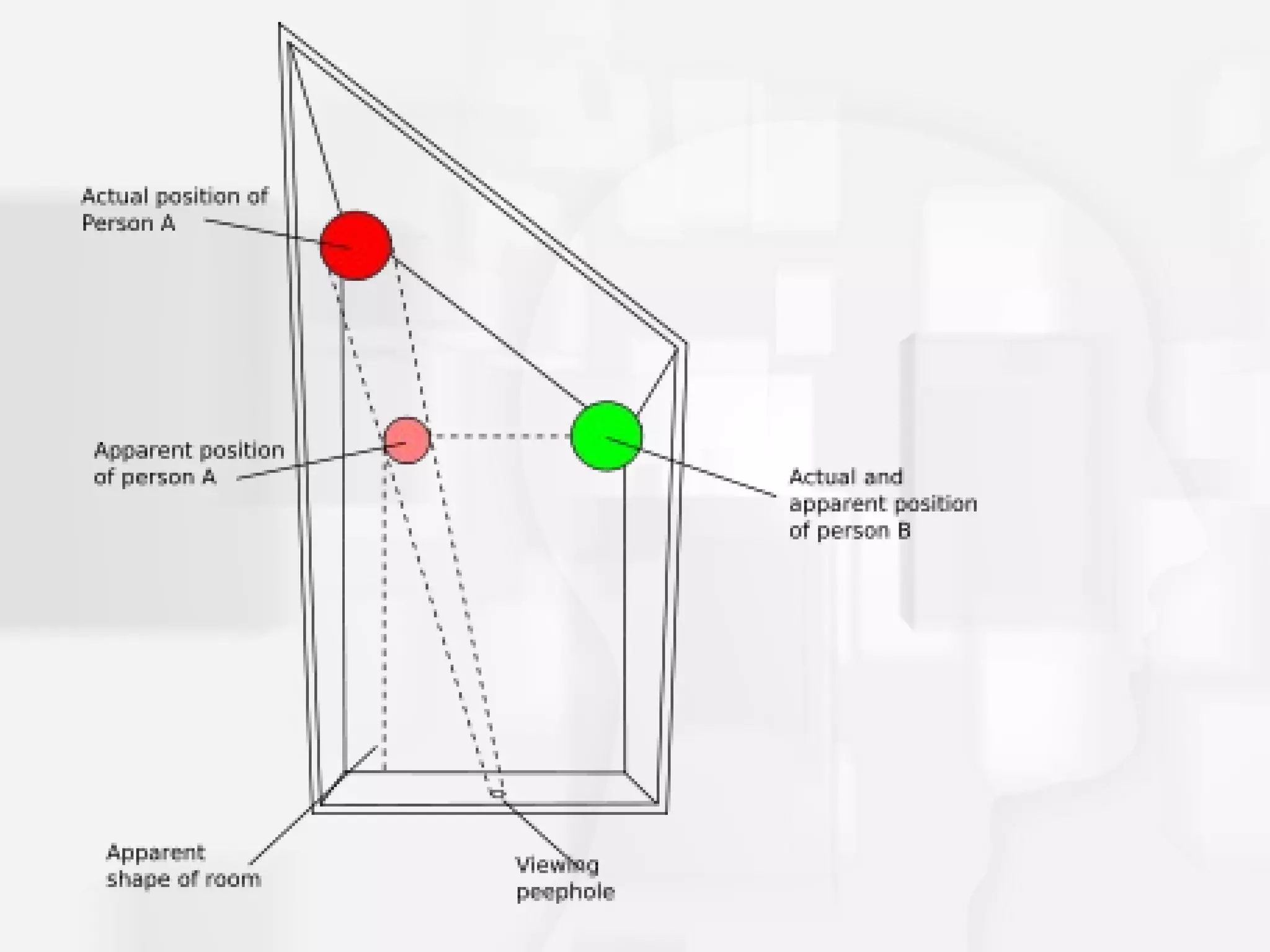
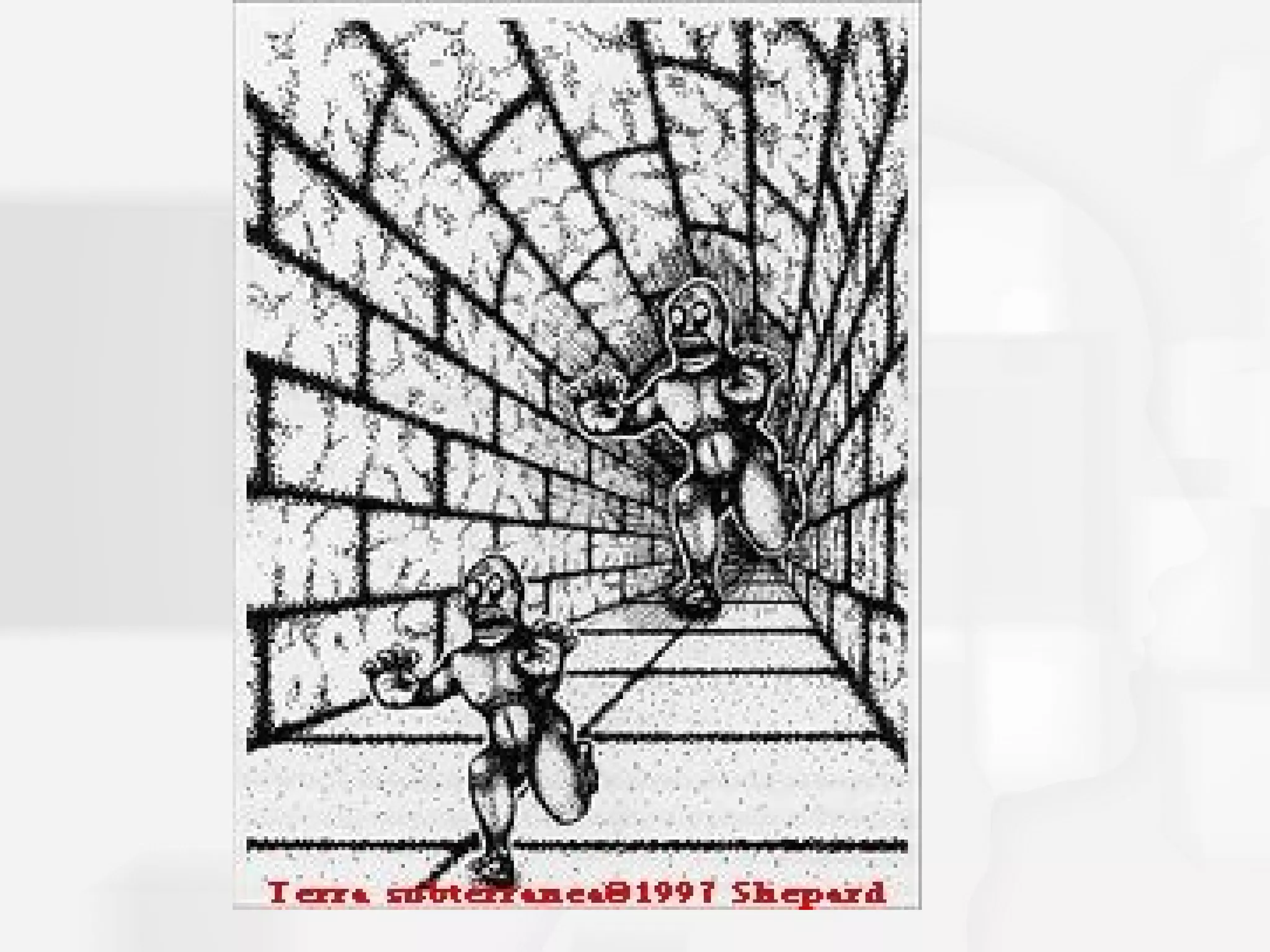
• Famous optical illusions: Muller-Lyer
  Illusion, Ponzo Illusion, Poggendorf
  Illusion, Upside-Down T Illusion, Zollner
  Illusion, the Ames Room, and Impossible
  Figures
• Cultural differences: Perceptual hypotheses
  at work
•   Imagine that you are outside on a clear night in which there are
    no clouds, and there is a bright full Moon. Pretend that on a
    table in front of you are objects that range in size from a BB to a
    beach ball as follows:
                 1. BB                 8. Baseball
                 2. Pea                9. Softball
                 3. Dime               10. Small salad plate
                                       11. Large dinner plate
                 4. Penny              12. Frisbee
                 5. Nickel             13. Basketball
                 6. Quarter            14. Beach ball
                 7. Golf ball
Please pretend that you are going to pick one of these things that
WHEN HELD AT ARM’S LENGTH JUST COVERS UP THE MOON.
Imagine that you are picking one that when you hold it in your hand
will JUST BARELY COVER UP THE MOON so that you can no
longer see it.
Window                                Mac O X


 http://www.youtube.com/watch?v=5ic7QGjGEX8
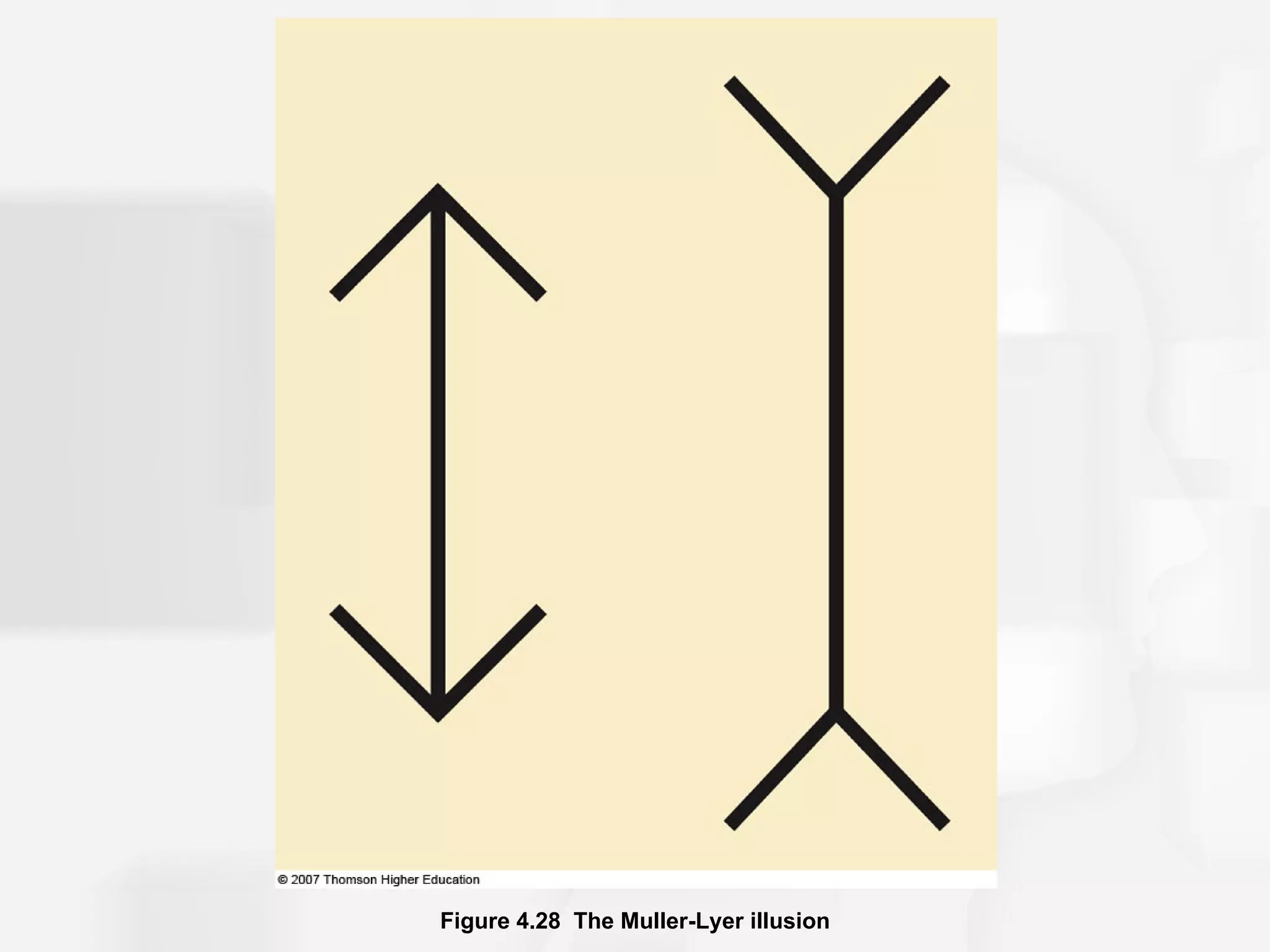
Figure 4.28 The Muller-Lyer illusion
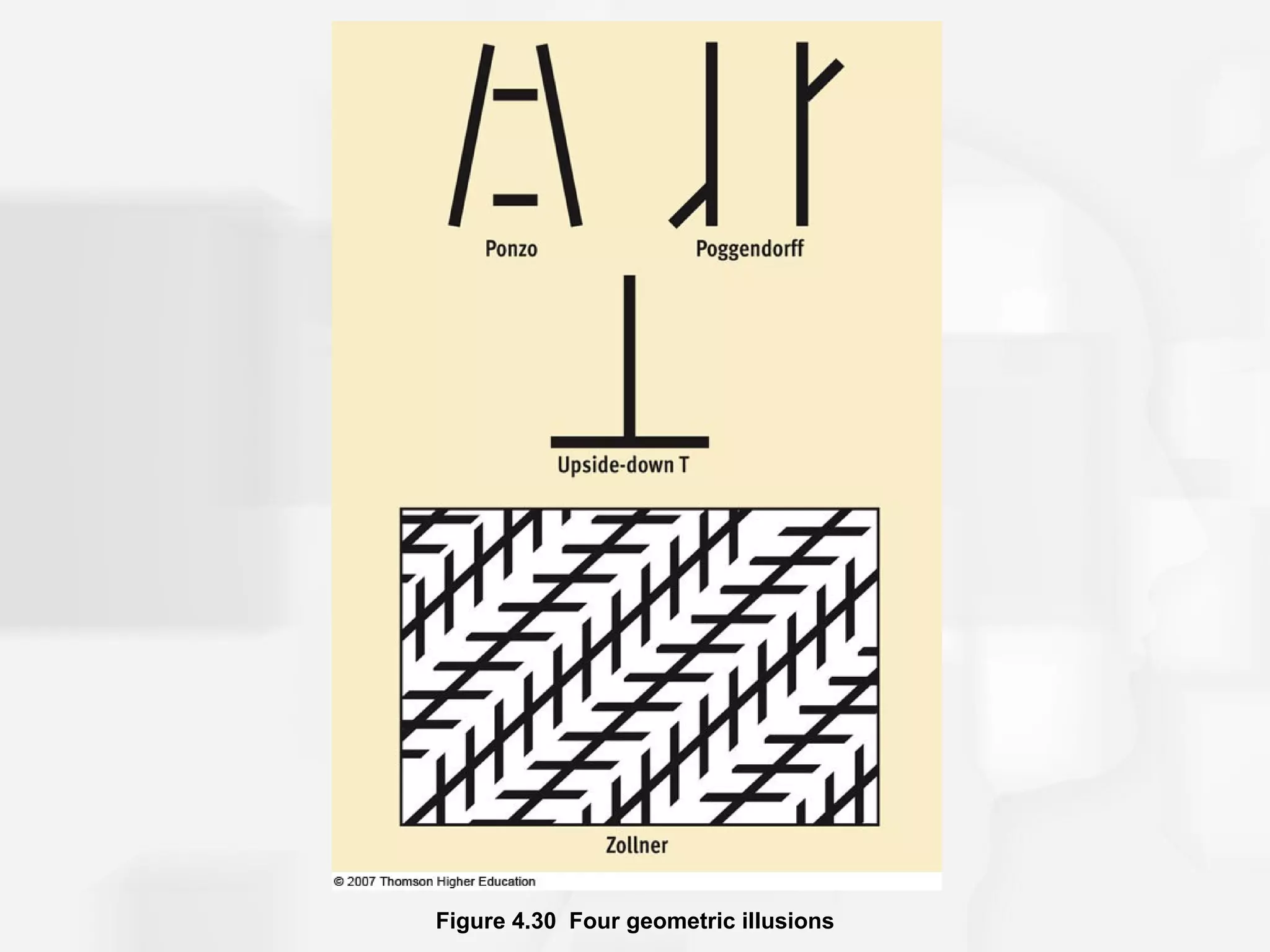
Figure 4.30 Four geometric illusions
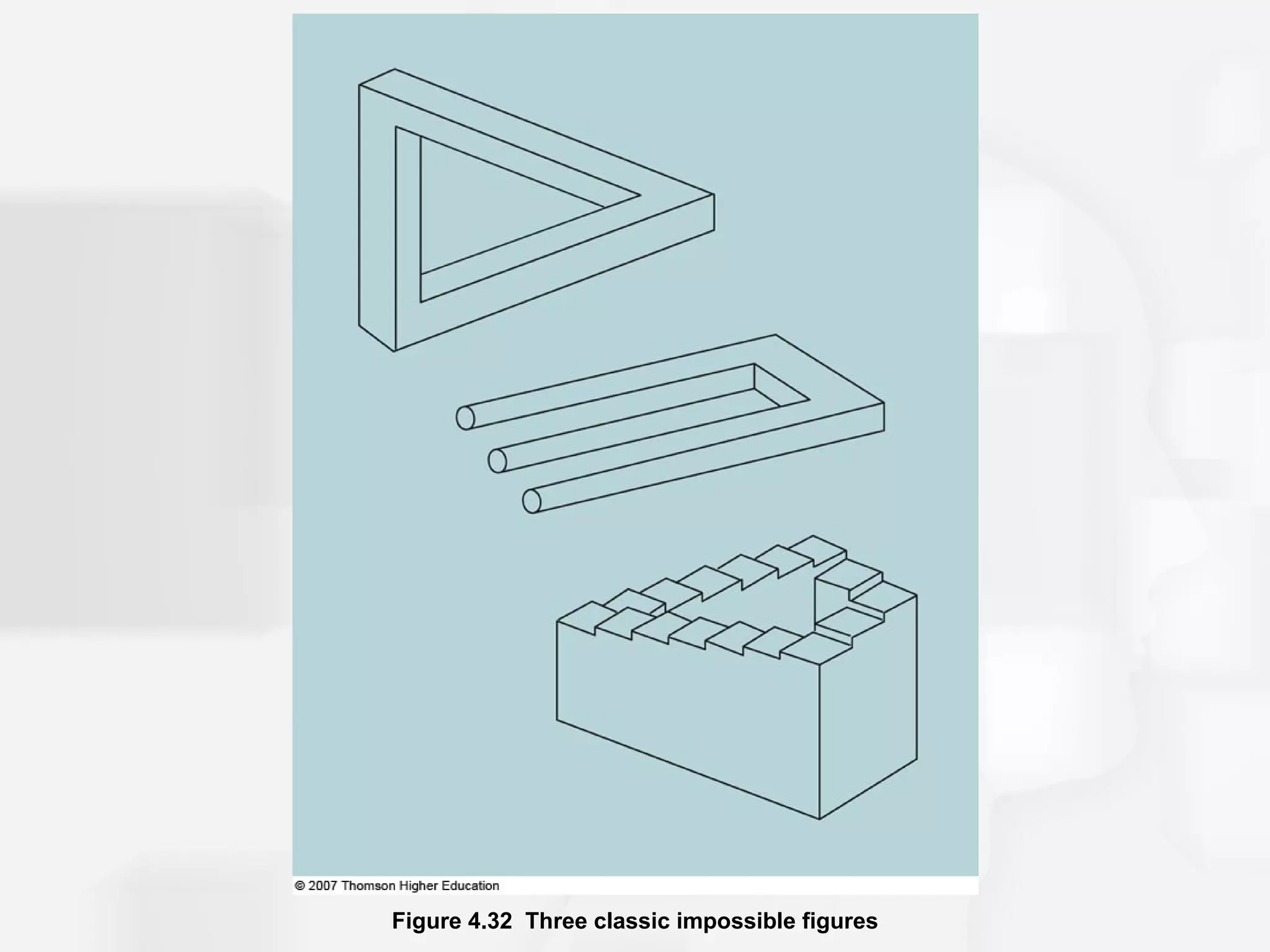
Figure 4.32 Three classic impossible figures
Change Blindness


• http://www.youtube.com/watch?v=mAnKvo-fPs0&fe
Selective Attention


• Neisser’s SA Test
  – http://www.youtube.com/watch?v=JX2BJC12uXQ

  – http://www.youtube.com/watch?v=Ahg6qcgoay4&
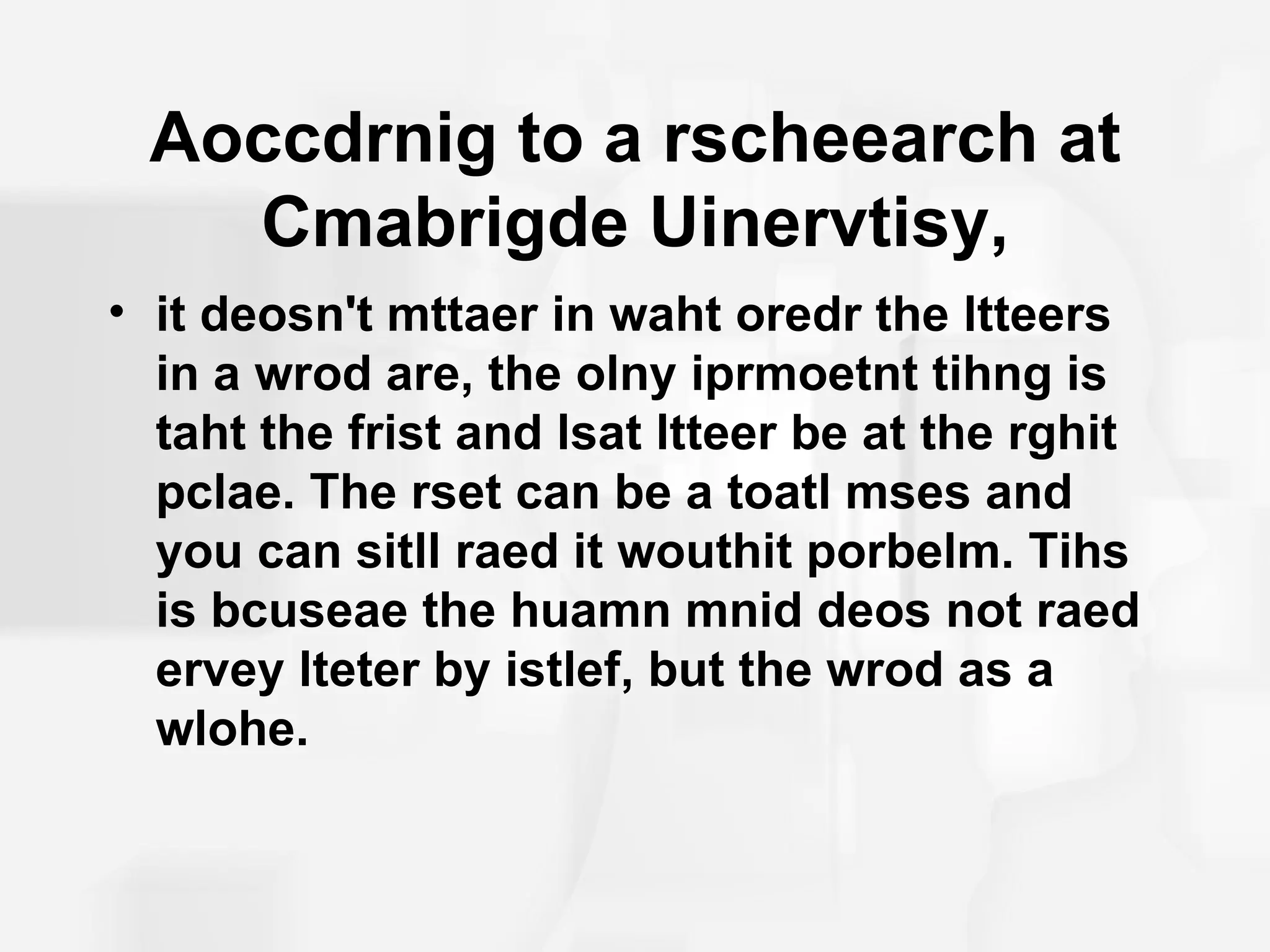
Aoccdrnig to a rscheearch at
   Cmabrigde Uinervtisy,
• it deosn't mttaer in waht oredr the ltteers
  in a wrod are, the olny iprmoetnt tihng is
  taht the frist and lsat ltteer be at the rghit
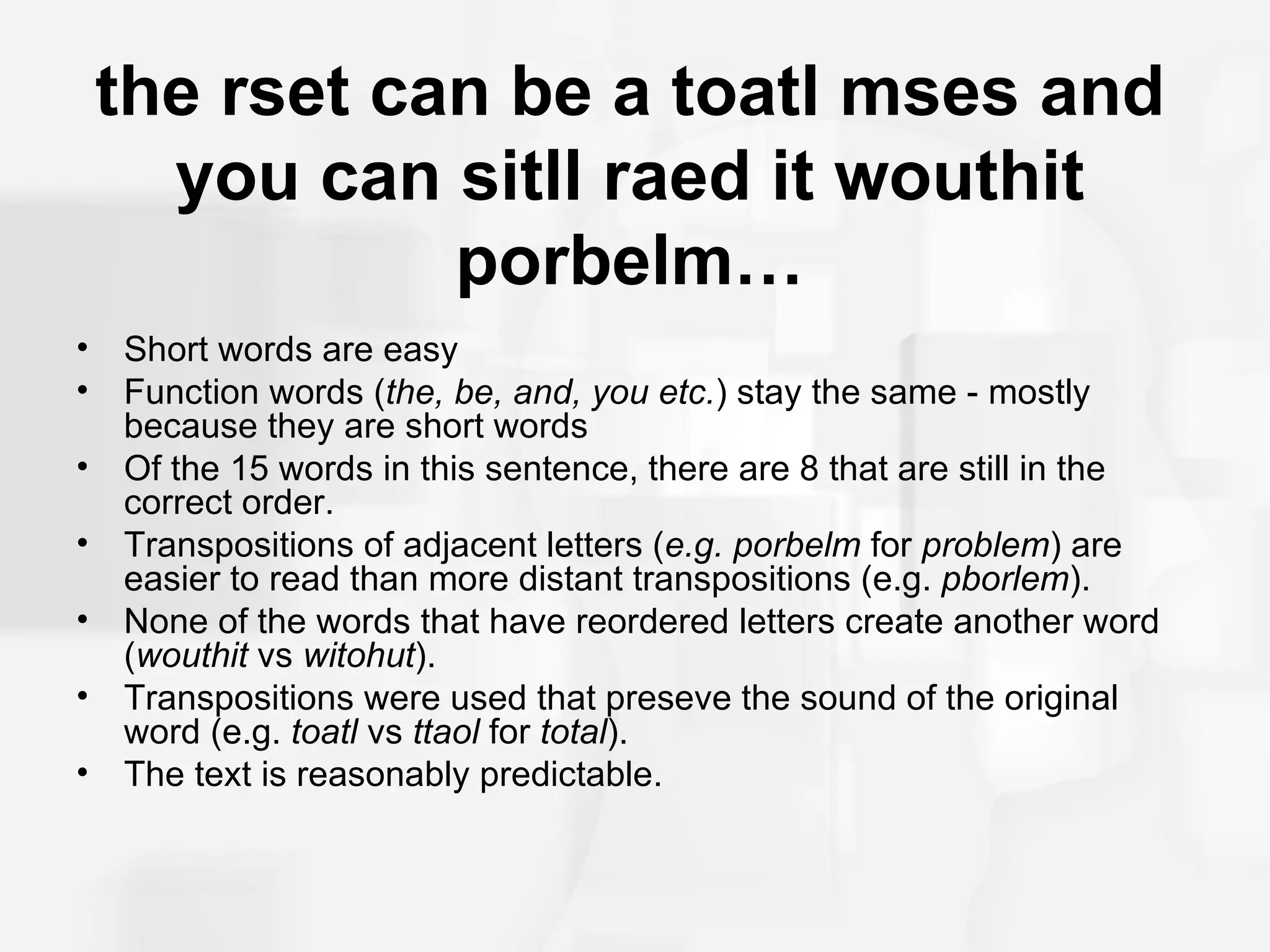
  pclae. The rset can be a toatl mses and
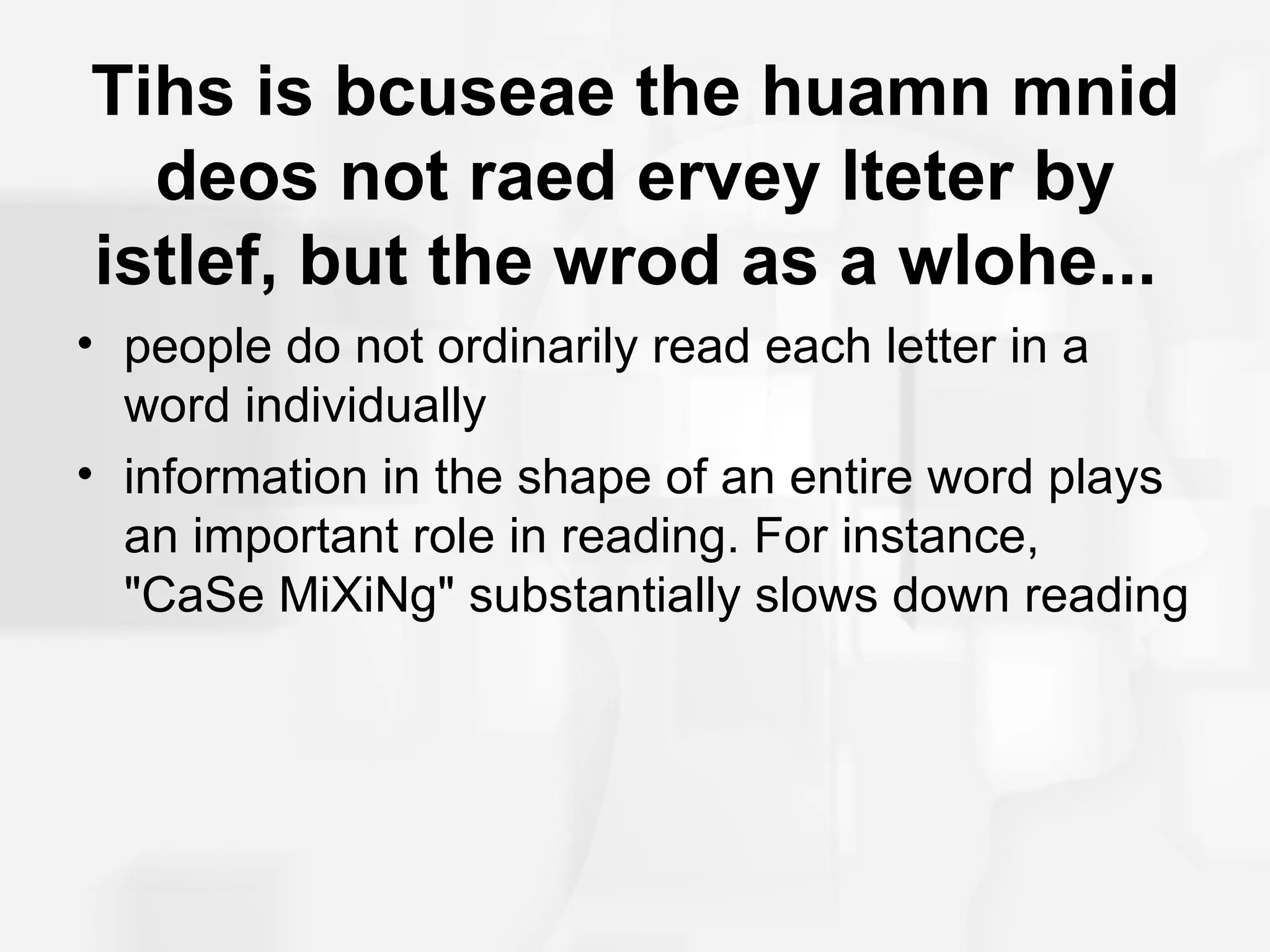
  you can sitll raed it wouthit porbelm. Tihs
  is bcuseae the huamn mnid deos not raed
  ervey lteter by istlef, but the wrod as a
  wlohe.
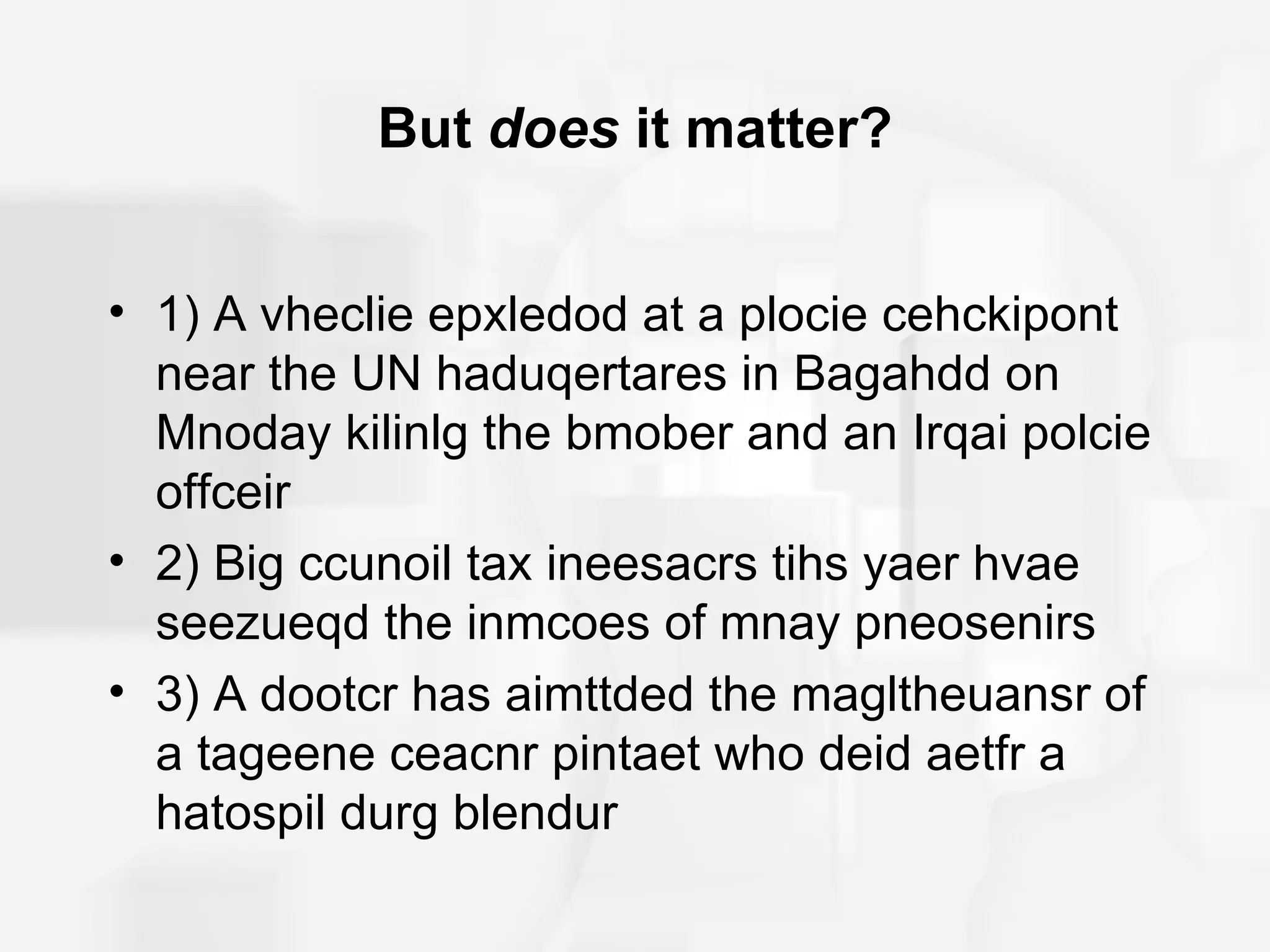
But does it matter?


• 1) A vheclie epxledod at a plocie cehckipont
  near the UN haduqertares in Bagahdd on
  Mnoday kilinlg the bmober and an Irqai polcie
  offceir
• 2) Big ccunoil tax ineesacrs tihs yaer hvae
  seezueqd the inmcoes of mnay pneosenirs
• 3) A dootcr has aimttded the magltheuansr of
  a tageene ceacnr pintaet who deid aetfr a
  hatospil durg blendur
the rset can be a toatl mses and
      you can sitll raed it wouthit
               porbelm…
•   Short words are easy
•   Function words (the, be, and, you etc.) stay the same - mostly
    because they are short words
•   Of the 15 words in this sentence, there are 8 that are still in the
    correct order.
•   Transpositions of adjacent letters (e.g. porbelm for problem) are
    easier to read than more distant transpositions (e.g. pborlem).
•   None of the words that have reordered letters create another word
    (wouthit vs witohut).
•   Transpositions were used that preseve the sound of the original
    word (e.g. toatl vs ttaol for total).
•   The text is reasonably predictable.
Tihs is bcuseae the huamn mnid
  deos not raed ervey lteter by
istlef, but the wrod as a wlohe...
• people do not ordinarily read each letter in a
  word individually
• information in the shape of an entire word plays
  an important role in reading. For instance,
  "CaSe MiXiNg" substantially slows down reading
Trehe wlil be a qiuz on
potiercepn at the end of cslas
           toady
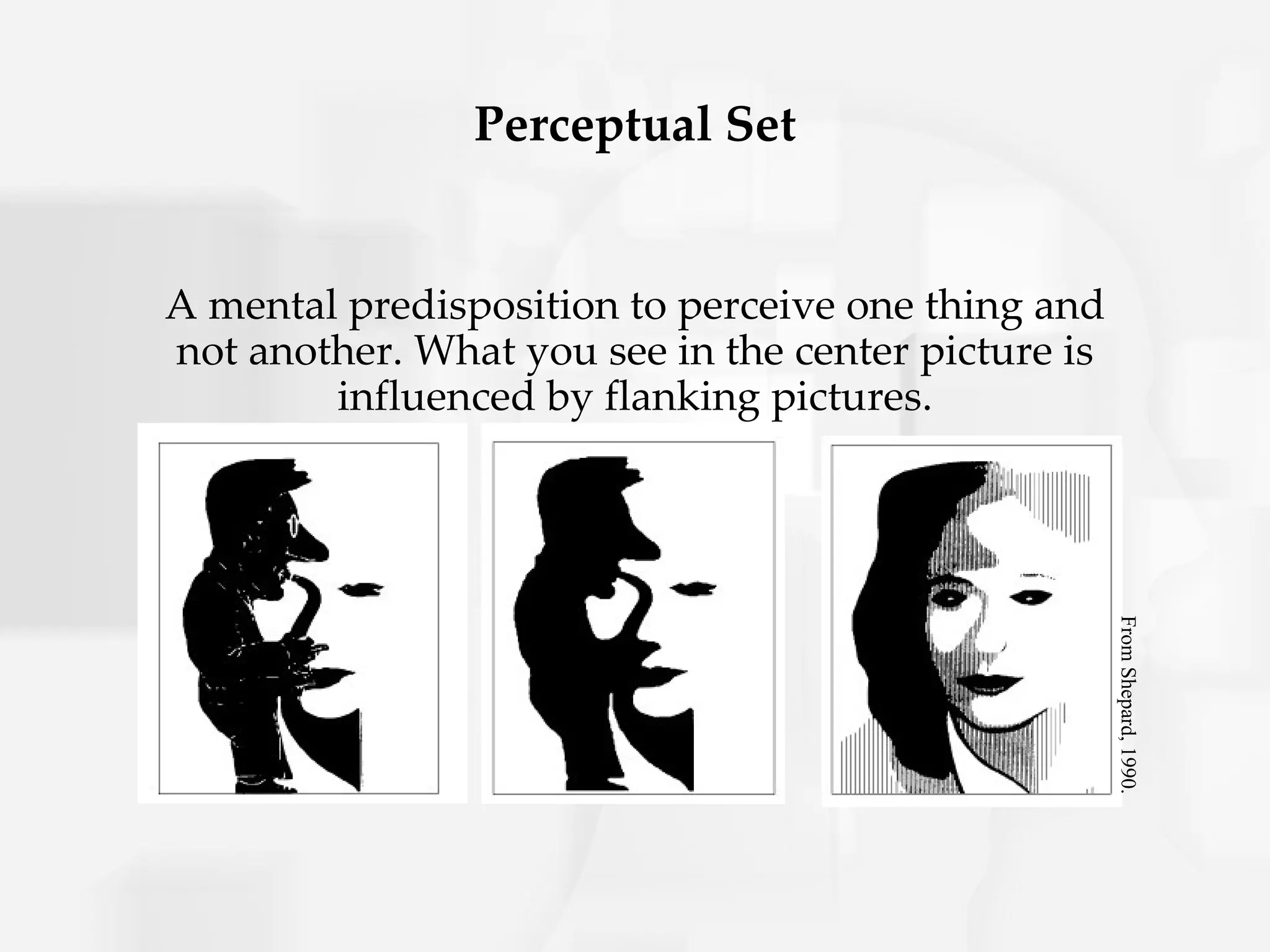
Perceptual Set


A mental predisposition to perceive one thing and
not another. What you see in the center picture is
        influenced by flanking pictures.


                                                     From Shepard, 1990.
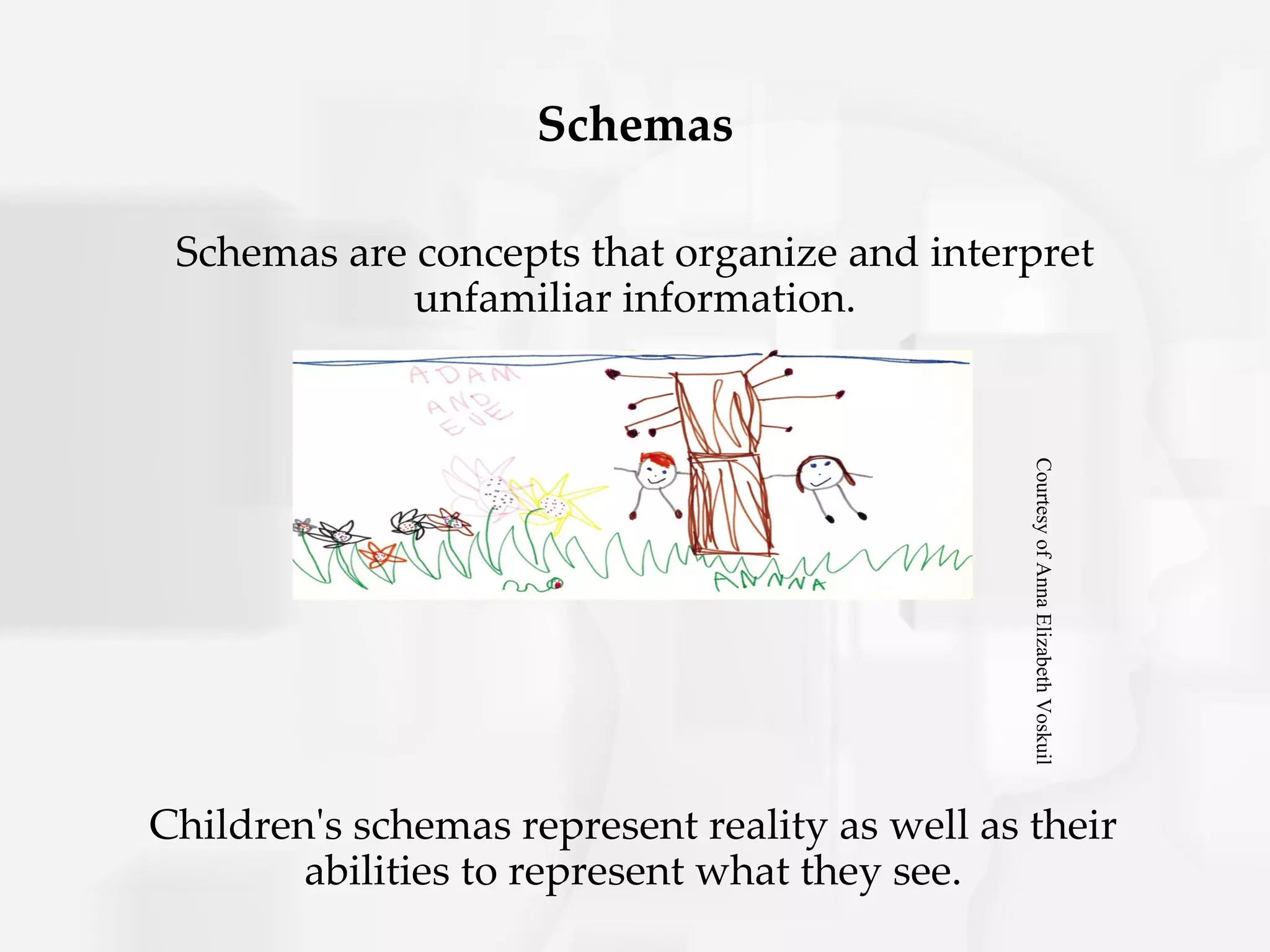
Schemas

 Schemas are concepts that organize and interpret
             unfamiliar information.


                                                Courtesy of Anna Elizabeth Voskuil
Children's schemas represent reality as well as their
        abilities to represent what they see.
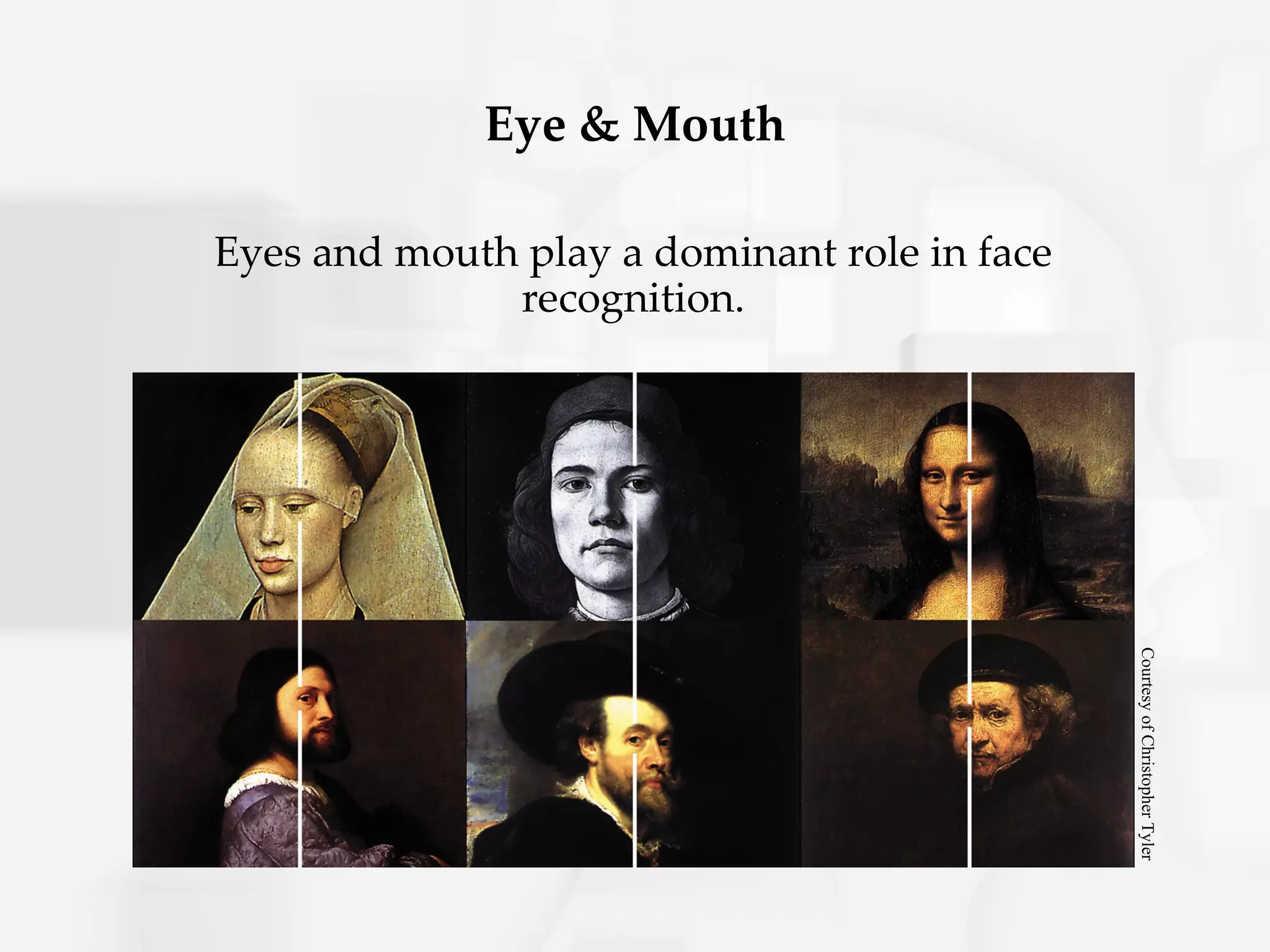
Eye & Mouth

Eyes and mouth play a dominant role in face
              recognition.


                                              Courtesy of Christopher Tyler
Perception & Human Factors


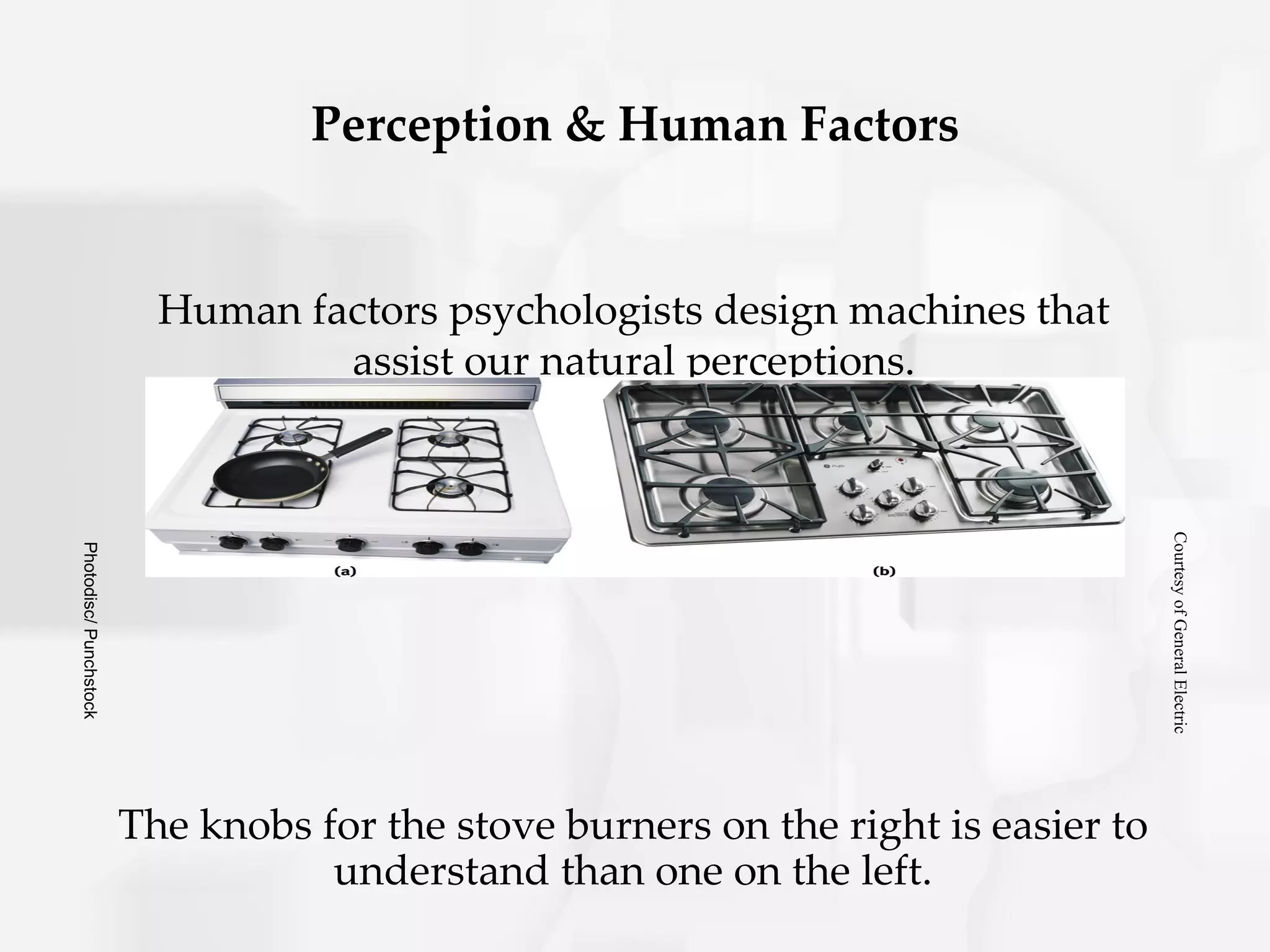
                          Human factors psychologists design machines that
                                  assist our natural perceptions.


                                                                                    Courtesy of General Electric
Photodisc/ Punchstock


                        The knobs for the stove burners on the right is easier to
                                   understand than one on the left.
Claims of ESP


 Telepathy: Mind-to mind communication. One
  person sending thoughts and the other receiving it.
 Clairvoyance: Perception of remote events. Like
  sensing a friend’s house on fire.
 Precognition: Perceiving future events. Such as a
  political leader’s death.
Premonitions or Pretensions?


Can psychics see the future? Can psychics aid police in
  identifying locations of dead bodies? What about
  psychic predictions of the famous Nostradamus?

The answers to these questions are NO! Nostradamus’
 predictions are “retrofitted” to events that took place
                      afterwards.
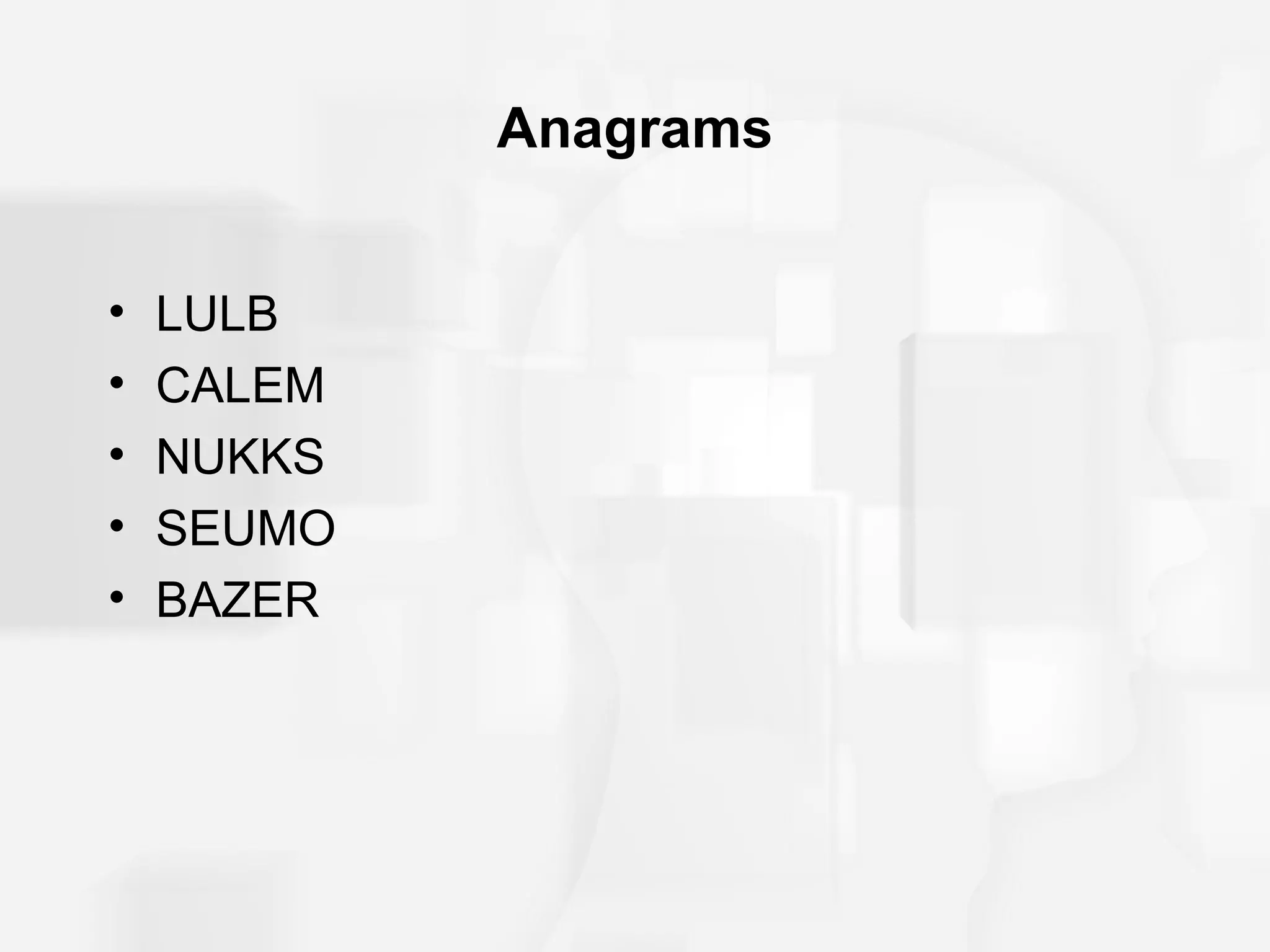
Anagrams


•   LULB
•   CALEM
•   NUKKS
•   SEUMO
•   BAZER
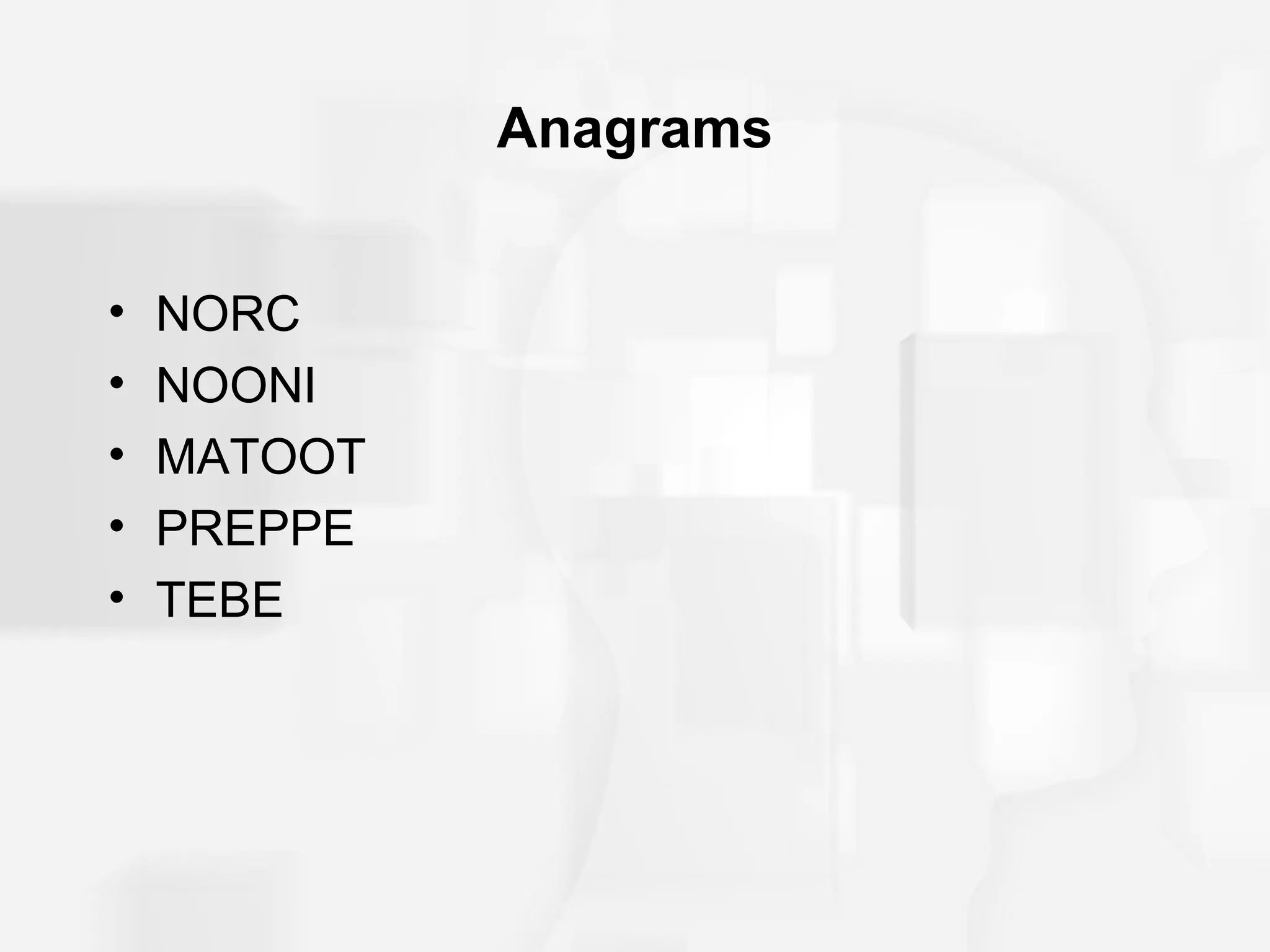
Anagrams


•   NORC
•   NOONI
•   MATOOT
•   PREPPE
•   TEBE
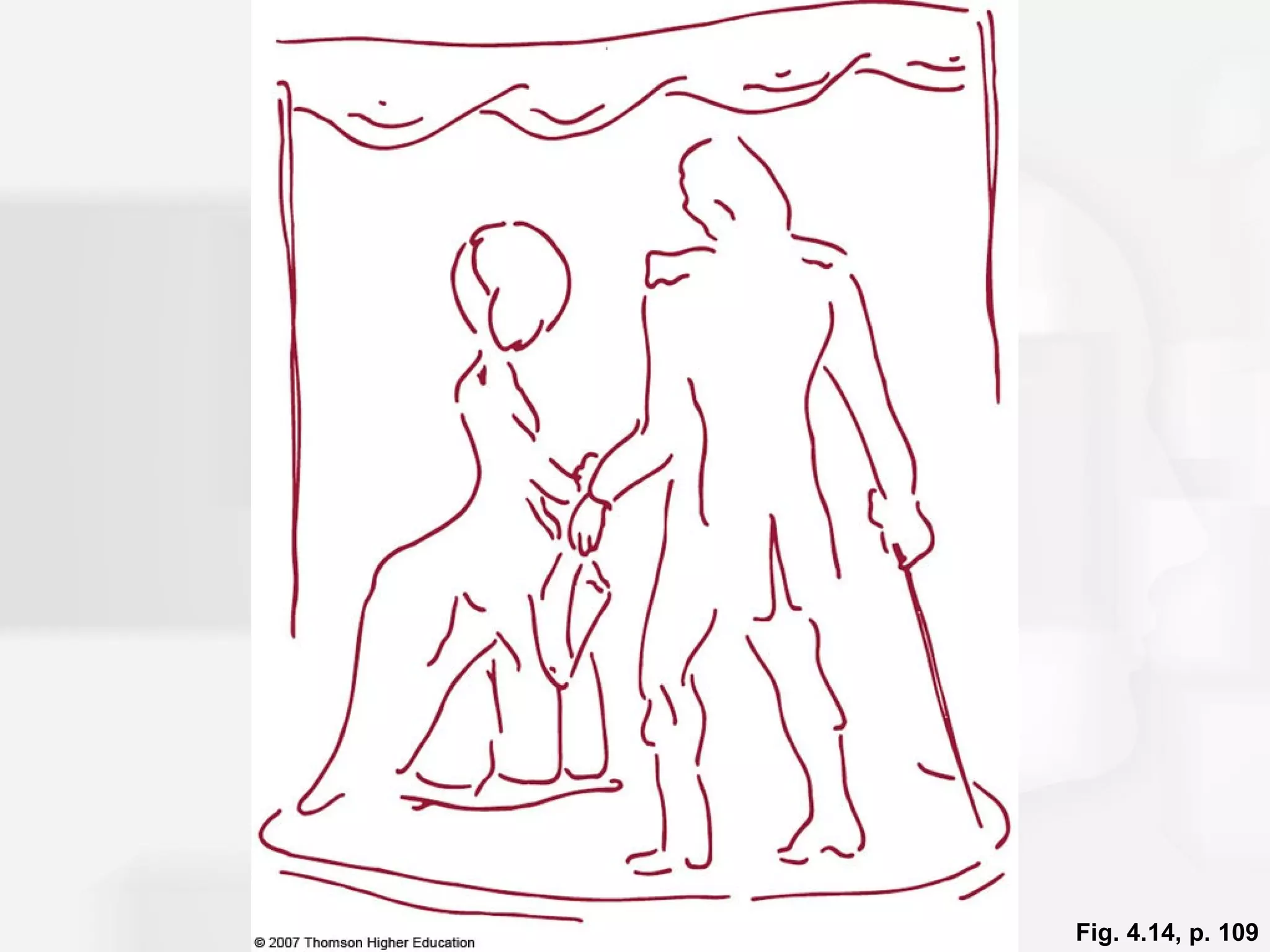
Fig. 4.14, p. 109
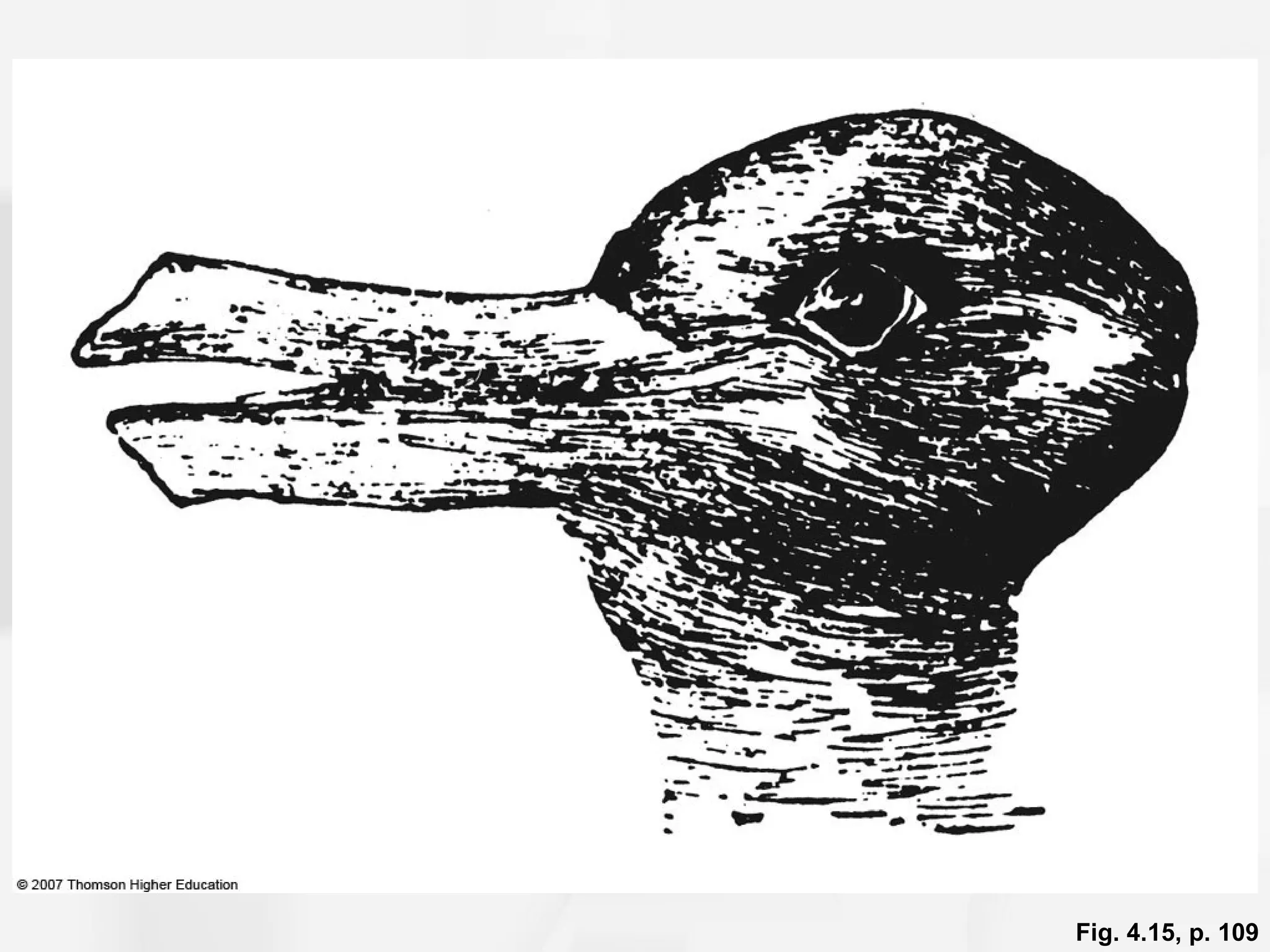
Fig. 4.15, p. 109
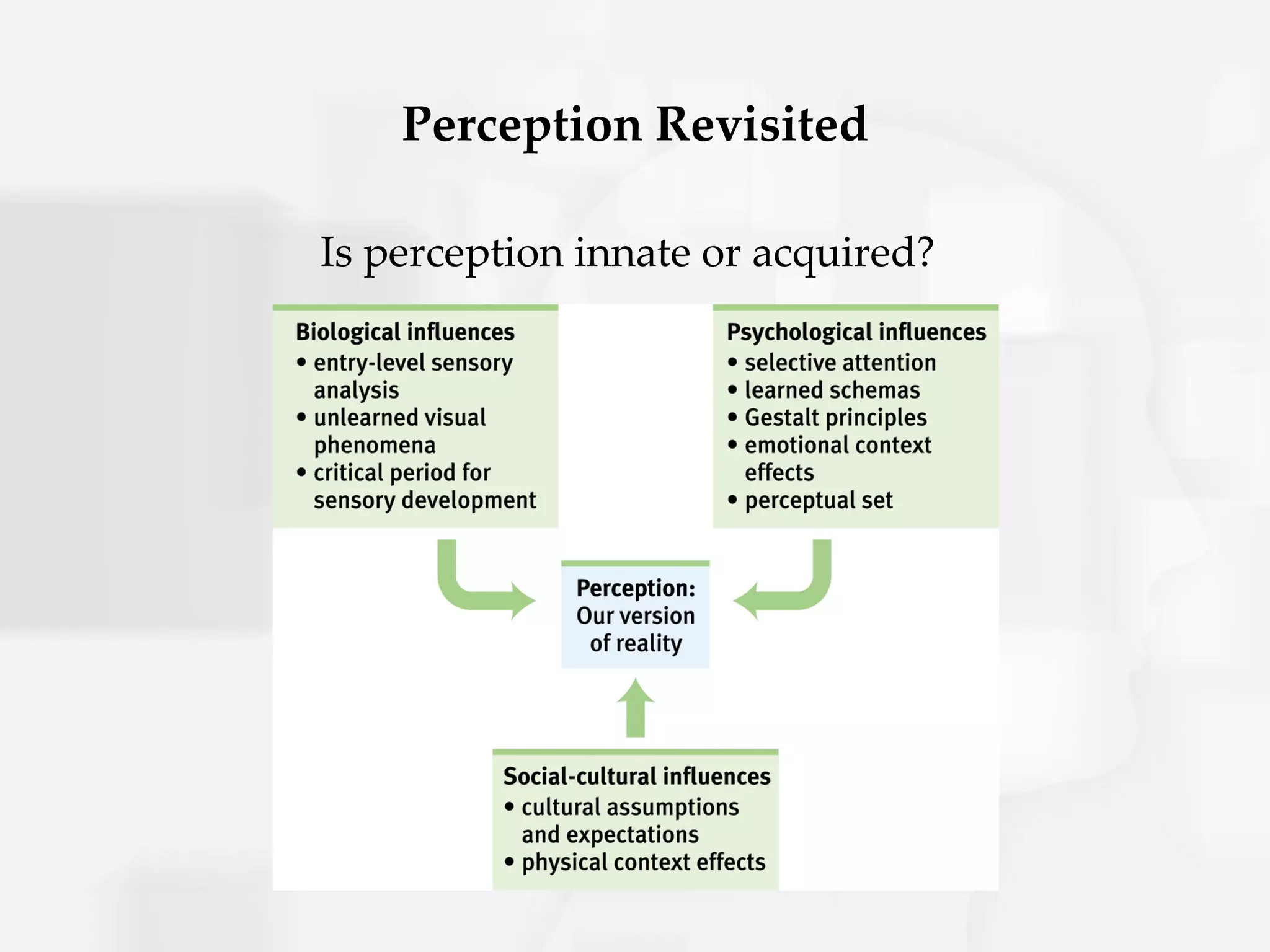
Perception Revisited

Is perception innate or acquired?

Sensation and perception_2012

  • 1.
  • 2.
    Sensation & Perception How do we construct our representations of the external world? To represent the world, we must detect physical energy (stimulus) from the environment and convert it into neural signals, a process called sensation. When we select, organize, and interpret our sensations, the process is called perception.
  • 3.
    Perceptual Interpretation Perceptual Interpretation Perceptual Adaptation  Perceptual Set  Perception and Human Factors
  • 4.
    From Sensation toRecognition Tim Bieber/ The Image Bank
  • 5.
    Information Processing inthe Visual Cortex • Early 1960s: Hubel and Wiesel – Microelectrode recording of axons in primary visual cortex of animals – Discovered feature detectors: neurons that respond selectively to lines, edges, etc. – Groundbreaking research: Nobel Prize in 1981 • Later research: cells specific to faces in the temporal lobes of monkeys and humans
  • 6.
    Shape Detection Specific combinations of temporal lobe activity occur as people look at shoes, faces, chairs and houses. Ishai, Ungerleider, Martin and Haxby/ NIMH
  • 7.
    Visual Information Processing Processing of several aspects of the stimulus simultaneously is called parallel processing. The brain divides a visual scene into subdivisions such as color, depth, form and movement etc.
  • 8.
  • 9.
    Color Constancy Color of an object remains the same under different illuminations. However, when context changes color of an object may look different. R. Beau Lotto at University College, London
  • 10.
    Figure 4.17 Bottom-upversus top-down processing
  • 11.
    Perception in Brain Our perceptions are a combination of sensory (bottom-up) and cognitive (top-down) processes.
  • 12.
    Bottom-up Processing Analysis ofthe stimulus begins with the sense receptors and works up to the level of the brain and mind. Letter “A” is sensed as a black blotch decomposed into features by the brain and perceived as an “A” by our mind .
  • 13.
  • 14.
    Principles of Perception •Gestalt principles of form perception: – figure-ground, proximity, closure, similarity, simplicity, and continuity • Recent research: – Perceptual hypotheses • Context
  • 15.
    Figure 4.18 Theprinciple of figure and ground
  • 16.
    Figure 4.21 Afamous reversible figure
  • 17.
    Figure 4.19 Gestaltprinciples of perceptual organization
  • 18.
    Making Sense ofComplexity Our sensory and perceptual processes work together to help us sort out complex images. “The Forest Has Eyes,” Bev Doolittle
  • 19.
  • 20.
    Figure 4.22 TheNecker cube
  • 21.
    The Power ofMisleading Cues: Visual Illusions • Optical Illusions - discrepancy between visual appearance and physical reality • Famous optical illusions: Muller-Lyer Illusion, Ponzo Illusion, Poggendorf Illusion, Upside-Down T Illusion, Zollner Illusion, the Ames Room, and Impossible Figures • Cultural differences: Perceptual hypotheses at work
  • 22.
    Imagine that you are outside on a clear night in which there are no clouds, and there is a bright full Moon. Pretend that on a table in front of you are objects that range in size from a BB to a beach ball as follows: 1. BB 8. Baseball 2. Pea 9. Softball 3. Dime 10. Small salad plate 11. Large dinner plate 4. Penny 12. Frisbee 5. Nickel 13. Basketball 6. Quarter 14. Beach ball 7. Golf ball Please pretend that you are going to pick one of these things that WHEN HELD AT ARM’S LENGTH JUST COVERS UP THE MOON. Imagine that you are picking one that when you hold it in your hand will JUST BARELY COVER UP THE MOON so that you can no longer see it.
  • 24.
    Window Mac O X http://www.youtube.com/watch?v=5ic7QGjGEX8
  • 28.
    Figure 4.28 TheMuller-Lyer illusion
  • 30.
    Figure 4.30 Fourgeometric illusions
  • 31.
    Figure 4.32 Threeclassic impossible figures
  • 32.
  • 33.
    Selective Attention • Neisser’sSA Test – http://www.youtube.com/watch?v=JX2BJC12uXQ – http://www.youtube.com/watch?v=Ahg6qcgoay4&
  • 34.
    Aoccdrnig to arscheearch at Cmabrigde Uinervtisy, • it deosn't mttaer in waht oredr the ltteers in a wrod are, the olny iprmoetnt tihng is taht the frist and lsat ltteer be at the rghit pclae. The rset can be a toatl mses and you can sitll raed it wouthit porbelm. Tihs is bcuseae the huamn mnid deos not raed ervey lteter by istlef, but the wrod as a wlohe.
  • 35.
    But does itmatter? • 1) A vheclie epxledod at a plocie cehckipont near the UN haduqertares in Bagahdd on Mnoday kilinlg the bmober and an Irqai polcie offceir • 2) Big ccunoil tax ineesacrs tihs yaer hvae seezueqd the inmcoes of mnay pneosenirs • 3) A dootcr has aimttded the magltheuansr of a tageene ceacnr pintaet who deid aetfr a hatospil durg blendur
  • 36.
    the rset canbe a toatl mses and you can sitll raed it wouthit porbelm… • Short words are easy • Function words (the, be, and, you etc.) stay the same - mostly because they are short words • Of the 15 words in this sentence, there are 8 that are still in the correct order. • Transpositions of adjacent letters (e.g. porbelm for problem) are easier to read than more distant transpositions (e.g. pborlem). • None of the words that have reordered letters create another word (wouthit vs witohut). • Transpositions were used that preseve the sound of the original word (e.g. toatl vs ttaol for total). • The text is reasonably predictable.
  • 37.
    Tihs is bcuseaethe huamn mnid deos not raed ervey lteter by istlef, but the wrod as a wlohe... • people do not ordinarily read each letter in a word individually • information in the shape of an entire word plays an important role in reading. For instance, "CaSe MiXiNg" substantially slows down reading
  • 38.
    Trehe wlil bea qiuz on potiercepn at the end of cslas toady
  • 40.
    Perceptual Set A mentalpredisposition to perceive one thing and not another. What you see in the center picture is influenced by flanking pictures. From Shepard, 1990.
  • 41.
    Schemas Schemas areconcepts that organize and interpret unfamiliar information. Courtesy of Anna Elizabeth Voskuil Children's schemas represent reality as well as their abilities to represent what they see.
  • 42.
    Eye & Mouth Eyesand mouth play a dominant role in face recognition. Courtesy of Christopher Tyler
  • 43.
    Perception & HumanFactors Human factors psychologists design machines that assist our natural perceptions. Courtesy of General Electric Photodisc/ Punchstock The knobs for the stove burners on the right is easier to understand than one on the left.
  • 44.
    Claims of ESP Telepathy: Mind-to mind communication. One person sending thoughts and the other receiving it.  Clairvoyance: Perception of remote events. Like sensing a friend’s house on fire.  Precognition: Perceiving future events. Such as a political leader’s death.
  • 45.
    Premonitions or Pretensions? Canpsychics see the future? Can psychics aid police in identifying locations of dead bodies? What about psychic predictions of the famous Nostradamus? The answers to these questions are NO! Nostradamus’ predictions are “retrofitted” to events that took place afterwards.
  • 46.
    Anagrams • LULB • CALEM • NUKKS • SEUMO • BAZER
  • 47.
    Anagrams • NORC • NOONI • MATOOT • PREPPE • TEBE
  • 48.
  • 49.
  • 50.

Editor's Notes

  • #2 Sensation – stimulation of the sense organs Perception – the meaning we make of sensation
  • #6 Hubel and Wiesel: Feature Detectors and the Nobel Prize In the early 1960s Hubel and Wiesel started research using microelectrode recording of axons in the primary visual cortex of animals. Initially, they had little success getting neurons to fire by having the cats look at flashing spots of light. Accidentally, they introduced a straight line light, which produced rapid firing occurred in the visual cortex. They went on to discover that the visual cortex has feature detectors in it, neurons that respond selectively to very specific features of complex stimuli: lines, edges, etc. This was groundbreaking research which won them the Nobel Prize in 1981. Later research has demonstrated that there are cells in the temporal lobes of monkeys and humans (along the visual pathway) that specifically respond to pictures of faces.
  • #9 Gaze at the middle of the flag for about 30 seconds, when it disappears, stare at the dot and report if you see Britain's flag.
  • #11 Bottom-up versus top-down processing. As explained in these diagrams, bottom-up processing progresses from individual elements to whole elements, whereas top-down processing progresses from the whole to the individual elements.
  • #14 TOP DOWN PROCESSING Information processing guided by higher-level mental processes as we construct perceptions drawing on our experience and expectations. Context effects. The context in which a stimulus is seen can affect your perceptual hypotheses. The middle character in the word on the left is assumed to be an “H,” whereas in the word on the right the same character is assumed to be an “A.” In addition to showing the potential influence of context, this example shows the power of expectations and top-down processing.
  • #15 The Gestalt principles of form perception include figure-ground, proximity, similarity, continuity, closure, and simplicity. The Gestalt emphasis is still felt in the study of perception, as they had useful insights that have stood the test of time, raised important issues, etc. More recently, theorists have come to focus on the hypothetical nature of perceptions: people may develop perceptual hypotheses about what they are seeing. This is one way in which context can affect perceptions. FIGURE-GROUND: organize into a figure and a background HOW WE ORGANIZE THE FIGURES PROXIMITY: Things near one another belong together CLOSURE: complete figures SIMILARITY: group similar elements SIMPLICITY (PRANANZ): form a “GOOD” figure CONTINUITY: follow in same direction, connect smooth paths
  • #17 How do we form perceptual hypotheses? Ambiguity leads to reversibility
  • #18 Figure 4.19 Gestalt principles of perceptual organization. Gestalt principles help explain some of the factors that influence form perception. (a) Proximity: These dots might well be organized in vertical columns rather than horizontal rows, but because of proximity (the dots are closer together horizontally), they tend to be perceived in rows. (b) Closure: Even though the figures are incomplete, you fill in the blanks and see a circle and a dog. (c) Similarity: Because of similarity of color, you see dots organized into the number 2 instead of a random array. If you did not group similar elements, you wouldn’t see the number 2 here. (d) Simplicity: You could view this as a complicated 11-sided figure, but given the preference for simplicity, you are more likely to see it as an overlapping rectangle and triangle. (e) Continuity: You tend to group these dots in a way that produces a smooth path rather than an abrupt shift in direction.
  • #20 Figure 4.20 Perceptual hypotheses. The images projected on the retina are often distorted, shifting representations of stimuli in the real world, requiring ongoing perceptual hypotheses about what form could be responsible for a particular pattern of sensory stimulation. For example, if you look directly down at a small, square piece of paper on a desk (a), the stimulus (the paper) and the image projected on your retina will both be square. But as you move the paper away on the desktop, as shown in (b) and (c), the square stimulus projects an increasingly trapezoidal image on your retina.
  • #21 Figure 4.22 The Necker cube. The tinted surface of this reversible figure can become either the front or the back of the cube.
  • #22 Optical Illusions involve an apparently inexplicable discrepancy between the appearance of a visual stimulus and its physical reality. Famous optical illusions include those listed. Cultural differences in susceptibility to illusions such as Muller-Lyer and Poggendorf demonstrate the importance of perceptual hypotheses.
  • #29 Figure 4.28 The Müller-Lyer illusion. Go ahead, measure them: The two vertical lines are of equal length.
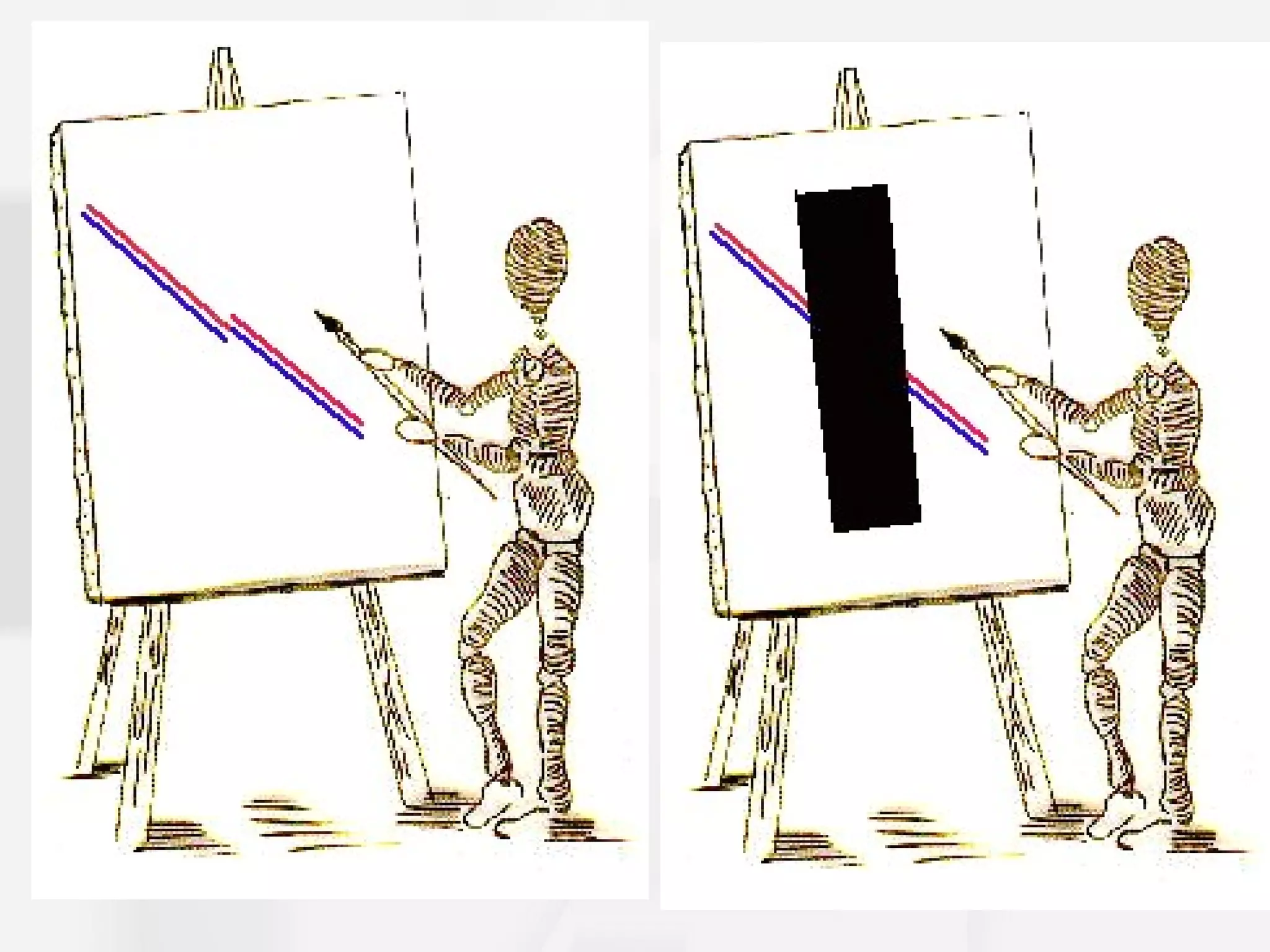
  • #31 Figure 4.30 Four geometric illusions. Ponzo: The horizontal lines are the same length. Poggendorff: The two diagonal segments lie on the same straight line. Upside-down T: The vertical and horizontal lines are the same length. Zollner: The long diagonals are all parallel (try covering up some of the short lines if you don’t believe it).
  • #32 Figure 4.32 Three classic impossible figures. The figures are impossible, yet they clearly exist—on the page. What makes them impossible is that they appear to be three-dimensional representations yet are drawn in a way that frustrates mental attempts to “assemble” their features into possible objects. It’s difficult to see the drawings simply as lines lying in a plane—even though this perceptual hypothesis is the only one that resolves the contradiction.
  • #41 Do you see the saxophonist or the woman’s face
  • #42 What we perceive not only comes from the environment but also from our minds. Schemas or concepts develop through experience.
  • #43 Portrait artists understood the importance of this recognition and therefore centered an eye in their paintings.
  • #45 Paranormal phenomena include claims of astrological predictions, psychic healing, communication with the dead and out-of-body experience, but the most relevant are telepathy, clairvoyance and precognition
  • #47 EAP
  • #48 EAP
  • #49 Figure 4.13 Three types of cones. Research has identified three types of cones that show varied sensitivity to different wavelengths of light. As the graph shows, these three types of cones correspond only roughly to the red, green, and blue receptors predicted by trichromatic theory, so it is more accurate to refer to them as cones sensitive to short, medium, and long wavelengths.
  • #50 Figure 4.13 Three types of cones. Research has identified three types of cones that show varied sensitivity to different wavelengths of light. As the graph shows, these three types of cones correspond only roughly to the red, green, and blue receptors predicted by trichromatic theory, so it is more accurate to refer to them as cones sensitive to short, medium, and long wavelengths.