Semantics, the Study of Meaning
By :
Rahaf Nidal Yousef Hamed Rhamneh
Abd AL-Aziz Salamat
Amman Arab University
Introduction to English Linguistics
Presented to : Dr. Khaleel Bataineh .
Kinds of meaning
•
What is semantics ?
•
It’s a single word even though it ends in “s” .. In the late 1800s,
Michel Bréal coined the term sémantique to describe the
psychology of language. That French word has its origins in
Greek: semantikos means "significant," and comes from
semainein "to show, signify, indicate by a sign."
•
It can be applied to entire texts or to single words. For example,
"destination" and "last stop" technically mean the same thing, but
students of semantics analyze their subtle shades of meaning.
•
?? - Compare the senses of kill, murder, assassinate.
Cognitive Meaning
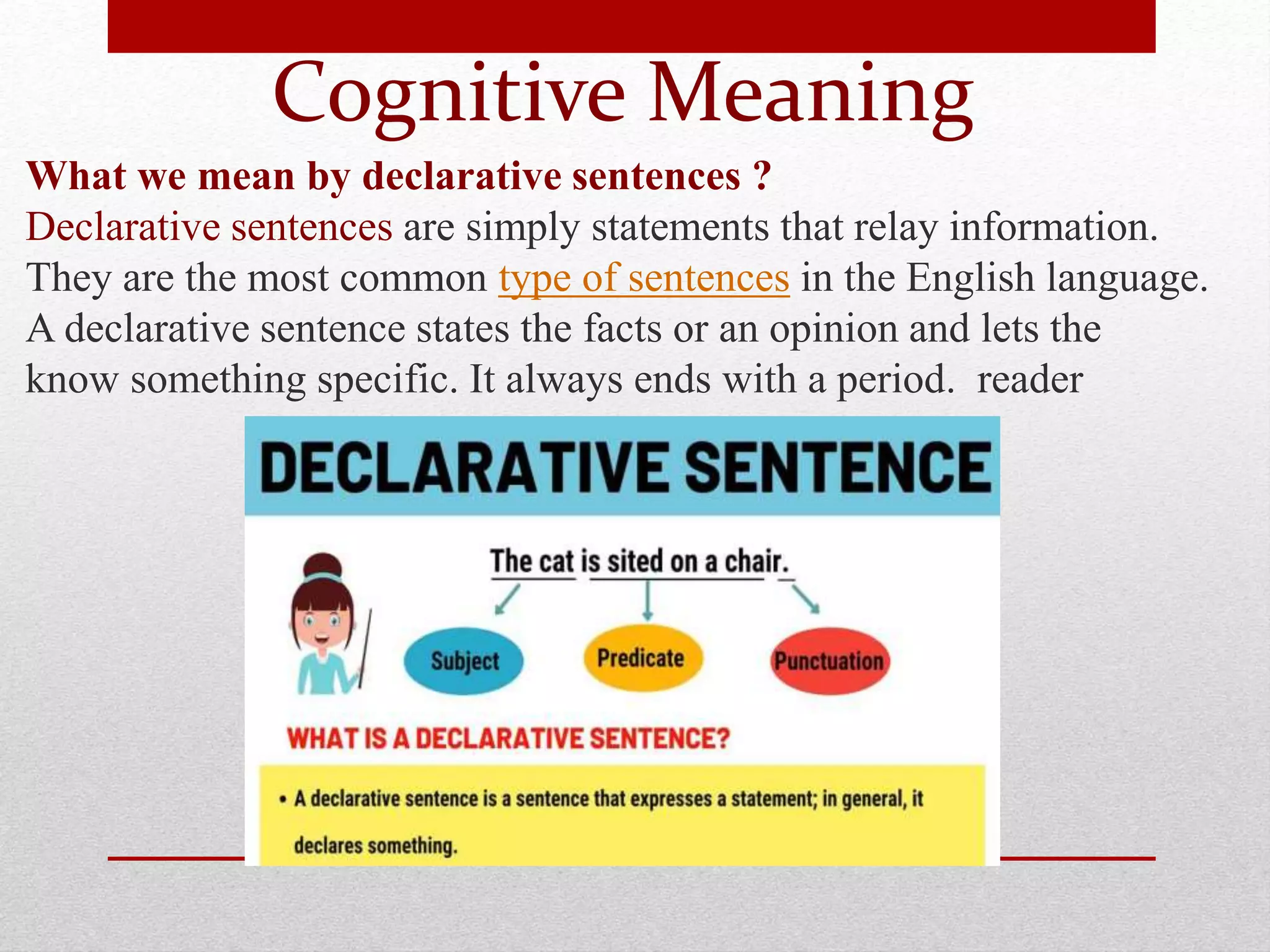
What we mean by declarative sentences ?
Declarative sentences are simply statements that relay information.
They are the most common type of sentences in the English language.
A declarative sentence states the facts or an opinion and lets the
reader
know something specific. It always ends with a period.
•
Cognitive meaning is the most important, central kind of meaning
or the core meaning. The cognitive meaning of a sentence is
sometimes called propositional meaning or proposition.
•
In the case of declarative sentences, this is a state of affairs
described by the sentence, which can be true or false.
•
The girl went to the garden.
•
In the case of words, cognitive meaning is the contribution that
the word (lexeme) systematically makes to the cognitive meaning
of sentences.
Sense : The cognitive meaning of lexemes
What is the cognitive meaning?
OTHER KINDS OF MEANINGS
•
1) Stylistic Meaning.
•
Stylistic meaning is that which a piece of language conveys about the
circumstances of its use. For instance :
archaic)
)
The damsel made her way to the garden.
2) Affective Meaning.
Affective meaning is a sort of meaning which an effect the personal
feeling of speakers, including his/her attitude to the listener, or his/her
attitude to something he/she talking about.
Wow! The girl went to the garden! (emotional)
3) speech act meaning
•
It could be a question and an imperative, respectively, cannot be treated
as being either true or false, but they can be claimed to
have a
questioning and a commanding
a. Did the girl go to the garden? (question)
b. Let the girl go to the garden. (command)
The cognitive meaning of sentences
•
Depends on three factors:
•
1) it depends on the cognitive meanings of the sentential constituents
•
a. Mr. Brown kicked the man
•
b. Mr. Brown kicked the dog.
•
2) it depends on the functional labels that the constituents have, which is
often, though not always, mirrored by the order of the
.
constituents
•
a. [subject The sheriff] kicked [object the man].
•
b. [subject The man] kicked [object the sheriff].
•
3) the cognitive meaning of a sentence depends on its structure.
•
a. They ((run and swim) fast).
•
b. They (run and (swim fast)).
proposition relations between sentences
•
Sentences can be synonymous, in this case they are each other’s
paraphrases. The synonymy of sentences may result from lexical
synonymy, for instance
•
A) I want to purchase tickets for the festival
•
B) I want to buy festival tickets
•
But sentential synonymy can also be achieved structurally, as in
the active–passive pair
•
The apple was eaten by the boy
•
The boy ate the apple
•
Sentences can also be ambiguous. This means that two sentences are
composed of the same constituents in the same order but they have
different meanings. This again can have lexical reasons (one of the
words being ambiguous)
•
a. We waited by the bank. (the building of the financial institution’).
•
b. We waited by the bank. (‘by the riverside’).
•
Or, ambiguity can be caused by structural differences.
•
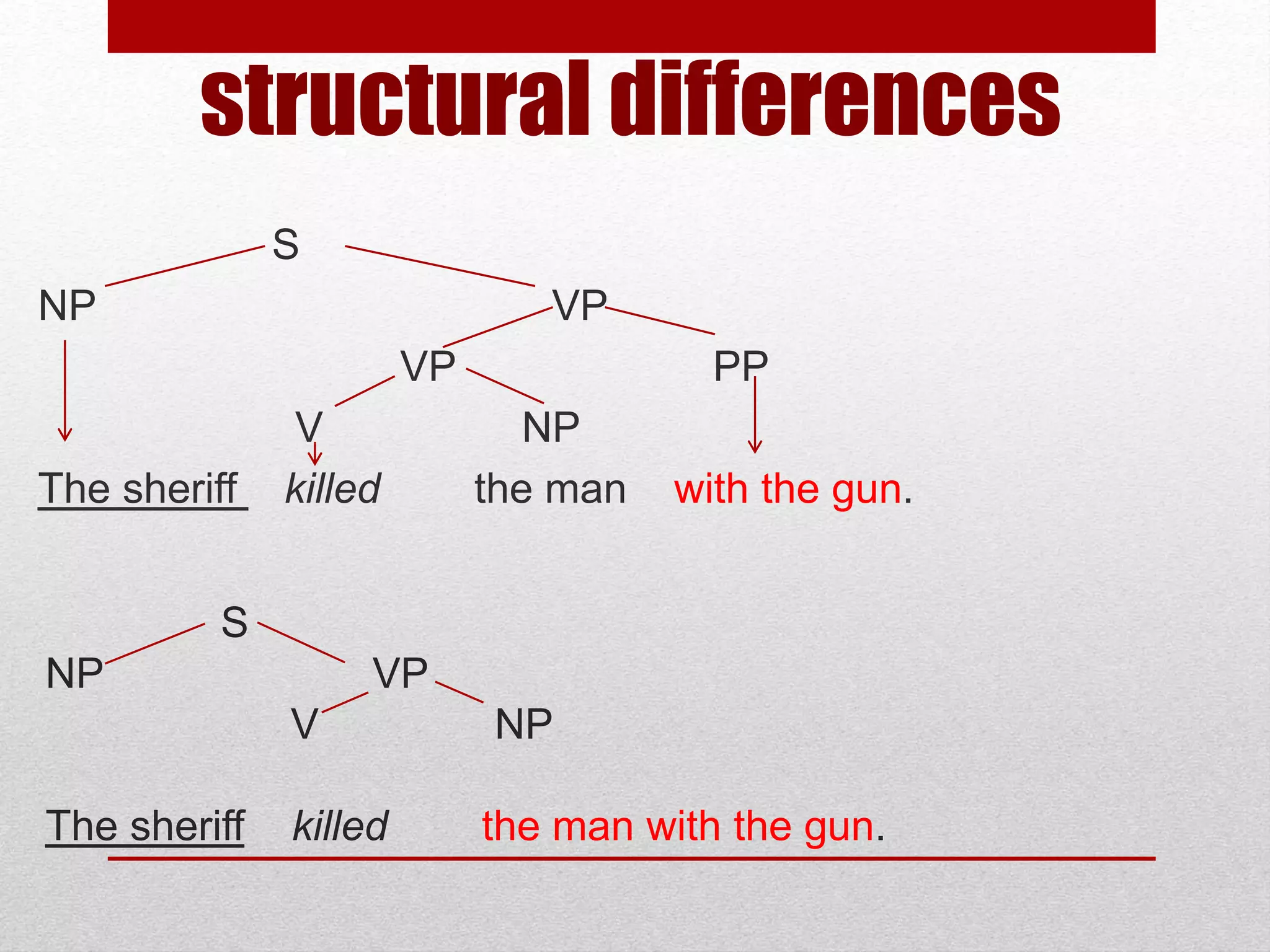
The sheriff killed the man with the gun.
(‘The sheriff fired the gun at the man’)
The sheriff killed the man with the gun.
(‘The sheriff fired at the man who had the gun.’)
•
Furthermore, ambiguity may also result from the different functions a
particular constituent can perform
•
A) [subject The lamb] is ready to eat. (‘The lamb will eat.’)
B) [object The lamb] is ready to eat. (‘Somebody will eat the lamb.’)
S
NP VP
V NP
The sheriff killed the man with the gun.
S
NP VP
VP PP
V NP
The sheriff killed the man with the gun.
structural differences
Incompatibility: the condition of two things being so different in
nature as to be incapable of coexisting
a) The wall is black b) the wall is white
Entailment : a relationship between propositions such that one must be
true if the others are
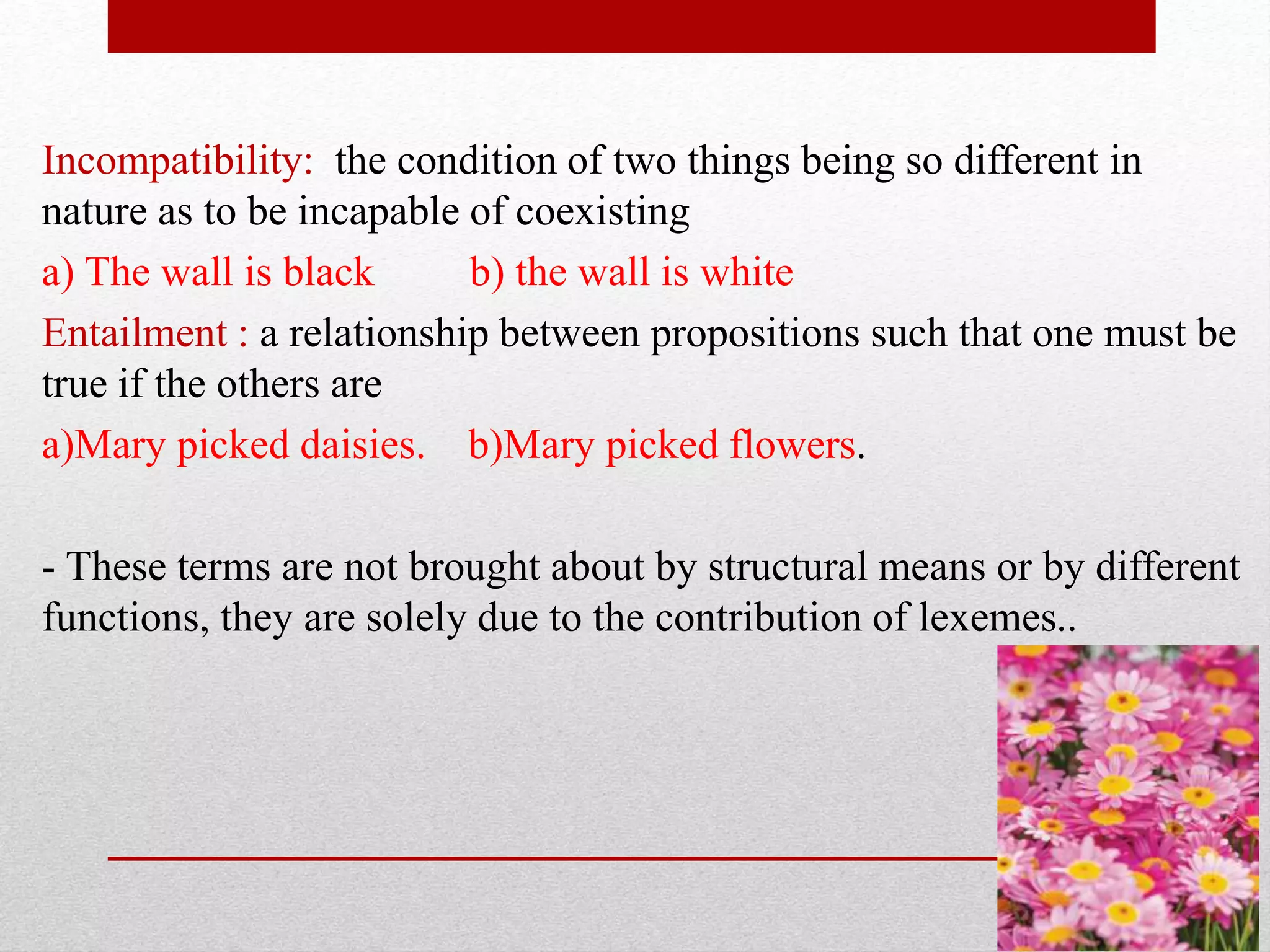
a)Mary picked daisies. b)Mary picked flowers.
- These terms are not brought about by structural means or by different
..
functions, they are solely due to the contribution of lexemes
Approaches to word meaning
•
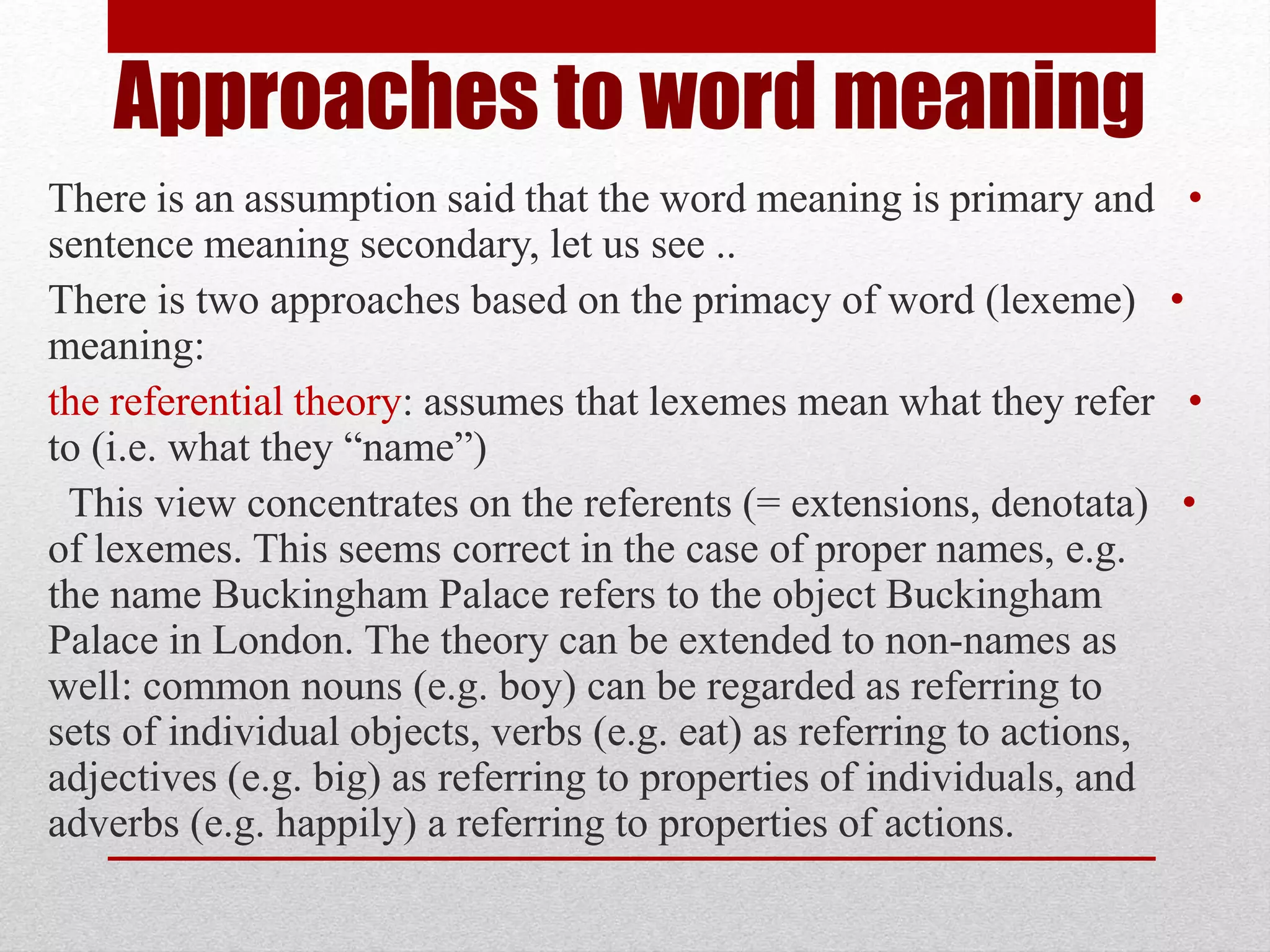
There is an assumption said that the word meaning is primary and
sentence meaning secondary, let us see ..
•
There is two approaches based on the primacy of word (lexeme)
meaning:
•
the referential theory: assumes that lexemes mean what they refer
to (i.e. what they “name”)
•
This view concentrates on the referents (= extensions, denotata)
of lexemes. This seems correct in the case of proper names, e.g.
the name Buckingham Palace refers to the object Buckingham
Palace in London. The theory can be extended to non-names as
well: common nouns (e.g. boy) can be regarded as referring to
sets of individual objects, verbs (e.g. eat) as referring to actions,
adjectives (e.g. big) as referring to properties of individuals, and
adverbs (e.g. happily) a referring to properties of actions.
The problems of the referential theory
•
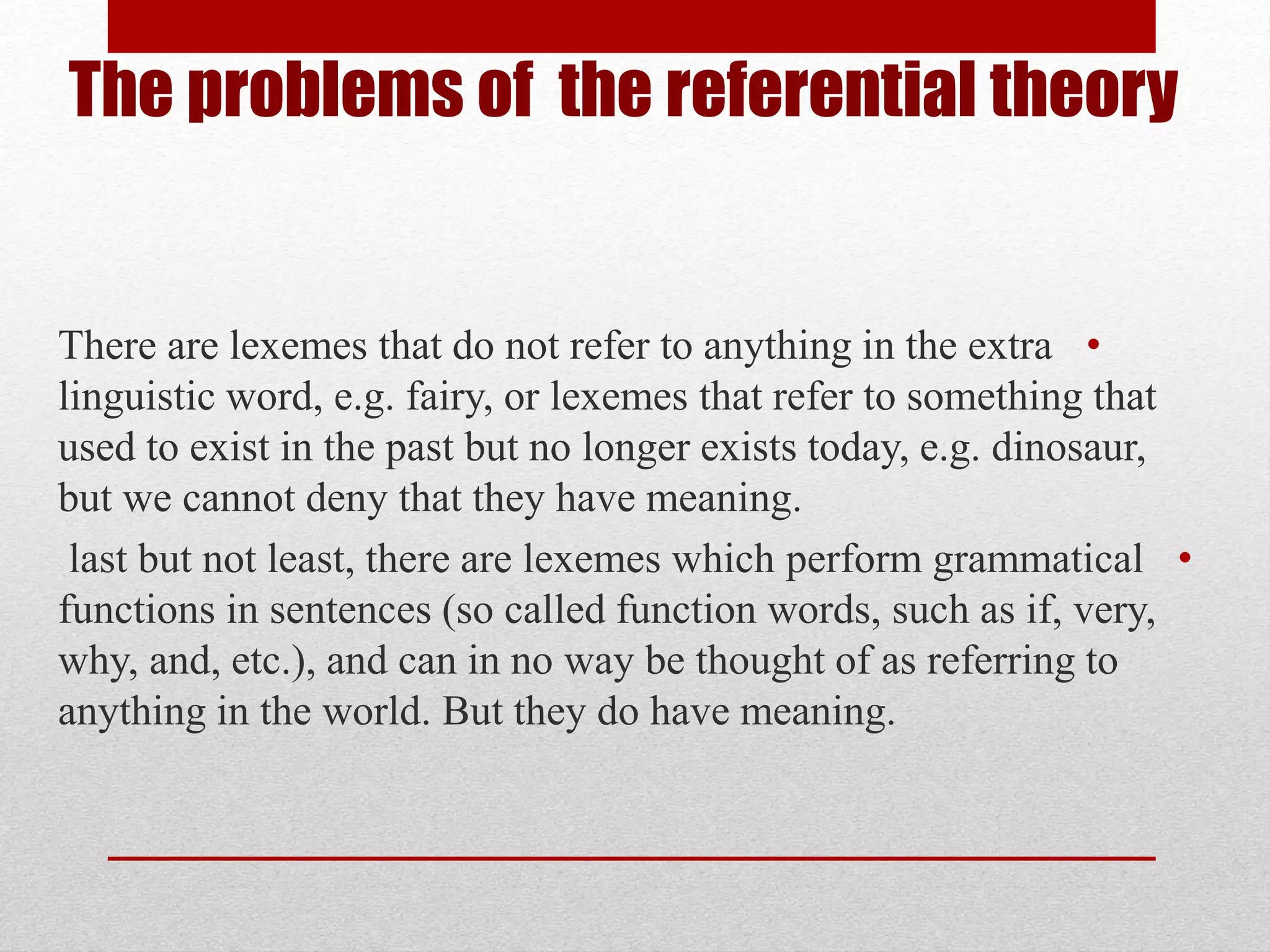
There are lexemes that do not refer to anything in the extra
linguistic word, e.g. fairy, or lexemes that refer to something that
used to exist in the past but no longer exists today, e.g. dinosaur,
but we cannot deny that they have meaning.
•
last but not least, there are lexemes which perform grammatical
functions in sentences (so called function words, such as if, very,
why, and, etc.), and can in no way be thought of as referring to
anything in the world. But they do have meaning.
Conceptual theory
•
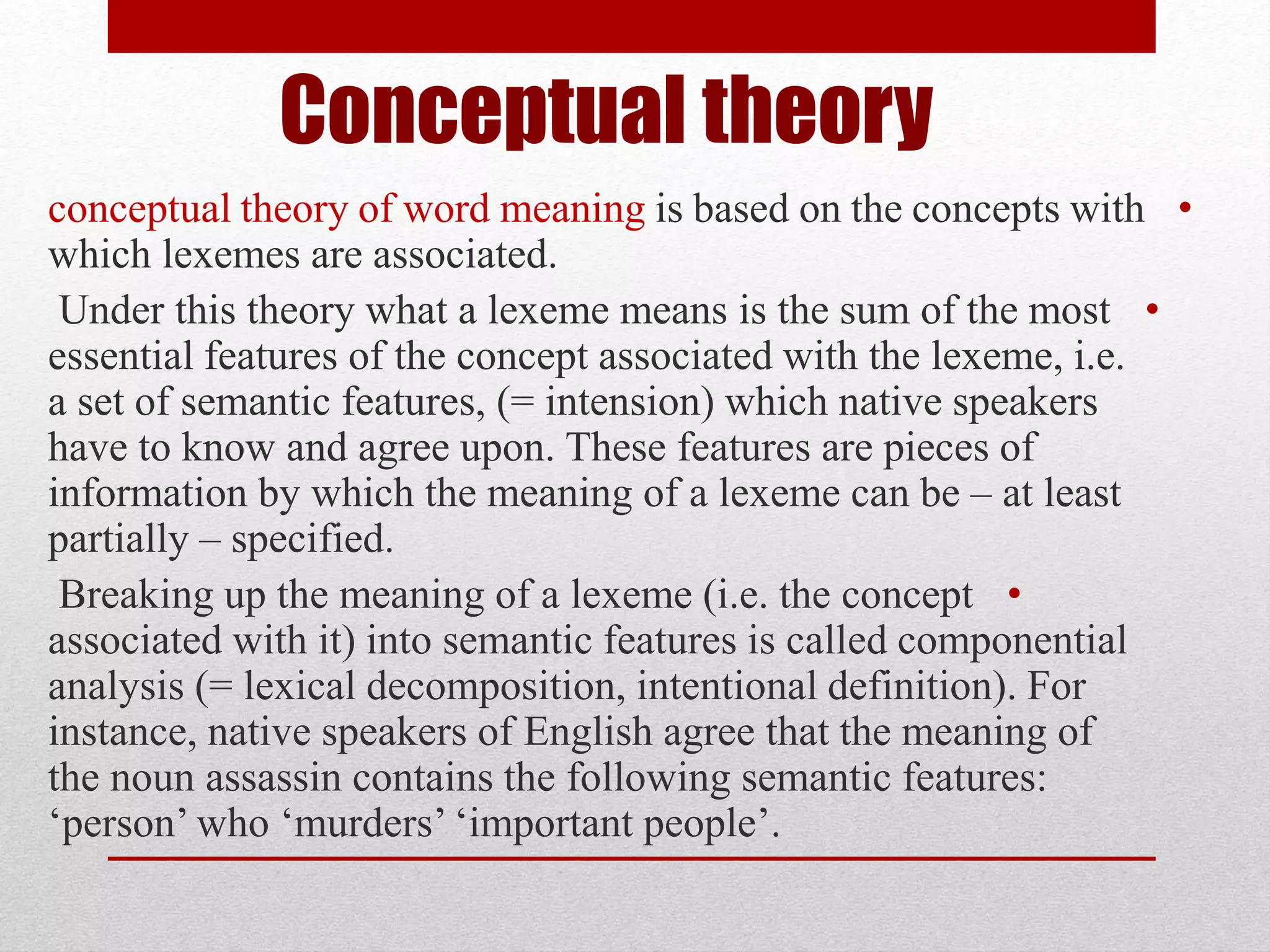
conceptual theory of word meaning is based on the concepts with
which lexemes are associated.
•
Under this theory what a lexeme means is the sum of the most
essential features of the concept associated with the lexeme, i.e.
a set of semantic features, (= intension) which native speakers
have to know and agree upon. These features are pieces of
information by which the meaning of a lexeme can be – at least
partially – specified.
•
Breaking up the meaning of a lexeme (i.e. the concept
associated with it) into semantic features is called componential
analysis (= lexical decomposition, intentional definition). For
instance, native speakers of English agree that the meaning of
the noun assassin contains the following semantic features:
‘person’ who ‘murders’ ‘important people’.
•
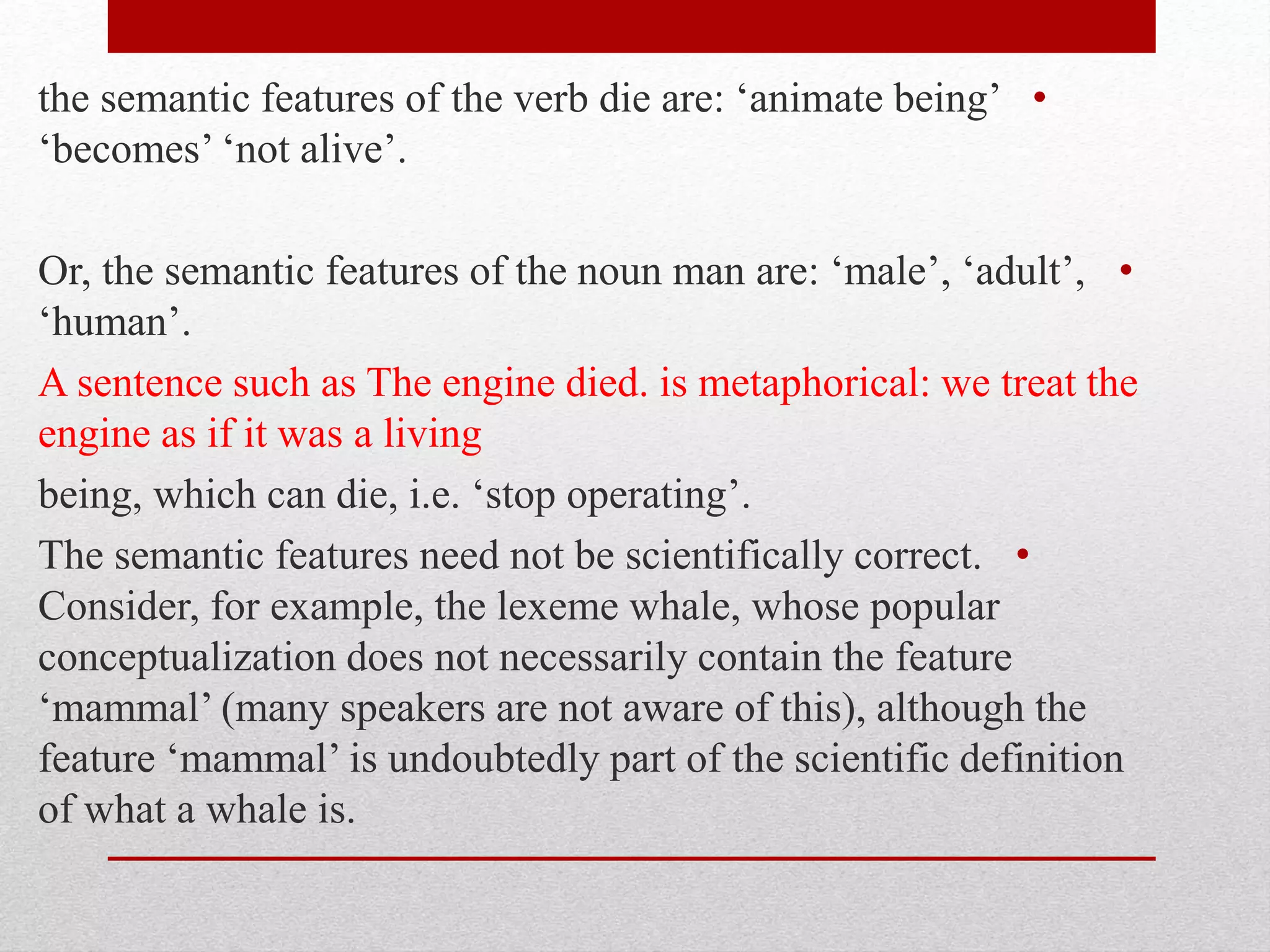
the semantic features of the verb die are: ‘animate being’
‘becomes’ ‘not alive’.
•
Or, the semantic features of the noun man are: ‘male’, ‘adult’,
‘human’.
A sentence such as The engine died. is metaphorical: we treat the
engine as if it was a living
being, which can die, i.e. ‘stop operating’.
•
The semantic features need not be scientifically correct.
Consider, for example, the lexeme whale, whose popular
conceptualization does not necessarily contain the feature
‘mammal’ (many speakers are not aware of this), although the
feature ‘mammal’ is undoubtedly part of the scientific definition
of what a whale is.
The problems of conceptual
theory
•
The most obvious one is that a large number of lexemes are not
associated with concepts at all. Again we can think of many
function words that are meaningful because they affect the
meaning of sentences (e.g. if, very, why, and, etc.) but are not
definable in terms of concepts or essential features of concepts.
And proper names like George Bush or The Louvre also
contribute to the meaning of sentences, but they are not associated
with concepts.
•
From this it follows that we cannot propose a definition of word
meaning suitable for all words, without taking sentence meaning
into consideration.
•
Since word meaning cannot be given an independent
characterization, our original assumption, viz. that word meaning is
primary, has to be replaced by the view that sentence meaning is
primary. If we give sentence meaning an independent
characterization, then the meaning of any word can be defined as
the contribution it systematically makes to the meaning of the
sentences in which it occurs. This will cover not only the meaning
of content words but the meaning of function words and the
meaning of proper names, too. It is important to emphasize that we
do not deny word meaning, we only identify it with the
contribution the word makes to the meaning of the sentence .
Sentence meaning
•
So we shall return to the question of word meaning after
we
have discussed sentence meaning…
•
We accept a truth-based account of sentence meaning.
According to this, what a declarative sentence means is the set
of the conditions that are necessary and sufficient for the
sentence to be true. These are called the truth conditions of the
sentence.
•
- 1) A boy saw a mouse.
•
This sentence is true if and only if an individual that has the
features which we attribute to boys (i.e. ‘human’, ‘male’, ‘non-
adult’) perceived through his eyes another individual that has the
features we attribute to mice, (i.e. ‘small’ ’rodent’). This set of
conditions, which minimally guarantees that (a) is true, is the
meaning of (a).
•
If, however, we replace the verb saw by the verb killed, as in (b),
the sentence will have a different set of truth conditions, i.e. a
different meaning: a boy (’human’, ‘male’,‘non-adult’) caused
another individual, having the features that we attribute to mice
(i.e. ‘small’, ‘rodent’), to die. (b) A boy killed a mouse.
•
Both (a) and (b) refer to different states of affairs, which can be
true or false.
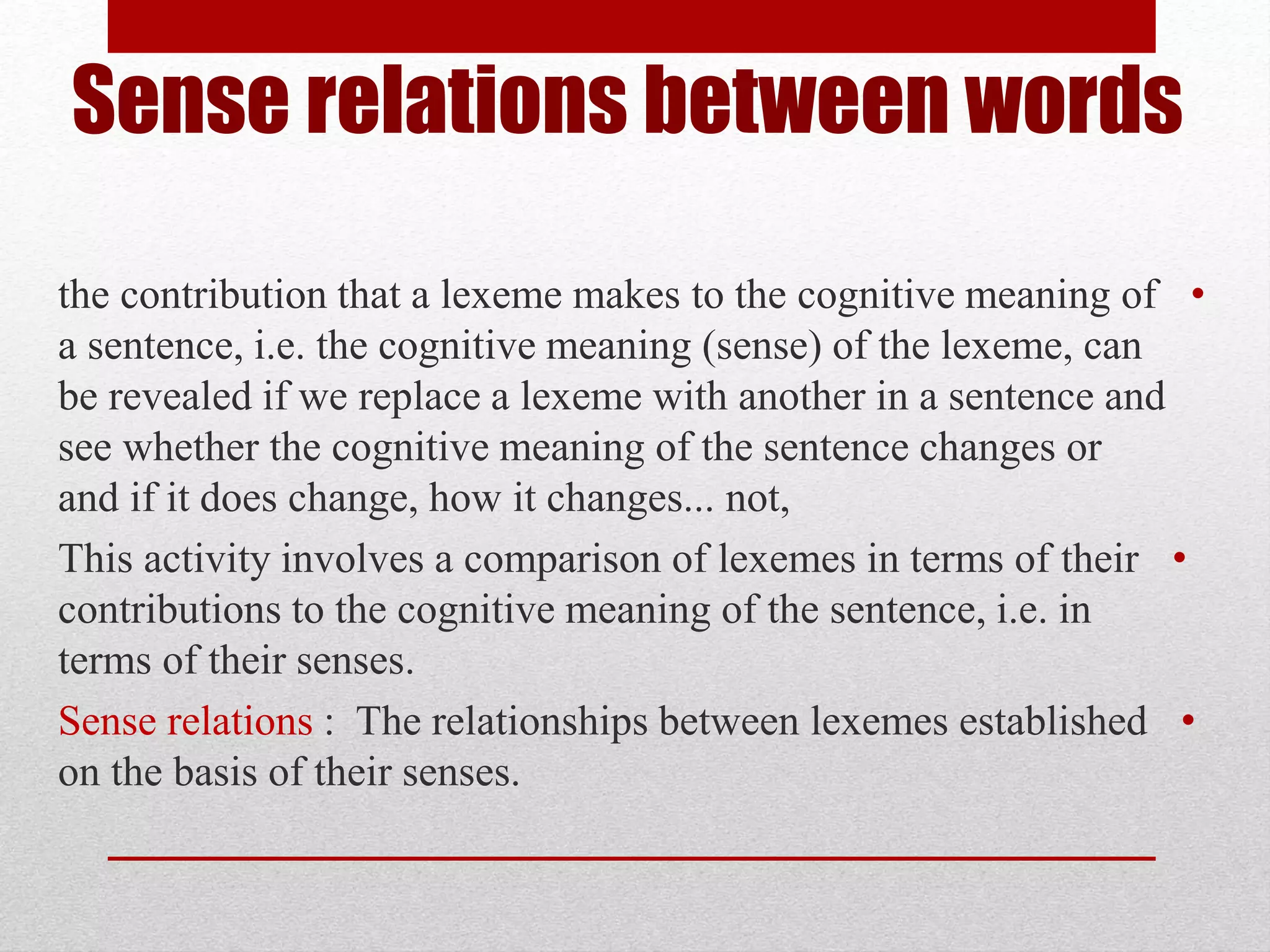
Sense relations between words
•
the contribution that a lexeme makes to the cognitive meaning of
a sentence, i.e. the cognitive meaning (sense) of the lexeme, can
be revealed if we replace a lexeme with another in a sentence and
see whether the cognitive meaning of the sentence changes or
not,
...
and if it does change, how it changes
•
This activity involves a comparison of lexemes in terms of their
contributions to the cognitive meaning of the sentence, i.e. in
terms of their senses.
•
Sense relations : The relationships between lexemes established
.
on the basis of their senses
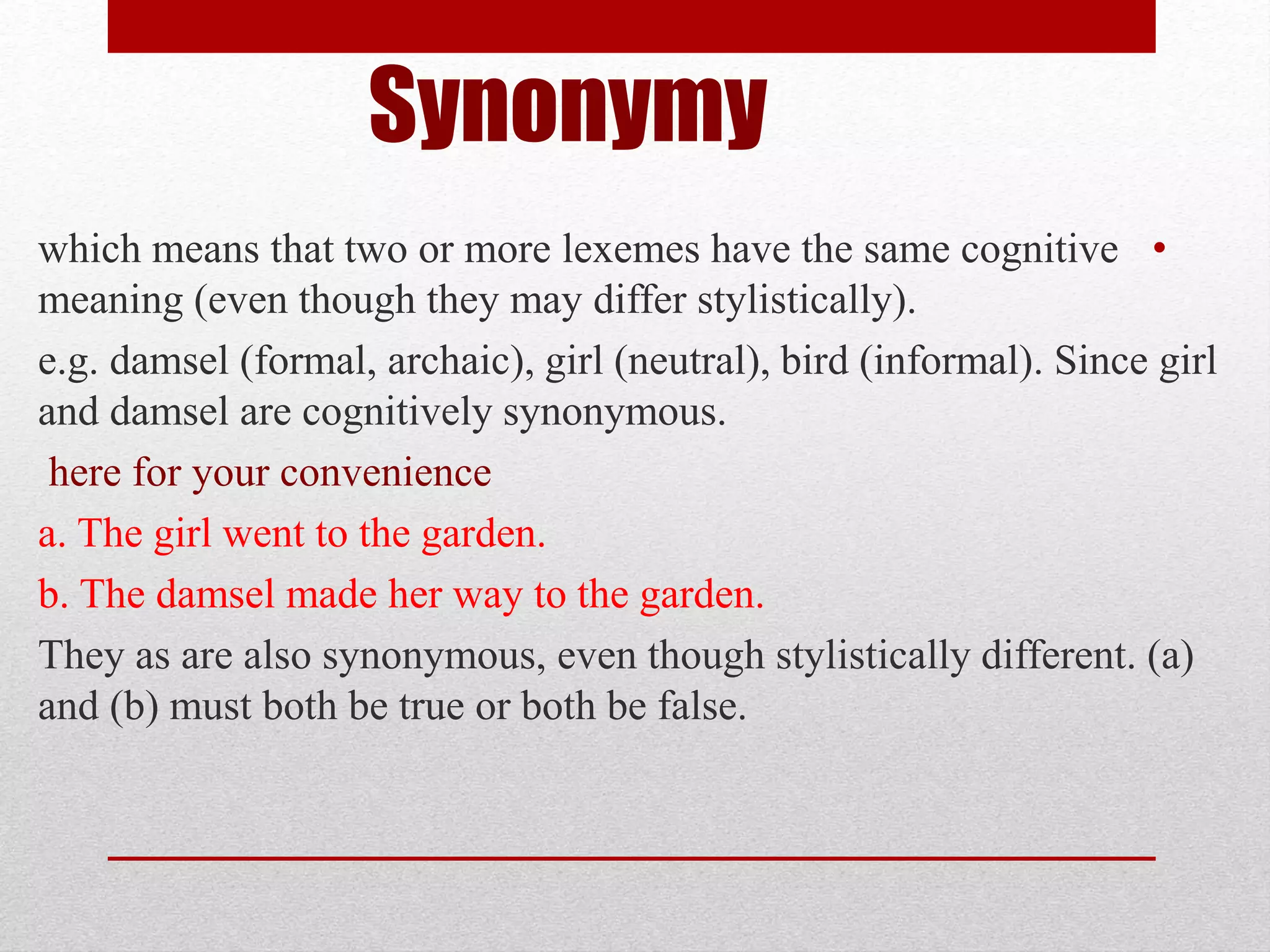
Synonymy
•
which means that two or more lexemes have the same cognitive
.
meaning (even though they may differ stylistically)
e.g. damsel (formal, archaic), girl (neutral), bird (informal). Since girl
and damsel are cognitively synonymous.
here for your convenience
a. The girl went to the garden.
b. The damsel made her way to the garden.
They as are also synonymous, even though stylistically different. (a)
and (b) must both be true or both be false.
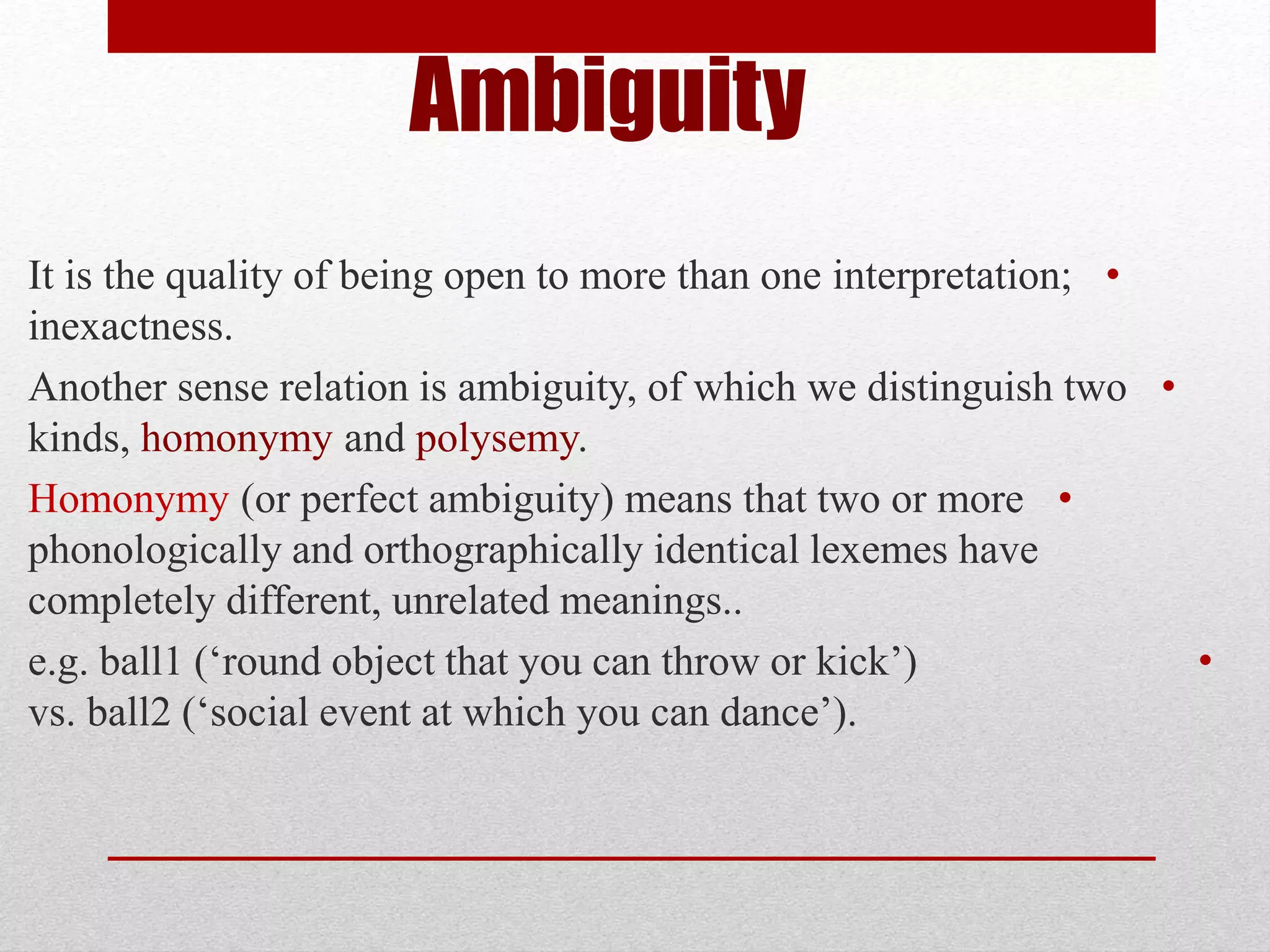
Ambiguity
•
It is the quality of being open to more than one interpretation;
inexactness.
•
Another sense relation is ambiguity, of which we distinguish two
kinds, homonymy and polysemy.
•
Homonymy (or perfect ambiguity) means that two or more
phonologically and orthographically identical lexemes have
completely different, unrelated meanings..
•
e.g. ball1 (‘round object that you can throw or kick’)
vs. ball2 (‘social event at which you can dance’).
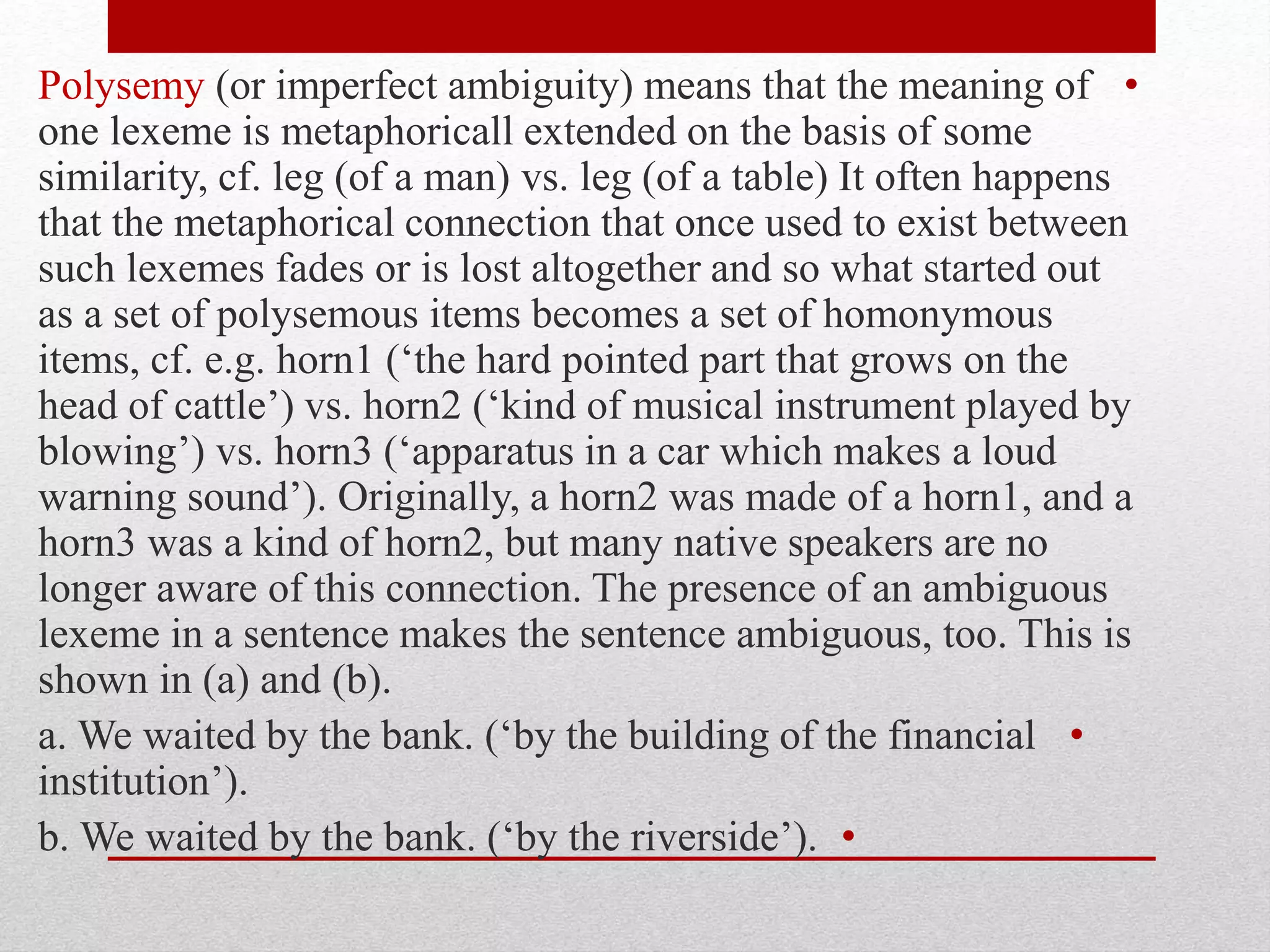
•
Polysemy (or imperfect ambiguity) means that the meaning of
one lexeme is metaphoricall extended on the basis of some
similarity, cf. leg (of a man) vs. leg (of a table) It often happens
that the metaphorical connection that once used to exist between
such lexemes fades or is lost altogether and so what started out
as a set of polysemous items becomes a set of homonymous
items, cf. e.g. horn1 (‘the hard pointed part that grows on the
head of cattle’) vs. horn2 (‘kind of musical instrument played by
blowing’) vs. horn3 (‘apparatus in a car which makes a loud
warning sound’). Originally, a horn2 was made of a horn1, and a
horn3 was a kind of horn2, but many native speakers are no
longer aware of this connection. The presence of an ambiguous
lexeme in a sentence makes the sentence ambiguous, too. This is
shown in (a) and (b).
•
a. We waited by the bank. (‘by the building of the financial
institution’).
•
b. We waited by the bank. (‘by the riverside’).
Antonymy •
(oppositeness) with subtypes called complementary, gradable and relational
opposites.
•
Complementary opposites are lexemes in such a relationship that the negation of
the meaning of one lexeme gives us the meaning of the other, e.g. dead vs. alive
(because ‘not dead’ means ‘alive’ and ‘not-alive’ means ‘dead’). Gradable
opposites a gradable lexemes, relative to some norm, e.g. large vs. small. (A
small elephant is not a small animal, it is only small for an elephant, a large
mouse is not a large animal, it is only large for a mouse.) More of one is less of
the other, e. smaller means ‘less large’, larger means ‘less small’.
•
One member of gradable opposites is normally unmarked, the other is marked.
It is the unmark member that is used in questions of degree unless we have
some good reason to use the other one; cf. How old are you? is unmarked, How
young are you? Is marked.
•
Relational opposites are lexemes referring to symmetrically opposite aspects of
the same situation, cf. e.g. employer vs. employee. (If Peter employs you, you
are his employee and he is your employer.) Replacing a lexeme by its opposite
in a sentence causes the original sentence and the new sentence to have opposite
or incompatible meanings. This means that they cannot both be true at the same
time
•
a. John is dead. b. John is alive.
hyponymy
•
Logical inclusion. This is the relation between a cognitively superordinate.
general, lexeme and the more specific lexemes that are cognitively subordinated
to it. For instance, tulip, rose, daisy, carnation, lily, daffodil, etc. are all
hyponyms in relation to flower (and co-hyponyms in relation to one another)
because the sets of semantic features that they all have include the feature
‘flower’. There are semantic features which are present in the sense of a
number of lexemes, e.g. ‘female’ or [–male] is present in the nouns, proper
names, verbs and adjectives enumerated in the following
•
a. tigress, doe, ewe, hen, mare, vixen, cow, actress, queen, girl, maiden, widow,
nun, woman, sister,
•
Mother. Agnes, Sue, Eve
•
c. to give birth, to breastfeed
•
d. pregnant, buxom, etc.
•
The noun phrase in (a) and the sentence in (b) are semantically anomalous
because they attempt to reconcile incompatible semantic properties:
•
a. !my brother called Sue
•
b. !My brother is pregnant.
•
.
•
If, in a sentence, we replace a hyponym lexeme with its
superordinate lexeme, the original, first sentence is said to
entail the new one. One sentence entails another sentence
if the truth of the first guarantees the truth of the second,
and the falsity of the second guarantees the falsity of the
first. For instance, (a) entails (b).
•
if (a) is true, is (b) true, too? If (b) is false, is (a) false,
too? If the answer to both questions is ‘yes’, then (a)
entails (b).
•
a. Mary picked daisies.
•
b. Mary picked flowers
Sources and references
•
Introduction to English Linguistics A Companion to the
Seminar book
•
english4oran.wordpress.com
•
englishan.com

Semantics, the Study of Meaning

  • 1.
    Semantics, the Studyof Meaning By : Rahaf Nidal Yousef Hamed Rhamneh Abd AL-Aziz Salamat Amman Arab University Introduction to English Linguistics Presented to : Dr. Khaleel Bataineh .
  • 2.
    Kinds of meaning • Whatis semantics ? • It’s a single word even though it ends in “s” .. In the late 1800s, Michel Bréal coined the term sémantique to describe the psychology of language. That French word has its origins in Greek: semantikos means "significant," and comes from semainein "to show, signify, indicate by a sign." • It can be applied to entire texts or to single words. For example, "destination" and "last stop" technically mean the same thing, but students of semantics analyze their subtle shades of meaning. • ?? - Compare the senses of kill, murder, assassinate.
  • 3.
    Cognitive Meaning What wemean by declarative sentences ? Declarative sentences are simply statements that relay information. They are the most common type of sentences in the English language. A declarative sentence states the facts or an opinion and lets the reader know something specific. It always ends with a period.
  • 4.
    • Cognitive meaning isthe most important, central kind of meaning or the core meaning. The cognitive meaning of a sentence is sometimes called propositional meaning or proposition. • In the case of declarative sentences, this is a state of affairs described by the sentence, which can be true or false. • The girl went to the garden. • In the case of words, cognitive meaning is the contribution that the word (lexeme) systematically makes to the cognitive meaning of sentences. Sense : The cognitive meaning of lexemes What is the cognitive meaning?
  • 5.
    OTHER KINDS OFMEANINGS • 1) Stylistic Meaning. • Stylistic meaning is that which a piece of language conveys about the circumstances of its use. For instance : archaic) ) The damsel made her way to the garden. 2) Affective Meaning. Affective meaning is a sort of meaning which an effect the personal feeling of speakers, including his/her attitude to the listener, or his/her attitude to something he/she talking about. Wow! The girl went to the garden! (emotional) 3) speech act meaning • It could be a question and an imperative, respectively, cannot be treated as being either true or false, but they can be claimed to have a questioning and a commanding a. Did the girl go to the garden? (question) b. Let the girl go to the garden. (command)
  • 6.
    The cognitive meaningof sentences • Depends on three factors: • 1) it depends on the cognitive meanings of the sentential constituents • a. Mr. Brown kicked the man • b. Mr. Brown kicked the dog. • 2) it depends on the functional labels that the constituents have, which is often, though not always, mirrored by the order of the . constituents • a. [subject The sheriff] kicked [object the man]. • b. [subject The man] kicked [object the sheriff]. • 3) the cognitive meaning of a sentence depends on its structure. • a. They ((run and swim) fast). • b. They (run and (swim fast)).
  • 7.
    proposition relations betweensentences • Sentences can be synonymous, in this case they are each other’s paraphrases. The synonymy of sentences may result from lexical synonymy, for instance • A) I want to purchase tickets for the festival • B) I want to buy festival tickets • But sentential synonymy can also be achieved structurally, as in the active–passive pair • The apple was eaten by the boy • The boy ate the apple
  • 8.
    • Sentences can alsobe ambiguous. This means that two sentences are composed of the same constituents in the same order but they have different meanings. This again can have lexical reasons (one of the words being ambiguous) • a. We waited by the bank. (the building of the financial institution’). • b. We waited by the bank. (‘by the riverside’). • Or, ambiguity can be caused by structural differences. • The sheriff killed the man with the gun. (‘The sheriff fired the gun at the man’) The sheriff killed the man with the gun. (‘The sheriff fired at the man who had the gun.’) • Furthermore, ambiguity may also result from the different functions a particular constituent can perform • A) [subject The lamb] is ready to eat. (‘The lamb will eat.’) B) [object The lamb] is ready to eat. (‘Somebody will eat the lamb.’)
  • 9.
    S NP VP V NP Thesheriff killed the man with the gun. S NP VP VP PP V NP The sheriff killed the man with the gun. structural differences
  • 10.
    Incompatibility: the conditionof two things being so different in nature as to be incapable of coexisting a) The wall is black b) the wall is white Entailment : a relationship between propositions such that one must be true if the others are a)Mary picked daisies. b)Mary picked flowers. - These terms are not brought about by structural means or by different .. functions, they are solely due to the contribution of lexemes
  • 11.
    Approaches to wordmeaning • There is an assumption said that the word meaning is primary and sentence meaning secondary, let us see .. • There is two approaches based on the primacy of word (lexeme) meaning: • the referential theory: assumes that lexemes mean what they refer to (i.e. what they “name”) • This view concentrates on the referents (= extensions, denotata) of lexemes. This seems correct in the case of proper names, e.g. the name Buckingham Palace refers to the object Buckingham Palace in London. The theory can be extended to non-names as well: common nouns (e.g. boy) can be regarded as referring to sets of individual objects, verbs (e.g. eat) as referring to actions, adjectives (e.g. big) as referring to properties of individuals, and adverbs (e.g. happily) a referring to properties of actions.
  • 12.
    The problems ofthe referential theory • There are lexemes that do not refer to anything in the extra linguistic word, e.g. fairy, or lexemes that refer to something that used to exist in the past but no longer exists today, e.g. dinosaur, but we cannot deny that they have meaning. • last but not least, there are lexemes which perform grammatical functions in sentences (so called function words, such as if, very, why, and, etc.), and can in no way be thought of as referring to anything in the world. But they do have meaning.
  • 13.
    Conceptual theory • conceptual theoryof word meaning is based on the concepts with which lexemes are associated. • Under this theory what a lexeme means is the sum of the most essential features of the concept associated with the lexeme, i.e. a set of semantic features, (= intension) which native speakers have to know and agree upon. These features are pieces of information by which the meaning of a lexeme can be – at least partially – specified. • Breaking up the meaning of a lexeme (i.e. the concept associated with it) into semantic features is called componential analysis (= lexical decomposition, intentional definition). For instance, native speakers of English agree that the meaning of the noun assassin contains the following semantic features: ‘person’ who ‘murders’ ‘important people’.
  • 14.
    • the semantic featuresof the verb die are: ‘animate being’ ‘becomes’ ‘not alive’. • Or, the semantic features of the noun man are: ‘male’, ‘adult’, ‘human’. A sentence such as The engine died. is metaphorical: we treat the engine as if it was a living being, which can die, i.e. ‘stop operating’. • The semantic features need not be scientifically correct. Consider, for example, the lexeme whale, whose popular conceptualization does not necessarily contain the feature ‘mammal’ (many speakers are not aware of this), although the feature ‘mammal’ is undoubtedly part of the scientific definition of what a whale is.
  • 15.
    The problems ofconceptual theory • The most obvious one is that a large number of lexemes are not associated with concepts at all. Again we can think of many function words that are meaningful because they affect the meaning of sentences (e.g. if, very, why, and, etc.) but are not definable in terms of concepts or essential features of concepts. And proper names like George Bush or The Louvre also contribute to the meaning of sentences, but they are not associated with concepts.
  • 16.
    • From this itfollows that we cannot propose a definition of word meaning suitable for all words, without taking sentence meaning into consideration. • Since word meaning cannot be given an independent characterization, our original assumption, viz. that word meaning is primary, has to be replaced by the view that sentence meaning is primary. If we give sentence meaning an independent characterization, then the meaning of any word can be defined as the contribution it systematically makes to the meaning of the sentences in which it occurs. This will cover not only the meaning of content words but the meaning of function words and the meaning of proper names, too. It is important to emphasize that we do not deny word meaning, we only identify it with the contribution the word makes to the meaning of the sentence .
  • 17.
    Sentence meaning • So weshall return to the question of word meaning after we have discussed sentence meaning… • We accept a truth-based account of sentence meaning. According to this, what a declarative sentence means is the set of the conditions that are necessary and sufficient for the sentence to be true. These are called the truth conditions of the sentence. • - 1) A boy saw a mouse.
  • 18.
    • This sentence istrue if and only if an individual that has the features which we attribute to boys (i.e. ‘human’, ‘male’, ‘non- adult’) perceived through his eyes another individual that has the features we attribute to mice, (i.e. ‘small’ ’rodent’). This set of conditions, which minimally guarantees that (a) is true, is the meaning of (a). • If, however, we replace the verb saw by the verb killed, as in (b), the sentence will have a different set of truth conditions, i.e. a different meaning: a boy (’human’, ‘male’,‘non-adult’) caused another individual, having the features that we attribute to mice (i.e. ‘small’, ‘rodent’), to die. (b) A boy killed a mouse. • Both (a) and (b) refer to different states of affairs, which can be true or false.
  • 19.
    Sense relations betweenwords • the contribution that a lexeme makes to the cognitive meaning of a sentence, i.e. the cognitive meaning (sense) of the lexeme, can be revealed if we replace a lexeme with another in a sentence and see whether the cognitive meaning of the sentence changes or not, ... and if it does change, how it changes • This activity involves a comparison of lexemes in terms of their contributions to the cognitive meaning of the sentence, i.e. in terms of their senses. • Sense relations : The relationships between lexemes established . on the basis of their senses
  • 20.
    Synonymy • which means thattwo or more lexemes have the same cognitive . meaning (even though they may differ stylistically) e.g. damsel (formal, archaic), girl (neutral), bird (informal). Since girl and damsel are cognitively synonymous. here for your convenience a. The girl went to the garden. b. The damsel made her way to the garden. They as are also synonymous, even though stylistically different. (a) and (b) must both be true or both be false.
  • 21.
    Ambiguity • It is thequality of being open to more than one interpretation; inexactness. • Another sense relation is ambiguity, of which we distinguish two kinds, homonymy and polysemy. • Homonymy (or perfect ambiguity) means that two or more phonologically and orthographically identical lexemes have completely different, unrelated meanings.. • e.g. ball1 (‘round object that you can throw or kick’) vs. ball2 (‘social event at which you can dance’).
  • 22.
    • Polysemy (or imperfectambiguity) means that the meaning of one lexeme is metaphoricall extended on the basis of some similarity, cf. leg (of a man) vs. leg (of a table) It often happens that the metaphorical connection that once used to exist between such lexemes fades or is lost altogether and so what started out as a set of polysemous items becomes a set of homonymous items, cf. e.g. horn1 (‘the hard pointed part that grows on the head of cattle’) vs. horn2 (‘kind of musical instrument played by blowing’) vs. horn3 (‘apparatus in a car which makes a loud warning sound’). Originally, a horn2 was made of a horn1, and a horn3 was a kind of horn2, but many native speakers are no longer aware of this connection. The presence of an ambiguous lexeme in a sentence makes the sentence ambiguous, too. This is shown in (a) and (b). • a. We waited by the bank. (‘by the building of the financial institution’). • b. We waited by the bank. (‘by the riverside’).
  • 23.
    Antonymy • (oppositeness) withsubtypes called complementary, gradable and relational opposites. • Complementary opposites are lexemes in such a relationship that the negation of the meaning of one lexeme gives us the meaning of the other, e.g. dead vs. alive (because ‘not dead’ means ‘alive’ and ‘not-alive’ means ‘dead’). Gradable opposites a gradable lexemes, relative to some norm, e.g. large vs. small. (A small elephant is not a small animal, it is only small for an elephant, a large mouse is not a large animal, it is only large for a mouse.) More of one is less of the other, e. smaller means ‘less large’, larger means ‘less small’. • One member of gradable opposites is normally unmarked, the other is marked. It is the unmark member that is used in questions of degree unless we have some good reason to use the other one; cf. How old are you? is unmarked, How young are you? Is marked. • Relational opposites are lexemes referring to symmetrically opposite aspects of the same situation, cf. e.g. employer vs. employee. (If Peter employs you, you are his employee and he is your employer.) Replacing a lexeme by its opposite in a sentence causes the original sentence and the new sentence to have opposite or incompatible meanings. This means that they cannot both be true at the same time • a. John is dead. b. John is alive.
  • 24.
    hyponymy • Logical inclusion. Thisis the relation between a cognitively superordinate. general, lexeme and the more specific lexemes that are cognitively subordinated to it. For instance, tulip, rose, daisy, carnation, lily, daffodil, etc. are all hyponyms in relation to flower (and co-hyponyms in relation to one another) because the sets of semantic features that they all have include the feature ‘flower’. There are semantic features which are present in the sense of a number of lexemes, e.g. ‘female’ or [–male] is present in the nouns, proper names, verbs and adjectives enumerated in the following • a. tigress, doe, ewe, hen, mare, vixen, cow, actress, queen, girl, maiden, widow, nun, woman, sister, • Mother. Agnes, Sue, Eve • c. to give birth, to breastfeed • d. pregnant, buxom, etc. • The noun phrase in (a) and the sentence in (b) are semantically anomalous because they attempt to reconcile incompatible semantic properties: • a. !my brother called Sue • b. !My brother is pregnant. • .
  • 25.
    • If, in asentence, we replace a hyponym lexeme with its superordinate lexeme, the original, first sentence is said to entail the new one. One sentence entails another sentence if the truth of the first guarantees the truth of the second, and the falsity of the second guarantees the falsity of the first. For instance, (a) entails (b). • if (a) is true, is (b) true, too? If (b) is false, is (a) false, too? If the answer to both questions is ‘yes’, then (a) entails (b). • a. Mary picked daisies. • b. Mary picked flowers
  • 26.
    Sources and references • Introductionto English Linguistics A Companion to the Seminar book • english4oran.wordpress.com • englishan.com