SEMINAR ON
LECODERMA
Presented by
Monika Devi
Msc (N)
HCN, SRHU
INTRODUCTION
leucoderma /vitiligo is a long term skin condition characterized
by patches of the skin loosing their pigment. The patches of
the skin affected become white and usually have sharp
margins.
 The hair from the skin may also become white . The inside
of the mouth and nose may also be involved.
 Typically both sides of the body are affected often the
patches begin on areas of skin that are exposed to the sun.
 it is more noticeable in people with dark
CAUSES
 Immune
 Autoimmune
The exact cause of vitiligo is unknown
 It is believed to be due to genetic susceptibility.
 That triggered by an environmental factor such .
 Auto immune disease which result in the destruction of
skin pigment cells.
RISK FACTORS
 Family history of autoimmune diseases such as
 hyperthyroidism,
 alopecia areata.
SIGN AND SYMPTOMS
 presence of pale patchy areas of depigmented skin which tend
to occur on the extremities.
 The patches are initially small ,but often grow and change
shape.
 When skin lesions occur. They are most prominent on the face,
hands and wrists.
 Loss of pigmentation may usually seen around body orifices
such as mouth, eyes, nastrils, genitalia and umblicus.
CONT…
 Some lesions have increased skin pigmentation around
the edge.
 People with vitiligo has stigmatized for their condition
may experience depression and similar mood disorders.
DIAGNOSIS
 History collection
 Physical examination
 Tissue biopsy
CLASSIFICATION
1. Non- segmental
2. Segmental
1. Non-segmental:-
Non-segmental vitiligo can come about at any age and the
patches usually in the symmetry from classes of non
segmental vitiligo includes the following five types of vitiligo
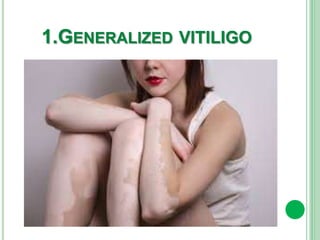
1.GENERALIZED VITILIGO
2.UNIVERSAL VITILIGO
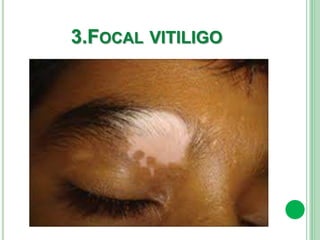
3.FOCAL VITILIGO
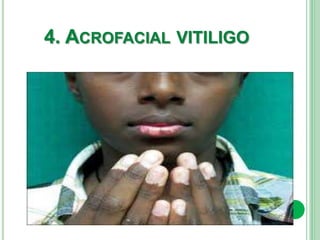
4. ACROFACIAL VITILIGO
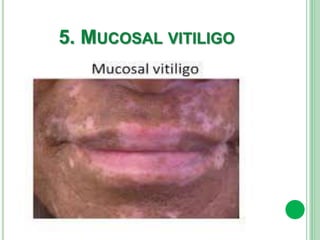
5. MUCOSAL VITILIGO
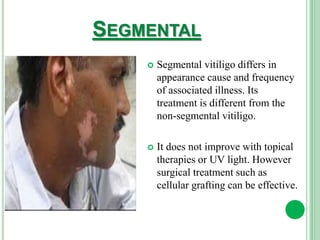
SEGMENTAL
 Segmental vitiligo differs in
appearance cause and frequency
of associated illness. Its
treatment is different from the
non-segmental vitiligo.
 It does not improve with topical
therapies or UV light. However
surgical treatment such as
cellular grafting can be effective.
DIFFERENTIAL DIAGNOSIS
 Chemical leucoderma is a similar condition due to multiple
exposure to chemical. Vitiligo however is a risk factor , triggers
may includes:-
 Inflammatory skin conditions
 Burns
 Intralesional steroid injection
 Abrasions.
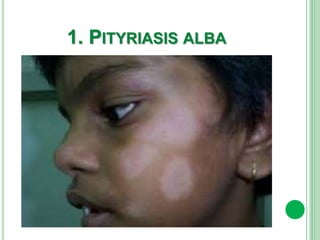
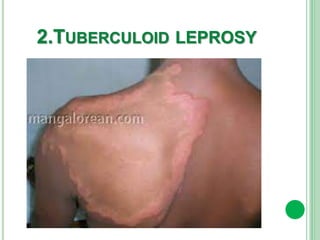
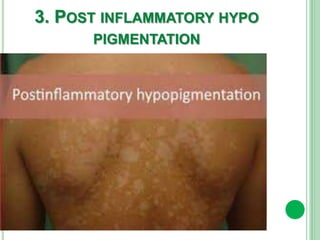
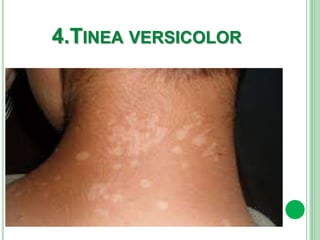
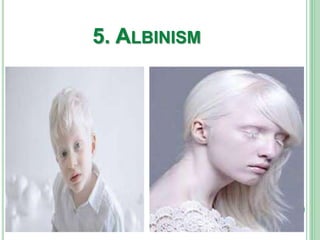
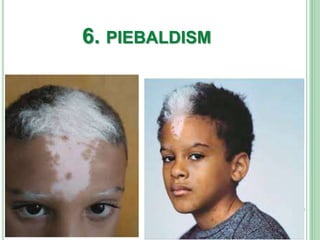
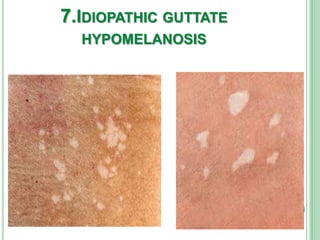
Other conditions with similar symptoms includes the following :-
1. PITYRIASIS ALBA
2.TUBERCULOID LEPROSY
3. POST INFLAMMATORY HYPO
PIGMENTATION
4.TINEA VERSICOLOR
5. ALBINISM
6. PIEBALDISM
7.IDIOPATHIC GUTTATE
HYPOMELANOSIS
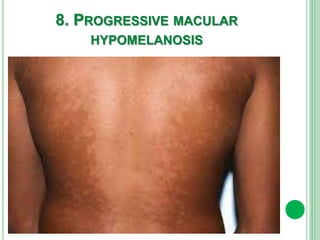
8. PROGRESSIVE MACULAR
HYPOMELANOSIS
TREATMENT
 There are no cure for vitiligo /lecoderma but several
treatment options are available.
 The best evidence is for applied steroids.
 Combination of ultraviolet light in combination with
creams.
 Phototherapy only be used if primary treatment are
ineffective.
 Lesions located on hands feet and joints are the most
difficult to repigment.
 Those on the face are easiest to return to the natural skin
color as the skin is thinner in nature.
CONT..
 Sunscreen
 Makeup
 Topical corticosteroids
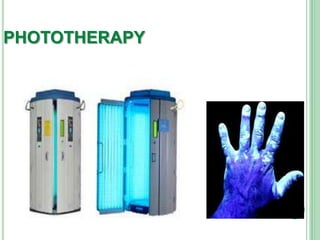
 phototherapy
PHOTOTHERAPY
PREVENTION
 Maintain a happy mood
 Regular sun
 A reasonable diet
NURSING CARE FOR VITILIGO /
LECODERMA
Nurse should advice the clients as :-
 Work and rest avoid over exertion.
 Establish a good living law to avoid the body’s biological clock
dis orders neuroen do crine disorders.
 Protect the skin from injury can not be forced to take a both
when rubbed.
CONT…
 Avoid contact with phenol and phenol compounds, such as
rubber products , rubber globes, shocks to avoid prolonged
intense sunlight.
 Large cloths should fit the body, especially under garments is
not too tight the belt should be loose clinically under the
breast , waist , groin white spots, often because of local
appression due , under garments should be cotton material.
SUMMARY
CONCLUSION
 Vitiligo is a multifactorial disease . Treatment of the condition
can be unsatisfactory, although recent guidelines propose more
robust treatment options, including a combination of typical
agents with phototherapy
 Alongside medical and surgical treatment, it is important to
consider cosmetic camouflage and psychological support for
patients with vitiligo.
 Abstract
 Vitiligo is one of the most common cutaneous disorders of depigmentation.
Although its underlying causes are still being studied and no definitive cure
currently exists, recent research has provided insight into pathogenic
mechanisms and new treatment options. Objective: The aim of this paper is to
provide a comprehensive overview of the medical and surgical therapies for
vitiligo with emphasis on the most recent treatment modalities. Design: This
review was conducted through a literature search using PubMed and the
National institutes of Health’s clinicalTrials.gov databases from January 2010
to July 2015. This yielded 86 studies, 12 of which were excluded, and 74 of
which were reviewed. Results: Recent studies and ongoing clinical trials
indicate that there are many promising new medical and surgical treatment
modalities for this chronic condition. Conclusion: A combination of
traditional and newer treatments may work synergistically to provide
additional improvement in patients’ disease state and quality of life.
 VITILIGO IS AN ACQUIRED disease with a variable course. It is
characterized clinically by well-defined depigmented macules or patches
 Advances in Vitiligo: An Update on Medical and
Surgical Treatments
 Alexander B. Dillon, MD, Andrew Sideris, MSC, [...],
and Nada Elbuluk, MD, MSC
REFERENCES
 Brunner and Suddarth's textbook of medical-surgical
nursing 12th edition. Page no 1660-1667.
THANK YOU

Seminar on lecoderma

  • 1.
  • 2.
    INTRODUCTION leucoderma /vitiligo isa long term skin condition characterized by patches of the skin loosing their pigment. The patches of the skin affected become white and usually have sharp margins.  The hair from the skin may also become white . The inside of the mouth and nose may also be involved.  Typically both sides of the body are affected often the patches begin on areas of skin that are exposed to the sun.  it is more noticeable in people with dark
  • 3.
    CAUSES  Immune  Autoimmune Theexact cause of vitiligo is unknown  It is believed to be due to genetic susceptibility.  That triggered by an environmental factor such .  Auto immune disease which result in the destruction of skin pigment cells.
  • 4.
    RISK FACTORS  Familyhistory of autoimmune diseases such as  hyperthyroidism,  alopecia areata.
  • 5.
    SIGN AND SYMPTOMS presence of pale patchy areas of depigmented skin which tend to occur on the extremities.  The patches are initially small ,but often grow and change shape.  When skin lesions occur. They are most prominent on the face, hands and wrists.  Loss of pigmentation may usually seen around body orifices such as mouth, eyes, nastrils, genitalia and umblicus.
  • 6.
    CONT…  Some lesionshave increased skin pigmentation around the edge.  People with vitiligo has stigmatized for their condition may experience depression and similar mood disorders.
  • 7.
    DIAGNOSIS  History collection Physical examination  Tissue biopsy
  • 8.
    CLASSIFICATION 1. Non- segmental 2.Segmental 1. Non-segmental:- Non-segmental vitiligo can come about at any age and the patches usually in the symmetry from classes of non segmental vitiligo includes the following five types of vitiligo
  • 9.
  • 10.
  • 11.
  • 12.
  • 13.
  • 14.
    SEGMENTAL  Segmental vitiligodiffers in appearance cause and frequency of associated illness. Its treatment is different from the non-segmental vitiligo.  It does not improve with topical therapies or UV light. However surgical treatment such as cellular grafting can be effective.
  • 15.
    DIFFERENTIAL DIAGNOSIS  Chemicalleucoderma is a similar condition due to multiple exposure to chemical. Vitiligo however is a risk factor , triggers may includes:-  Inflammatory skin conditions  Burns  Intralesional steroid injection  Abrasions. Other conditions with similar symptoms includes the following :-
  • 16.
  • 17.
  • 18.
    3. POST INFLAMMATORYHYPO PIGMENTATION
  • 19.
  • 20.
  • 21.
  • 22.
  • 23.
  • 24.
    TREATMENT  There areno cure for vitiligo /lecoderma but several treatment options are available.  The best evidence is for applied steroids.  Combination of ultraviolet light in combination with creams.  Phototherapy only be used if primary treatment are ineffective.  Lesions located on hands feet and joints are the most difficult to repigment.  Those on the face are easiest to return to the natural skin color as the skin is thinner in nature.
  • 25.
    CONT..  Sunscreen  Makeup Topical corticosteroids  phototherapy
  • 26.
  • 27.
    PREVENTION  Maintain ahappy mood  Regular sun  A reasonable diet
  • 30.
    NURSING CARE FORVITILIGO / LECODERMA Nurse should advice the clients as :-  Work and rest avoid over exertion.  Establish a good living law to avoid the body’s biological clock dis orders neuroen do crine disorders.  Protect the skin from injury can not be forced to take a both when rubbed.
  • 31.
    CONT…  Avoid contactwith phenol and phenol compounds, such as rubber products , rubber globes, shocks to avoid prolonged intense sunlight.  Large cloths should fit the body, especially under garments is not too tight the belt should be loose clinically under the breast , waist , groin white spots, often because of local appression due , under garments should be cotton material.
  • 32.
  • 33.
    CONCLUSION  Vitiligo isa multifactorial disease . Treatment of the condition can be unsatisfactory, although recent guidelines propose more robust treatment options, including a combination of typical agents with phototherapy  Alongside medical and surgical treatment, it is important to consider cosmetic camouflage and psychological support for patients with vitiligo.
  • 34.
     Abstract  Vitiligois one of the most common cutaneous disorders of depigmentation. Although its underlying causes are still being studied and no definitive cure currently exists, recent research has provided insight into pathogenic mechanisms and new treatment options. Objective: The aim of this paper is to provide a comprehensive overview of the medical and surgical therapies for vitiligo with emphasis on the most recent treatment modalities. Design: This review was conducted through a literature search using PubMed and the National institutes of Health’s clinicalTrials.gov databases from January 2010 to July 2015. This yielded 86 studies, 12 of which were excluded, and 74 of which were reviewed. Results: Recent studies and ongoing clinical trials indicate that there are many promising new medical and surgical treatment modalities for this chronic condition. Conclusion: A combination of traditional and newer treatments may work synergistically to provide additional improvement in patients’ disease state and quality of life.  VITILIGO IS AN ACQUIRED disease with a variable course. It is characterized clinically by well-defined depigmented macules or patches
  • 35.
     Advances inVitiligo: An Update on Medical and Surgical Treatments  Alexander B. Dillon, MD, Andrew Sideris, MSC, [...], and Nada Elbuluk, MD, MSC
  • 36.
    REFERENCES  Brunner andSuddarth's textbook of medical-surgical nursing 12th edition. Page no 1660-1667.
  • 37.

Editor's Notes