RENAL CALCULI
By
Monika Devi NR
M.Sc.Nursing
GMCH Jammu
INTRODUCTION
 A kidney stone is a hard solid mass of material that
forms in the kidney from the substances in the
urine.
 Kidney stones or calculi develop as a result of
various metabolic disorders which affect the fate of
calcium and other mineral elements in the body.
 Stones may be formed in the kidney, urinary
bladder, ureter and urethra
DEFINITION
A kidney stone, also
known as a renal
calculus or nephrolith,
is a solid piece of
material which Is
formed in the kidneys
from
minerals in urine
ETIOLOGY
 Unknown
Risk factor:-
 Imbalance of pH in urine
Alkalic: - Calcium stone
Acidic:- Uric & cristine stone
 Gout
 Hyperparathyroidism
CONT…
RISK FACTORS :-
 Immobility
 Sedentary life style
 Dehydration
 Metabolic disturbances
 History of renal calculi
CONT…
 High mineral content in drinking water
 Dietary intake
 UTI
 Prolonged Indwelling Catheterization
TYPES
There are mainly 5 types:-
1. Calcium oxalate stone (Is the most common
80% )
2. Calcium phosphate stone
3. Struvite stone (Triple stone)
4. Uric acid stone
5. Cystic stone
TYPES
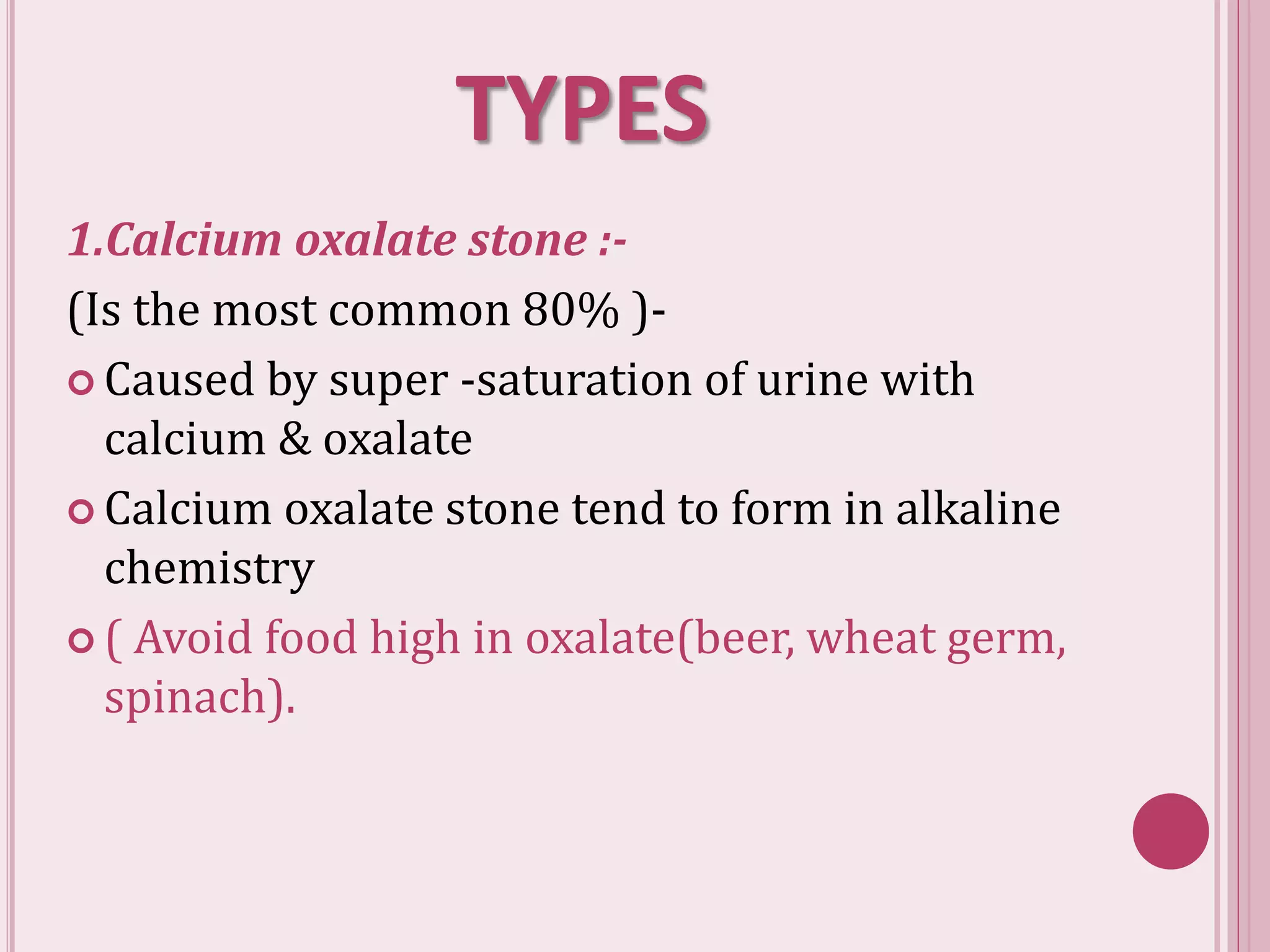
1.Calcium oxalate stone :-
(Is the most common 80% )-
 Caused by super -saturation of urine with
calcium & oxalate
 Calcium oxalate stone tend to form in alkaline
chemistry
 ( Avoid food high in oxalate(beer, wheat germ,
spinach).
CONT..
2. Calcium phosphate stone:-
 (5-10%):- Caused by
 super -saturation of urine with calcium
phosphate.
 Calcium phosphate stone tend to form in
alkaline chemistry
 (Avoid food high in calcium (Milk & dairy
product)
CONT…
3. Struvite stone (Triple phosphate stone):-
 Caused by urea splitting bacteria (Proteus,
Pseudomonas, Klebsiella, Staphylococcus).
more common in women then the man
because of UTI
 Struvite stone tend to form in alkaline
chemistry
CONT…
4. Cystic stone (10-15%):-
 Caused by cystine crystal formation.
 Cystic stone tend to form in Acidic urine ( cystine
source Avoid meat milk ,cheese, Egg)
CONT…
5. Uric acid stone (5-10%):-
 Caused by excessive dietary purine or gout
 Uric acid stone tend to form in Acidic urine
(Avoid purine sources eg. Meats, gravies, red
wine)
PATHOPHYSIOLOGY
 Urine saturation
 Supersaturation
 Crystal nucleation
 Aggregation
 Retention and growth
CLINICAL MANIFESTATION
 Severe pain in the side and back, below the ribs
 Pain that spreads to the lower abdomen and groin
 Pain that comes in waves and fluctuates in
intensity
 Pain on urination
 Cloudy or foul-smelling urine
 Nausea and vomiting
 Fever and chills if an infection is present
 Urinating small amounts of urine
DIAGNOSTIC EVALUATION
 Blood
 Urine-analysis
 Cystoscopy
 X-ray
 CT scan, MRI
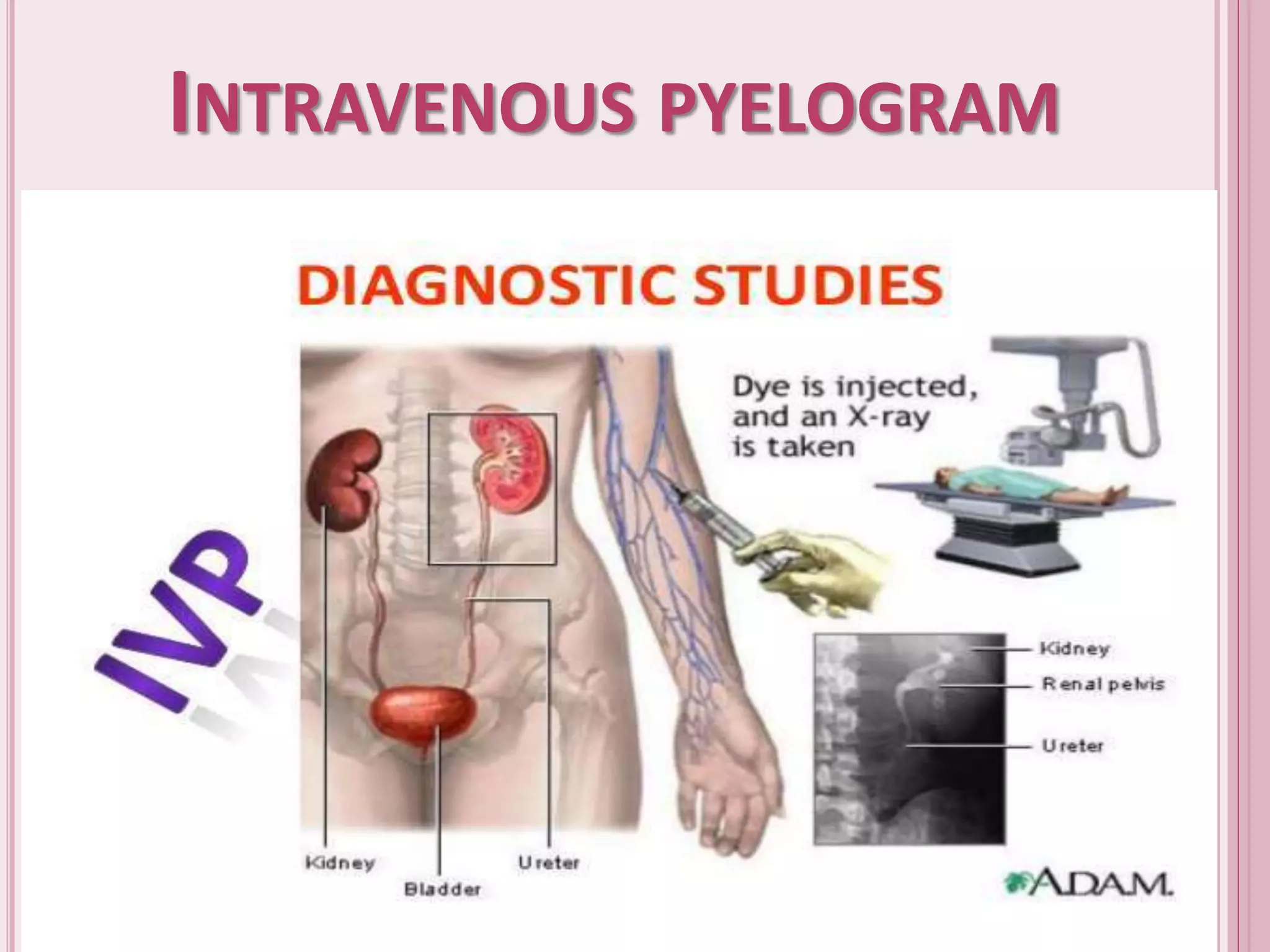
 Intravenous urogram (IVU) or intravenous
pyelogram
 USG
 KUB
CYSTOSCOPY
INTRAVENOUS PYELOGRAM
ULTRASOUND
MEDICAL MANAGEMENT
 Analgesic
 Spasmodic e.g. Buscopan
 NSAIDs e.g. Steroid
 Maintain I/O charting
 Provide rest
SURGICAL MANAGEMENT
Close procedure:-
 Lithotripsy (Extracorporeal Shockwave
lithotripsy (ESWL)-
 Noninvasive
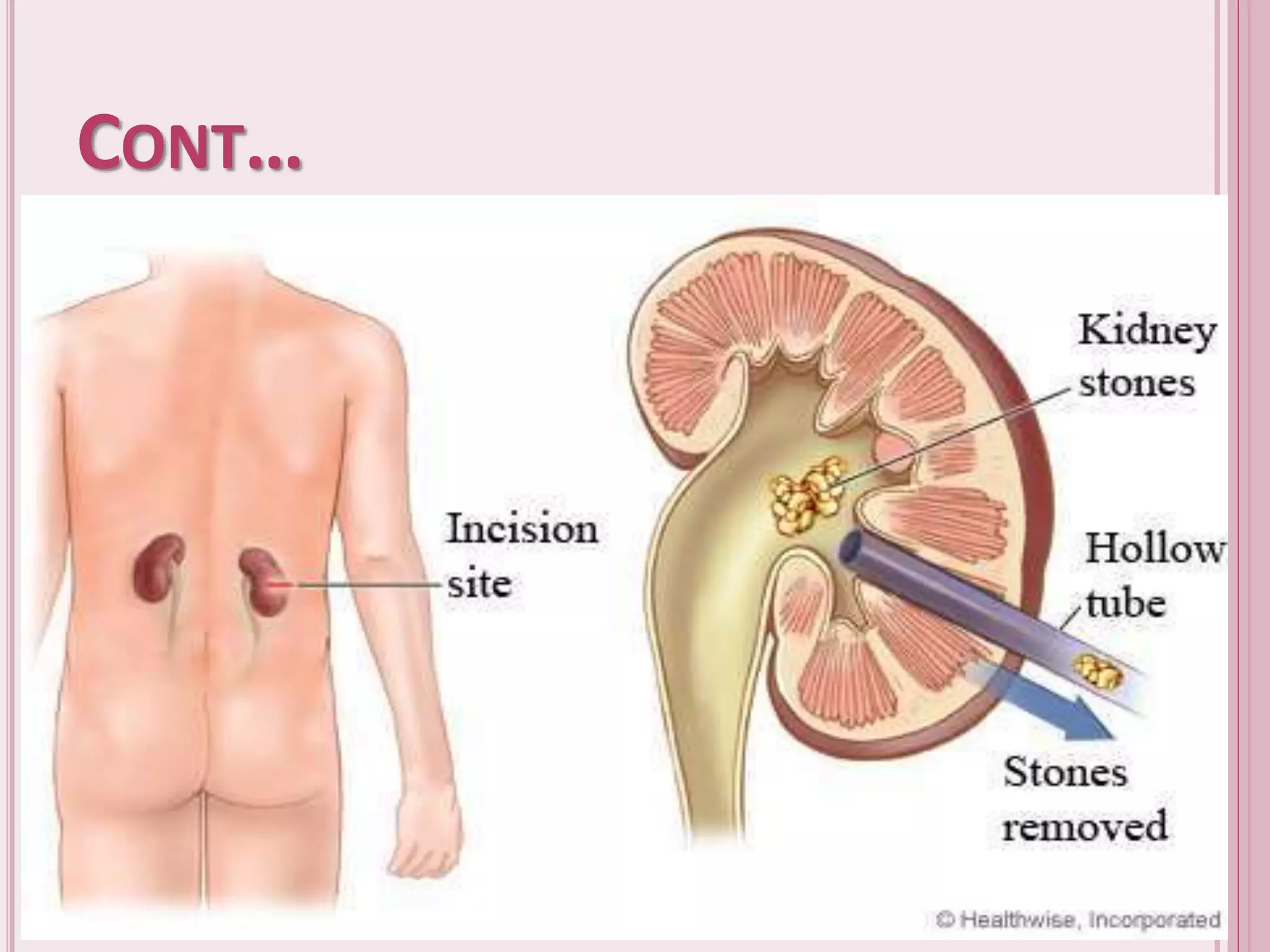
 Percutaneous Nephrolithotomy
LITHOTRIPSY
USG SHOCK WAVES CRUSH STONES
PERCUTANEOUS NEPHROLITHOTOMY
CONT…
OPEN PROCEDURE
 Ureterolithotomy
 Pyelolithotomy
 Nephrolithotomy
 Partial or total nephrectomy
PREVENTION
 Avoid protein intake;- usually protein is
restricted to 60g/day to decrease urinary excretion
of calcium and uric acid.
 A sodium intake of 3 to 4 g/day is recommended.
Table salt and high-sodium foods should be
reduced, because sodium competes with calcium for
reabsorption in the kidneys.
 Low-calcium diets are not generally
recommended ,except for true absorptive
hypercalciuria. Evidence shows that limiting
calcium, especially in women, can lead to
osteoporosis and does not prevent renal stones.
CONT..
 Avoid intake of oxalate-containing foods (e.g.
spinach, strawberries, tea, peanuts, wheat bran).
 During the day, drink fluids (ideally
water)everyday1 to 2 hours.
 Drink two glasses of water at bedtime and an
additional glass at each night time awakening to
prevent urine from becoming too concentrated
during the night
CONT..
 Avoid activities leading to sudden increases in
environmental temperatures that may cause
excessive sweating and dehydration.
 Contact your primary health care provider at
the first sign of a urinary tract infection.
NUTRITIONAL THERAPY
 Foods high in purine, calcium, or oxalate:
 Purine:
High: Sardines, herring, mussels, liver, kidney,
goose, venison, meat soups sweetbreads
Moderate: Chicken, salmon, crab, veal, mutton,
bacon, pork, beef, ham
 Calcium: milk, cheese, ice cream, yogurt, sauces
containing milk, all beans (except green beans),
lentils, fish with fine bones (sardines, kippers
herring, salmon); dried fruits, nuts, chocolate, cocoa.
 Oxalate: spinach, rhubarb, asparagus, cabbage,
tomatoes, beets, nuts, celery, parsley, runner beans,
chocolate, cocoa, instant coffee, Ovaltine, tea;
Worcestershire sauce
NURSING DIAGNOSIS
1. Acute pain related to irritation and spasm from
stone movement in the urinary tract as
manifested by complaints of pain, facial
grimacing, restlessness.
Goal :-
To reduce pain.
Intervention:-
CONT…
2. Anxiety related to uncertain outcome and lack of
knowledge regarding possible surgery as
manifested by expressions.
Goal:-
To reduce anxiety.
Intervention:-
CONT…
3. Impaired urinary elimination related to trauma or
blockage of ureters or urethra as manifested by
decreased urinary output and bloody urine.
Goal:-
To increase the urine out put.
Intervention
CONT…
4. Risk for infection related to introduction of
bacteria following manipulations of the urinary
tract and obstructed urinary blood flow.
Goal:-
To reduce the risk of infection.
Intervention
NURSING DIAGNOSIS
5. Acute pain r/t obstructing urinary Calculus.
6. Altered urinary elimination related To presence
of urinary calculi
7. Risk for infection r/t obstructing Urinary
calculus.
8. Altered renal peripheral tissue Perfusion r/t
post renal Obstruction
SUMMARY
BIBLIOGRAPHY
 Brunner and Suddarth's text book of medical –surgical
nursing twelfth edition . Page no. 1295.
 Lewis’s medical –surgical nursing , assessment and
management of clinical problems , second edition .
Page no. 1131.
THANK YOU

Renalcalculi

  • 1.
    RENAL CALCULI By Monika DeviNR M.Sc.Nursing GMCH Jammu
  • 2.
    INTRODUCTION  A kidneystone is a hard solid mass of material that forms in the kidney from the substances in the urine.  Kidney stones or calculi develop as a result of various metabolic disorders which affect the fate of calcium and other mineral elements in the body.  Stones may be formed in the kidney, urinary bladder, ureter and urethra
  • 3.
    DEFINITION A kidney stone,also known as a renal calculus or nephrolith, is a solid piece of material which Is formed in the kidneys from minerals in urine
  • 4.
    ETIOLOGY  Unknown Risk factor:- Imbalance of pH in urine Alkalic: - Calcium stone Acidic:- Uric & cristine stone  Gout  Hyperparathyroidism
  • 5.
    CONT… RISK FACTORS :- Immobility  Sedentary life style  Dehydration  Metabolic disturbances  History of renal calculi
  • 6.
    CONT…  High mineralcontent in drinking water  Dietary intake  UTI  Prolonged Indwelling Catheterization
  • 7.
    TYPES There are mainly5 types:- 1. Calcium oxalate stone (Is the most common 80% ) 2. Calcium phosphate stone 3. Struvite stone (Triple stone) 4. Uric acid stone 5. Cystic stone
  • 8.
    TYPES 1.Calcium oxalate stone:- (Is the most common 80% )-  Caused by super -saturation of urine with calcium & oxalate  Calcium oxalate stone tend to form in alkaline chemistry  ( Avoid food high in oxalate(beer, wheat germ, spinach).
  • 9.
    CONT.. 2. Calcium phosphatestone:-  (5-10%):- Caused by  super -saturation of urine with calcium phosphate.  Calcium phosphate stone tend to form in alkaline chemistry  (Avoid food high in calcium (Milk & dairy product)
  • 10.
    CONT… 3. Struvite stone(Triple phosphate stone):-  Caused by urea splitting bacteria (Proteus, Pseudomonas, Klebsiella, Staphylococcus). more common in women then the man because of UTI  Struvite stone tend to form in alkaline chemistry
  • 11.
    CONT… 4. Cystic stone(10-15%):-  Caused by cystine crystal formation.  Cystic stone tend to form in Acidic urine ( cystine source Avoid meat milk ,cheese, Egg)
  • 12.
    CONT… 5. Uric acidstone (5-10%):-  Caused by excessive dietary purine or gout  Uric acid stone tend to form in Acidic urine (Avoid purine sources eg. Meats, gravies, red wine)
  • 13.
    PATHOPHYSIOLOGY  Urine saturation Supersaturation  Crystal nucleation  Aggregation  Retention and growth
  • 15.
    CLINICAL MANIFESTATION  Severepain in the side and back, below the ribs  Pain that spreads to the lower abdomen and groin  Pain that comes in waves and fluctuates in intensity  Pain on urination  Cloudy or foul-smelling urine  Nausea and vomiting  Fever and chills if an infection is present  Urinating small amounts of urine
  • 16.
    DIAGNOSTIC EVALUATION  Blood Urine-analysis  Cystoscopy  X-ray  CT scan, MRI  Intravenous urogram (IVU) or intravenous pyelogram  USG  KUB
  • 17.
  • 18.
  • 19.
  • 20.
    MEDICAL MANAGEMENT  Analgesic Spasmodic e.g. Buscopan  NSAIDs e.g. Steroid  Maintain I/O charting  Provide rest
  • 21.
    SURGICAL MANAGEMENT Close procedure:- Lithotripsy (Extracorporeal Shockwave lithotripsy (ESWL)-  Noninvasive  Percutaneous Nephrolithotomy
  • 22.
  • 23.
    USG SHOCK WAVESCRUSH STONES
  • 24.
  • 25.
  • 26.
    OPEN PROCEDURE  Ureterolithotomy Pyelolithotomy  Nephrolithotomy  Partial or total nephrectomy
  • 27.
    PREVENTION  Avoid proteinintake;- usually protein is restricted to 60g/day to decrease urinary excretion of calcium and uric acid.  A sodium intake of 3 to 4 g/day is recommended. Table salt and high-sodium foods should be reduced, because sodium competes with calcium for reabsorption in the kidneys.  Low-calcium diets are not generally recommended ,except for true absorptive hypercalciuria. Evidence shows that limiting calcium, especially in women, can lead to osteoporosis and does not prevent renal stones.
  • 28.
    CONT..  Avoid intakeof oxalate-containing foods (e.g. spinach, strawberries, tea, peanuts, wheat bran).  During the day, drink fluids (ideally water)everyday1 to 2 hours.  Drink two glasses of water at bedtime and an additional glass at each night time awakening to prevent urine from becoming too concentrated during the night
  • 29.
    CONT..  Avoid activitiesleading to sudden increases in environmental temperatures that may cause excessive sweating and dehydration.  Contact your primary health care provider at the first sign of a urinary tract infection.
  • 30.
    NUTRITIONAL THERAPY  Foodshigh in purine, calcium, or oxalate:  Purine: High: Sardines, herring, mussels, liver, kidney, goose, venison, meat soups sweetbreads Moderate: Chicken, salmon, crab, veal, mutton, bacon, pork, beef, ham  Calcium: milk, cheese, ice cream, yogurt, sauces containing milk, all beans (except green beans), lentils, fish with fine bones (sardines, kippers herring, salmon); dried fruits, nuts, chocolate, cocoa.  Oxalate: spinach, rhubarb, asparagus, cabbage, tomatoes, beets, nuts, celery, parsley, runner beans, chocolate, cocoa, instant coffee, Ovaltine, tea; Worcestershire sauce
  • 32.
    NURSING DIAGNOSIS 1. Acutepain related to irritation and spasm from stone movement in the urinary tract as manifested by complaints of pain, facial grimacing, restlessness. Goal :- To reduce pain. Intervention:-
  • 33.
    CONT… 2. Anxiety relatedto uncertain outcome and lack of knowledge regarding possible surgery as manifested by expressions. Goal:- To reduce anxiety. Intervention:-
  • 34.
    CONT… 3. Impaired urinaryelimination related to trauma or blockage of ureters or urethra as manifested by decreased urinary output and bloody urine. Goal:- To increase the urine out put. Intervention
  • 35.
    CONT… 4. Risk forinfection related to introduction of bacteria following manipulations of the urinary tract and obstructed urinary blood flow. Goal:- To reduce the risk of infection. Intervention
  • 36.
    NURSING DIAGNOSIS 5. Acutepain r/t obstructing urinary Calculus. 6. Altered urinary elimination related To presence of urinary calculi 7. Risk for infection r/t obstructing Urinary calculus. 8. Altered renal peripheral tissue Perfusion r/t post renal Obstruction
  • 37.
  • 38.
    BIBLIOGRAPHY  Brunner andSuddarth's text book of medical –surgical nursing twelfth edition . Page no. 1295.  Lewis’s medical –surgical nursing , assessment and management of clinical problems , second edition . Page no. 1131.
  • 39.