

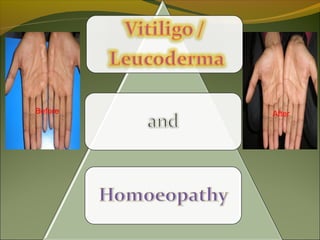
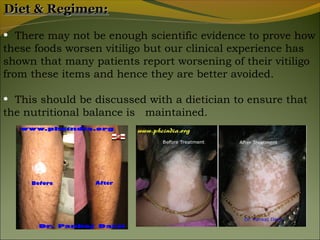
Before   After
Faith is the Best Healer
         PRAMUKH HOMOEOPATHIC CLINIC
         PREgNANCy COUSELINg CENTRE
  -: Panel Doctor :-                                                   Regd. No. G 5882
     GSECL, UGVCL
                                                                  www.phcindia.org,
 Mobile : +91 9824022384,                                      contact@phcindia.org,
     +91 9998817447
                                                                 info@phcindia.org

Clinic -1                                                                 Clinic – 2
Plot No. 286, F – 1,                                               ‘Akshar Krupa’,
Akshar Complex,                                                      Plot No. 598/2,
Opp. Gopal Dairy,                                                       Sector – 5 B,
Sector –20,                                                             Near KH – 2,
Gandhinagar - 382020                                           Gandhinagar 382006

                       Dr. PANKAJ N. DARJI
                                                   B.H.M.S;I.C.R.
                            Consultant Classical Homoeopath
         www.phcindia.org
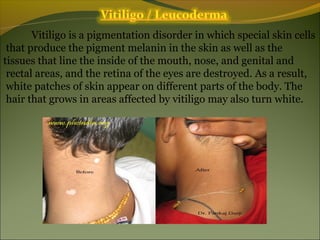
Vitiligo is a pigmentation disorder in which special skin cells
 that produce the pigment melanin in the skin as well as the
tissues that line the inside of the mouth, nose, and genital and
 rectal areas, and the retina of the eyes are destroyed. As a result,
 white patches of skin appear on different parts of the body. The
 hair that grows in areas affected by vitiligo may also turn white.
Vitiligo is the most common skin disorder.

       Now the disease is most prevalent all over the world. his non-
infectious skin ailment appears as white patches all over the body,
symmetrically or asymmetrically. Vitiligo or Leucoderma is
localized to a part of the skin whereas the vitiligo is a skin disorder
in which smooth white areas appear on a person’s skin. The
condition occurs when the body’s melanocytes are destroyed. In
addition to the skin, vitiligo can affect the mucous membranes.
Eyes, inner ears, and hair. The patient becomes a social stigma.
They are humiliated and boycotted socially. This would be really an
unfortunate situation for them. If the victim is a woman she is much
depressed because she has lost her beauty and charm as well and
becomes a victim of humiliation.
What causes vitiligo?
     Although the causes of vitiligo aren’t completely understood,
there are a number of different theories:
Auto immune disorder—the effected person’s immune system may
 develop antibodies that destroy melanocytes.
Genetic factors—certain factors that may increase the chance of
getting vitiligo can be inherited. About 30% of vitiligo cases run in
families.
Neurogenic factors—a substance that is toxic to melanocytes
May be released at nerve endings in the skin.
Self-destruction—a defect in the melanocytes causes them to
 destroy themselves.
  Vitiligo may also be triggered by certain events, such as sunburns
 or emotional stress; however, this has not been proven. Because
 none of the explanations seem to completely account for the
condition, it’s possible that a combination of these factors is
responsible for vitiligo.
What are the types of vitiligo?

There are several variations of vitiligo. The most common are:
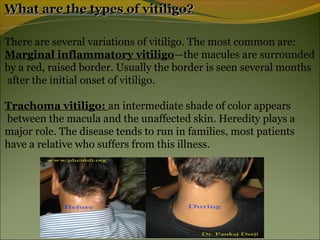
Marginal inflammatory vitiligo—the macules are surrounded
by a red, raised border. Usually the border is seen several months
after the initial onset of vitiligo.

Trachoma vitiligo: an intermediate shade of color appears
between the macula and the unaffected skin. Heredity plays a
major role. The disease tends to run in families, most patients
have a relative who suffers from this illness.
Clinically this disease : diabetes mellitus, thyroid
disorders, endocrine disorders and anemia, gastrointestinal
disorders or chronic Amoebic dysentery ,Typhoid and Jaundice.
Injury Cause: rubber footwear, synthetic underwear, tight thing
had been reported often to my clinic. In many cases of burns,
hypopgmentations occurs. Psoriasis, eczema shall interfere with
 melanin synthesis in a few patients who reports with white
discolorations. Long-time in take of certain material medicines
 is found to produce this pigment disorder. Emotional and physical
stress may precipitate the onset more.


The Fungal infections: Tinea alba, Tinea versicolor looks similar
to vitiligo patches which requires differential.The typical
appearance of Vitiligo is a milky white de-pigmented spot or spots
Sine and Symptoms:

It may vary from a single white spot to multiple spots.
The shape too is a variable. In some cases generalized
de-pigmentation observed all over the body. It has a tendency to
start as a single spot and gradually grow in size and number.
It may present with a single or several spots on limbs or abdomen
or back and then spreading to other parts of the body.

Who is affected by vitiligo?

About 1 to 2% of people in the world, or 40 to 50 million people,
have vitiligo. In the United States alone, 2 to 5 million people have
the disorder.
Ninety-five percent of people who have vitiligo develop it before
their 40th birthday. The disorder affects all races and both sexes
equally.
Diet & Regimen:
    There are a few instructions for patients regarding their
diet in vitiligo especially with mention of what they should
avoid during the treatment of vitiligo.
       Following are some of our observations based on our
 clinical experience of treating a large number of patients
(clinical observations):
•Foods that are excessively sour should be avoided.

•The ascorbic acid in sour foods tends to reduce melanin
 pigmentation. So the patients should restrict their intake
 of citrus foods.

•Non vegetarian foods are also to be avoided as they act as
 a foreign body to pigment cells.

•Flavoured drinks are to be avoided. Artificial colours used
Diet & Regimen:
in various food preparations should also be avoided.

• Usually small amounts of milk, for example in tea or
  coffee, do not cause any problems.

• If milk is excluded, it should be replaced with low lactose

 milk or with Soya milk.

• Do not take salt, curd, buttermilk, papaya, watermelon,
  melon etc. with milk.

•Please avoid salt as well sweet to improve vitiligo.

• To avoid brinjal, gram, rajama. Do not take product of
  Besan, burger, pizza etc.
Diet & Regimen:

• There may not be enough scientific evidence to prove how
these foods worsen vitiligo but our clinical experience has
shown that many patients report worsening of their vitiligo
from these items and hence they are better avoided.

• This should be discussed with a dietician to ensure that
the nutritional balance is maintained.
Is vitiligo inherited?

In some cases it is. Vitiligo may be hereditary and run in families.
 Children whose parents have the disorder are more likely to
 develop vitiligo. However, most children will not get vitiligo even
 if a parent has it, and most people with vitiligo do not have a
family history of the disorder.
There are a sizable number of inherited disorders associated with
vitiligo. To illustrate, they include: albinism of the ocular type,
auto immune polyendocrinopathy syndrome, congenital deafness
with vitiligo and achalasia, dyschromatosis symmetrica hereditaria,
 ermine phenotype, familial histiocyctic reticulosis, kabuki
HOMEOPATHY TREATMENT:

The Homoeopathic remedy selected in every case after such a
detailed study is the samarium for the vitiligo patient, which when
 administered in the correct dose brings about harmony at the
 constitutional level, stimulating the normal pigmentation and
hence induces normal skin colorations. The disease force in
vitiligo will be eliminated completely from the patients layer-by-
layer with the wonderful Homoeopathic Remedy.
As a rule, homoeopathy never looks at Vitiligo as a local disease.
Vitiligo has been considered as a local expression of a system
disturbance. As per the classical homoeopathy, we believe in
constitutional prescribing. This calls for individual case study
in every case of Vitiligo. There is no single specific remedy for all
the cases of Vitiligo. The exact treatment is determined only on
 in-depth evaluation of individual case.
Along with homeopathy treatment following seven
Pranayam are very helpful:-


    Bhastrika pranayam for 5 minutes
    Kapalbhati pranayam for 15 to 20 minutes
    Bahya pranayam for 5 minutes
    Anulom Vilom pranayam for 15 to 20 minutes
    Bhramari pranayam for 5 minutes
    Udgeet pranayam for 5 minutes
    Omkar pranayam for 5 minutes

Leucoderma presentation

  • 2.
    Before After
  • 3.
    Faith is theBest Healer PRAMUKH HOMOEOPATHIC CLINIC PREgNANCy COUSELINg CENTRE -: Panel Doctor :- Regd. No. G 5882 GSECL, UGVCL www.phcindia.org, Mobile : +91 9824022384, contact@phcindia.org, +91 9998817447 info@phcindia.org Clinic -1 Clinic – 2 Plot No. 286, F – 1, ‘Akshar Krupa’, Akshar Complex, Plot No. 598/2, Opp. Gopal Dairy, Sector – 5 B, Sector –20, Near KH – 2, Gandhinagar - 382020 Gandhinagar 382006 Dr. PANKAJ N. DARJI B.H.M.S;I.C.R. Consultant Classical Homoeopath www.phcindia.org
  • 4.
    Vitiligo is apigmentation disorder in which special skin cells that produce the pigment melanin in the skin as well as the tissues that line the inside of the mouth, nose, and genital and rectal areas, and the retina of the eyes are destroyed. As a result, white patches of skin appear on different parts of the body. The hair that grows in areas affected by vitiligo may also turn white.
  • 5.
    Vitiligo is themost common skin disorder. Now the disease is most prevalent all over the world. his non- infectious skin ailment appears as white patches all over the body, symmetrically or asymmetrically. Vitiligo or Leucoderma is localized to a part of the skin whereas the vitiligo is a skin disorder in which smooth white areas appear on a person’s skin. The condition occurs when the body’s melanocytes are destroyed. In addition to the skin, vitiligo can affect the mucous membranes. Eyes, inner ears, and hair. The patient becomes a social stigma. They are humiliated and boycotted socially. This would be really an unfortunate situation for them. If the victim is a woman she is much depressed because she has lost her beauty and charm as well and becomes a victim of humiliation.
  • 6.
    What causes vitiligo? Although the causes of vitiligo aren’t completely understood, there are a number of different theories: Auto immune disorder—the effected person’s immune system may develop antibodies that destroy melanocytes. Genetic factors—certain factors that may increase the chance of getting vitiligo can be inherited. About 30% of vitiligo cases run in families. Neurogenic factors—a substance that is toxic to melanocytes May be released at nerve endings in the skin. Self-destruction—a defect in the melanocytes causes them to destroy themselves. Vitiligo may also be triggered by certain events, such as sunburns or emotional stress; however, this has not been proven. Because none of the explanations seem to completely account for the condition, it’s possible that a combination of these factors is responsible for vitiligo.
  • 7.
    What are thetypes of vitiligo? There are several variations of vitiligo. The most common are: Marginal inflammatory vitiligo—the macules are surrounded by a red, raised border. Usually the border is seen several months after the initial onset of vitiligo. Trachoma vitiligo: an intermediate shade of color appears between the macula and the unaffected skin. Heredity plays a major role. The disease tends to run in families, most patients have a relative who suffers from this illness.
  • 8.
    Clinically this disease: diabetes mellitus, thyroid disorders, endocrine disorders and anemia, gastrointestinal disorders or chronic Amoebic dysentery ,Typhoid and Jaundice. Injury Cause: rubber footwear, synthetic underwear, tight thing had been reported often to my clinic. In many cases of burns, hypopgmentations occurs. Psoriasis, eczema shall interfere with melanin synthesis in a few patients who reports with white discolorations. Long-time in take of certain material medicines is found to produce this pigment disorder. Emotional and physical stress may precipitate the onset more. The Fungal infections: Tinea alba, Tinea versicolor looks similar to vitiligo patches which requires differential.The typical appearance of Vitiligo is a milky white de-pigmented spot or spots
  • 9.
    Sine and Symptoms: Itmay vary from a single white spot to multiple spots. The shape too is a variable. In some cases generalized de-pigmentation observed all over the body. It has a tendency to start as a single spot and gradually grow in size and number. It may present with a single or several spots on limbs or abdomen or back and then spreading to other parts of the body. Who is affected by vitiligo? About 1 to 2% of people in the world, or 40 to 50 million people, have vitiligo. In the United States alone, 2 to 5 million people have the disorder. Ninety-five percent of people who have vitiligo develop it before their 40th birthday. The disorder affects all races and both sexes equally.
  • 10.
    Diet & Regimen: There are a few instructions for patients regarding their diet in vitiligo especially with mention of what they should avoid during the treatment of vitiligo. Following are some of our observations based on our clinical experience of treating a large number of patients (clinical observations): •Foods that are excessively sour should be avoided. •The ascorbic acid in sour foods tends to reduce melanin pigmentation. So the patients should restrict their intake of citrus foods. •Non vegetarian foods are also to be avoided as they act as a foreign body to pigment cells. •Flavoured drinks are to be avoided. Artificial colours used
  • 11.
    Diet & Regimen: invarious food preparations should also be avoided. • Usually small amounts of milk, for example in tea or coffee, do not cause any problems. • If milk is excluded, it should be replaced with low lactose milk or with Soya milk. • Do not take salt, curd, buttermilk, papaya, watermelon, melon etc. with milk. •Please avoid salt as well sweet to improve vitiligo. • To avoid brinjal, gram, rajama. Do not take product of Besan, burger, pizza etc.
  • 12.
    Diet & Regimen: •There may not be enough scientific evidence to prove how these foods worsen vitiligo but our clinical experience has shown that many patients report worsening of their vitiligo from these items and hence they are better avoided. • This should be discussed with a dietician to ensure that the nutritional balance is maintained.
  • 13.
    Is vitiligo inherited? Insome cases it is. Vitiligo may be hereditary and run in families. Children whose parents have the disorder are more likely to develop vitiligo. However, most children will not get vitiligo even if a parent has it, and most people with vitiligo do not have a family history of the disorder. There are a sizable number of inherited disorders associated with vitiligo. To illustrate, they include: albinism of the ocular type, auto immune polyendocrinopathy syndrome, congenital deafness with vitiligo and achalasia, dyschromatosis symmetrica hereditaria, ermine phenotype, familial histiocyctic reticulosis, kabuki
  • 14.
    HOMEOPATHY TREATMENT: The Homoeopathicremedy selected in every case after such a detailed study is the samarium for the vitiligo patient, which when administered in the correct dose brings about harmony at the constitutional level, stimulating the normal pigmentation and hence induces normal skin colorations. The disease force in vitiligo will be eliminated completely from the patients layer-by- layer with the wonderful Homoeopathic Remedy. As a rule, homoeopathy never looks at Vitiligo as a local disease. Vitiligo has been considered as a local expression of a system disturbance. As per the classical homoeopathy, we believe in constitutional prescribing. This calls for individual case study in every case of Vitiligo. There is no single specific remedy for all the cases of Vitiligo. The exact treatment is determined only on in-depth evaluation of individual case.
  • 15.
    Along with homeopathytreatment following seven Pranayam are very helpful:-  Bhastrika pranayam for 5 minutes  Kapalbhati pranayam for 15 to 20 minutes  Bahya pranayam for 5 minutes  Anulom Vilom pranayam for 15 to 20 minutes  Bhramari pranayam for 5 minutes  Udgeet pranayam for 5 minutes  Omkar pranayam for 5 minutes