Topic: Hansen’s disease
Submitted by: Ambreen Sadaf
BSOT02153003
Submitted to: Ma’am Wajeeha Abdul Ahad
 Introduction
 Epidemiology
 Disabilities
 Risk factors
 Symptoms
 Signs
 Mode of transmission
 Treatment
 Role of occupational therapist
Leprosy (Hansen's Disease) is a chronic
infectious disease that primarily affects the
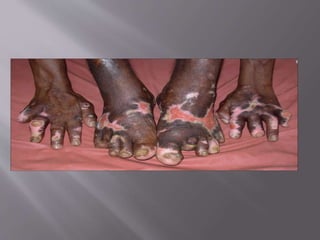
peripheral nerves, skin, upper respiratory
tract, eyes, and nasal mucosa (lining of the
nose).
The disease is caused by a bacillus (rod-
shaped) bacterium known as Mycobacterium
leprae.
 Leprosy is common in parts of tropical and
subtropical Asia, Africa, Central and South
America, some Pacific countries, and in parts of
the USA.
 In Australia, leprosy is now rare. With the
introduction of multi-drug therapy in the early
1980s, the disease is now curable.
 Leprosy is one of the infectious diseases that
pose a very complex problem.
 The problem is not only in terms of medical,
but extends to social, economic, and
psychological.
 The source of infection of leprosy is that
patients with many types of multibacillary
bacillary (MB).
 How this bacteria can infect into human is not
known with certainty, only on the assumption
that the classic is through direct contact
between the skin.
 The second assumption this bacteria can infect
into human by inhaled, because M. leprae can
still live a few days in the droplet on air.
 WHO classification (1982) which was then
revised in 1997.
 In this classification throughout the leprosy
patient only be divided into two types:
1. Type Paucibacillary (PB)
2. multibacillary (MB).
This classification is the basis of the negative and
positive acid-fast bacilli (BT) in the skin.
 Mycobacterium leprae attacks the peripheral
nerves of the human body. Depending on the
peripheral nerve damage, there will be
malfunctioning of peripheral nerves: sensory,
motor and autonomic..
 The occurrence of defects in leprosy is caused
by damage to the peripheral nerve function, or
because the leprosy bacteria and inflammation
(neuritis) when the state of leprosy reactions
 Sensory dysfunction
 Motor dysfunction
 Damage to autonomic functions
 This sensory dysfunction causes numbness
(anesthesia). Due to lack / loss of sensation in
the hands and feet can occur wounds. While on
the cornea of the eye will lead to lack / loss of
reflex eye blink so easily let dirt, foreign objects
that can cause eye infections and blindness as a
result.
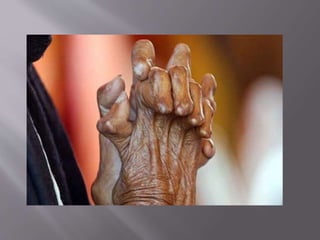
 The muscle strength of the hands and feet can
become weak / paralyzed and causes the
muscle to shrink (atrophy) because not be used.
fingers and toes become bent (Hand Claw /
Claw toes) and eventually may occur stiffness
in the joints, in case of weakness / stiffness in
the eyes, eyelids can not be sealed
(lagoptalmus)
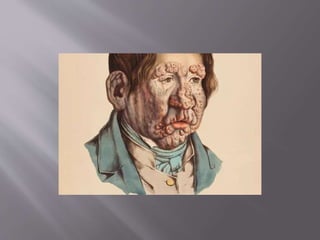
 Disruption sweat glands, oil glands and
impaired blood circulation so that the skin
becomes dry, thickened, hardens, and may
eventually cracked. In general, if there is
damage nerve function not handled properly
and appropriately, there will be deformed to a
more severe level
 Agent
 Host
 Environment
 The main symptom of leprosy is skin lesions.
Other effects of leprosy are due to its impact on the
body's nervous system.
 Leprosy does not affect the central nervous system.
However, it can affect the peripheral nervous
system (PNS) (sensory, motor and autonomic
nerves) by:
 Sensory nerve damage
 Eye nerve damage
 Motor nerve damage
 Autonomic nerve damage
 Pale or slightly reddish patch.
 Definite loss of sensation in the patch.
 Signs of damage to nerves.
 Definite loss of sensation in hands/feet.
 Weakness of muscles of hands/feet/face.
 Visible deformity of hands/feet/face.
 Transmission by inhalation.
 Droplet infection (most common).
 Transmission by contact.
 Skin to skin contact with infectious cases.
 Contact with soil.
 Leprosy is curable with a treatment known as
multidrug therapy.
 Treatment for paucibacillary leprosy is with the
medications dapsone and rifampicin for six months.
 Treatment for multibacillary leprosy consists of
rifampicin, dapsone, and clofazimine for 12 months.
 Before the introduction of multi-drug therapy
in the early 1980s, leprosy could only be
slowed but not cured, as the bacteria could not
be killed.
 Now, with the use of antibiotics and with other
medicines, the disease is curable. Once a
person with leprosy begins appropriate
treatment, they quickly become non-infectious.
 There is no vaccine generally available to
specifically prevent leprosy. .
 However, the vaccine against tuberculosis (TB),
called the BCG vaccine, may provide some
protection against leprosy.
 This is because the organism that causes
leprosy is closely related to the one that causes
TB.
 The role of occupational therapists in the
treatment of leprosy patient cases can divide
into three effort :
(1) Preventive
(2) Curative
(3) Rehabilitative
in the handling of preventive, occupational
therapist acts as a controlling agent in charge of
analyzing the environmental environment in an
effort to control leprosy bacteria in environments
where human activities take place.
 Curative effort carried out by an occupational
therapy in order to deal with a movement
disorder resulting from the leprosy who
causing dysfunction in the peripheral nervous
system and cause a movement disorder
eventually cause muscle wasting or muscle
atrophy.
 Rehabilitative efforts carried out by an
occupational therapist who aims to restore and
maximize motor and sensory function in
patients with leprosy in order to carry out
activities aimed like eating and drinking.
 An occupational therapist considering its
aspects in order to provide hope and
encouragement to the patient that the patient is
still able to perform activities in sickness.
 Treatment of occupational therapists to analyze
the environment included in curative way to
do as an occupational therapist.
 Where an occupational therapist can design an
environment such as houses with ergonomics
element, so that the element in the home
environment are made ergonomic, then when it
used for activities it can be free of pathogens
who can cause diseases.
 Leprosy is a chronic bacterial infection.
 It affects the skin and various nervous
systems of the body, particularly the
peripheral nerves.
 Leprosy is more common in tropical and
subtropical areas.
 The disease is curable through multi-
drug therapy.
 https://www.niaid.nih.gov/diseases-
conditions/leprosy-hansens-disease
 https://www.betterhealth.vic.gov.au/health/con
ditionsandtreatments/leprosy
 http://iluniotui.blogspot.com/2016/01/environm
ent-analysis-of-occupational.html
 Helen L.Hopkins. Helen D.Smith. “Willard And
Spackman Occupational Therapy : Eight Edition”.
Pennsylvania: J.B Lippincott Company
Philadelphia.
 http://eprints.undip.ac.id/42543/2/BAB_II.pdf
Hansen's disease

Hansen's disease

  • 2.
    Topic: Hansen’s disease Submittedby: Ambreen Sadaf BSOT02153003 Submitted to: Ma’am Wajeeha Abdul Ahad
  • 3.
     Introduction  Epidemiology Disabilities  Risk factors  Symptoms  Signs  Mode of transmission  Treatment  Role of occupational therapist
  • 5.
    Leprosy (Hansen's Disease)is a chronic infectious disease that primarily affects the peripheral nerves, skin, upper respiratory tract, eyes, and nasal mucosa (lining of the nose). The disease is caused by a bacillus (rod- shaped) bacterium known as Mycobacterium leprae.
  • 6.
     Leprosy iscommon in parts of tropical and subtropical Asia, Africa, Central and South America, some Pacific countries, and in parts of the USA.  In Australia, leprosy is now rare. With the introduction of multi-drug therapy in the early 1980s, the disease is now curable.
  • 7.
     Leprosy isone of the infectious diseases that pose a very complex problem.  The problem is not only in terms of medical, but extends to social, economic, and psychological.
  • 8.
     The sourceof infection of leprosy is that patients with many types of multibacillary bacillary (MB).  How this bacteria can infect into human is not known with certainty, only on the assumption that the classic is through direct contact between the skin.  The second assumption this bacteria can infect into human by inhaled, because M. leprae can still live a few days in the droplet on air.
  • 9.
     WHO classification(1982) which was then revised in 1997.  In this classification throughout the leprosy patient only be divided into two types: 1. Type Paucibacillary (PB) 2. multibacillary (MB). This classification is the basis of the negative and positive acid-fast bacilli (BT) in the skin.
  • 10.
     Mycobacterium lepraeattacks the peripheral nerves of the human body. Depending on the peripheral nerve damage, there will be malfunctioning of peripheral nerves: sensory, motor and autonomic..
  • 11.
     The occurrenceof defects in leprosy is caused by damage to the peripheral nerve function, or because the leprosy bacteria and inflammation (neuritis) when the state of leprosy reactions
  • 13.
     Sensory dysfunction Motor dysfunction  Damage to autonomic functions
  • 14.
     This sensorydysfunction causes numbness (anesthesia). Due to lack / loss of sensation in the hands and feet can occur wounds. While on the cornea of the eye will lead to lack / loss of reflex eye blink so easily let dirt, foreign objects that can cause eye infections and blindness as a result.
  • 15.
     The musclestrength of the hands and feet can become weak / paralyzed and causes the muscle to shrink (atrophy) because not be used. fingers and toes become bent (Hand Claw / Claw toes) and eventually may occur stiffness in the joints, in case of weakness / stiffness in the eyes, eyelids can not be sealed (lagoptalmus)
  • 16.
     Disruption sweatglands, oil glands and impaired blood circulation so that the skin becomes dry, thickened, hardens, and may eventually cracked. In general, if there is damage nerve function not handled properly and appropriately, there will be deformed to a more severe level
  • 17.
  • 18.
     The mainsymptom of leprosy is skin lesions. Other effects of leprosy are due to its impact on the body's nervous system.  Leprosy does not affect the central nervous system. However, it can affect the peripheral nervous system (PNS) (sensory, motor and autonomic nerves) by:  Sensory nerve damage  Eye nerve damage  Motor nerve damage  Autonomic nerve damage
  • 20.
     Pale orslightly reddish patch.  Definite loss of sensation in the patch.  Signs of damage to nerves.  Definite loss of sensation in hands/feet.  Weakness of muscles of hands/feet/face.  Visible deformity of hands/feet/face.
  • 21.
     Transmission byinhalation.  Droplet infection (most common).  Transmission by contact.  Skin to skin contact with infectious cases.  Contact with soil.
  • 23.
     Leprosy iscurable with a treatment known as multidrug therapy.  Treatment for paucibacillary leprosy is with the medications dapsone and rifampicin for six months.  Treatment for multibacillary leprosy consists of rifampicin, dapsone, and clofazimine for 12 months.
  • 24.
     Before theintroduction of multi-drug therapy in the early 1980s, leprosy could only be slowed but not cured, as the bacteria could not be killed.  Now, with the use of antibiotics and with other medicines, the disease is curable. Once a person with leprosy begins appropriate treatment, they quickly become non-infectious.
  • 25.
     There isno vaccine generally available to specifically prevent leprosy. .  However, the vaccine against tuberculosis (TB), called the BCG vaccine, may provide some protection against leprosy.  This is because the organism that causes leprosy is closely related to the one that causes TB.
  • 26.
     The roleof occupational therapists in the treatment of leprosy patient cases can divide into three effort : (1) Preventive (2) Curative (3) Rehabilitative in the handling of preventive, occupational therapist acts as a controlling agent in charge of analyzing the environmental environment in an effort to control leprosy bacteria in environments where human activities take place.
  • 27.
     Curative effortcarried out by an occupational therapy in order to deal with a movement disorder resulting from the leprosy who causing dysfunction in the peripheral nervous system and cause a movement disorder eventually cause muscle wasting or muscle atrophy.
  • 28.
     Rehabilitative effortscarried out by an occupational therapist who aims to restore and maximize motor and sensory function in patients with leprosy in order to carry out activities aimed like eating and drinking.  An occupational therapist considering its aspects in order to provide hope and encouragement to the patient that the patient is still able to perform activities in sickness.
  • 29.
     Treatment ofoccupational therapists to analyze the environment included in curative way to do as an occupational therapist.  Where an occupational therapist can design an environment such as houses with ergonomics element, so that the element in the home environment are made ergonomic, then when it used for activities it can be free of pathogens who can cause diseases.
  • 30.
     Leprosy isa chronic bacterial infection.  It affects the skin and various nervous systems of the body, particularly the peripheral nerves.  Leprosy is more common in tropical and subtropical areas.  The disease is curable through multi- drug therapy.
  • 31.
     https://www.niaid.nih.gov/diseases- conditions/leprosy-hansens-disease  https://www.betterhealth.vic.gov.au/health/con ditionsandtreatments/leprosy http://iluniotui.blogspot.com/2016/01/environm ent-analysis-of-occupational.html  Helen L.Hopkins. Helen D.Smith. “Willard And Spackman Occupational Therapy : Eight Edition”. Pennsylvania: J.B Lippincott Company Philadelphia.  http://eprints.undip.ac.id/42543/2/BAB_II.pdf

Editor's Notes

  • #18 B. Factors That Cause Incidence of Leprosy 1. Agent Mycobacterium leprae can cause disfunction in peripheral nerves, skin and other body tissues except the central nervous system. Leprosy is a disease caused by the bacteria call M. leprae that affects the skin, peripheral nerves in the hands and feet, and mucous membranes of the nose, throat and eyes. This bacteria are similar genus with the TB bacteria outside the human body, leprosy bacteria live well in a moist environment but not resistant to sunlight. Leprosy germs can survive on a cool, damp, dark without sunlight until many years. 2. Host Humans are the reservoir for the spread of bacteria such as Mycobacterium tuberculosis and Morbus Hansen, these germs can infect 10-15 people. According to the study of ecological health center (1991), the rate of transmission of leprosy sufferers in the family environment is quite high, with an average patient can transmit to 2-3 people in the house. In the house with good ventilation, these germs can be lost in the wind and it would be better if the room ventilation using air purifiers that can catch germs. 3. Environment Environment is everything that exists outside of the host, including inanimate objects, living objects, real or abstract, such as the atmosphere, which is formed by the interaction of all the elements including a host of others. Environment consists of physical and non-physical environment, physical environment consists of: the geographical situation (high or low plains, rice fields and others), humidity, temperature, living environment. As for non-physical environment include: social (education, employment), culture (customs, habits hereditary), economics (micro and local policy) and political (leadership succession that influence the policy of prevention and control of disease).
  • #19 Symptoms of leprosy The main symptom of leprosy is skin lesions. Other effects of leprosy are due to its impact on the body's nervous system. Leprosy does not affect the central nervous system. However, it can affect the peripheral nervous system (PNS) (sensory, motor and autonomic nerves) by: sensory nerve damage – when the sensory nerves are damaged, they cannot register pain. This leaves the extremities of hands and feet vulnerable to burns and injuries that can result in loss of fingers, toes, hands and feet eye nerve damage – when the eye is affected, it can lead to blindness, particularly if the person does not know how to prevent injury due to dust or other irritants motor nerve damage – when the motor nerves are involved, various forms of paralysis can occur such as ‘dropped foot’, ‘dropped wrist’, ‘clawed hand’, or lagophthalmos (where the eye cannot close) autonomic nerve damage – the autonomic nerves regulate the PNS body functions, such as blood pressure, heart rate, sweating, bowel and bladder emptying, and digestion. Damage to the autonomic nerves can cause hair loss and can affect the ability to sweat, leaving the skin dry and cracked and exposed to secondary infection.