Measurement :Scaling, Reliability &
Validity
Scale
“A tool through which researcher
records the responses of the respondents
in measureable way.”
o With the help of suitable scale,
researcher can have the information
regarding variables in detail.
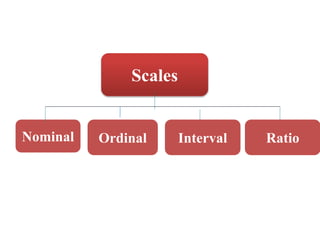
Scales
Nominal Ordinal Interval Ratio
Nominal Scale
“A nominal scale is one that allows the
researcher to assign subjects to certain
categories or groups.”
oSuch categories are non overlapping, or
mutually exclusive and collectively
exhaustive.
oNominal scale is categorical in nature and
gives only the basic information.
Use of Nominal Scale
oThe nominal scale is always used for
obtaining personal data.
oFor example; with respect to the variable
of gender, respondents can be grouped
into two categories- male and female.
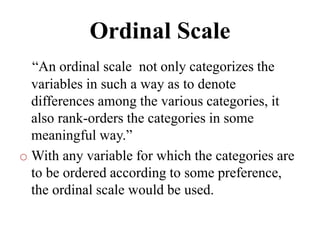
Ordinal Scale
“An ordinal scale not only categorizes the
variables in such a way as to denote
differences among the various categories, it
also rank-orders the categories in some
meaningful way.”
o With any variable for which the categories are
to be ordered according to some preference,
the ordinal scale would be used.
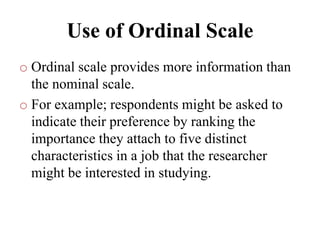
Use of Ordinal Scale
o Ordinal scale provides more information than
the nominal scale.
o For example; respondents might be asked to
indicate their preference by ranking the
importance they attach to five distinct
characteristics in a job that the researcher
might be interested in studying.
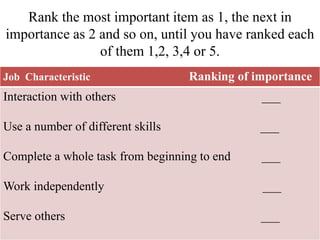
Rank the most important item as 1, the next in
importance as 2 and so on, until you have ranked each
of them 1,2, 3,4 or 5.
Job Characteristic Ranking of importance
Interaction with others ___
Use a number of different skills ___
Complete a whole task from beginning to end ___
Work independently ___
Serve others ___
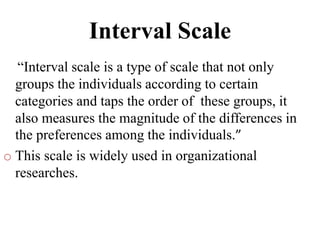
Interval Scale
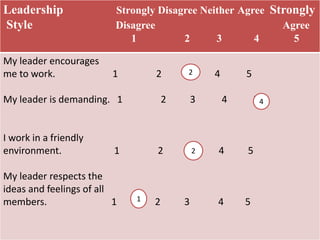
“Interval scale is a type of scale that not only
groups the individuals according to certain
categories and taps the order of these groups, it
also measures the magnitude of the differences in
the preferences among the individuals.”
o This scale is widely used in organizational
researches.
Leadership Strongly Disagree Neither Agree Strongly
Style Disagree Agree
1 2 3 4 5
My leader encourages
me to work. 1 2 3 4 5
My leader is demanding. 1 2 3 4 5
I work in a friendly
environment. 1 2 3 4 5
My leader respects the
ideas and feelings of all
members. 1 2 3 4 5
2
4
2
1
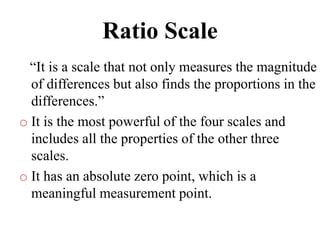
Ratio Scale
“It is a scale that not only measures the magnitude
of differences but also finds the proportions in the
differences.”
o It is the most powerful of the four scales and
includes all the properties of the other three
scales.
o It has an absolute zero point, which is a
meaningful measurement point.
Ratio Scale
• Kindly see the example of ratio scale in your
recommended book (Uma Sekaran).
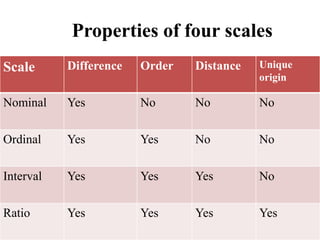
Properties of four scales
Scale Difference Order Distance Unique
origin
Nominal Yes No No No
Ordinal Yes Yes No No
Interval Yes Yes Yes No
Ratio Yes Yes Yes Yes
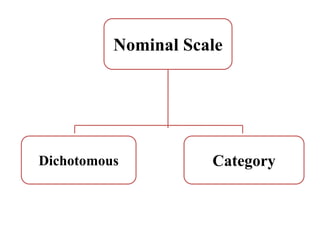
Nominal Scale
Dichotomous Category
Dichotomous Scale
The dichotomous scale is used to elicit a Yes or
No answer.
Example;
Do you like this product?
(a) Yes (b) No
Category Scale
The category scale uses multiple items to elicit a
single response.
Example;
Nationality:
(a) Pakistani
(b)American
(c) Indian
(d)Other
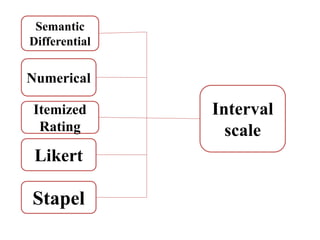
Semantic
Differential
Numerical
Itemized
Rating
Likert
Stapel
Interval
scale
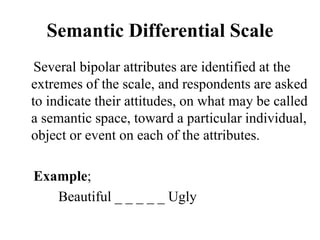
Semantic Differential Scale
Several bipolar attributes are identified at the
extremes of the scale, and respondents are asked
to indicate their attitudes, on what may be called
a semantic space, toward a particular individual,
object or event on each of the attributes.
Example;
Beautiful _ _ _ _ _ Ugly
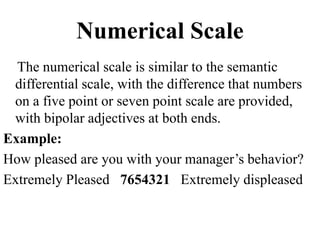
Numerical Scale
The numerical scale is similar to the semantic
differential scale, with the difference that numbers
on a five point or seven point scale are provided,
with bipolar adjectives at both ends.
Example:
How pleased are you with your manager’s behavior?
Extremely Pleased 7654321 Extremely displeased
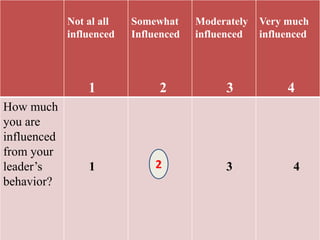
Itemized rating scale
“A five-point or seven-point scale with
anchors, as needed, is provided for each
item and the respondent states the
appropriate number on the side of each
item, or circles the relevant number
against each item.”
o The itemized scale provides the
flexibility to use as many points in the
scale as considered necessary and it is
also possible to use different anchors.
Not al all
influenced
1
Somewhat
Influenced
2
Moderately
influenced
3
Very much
influenced
4
How much
you are
influenced
from your
leader’s
behavior?
1 3 4
2
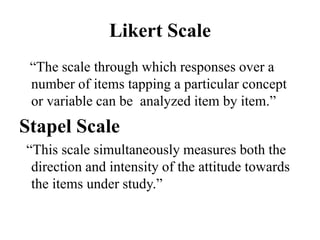
Likert Scale
“The scale through which responses over a
number of items tapping a particular concept
or variable can be analyzed item by item.”
Stapel Scale
“This scale simultaneously measures both the
direction and intensity of the attitude towards
the items under study.”
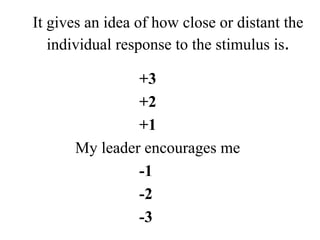
It gives an idea of how close or distant the
individual response to the stimulus is.
+3
+2
+1
My leader encourages me
-1
-2
-3
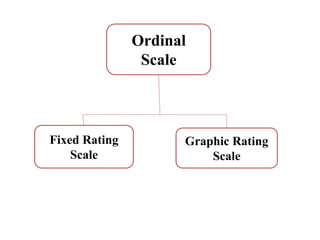
Ordinal
Scale
Fixed Rating
Scale
Graphic Rating
Scale
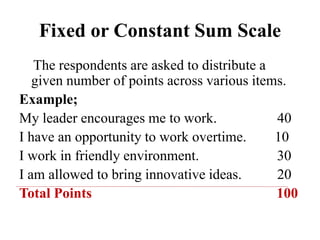
Fixed or Constant Sum Scale
The respondents are asked to distribute a
given number of points across various items.
Example;
My leader encourages me to work. 40
I have an opportunity to work overtime. 10
I work in friendly environment. 30
I am allowed to bring innovative ideas. 20
Total Points 100
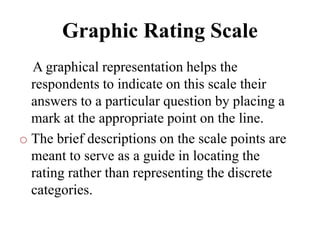
Graphic Rating Scale
A graphical representation helps the
respondents to indicate on this scale their
answers to a particular question by placing a
mark at the appropriate point on the line.
o The brief descriptions on the scale points are
meant to serve as a guide in locating the
rating rather than representing the discrete
categories.
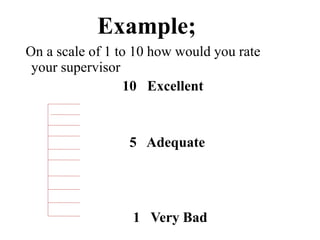
Example;
On a scale of 1 to 10 how would you rate
your supervisor
10 Excellent
5 Adequate
1 Very Bad
Consensus Scale
o Scales can be developed by consensus, where
a panel of judges selects certain items which in
its view measure the relevant concept.
o Such a consensus scale is developed after the
selected items have been examined and tested
for their validity and reliability.
o This scale is rarely used for measuring
organizational concepts.
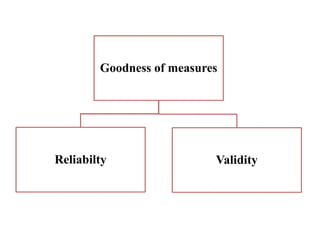
Goodness of measures
Reliabilty Validity
Reliability
o The reliability of a measure indicates the extent
to which it is without bias and hence ensures
consistent measurement across time and across
the various items in the instrument.
o The reliability of a measure is an indication of the
stability and consistency with which the
instrument measures the concept and helps to
access the goodness of a measure.
Validity
“Validity is a test of how well an instrument
that is developed measures the particular
concept it is intended to measure.”
Kindly consult your recommended book to see
the example of Reliability and validity.

Measurement and Scale.pptx

  • 1.
  • 2.
    Scale “A tool throughwhich researcher records the responses of the respondents in measureable way.” o With the help of suitable scale, researcher can have the information regarding variables in detail.
  • 3.
  • 4.
    Nominal Scale “A nominalscale is one that allows the researcher to assign subjects to certain categories or groups.” oSuch categories are non overlapping, or mutually exclusive and collectively exhaustive. oNominal scale is categorical in nature and gives only the basic information.
  • 5.
    Use of NominalScale oThe nominal scale is always used for obtaining personal data. oFor example; with respect to the variable of gender, respondents can be grouped into two categories- male and female.
  • 6.
    Ordinal Scale “An ordinalscale not only categorizes the variables in such a way as to denote differences among the various categories, it also rank-orders the categories in some meaningful way.” o With any variable for which the categories are to be ordered according to some preference, the ordinal scale would be used.
  • 7.
    Use of OrdinalScale o Ordinal scale provides more information than the nominal scale. o For example; respondents might be asked to indicate their preference by ranking the importance they attach to five distinct characteristics in a job that the researcher might be interested in studying.
  • 8.
    Rank the mostimportant item as 1, the next in importance as 2 and so on, until you have ranked each of them 1,2, 3,4 or 5. Job Characteristic Ranking of importance Interaction with others ___ Use a number of different skills ___ Complete a whole task from beginning to end ___ Work independently ___ Serve others ___
  • 9.
    Interval Scale “Interval scaleis a type of scale that not only groups the individuals according to certain categories and taps the order of these groups, it also measures the magnitude of the differences in the preferences among the individuals.” o This scale is widely used in organizational researches.
  • 10.
    Leadership Strongly DisagreeNeither Agree Strongly Style Disagree Agree 1 2 3 4 5 My leader encourages me to work. 1 2 3 4 5 My leader is demanding. 1 2 3 4 5 I work in a friendly environment. 1 2 3 4 5 My leader respects the ideas and feelings of all members. 1 2 3 4 5 2 4 2 1
  • 11.
    Ratio Scale “It isa scale that not only measures the magnitude of differences but also finds the proportions in the differences.” o It is the most powerful of the four scales and includes all the properties of the other three scales. o It has an absolute zero point, which is a meaningful measurement point.
  • 12.
    Ratio Scale • Kindlysee the example of ratio scale in your recommended book (Uma Sekaran).
  • 13.
    Properties of fourscales Scale Difference Order Distance Unique origin Nominal Yes No No No Ordinal Yes Yes No No Interval Yes Yes Yes No Ratio Yes Yes Yes Yes
  • 14.
  • 15.
    Dichotomous Scale The dichotomousscale is used to elicit a Yes or No answer. Example; Do you like this product? (a) Yes (b) No
  • 16.
    Category Scale The categoryscale uses multiple items to elicit a single response. Example; Nationality: (a) Pakistani (b)American (c) Indian (d)Other
  • 17.
  • 18.
    Semantic Differential Scale Severalbipolar attributes are identified at the extremes of the scale, and respondents are asked to indicate their attitudes, on what may be called a semantic space, toward a particular individual, object or event on each of the attributes. Example; Beautiful _ _ _ _ _ Ugly
  • 19.
    Numerical Scale The numericalscale is similar to the semantic differential scale, with the difference that numbers on a five point or seven point scale are provided, with bipolar adjectives at both ends. Example: How pleased are you with your manager’s behavior? Extremely Pleased 7654321 Extremely displeased
  • 20.
    Itemized rating scale “Afive-point or seven-point scale with anchors, as needed, is provided for each item and the respondent states the appropriate number on the side of each item, or circles the relevant number against each item.” o The itemized scale provides the flexibility to use as many points in the scale as considered necessary and it is also possible to use different anchors.
  • 21.
    Not al all influenced 1 Somewhat Influenced 2 Moderately influenced 3 Verymuch influenced 4 How much you are influenced from your leader’s behavior? 1 3 4 2
  • 22.
    Likert Scale “The scalethrough which responses over a number of items tapping a particular concept or variable can be analyzed item by item.” Stapel Scale “This scale simultaneously measures both the direction and intensity of the attitude towards the items under study.”
  • 23.
    It gives anidea of how close or distant the individual response to the stimulus is. +3 +2 +1 My leader encourages me -1 -2 -3
  • 24.
  • 25.
    Fixed or ConstantSum Scale The respondents are asked to distribute a given number of points across various items. Example; My leader encourages me to work. 40 I have an opportunity to work overtime. 10 I work in friendly environment. 30 I am allowed to bring innovative ideas. 20 Total Points 100
  • 26.
    Graphic Rating Scale Agraphical representation helps the respondents to indicate on this scale their answers to a particular question by placing a mark at the appropriate point on the line. o The brief descriptions on the scale points are meant to serve as a guide in locating the rating rather than representing the discrete categories.
  • 27.
    Example; On a scaleof 1 to 10 how would you rate your supervisor 10 Excellent 5 Adequate 1 Very Bad
  • 28.
    Consensus Scale o Scalescan be developed by consensus, where a panel of judges selects certain items which in its view measure the relevant concept. o Such a consensus scale is developed after the selected items have been examined and tested for their validity and reliability. o This scale is rarely used for measuring organizational concepts.
  • 29.
  • 30.
    Reliability o The reliabilityof a measure indicates the extent to which it is without bias and hence ensures consistent measurement across time and across the various items in the instrument. o The reliability of a measure is an indication of the stability and consistency with which the instrument measures the concept and helps to access the goodness of a measure.
  • 31.
    Validity “Validity is atest of how well an instrument that is developed measures the particular concept it is intended to measure.” Kindly consult your recommended book to see the example of Reliability and validity.