Self-actualizationGroup B| Heather Mather | Marylhurst UniversityWhat are some ways modern students, young adults to aging adults, can effectively achieve and utilize self-actualized learning in their pursuit of a four year degree?
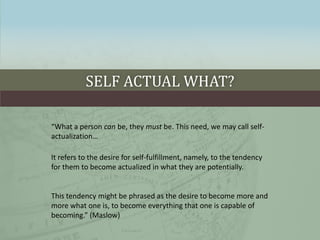
self actual what?“What a person can be, they must be. This need, we may call self-actualization…It refers to the desire for self-fulfillment, namely, to the tendency for them to become actualized in what they are potentially. This tendency might be phrased as the desire to become more and more what one is, to become everything that one is capable of becoming.” (Maslow)
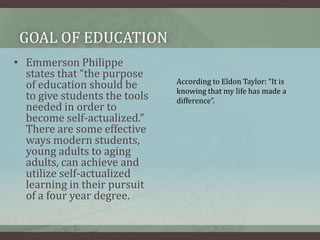
Goal of educationEmmerson Philippe states that “the purpose of education should be to give students the tools needed in order to become self-actualized.” There are some effective ways modern students, young adults to aging adults, can achieve and utilize self-actualized learning in their pursuit of a four year degree. According to Eldon Taylor: “It is knowing that my life has made a difference”.
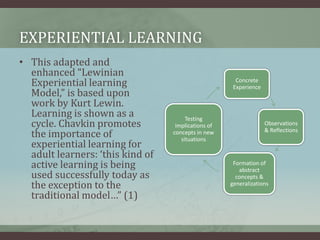
Experiential learningThis adapted and enhanced “Lewinian Experiential learning Model,” is based upon work by Kurt Lewin. Learning is shown as a cycle. Chavkin promotes the importance of experiential learning for adult learners: ‘this kind of active learning is being used successfully today as the exception to the traditional model…” (1)
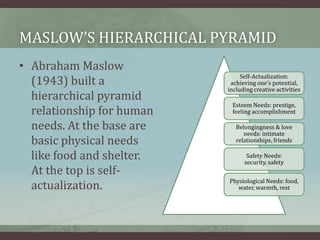
Maslow’s Hierarchical PyramidAbraham Maslow (1943) built a hierarchical pyramid relationship for human needs. At the base are basic physical needs like food and shelter. At the top is self-actualization.
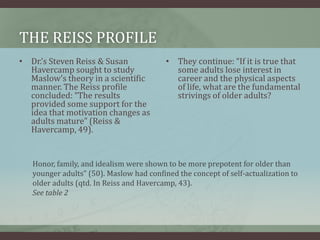
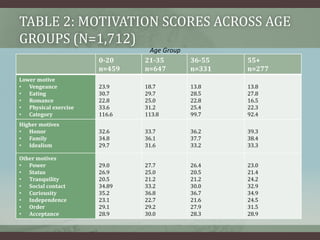
The reiss profileDr.’s Steven Reiss & Susan Havercamp sought to study Maslow’s theory in a scientific manner. The Reiss profile concluded: “The results provided some support for the idea that motivation changes as adults mature” (Reiss & Havercamp, 49).They continue: “If it is true that some adults lose interest in career and the physical aspects of life, what are the fundamental strivings of older adults? Honor, family, and idealism were shown to be more prepotent for older than younger adults” (50). Maslow had confined the concept of self-actualization to older adults (qtd. In Reiss and Havercamp, 43).See table 2
Table 2: motivation scores across age groups (n=1,712)Age Group
Generational contextAnother study performed by Laura Holyoke and Erick Larson surveyed adult learners based upon their placement in a generational context; the Bay Boomers (1943-1960), Gen-X (1960-1980), and the Millennial (1981-2002).They found adults viewed learning differently as they age. Readiness to learn, orientation to learn, and motivation to learn were attributes explored.  “Letting adult learners do assignments that pertain to their real life situation provides a natural orientation to learn new theories for each generation”(21).
PLA: Prior Learning AssessmentThe process in granting credits for college-level learning from previous life experience. Better outcomes for participants:56% earn degreeswithin 7 years as opposed to 21% of non PLA adult learners. Cathy Brigham and Rebecca Klein-Collins of Council for Adult & Experiential Learner state that these findings support claims that PLA is a strategy that will help adults earn degrees…(112)
The marylhurst communityAdam & Ramona interviewed  some of our fellow using the following questions:1.  Please share a situation that you noticed you handled differently since you've been taking courses at Marylhurst?2.  When engaging in a conversation with "highly educated" individuals, does it feel different; do you "know more" which makes you more comfortable?3.  Philippe once said "The purpose of learning and education should be to help the individual grasp and create a self-identity as he/she learned integral facts about the universe and his/her role in it."  When you think of Philippe's statement, where would you like to see yourself fitting into the universe?4.  Do you feel your work at Marylhurst will help you make a difference for others in the future and how does this effect your learning experience?  Have you already seen yourself making a difference?  Please give an example.
The marylhurst communityInterviewees were asked the following questions:First Interviewee:  Richard Nelson, answered questions 1,4 and 3  Second:  Matthew Worley, Question 4Third:  Sister Baxter, question 4, 2Fourth:  Lesley, question 2Fifth:  Natalie, question 4Our impact on others is important. Self Actualization is really about changing our community. To impact those around us through our education is a gift we are just beginning to explore.
Self actualization at marylhurstWhat are some ways modern students, young adults to aging adults, can effectively achieve and utilize self-actualized learning in their pursuit of a four year degree?By creating a sense of community, truly being present in our conversations with others, and educating ourselves around our passion we are practicing self actualized learning.
bibliographyMaslow, A. H. (1943). A Theory of Human Motivation, Psychological Review 50, 370-96Reiss, Steven & Havercamp, Susan. "Motivational in Developmental Context: A New Method for Studying Self- Actualization." Journal of Humanistic Psychology (2005): 41-53.Philippe, E. (2009, October 7). Self-Actualization and Education. Retrieved May 20, 2011, from Suite 101: http://www.suite101.com/content/the-role-of-selfactualization-in-education-a156590Taylor, Eldon. “Self Actualization” Speech. 13 Jan. 2008 YouTube. 22 May 2011.Interview at Marylhurst University conducted by Adam Webber and Ramona Kauhi:Natalie, Music Therapy student looking forward to helping teenage girlsLesley, MBA studentSister Baxter, Lake OswegoMatthew Worley, Interdisciplinary Studies in Business and Organizational CommunicationRichard Nelson, Design Student.

Self actualization

  • 1.
    Self-actualizationGroup B| HeatherMather | Marylhurst UniversityWhat are some ways modern students, young adults to aging adults, can effectively achieve and utilize self-actualized learning in their pursuit of a four year degree?
  • 2.
    self actual what?“Whata person can be, they must be. This need, we may call self-actualization…It refers to the desire for self-fulfillment, namely, to the tendency for them to become actualized in what they are potentially. This tendency might be phrased as the desire to become more and more what one is, to become everything that one is capable of becoming.” (Maslow)
  • 3.
    Goal of educationEmmersonPhilippe states that “the purpose of education should be to give students the tools needed in order to become self-actualized.” There are some effective ways modern students, young adults to aging adults, can achieve and utilize self-actualized learning in their pursuit of a four year degree. According to Eldon Taylor: “It is knowing that my life has made a difference”.
  • 4.
    Experiential learningThis adaptedand enhanced “Lewinian Experiential learning Model,” is based upon work by Kurt Lewin. Learning is shown as a cycle. Chavkin promotes the importance of experiential learning for adult learners: ‘this kind of active learning is being used successfully today as the exception to the traditional model…” (1)
  • 5.
    Maslow’s Hierarchical PyramidAbrahamMaslow (1943) built a hierarchical pyramid relationship for human needs. At the base are basic physical needs like food and shelter. At the top is self-actualization.
  • 6.
    The reiss profileDr.’sSteven Reiss & Susan Havercamp sought to study Maslow’s theory in a scientific manner. The Reiss profile concluded: “The results provided some support for the idea that motivation changes as adults mature” (Reiss & Havercamp, 49).They continue: “If it is true that some adults lose interest in career and the physical aspects of life, what are the fundamental strivings of older adults? Honor, family, and idealism were shown to be more prepotent for older than younger adults” (50). Maslow had confined the concept of self-actualization to older adults (qtd. In Reiss and Havercamp, 43).See table 2
  • 7.
    Table 2: motivationscores across age groups (n=1,712)Age Group
  • 8.
    Generational contextAnother studyperformed by Laura Holyoke and Erick Larson surveyed adult learners based upon their placement in a generational context; the Bay Boomers (1943-1960), Gen-X (1960-1980), and the Millennial (1981-2002).They found adults viewed learning differently as they age. Readiness to learn, orientation to learn, and motivation to learn were attributes explored. “Letting adult learners do assignments that pertain to their real life situation provides a natural orientation to learn new theories for each generation”(21).
  • 9.
    PLA: Prior LearningAssessmentThe process in granting credits for college-level learning from previous life experience. Better outcomes for participants:56% earn degreeswithin 7 years as opposed to 21% of non PLA adult learners. Cathy Brigham and Rebecca Klein-Collins of Council for Adult & Experiential Learner state that these findings support claims that PLA is a strategy that will help adults earn degrees…(112)
  • 10.
    The marylhurst communityAdam& Ramona interviewed some of our fellow using the following questions:1.  Please share a situation that you noticed you handled differently since you've been taking courses at Marylhurst?2.  When engaging in a conversation with "highly educated" individuals, does it feel different; do you "know more" which makes you more comfortable?3.  Philippe once said "The purpose of learning and education should be to help the individual grasp and create a self-identity as he/she learned integral facts about the universe and his/her role in it."  When you think of Philippe's statement, where would you like to see yourself fitting into the universe?4.  Do you feel your work at Marylhurst will help you make a difference for others in the future and how does this effect your learning experience?  Have you already seen yourself making a difference?  Please give an example.
  • 11.
    The marylhurst communityIntervieweeswere asked the following questions:First Interviewee:  Richard Nelson, answered questions 1,4 and 3  Second:  Matthew Worley, Question 4Third:  Sister Baxter, question 4, 2Fourth:  Lesley, question 2Fifth:  Natalie, question 4Our impact on others is important. Self Actualization is really about changing our community. To impact those around us through our education is a gift we are just beginning to explore.
  • 12.
    Self actualization atmarylhurstWhat are some ways modern students, young adults to aging adults, can effectively achieve and utilize self-actualized learning in their pursuit of a four year degree?By creating a sense of community, truly being present in our conversations with others, and educating ourselves around our passion we are practicing self actualized learning.
  • 13.
    bibliographyMaslow, A. H.(1943). A Theory of Human Motivation, Psychological Review 50, 370-96Reiss, Steven & Havercamp, Susan. "Motivational in Developmental Context: A New Method for Studying Self- Actualization." Journal of Humanistic Psychology (2005): 41-53.Philippe, E. (2009, October 7). Self-Actualization and Education. Retrieved May 20, 2011, from Suite 101: http://www.suite101.com/content/the-role-of-selfactualization-in-education-a156590Taylor, Eldon. “Self Actualization” Speech. 13 Jan. 2008 YouTube. 22 May 2011.Interview at Marylhurst University conducted by Adam Webber and Ramona Kauhi:Natalie, Music Therapy student looking forward to helping teenage girlsLesley, MBA studentSister Baxter, Lake OswegoMatthew Worley, Interdisciplinary Studies in Business and Organizational CommunicationRichard Nelson, Design Student.