

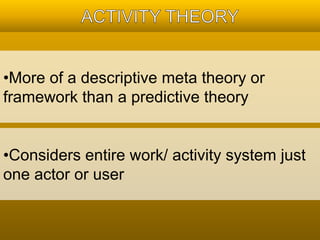







•More of a descriptive meta theory or 
framework than a predictive theory 
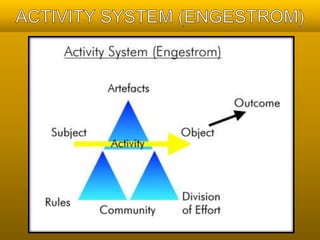
•Considers entire work/ activity system just 
one actor or user
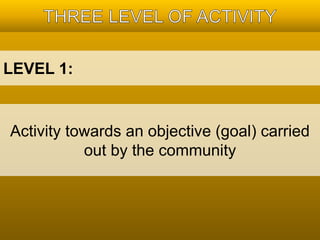
LEVEL 1: 
Activity towards an objective (goal) carried 
out by the community
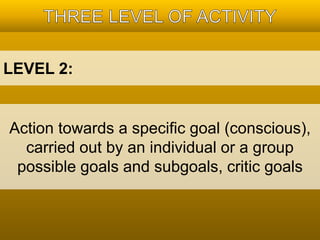
LEVEL 2: 
Action towards a specific goal (conscious), 
carried out by an individual or a group 
possible goals and subgoals, critic goals
LEVEL 3: 
Operation structure of activity typically 
automated and not conscious concrete way 
of executing an action in according with the 
specific conditions surrounding the goal
OBJECT- ORIENTEDNESS 
People live in a reality that is objective in a 
broad sense
INTERNALIZATION/ EXTERNALIZATION 
Distinction between internal and external 
activities, because they transform to each 
other
INTERNALIZATION 
provides a means for a people to try 
potential interactions with reality without 
performing actual manipulation with real 
objects
EXTERNALIZATION 
often necessary when an internalized action 
needs to be “repaired” or scaled.
MEDIATION 
Emphasizes that human activity is mediated 
by tools in broad sense
DEVELOPMENT 
Activity Theory development is not only an 
object of a study, it is also the general 
research methodology
Originally created by scholars Latour, and 
Callon as an attempt to understand process 
of technological innovation and scientific 
knowledge- creation
incorporates what is known as a principle of 
generalized symmetry; that is, what human 
and non- human 
should be integrated into the same 
conceptual framework and assign equal 
amount of agency.
•Remembering; 
•Memorizing; 
•Recognizing; 
•Recalling identification and 
•Recall of information 
-Who, what, when, where, how…? 
-Describe
•Interpreting; 
•Translating from one medium to another; 
•Describing in one’s own word; 
•Organization and selection of facts and 
ideas 
-Retell…
•Problem Solving; 
•Applying information to produce some 
result; 
•Use of facts, rules, and principles 
-How is… an example of? 
-How is… related to… 
-Why is… significant?
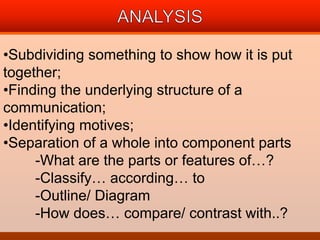
•Subdividing something to show how it is put 
together; 
•Finding the underlying structure of a 
communication; 
•Identifying motives; 
•Separation of a whole into component parts 
-What are the parts or features of…? 
-Classify… according… to 
-Outline/ Diagram 
-How does… compare/ contrast with..?
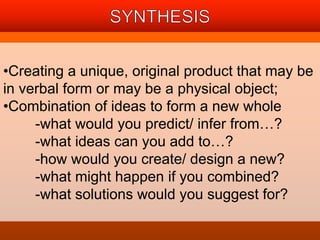
•Creating a unique, original product that may be 
in verbal form or may be a physical object; 
•Combination of ideas to form a new whole 
-what would you predict/ infer from…? 
-what ideas can you add to…? 
-how would you create/ design a new? 
-what might happen if you combined? 
-what solutions would you suggest for?
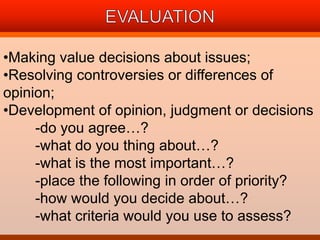
•Making value decisions about issues; 
•Resolving controversies or differences of 
opinion; 
•Development of opinion, judgment or decisions 
-do you agree…? 
-what do you thing about…? 
-what is the most important…? 
-place the following in order of priority? 
-how would you decide about…? 
-what criteria would you use to assess?
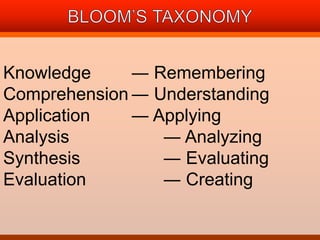
Knowledge ― Remembering 
Comprehension ― Understanding 
Application ― Applying 
Analysis ― Analyzing 
Synthesis ― Evaluating 
Evaluation ― Creating
• Students must responses to critical thinking 
questions reveal the extent of their literal 
understanding of the facts 
• In addition, a student’s ability to apply and 
transfer that knowledge in different context 
can be assessed
• Student interest and motivation are 
enhanced by questions that help students 
relate what they are learning to their own 
background knowledge, experience and 
values 
• Higher- order questions are also important 
for modeling different ways to students can 
interpret, apply, evaluate, and reflect on what 
they are learning
• An effective way for teachers to replace 
literal questions with critical thinking 
questions involves the use of BLOOM’S 
TAXONOMY OF THINKING 
• Since the first two levels in taxonomy reflect 
Literal- Level Thinking Questions should be 
avoided 
• Instead teachers should make their questions 
can be classified as Higher Cognitive Level
• VERBS REPRESENTING COGNITIVE 
TASKS IN BLOOM’S TAXONOMY are 
useful in the formulation of questions and 
learning objectives in demonstrating what 
they have learned
• A TASK- ORIENTED QUESTION 
CONSTRUCTION WHEEL can be used to 
consider to both the verbs and task 
associated with the higher- order levels of 
thinking of Bloom’s Taxonomy
1. Pose question first, before asking a 
student to respond 
2. Allow plenty of “think time” by waiting at 
least 7- 10 seconds before expecting 
students to respond
3. Make sure you give all students the 
opportunity to respond rather than relying 
on volunteers 
4. Hold students accountable by expecting, 
requiring and facilitating their participation 
and contributions
5. Establish a safe atmosphere for risk taking 
by guiding students in the process of 
learning from their mistakes
a useful descriptive framework that 
describes human work systems in 
informational and computational terms
describe how distributed units are 
coordinated by analyzing the interactions 
between individuals, the representational 
media used, and the environment within 
which activity takes place
considers the impact of external factors, 
parents and society on personality 
development from childhood to adulthood
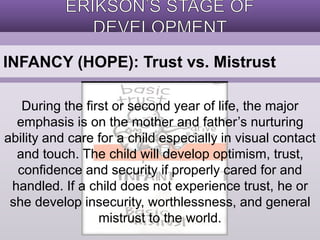
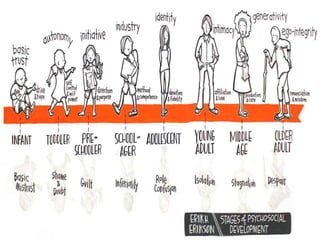
INFANCY (HOPE): Trust vs. Mistrust 
During the first or second year of life, the major 
emphasis is on the mother and father’s nurturing 
ability and care for a child especially in visual contact 
and touch. The child will develop optimism, trust, 
confidence and security if properly cared for and 
handled. If a child does not experience trust, he or 
she develop insecurity, worthlessness, and general 
mistrust to the world.
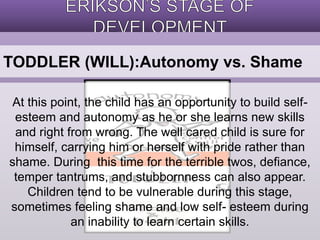
TODDLER (WILL):Autonomy vs. Shame 
At this point, the child has an opportunity to build self-esteem 
and autonomy as he or she learns new skills 
and right from wrong. The well cared child is sure for 
himself, carrying him or herself with pride rather than 
shame. During this time for the terrible twos, defiance, 
temper tantrums, and stubbornness can also appear. 
Children tend to be vulnerable during this stage, 
sometimes feeling shame and low self- esteem during 
an inability to learn certain skills.
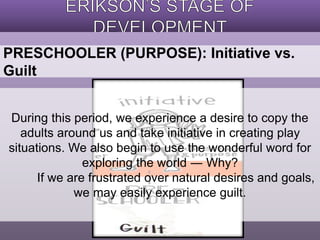
PRESCHOOLER (PURPOSE): Initiative vs. 
Guilt 
During this period, we experience a desire to copy the 
adults around us and take initiative in creating play 
situations. We also begin to use the wonderful word for 
exploring the world ― Why? 
If we are frustrated over natural desires and goals, 
we may easily experience guilt.
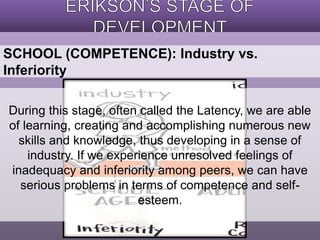
SCHOOL (COMPETENCE): Industry vs. 
Inferiority 
During this stage, often called the Latency, we are able 
of learning, creating and accomplishing numerous new 
skills and knowledge, thus developing in a sense of 
industry. If we experience unresolved feelings of 
inadequacy and inferiority among peers, we can have 
serious problems in terms of competence and self-esteem.
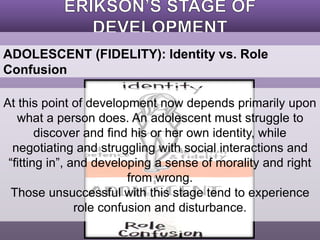
ADOLESCENT (FIDELITY): Identity vs. Role 
Confusion 
At this point of development now depends primarily upon 
what a person does. An adolescent must struggle to 
discover and find his or her own identity, while 
negotiating and struggling with social interactions and 
“fitting in”, and developing a sense of morality and right 
from wrong. 
Those unsuccessful with this stage tend to experience 
role confusion and disturbance.
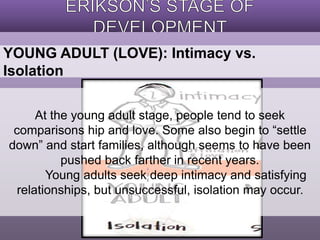
YOUNG ADULT (LOVE): Intimacy vs. 
Isolation 
At the young adult stage, people tend to seek 
comparisons hip and love. Some also begin to “settle 
down” and start families, although seems to have been 
pushed back farther in recent years. 
Young adults seek deep intimacy and satisfying 
relationships, but unsuccessful, isolation may occur.
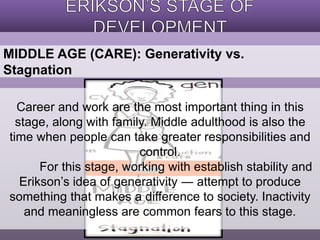
MIDDLE AGE (CARE): Generativity vs. 
Stagnation 
Career and work are the most important thing in this 
stage, along with family. Middle adulthood is also the 
time when people can take greater responsibilities and 
control. 
For this stage, working with establish stability and 
Erikson’s idea of generativity ― attempt to produce 
something that makes a difference to society. Inactivity 
and meaningless are common fears to this stage.
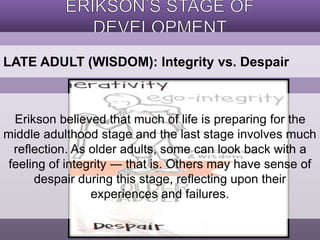
LATE ADULT (WISDOM): Integrity vs. Despair 
Erikson believed that much of life is preparing for the 
middle adulthood stage and the last stage involves much 
reflection. As older adults, some can look back with a 
feeling of integrity ― that is. Others may have sense of 
despair during this stage, reflecting upon their 
experiences and failures.
Extended Erikson’s Model that primarily 
focusing on adolescent development. 
Addressing Erikson notion of identity crisis
IDENTITY DIFFUSION 
the status in which the adolescent doesn’t 
have a sense of having choices; he or she 
has not yet made 
a commitment
IDENTITY DISCLOSURE 
the status in which the adolescent seems 
have a sense of having relevant roles, 
values, or goal for the future
IDENTITY MORATORIUM 
the status in which the adolescent is current 
in crisis, exploring various commitments 
and is ready to make choices, but has not 
made a commitment to these choices yet
IDENTITY ACHIEVEMENT 
the status in which the adolescent has gone 
through an identity crisis and has made a 
commitment to sense of identity that he or 
she has chosen
•Sexual Orientation 
•A Set of values and ideas 
•A Vocational Direction
a series of empirically- based studies that 
investigate how people develop beliefs 
about themselves and how these self 
theories create their psychological world, 
shaping thoughts, feelings and behavior
ENTITY VIEW (ENTITY THEORISTS) 
this view treats intelligence as fixed and 
stable
INCREMENTAL VIEW 
this view treats intelligence as malleable, 
fluid and changeable
Perception of the environment inevitably 
leads to some course of action. 
Affordances, or clues in environment that 
indicate possibilities for actions, are 
perceived in a direct, immediate way with 
no sensory processing.
Refers to the preferred way an individual 
processes information. They describe a 
person’s typical mode of thinking, 
remembering or problem solving
Individuals tend to gravitate toward one or 
two types of sensory input and maintain a 
dominance in other types
These learners must see their teacher’s 
action and facial expression to fully 
understand the content of the lesson
•Visual Iconic 
•Visual Symbolic
Those who prefer this form of input are 
more interpreted in visual imagery such as 
films graphic display, or picture in order to 
solidify learning
Those who prefer this form of input feel 
comfortable with the abstract symbolism 
such as mathematical formulate or written 
word
They learn best through verbal lectures, 
discussions, talking things through and 
listening to what others have to say
•The Listeners 
•The Talkers
This is the more common type. Listener’s 
most likely do well in school
Persons benefit much from hands on 
approach, actively exploring the physical 
world around them
•Visual Learners 
-Visual Iconic 
-Visual Symbolic 
•Auditory Learners 
-The Listeners 
-The Talkers 
•Tactile/ Kinesthetic Learners
•Analytic Thinkers 
•Global Thinkers
Tend toward the linear, step- by- step 
processes of learning
Lean towards non- linear thought and tend 
to see the whole pattern rather than the 
particle elements
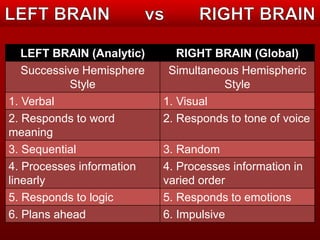
LEFT BRAIN (Analytic) RIGHT BRAIN (Global) 
Successive Hemisphere 
Style 
Simultaneous Hemispheric 
Style 
1. Verbal 1. Visual 
2. Responds to word 
meaning 
2. Responds to tone of voice 
3. Sequential 3. Random 
4. Processes information 
linearly 
4. Processes information in 
varied order 
5. Responds to logic 5. Responds to emotions 
6. Plans ahead 6. Impulsive
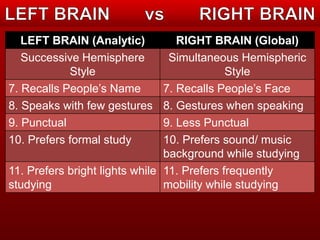
LEFT BRAIN (Analytic) RIGHT BRAIN (Global) 
Successive Hemisphere 
Style 
Simultaneous Hemispheric 
Style 
7. Recalls People’s Name 7. Recalls People’s Face 
8. Speaks with few gestures 8. Gestures when speaking 
9. Punctual 9. Less Punctual 
10. Prefers formal study 10. Prefers sound/ music 
background while studying 
11. Prefers bright lights while 
studying 
11. Prefers frequently 
mobility while studying
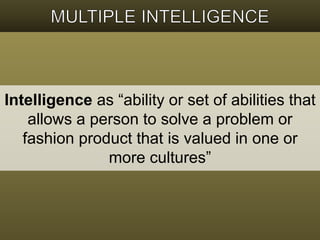
Intelligence as “ability or set of abilities that 
allows a person to solve a problem or 
fashion product that is valued in one or 
more cultures”
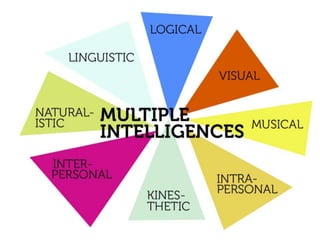
Learning visually and organizing ideas 
spatially
Learning through the spoken and written 
word
Learning through reasoning and problem 
solving
Learning through interaction with one’s 
environment
Learning through patterns, rhythms and 
music
Learning through feelings, values and 
attitudes
Learning through interactions with others
Learning through classification, categories, 
and hierarchies
Learning by seeing a big picture
1. Without rehearsal or constant attention, 
information remains in working memory for 
only about 15 to 20 seconds. This implies the 
need for memory aids.
2. Learning is a process of building neural 
networks. This network is formed through 
concrete experience, representational or 
symbolic learning, and abstract learning. The 
three levels of learning are concrete, 
symbolic, and abstract
… you see a small, furry, four legged animal 
and your father tells you it is an animal called 
dog. This experienced will be stored in your 
brain in an actual physiological connection 
between neurons. In your experience of dogs 
in your neighborhood, you will realize that the 
dogs come in many shapes, sizes, and 
colors. All this information will be 
incorporated into your dog network.
You are out for a walk. You see a small, furry, four 
legged animal and you say it is a dog. Your father 
laughs and tells you that that animal is not a dog, it’s 
a cat. Your brain now has to begin forming a network 
containing information about cats. Then you parents 
bring you to the zoo. You are exposed t to large 
number of creatures you have not seen before. Your 
parents tell you that they are all animals. Your brain 
takes all this information and begins to fit it into the 
previously established animal network. With 
experiences of animals your animal network will 
become stronger 
(CONCRETE LEVEL)
Now that you are older and your parent no longer 
take you to the zoo or buy you a picture books you 
have your way of expanding the neural network of 
animals. Later you see pictures of animals in a book 
that your mother reads to you. You quickly match the 
name of the animal to its picture. Your repeated 
exposure to the pictures in the animal book can 
make the more exotic animals much more 
meaningful than if you had never visited the zoo. 
(SYMBOLIC LEVEL)
Now that you are older and your parents no longer 
take you to the zoo or buy you books, what is your 
way of expanding the neural networks of animals? 
It’s probable that you can now discuss animals 
you’ve never seen whether real or imaginary. 
(ABSTRACT LEVEL)
3. Our brains have difficulty comprehending 
very large numbers because we have 
nothing our experience to “hook” them to.
4. The eyes contain early 70 percent of the 
body’s sensory receptors and send millions 
signals every second along the optic nerves 
to the visual processing of the brain.
5. There is little doubt that when information 
is embedded in music or rhyme, Its recall is 
easier than when it is in prose.
Involving Students in Real- Life or 
Authentic Problem Solving 
Involving Students in Real- Life or 
Authentic Problem Solving 
Simulations and Roleplays as Meaning 
Makers 
Classroom Strategies Using Visual 
Processing
Songs, Jingles, raps 
Mnemonic Strategies 
Writing Strategies 
Active Review 
Hands- On- Activities
REPORTED BY: Dennis Jay G. Gumboc 
BSIE- COED/ 3- J 
PIE 5: Principles of Teaching 1

Activity Theory

  • 2.
    •More of adescriptive meta theory or framework than a predictive theory •Considers entire work/ activity system just one actor or user
  • 4.
    LEVEL 1: Activitytowards an objective (goal) carried out by the community
  • 5.
    LEVEL 2: Actiontowards a specific goal (conscious), carried out by an individual or a group possible goals and subgoals, critic goals
  • 6.
    LEVEL 3: Operationstructure of activity typically automated and not conscious concrete way of executing an action in according with the specific conditions surrounding the goal
  • 7.
    OBJECT- ORIENTEDNESS Peoplelive in a reality that is objective in a broad sense
  • 8.
    INTERNALIZATION/ EXTERNALIZATION Distinctionbetween internal and external activities, because they transform to each other
  • 9.
    INTERNALIZATION provides ameans for a people to try potential interactions with reality without performing actual manipulation with real objects
  • 10.
    EXTERNALIZATION often necessarywhen an internalized action needs to be “repaired” or scaled.
  • 11.
    MEDIATION Emphasizes thathuman activity is mediated by tools in broad sense
  • 12.
    DEVELOPMENT Activity Theorydevelopment is not only an object of a study, it is also the general research methodology
  • 14.
    Originally created byscholars Latour, and Callon as an attempt to understand process of technological innovation and scientific knowledge- creation
  • 15.
    incorporates what isknown as a principle of generalized symmetry; that is, what human and non- human should be integrated into the same conceptual framework and assign equal amount of agency.
  • 17.
    •Remembering; •Memorizing; •Recognizing; •Recalling identification and •Recall of information -Who, what, when, where, how…? -Describe
  • 18.
    •Interpreting; •Translating fromone medium to another; •Describing in one’s own word; •Organization and selection of facts and ideas -Retell…
  • 19.
    •Problem Solving; •Applyinginformation to produce some result; •Use of facts, rules, and principles -How is… an example of? -How is… related to… -Why is… significant?
  • 20.
    •Subdividing something toshow how it is put together; •Finding the underlying structure of a communication; •Identifying motives; •Separation of a whole into component parts -What are the parts or features of…? -Classify… according… to -Outline/ Diagram -How does… compare/ contrast with..?
  • 21.
    •Creating a unique,original product that may be in verbal form or may be a physical object; •Combination of ideas to form a new whole -what would you predict/ infer from…? -what ideas can you add to…? -how would you create/ design a new? -what might happen if you combined? -what solutions would you suggest for?
  • 22.
    •Making value decisionsabout issues; •Resolving controversies or differences of opinion; •Development of opinion, judgment or decisions -do you agree…? -what do you thing about…? -what is the most important…? -place the following in order of priority? -how would you decide about…? -what criteria would you use to assess?
  • 23.
    Knowledge ― Remembering Comprehension ― Understanding Application ― Applying Analysis ― Analyzing Synthesis ― Evaluating Evaluation ― Creating
  • 24.
    • Students mustresponses to critical thinking questions reveal the extent of their literal understanding of the facts • In addition, a student’s ability to apply and transfer that knowledge in different context can be assessed
  • 25.
    • Student interestand motivation are enhanced by questions that help students relate what they are learning to their own background knowledge, experience and values • Higher- order questions are also important for modeling different ways to students can interpret, apply, evaluate, and reflect on what they are learning
  • 26.
    • An effectiveway for teachers to replace literal questions with critical thinking questions involves the use of BLOOM’S TAXONOMY OF THINKING • Since the first two levels in taxonomy reflect Literal- Level Thinking Questions should be avoided • Instead teachers should make their questions can be classified as Higher Cognitive Level
  • 27.
    • VERBS REPRESENTINGCOGNITIVE TASKS IN BLOOM’S TAXONOMY are useful in the formulation of questions and learning objectives in demonstrating what they have learned
  • 28.
    • A TASK-ORIENTED QUESTION CONSTRUCTION WHEEL can be used to consider to both the verbs and task associated with the higher- order levels of thinking of Bloom’s Taxonomy
  • 29.
    1. Pose questionfirst, before asking a student to respond 2. Allow plenty of “think time” by waiting at least 7- 10 seconds before expecting students to respond
  • 30.
    3. Make sureyou give all students the opportunity to respond rather than relying on volunteers 4. Hold students accountable by expecting, requiring and facilitating their participation and contributions
  • 31.
    5. Establish asafe atmosphere for risk taking by guiding students in the process of learning from their mistakes
  • 33.
    a useful descriptiveframework that describes human work systems in informational and computational terms
  • 34.
    describe how distributedunits are coordinated by analyzing the interactions between individuals, the representational media used, and the environment within which activity takes place
  • 36.
    considers the impactof external factors, parents and society on personality development from childhood to adulthood
  • 37.
    INFANCY (HOPE): Trustvs. Mistrust During the first or second year of life, the major emphasis is on the mother and father’s nurturing ability and care for a child especially in visual contact and touch. The child will develop optimism, trust, confidence and security if properly cared for and handled. If a child does not experience trust, he or she develop insecurity, worthlessness, and general mistrust to the world.
  • 38.
    TODDLER (WILL):Autonomy vs.Shame At this point, the child has an opportunity to build self-esteem and autonomy as he or she learns new skills and right from wrong. The well cared child is sure for himself, carrying him or herself with pride rather than shame. During this time for the terrible twos, defiance, temper tantrums, and stubbornness can also appear. Children tend to be vulnerable during this stage, sometimes feeling shame and low self- esteem during an inability to learn certain skills.
  • 39.
    PRESCHOOLER (PURPOSE): Initiativevs. Guilt During this period, we experience a desire to copy the adults around us and take initiative in creating play situations. We also begin to use the wonderful word for exploring the world ― Why? If we are frustrated over natural desires and goals, we may easily experience guilt.
  • 40.
    SCHOOL (COMPETENCE): Industryvs. Inferiority During this stage, often called the Latency, we are able of learning, creating and accomplishing numerous new skills and knowledge, thus developing in a sense of industry. If we experience unresolved feelings of inadequacy and inferiority among peers, we can have serious problems in terms of competence and self-esteem.
  • 41.
    ADOLESCENT (FIDELITY): Identityvs. Role Confusion At this point of development now depends primarily upon what a person does. An adolescent must struggle to discover and find his or her own identity, while negotiating and struggling with social interactions and “fitting in”, and developing a sense of morality and right from wrong. Those unsuccessful with this stage tend to experience role confusion and disturbance.
  • 42.
    YOUNG ADULT (LOVE):Intimacy vs. Isolation At the young adult stage, people tend to seek comparisons hip and love. Some also begin to “settle down” and start families, although seems to have been pushed back farther in recent years. Young adults seek deep intimacy and satisfying relationships, but unsuccessful, isolation may occur.
  • 43.
    MIDDLE AGE (CARE):Generativity vs. Stagnation Career and work are the most important thing in this stage, along with family. Middle adulthood is also the time when people can take greater responsibilities and control. For this stage, working with establish stability and Erikson’s idea of generativity ― attempt to produce something that makes a difference to society. Inactivity and meaningless are common fears to this stage.
  • 44.
    LATE ADULT (WISDOM):Integrity vs. Despair Erikson believed that much of life is preparing for the middle adulthood stage and the last stage involves much reflection. As older adults, some can look back with a feeling of integrity ― that is. Others may have sense of despair during this stage, reflecting upon their experiences and failures.
  • 47.
    Extended Erikson’s Modelthat primarily focusing on adolescent development. Addressing Erikson notion of identity crisis
  • 48.
    IDENTITY DIFFUSION thestatus in which the adolescent doesn’t have a sense of having choices; he or she has not yet made a commitment
  • 49.
    IDENTITY DISCLOSURE thestatus in which the adolescent seems have a sense of having relevant roles, values, or goal for the future
  • 50.
    IDENTITY MORATORIUM thestatus in which the adolescent is current in crisis, exploring various commitments and is ready to make choices, but has not made a commitment to these choices yet
  • 51.
    IDENTITY ACHIEVEMENT thestatus in which the adolescent has gone through an identity crisis and has made a commitment to sense of identity that he or she has chosen
  • 52.
    •Sexual Orientation •ASet of values and ideas •A Vocational Direction
  • 54.
    a series ofempirically- based studies that investigate how people develop beliefs about themselves and how these self theories create their psychological world, shaping thoughts, feelings and behavior
  • 55.
    ENTITY VIEW (ENTITYTHEORISTS) this view treats intelligence as fixed and stable
  • 56.
    INCREMENTAL VIEW thisview treats intelligence as malleable, fluid and changeable
  • 58.
    Perception of theenvironment inevitably leads to some course of action. Affordances, or clues in environment that indicate possibilities for actions, are perceived in a direct, immediate way with no sensory processing.
  • 60.
    Refers to thepreferred way an individual processes information. They describe a person’s typical mode of thinking, remembering or problem solving
  • 61.
    Individuals tend togravitate toward one or two types of sensory input and maintain a dominance in other types
  • 62.
    These learners mustsee their teacher’s action and facial expression to fully understand the content of the lesson
  • 63.
  • 64.
    Those who preferthis form of input are more interpreted in visual imagery such as films graphic display, or picture in order to solidify learning
  • 65.
    Those who preferthis form of input feel comfortable with the abstract symbolism such as mathematical formulate or written word
  • 66.
    They learn bestthrough verbal lectures, discussions, talking things through and listening to what others have to say
  • 67.
  • 68.
    This is themore common type. Listener’s most likely do well in school
  • 69.
    Persons benefit muchfrom hands on approach, actively exploring the physical world around them
  • 70.
    •Visual Learners -VisualIconic -Visual Symbolic •Auditory Learners -The Listeners -The Talkers •Tactile/ Kinesthetic Learners
  • 71.
  • 72.
    Tend toward thelinear, step- by- step processes of learning
  • 73.
    Lean towards non-linear thought and tend to see the whole pattern rather than the particle elements
  • 74.
    LEFT BRAIN (Analytic)RIGHT BRAIN (Global) Successive Hemisphere Style Simultaneous Hemispheric Style 1. Verbal 1. Visual 2. Responds to word meaning 2. Responds to tone of voice 3. Sequential 3. Random 4. Processes information linearly 4. Processes information in varied order 5. Responds to logic 5. Responds to emotions 6. Plans ahead 6. Impulsive
  • 75.
    LEFT BRAIN (Analytic)RIGHT BRAIN (Global) Successive Hemisphere Style Simultaneous Hemispheric Style 7. Recalls People’s Name 7. Recalls People’s Face 8. Speaks with few gestures 8. Gestures when speaking 9. Punctual 9. Less Punctual 10. Prefers formal study 10. Prefers sound/ music background while studying 11. Prefers bright lights while studying 11. Prefers frequently mobility while studying
  • 77.
    Intelligence as “abilityor set of abilities that allows a person to solve a problem or fashion product that is valued in one or more cultures”
  • 78.
    Learning visually andorganizing ideas spatially
  • 79.
    Learning through thespoken and written word
  • 80.
    Learning through reasoningand problem solving
  • 81.
    Learning through interactionwith one’s environment
  • 82.
    Learning through patterns,rhythms and music
  • 83.
    Learning through feelings,values and attitudes
  • 84.
  • 85.
    Learning through classification,categories, and hierarchies
  • 86.
    Learning by seeinga big picture
  • 88.
    1. Without rehearsalor constant attention, information remains in working memory for only about 15 to 20 seconds. This implies the need for memory aids.
  • 89.
    2. Learning isa process of building neural networks. This network is formed through concrete experience, representational or symbolic learning, and abstract learning. The three levels of learning are concrete, symbolic, and abstract
  • 90.
    … you seea small, furry, four legged animal and your father tells you it is an animal called dog. This experienced will be stored in your brain in an actual physiological connection between neurons. In your experience of dogs in your neighborhood, you will realize that the dogs come in many shapes, sizes, and colors. All this information will be incorporated into your dog network.
  • 91.
    You are outfor a walk. You see a small, furry, four legged animal and you say it is a dog. Your father laughs and tells you that that animal is not a dog, it’s a cat. Your brain now has to begin forming a network containing information about cats. Then you parents bring you to the zoo. You are exposed t to large number of creatures you have not seen before. Your parents tell you that they are all animals. Your brain takes all this information and begins to fit it into the previously established animal network. With experiences of animals your animal network will become stronger (CONCRETE LEVEL)
  • 92.
    Now that youare older and your parent no longer take you to the zoo or buy you a picture books you have your way of expanding the neural network of animals. Later you see pictures of animals in a book that your mother reads to you. You quickly match the name of the animal to its picture. Your repeated exposure to the pictures in the animal book can make the more exotic animals much more meaningful than if you had never visited the zoo. (SYMBOLIC LEVEL)
  • 93.
    Now that youare older and your parents no longer take you to the zoo or buy you books, what is your way of expanding the neural networks of animals? It’s probable that you can now discuss animals you’ve never seen whether real or imaginary. (ABSTRACT LEVEL)
  • 94.
    3. Our brainshave difficulty comprehending very large numbers because we have nothing our experience to “hook” them to.
  • 95.
    4. The eyescontain early 70 percent of the body’s sensory receptors and send millions signals every second along the optic nerves to the visual processing of the brain.
  • 96.
    5. There islittle doubt that when information is embedded in music or rhyme, Its recall is easier than when it is in prose.
  • 97.
    Involving Students inReal- Life or Authentic Problem Solving Involving Students in Real- Life or Authentic Problem Solving Simulations and Roleplays as Meaning Makers Classroom Strategies Using Visual Processing
  • 98.
    Songs, Jingles, raps Mnemonic Strategies Writing Strategies Active Review Hands- On- Activities
  • 99.
    REPORTED BY: DennisJay G. Gumboc BSIE- COED/ 3- J PIE 5: Principles of Teaching 1