

















Self Actualization
Table of Contents
1. Maslow’s Hierarchey of Need theory Majid Ali
2. Characteristics of self Actualization Ahmer Mairaj
3. Criticism, Conclusion, Quotes Danish Ali
Majid Ali
BT10136
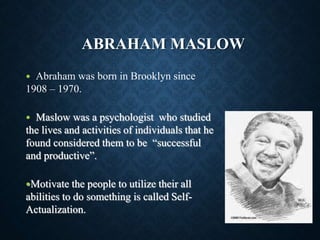
ABRAHAM MASLOW
 Abraham was born in Brooklyn since
1908 – 1970.
 Maslow was a psychologist who studied
the lives and activities of individuals that he
found considered them to be “successful
and productive”.
Motivate the people to utilize their all
abilities to do something is called Self-
Actualization.
This theory indicates
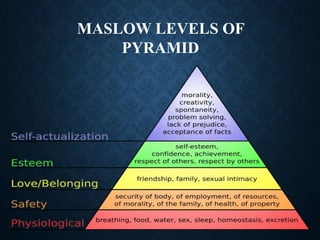
 There are 5 levels of needs
 All these needs are arranged in a hierarchy.
 The physiological and security needs are finite but the needs of
higher order are infinite and are likely to be dominant in persons
at higher levels in the organization.
 Maslow suggests that various levels are interdependent and
overlapping.
MASLOW THEORIES
MASLOW LEVELS OF
PYRAMID
 These are the basic human needs including food, clothing, shelter and other
necessities of life.
 Air
 Water
 Food
 Rest
 Exercise
Physical needs
LEVEL ONE:
LEVEL TWO
Safety Needs
Social needs
LEVEL THREE
• Social needs: Need for love, affection,
emotional needs, warmth and friendship.
• Love
• Belongingness
• Affection
Esteem Needs
LEVEL FOUR
• Self-esteem: Ego or self esteem, self respect, self
confidence, recognition.
• Self-Respect (esteem)
• Reputation (esteem)
Esteem needs
LEVEL FOUR
• Self actualization needs: desire for personal achievement or mission of his
life.
“What a man can be, he must be.”
• 10% people have self actualization potential.
• 2-3% people become self actualized persons.
Self - Actualization
LEVEL FIVE
Ahmer Mairaj
BT10109
CHARACTERISTICS OF SELF
ACTUALIZATION
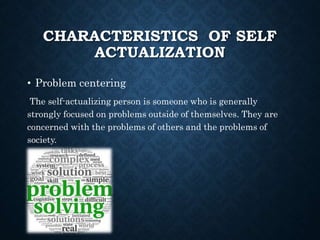
• Problem centering
The self-actualizing person is someone who is generally
strongly focused on problems outside of themselves. They are
concerned with the problems of others and the problems of
society.
CHARACTERISTICS CONT’D
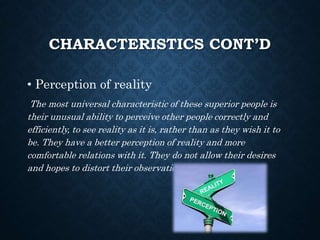
• Perception of reality
The most universal characteristic of these superior people is
their unusual ability to perceive other people correctly and
efficiently, to see reality as it is, rather than as they wish it to
be. They have a better perception of reality and more
comfortable relations with it. They do not allow their desires
and hopes to distort their observations.
CHARACTERISTICS
• Democratic Character structure:
Self-actualized people are said to be democratic. They are able
to be friendly with anyone no matter what their background
,class or beliefs are. They believe it is possible to learn
something from everyone.
CHARACTERISTICS CONT’D
• Acceptance of self, others, and nature.
Self-actualizers accept themselves as they are, and are not
ashamed or guilty about their human nature, with its
shortcoming, imperfections, and weaknesses.
They are also able to accept others in the same without trying to
control them or perfect them in any way.
CHARACTERISTICS
• Spontaneous
self actualized people are spontaneous, simple, and natural. In
other words, this kind of person is not concerned with being as
others think they should be. They are individuals who are able
to do what feels good and natural, simply because that is how
they feel.
• Imperfections
Self-actualizing people are individuals who are aware of the
fact that they are not perfect, that they are as human as the
next person, and that there are constantly new things to learn
and new ways to grow.
CHARACTERISTICS
• Autonomous
The self-actualizing person is autonomous meaning they are
capable of doing things for themselves and making decisions on
their own. They are strong enough to be independent of the good
opinion of others.
CHARACTERISTICS
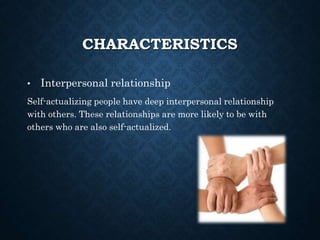
• Interpersonal relationship
Self-actualizing people have deep interpersonal relationship
with others. These relationships are more likely to be with
others who are also self-actualized.
CHARACTERISTICS
• Creative
Creativeness. Self-actualizing people are capable of being highly
creative. Creativeness can be expressed in many dimensions by
writing, speaking, playing, fantasies, or whatever, but self-
actualizing do have moods of being creative.
Danish Ali
BT10140
CRITICISM
• Researchers have proved that there is lack of hierarchical
structure of needs as suggested by Maslow.
Some people may have deprived of lower level
needs but strive for self actualization.
“starving artist“ and “student”
CRITICISM (CONT’D)
• There is evidence that contradicts the
order of needs specified by the model. For example, some
cultures appear to place social
needs before any others.
CRITICISM (CONT’D)
• There is little evidence to suggest that people are motivated to
satisfy only one need level at a time.
• According to maslow theory a person does not move on the
next level until the previous need is fairly well satisfied.
CRITICISM (CONT’D)
• Sometimes people are not aware of their own needs.
CRITICISM (CONT’D)
• Measurement of satisfaction of needs is not possible.
CONCLUSION
The basis of Maslow's motivation theory is that human beings are
motivated by unsatisfied needs, and that certain lower factors need
to be satisfied before higher needs can be satisfied. According to
Maslow, there are general types of needs (physiological, survival,
safety, love, and esteem) that must be satisfied before a person can
act unselfishly.
He called these needs "deficiency needs." As long as we are
motivated to satisfy these cravings, we are moving towards growth,
toward self-actualization. Satisfying needs is healthy, while preventing
gratification makes us sick or act evilly.
QUOTES
“Let yourself be drawn by the stronger pull of that
which you truly love.”
Maulana Rumi
“A musician must make music, an artist must paint, a
poet must write, if he is to be ultimately happy. What a
man can be, he must be. This need we may call self-
actualization.”
Abraham Maslow
QUOTES (CONT’D)
“No matter who you are, no matter what
you did, no matter where you've come from,
you can always change, become a better
version of yourself.”
Madonna
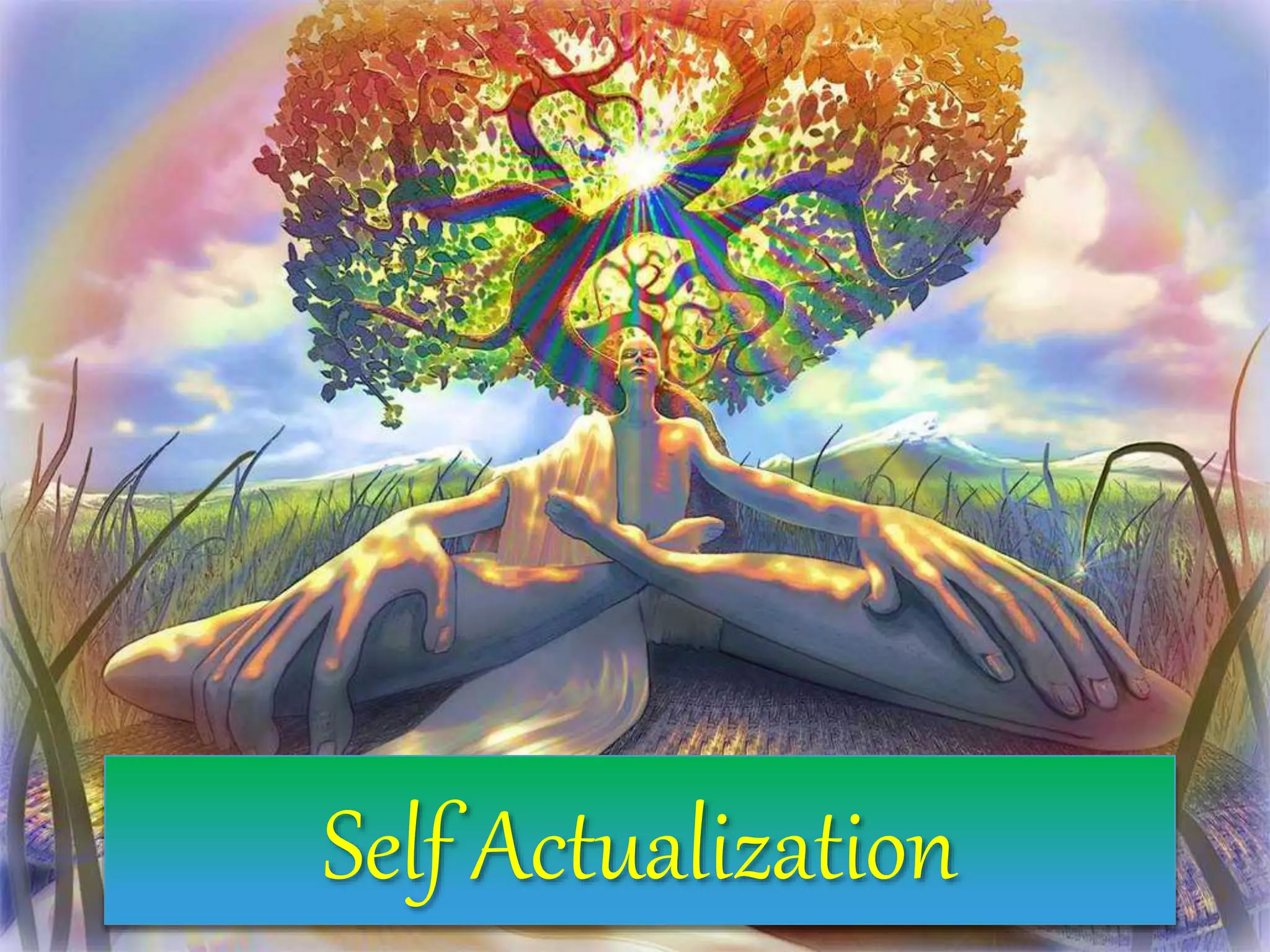
Self Actualization

Self Actualization

  • 1.
  • 2.
    Table of Contents 1.Maslow’s Hierarchey of Need theory Majid Ali 2. Characteristics of self Actualization Ahmer Mairaj 3. Criticism, Conclusion, Quotes Danish Ali
  • 3.
  • 4.
    ABRAHAM MASLOW  Abrahamwas born in Brooklyn since 1908 – 1970.  Maslow was a psychologist who studied the lives and activities of individuals that he found considered them to be “successful and productive”. Motivate the people to utilize their all abilities to do something is called Self- Actualization.
  • 5.
    This theory indicates There are 5 levels of needs  All these needs are arranged in a hierarchy.  The physiological and security needs are finite but the needs of higher order are infinite and are likely to be dominant in persons at higher levels in the organization.  Maslow suggests that various levels are interdependent and overlapping. MASLOW THEORIES
  • 6.
  • 7.
     These arethe basic human needs including food, clothing, shelter and other necessities of life.  Air  Water  Food  Rest  Exercise Physical needs LEVEL ONE:
  • 8.
  • 9.
    Social needs LEVEL THREE •Social needs: Need for love, affection, emotional needs, warmth and friendship. • Love • Belongingness • Affection
  • 10.
  • 11.
    • Self-esteem: Egoor self esteem, self respect, self confidence, recognition. • Self-Respect (esteem) • Reputation (esteem) Esteem needs LEVEL FOUR
  • 13.
    • Self actualizationneeds: desire for personal achievement or mission of his life. “What a man can be, he must be.” • 10% people have self actualization potential. • 2-3% people become self actualized persons. Self - Actualization LEVEL FIVE
  • 14.
  • 15.
    CHARACTERISTICS OF SELF ACTUALIZATION •Problem centering The self-actualizing person is someone who is generally strongly focused on problems outside of themselves. They are concerned with the problems of others and the problems of society.
  • 16.
    CHARACTERISTICS CONT’D • Perceptionof reality The most universal characteristic of these superior people is their unusual ability to perceive other people correctly and efficiently, to see reality as it is, rather than as they wish it to be. They have a better perception of reality and more comfortable relations with it. They do not allow their desires and hopes to distort their observations.
  • 17.
    CHARACTERISTICS • Democratic Characterstructure: Self-actualized people are said to be democratic. They are able to be friendly with anyone no matter what their background ,class or beliefs are. They believe it is possible to learn something from everyone.
  • 18.
    CHARACTERISTICS CONT’D • Acceptanceof self, others, and nature. Self-actualizers accept themselves as they are, and are not ashamed or guilty about their human nature, with its shortcoming, imperfections, and weaknesses. They are also able to accept others in the same without trying to control them or perfect them in any way.
  • 19.
    CHARACTERISTICS • Spontaneous self actualizedpeople are spontaneous, simple, and natural. In other words, this kind of person is not concerned with being as others think they should be. They are individuals who are able to do what feels good and natural, simply because that is how they feel. • Imperfections Self-actualizing people are individuals who are aware of the fact that they are not perfect, that they are as human as the next person, and that there are constantly new things to learn and new ways to grow.
  • 20.
    CHARACTERISTICS • Autonomous The self-actualizingperson is autonomous meaning they are capable of doing things for themselves and making decisions on their own. They are strong enough to be independent of the good opinion of others.
  • 21.
    CHARACTERISTICS • Interpersonal relationship Self-actualizingpeople have deep interpersonal relationship with others. These relationships are more likely to be with others who are also self-actualized.
  • 22.
    CHARACTERISTICS • Creative Creativeness. Self-actualizingpeople are capable of being highly creative. Creativeness can be expressed in many dimensions by writing, speaking, playing, fantasies, or whatever, but self- actualizing do have moods of being creative.
  • 23.
  • 24.
    CRITICISM • Researchers haveproved that there is lack of hierarchical structure of needs as suggested by Maslow. Some people may have deprived of lower level needs but strive for self actualization. “starving artist“ and “student”
  • 25.
    CRITICISM (CONT’D) • Thereis evidence that contradicts the order of needs specified by the model. For example, some cultures appear to place social needs before any others.
  • 26.
    CRITICISM (CONT’D) • Thereis little evidence to suggest that people are motivated to satisfy only one need level at a time. • According to maslow theory a person does not move on the next level until the previous need is fairly well satisfied.
  • 27.
    CRITICISM (CONT’D) • Sometimespeople are not aware of their own needs.
  • 28.
    CRITICISM (CONT’D) • Measurementof satisfaction of needs is not possible.
  • 29.
    CONCLUSION The basis ofMaslow's motivation theory is that human beings are motivated by unsatisfied needs, and that certain lower factors need to be satisfied before higher needs can be satisfied. According to Maslow, there are general types of needs (physiological, survival, safety, love, and esteem) that must be satisfied before a person can act unselfishly. He called these needs "deficiency needs." As long as we are motivated to satisfy these cravings, we are moving towards growth, toward self-actualization. Satisfying needs is healthy, while preventing gratification makes us sick or act evilly.
  • 30.
    QUOTES “Let yourself bedrawn by the stronger pull of that which you truly love.” Maulana Rumi “A musician must make music, an artist must paint, a poet must write, if he is to be ultimately happy. What a man can be, he must be. This need we may call self- actualization.” Abraham Maslow
  • 31.
    QUOTES (CONT’D) “No matterwho you are, no matter what you did, no matter where you've come from, you can always change, become a better version of yourself.” Madonna