WHO ME??
I’m not
shouting!!!
An Intro to Emotional Intelligence
By Leon Steyn
To empower you,
to take ownership of your own life,
and your relationships,
for greater positive influence.
The Objective
Contents
1. An introduction to Emotional Intelligence (EI)
2. Becoming self-aware
3. Practicing self-control
4. Becoming self-motivated
5. Building positive relationships
6. Developing personal influence
 What is Emotional Intelligence
 How will I benefit from developing my
Emotional Intelligence?
 Why should I change?
 How do I change?
1. An Introduction to EI
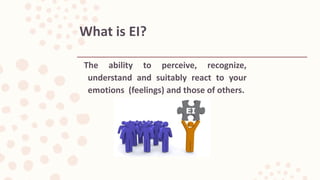
The ability to perceive, recognize,
understand and suitably react to your
emotions (feelings) and those of others.
What is EI?
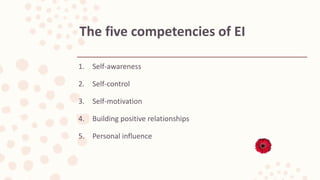
1. Self-awareness
2. Self-control
3. Self-motivation
4. Building positive relationships
5. Personal influence
The five competencies of EI
Activity 1
 A better understanding of yourself & what drives you
 Balance between expressing and controlling your feeling
 A better understanding of others and what drives them
 Improved relationships with others
How will I benefit from improving?
 Improved assertiveness, based on ownership
 Ability to leave the emotional baggage behind
 Ability to formulate meaning and purpose
 You will be equipped to build a network of
influential relationships
How will I benefit from improving? cont
“If you always do what you’ve always done,
you’ll always get what you’ve always got. So if
you want something different, do something
different”
- Anonymous
Why should I change/improve?
 Become self-aware and aware of others
 Realize the impact of your present behavior on yourself
and others
 Commit to change
 Start “catching yourself in the act”
 Choose new behaviors continuously
How do I change?
 The ability to perceive, recognize, understand and suitably re-act
to your emotions/feelings and the emotions/feelings of others
 Lots of benefits
 If you want different results, you need to start doing things
differently
 It starts with becoming self-aware
Summary of Introduction
 Complete the Emotional awareness questionnaire
 What are emotions and where do they come from?
 What happens when we suppress emotions?
 Why are emotions important?
 How do we identify emotions?
 What are you feeling?
2. Becoming self-aware
Complete activity 2 in your workbook.
Activity 2
You should now know if you:
 Can recognize different feelings in yourself and others
and their intensity or not
 You can control (NOT SUPPRESS) your emotions or not
The Questionnaire
 Physical re-action to our thoughts
 Triggered by experiences
 We perceive through our senses - sight, hearing,
smell, touch
 It is expressed/ communicated through our behavior
 Feelings
What are emotions?
Suppressed = not perceived, recognized, understood and
therefore not dealt with appropriately
 Physical illness or symptoms
 Compulsive behavior
 Aggressive or submissive
 Blame
What happens when we suppress?
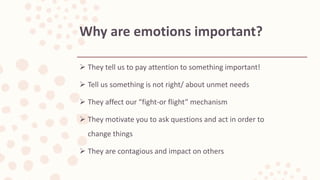
 They tell us to pay attention to something important!
 Tell us something is not right/ about unmet needs
 They affect our “fight-or flight” mechanism
 They motivate you to ask questions and act in order to
change things
 They are contagious and impact on others
Why are emotions important?
Complete activity 3 in your workbook.
Activity
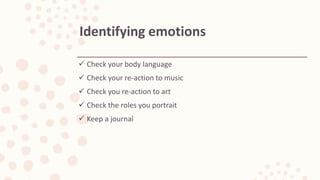
 Check your body language
 Check your re-action to music
 Check you re-action to art
 Check the roles you portrait
 Keep a journal
Identifying emotions
Complete activity 4 in your workbook.
Activity
Complete activity 5 in your workbook.
Activity
Complete activity 6 in your workbook.
Activity
Complete activity 7 in your workbook.
Activity
 Transfer of “old feelings” to new situations is possible
 Different feelings can happen at the same time
 Some emotions belong together
 Emotions can intensify
 There are primary and secondary emotions
 The origin can be traced
Points of interest
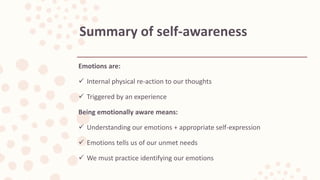
Emotions are:
 Internal physical re-action to our thoughts
 Triggered by an experience
Being emotionally aware means:
 Understanding our emotions + appropriate self-expression
 Emotions tells us of our unmet needs
 We must practice identifying our emotions
Summary of self-awareness
Summary on self-awareness (2)
 What is self-control?
 Understanding the things that shaped our thoughts
 The importance of our thoughts
 The importance of diet for emotional control
3. Practicing self-control
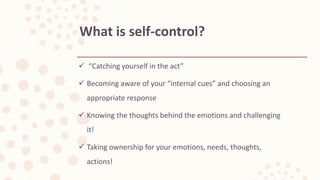
 “Catching yourself in the act”
 Becoming aware of your “internal cues” and choosing an
appropriate response
 Knowing the thoughts behind the emotions and challenging
it!
 Taking ownership for your emotions, needs, thoughts,
actions!
What is self-control?
Complete the reflection exercise in your workbook.
Reflection
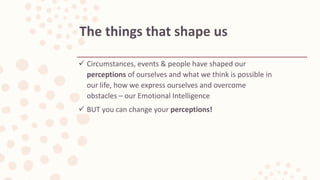
 Circumstances, events & people have shaped our
perceptions of ourselves and what we think is possible in
our life, how we express ourselves and overcome
obstacles – our Emotional Intelligence
 BUT you can change your perceptions!
The things that shape us
Complete the reflection exercise in your workbook.
Reflection
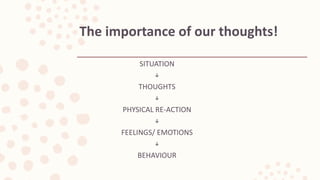
SITUATION
↓
THOUGHTS
↓
PHYSICAL RE-ACTION
↓
FEELINGS/ EMOTIONS
↓
BEHAVIOUR
The importance of our thoughts!
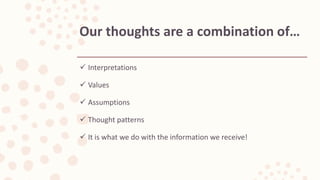
 Interpretations
 Values
 Assumptions
 Thought patterns
 It is what we do with the information we receive!
Our thoughts are a combination of…
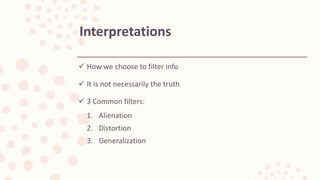
 How we choose to filter info
 It is not necessarily the truth
 3 Common filters:
1. Alienation
2. Distortion
3. Generalization
Interpretations
Complete the reflection exercise in your workbook.
Reflection
 What we strive for/ think is important
 3 Different types of values:
1. Getting
2. Giving
3. Being
Values
Complete activity 8 in your workbook.
Activity
 Preconceptions and Prejudices
 “Our truth”
 It might not be the truth or rational
 Convictions learnt from early childhood and onwards.
Assumptions
Complete the reflection exercise in your workbook.
Reflection
 Yourself
 Relationships
 Your needs
 The world
 Your rights
 Mistakes
 Feelings
 Problems
 Trust
Assumptions – what YOU think about
 No change without challenge!
 Challenge you interpretation of info, your values and
assumptions!
 Change your thoughts and you will change your emotions
and behavior!
Change required!
 Exaggeration or Minimization
 “Reading other people’s thoughts”
 White-or-black thinking
 Ignore the positive
 Labels- I am a …; You are a …
 Blaming- yourself and others
Other thought patterns…
 Rules of behavior- expectations
 Prediction of the future- in a negative way
 Feelings are reality
 Catastrophic thinking
 Ought to
 Personification
Other thought patterns… cont
Complete the reflection exercise in your workbook.
Reflection
 “Catching yourself in the act”
 Becoming aware of your thoughts
 Being aware of the circumstances, events and important
people that shaped your thoughts
 Challenging thoughts impacting negatively on your
performance
 If you want to behave differently, you need to start thinking
differently
Summary of self-control
 What does a self-motivated person look like?
 How do I become a self-motivated person?
4. Becoming self-motivated
Complete the reflection exercise in your workbook.
Reflection
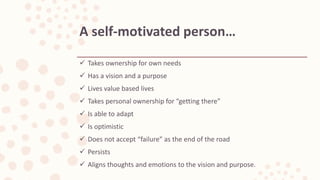
 Takes ownership for own needs
 Has a vision and a purpose
 Lives value based lives
 Takes personal ownership for “getting there”
 Is able to adapt
 Is optimistic
 Does not accept “failure” as the end of the road
 Persists
 Aligns thoughts and emotions to the vision and purpose.
A self-motivated person…
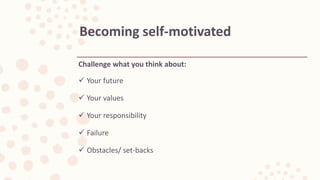
Challenge what you think about:
 Your future
 Your values
 Your responsibility
 Failure
 Obstacles/ set-backs
Becoming self-motivated
Complete the reflection exercise in your workbook.
Reflection
A self-motivated person takes ownership for meeting their
needs, has a vision of what they want to achieve and does
not allow obstacles, set-backs or failure to stand in their
way. Their values support their vision for their lives and
they are able to align their thoughts, feelings and behavior
to achieve that vision. They are optimist.
Challenge your thoughts to become self-motivated!
Summary of self motivation
 Having empathy for others
 Your intentions towards others
 The way you carry yourself
 The way you act towards others
5. Building positive relationships
It’s about caring about the experiences, feelings, needs and
wants of the people around us.
You have to:
 Pay close attention
 Check for understanding
Having empathy with others
 Consistently demonstrate a pure intent
 Give of yourself
 Care for the welfare and growth of others
Your intent towards others
 The message you send to others, through your body language
 It can attract or distance
 Smile, make eye-contact, greet friendly
The way you carry yourself
 We are often blind to the things we do that distance us from
others
 Get some honest feedback from someone you trust
 Act differently
The way you act towards others
 Learn to respect others
 Get to know the people working for you
 Reach out
 Ask questions, listen and respond with genuine interest
 Break inappropriate habits
Things I can do differently
 Deal with conflict in an appropriate manner
 Express yourself in an assertive manner- be approachable
 Build an atmosphere of trust and openness where people
feel free to express themselves and their ideas
 Encourage creative thinking and participation
Things I can do differently cont
Complete the reflection exercise in your workbook.
Reflection
To build positive relationships you need to:
 Become empathetic (awareness of others)
 Have pure intent
 Carry yourself and act in a way that does not distance
yourself from others
Summary of positive relationships
To have personal influence, you must have:
 Technical mastery
 Self-awareness
 Self-control
 Self-motivation
 Positive relationships with others
 The ability to convince, persuade and inspire
6. Develop personal influence
It is about constantly learning and having an expanded
knowledge base in the field you operate in.
Knowledge can be expanded through:
 Reading
 Belonging to a Professional body
 Attending conferences & workshops
 Research
Technical mastery
Complete the reflection exercise in your workbook.
Reflection
 Understanding what drives your people
 Having a vision
 Understanding the value the team adds
 Aligning the above into a WIN-WIN through skillful
communication
 On a foundation of relationship
 Being contagiously enthusiastic
 Neutralize negative emotions
To convince, persuade and inspire
Complete the reflection exercise in your workbook.
Reflection
Developing personal influence is about developing:
 Technical mastery + Emotional Intelligence
Summary develop personal influence
Complete activity 9 in your workbook.
Activity
Applying what you’ve learnt
Complete the reflection exercise in the back of your book.
You have taken a nice, positive step
to empowering yourself,
taking ownership of your own life,
and your relationships,
for greater positive influence.
Congratulations!!
References
1. Coaching for Emotional Intelligence. Bob Wall,2007, New York.
2. Emotional Intelligence Workbook. Le Roux, de Klerk, 2001. Human
and Rosseau, Cape Town
3. The Heart of a Winner. Van Jaarsveld, 2003. Lux Verbi, Wellington,
South Africa

Emotional Intelligence: Help Relieve the Pain

  • 1.
    WHO ME?? I’m not shouting!!! AnIntro to Emotional Intelligence By Leon Steyn
  • 2.
    To empower you, totake ownership of your own life, and your relationships, for greater positive influence. The Objective
  • 3.
    Contents 1. An introductionto Emotional Intelligence (EI) 2. Becoming self-aware 3. Practicing self-control 4. Becoming self-motivated 5. Building positive relationships 6. Developing personal influence
  • 4.
     What isEmotional Intelligence  How will I benefit from developing my Emotional Intelligence?  Why should I change?  How do I change? 1. An Introduction to EI
  • 5.
    The ability toperceive, recognize, understand and suitably react to your emotions (feelings) and those of others. What is EI?
  • 6.
    1. Self-awareness 2. Self-control 3.Self-motivation 4. Building positive relationships 5. Personal influence The five competencies of EI
  • 7.
  • 8.
     A betterunderstanding of yourself & what drives you  Balance between expressing and controlling your feeling  A better understanding of others and what drives them  Improved relationships with others How will I benefit from improving?
  • 9.
     Improved assertiveness,based on ownership  Ability to leave the emotional baggage behind  Ability to formulate meaning and purpose  You will be equipped to build a network of influential relationships How will I benefit from improving? cont
  • 10.
    “If you alwaysdo what you’ve always done, you’ll always get what you’ve always got. So if you want something different, do something different” - Anonymous Why should I change/improve?
  • 11.
     Become self-awareand aware of others  Realize the impact of your present behavior on yourself and others  Commit to change  Start “catching yourself in the act”  Choose new behaviors continuously How do I change?
  • 12.
     The abilityto perceive, recognize, understand and suitably re-act to your emotions/feelings and the emotions/feelings of others  Lots of benefits  If you want different results, you need to start doing things differently  It starts with becoming self-aware Summary of Introduction
  • 13.
     Complete theEmotional awareness questionnaire  What are emotions and where do they come from?  What happens when we suppress emotions?  Why are emotions important?  How do we identify emotions?  What are you feeling? 2. Becoming self-aware
  • 14.
    Complete activity 2in your workbook. Activity 2
  • 15.
    You should nowknow if you:  Can recognize different feelings in yourself and others and their intensity or not  You can control (NOT SUPPRESS) your emotions or not The Questionnaire
  • 16.
     Physical re-actionto our thoughts  Triggered by experiences  We perceive through our senses - sight, hearing, smell, touch  It is expressed/ communicated through our behavior  Feelings What are emotions?
  • 17.
    Suppressed = notperceived, recognized, understood and therefore not dealt with appropriately  Physical illness or symptoms  Compulsive behavior  Aggressive or submissive  Blame What happens when we suppress?
  • 18.
     They tellus to pay attention to something important!  Tell us something is not right/ about unmet needs  They affect our “fight-or flight” mechanism  They motivate you to ask questions and act in order to change things  They are contagious and impact on others Why are emotions important?
  • 19.
    Complete activity 3in your workbook. Activity
  • 20.
     Check yourbody language  Check your re-action to music  Check you re-action to art  Check the roles you portrait  Keep a journal Identifying emotions
  • 21.
    Complete activity 4in your workbook. Activity
  • 22.
    Complete activity 5in your workbook. Activity
  • 23.
    Complete activity 6in your workbook. Activity
  • 24.
    Complete activity 7in your workbook. Activity
  • 25.
     Transfer of“old feelings” to new situations is possible  Different feelings can happen at the same time  Some emotions belong together  Emotions can intensify  There are primary and secondary emotions  The origin can be traced Points of interest
  • 26.
    Emotions are:  Internalphysical re-action to our thoughts  Triggered by an experience Being emotionally aware means:  Understanding our emotions + appropriate self-expression  Emotions tells us of our unmet needs  We must practice identifying our emotions Summary of self-awareness
  • 27.
  • 28.
     What isself-control?  Understanding the things that shaped our thoughts  The importance of our thoughts  The importance of diet for emotional control 3. Practicing self-control
  • 29.
     “Catching yourselfin the act”  Becoming aware of your “internal cues” and choosing an appropriate response  Knowing the thoughts behind the emotions and challenging it!  Taking ownership for your emotions, needs, thoughts, actions! What is self-control?
  • 30.
    Complete the reflectionexercise in your workbook. Reflection
  • 31.
     Circumstances, events& people have shaped our perceptions of ourselves and what we think is possible in our life, how we express ourselves and overcome obstacles – our Emotional Intelligence  BUT you can change your perceptions! The things that shape us
  • 32.
    Complete the reflectionexercise in your workbook. Reflection
  • 33.
  • 34.
     Interpretations  Values Assumptions  Thought patterns  It is what we do with the information we receive! Our thoughts are a combination of…
  • 35.
     How wechoose to filter info  It is not necessarily the truth  3 Common filters: 1. Alienation 2. Distortion 3. Generalization Interpretations
  • 36.
    Complete the reflectionexercise in your workbook. Reflection
  • 37.
     What westrive for/ think is important  3 Different types of values: 1. Getting 2. Giving 3. Being Values
  • 38.
    Complete activity 8in your workbook. Activity
  • 39.
     Preconceptions andPrejudices  “Our truth”  It might not be the truth or rational  Convictions learnt from early childhood and onwards. Assumptions
  • 40.
    Complete the reflectionexercise in your workbook. Reflection
  • 41.
     Yourself  Relationships Your needs  The world  Your rights  Mistakes  Feelings  Problems  Trust Assumptions – what YOU think about
  • 42.
     No changewithout challenge!  Challenge you interpretation of info, your values and assumptions!  Change your thoughts and you will change your emotions and behavior! Change required!
  • 43.
     Exaggeration orMinimization  “Reading other people’s thoughts”  White-or-black thinking  Ignore the positive  Labels- I am a …; You are a …  Blaming- yourself and others Other thought patterns…
  • 44.
     Rules ofbehavior- expectations  Prediction of the future- in a negative way  Feelings are reality  Catastrophic thinking  Ought to  Personification Other thought patterns… cont
  • 45.
    Complete the reflectionexercise in your workbook. Reflection
  • 46.
     “Catching yourselfin the act”  Becoming aware of your thoughts  Being aware of the circumstances, events and important people that shaped your thoughts  Challenging thoughts impacting negatively on your performance  If you want to behave differently, you need to start thinking differently Summary of self-control
  • 47.
     What doesa self-motivated person look like?  How do I become a self-motivated person? 4. Becoming self-motivated
  • 48.
    Complete the reflectionexercise in your workbook. Reflection
  • 49.
     Takes ownershipfor own needs  Has a vision and a purpose  Lives value based lives  Takes personal ownership for “getting there”  Is able to adapt  Is optimistic  Does not accept “failure” as the end of the road  Persists  Aligns thoughts and emotions to the vision and purpose. A self-motivated person…
  • 50.
    Challenge what youthink about:  Your future  Your values  Your responsibility  Failure  Obstacles/ set-backs Becoming self-motivated
  • 51.
    Complete the reflectionexercise in your workbook. Reflection
  • 52.
    A self-motivated persontakes ownership for meeting their needs, has a vision of what they want to achieve and does not allow obstacles, set-backs or failure to stand in their way. Their values support their vision for their lives and they are able to align their thoughts, feelings and behavior to achieve that vision. They are optimist. Challenge your thoughts to become self-motivated! Summary of self motivation
  • 53.
     Having empathyfor others  Your intentions towards others  The way you carry yourself  The way you act towards others 5. Building positive relationships
  • 54.
    It’s about caringabout the experiences, feelings, needs and wants of the people around us. You have to:  Pay close attention  Check for understanding Having empathy with others
  • 55.
     Consistently demonstratea pure intent  Give of yourself  Care for the welfare and growth of others Your intent towards others
  • 56.
     The messageyou send to others, through your body language  It can attract or distance  Smile, make eye-contact, greet friendly The way you carry yourself
  • 57.
     We areoften blind to the things we do that distance us from others  Get some honest feedback from someone you trust  Act differently The way you act towards others
  • 58.
     Learn torespect others  Get to know the people working for you  Reach out  Ask questions, listen and respond with genuine interest  Break inappropriate habits Things I can do differently
  • 59.
     Deal withconflict in an appropriate manner  Express yourself in an assertive manner- be approachable  Build an atmosphere of trust and openness where people feel free to express themselves and their ideas  Encourage creative thinking and participation Things I can do differently cont
  • 60.
    Complete the reflectionexercise in your workbook. Reflection
  • 61.
    To build positiverelationships you need to:  Become empathetic (awareness of others)  Have pure intent  Carry yourself and act in a way that does not distance yourself from others Summary of positive relationships
  • 62.
    To have personalinfluence, you must have:  Technical mastery  Self-awareness  Self-control  Self-motivation  Positive relationships with others  The ability to convince, persuade and inspire 6. Develop personal influence
  • 63.
    It is aboutconstantly learning and having an expanded knowledge base in the field you operate in. Knowledge can be expanded through:  Reading  Belonging to a Professional body  Attending conferences & workshops  Research Technical mastery
  • 64.
    Complete the reflectionexercise in your workbook. Reflection
  • 65.
     Understanding whatdrives your people  Having a vision  Understanding the value the team adds  Aligning the above into a WIN-WIN through skillful communication  On a foundation of relationship  Being contagiously enthusiastic  Neutralize negative emotions To convince, persuade and inspire
  • 66.
    Complete the reflectionexercise in your workbook. Reflection
  • 67.
    Developing personal influenceis about developing:  Technical mastery + Emotional Intelligence Summary develop personal influence
  • 68.
    Complete activity 9in your workbook. Activity
  • 69.
    Applying what you’velearnt Complete the reflection exercise in the back of your book.
  • 70.
    You have takena nice, positive step to empowering yourself, taking ownership of your own life, and your relationships, for greater positive influence. Congratulations!!
  • 71.
    References 1. Coaching forEmotional Intelligence. Bob Wall,2007, New York. 2. Emotional Intelligence Workbook. Le Roux, de Klerk, 2001. Human and Rosseau, Cape Town 3. The Heart of a Winner. Van Jaarsveld, 2003. Lux Verbi, Wellington, South Africa
Editor's Notes

  • #2 A very good morning everybody! Thank you for this fantastic opportunity to share this very interesting and important topic…Emotional Intelligence. Today’s session is for you and will include fun, interactive and non-embarrassing tasks which will contribute to expanding your knowledge of yourself and your emotions and how these emotions affect our daily lives. To get us going, we are going to share the one most powerful emotion we felt when we arrived in this venue this morning. While thinking about this, can we agree on a few ground rules to ensure we all get the most out of today? ASK FOR SUGGESTIONS AND WRITE ON FLIPCHART 4X MAX.