Jeremy Mason
ED Registrar SCGH
Thursday 18th February 2016
 The process of showing people what can
happen to you under stress
 Developing and building tools to cope with
the physiological response to stress
 “Innoculating” by exposing yourself to the
stressors that you’re likely to experience in
your field
 1) To gain knowledge and familiarity with a
stressful environment
 2) To develop and practice task-specific
skills, including psychological skills as well as
decision making faculties, to be performed
under stress
 3) To build confidence in an individuals
capabilities
 Simple message; How you train is how you fight
 Tachycardia can make you stupid
 If you let your vital signs and catechloamine surge
over take your cognitive ability – it will completely
ruin your ability to manage a stressful situation
 You will encounter stress and its negative effects
taking care of critically ill or injured patients
 Preparation is required to perform at your very best
 Developed by psychologist Donald Meichenbaum in 1980’s
 Multifaceted type of Cognitive Behavioural Therapy designed to help
individuals cope with stress
 Based on the concept of inoculation – prepares a person to be more
resistant to stress through prior exposure to milder forms of stress
 Widely used by Military and NASA to mitigate stress in a variety of
situations
 Psychological technique used in PTSD, anxiety and anger
 Starting to be used in medical education to help improve performance in
emergency and critical care
 Dedicated EMCRIT & iTeachEM Podcasts on the topic + dedicated
preconference workshop at SMACC Chicago 2015
 Based on appraisal and coping behaviour
◦ We experience stress when we evaluate the
relationship we have with our environment as
being:
 Over demanding
 Beyond our ability to cope with
 Posing a threat to our health and wellbeing
 We construct stories about ourselves
 These stories affect persons ability to cope
with stress
 Being a “Victim” vs being and “Overcomer”
 SIT uses this perspective to help people
construct life narratives to help them cope
with stress
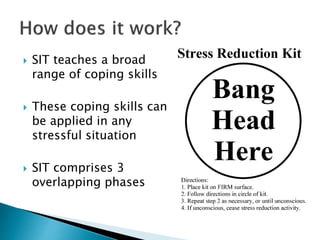
 SIT teaches a broad
range of coping skills
 These coping skills can
be applied in any
stressful situation
 SIT comprises 3
overlapping phases
 Phase 1 – Information Provision
◦ Learns about the nature and impact of the human stress
response
◦ Made aware of their ability to solve problems
◦ Encouraged to think adaptively
 Phase 2 – Skills acquisition
◦ Develops and refines behavioural, technical & cognitive skills
 Phase 3 – Application and practice
◦ Practice skills learnt
◦ Graded exposure to increasingly stressful situations
 Educational phase
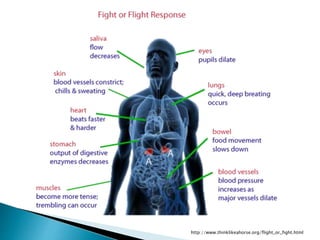
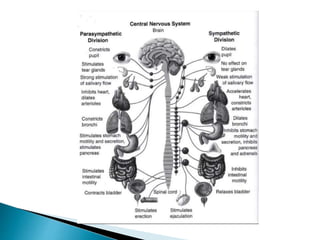
 Show people the physiological response to stress
 There’s a difference between having knowledge stored in
your memory and having the ability to apply that
knowledge and get things done when you’re stressed or
when things aren’t going well
 Same applies with technical skills e.g. Intubating a
mannequin in a quiet room vs massive haematemesis with
SATS dropping
 Tell people there’s a way to improve your performance
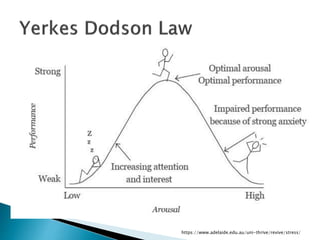
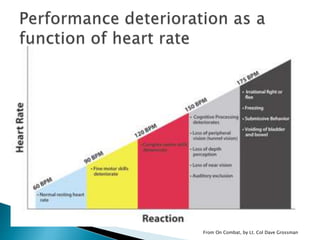
 Grossman & Sidel 1996 review– Examined combat
and the warrior mindset
 Used heart rate as a surrogate for amount of stress
 Looked at skills performance and how people
respond
 Found an “ideal” level of arousal
 As stress increased there was a point where they
became overloaded and experienced a deterioration
in cognitive and skills performance
http://www.thinklikeahorse.org/flight_or_fight.html
https://www.adelaide.edu.au/uni-thrive/revive/stress/
From On Combat, by Lt. Col Dave Grossman
 Building skills and muscle memory to perform
skills when it really counts
 Develop technical & non technical skills
needed to perform in the resus environment
without the addition of stressful stimuli
 Goals:
◦ Learn & develop constructive coping mechanisms
◦ Develop effective performance habits
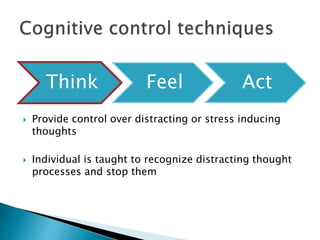
Think Feel Act
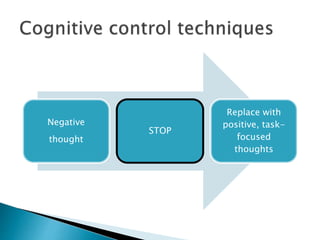
 Provide control over distracting or stress inducing
thoughts
 Individual is taught to recognize distracting thought
processes and stop them
Negative
thought
STOP
Replace with
positive, task-
focused
thoughts
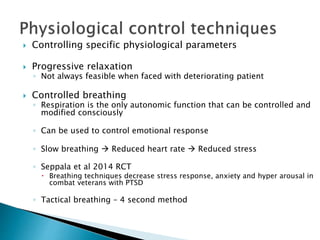
 Controlling specific physiological parameters
 Progressive relaxation
◦ Not always feasible when faced with deteriorating patient
 Controlled breathing
◦ Respiration is the only autonomic function that can be controlled and
modified consciously
◦ Can be used to control emotional response
◦ Slow breathing  Reduced heart rate  Reduced stress
◦ Seppala et al 2014 RCT
 Breathing techniques decrease stress response, anxiety and hyper arousal in
combat veterans with PTSD
◦ Tactical breathing – 4 second method
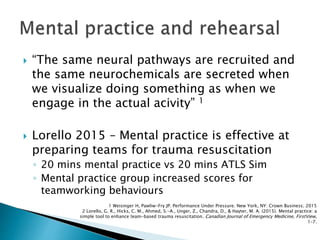
 “The same neural pathways are recruited and
the same neurochemicals are secreted when
we visualize doing something as when we
engage in the actual acivity” 1
 Lorello 2015 – Mental practice is effective at
preparing teams for trauma resuscitation
◦ 20 mins mental practice vs 20 mins ATLS Sim
◦ Mental practice group increased scores for
teamworking behaviours
1 Weisinger H, Pawliw-Fry JP. Performance Under Pressure. New York, NY: Crown Business; 2015
2 Lorello, G. R., Hicks, C. M., Ahmed, S.-A., Unger, Z., Chandra, D., & Hayter, M. A. (2015). Mental practice: a
simple tool to enhance team-based trauma resuscitation. Canadian Journal of Emergency Medicine, FirstView,
1–7.
 Training decision making skills
◦ Eg algorithms and checklists
 Overleaning technical skills
 Teaching on communication
 Team training / simulations
 Take skills from Phase 2 and rehearse them in
increasingly graduated stressful conditions
 Allows trainees to experience in real time the
performance challenges they will face in a
specific setting
 Reduces uncertainty and anxiety
 Increases confidence when individuals realise
they can overcome stressors
 1) Performance diminishes under stress
 2) Technical skill & knowledge necessary but not
enough to perform effectively in stressful
situations
 3) Focus on developing the skills to perform
under stress
 4) No RCTs yet exploring SIT in resuscitation –
some currently under way but needs further
investigation
 iTeachEM Podcast by Rob Rogers, Stress Inoculation
Training http://iteachem.net/2014/12/stress-
inoculation-training/
 http://emcrit.org/blogpost/on-stress-inoculation-
training/
 http://emcrit.org/blogpost/performance-enhancing-
psychological-skills/
 http://emcrit.org/blogpost/flow/
 https://www.adelaide.edu.au/uni-
thrive/revive/stress
 Weisinger H, Pawliw-Fry JP. Performance Under Pressure.
New York, NY: Crown Business; 2015
 Lorello, G. R., Hicks, C. M., Ahmed, S.-A., Unger, Z.,
Chandra, D., & Hayter, M. A. (2015). Mental practice: a
simple tool to enhance team-based trauma
resuscitation. Canadian Journal of Emergency
Medicine, FirstView, 1–7.
 M Seppälä, E., B Nitschke, J., L Tudorascu, D., Hayes, A., R
Goldstein, M., T H Nguyen, D., … J Davidson, R. (2014).
Breathing-Based Meditation Decreases Posttraumatic
Stress Disorder Symptoms in U.S. Military Veterans: A
Randomized Controlled Longitudinal Study. Journal of
Traumatic Stress, 27(4), 397–405

Stress innoculation training

  • 1.
    Jeremy Mason ED RegistrarSCGH Thursday 18th February 2016
  • 2.
     The processof showing people what can happen to you under stress  Developing and building tools to cope with the physiological response to stress  “Innoculating” by exposing yourself to the stressors that you’re likely to experience in your field
  • 3.
     1) Togain knowledge and familiarity with a stressful environment  2) To develop and practice task-specific skills, including psychological skills as well as decision making faculties, to be performed under stress  3) To build confidence in an individuals capabilities
  • 4.
     Simple message;How you train is how you fight  Tachycardia can make you stupid  If you let your vital signs and catechloamine surge over take your cognitive ability – it will completely ruin your ability to manage a stressful situation  You will encounter stress and its negative effects taking care of critically ill or injured patients  Preparation is required to perform at your very best
  • 5.
     Developed bypsychologist Donald Meichenbaum in 1980’s  Multifaceted type of Cognitive Behavioural Therapy designed to help individuals cope with stress  Based on the concept of inoculation – prepares a person to be more resistant to stress through prior exposure to milder forms of stress  Widely used by Military and NASA to mitigate stress in a variety of situations  Psychological technique used in PTSD, anxiety and anger  Starting to be used in medical education to help improve performance in emergency and critical care  Dedicated EMCRIT & iTeachEM Podcasts on the topic + dedicated preconference workshop at SMACC Chicago 2015
  • 6.
     Based onappraisal and coping behaviour ◦ We experience stress when we evaluate the relationship we have with our environment as being:  Over demanding  Beyond our ability to cope with  Posing a threat to our health and wellbeing
  • 7.
     We constructstories about ourselves  These stories affect persons ability to cope with stress  Being a “Victim” vs being and “Overcomer”  SIT uses this perspective to help people construct life narratives to help them cope with stress
  • 8.
     SIT teachesa broad range of coping skills  These coping skills can be applied in any stressful situation  SIT comprises 3 overlapping phases
  • 9.
     Phase 1– Information Provision ◦ Learns about the nature and impact of the human stress response ◦ Made aware of their ability to solve problems ◦ Encouraged to think adaptively  Phase 2 – Skills acquisition ◦ Develops and refines behavioural, technical & cognitive skills  Phase 3 – Application and practice ◦ Practice skills learnt ◦ Graded exposure to increasingly stressful situations
  • 10.
     Educational phase Show people the physiological response to stress  There’s a difference between having knowledge stored in your memory and having the ability to apply that knowledge and get things done when you’re stressed or when things aren’t going well  Same applies with technical skills e.g. Intubating a mannequin in a quiet room vs massive haematemesis with SATS dropping  Tell people there’s a way to improve your performance
  • 11.
     Grossman &Sidel 1996 review– Examined combat and the warrior mindset  Used heart rate as a surrogate for amount of stress  Looked at skills performance and how people respond  Found an “ideal” level of arousal  As stress increased there was a point where they became overloaded and experienced a deterioration in cognitive and skills performance
  • 12.
  • 14.
  • 15.
    From On Combat,by Lt. Col Dave Grossman
  • 16.
     Building skillsand muscle memory to perform skills when it really counts  Develop technical & non technical skills needed to perform in the resus environment without the addition of stressful stimuli  Goals: ◦ Learn & develop constructive coping mechanisms ◦ Develop effective performance habits
  • 17.
    Think Feel Act Provide control over distracting or stress inducing thoughts  Individual is taught to recognize distracting thought processes and stop them
  • 18.
  • 19.
     Controlling specificphysiological parameters  Progressive relaxation ◦ Not always feasible when faced with deteriorating patient  Controlled breathing ◦ Respiration is the only autonomic function that can be controlled and modified consciously ◦ Can be used to control emotional response ◦ Slow breathing  Reduced heart rate  Reduced stress ◦ Seppala et al 2014 RCT  Breathing techniques decrease stress response, anxiety and hyper arousal in combat veterans with PTSD ◦ Tactical breathing – 4 second method
  • 20.
     “The sameneural pathways are recruited and the same neurochemicals are secreted when we visualize doing something as when we engage in the actual acivity” 1  Lorello 2015 – Mental practice is effective at preparing teams for trauma resuscitation ◦ 20 mins mental practice vs 20 mins ATLS Sim ◦ Mental practice group increased scores for teamworking behaviours 1 Weisinger H, Pawliw-Fry JP. Performance Under Pressure. New York, NY: Crown Business; 2015 2 Lorello, G. R., Hicks, C. M., Ahmed, S.-A., Unger, Z., Chandra, D., & Hayter, M. A. (2015). Mental practice: a simple tool to enhance team-based trauma resuscitation. Canadian Journal of Emergency Medicine, FirstView, 1–7.
  • 21.
     Training decisionmaking skills ◦ Eg algorithms and checklists  Overleaning technical skills  Teaching on communication  Team training / simulations
  • 22.
     Take skillsfrom Phase 2 and rehearse them in increasingly graduated stressful conditions  Allows trainees to experience in real time the performance challenges they will face in a specific setting  Reduces uncertainty and anxiety  Increases confidence when individuals realise they can overcome stressors
  • 23.
     1) Performancediminishes under stress  2) Technical skill & knowledge necessary but not enough to perform effectively in stressful situations  3) Focus on developing the skills to perform under stress  4) No RCTs yet exploring SIT in resuscitation – some currently under way but needs further investigation
  • 24.
     iTeachEM Podcastby Rob Rogers, Stress Inoculation Training http://iteachem.net/2014/12/stress- inoculation-training/  http://emcrit.org/blogpost/on-stress-inoculation- training/  http://emcrit.org/blogpost/performance-enhancing- psychological-skills/  http://emcrit.org/blogpost/flow/  https://www.adelaide.edu.au/uni- thrive/revive/stress
  • 25.
     Weisinger H,Pawliw-Fry JP. Performance Under Pressure. New York, NY: Crown Business; 2015  Lorello, G. R., Hicks, C. M., Ahmed, S.-A., Unger, Z., Chandra, D., & Hayter, M. A. (2015). Mental practice: a simple tool to enhance team-based trauma resuscitation. Canadian Journal of Emergency Medicine, FirstView, 1–7.  M Seppälä, E., B Nitschke, J., L Tudorascu, D., Hayes, A., R Goldstein, M., T H Nguyen, D., … J Davidson, R. (2014). Breathing-Based Meditation Decreases Posttraumatic Stress Disorder Symptoms in U.S. Military Veterans: A Randomized Controlled Longitudinal Study. Journal of Traumatic Stress, 27(4), 397–405

Editor's Notes

  • #12 Tachycardia and hyperventilation magnify the effects of anxiety and contribute to the unfavourable effects of stress on fine motor control, visual acquity and cognition.
  • #18 The foundation of evidence based cognitive behavioural therapy in psychiatry is the fact that there is a fundamental connection between what a person thinks, what they feel and how they act.