Mastitis Management and Prevention
Jeffrey Bewley, PhD, PAS
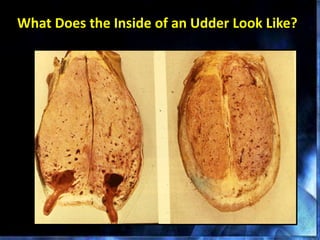
What Does the Inside of an Udder Look Like?
General Mammary Structure
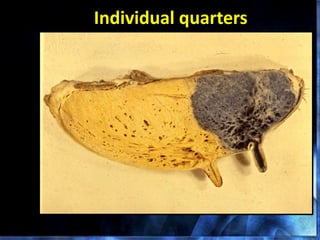
Individual quarters
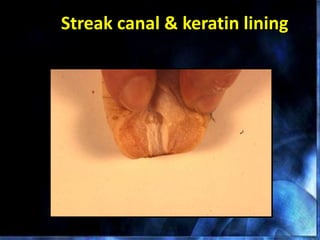
Streak canal & keratin lining
Streak Canal
Purdue University Milking for Quality
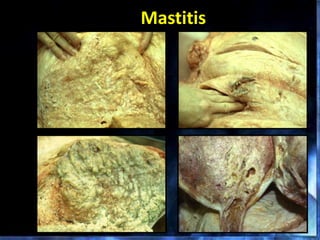
What is Mastitis?
• Inflammation of the
mammary gland caused by:
•Microorganisms (primarily
bacteria)
•Trauma or injury to the
udder
•Chemical irritation
• Most costly disease in the
dairy industry
Mastitis
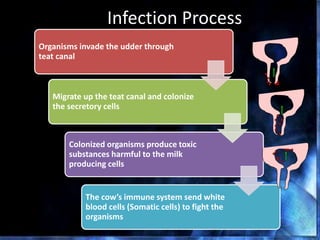
Infection Process
Organisms invade the udder through
teat canal
Migrate up the teat canal and colonize
the secretory cells
Colonized organisms produce toxic
substances harmful to the milk
producing cells
The cow’s immune system send white
blood cells (Somatic cells) to fight the
organisms
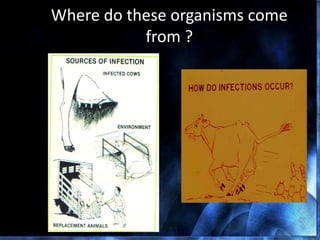
Where do these organisms come
from ?
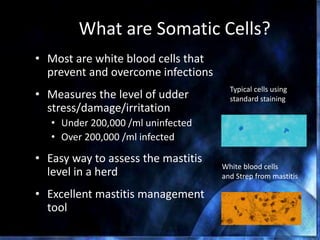
What are Somatic Cells?
• Most are white blood cells that
prevent and overcome infections
• Measures the level of udder
stress/damage/irritation
• Under 200,000 /ml uninfected
• Over 200,000 /ml infected
• Easy way to assess the mastitis
level in a herd
• Excellent mastitis management
tool
Typical cells using
standard staining
White blood cells
and Strep from mastitis
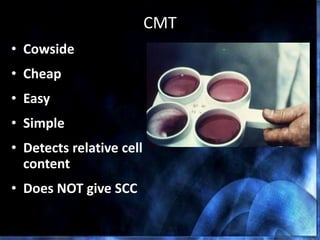
CMT
• Cowside
• Cheap
• Easy
• Simple
• Detects relative cell
content
• Does NOT give SCC
Other Tests
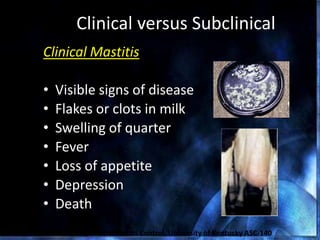
Clinical versus Subclinical
Clinical Mastitis
• Visible signs of disease
• Flakes or clots in milk
• Swelling of quarter
• Fever
• Loss of appetite
• Depression
• Death
Crist et al., 1997, Mastitis and its Control, University of Kentucky ASC-140
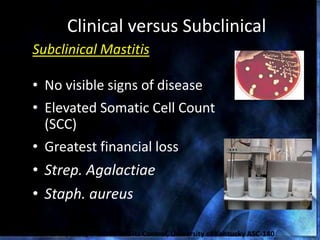
Clinical versus Subclinical
Subclinical Mastitis
• No visible signs of disease
• Elevated Somatic Cell Count
(SCC)
• Greatest financial loss
• Strep. Agalactiae
• Staph. aureus
Crist et al., 1997, Mastitis and its Control, University of Kentucky ASC-140
Mastitis in a Herd
Clinical
Subclinical
1 clinical
case
=15-40
subclinical
cases
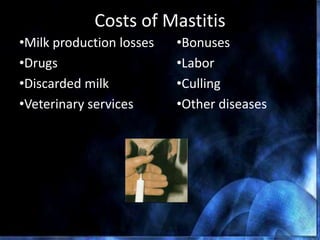
Costs of Mastitis
•Milk production losses
•Drugs
•Discarded milk
•Veterinary services
•Bonuses
•Labor
•Culling
•Other diseases
Production Losses by SCC Score
Lactation Average
SCC Score
Lactation Average
SCC (cells/ml)
Lactation 1 Lactation 2 or
greater
0 12,500 -- --
1 25,000 -- --
2 50,000 -- --
3 100,000 200 400
4 200,000 400 800
5 400,000 600 1200
6 800,000 800 1600
7 1,600,000 1000 2000
*Comparison are with lactation yields at SCC score of 2.
Source: Current Concepts of Bovine Mastitis, NMC, 1987
http://www2.ca.uky.edu/afsdairy/MilkQualityCalculator
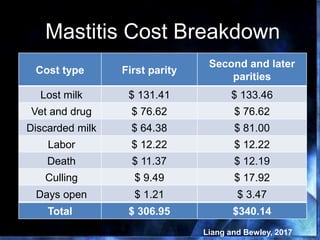
Mastitis Cost Breakdown
Cost type First parity
Second and later
parities
Lost milk $ 131.41 $ 133.46
Vet and drug $ 76.62 $ 76.62
Discarded milk $ 64.38 $ 81.00
Labor $ 12.22 $ 12.22
Death $ 11.37 $ 12.19
Culling $ 9.49 $ 17.92
Days open $ 1.21 $ 3.47
Total $ 306.95 $340.14
Liang and Bewley, 2017
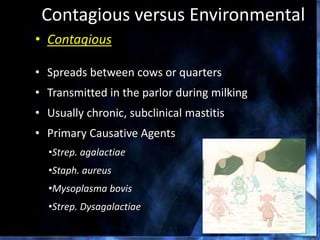
Contagious versus Environmental
• Contagious
• Spreads between cows or quarters
• Transmitted in the parlor during milking
• Usually chronic, subclinical mastitis
• Primary Causative Agents
•Strep. agalactiae
•Staph. aureus
•Mysoplasma bovis
•Strep. Dysagalactiae
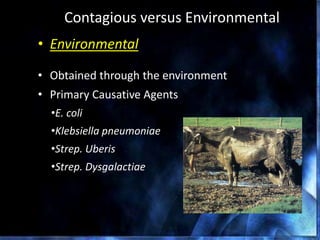
Contagious versus Environmental
• Environmental
• Obtained through the environment
• Primary Causative Agents
•E. coli
•Klebsiella pneumoniae
•Strep. Uberis
•Strep. Dysgalactiae
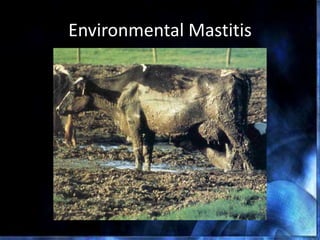
Environmental Mastitis
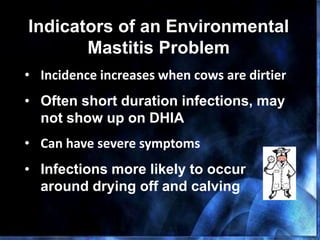
Indicators of an Environmental
Mastitis Problem
• Incidence increases when cows are dirtier
• Often short duration infections, may
not show up on DHIA
• Can have severe symptoms
• Infections more likely to occur
around drying off and calving
Indicators of an Environmental
Mastitis Problem
• More infections during hot/humid
weather
• Often only a few cows infected at one
time
• Poor teat end condition gives bacteria
easier access to teat end
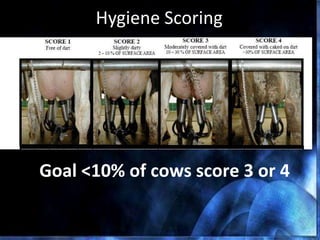
Hygiene Scoring
Goal <10% of cows score 3 or 4
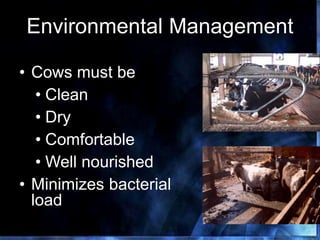
Environmental Management
• Cows must be
• Clean
• Dry
• Comfortable
• Well nourished
• Minimizes bacterial
load
Steps for Controlling Environmental
Mastitis
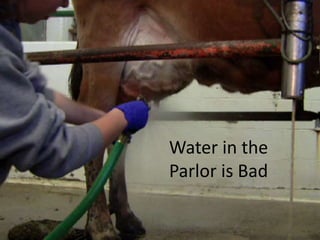
1. Limit water use in parlor
2. Avoid overmilking to keep teat ends healthy
3. Remove hair from udder
4. Use E-coli vaccines (i.e. J5, J-VAC, ENDOVAC-
Bovi)
5. Consider using sand
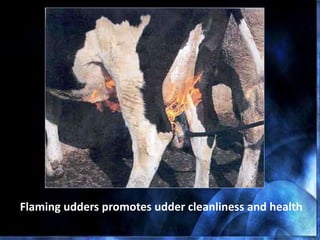
Flaming udders promotes udder cleanliness and health
Swimming is NOT Good for Their
Health
Avoid Muddy Lots
Is This Cow Exposed to Bacteria?
Scrape Alleys Frequently
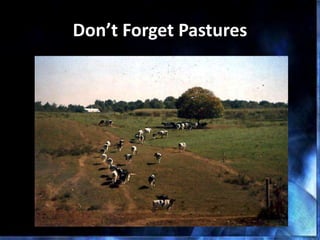
Don’t Forget Pastures
Rotate Shaded Areas
Geotextile fabric
reduces mud!
Water in the
Parlor is Bad
Contagious Mastitis
YouTube: Milking Procedures Video
http://www.youtube.com/watch?v=mBgon39usbQ
Focus on Teat Ends
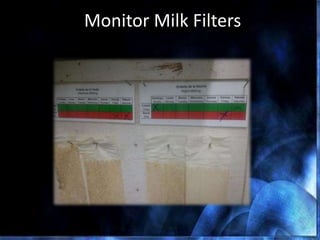
Monitor Milk Filters
Milk Problem Cows Last
• Based on high SCC or
clinical mastitis
• Dumping high SCC
cows may lower bulk
tank SCC
• Reduces chances of
antibiotics residues
• Reduces spread of
mastitis between cows
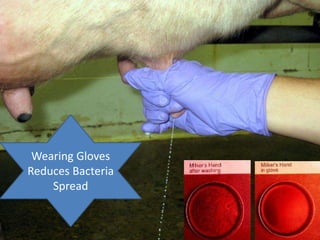
Wearing Gloves
Reduces Bacteria
Spread
Teat Dips
• Pre- and post-milking are essential
• Prevent new intramammary infections
• Reduce colonization of mastitis-causing bacteria
on teats
• Minimize bacteria penetration into teat canals
• Reduce mastitis incidence by 50 to 95%
Nickerson, Choosing the Best Teat Dip for Mastitis Control and Milk Quality
Spraying Versus Dipping
• Spraying may
also use 2X as
much dip
Sprayed Teat
Dipped Teat
Pre and Post
Nickerson, Choosing the Best Teat Dip for Mastitis Control and Milk Quality
• Streptococcus uberis
• Escherichia coli
• Klebsiella pneumoniae
Pre-dipping
(Environmental)
• Staphylococcus aureus
• Streptococcus agalactiae
• Mycoplasma bovis
• Corynebacterium bovis
Post-dipping
(Contagious)
Pre-Dipping Considerations
• More effective with less manure and dirt on teats
• Application method is important (> ¾ of teat)
• Must allow recommended contact time (15 to 30
seconds)
• Dry teats thoroughly to avoid residues
• Keeping cows clean for 1-2 hours after milking
maximizes pre-dip effectiveness
Nickerson, Choosing the Best Teat Dip for Mastitis Control and Milk Quality
Post-Dipping Considerations
• Post-dip ASAP after milkers are removed
• Application method is important (> ¾ of teat)
• Most products will reduce new infection rates
• Use non-return cups and keep them clean
• Follow label
Nickerson, Choosing the Best Teat Dip for Mastitis Control and Milk Quality
Which Teat Dip is Best?
• Many teat dips are effective
• Make sure it meets FDA regulations
• Proven to be effective
• Does not harm teat skin or promote new
infections
• National Mastitis Council publishes a guideline
every 2 years summarizing effectiveness of teat
dips
Nickerson, Choosing the Best Teat Dip for Mastitis Control and Milk Quality
Teat Dip Problems
• May cause irritation, chapping, lesions, drying, or caustic
reactions
• Caused by:
– Chemical composition of germicide
– pH (too low or too high)
– Improper storage
– Manufacturing errors
– Improper dilution
– Incompatible water
• Contamination may actually cause mastitis
Nickerson, Choosing the Best Teat Dip for Mastitis Control and Milk Quality
Selection of Teat Dip
• Dips are most often selected on price alone
• Other factors influencing choice:
– High pressure sales tactics
– Magazine testimonials
– Industry-sponsored meetings
• Cost should examined, but shouldn't be the sole
determining factor
• The teat dip you use should match the facilities,
environmental factors and mastitis pathogens present
on the dairy
Staphylococcus aureus Vaccines
• Brand Names: Somato-Staph and Lysigin
• Some chance of effectiveness with young heifers (6 months)
• 6 month boosters
• Cure rate poor in chronically infected cows
• Limited ability to prevent new infections
• Most veterinarians in this state will not recommend these
vaccines
– Vaccine alone will not solve the problem
Coliform Vaccines
• Brand Names: J-5 Bacterin and Mastiguard (identical), JVAC,
Endovac-Bovi
• Standard practice in many dairy farms
• Efficacy demonstrated in research and commercial settings
• Do not affect the rate of infections
• Reduce bacterial counts
• Fewer, shorter, and less severe clinical symptoms
• Provide the cow with better defense against bacteria
Coliform Vaccines
• Generally economical
–Improved production
–Less culling
–Fewer deaths
• 5 to 1 benefit to cost ratio
Nutrition and Immunity
• Optimize dry matter intake and water consumption
• Ensure cows receive adequate minerals and vitamins
• Vitamin E
• Selenium
• Copper
• Vitamin E
• These tools can enhance immune response
• But, they do not replace good management (clean
cows and good milking procedures)
Dry Cows
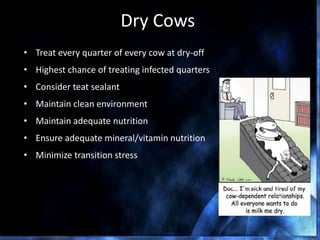
• Treat every quarter of every cow at dry-off
• Highest chance of treating infected quarters
• Consider teat sealant
• Maintain clean environment
• Maintain adequate nutrition
• Ensure adequate mineral/vitamin nutrition
• Minimize transition stress
Orbeseal
If You Don’t Culture……
You Don’t Know
Who Needs to Be Cultured?
• New clinical cases
(before treating)
• Fresh cows
• High SCC cows
• Positive CMT cows
Culturing Helps Answer
• Which bacteria are the
problems?
• How prevalent are these
bacteria?
• Where should we focus
prevention?
• Which cows should be culled?
• What is the best treatment?
Necessary Supplies
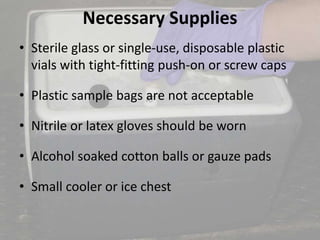
• Sterile glass or single-use, disposable plastic
vials with tight-fitting push-on or screw caps
• Plastic sample bags are not acceptable
• Nitrile or latex gloves should be worn
• Alcohol soaked cotton balls or gauze pads
• Small cooler or ice chest
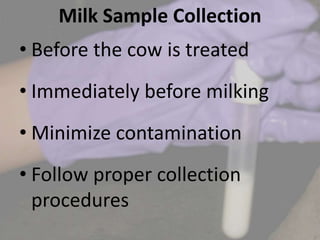
Milk Sample Collection
• Before the cow is treated
• Immediately before milking
• Minimize contamination
• Follow proper collection
procedures
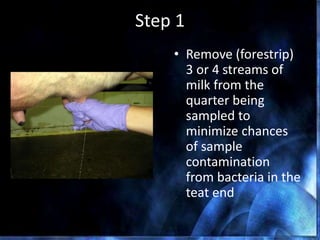
Step 1
• Remove (forestrip)
3 or 4 streams of
milk from the
quarter being
sampled to
minimize chances
of sample
contamination
from bacteria in the
teat end
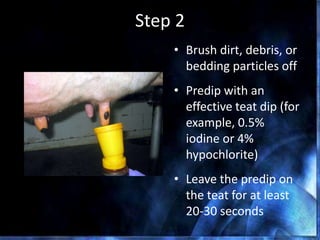
Step 2
• Brush dirt, debris, or
bedding particles off
• Predip with an
effective teat dip (for
example, 0.5%
iodine or 4%
hypochlorite)
• Leave the predip on
the teat for at least
20-30 seconds
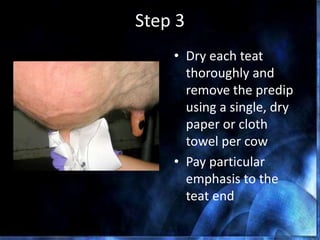
Step 3
• Dry each teat
thoroughly and
remove the predip
using a single, dry
paper or cloth
towel per cow
• Pay particular
emphasis to the
teat end
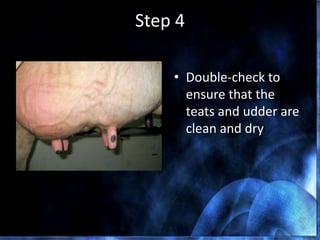
Step 4
• Double-check to
ensure that the
teats and udder are
clean and dry
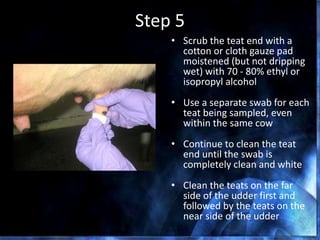
Step 5
• Scrub the teat end with a
cotton or cloth gauze pad
moistened (but not dripping
wet) with 70 - 80% ethyl or
isopropyl alcohol
• Use a separate swab for each
teat being sampled, even
within the same cow
• Continue to clean the teat
end until the swab is
completely clean and white
• Clean the teats on the far
side of the udder first and
followed by the teats on the
near side of the udder
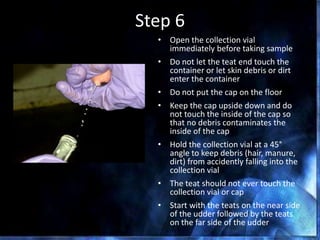
Step 6
• Open the collection vial
immediately before taking sample
• Do not let the teat end touch the
container or let skin debris or dirt
enter the container
• Do not put the cap on the floor
• Keep the cap upside down and do
not touch the inside of the cap so
that no debris contaminates the
inside of the cap
• Hold the collection vial at a 45°
angle to keep debris (hair, manure,
dirt) from accidently falling into the
collection vial
• The teat should not ever touch the
collection vial or cap
• Start with the teats on the near side
of the udder followed by the teats
on the far side of the udder
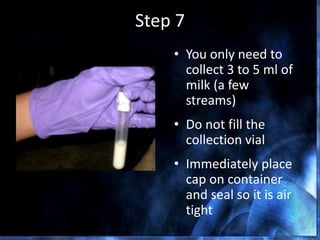
Step 7
• You only need to
collect 3 to 5 ml of
milk (a few
streams)
• Do not fill the
collection vial
• Immediately place
cap on container
and seal so it is air
tight
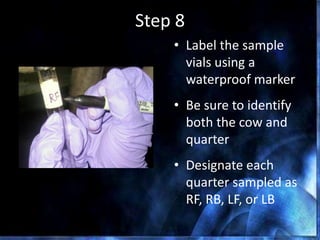
Step 8
• Label the sample
vials using a
waterproof marker
• Be sure to identify
both the cow and
quarter
• Designate each
quarter sampled as
RF, RB, LF, or LB
Step 9
• Immediately place
collection vial on ice
• Keep refrigerated or
on ice until delivered
to the lab
• When samples cannot
be delivered to the
laboratory within 24
hours, they should be
frozen
Common Problems
• Udders and teats not cleaned properly
• Samples taken from cows on antibiotic
therapy
• Identification numbers on the containers are
not legible or have been wiped off
• Number orientation (e.g. 18 or 81)
• Samples not transported to the laboratory
within 24 hours
• Samples not chilled during transport
• Containers broken or leaking during transport
After Culture
• If you don’t use the results, it was a waste of time!
• Make individual treat/cull decisions
• Separate cows with contagious mastitis
• Evaluate product choices
• Antibiotic treatment
• Dry cow treatment
• Teat dip
• Vaccines
• Determine best preventative management
strategies
But, the results say “No Growth”
• Doesn’t mean the lab made a mistake
• 1/3 to 1/2 of cultures will come back as “no
growth”
• Could be improper collection
• Periodic shedding of bacteria
• Cow has handled infection already
Strep agalactiae
Source
• Infected udders of other cows in
herd
Spread
• Cow-to-cow
• Contaminated udder wash rag
• Teat cups
Control
• Use separate towels to wash /
dry
• Teat dipping
• Dry cow treatment
Source: University of Minnesota SCC Diagnostics Tool Box
Strep agalactiae
• Only 10-15% show clinical signs
• Decreased milk production and high somatic cell counts
• In small herds, even one cow infected with Strep. ag can
raise the bulk tank cell count
• Purchased animals are frequently the source
• Treat all cows that culture positive for Strep. ag at the same
time in all four quarters
• Penicillin is usually effective
• Milk all infected cows last until subsequent cultures are
negative
• Cull the cows that do not respond to therapy
Staph aureus
Source
• Infected udders of other cows
• Contaminated bedding from milk of infected cows
Spread
• Cow-to-cow
• Contaminated udder wash rag
• Milker’s hands
• Contaminated milking equipment
• Improperly functioning equipment
• Injured teat ends
Control
• Use separate towels to wash / dry
• Teat dipping
• Dry cow treatment
• Milk infected cows last
• Cull chronically infected cows
Source: University of Minnesota SCC Diagnostics Tool Box
Staph aureus
• Very chronic, subclinical infection
• Can damage tissue producing areas of walled off infections that
do not respond to antibiotic therapy
• High SCC and recurrent clinical mastitis
• New infections in young animals may respond to antibiotic
therapy
• Low chance of response to antibiotics during lactation
• Somewhat higher during dry period
• Milk known Staph aureus cows last
• If it is economically feasible, cull chronically infected cows
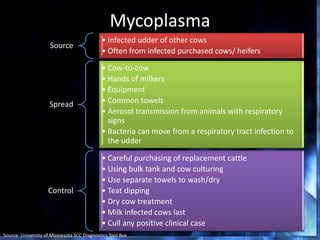
Mycoplasma
Source
• Infected udder of other cows
• Often from infected purchased cows/ heifers
Spread
• Cow-to-cow
• Hands of milkers
• Equipment
• Common towels
• Aerosol transmission from animals with respiratory
signs
• Bacteria can move from a respiratory tract infection to
the udder
Control
• Careful purchasing of replacement cattle
• Using bulk tank and cow culturing
• Use separate towels to wash/dry
• Teat dipping
• Dry cow treatment
• Milk infected cows last
• Cull any positive clinical case
Source: University of Minnesota SCC Diagnostics Tool Box
Mycoplasma
• Tend to shed high numbers of organisms at calving time
• Often subclinical, may not have high SCC
• Does not respond to antibiotic therapy
• Milk may vary from thick appearing milk to a watery,
sandy consistency
• Cull all cows that are known to be Mycoplasma positive
• When buying animals, multiple bulk tank cultures from
the herd of origin are recommended
• Do not feed waste milk to calves
• Practice good fly control on the dairy and heifer grower
facilities
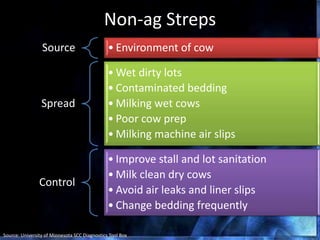
Non-ag Streps
Source • Environment of cow
Spread
• Wet dirty lots
• Contaminated bedding
• Milking wet cows
• Poor cow prep
• Milking machine air slips
Control
• Improve stall and lot sanitation
• Milk clean dry cows
• Avoid air leaks and liner slips
• Change bedding frequently
Source: University of Minnesota SCC Diagnostics Tool Box
Non-ag Streps
• Streptococcus and Enterococcus species (non-agalactiae streps) include
Streptococcus uberis and Streptococcus dysgalactiae
• Frequently occur during the dry period especially during the first 2 weeks
following dry off and during the first 2-3 weeks prior to calving
• These bacteria may cause
– Clinical mastitis with abnormal milk
– Swelling of the gland
– Fever
– Subclinical mastitis with no apparent signs
– High SCC
• Most infections eliminated by the cow's immune system or by antibiotic
therapy
• Some environmental strep. infections (18%) will become chronic and poorly
responsive to treatment
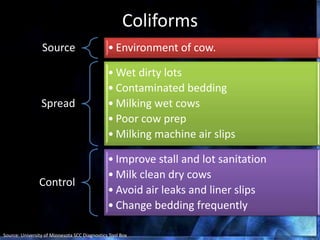
Coliforms
Source • Environment of cow.
Spread
• Wet dirty lots
• Contaminated bedding
• Milking wet cows
• Poor cow prep
• Milking machine air slips
Control
• Improve stall and lot sanitation
• Milk clean dry cows
• Avoid air leaks and liner slips
• Change bedding frequently
Source: University of Minnesota SCC Diagnostics Tool Box
Escherichia coli
• E. coli is commonly found in bedding, manure, water,
and soil
• Can cause life-threatening illness
• Most E. coli infections are of short duration
• Some chronic
• 10% of cows may have a sudden onset of fever,
markedly decreased milk production, loss of appetite
and dehydration
• Often these cows will go down and be unable to rise
• Milk may have large clots or be watery or bloody
Escherichia coli
• Clinical signs are due to toxins produced and
released by the bacteria
• Supportive therapy with anti-inflammatory
drugs and fluids may be required for these
cases
• Antibiotic therapy is often of little benefit
• Most often the cow's immune system will
effectively kill the bacteria
• Immunization with J5 vaccine can reduce the
incidence and severity of clinical cases
Klebsiella
• Commonly found in organic bedding, manure, and soil
• Associated with the use of green sawdust or recycled
manure bedding
• Rates of new infections are higher in the summer
• Very difficult to treat
• Infected animals frequently have to be culled
• May have a sudden onset of fever, markedly decreased
milk production, loss of appetite and dehydration
• Often these cows will go down and be unable to rise
• Milk from the affected quarter may have large clots or be
watery or bloody
Klebsiella
• Clinical signs are due to toxins produced and
released by the bacteria
• Supportive therapy with anti-inflammatory
drugs and fluids may be required for these
cases
• Antibiotic therapy is often of little benefit
• Most often the cow's immune system will
effectively kill the bacteria
• Immunization with J5 vaccine can reduce the
incidence and severity of clinical cases
Enterobacter and Citrobacter
• Found in bedding, manure and soil
• May cause a life threatening acute mastitis.
• Cows may have a sudden onset of fever, markedly decreased milk
production, loss of appetite and dehydration
• Often these cows will go down and be unable to rise
• Milk from the affected quarter may have large clots or be watery or
bloody
• Supportive therapy with anti-inflammatory drugs and fluids may be
required for these cases
• Antibiotic therapy is often of little benefit
• Most often the cow's immune system will effectively kill the bacteria
• Immunization with J5 vaccine can reduce the incidence and severity
of clinical cases
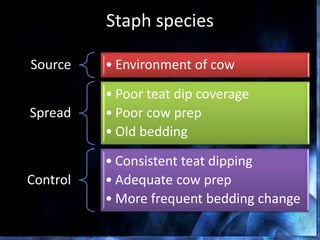
Staph species
Source • Environment of cow
Spread
• Poor teat dip coverage
• Poor cow prep
• Old bedding
Control
• Consistent teat dipping
• Adequate cow prep
• More frequent bedding change
Source: University of Minnesota SCC Diagnostics Tool Box
Coagulase-negative Staphylococcus
species (Staph species)
• Can be normal inhabitants of bovine skin
• Can be found in the environment in bedding and manure
• One of the most common organisms cultured from dairy cows
• Usually subclinical mastitis
• If a herd is experiencing a high incidence of Staph species
infections, post milking teat dip products and their application
should be re-evaluated
• Staph species can be quite resistant to antibiotic therapy
• Most infections will resolve without treatment, given enough
time
• Persistent infection will likely clear during the dry period
Pseudomonas species
• Commonly found in water (ponds, troughs, wells, and wash
hoses), contaminated teat dips
• Poor intramammary treatment administration and
contaminated multidose bottles of medications can be
sources
• Usually chronic infections
• Respond poorly to antibiotic therapy
• Clinical outbreaks can occur with swelling of the udder, high
fevers, and abnormal milk
• If clinical outbreaks occur, water supplies on the dairy
should be cultured
• Avoid access to ponds, low wet areas, and standing water
Serratia species
• Commonly found in soil and water
• Generally a contaminant in the milk sample
• However, Serratia species may cause clinical mastitis
• Does not respond well to lactating cow antibiotic
treatment
• If Serratia species are isolated along with other more
common mastitis causing agents it may be a
contaminant
• If it is the only agent isolated, it is probably the
responsible agent
Yeast
• May be found in contaminated multi-dose antibiotic or
other medication bottles and contaminated syringes
• Spread by contaminated intramammary infusions
where aseptic technique has not been followed
• Most cases cure themselves
• Yeast mastitis is not responsive to standard anti-
microbial therapy
• Care during when inserting instrument or antibiotic into
the udder
• Be sure to disinfect scrub teat ends with alcohol
• Use single use treatment tubes only
• Avoid treatment with multi-dose bottles of medication
Prototheca species
• Prototheca species are algae
• Isolated from plants, bedding material, soil, mud, ponds and
standing water, manure, and water troughs
• May cause acute or chronic mastitis.
• A watery mammary secretion with flakes and clots
• Unresponsive to intramammary or systemic antibiotics
• Limit access to ponds, mud, and other areas with standing
water
• Milk cows infected with Prototheca spp. last, or with a
separate unit
• Remove infected cows from the herd
Corynebacterium (Arcanobacterium
pyogenes)• Environmental mastitis (wounds, abscesses, contaminated bedding material
and damaged teat ends)
• Often called “summer mastitis,” more common when humid
• Some cows spontaneously cure
• Does not respond to therapy
• Frequently spread by flies or by direct teat end contact with a contaminated
surface
• Once an infection is established, the prognosis is poor and loss of the
quarter is expected
• Severe clinical mastitis caused by A. pyogenes is characterized by a thick,
yellow, foul smelling discharge
• Stalls should be comfortable and overcrowding should be avoided to
minimize teat injuries
• Establish an effective fly control program
Considerations for Treating Mastitis
Four ways
to
eliminate
mastitis
Culling
Treating at
dry-off
Treatment in
lactation
Spontaneous
recovery
Winning the Fight Against Mastitis, 2000
Goals of Antimicrobial Therapy
1. Return cow to
normal production
and composition
2. Prevent
mortality in
peracute cases
3. Eliminate
infectious
organisms
4. Prevent new
infections
5. Prevent drug
residues
6. Keep existing
cases from getting
worse
7. Minimize
damage to
secretory tissues
8. Reduce spread
of existing
infections to other
cows
9. Improve overall
herd health
Winning the Fight Against Mastitis, 2000
Spontaneous Recovery
• Sometimes, cows can recover
spontaneously without antibiotics
• Rate varies by pathogen
• More likely in mild or recently acquired
infections
• Cow’s immune system beats the infection
• Enhanced by vaccinations, nutrition, and
other efforts to minimize stress
To Treat Or Not to Treat
• Depends on type of pathogen
– Cure rates for yeasts, pseudomonas,
mycoplasma, protoeca, etc. are almost zero
– Chronic Staph aureus not cost effective because
of low cure rates and return to subclinical state
– New cases of Staph aureus particularly in early
lactation or in younger cows may merit
treatment
Ruegg, 2009
To Treat Or Not to Treat
• Depends on type of pathogen
– Mild or moderate coliform or Klebsiella mastitis
questionable because of spontaneous cure rate
and low antibiotic effectiveness
– Strep ag. most likely to respond to treatment,
but not prevalent any more
– Environmental streps may respond to
treatment
Ruegg, 2009
Cure rates for Existing Infections-
Antibiotic Therapy
Species Cure Rate
Streptococcus agalactiae 90-95%
Environmental Streptococci (i.e. Strep
uberis and Strep dysgalactiae)
40-50%
Staph aureus, chronic cases 20-30%
Staph species 50 to 60%
Coliforms 0 to 10%
Mycoplasma, yeasts, Nocardia 0%
Winning the Fight Against Mastitis, 2000
Ruegg Treatment Flowchart
Reasons for Treatment Failures
1. Delayed treatment
2. Poor selection of
drugs or dose levels
3. Stopping treatment
too soon
4. Resistance of
organisms to drugs
5. Development of
bacterial-L forms
6. Protection of
bacteria within white
blood cells
7. Presence of deep-
seated infections
walled off by scar
tissue, clots, and
swelling
Winning the Fight Against Mastitis, 2000
What about Homeopathic Treatments?
• Be skeptical
• May hold promise in the future
• Generally, reported to improve immune status
• Method of action sometimes questionable
• Little to no conclusive data at this point
• Be sure they meet federal regulations (i.e residues)
• Insist on research evidence of efficacy
– How do they perform compared to no treatment
(spontaneous cures) or antibiotics
The Milking Machine Can Increase the
Risk of Mastitis By:
1. Spreading pathogenic bacteria between cows or quarters.
2. Damaging the teat end
- High vacuum
- Over milking
- Inadequate pulsation caused by
- Pulsator malfunction
- Short liners not closing under the teat
3. Impacts against teat ends
- Liner slips
- Air entering claw
Teat-end Condition Scoring
• N (no ring)
• Teat end is smooth with a small, even opening
• Typical for teats soon after calving
• S (Smooth or Slightly rough ring)
• A raised ring encircles the opening
• The surface of the ring is smooth or it may feel
slightly rough but no old keratin evident
• R (Rough ring)
• Raised, roughened ring with isolated mounds of old
keratin extending 1-3 mm from opening
• VR (Very rough ring)
• Raised ring with rough mounds of old keratin
extending 4 mm or more from opening
• Rim of ring is rough and cracked, often giving the
teat-end a “flowered” appearance
Mein et al., 2001
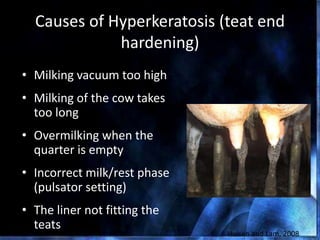
Causes of Hyperkeratosis (teat end
hardening)
• Milking vacuum too high
• Milking of the cow takes
too long
• Overmilking when the
quarter is empty
• Incorrect milk/rest phase
(pulsator setting)
• The liner not fitting the
teats
Hulsen and Lam, 2008
Equipment Daily Checklist
• Develop list with installer
• Rubber goods
• Leaks in vacuum or milk lines
• Cracks or cloudiness in milk hoses
• Vacuum pump oiler and other items specific to
your milking system
• Inflations not twisted
• Dual pulsation hoses not reversed
DPC 85 The Dairy Practices Council
Vacuum Settings
• Equipment manufacturer should know best
settings for your system
• Vacuum 10.5 to 12.5 inches (35 to 42 kPa) in
the claw
• Best setting will depend on inflations and
equipment designs
• Know what your normal line vacuum setting
is and check it several times during milking

DPC 85 The Dairy Practices Council
Inflations (Liners)
• Need to be changed on
schedule
• As specified by supplier
• Proper tension for optimal
milking speed
If they are out of round
it is past time to change
If they are rough inside
they harbor bacteria
DPC 85 The Dairy Practices Council
Pulsation settings
• 50% to 70% milk phase
• 50% only on single pulsation systems
• Normally 45 to 60 pulsations per minute
• 60:40 means that 60% of the time the inflation is
opening or open (milk phase) and 40% of the time
it is closing or closed (rest phase)
DPC 85 The Dairy Practices Council
February 2006
DPC 85 The Dairy Practices
Council
113
Keys to Watch
Vacuum
Inflations
Pulsation
February 2006 DPC 85 The Dairy Practices Council
Pulsation settings
• 50% to 70% milk phase
– 50% only on single pulsation systems
• Normally 45 to 60 pulsations per minute
• 60:40 means that 60% of the time the inflation is
opening or open (milk phase) and 40% of the time
it is closing or closed (rest phase)
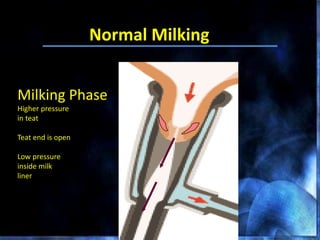
Milking Phase
Higher pressure
in teat
Teat end is open
Low pressure
inside milk
liner
Normal Milking
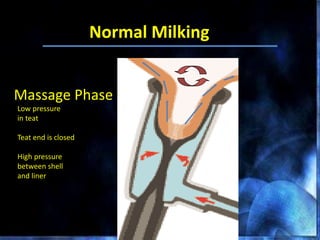
Massage Phase
Low pressure
in teat
Teat end is closed
High pressure
between shell
and liner
Normal Milking
Liner Slips
on other teat
High pressure inside
teat
Teat end is still open
Higher pressure
inside milk liners
when air gets into
system
Liner Slip
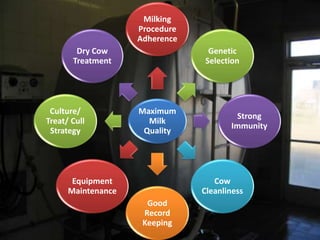
Maximum
Milk
Quality
Milking
Procedure
Adherence
Genetic
Selection
Strong
Immunity
Cow
Cleanliness
Good
Record
Keeping
Equipment
Maintenance
Culture/
Treat/ Cull
Strategy
Dry Cow
Treatment
Questions
Jeffrey Bewley, PhD, PAS
jbewley@bovisync.com
jbewley@cowfocused.com

Mastitis Management and Prevention

  • 1.
    Mastitis Management andPrevention Jeffrey Bewley, PhD, PAS
  • 2.
    What Does theInside of an Udder Look Like?
  • 3.
  • 4.
  • 5.
    Streak canal &keratin lining
  • 6.
    Streak Canal Purdue UniversityMilking for Quality
  • 7.
    What is Mastitis? •Inflammation of the mammary gland caused by: •Microorganisms (primarily bacteria) •Trauma or injury to the udder •Chemical irritation • Most costly disease in the dairy industry
  • 8.
  • 9.
    Infection Process Organisms invadethe udder through teat canal Migrate up the teat canal and colonize the secretory cells Colonized organisms produce toxic substances harmful to the milk producing cells The cow’s immune system send white blood cells (Somatic cells) to fight the organisms
  • 10.
    Where do theseorganisms come from ?
  • 11.
    What are SomaticCells? • Most are white blood cells that prevent and overcome infections • Measures the level of udder stress/damage/irritation • Under 200,000 /ml uninfected • Over 200,000 /ml infected • Easy way to assess the mastitis level in a herd • Excellent mastitis management tool Typical cells using standard staining White blood cells and Strep from mastitis
  • 12.
    CMT • Cowside • Cheap •Easy • Simple • Detects relative cell content • Does NOT give SCC
  • 13.
  • 14.
    Clinical versus Subclinical ClinicalMastitis • Visible signs of disease • Flakes or clots in milk • Swelling of quarter • Fever • Loss of appetite • Depression • Death Crist et al., 1997, Mastitis and its Control, University of Kentucky ASC-140
  • 15.
    Clinical versus Subclinical SubclinicalMastitis • No visible signs of disease • Elevated Somatic Cell Count (SCC) • Greatest financial loss • Strep. Agalactiae • Staph. aureus Crist et al., 1997, Mastitis and its Control, University of Kentucky ASC-140
  • 16.
    Mastitis in aHerd Clinical Subclinical 1 clinical case =15-40 subclinical cases
  • 17.
    Costs of Mastitis •Milkproduction losses •Drugs •Discarded milk •Veterinary services •Bonuses •Labor •Culling •Other diseases
  • 18.
    Production Losses bySCC Score Lactation Average SCC Score Lactation Average SCC (cells/ml) Lactation 1 Lactation 2 or greater 0 12,500 -- -- 1 25,000 -- -- 2 50,000 -- -- 3 100,000 200 400 4 200,000 400 800 5 400,000 600 1200 6 800,000 800 1600 7 1,600,000 1000 2000 *Comparison are with lactation yields at SCC score of 2. Source: Current Concepts of Bovine Mastitis, NMC, 1987
  • 19.
  • 20.
    Mastitis Cost Breakdown Costtype First parity Second and later parities Lost milk $ 131.41 $ 133.46 Vet and drug $ 76.62 $ 76.62 Discarded milk $ 64.38 $ 81.00 Labor $ 12.22 $ 12.22 Death $ 11.37 $ 12.19 Culling $ 9.49 $ 17.92 Days open $ 1.21 $ 3.47 Total $ 306.95 $340.14 Liang and Bewley, 2017
  • 21.
    Contagious versus Environmental •Contagious • Spreads between cows or quarters • Transmitted in the parlor during milking • Usually chronic, subclinical mastitis • Primary Causative Agents •Strep. agalactiae •Staph. aureus •Mysoplasma bovis •Strep. Dysagalactiae
  • 22.
    Contagious versus Environmental •Environmental • Obtained through the environment • Primary Causative Agents •E. coli •Klebsiella pneumoniae •Strep. Uberis •Strep. Dysgalactiae
  • 23.
  • 24.
    Indicators of anEnvironmental Mastitis Problem • Incidence increases when cows are dirtier • Often short duration infections, may not show up on DHIA • Can have severe symptoms • Infections more likely to occur around drying off and calving
  • 25.
    Indicators of anEnvironmental Mastitis Problem • More infections during hot/humid weather • Often only a few cows infected at one time • Poor teat end condition gives bacteria easier access to teat end
  • 26.
    Hygiene Scoring Goal <10%of cows score 3 or 4
  • 27.
    Environmental Management • Cowsmust be • Clean • Dry • Comfortable • Well nourished • Minimizes bacterial load
  • 28.
    Steps for ControllingEnvironmental Mastitis 1. Limit water use in parlor 2. Avoid overmilking to keep teat ends healthy 3. Remove hair from udder 4. Use E-coli vaccines (i.e. J5, J-VAC, ENDOVAC- Bovi) 5. Consider using sand
  • 29.
    Flaming udders promotesudder cleanliness and health
  • 30.
    Swimming is NOTGood for Their Health
  • 31.
  • 32.
    Is This CowExposed to Bacteria?
  • 33.
  • 34.
  • 35.
  • 36.
  • 37.
  • 38.
  • 39.
    YouTube: Milking ProceduresVideo http://www.youtube.com/watch?v=mBgon39usbQ
  • 40.
  • 41.
  • 42.
    Milk Problem CowsLast • Based on high SCC or clinical mastitis • Dumping high SCC cows may lower bulk tank SCC • Reduces chances of antibiotics residues • Reduces spread of mastitis between cows
  • 43.
  • 44.
    Teat Dips • Pre-and post-milking are essential • Prevent new intramammary infections • Reduce colonization of mastitis-causing bacteria on teats • Minimize bacteria penetration into teat canals • Reduce mastitis incidence by 50 to 95% Nickerson, Choosing the Best Teat Dip for Mastitis Control and Milk Quality
  • 45.
    Spraying Versus Dipping •Spraying may also use 2X as much dip Sprayed Teat Dipped Teat
  • 46.
    Pre and Post Nickerson,Choosing the Best Teat Dip for Mastitis Control and Milk Quality • Streptococcus uberis • Escherichia coli • Klebsiella pneumoniae Pre-dipping (Environmental) • Staphylococcus aureus • Streptococcus agalactiae • Mycoplasma bovis • Corynebacterium bovis Post-dipping (Contagious)
  • 47.
    Pre-Dipping Considerations • Moreeffective with less manure and dirt on teats • Application method is important (> ¾ of teat) • Must allow recommended contact time (15 to 30 seconds) • Dry teats thoroughly to avoid residues • Keeping cows clean for 1-2 hours after milking maximizes pre-dip effectiveness Nickerson, Choosing the Best Teat Dip for Mastitis Control and Milk Quality
  • 48.
    Post-Dipping Considerations • Post-dipASAP after milkers are removed • Application method is important (> ¾ of teat) • Most products will reduce new infection rates • Use non-return cups and keep them clean • Follow label Nickerson, Choosing the Best Teat Dip for Mastitis Control and Milk Quality
  • 49.
    Which Teat Dipis Best? • Many teat dips are effective • Make sure it meets FDA regulations • Proven to be effective • Does not harm teat skin or promote new infections • National Mastitis Council publishes a guideline every 2 years summarizing effectiveness of teat dips Nickerson, Choosing the Best Teat Dip for Mastitis Control and Milk Quality
  • 50.
    Teat Dip Problems •May cause irritation, chapping, lesions, drying, or caustic reactions • Caused by: – Chemical composition of germicide – pH (too low or too high) – Improper storage – Manufacturing errors – Improper dilution – Incompatible water • Contamination may actually cause mastitis Nickerson, Choosing the Best Teat Dip for Mastitis Control and Milk Quality
  • 51.
    Selection of TeatDip • Dips are most often selected on price alone • Other factors influencing choice: – High pressure sales tactics – Magazine testimonials – Industry-sponsored meetings • Cost should examined, but shouldn't be the sole determining factor • The teat dip you use should match the facilities, environmental factors and mastitis pathogens present on the dairy
  • 52.
    Staphylococcus aureus Vaccines •Brand Names: Somato-Staph and Lysigin • Some chance of effectiveness with young heifers (6 months) • 6 month boosters • Cure rate poor in chronically infected cows • Limited ability to prevent new infections • Most veterinarians in this state will not recommend these vaccines – Vaccine alone will not solve the problem
  • 53.
    Coliform Vaccines • BrandNames: J-5 Bacterin and Mastiguard (identical), JVAC, Endovac-Bovi • Standard practice in many dairy farms • Efficacy demonstrated in research and commercial settings • Do not affect the rate of infections • Reduce bacterial counts • Fewer, shorter, and less severe clinical symptoms • Provide the cow with better defense against bacteria
  • 54.
    Coliform Vaccines • Generallyeconomical –Improved production –Less culling –Fewer deaths • 5 to 1 benefit to cost ratio
  • 55.
    Nutrition and Immunity •Optimize dry matter intake and water consumption • Ensure cows receive adequate minerals and vitamins • Vitamin E • Selenium • Copper • Vitamin E • These tools can enhance immune response • But, they do not replace good management (clean cows and good milking procedures)
  • 56.
    Dry Cows • Treatevery quarter of every cow at dry-off • Highest chance of treating infected quarters • Consider teat sealant • Maintain clean environment • Maintain adequate nutrition • Ensure adequate mineral/vitamin nutrition • Minimize transition stress
  • 57.
  • 58.
    If You Don’tCulture…… You Don’t Know
  • 59.
    Who Needs toBe Cultured? • New clinical cases (before treating) • Fresh cows • High SCC cows • Positive CMT cows
  • 60.
    Culturing Helps Answer •Which bacteria are the problems? • How prevalent are these bacteria? • Where should we focus prevention? • Which cows should be culled? • What is the best treatment?
  • 61.
    Necessary Supplies • Sterileglass or single-use, disposable plastic vials with tight-fitting push-on or screw caps • Plastic sample bags are not acceptable • Nitrile or latex gloves should be worn • Alcohol soaked cotton balls or gauze pads • Small cooler or ice chest
  • 62.
    Milk Sample Collection •Before the cow is treated • Immediately before milking • Minimize contamination • Follow proper collection procedures
  • 63.
    Step 1 • Remove(forestrip) 3 or 4 streams of milk from the quarter being sampled to minimize chances of sample contamination from bacteria in the teat end
  • 64.
    Step 2 • Brushdirt, debris, or bedding particles off • Predip with an effective teat dip (for example, 0.5% iodine or 4% hypochlorite) • Leave the predip on the teat for at least 20-30 seconds
  • 65.
    Step 3 • Dryeach teat thoroughly and remove the predip using a single, dry paper or cloth towel per cow • Pay particular emphasis to the teat end
  • 66.
    Step 4 • Double-checkto ensure that the teats and udder are clean and dry
  • 67.
    Step 5 • Scrubthe teat end with a cotton or cloth gauze pad moistened (but not dripping wet) with 70 - 80% ethyl or isopropyl alcohol • Use a separate swab for each teat being sampled, even within the same cow • Continue to clean the teat end until the swab is completely clean and white • Clean the teats on the far side of the udder first and followed by the teats on the near side of the udder
  • 68.
    Step 6 • Openthe collection vial immediately before taking sample • Do not let the teat end touch the container or let skin debris or dirt enter the container • Do not put the cap on the floor • Keep the cap upside down and do not touch the inside of the cap so that no debris contaminates the inside of the cap • Hold the collection vial at a 45° angle to keep debris (hair, manure, dirt) from accidently falling into the collection vial • The teat should not ever touch the collection vial or cap • Start with the teats on the near side of the udder followed by the teats on the far side of the udder
  • 69.
    Step 7 • Youonly need to collect 3 to 5 ml of milk (a few streams) • Do not fill the collection vial • Immediately place cap on container and seal so it is air tight
  • 70.
    Step 8 • Labelthe sample vials using a waterproof marker • Be sure to identify both the cow and quarter • Designate each quarter sampled as RF, RB, LF, or LB
  • 71.
    Step 9 • Immediatelyplace collection vial on ice • Keep refrigerated or on ice until delivered to the lab • When samples cannot be delivered to the laboratory within 24 hours, they should be frozen
  • 72.
    Common Problems • Uddersand teats not cleaned properly • Samples taken from cows on antibiotic therapy • Identification numbers on the containers are not legible or have been wiped off • Number orientation (e.g. 18 or 81) • Samples not transported to the laboratory within 24 hours • Samples not chilled during transport • Containers broken or leaking during transport
  • 73.
    After Culture • Ifyou don’t use the results, it was a waste of time! • Make individual treat/cull decisions • Separate cows with contagious mastitis • Evaluate product choices • Antibiotic treatment • Dry cow treatment • Teat dip • Vaccines • Determine best preventative management strategies
  • 74.
    But, the resultssay “No Growth” • Doesn’t mean the lab made a mistake • 1/3 to 1/2 of cultures will come back as “no growth” • Could be improper collection • Periodic shedding of bacteria • Cow has handled infection already
  • 75.
    Strep agalactiae Source • Infectedudders of other cows in herd Spread • Cow-to-cow • Contaminated udder wash rag • Teat cups Control • Use separate towels to wash / dry • Teat dipping • Dry cow treatment Source: University of Minnesota SCC Diagnostics Tool Box
  • 76.
    Strep agalactiae • Only10-15% show clinical signs • Decreased milk production and high somatic cell counts • In small herds, even one cow infected with Strep. ag can raise the bulk tank cell count • Purchased animals are frequently the source • Treat all cows that culture positive for Strep. ag at the same time in all four quarters • Penicillin is usually effective • Milk all infected cows last until subsequent cultures are negative • Cull the cows that do not respond to therapy
  • 77.
    Staph aureus Source • Infectedudders of other cows • Contaminated bedding from milk of infected cows Spread • Cow-to-cow • Contaminated udder wash rag • Milker’s hands • Contaminated milking equipment • Improperly functioning equipment • Injured teat ends Control • Use separate towels to wash / dry • Teat dipping • Dry cow treatment • Milk infected cows last • Cull chronically infected cows Source: University of Minnesota SCC Diagnostics Tool Box
  • 78.
    Staph aureus • Verychronic, subclinical infection • Can damage tissue producing areas of walled off infections that do not respond to antibiotic therapy • High SCC and recurrent clinical mastitis • New infections in young animals may respond to antibiotic therapy • Low chance of response to antibiotics during lactation • Somewhat higher during dry period • Milk known Staph aureus cows last • If it is economically feasible, cull chronically infected cows
  • 79.
    Mycoplasma Source • Infected udderof other cows • Often from infected purchased cows/ heifers Spread • Cow-to-cow • Hands of milkers • Equipment • Common towels • Aerosol transmission from animals with respiratory signs • Bacteria can move from a respiratory tract infection to the udder Control • Careful purchasing of replacement cattle • Using bulk tank and cow culturing • Use separate towels to wash/dry • Teat dipping • Dry cow treatment • Milk infected cows last • Cull any positive clinical case Source: University of Minnesota SCC Diagnostics Tool Box
  • 80.
    Mycoplasma • Tend toshed high numbers of organisms at calving time • Often subclinical, may not have high SCC • Does not respond to antibiotic therapy • Milk may vary from thick appearing milk to a watery, sandy consistency • Cull all cows that are known to be Mycoplasma positive • When buying animals, multiple bulk tank cultures from the herd of origin are recommended • Do not feed waste milk to calves • Practice good fly control on the dairy and heifer grower facilities
  • 81.
    Non-ag Streps Source •Environment of cow Spread • Wet dirty lots • Contaminated bedding • Milking wet cows • Poor cow prep • Milking machine air slips Control • Improve stall and lot sanitation • Milk clean dry cows • Avoid air leaks and liner slips • Change bedding frequently Source: University of Minnesota SCC Diagnostics Tool Box
  • 82.
    Non-ag Streps • Streptococcusand Enterococcus species (non-agalactiae streps) include Streptococcus uberis and Streptococcus dysgalactiae • Frequently occur during the dry period especially during the first 2 weeks following dry off and during the first 2-3 weeks prior to calving • These bacteria may cause – Clinical mastitis with abnormal milk – Swelling of the gland – Fever – Subclinical mastitis with no apparent signs – High SCC • Most infections eliminated by the cow's immune system or by antibiotic therapy • Some environmental strep. infections (18%) will become chronic and poorly responsive to treatment
  • 83.
    Coliforms Source • Environmentof cow. Spread • Wet dirty lots • Contaminated bedding • Milking wet cows • Poor cow prep • Milking machine air slips Control • Improve stall and lot sanitation • Milk clean dry cows • Avoid air leaks and liner slips • Change bedding frequently Source: University of Minnesota SCC Diagnostics Tool Box
  • 84.
    Escherichia coli • E.coli is commonly found in bedding, manure, water, and soil • Can cause life-threatening illness • Most E. coli infections are of short duration • Some chronic • 10% of cows may have a sudden onset of fever, markedly decreased milk production, loss of appetite and dehydration • Often these cows will go down and be unable to rise • Milk may have large clots or be watery or bloody
  • 85.
    Escherichia coli • Clinicalsigns are due to toxins produced and released by the bacteria • Supportive therapy with anti-inflammatory drugs and fluids may be required for these cases • Antibiotic therapy is often of little benefit • Most often the cow's immune system will effectively kill the bacteria • Immunization with J5 vaccine can reduce the incidence and severity of clinical cases
  • 86.
    Klebsiella • Commonly foundin organic bedding, manure, and soil • Associated with the use of green sawdust or recycled manure bedding • Rates of new infections are higher in the summer • Very difficult to treat • Infected animals frequently have to be culled • May have a sudden onset of fever, markedly decreased milk production, loss of appetite and dehydration • Often these cows will go down and be unable to rise • Milk from the affected quarter may have large clots or be watery or bloody
  • 87.
    Klebsiella • Clinical signsare due to toxins produced and released by the bacteria • Supportive therapy with anti-inflammatory drugs and fluids may be required for these cases • Antibiotic therapy is often of little benefit • Most often the cow's immune system will effectively kill the bacteria • Immunization with J5 vaccine can reduce the incidence and severity of clinical cases
  • 88.
    Enterobacter and Citrobacter •Found in bedding, manure and soil • May cause a life threatening acute mastitis. • Cows may have a sudden onset of fever, markedly decreased milk production, loss of appetite and dehydration • Often these cows will go down and be unable to rise • Milk from the affected quarter may have large clots or be watery or bloody • Supportive therapy with anti-inflammatory drugs and fluids may be required for these cases • Antibiotic therapy is often of little benefit • Most often the cow's immune system will effectively kill the bacteria • Immunization with J5 vaccine can reduce the incidence and severity of clinical cases
  • 89.
    Staph species Source •Environment of cow Spread • Poor teat dip coverage • Poor cow prep • Old bedding Control • Consistent teat dipping • Adequate cow prep • More frequent bedding change Source: University of Minnesota SCC Diagnostics Tool Box
  • 90.
    Coagulase-negative Staphylococcus species (Staphspecies) • Can be normal inhabitants of bovine skin • Can be found in the environment in bedding and manure • One of the most common organisms cultured from dairy cows • Usually subclinical mastitis • If a herd is experiencing a high incidence of Staph species infections, post milking teat dip products and their application should be re-evaluated • Staph species can be quite resistant to antibiotic therapy • Most infections will resolve without treatment, given enough time • Persistent infection will likely clear during the dry period
  • 91.
    Pseudomonas species • Commonlyfound in water (ponds, troughs, wells, and wash hoses), contaminated teat dips • Poor intramammary treatment administration and contaminated multidose bottles of medications can be sources • Usually chronic infections • Respond poorly to antibiotic therapy • Clinical outbreaks can occur with swelling of the udder, high fevers, and abnormal milk • If clinical outbreaks occur, water supplies on the dairy should be cultured • Avoid access to ponds, low wet areas, and standing water
  • 92.
    Serratia species • Commonlyfound in soil and water • Generally a contaminant in the milk sample • However, Serratia species may cause clinical mastitis • Does not respond well to lactating cow antibiotic treatment • If Serratia species are isolated along with other more common mastitis causing agents it may be a contaminant • If it is the only agent isolated, it is probably the responsible agent
  • 93.
    Yeast • May befound in contaminated multi-dose antibiotic or other medication bottles and contaminated syringes • Spread by contaminated intramammary infusions where aseptic technique has not been followed • Most cases cure themselves • Yeast mastitis is not responsive to standard anti- microbial therapy • Care during when inserting instrument or antibiotic into the udder • Be sure to disinfect scrub teat ends with alcohol • Use single use treatment tubes only • Avoid treatment with multi-dose bottles of medication
  • 94.
    Prototheca species • Protothecaspecies are algae • Isolated from plants, bedding material, soil, mud, ponds and standing water, manure, and water troughs • May cause acute or chronic mastitis. • A watery mammary secretion with flakes and clots • Unresponsive to intramammary or systemic antibiotics • Limit access to ponds, mud, and other areas with standing water • Milk cows infected with Prototheca spp. last, or with a separate unit • Remove infected cows from the herd
  • 95.
    Corynebacterium (Arcanobacterium pyogenes)• Environmentalmastitis (wounds, abscesses, contaminated bedding material and damaged teat ends) • Often called “summer mastitis,” more common when humid • Some cows spontaneously cure • Does not respond to therapy • Frequently spread by flies or by direct teat end contact with a contaminated surface • Once an infection is established, the prognosis is poor and loss of the quarter is expected • Severe clinical mastitis caused by A. pyogenes is characterized by a thick, yellow, foul smelling discharge • Stalls should be comfortable and overcrowding should be avoided to minimize teat injuries • Establish an effective fly control program
  • 96.
  • 97.
    Four ways to eliminate mastitis Culling Treating at dry-off Treatmentin lactation Spontaneous recovery Winning the Fight Against Mastitis, 2000
  • 98.
    Goals of AntimicrobialTherapy 1. Return cow to normal production and composition 2. Prevent mortality in peracute cases 3. Eliminate infectious organisms 4. Prevent new infections 5. Prevent drug residues 6. Keep existing cases from getting worse 7. Minimize damage to secretory tissues 8. Reduce spread of existing infections to other cows 9. Improve overall herd health Winning the Fight Against Mastitis, 2000
  • 99.
    Spontaneous Recovery • Sometimes,cows can recover spontaneously without antibiotics • Rate varies by pathogen • More likely in mild or recently acquired infections • Cow’s immune system beats the infection • Enhanced by vaccinations, nutrition, and other efforts to minimize stress
  • 100.
    To Treat OrNot to Treat • Depends on type of pathogen – Cure rates for yeasts, pseudomonas, mycoplasma, protoeca, etc. are almost zero – Chronic Staph aureus not cost effective because of low cure rates and return to subclinical state – New cases of Staph aureus particularly in early lactation or in younger cows may merit treatment Ruegg, 2009
  • 101.
    To Treat OrNot to Treat • Depends on type of pathogen – Mild or moderate coliform or Klebsiella mastitis questionable because of spontaneous cure rate and low antibiotic effectiveness – Strep ag. most likely to respond to treatment, but not prevalent any more – Environmental streps may respond to treatment Ruegg, 2009
  • 102.
    Cure rates forExisting Infections- Antibiotic Therapy Species Cure Rate Streptococcus agalactiae 90-95% Environmental Streptococci (i.e. Strep uberis and Strep dysgalactiae) 40-50% Staph aureus, chronic cases 20-30% Staph species 50 to 60% Coliforms 0 to 10% Mycoplasma, yeasts, Nocardia 0% Winning the Fight Against Mastitis, 2000
  • 103.
  • 104.
    Reasons for TreatmentFailures 1. Delayed treatment 2. Poor selection of drugs or dose levels 3. Stopping treatment too soon 4. Resistance of organisms to drugs 5. Development of bacterial-L forms 6. Protection of bacteria within white blood cells 7. Presence of deep- seated infections walled off by scar tissue, clots, and swelling Winning the Fight Against Mastitis, 2000
  • 105.
    What about HomeopathicTreatments? • Be skeptical • May hold promise in the future • Generally, reported to improve immune status • Method of action sometimes questionable • Little to no conclusive data at this point • Be sure they meet federal regulations (i.e residues) • Insist on research evidence of efficacy – How do they perform compared to no treatment (spontaneous cures) or antibiotics
  • 106.
    The Milking MachineCan Increase the Risk of Mastitis By: 1. Spreading pathogenic bacteria between cows or quarters. 2. Damaging the teat end - High vacuum - Over milking - Inadequate pulsation caused by - Pulsator malfunction - Short liners not closing under the teat 3. Impacts against teat ends - Liner slips - Air entering claw
  • 107.
    Teat-end Condition Scoring •N (no ring) • Teat end is smooth with a small, even opening • Typical for teats soon after calving • S (Smooth or Slightly rough ring) • A raised ring encircles the opening • The surface of the ring is smooth or it may feel slightly rough but no old keratin evident • R (Rough ring) • Raised, roughened ring with isolated mounds of old keratin extending 1-3 mm from opening • VR (Very rough ring) • Raised ring with rough mounds of old keratin extending 4 mm or more from opening • Rim of ring is rough and cracked, often giving the teat-end a “flowered” appearance Mein et al., 2001
  • 108.
    Causes of Hyperkeratosis(teat end hardening) • Milking vacuum too high • Milking of the cow takes too long • Overmilking when the quarter is empty • Incorrect milk/rest phase (pulsator setting) • The liner not fitting the teats Hulsen and Lam, 2008
  • 109.
    Equipment Daily Checklist •Develop list with installer • Rubber goods • Leaks in vacuum or milk lines • Cracks or cloudiness in milk hoses • Vacuum pump oiler and other items specific to your milking system • Inflations not twisted • Dual pulsation hoses not reversed DPC 85 The Dairy Practices Council
  • 110.
    Vacuum Settings • Equipmentmanufacturer should know best settings for your system • Vacuum 10.5 to 12.5 inches (35 to 42 kPa) in the claw • Best setting will depend on inflations and equipment designs • Know what your normal line vacuum setting is and check it several times during milking DPC 85 The Dairy Practices Council

  • 111.
    Inflations (Liners) • Needto be changed on schedule • As specified by supplier • Proper tension for optimal milking speed If they are out of round it is past time to change If they are rough inside they harbor bacteria DPC 85 The Dairy Practices Council


  • 112.
    Pulsation settings • 50%to 70% milk phase • 50% only on single pulsation systems • Normally 45 to 60 pulsations per minute • 60:40 means that 60% of the time the inflation is opening or open (milk phase) and 40% of the time it is closing or closed (rest phase) DPC 85 The Dairy Practices Council

  • 113.
    February 2006 DPC 85The Dairy Practices Council 113 Keys to Watch Vacuum Inflations Pulsation
  • 114.
    February 2006 DPC85 The Dairy Practices Council Pulsation settings • 50% to 70% milk phase – 50% only on single pulsation systems • Normally 45 to 60 pulsations per minute • 60:40 means that 60% of the time the inflation is opening or open (milk phase) and 40% of the time it is closing or closed (rest phase)
  • 115.
    Milking Phase Higher pressure inteat Teat end is open Low pressure inside milk liner Normal Milking
  • 116.
    Massage Phase Low pressure inteat Teat end is closed High pressure between shell and liner Normal Milking
  • 117.
    Liner Slips on otherteat High pressure inside teat Teat end is still open Higher pressure inside milk liners when air gets into system Liner Slip
  • 118.
  • 119.
    Questions Jeffrey Bewley, PhD,PAS jbewley@bovisync.com jbewley@cowfocused.com