PREPARED BY:
JAYANTA KUMAR BISWAL
D.M.SCHOOL, RIE. BBSR
Selection ………..
• It refers to choosing the right person for the
right job.
• In selection more number of candidates are
rejected than the number of candidates
selected that is why selection is considered as
negative process.
Selection ………..
Selection ………..
Selection ………..
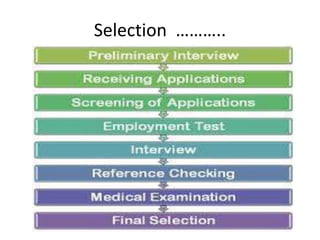
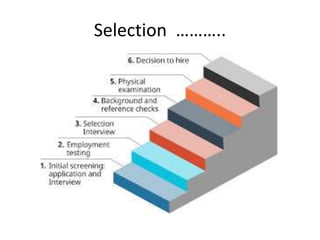
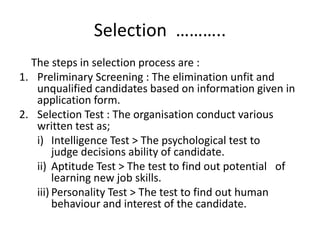
The steps in selection process are :
1. Preliminary Screening : The elimination unfit and
unqualified candidates based on information given in
application form.
2. Selection Test : The organisation conduct various
written test as;
i) Intelligence Test > The psychological test to
judge decisions ability of candidate.
ii) Aptitude Test > The test to find out potential of
learning new job skills.
iii) Personality Test > The test to find out human
behaviour and interest of the candidate.
Selection ………..
iv) Trade Test > It find out existing skills and
technical knowledge of an individual.
v) Interest Test > To find out the type of job in
which candidate has more interest than
others.
3. Employment Interview : It is a face to face
interaction between candidate and experts /
consultants of the organisation to know detail
about the candidate knowledge and skills of
doing the job.
Selection ………..
4. Checking References > To check the historical
background and personal character of the candidate .
5. Medical Test > It is conducted to test the medical
fitness of the candidate for the job.
6. Selection Decision > The decision taken for selecting
the candidate for the job on the basis of test and
interview.
7. Job Offer > The candidates selected will offer the job
through the letter of appointment.
8. Contract of Employment > It includes the term and
conditions of the job, remuneration ,rules etc.
Selection Flow Chart
Recruitment Vs. Selection
Training and Development
• Training :
It refers to imparting knowledge and
skills for improving the performance of
job.
. Development :
It refers to overall growth of an
individual while performing job in the
organisation.
Training ………..
Training ,Development and Education
Training and Development ………
Methods of Training
Methods of Training
Methods of Training
Methods of Training
1. Apprenticeship : Acquiring higher level skill
under a master trainer. Suitable for plumber,
electrician etc.
2. Internship : Acquiring practical with theoretical
skill by trainees. Suitable for professional
courses.
3. Induction/Orientation : Familarising with rules,
regulation and working style by new employees.
4. Vestibule School : Acquiring skill or knowledge in
dummy/duplicate model in an institution.
Suitable for delicate/expensive machinery.
PPT ON STAFFING ( Selection process and Training & Development )

PPT ON STAFFING ( Selection process and Training & Development )

  • 1.
    PREPARED BY: JAYANTA KUMARBISWAL D.M.SCHOOL, RIE. BBSR
  • 2.
    Selection ……….. • Itrefers to choosing the right person for the right job. • In selection more number of candidates are rejected than the number of candidates selected that is why selection is considered as negative process.
  • 3.
  • 4.
  • 5.
    Selection ……….. The stepsin selection process are : 1. Preliminary Screening : The elimination unfit and unqualified candidates based on information given in application form. 2. Selection Test : The organisation conduct various written test as; i) Intelligence Test > The psychological test to judge decisions ability of candidate. ii) Aptitude Test > The test to find out potential of learning new job skills. iii) Personality Test > The test to find out human behaviour and interest of the candidate.
  • 6.
    Selection ……….. iv) TradeTest > It find out existing skills and technical knowledge of an individual. v) Interest Test > To find out the type of job in which candidate has more interest than others. 3. Employment Interview : It is a face to face interaction between candidate and experts / consultants of the organisation to know detail about the candidate knowledge and skills of doing the job.
  • 7.
    Selection ……….. 4. CheckingReferences > To check the historical background and personal character of the candidate . 5. Medical Test > It is conducted to test the medical fitness of the candidate for the job. 6. Selection Decision > The decision taken for selecting the candidate for the job on the basis of test and interview. 7. Job Offer > The candidates selected will offer the job through the letter of appointment. 8. Contract of Employment > It includes the term and conditions of the job, remuneration ,rules etc.
  • 8.
  • 9.
  • 11.
    Training and Development •Training : It refers to imparting knowledge and skills for improving the performance of job. . Development : It refers to overall growth of an individual while performing job in the organisation.
  • 12.
  • 13.
  • 14.
  • 15.
  • 16.
  • 17.
  • 18.
  • 19.
    Methods of Training 1.Apprenticeship : Acquiring higher level skill under a master trainer. Suitable for plumber, electrician etc. 2. Internship : Acquiring practical with theoretical skill by trainees. Suitable for professional courses. 3. Induction/Orientation : Familarising with rules, regulation and working style by new employees. 4. Vestibule School : Acquiring skill or knowledge in dummy/duplicate model in an institution. Suitable for delicate/expensive machinery.