Subtitle
“There is nothing training cannot do. 
Nothing is above its reach. 
It can turn bad morals to good. 
It can destroy bad principles and recreate good 
ones. 
It can lift men to performing excellence.” 
-Mark Twain
Training is the act of increasing the knowledge and technical skills 
of an employee for doing a particular job efficiently. It is a process 
of learning new skills. 
DEVELOPMENT 
Development refers to the learning opportunities designed to help 
the employees to grow. It involves growth of an individual in all 
respects. It denotes the process by which the employees acquire 
skills & competence to do their present jobs & increase their 
capabilities for handling higher jobs in future.
Basis Training Development 
1.Meaning It is a process of increasing 
knowledge and skills. 
It is a process of learning and 
growth. 
2.Scope Narrow. Wider. 
3.Work or Person Centred Work-Centred. Person-Centred. 
4.Duration Time bound. Lifelong. 
5.Methods Used Job Rotation, Internship etc. Lectures, Conferences etc. 
6.Use/Depth of Knowledge It is to enable the employee 
to do job better. 
It is to enable the overall 
growth of employee. 
7.Orientation/Focus Job-Oriented. Career-Oriented. 
8.Participants Non-Managerial Staff. Managerial Staff. 
9.Initiative From the employee. From the individual.
For Organization For Employees 
Trained Workers can work more efficiently. He will find employment more easily. 
Wastage is eliminated to a larger extent. They are able to produce more with 
minimum efforts. 
There will be fewer accidents. Secure Promotions easily. 
Makes employees more loyal. Their morale would be high. 
Higher Profits. More Earnings. 
Attitude Formation. Develop Future Managers.
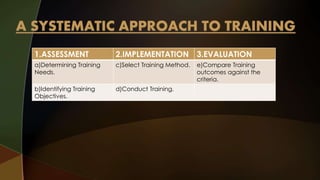
1.ASSESSMENT 2.IMPLEMENTATION 3.EVALUATION 
a)Determining Training 
Needs. 
c)Select Training Method. e)Compare Training 
outcomes against the 
criteria. 
b)Identifying Training 
Objectives. 
d)Conduct Training.
ORGANIZATIONAL 
ANALYSIS 
TASK ANALYSIS PERSON ANALYSIS 
Organizational Goals. Performance Standards. Customers and Employee 
Attitude Surveys. 
Skills Inventories. Performing jobs. Tests. 
Organizational Climate 
Analysis. 
Asking Questions about job. Questionnaires.
Innovati 
ve 
• Anticipating problems before they occur. 
• Team Building Sessions with the employees. 
Regular 
• Orientation, Refresher Courses.. 
•Scheduling Training Programs. 
Problem 
Solving 
• Training Clerks to reduce complaints. 
• Training Supervisors for handling grievances.
Vestibule 
Training 
Off 
The 
job 
Role 
Playing 
Films 
Lecture 
Method 
Job 
Instruction 
Training 
On 
The 
Job 
Apprentic 
eship 
Job 
Rotation 
Mentoring
Presentation 
JIT 
Performance 
Try out 
Follow 
Up 
Preparation
 Structured vocational skill training in a given job through a combination 
of on the job training and classroom instruction.. 
 Qualify registered apprenticeship program under state government –: 
1) 144 hour of classroom instruction. 
2) 2000 hour or one year of OJT experience.
 "Mentoring is to support and encourage people to manage their own 
learning in order that they may maximize their potential, develop 
their skills, improve their performance and become the person they 
want to be.” 
- Eric Parsloe, The Oxford School of Coaching & Mentoring
 Takes place away from production area. 
 Uses equipment closely resembling equipment actually 
used on the job. 
 Removes employee from pressure of having to produce while learning. 
 Emphasis on learning skills required by the job.
Respond to specific problems they may actually 
encounter in jobs. 
Used to teach such skills as: 
 Interviewing 
Grievance handling 
 Team problem solving 
 Communication
They can provide information and explicitly 
demonstrate skills that are not easily represented by 
other techniques. Used in conjunction with conference 
discussions, it is very effective in certain cases.
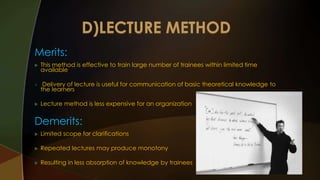
Merits: 
 This method is effective to train large number of trainees within limited time 
available 
 Delivery of lecture is useful for communication of basic theoretical knowledge to 
the learners 
 Lecture method is less expensive for an organization 
Demerits: 
 Limited scope for clarifications 
 Repeated lectures may produce monotony 
 Resulting in less absorption of knowledge by trainees
Feedbacks 
EVALUATION 
Interviews Questionnaires
Training

Training

  • 1.
  • 2.
    “There is nothingtraining cannot do. Nothing is above its reach. It can turn bad morals to good. It can destroy bad principles and recreate good ones. It can lift men to performing excellence.” -Mark Twain
  • 3.
    Training is theact of increasing the knowledge and technical skills of an employee for doing a particular job efficiently. It is a process of learning new skills. DEVELOPMENT Development refers to the learning opportunities designed to help the employees to grow. It involves growth of an individual in all respects. It denotes the process by which the employees acquire skills & competence to do their present jobs & increase their capabilities for handling higher jobs in future.
  • 4.
    Basis Training Development 1.Meaning It is a process of increasing knowledge and skills. It is a process of learning and growth. 2.Scope Narrow. Wider. 3.Work or Person Centred Work-Centred. Person-Centred. 4.Duration Time bound. Lifelong. 5.Methods Used Job Rotation, Internship etc. Lectures, Conferences etc. 6.Use/Depth of Knowledge It is to enable the employee to do job better. It is to enable the overall growth of employee. 7.Orientation/Focus Job-Oriented. Career-Oriented. 8.Participants Non-Managerial Staff. Managerial Staff. 9.Initiative From the employee. From the individual.
  • 5.
    For Organization ForEmployees Trained Workers can work more efficiently. He will find employment more easily. Wastage is eliminated to a larger extent. They are able to produce more with minimum efforts. There will be fewer accidents. Secure Promotions easily. Makes employees more loyal. Their morale would be high. Higher Profits. More Earnings. Attitude Formation. Develop Future Managers.
  • 7.
    1.ASSESSMENT 2.IMPLEMENTATION 3.EVALUATION a)Determining Training Needs. c)Select Training Method. e)Compare Training outcomes against the criteria. b)Identifying Training Objectives. d)Conduct Training.
  • 8.
    ORGANIZATIONAL ANALYSIS TASKANALYSIS PERSON ANALYSIS Organizational Goals. Performance Standards. Customers and Employee Attitude Surveys. Skills Inventories. Performing jobs. Tests. Organizational Climate Analysis. Asking Questions about job. Questionnaires.
  • 9.
    Innovati ve •Anticipating problems before they occur. • Team Building Sessions with the employees. Regular • Orientation, Refresher Courses.. •Scheduling Training Programs. Problem Solving • Training Clerks to reduce complaints. • Training Supervisors for handling grievances.
  • 10.
    Vestibule Training Off The job Role Playing Films Lecture Method Job Instruction Training On The Job Apprentic eship Job Rotation Mentoring
  • 11.
    Presentation JIT Performance Try out Follow Up Preparation
  • 13.
     Structured vocationalskill training in a given job through a combination of on the job training and classroom instruction..  Qualify registered apprenticeship program under state government –: 1) 144 hour of classroom instruction. 2) 2000 hour or one year of OJT experience.
  • 14.
     "Mentoring isto support and encourage people to manage their own learning in order that they may maximize their potential, develop their skills, improve their performance and become the person they want to be.” - Eric Parsloe, The Oxford School of Coaching & Mentoring
  • 15.
     Takes placeaway from production area.  Uses equipment closely resembling equipment actually used on the job.  Removes employee from pressure of having to produce while learning.  Emphasis on learning skills required by the job.
  • 16.
    Respond to specificproblems they may actually encounter in jobs. Used to teach such skills as:  Interviewing Grievance handling  Team problem solving  Communication
  • 17.
    They can provideinformation and explicitly demonstrate skills that are not easily represented by other techniques. Used in conjunction with conference discussions, it is very effective in certain cases.
  • 18.
    Merits:  Thismethod is effective to train large number of trainees within limited time available  Delivery of lecture is useful for communication of basic theoretical knowledge to the learners  Lecture method is less expensive for an organization Demerits:  Limited scope for clarifications  Repeated lectures may produce monotony  Resulting in less absorption of knowledge by trainees
  • 19.